

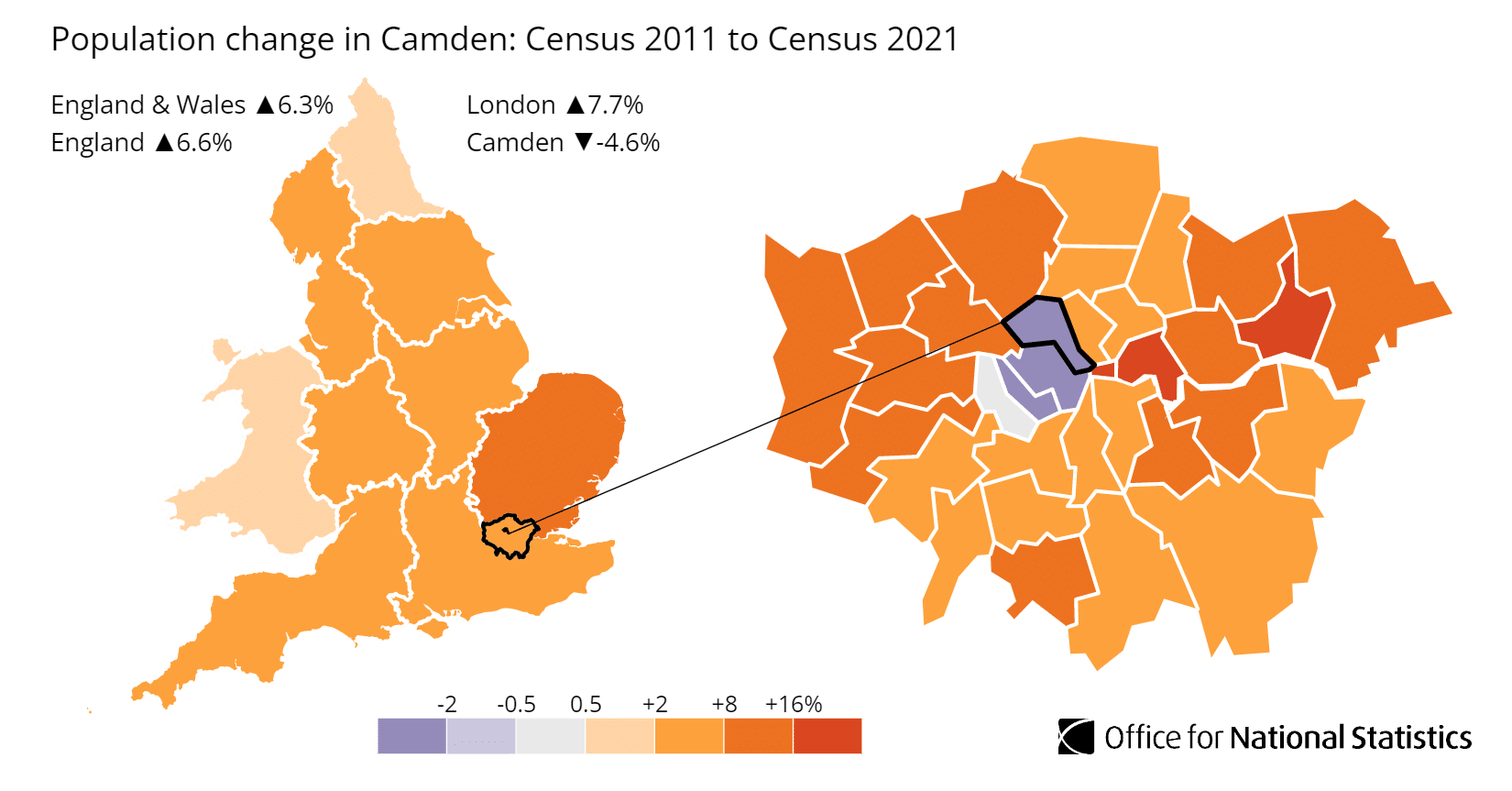
Camden is a borough of inner north-west London, running from Hampstead Heath down towards Holborn. The average sold price across the London Borough of Camden is £772,336 on the HM Land Registry House Price Index, 2.7 times the England average of £289,946 and 42.5% above the wider London average of £542,065. That puts Camden among the most expensive boroughs in the country to buy into, and the price is the first thing any investor has to reckon with here. The borough's resident population fell 4.63% between the 2011 and 2021 censuses, from 220,338 to 210,136, one of the few inner London boroughs to shrink rather than grow over the decade.
Camden's price tag rests on a tenant base that earns well above the London average. The median resident takes home £1,032.40 a week, against £902.70 across London and £766.60 for Great Britain, and the median annual salary is £53,133. That wage base supports the borough's flat-heavy rental stock, but it does not stretch evenly across all eleven postcodes. The spread between NW5 (Kentish Town) at a £647,154 average asking price and W1 (Fitzrovia) at £2,006,996 creates a market where the cheaper north-Camden postcodes behave very differently from the trophy central core.
This guide covers the London Borough of Camden (ONS code E09000007) across postcodes EC1, N1, N6, NW1, NW3, NW5, NW6, NW8, W1, WC1 and WC2. Camden sits in inner north-west London, running from Hampstead Heath in the north down to Covent Garden and Holborn. Several of its postcodes cross borough lines, with N1 reaching into Islington and W1 and WC2 touching Westminster. For a wider view, see the London buy-to-let overview.
Article updated: July 2026
Why Invest in Camden?
Camden's resident population fell 4.63% between the 2011 and 2021 censuses, from 220,338 to 210,136, one of only a handful of inner London boroughs to lose residents over the decade. That headline reads worse than it lives. The fall reflects the unusual shape of the borough, where a dense residential ring in the north (Hampstead, Kentish Town, Kilburn) sits alongside a central core given over to offices, hotels, universities and commercial floorspace (Bloomsbury, Fitzrovia, Covent Garden). A shrinking resident count does not thin out the rental pool, because Camden draws its tenants from three mainline termini at Euston, St Pancras International and King's Cross and the deep commuter-professional and student demand those stations carry.
The borough runs from Hampstead Heath in the north, through Belsize Park, Kentish Town and Camden Town, down into Bloomsbury, Fitzrovia and Holborn. It is one of the smaller London boroughs by area but one of the most institutional, home to University College London's main Bloomsbury campus, University College London Hospitals on Euston Road, the Royal Free Hospital in Hampstead, SOAS and Birkbeck. That concentration of universities and teaching hospitals is what keeps the student and key-worker tenant demand steady even as the resident headcount drifts down.
Median gross annual earnings for Camden residents are £53,133, well above the London median of £46,414 and the Great Britain median of £39,125. Weekly gross pay runs at £1,032.40 in Camden against £902.70 for London. The local employment rate of 74.7% sits just below both the London and Great Britain rates. The high earnings figure reflects the senior knowledge-economy roles clustered in Bloomsbury, King's Cross and Fitzrovia, rather than the broader mix of tenants living out in the NW postcodes, which is worth keeping in mind when reading rent against income later in this guide.
Camden Economic Summary
- Population: 210,136 (2021 Census). Decline of 4.63% from 2011.
- Median annual salary: £53,133 (Camden), £46,414 (London), £39,125 (Great Britain)
- Median gross weekly pay: £1,032.40 (Camden), £902.70 (London), £766.60 (Great Britain)
- Employment rate: 74.7% (Camden)
- Key institutions: University College London, UCL Hospitals, Royal Free Hospital, SOAS, Birkbeck, the British Library and the King's Cross Central knowledge cluster
Source: ONS Explore Local Statistics for Camden, Nomis Labour Market Profile for Camden (ASHE 2025)
Regeneration and Investment in Camden
Camden's regeneration splits cleanly into three programmes at three different stages: a private-led district at King's Cross that is now largely built, a council-led development corporation around Euston that is years from first delivery, and a public realm scheme along a disused railway viaduct in Camden Town. Read together, they tell an investor where the borough has already been reshaped and where the next wave of new homes will eventually land.
- King's Cross Central (substantially delivered): A 67-acre mixed-use district built by the King's Cross Central Limited Partnership with Argent, running north of the King's Cross and St Pancras termini on Camden's eastern edge. The masterplan delivers 50 new buildings alongside 20 restored historic structures, around 1,700 homes, 3.4 million square feet of office space and capacity for roughly 30,000 jobs. The final commercial plot was due to complete in early 2026. The district has already reshaped tenant demand across NW1, N1 and WC1, anchored by occupiers including Google at Pancras Square and a Central Saint Martins campus. Details at King's Cross Central.
- Euston HS2 Regeneration (proposed): Camden Council has announced its intention to set up a Locally Led Urban Development Corporation for the Euston area, working with the Greater London Authority and central government. The proposal covers up to 2,500 new homes, including 1,200 affordable, plus around 470,000 square metres of commercial space and new public realm linking Somers Town, the Regent's Park Estate and the Euston station site. Delivery is tied to the pace of the HS2 Euston terminus, so the new supply is a long-dated story rather than a 2026 to 2028 event. Updates at Camden Council.
- Camden Highline (in fundraising): A 1.2 km elevated linear park proposed along a disused North London Line viaduct running east from Camden Town towards York Way. The first section won planning approval in January 2023, and the project charity is fundraising against a first-phase budget of around £14 million. This is public realm rather than new housing, but the kind of amenity that lifts tenant desirability along the Camden Town to King's Cross stretch. Updates at Camden Highline.
The pattern matters for timing. King's Cross has already landed and is priced into NW1, N1 and WC1 comparables. The Euston homes will arrive only once the existing stock has had a full cycle to reprice. So none of these three programmes is adding meaningful new supply in the near term, which leaves Camden's current pricing driven by the wider London market rather than a local building boom.
Source: Office for National Statistics - Population for Camden
Camden Property Market Analysis
Average property prices across Camden have risen 544.8% since January 1995, from £119,775 to £772,336. The sections below walk through that journey cycle by cycle, then drill into current postcode-level data for sold prices, price per square foot, asking prices, growth, and how long property takes to sell.
When was the last house price crash in Camden?
Camden's sold prices come from HM Land Registry at borough level, since the London Borough of Camden is its own local authority. The index tracks average prices from January 1995 to March 2026, covering 31 years and, unusually for a London borough, more than one correction.
The 1995 to 2008 boom: Camden started at £119,775 in January 1995. Prices more than doubled by December 2000 to £250,600, then pushed on through the 2000s to £363,743 by December 2005. The market peaked at £520,267 in August 2008, late in the cycle by national standards, with annual growth still running at 7.1% that month even as the wider economy was turning.
2008 to 2009, the financial crisis: Prices fell from the August 2008 peak of £520,267 to a trough of £430,735 in June 2009, a decline of 17.2% over ten months, with the worst year-on-year reading at -14.1% in June 2009. England fell 18.2% over a longer window, from £183,883 in September 2007 to £150,438 in March 2009. Camden's drop was a touch shallower and far quicker, which set up an equally quick recovery.
2010 to 2014, a fast recovery: Camden bounced hard. Prices were back above the August 2008 peak by August 2010 at £544,698, recovering in roughly two years where many markets took the best part of a decade. Growth then ran in double digits, reaching £614,412 by December 2012 and £754,303 by December 2014. The pull of central London and overseas demand drove the borough well past its pre-crash high.
2016 to 2020, the prime-London cooling: The run carried prices to £846,504 by March 2016, but the higher stamp duty surcharge on additional homes, the Brexit vote and a pull-back in overseas buyers then weighed on the top of the market. Prices wobbled, touched a local high of £886,331 in July 2019, and slipped to £779,910 by December 2020. Camden spent close to five years going sideways, a softer patch that hit the prime central postcodes harder than the residential north of the borough.
2021 to 2025, the surge and the record: The market found a second wind. Prices climbed back to £871,467 by December 2021 at 11.7% annual growth, held through 2022 and 2023, then reached a fresh all-time high of £913,299 in July 2025. For the first time, Camden's average cleared the £900,000 mark.
2025 to present: That high did not hold. Prices have eased to £772,336 by the latest reading in March 2026, down 15.4% from the July 2025 peak, with annual growth back in negative territory at -7.4%. The current average still sits 48.4% above the August 2008 pre-crash peak, but the borough is clearly in a cooling phase rather than a rising one.
Long-term growth summary:
- 5 years (March 2021 to March 2026): -3.7% (£801,980 to £772,336)
- 10 years (March 2016 to March 2026): -8.8% (£846,504 to £772,336)
- 15 years (March 2011 to March 2026): 42.4% (£542,307 to £772,336)
- 20 years (March 2006 to March 2026): 106.7% (£373,727 to £772,336)
- 30 years (January 1995 to March 2026): 544.8% (£119,775 to £772,336)
The 30-year return of 544.8% is among the strongest of any UK location, but the recent record is the part an investor has to weigh. Camden's average price is lower today than it was five and ten years ago, after the 2016 to 2020 cooling and the sharp 2025 to 2026 easing. The borough has recovered from every previous correction, and quickly after 2008, but anyone buying now is buying into a market still working through the come-down from its mid-2025 record.
- All property types
- Detached
- Semi-detached
- Terraced
- Flats
Source: HM Land Registry House Price Index
| Year | All property types | Detached | Semi-detached | Terraced | Flats |
|---|---|---|---|---|---|
| 1995-01 | £119,775 | £444,944 | £236,789 | £179,573 | £104,062 |
| 1995-02 | £118,365 | £434,314 | £233,765 | £178,146 | £102,782 |
| 1995-03 | £119,131 | £436,397 | £234,721 | £179,273 | £103,477 |
| 1995-04 | £118,948 | £430,148 | £233,493 | £179,059 | £103,377 |
| 1995-05 | £118,781 | £429,515 | £233,962 | £179,117 | £103,159 |
| 1995-06 | £120,721 | £431,562 | £237,699 | £181,448 | £104,962 |
| 1995-07 | £122,840 | £442,230 | £243,405 | £185,742 | £106,572 |
| 1995-08 | £124,328 | £449,816 | £246,799 | £188,254 | £107,796 |
| 1995-09 | £119,442 | £436,834 | £238,719 | £182,086 | £103,296 |
| 1995-10 | £116,334 | £426,551 | £232,537 | £176,589 | £100,705 |
| 1995-11 | £114,314 | £414,520 | £227,272 | £172,399 | £99,189 |
| 1995-12 | £117,602 | £425,446 | £233,185 | £176,912 | £102,135 |
| 1996-01 | £118,416 | £426,521 | £234,329 | £178,226 | £102,858 |
| 1996-02 | £122,190 | £440,632 | £242,527 | £184,151 | £106,066 |
| 1996-03 | £123,529 | £447,636 | £246,824 | £186,596 | £107,109 |
| 1996-04 | £127,922 | £458,457 | £254,917 | £192,736 | £111,037 |
| 1996-05 | £134,040 | £477,930 | £266,879 | £202,807 | £116,287 |
| 1996-06 | £142,485 | £504,051 | £282,186 | £215,064 | £123,752 |
| 1996-07 | £146,558 | £525,787 | £292,562 | £222,485 | £127,017 |
| 1996-08 | £141,098 | £513,359 | £283,589 | £215,067 | £122,071 |
| 1996-09 | £135,245 | £494,682 | £272,355 | £206,801 | £116,899 |
| 1996-10 | £132,568 | £486,077 | £267,331 | £202,528 | £114,582 |
| 1996-11 | £132,844 | £483,562 | £267,192 | £202,463 | £114,923 |
| 1996-12 | £133,459 | £483,569 | £269,102 | £203,494 | £115,441 |
| 1997-01 | £134,655 | £485,437 | £271,479 | £206,147 | £116,412 |
| 1997-02 | £140,176 | £506,744 | £283,205 | £214,362 | £121,174 |
| 1997-03 | £142,071 | £515,645 | £287,281 | £217,644 | £122,740 |
| 1997-04 | £142,217 | £517,924 | £288,792 | £217,746 | £122,834 |
| 1997-05 | £147,194 | £540,110 | £300,746 | £226,429 | £126,957 |
| 1997-06 | £146,916 | £545,435 | £302,851 | £227,263 | £126,485 |
| 1997-07 | £147,515 | £549,265 | £304,888 | £229,539 | £126,843 |
| 1997-08 | £144,229 | £536,693 | £298,705 | £224,916 | £123,957 |
| 1997-09 | £150,295 | £558,255 | £312,016 | £234,524 | £129,144 |
| 1997-10 | £156,387 | £581,617 | £324,571 | £243,260 | £134,448 |
| 1997-11 | £165,588 | £620,176 | £344,490 | £257,308 | £142,334 |
| 1997-12 | £167,223 | £624,028 | £347,000 | £259,458 | £143,814 |
| 1998-01 | £167,394 | £629,839 | £348,356 | £260,654 | £143,815 |
| 1998-02 | £160,791 | £598,440 | £332,642 | £249,585 | £138,288 |
| 1998-03 | £162,260 | £600,758 | £335,818 | £252,321 | £139,511 |
| 1998-04 | £164,066 | £601,947 | £340,207 | £255,433 | £141,051 |
| 1998-05 | £167,431 | £613,296 | £347,784 | £262,127 | £143,803 |
| 1998-06 | £170,930 | £625,627 | £353,750 | £266,912 | £146,903 |
| 1998-07 | £174,165 | £639,144 | £361,130 | £272,601 | £149,602 |
| 1998-08 | £174,886 | £651,651 | £364,588 | £274,612 | £150,046 |
| 1998-09 | £171,676 | £648,980 | £360,059 | £270,657 | £147,095 |
| 1998-10 | £170,734 | £640,575 | £355,273 | £267,077 | £146,566 |
| 1998-11 | £172,911 | £643,505 | £358,259 | £268,551 | £148,671 |
| 1998-12 | £171,415 | £629,866 | £353,656 | £264,940 | £147,578 |
| 1999-01 | £169,324 | £629,015 | £351,173 | £262,453 | £145,633 |
| 1999-02 | £171,820 | £644,234 | £357,613 | £267,322 | £147,627 |
| 1999-03 | £177,165 | £665,237 | £368,238 | £275,485 | £152,251 |
| 1999-04 | £181,175 | £677,899 | £375,902 | £282,516 | £155,659 |
| 1999-05 | £179,050 | £659,470 | £370,168 | £279,170 | £153,936 |
| 1999-06 | £184,066 | £681,596 | £382,192 | £288,776 | £158,024 |
| 1999-07 | £189,972 | £707,599 | £395,847 | £299,276 | £162,926 |
| 1999-08 | £196,748 | £742,764 | £411,780 | £311,870 | £168,460 |
| 1999-09 | £201,564 | £764,767 | £421,870 | £319,478 | £172,562 |
| 1999-10 | £204,728 | £770,907 | £426,067 | £321,586 | £175,625 |
| 1999-11 | £207,296 | £780,496 | £430,487 | £324,062 | £177,988 |
| 1999-12 | £208,227 | £771,055 | £428,929 | £323,544 | £179,136 |
| 2000-01 | £215,615 | £806,976 | £448,108 | £337,353 | £185,132 |
| 2000-02 | £225,979 | £840,111 | £467,855 | £353,074 | £194,114 |
| 2000-03 | £228,333 | £862,482 | £476,860 | £358,977 | £195,731 |
| 2000-04 | £237,364 | £890,895 | £492,456 | £372,096 | £203,656 |
| 2000-05 | £246,433 | £924,135 | £512,445 | £386,634 | £211,395 |
| 2000-06 | £259,267 | £965,364 | £536,771 | £405,045 | £222,627 |
| 2000-07 | £262,113 | £986,398 | £546,723 | £410,491 | £224,847 |
| 2000-08 | £259,614 | £978,634 | £540,914 | £404,917 | £222,829 |
| 2000-09 | £256,304 | £972,288 | £534,213 | £399,004 | £219,999 |
| 2000-10 | £246,838 | £932,285 | £512,083 | £381,694 | £212,141 |
| 2000-11 | £248,525 | £944,860 | £515,394 | £383,532 | £213,611 |
| 2000-12 | £250,600 | £943,566 | £517,092 | £384,852 | £215,656 |
| 2001-01 | £262,973 | £980,795 | £539,687 | £404,302 | £226,392 |
| 2001-02 | £265,222 | £981,401 | £544,954 | £408,798 | £228,290 |
| 2001-03 | £270,445 | £1,001,512 | £557,407 | £418,721 | £232,609 |
| 2001-04 | £266,373 | £984,668 | £549,075 | £413,687 | £229,013 |
| 2001-05 | £267,254 | £981,118 | £548,724 | £415,666 | £229,819 |
| 2001-06 | £268,958 | £978,869 | £547,721 | £416,449 | £231,605 |
| 2001-07 | £277,797 | £1,014,542 | £567,573 | £430,022 | £239,160 |
| 2001-08 | £284,126 | £1,039,930 | £579,273 | £439,236 | £244,664 |
| 2001-09 | £285,051 | £1,049,725 | £583,357 | £441,885 | £245,260 |
| 2001-10 | £286,072 | £1,053,111 | £584,292 | £440,933 | £246,375 |
| 2001-11 | £288,083 | £1,056,157 | £586,427 | £440,945 | £248,444 |
| 2001-12 | £288,768 | £1,047,405 | £583,962 | £438,330 | £249,522 |
| 2002-01 | £287,681 | £1,036,190 | £578,151 | £434,793 | £248,875 |
| 2002-02 | £286,501 | £1,027,925 | £573,248 | £433,138 | £247,930 |
| 2002-03 | £286,842 | £1,034,581 | £576,348 | £435,005 | £248,013 |
| 2002-04 | £294,136 | £1,052,009 | £587,297 | £444,439 | £254,610 |
| 2002-05 | £305,956 | £1,089,542 | £610,873 | £461,168 | £264,978 |
| 2002-06 | £316,407 | £1,112,880 | £623,767 | £474,881 | £274,496 |
| 2002-07 | £320,060 | £1,131,866 | £632,883 | £482,786 | £277,366 |
| 2002-08 | £321,962 | £1,136,565 | £635,081 | £485,664 | £279,063 |
| 2002-09 | £329,188 | £1,171,023 | £653,928 | £497,884 | £285,037 |
| 2002-10 | £330,624 | £1,171,082 | £654,884 | £496,718 | £286,649 |
| 2002-11 | £328,857 | £1,170,437 | £649,499 | £491,732 | £285,314 |
| 2002-12 | £325,847 | £1,150,826 | £640,986 | £484,184 | £283,099 |
| 2003-01 | £319,424 | £1,123,853 | £624,940 | £474,528 | £277,638 |
| 2003-02 | £303,252 | £1,057,026 | £592,436 | £450,101 | £263,719 |
| 2003-03 | £296,890 | £1,035,342 | £577,144 | £440,159 | £258,291 |
| 2003-04 | £303,203 | £1,051,554 | £588,188 | £447,935 | £263,998 |
| 2003-05 | £318,303 | £1,105,415 | £617,057 | £470,793 | £277,093 |
| 2003-06 | £324,205 | £1,122,512 | £630,160 | £479,984 | £282,182 |
| 2003-07 | £331,690 | £1,146,955 | £647,850 | £493,258 | £288,449 |
| 2003-08 | £334,524 | £1,153,416 | £655,154 | £498,255 | £290,834 |
| 2003-09 | £335,081 | £1,160,908 | £659,063 | £501,622 | £290,987 |
| 2003-10 | £328,211 | £1,133,751 | £642,025 | £490,141 | £285,232 |
| 2003-11 | £324,068 | £1,116,600 | £631,776 | £482,749 | £281,808 |
| 2003-12 | £320,682 | £1,090,939 | £621,364 | £475,698 | £279,244 |
| 2004-01 | £326,504 | £1,116,155 | £635,034 | £484,801 | £284,174 |
| 2004-02 | £329,119 | £1,127,789 | £642,922 | £490,181 | £286,238 |
| 2004-03 | £336,465 | £1,157,698 | £656,721 | £502,492 | £292,468 |
| 2004-04 | £333,447 | £1,139,251 | £651,385 | £500,299 | £289,714 |
| 2004-05 | £339,817 | £1,143,819 | £658,469 | £509,960 | £295,460 |
| 2004-06 | £351,146 | £1,173,082 | £680,005 | £526,606 | £305,387 |
| 2004-07 | £365,280 | £1,223,480 | £709,575 | £548,599 | £317,556 |
| 2004-08 | £366,595 | £1,240,378 | £716,756 | £551,319 | £318,472 |
| 2004-09 | £361,040 | £1,230,959 | £709,285 | £544,174 | £313,434 |
| 2004-10 | £358,437 | £1,213,788 | £697,310 | £536,412 | £311,643 |
| 2004-11 | £360,920 | £1,214,330 | £697,249 | £538,122 | £314,099 |
| 2004-12 | £352,983 | £1,173,296 | £675,082 | £523,349 | £307,634 |
| 2005-01 | £341,827 | £1,138,934 | £656,311 | £509,512 | £297,653 |
| 2005-02 | £338,474 | £1,137,189 | £657,318 | £506,805 | £294,335 |
| 2005-03 | £345,446 | £1,165,518 | £674,423 | £519,414 | £300,168 |
| 2005-04 | £356,284 | £1,196,158 | £695,644 | £535,782 | £309,594 |
| 2005-05 | £365,874 | £1,213,329 | £706,823 | £548,902 | £318,323 |
| 2005-06 | £375,745 | £1,245,710 | £728,561 | £566,295 | £326,601 |
| 2005-07 | £377,328 | £1,254,290 | £734,137 | £569,703 | £327,800 |
| 2005-08 | £387,421 | £1,296,830 | £756,980 | £586,749 | £336,281 |
| 2005-09 | £382,796 | £1,290,685 | £749,553 | £579,801 | £332,184 |
| 2005-10 | £380,040 | £1,279,536 | £740,680 | £574,264 | £330,026 |
| 2005-11 | £362,844 | £1,215,589 | £705,191 | £547,920 | £315,205 |
| 2005-12 | £363,743 | £1,203,210 | £701,192 | £547,175 | £316,397 |
| 2006-01 | £365,180 | £1,212,391 | £707,424 | £552,248 | £317,272 |
| 2006-02 | £370,093 | £1,231,085 | £719,883 | £561,228 | £321,300 |
| 2006-03 | £373,727 | £1,255,163 | £731,940 | £569,649 | £323,995 |
| 2006-04 | £379,266 | £1,270,698 | £742,166 | £578,389 | £328,800 |
| 2006-05 | £385,866 | £1,299,084 | £757,213 | £588,560 | £334,434 |
| 2006-06 | £389,088 | £1,313,388 | £766,244 | £593,850 | £337,120 |
| 2006-07 | £396,599 | £1,343,477 | £785,107 | £608,656 | £343,229 |
| 2006-08 | £402,772 | £1,361,980 | £797,588 | £621,226 | £348,310 |
| 2006-09 | £402,138 | £1,366,133 | £799,234 | £622,727 | £347,454 |
| 2006-10 | £399,361 | £1,356,152 | £790,499 | £615,409 | £345,384 |
| 2006-11 | £403,714 | £1,370,634 | £798,473 | £621,043 | £349,257 |
| 2006-12 | £424,670 | £1,443,334 | £840,597 | £653,318 | £367,360 |
| 2007-01 | £429,747 | £1,463,425 | £853,327 | £662,330 | £371,578 |
| 2007-02 | £437,383 | £1,491,723 | £868,647 | £671,567 | £378,302 |
| 2007-03 | £435,762 | £1,487,167 | £865,242 | £669,805 | £376,878 |
| 2007-04 | £447,639 | £1,528,391 | £892,011 | £691,543 | £386,863 |
| 2007-05 | £437,043 | £1,487,025 | £871,322 | £678,175 | £377,507 |
| 2007-06 | £449,774 | £1,526,736 | £897,807 | £698,025 | £388,490 |
| 2007-07 | £461,651 | £1,575,507 | £927,126 | £718,127 | £398,526 |
| 2007-08 | £485,798 | £1,671,615 | £980,038 | £759,633 | £418,995 |
| 2007-09 | £495,127 | £1,714,262 | £1,006,307 | £775,495 | £426,808 |
| 2007-10 | £495,855 | £1,711,341 | £997,847 | £771,756 | £427,936 |
| 2007-11 | £490,508 | £1,697,077 | £989,734 | £760,003 | £423,498 |
| 2007-12 | £477,949 | £1,639,499 | £953,952 | £736,929 | £413,105 |
| 2008-01 | £482,000 | £1,667,434 | £966,006 | £743,957 | £416,450 |
| 2008-02 | £500,633 | £1,730,790 | £1,001,404 | £772,564 | £432,617 |
| 2008-03 | £505,176 | £1,762,169 | £1,011,503 | £782,098 | £436,324 |
| 2008-04 | £505,189 | £1,772,954 | £1,010,722 | £785,060 | £436,104 |
| 2008-05 | £501,051 | £1,765,034 | £1,010,726 | £784,142 | £432,003 |
| 2008-06 | £501,325 | £1,763,732 | £1,020,536 | £788,368 | £431,851 |
| 2008-07 | £516,994 | £1,821,262 | £1,062,263 | £815,005 | £445,040 |
| 2008-08 | £520,267 | £1,831,446 | £1,072,416 | £820,512 | £447,784 |
| 2008-09 | £510,089 | £1,804,316 | £1,047,450 | £802,045 | £439,197 |
| 2008-10 | £493,622 | £1,730,756 | £1,005,280 | £771,743 | £425,526 |
| 2008-11 | £467,840 | £1,647,394 | £948,342 | £729,042 | £403,487 |
| 2008-12 | £452,912 | £1,590,387 | £920,170 | £707,064 | £390,519 |
| 2009-01 | £442,619 | £1,558,743 | £903,923 | £691,016 | £381,536 |
| 2009-02 | £448,803 | £1,569,009 | £916,103 | £700,881 | £386,894 |
| 2009-03 | £461,106 | £1,602,230 | £939,867 | £719,326 | £397,618 |
| 2009-04 | £447,319 | £1,525,706 | £908,454 | £700,827 | £385,757 |
| 2009-05 | £438,368 | £1,492,340 | £891,037 | £690,747 | £377,731 |
| 2009-06 | £430,735 | £1,466,620 | £878,418 | £684,085 | £370,667 |
| 2009-07 | £446,884 | £1,543,548 | £921,531 | £716,281 | £383,684 |
| 2009-08 | £462,699 | £1,614,522 | £960,544 | £744,726 | £396,777 |
| 2009-09 | £470,662 | £1,652,624 | £982,207 | £759,929 | £403,243 |
| 2009-10 | £466,786 | £1,653,238 | £977,161 | £753,755 | £399,757 |
| 2009-11 | £445,187 | £1,578,556 | £930,182 | £721,238 | £381,107 |
| 2009-12 | £442,139 | £1,565,471 | £923,619 | £716,518 | £378,500 |
| 2010-01 | £450,196 | £1,590,208 | £942,406 | £735,330 | £384,946 |
| 2010-02 | £475,997 | £1,699,071 | £1,010,495 | £781,763 | £406,323 |
| 2010-03 | £494,116 | £1,778,862 | £1,051,886 | £813,979 | £421,456 |
| 2010-04 | £494,982 | £1,784,506 | £1,056,419 | £813,688 | £422,259 |
| 2010-05 | £485,551 | £1,747,938 | £1,032,416 | £796,237 | £414,446 |
| 2010-06 | £487,877 | £1,761,033 | £1,042,994 | £802,485 | £416,116 |
| 2010-07 | £519,184 | £1,913,414 | £1,126,425 | £863,417 | £441,619 |
| 2010-08 | £544,698 | £1,999,385 | £1,188,002 | £909,860 | £462,943 |
| 2010-09 | £545,103 | £2,018,019 | £1,195,085 | £915,114 | £462,748 |
| 2010-10 | £535,436 | £1,957,918 | £1,164,275 | £894,707 | £455,143 |
| 2010-11 | £527,874 | £1,938,650 | £1,146,001 | £880,032 | £448,859 |
| 2010-12 | £538,680 | £1,978,371 | £1,170,230 | £896,335 | £458,160 |
| 2011-01 | £535,129 | £2,007,959 | £1,170,601 | £892,949 | £454,604 |
| 2011-02 | £537,530 | £2,059,278 | £1,180,184 | £898,858 | £456,235 |
| 2011-03 | £542,307 | £2,120,305 | £1,198,598 | £910,252 | £459,696 |
| 2011-04 | £551,082 | £2,141,540 | £1,212,150 | £924,074 | £467,366 |
| 2011-05 | £539,408 | £2,033,147 | £1,169,714 | £899,859 | £458,439 |
| 2011-06 | £540,074 | £1,970,290 | £1,156,190 | £895,998 | £459,965 |
| 2011-07 | £542,147 | £1,951,922 | £1,156,478 | £897,662 | £462,067 |
| 2011-08 | £558,293 | £2,053,400 | £1,211,586 | £934,628 | £474,440 |
| 2011-09 | £570,963 | £2,147,384 | £1,253,817 | £963,062 | £484,155 |
| 2011-10 | £568,044 | £2,157,478 | £1,256,258 | £960,777 | £481,218 |
| 2011-11 | £561,635 | £2,138,092 | £1,238,938 | £944,410 | £476,254 |
| 2011-12 | £542,413 | £2,019,359 | £1,185,688 | £905,612 | £460,870 |
| 2012-01 | £543,166 | £2,006,899 | £1,189,914 | £910,237 | £461,274 |
| 2012-02 | £545,567 | £2,020,452 | £1,202,454 | £920,782 | £462,690 |
| 2012-03 | £563,532 | £2,104,403 | £1,246,907 | £953,180 | £477,543 |
| 2012-04 | £569,457 | £2,123,005 | £1,252,493 | £960,382 | £482,897 |
| 2012-05 | £570,482 | £2,100,015 | £1,243,595 | £957,726 | £484,346 |
| 2012-06 | £569,841 | £2,093,964 | £1,244,183 | £963,015 | £483,339 |
| 2012-07 | £594,658 | £2,198,092 | £1,309,821 | £1,009,498 | £503,840 |
| 2012-08 | £608,542 | £2,255,826 | £1,349,924 | £1,040,361 | £514,920 |
| 2012-09 | £607,610 | £2,264,034 | £1,347,912 | £1,038,435 | £514,113 |
| 2012-10 | £588,814 | £2,185,165 | £1,299,404 | £1,004,725 | £498,462 |
| 2012-11 | £590,570 | £2,197,597 | £1,301,219 | £1,007,140 | £500,001 |
| 2012-12 | £614,412 | £2,279,239 | £1,355,916 | £1,048,159 | £520,150 |
| 2013-01 | £621,533 | £2,333,359 | £1,385,481 | £1,064,239 | £525,590 |
| 2013-02 | £645,756 | £2,436,779 | £1,441,763 | £1,103,976 | £546,106 |
| 2013-03 | £629,019 | £2,382,499 | £1,403,942 | £1,072,030 | £532,161 |
| 2013-04 | £643,322 | £2,425,532 | £1,429,372 | £1,095,868 | £544,424 |
| 2013-05 | £645,239 | £2,431,142 | £1,434,072 | £1,099,552 | £546,015 |
| 2013-06 | £665,011 | £2,514,023 | £1,488,132 | £1,140,035 | £562,069 |
| 2013-07 | £678,769 | £2,561,517 | £1,521,191 | £1,167,846 | £573,366 |
| 2013-08 | £700,587 | £2,645,445 | £1,575,735 | £1,210,733 | £591,314 |
| 2013-09 | £698,998 | £2,648,217 | £1,568,993 | £1,206,070 | £590,126 |
| 2013-10 | £683,313 | £2,581,520 | £1,524,494 | £1,172,054 | £577,557 |
| 2013-11 | £656,356 | £2,466,443 | £1,453,219 | £1,119,676 | £555,427 |
| 2013-12 | £664,789 | £2,466,688 | £1,458,699 | £1,127,260 | £563,370 |
| 2014-01 | £688,812 | £2,570,715 | £1,516,482 | £1,168,748 | £583,551 |
| 2014-02 | £712,957 | £2,672,110 | £1,567,946 | £1,205,860 | £604,226 |
| 2014-03 | £713,171 | £2,684,353 | £1,574,296 | £1,208,301 | £604,086 |
| 2014-04 | £721,963 | £2,723,220 | £1,593,093 | £1,224,534 | £611,440 |
| 2014-05 | £739,787 | £2,780,837 | £1,635,039 | £1,258,753 | £626,283 |
| 2014-06 | £762,260 | £2,849,523 | £1,682,041 | £1,297,511 | £645,359 |
| 2014-07 | £779,824 | £2,893,644 | £1,722,456 | £1,329,777 | £660,129 |
| 2014-08 | £786,438 | £2,916,629 | £1,739,958 | £1,343,140 | £665,568 |
| 2014-09 | £795,769 | £2,969,548 | £1,763,937 | £1,361,295 | £673,226 |
| 2014-10 | £773,164 | £2,890,407 | £1,708,843 | £1,317,183 | £654,486 |
| 2014-11 | £762,482 | £2,852,499 | £1,679,884 | £1,294,888 | £645,759 |
| 2014-12 | £754,303 | £2,807,003 | £1,652,002 | £1,274,622 | £639,404 |
| 2015-01 | £762,355 | £2,833,950 | £1,672,879 | £1,289,011 | £646,150 |
| 2015-02 | £761,807 | £2,839,307 | £1,679,116 | £1,288,745 | £645,519 |
| 2015-03 | £749,669 | £2,786,221 | £1,654,595 | £1,266,888 | £635,332 |
| 2015-04 | £742,445 | £2,769,319 | £1,633,802 | £1,254,785 | £629,230 |
| 2015-05 | £738,545 | £2,727,140 | £1,614,319 | £1,243,210 | £626,488 |
| 2015-06 | £762,781 | £2,834,151 | £1,673,718 | £1,292,866 | £646,338 |
| 2015-07 | £785,619 | £2,902,797 | £1,727,455 | £1,332,069 | £665,673 |
| 2015-08 | £811,896 | £3,002,753 | £1,785,176 | £1,381,009 | £687,652 |
| 2015-09 | £825,356 | £3,071,869 | £1,810,888 | £1,400,210 | £699,260 |
| 2015-10 | £820,386 | £3,062,329 | £1,792,522 | £1,391,692 | £695,119 |
| 2015-11 | £808,829 | £3,032,297 | £1,768,634 | £1,371,964 | £685,266 |
| 2015-12 | £789,139 | £2,939,090 | £1,726,268 | £1,338,754 | £668,637 |
| 2016-01 | £800,790 | £2,971,552 | £1,758,303 | £1,357,669 | £678,517 |
| 2016-02 | £819,667 | £3,059,382 | £1,808,401 | £1,390,509 | £694,278 |
| 2016-03 | £846,504 | £3,179,585 | £1,869,494 | £1,434,458 | £717,006 |
| 2016-04 | £830,229 | £3,101,284 | £1,823,280 | £1,403,611 | £703,630 |
| 2016-05 | £799,671 | £2,927,430 | £1,733,726 | £1,345,647 | £678,660 |
| 2016-06 | £763,525 | £2,756,122 | £1,644,710 | £1,280,846 | £648,527 |
| 2016-07 | £746,738 | £2,692,678 | £1,610,635 | £1,254,178 | £634,158 |
| 2016-08 | £762,145 | £2,764,891 | £1,651,050 | £1,282,609 | £646,916 |
| 2016-09 | £779,332 | £2,814,656 | £1,687,635 | £1,310,732 | £661,615 |
| 2016-10 | £797,438 | £2,881,456 | £1,721,004 | £1,334,034 | £677,511 |
| 2016-11 | £822,504 | £2,979,295 | £1,772,355 | £1,370,404 | £699,168 |
| 2016-12 | £824,159 | £2,991,033 | £1,772,375 | £1,370,018 | £700,800 |
| 2017-01 | £847,875 | £3,072,898 | £1,818,747 | £1,410,432 | £720,982 |
| 2017-02 | £816,510 | £2,958,476 | £1,744,205 | £1,351,586 | £694,895 |
| 2017-03 | £806,115 | £2,942,209 | £1,726,679 | £1,331,170 | £686,164 |
| 2017-04 | £791,574 | £2,924,432 | £1,704,875 | £1,303,279 | £673,831 |
| 2017-05 | £807,686 | £2,974,600 | £1,735,113 | £1,324,587 | £688,010 |
| 2017-06 | £835,166 | £3,068,949 | £1,798,205 | £1,368,688 | £711,453 |
| 2017-07 | £856,794 | £3,116,714 | £1,841,297 | £1,402,484 | £730,134 |
| 2017-08 | £856,303 | £3,151,678 | £1,866,500 | £1,414,272 | £728,363 |
| 2017-09 | £856,326 | £3,162,751 | £1,866,205 | £1,419,813 | £727,966 |
| 2017-10 | £826,810 | £3,090,462 | £1,815,274 | £1,376,910 | £702,167 |
| 2017-11 | £838,251 | £3,101,310 | £1,823,013 | £1,391,030 | £712,552 |
| 2017-12 | £836,332 | £3,097,294 | £1,823,026 | £1,386,735 | £710,935 |
| 2018-01 | £851,363 | £3,122,021 | £1,851,238 | £1,409,425 | £724,019 |
| 2018-02 | £866,701 | £3,193,363 | £1,900,441 | £1,436,442 | £736,654 |
| 2018-03 | £845,226 | £3,077,461 | £1,848,978 | £1,403,656 | £718,427 |
| 2018-04 | £858,143 | £3,131,868 | £1,883,678 | £1,431,450 | £728,892 |
| 2018-05 | £829,906 | £3,037,118 | £1,836,356 | £1,394,860 | £704,020 |
| 2018-06 | £842,469 | £3,120,281 | £1,878,675 | £1,417,472 | £714,197 |
| 2018-07 | £829,692 | £3,118,215 | £1,866,742 | £1,401,708 | £702,575 |
| 2018-08 | £819,442 | £3,089,865 | £1,834,803 | £1,383,627 | £694,021 |
| 2018-09 | £809,638 | £3,057,079 | £1,819,186 | £1,372,336 | £685,292 |
| 2018-10 | £800,734 | £2,997,206 | £1,782,899 | £1,350,415 | £678,518 |
| 2018-11 | £799,838 | £3,017,493 | £1,792,033 | £1,352,265 | £677,291 |
| 2018-12 | £856,338 | £3,218,694 | £1,906,153 | £1,436,049 | £726,077 |
| 2019-01 | £859,500 | £3,235,525 | £1,918,124 | £1,442,130 | £728,617 |
| 2019-02 | £855,742 | £3,210,304 | £1,901,558 | £1,429,393 | £725,986 |
| 2019-03 | £801,116 | £3,007,866 | £1,787,040 | £1,346,217 | £679,041 |
| 2019-04 | £813,273 | £3,057,455 | £1,817,912 | £1,371,759 | £688,979 |
| 2019-05 | £832,928 | £3,110,311 | £1,866,202 | £1,414,451 | £705,108 |
| 2019-06 | £865,461 | £3,227,487 | £1,941,637 | £1,472,676 | £732,457 |
| 2019-07 | £886,331 | £3,273,183 | £1,981,273 | £1,506,600 | £750,456 |
| 2019-08 | £868,972 | £3,231,404 | £1,955,312 | £1,482,496 | £735,171 |
| 2019-09 | £853,657 | £3,202,496 | £1,924,871 | £1,461,305 | £721,757 |
| 2019-10 | £810,871 | £3,095,917 | £1,846,216 | £1,391,124 | £684,911 |
| 2019-11 | £825,758 | £3,145,061 | £1,875,753 | £1,414,077 | £697,726 |
| 2019-12 | £806,841 | £3,062,121 | £1,827,884 | £1,375,989 | £682,184 |
| 2020-01 | £819,361 | £3,088,398 | £1,850,109 | £1,398,159 | £692,904 |
| 2020-02 | £807,901 | £3,098,936 | £1,838,871 | £1,382,527 | £682,402 |
| 2020-03 | £839,698 | £3,262,678 | £1,929,120 | £1,443,425 | £708,366 |
| 2020-04 | £855,249 | £3,376,498 | £1,984,490 | £1,484,487 | £719,977 |
| 2020-05 | £855,142 | £3,348,006 | £1,966,871 | £1,476,323 | £720,810 |
| 2020-06 | £838,573 | £3,241,702 | £1,918,488 | £1,452,339 | £706,929 |
| 2020-07 | £810,762 | £3,102,641 | £1,847,107 | £1,398,962 | £684,102 |
| 2020-08 | £827,652 | £3,200,364 | £1,912,385 | £1,442,976 | £696,831 |
| 2020-09 | £839,702 | £3,301,469 | £1,964,697 | £1,473,762 | £705,696 |
| 2020-10 | £825,440 | £3,265,879 | £1,941,508 | £1,459,029 | £692,799 |
| 2020-11 | £807,686 | £3,180,220 | £1,890,256 | £1,429,620 | £677,994 |
| 2020-12 | £779,910 | £3,066,390 | £1,820,881 | £1,380,931 | £654,736 |
| 2021-01 | £795,463 | £3,105,638 | £1,846,857 | £1,398,170 | £668,713 |
| 2021-02 | £791,156 | £3,074,209 | £1,826,055 | £1,379,756 | £666,057 |
| 2021-03 | £801,980 | £3,078,769 | £1,832,667 | £1,385,180 | £676,590 |
| 2021-04 | £804,365 | £3,102,800 | £1,833,557 | £1,386,080 | £678,844 |
| 2021-05 | £820,858 | £3,170,164 | £1,871,317 | £1,414,614 | £692,731 |
| 2021-06 | £813,498 | £3,148,087 | £1,851,902 | £1,406,616 | £686,154 |
| 2021-07 | £859,918 | £3,371,718 | £1,980,377 | £1,493,633 | £724,187 |
| 2021-08 | £858,515 | £3,436,708 | £2,016,959 | £1,506,285 | £720,858 |
| 2021-09 | £864,925 | £3,512,123 | £2,056,112 | £1,523,064 | £725,159 |
| 2021-10 | £827,918 | £3,398,115 | £1,983,738 | £1,461,538 | £693,427 |
| 2021-11 | £858,680 | £3,526,534 | £2,054,431 | £1,513,553 | £719,398 |
| 2021-12 | £871,467 | £3,596,121 | £2,093,229 | £1,540,890 | £729,527 |
| 2022-01 | £881,564 | £3,628,787 | £2,120,095 | £1,563,566 | £737,618 |
| 2022-02 | £867,460 | £3,536,021 | £2,072,937 | £1,532,607 | £726,630 |
| 2022-03 | £874,416 | £3,593,384 | £2,098,243 | £1,543,647 | £732,297 |
| 2022-04 | £861,341 | £3,535,950 | £2,061,206 | £1,521,371 | £721,381 |
| 2022-05 | £837,860 | £3,484,094 | £2,021,024 | £1,489,967 | £700,513 |
| 2022-06 | £832,560 | £3,421,677 | £2,000,047 | £1,481,138 | £696,305 |
| 2022-07 | £848,087 | £3,480,521 | £2,048,989 | £1,516,951 | £708,495 |
| 2022-08 | £868,411 | £3,562,027 | £2,101,050 | £1,561,135 | £724,827 |
| 2022-09 | £857,361 | £3,582,792 | £2,096,579 | £1,554,125 | £714,030 |
| 2022-10 | £842,985 | £3,525,584 | £2,052,827 | £1,523,813 | £702,504 |
| 2022-11 | £831,734 | £3,489,434 | £2,021,512 | £1,498,278 | £693,550 |
| 2022-12 | £861,027 | £3,569,998 | £2,075,785 | £1,541,796 | £719,097 |
| 2023-01 | £861,096 | £3,580,953 | £2,087,035 | £1,543,742 | £718,811 |
| 2023-02 | £864,562 | £3,563,594 | £2,095,065 | £1,549,857 | £721,857 |
| 2023-03 | £844,528 | £3,504,284 | £2,058,182 | £1,511,735 | £705,057 |
| 2023-04 | £867,412 | £3,612,701 | £2,116,019 | £1,552,359 | £724,091 |
| 2023-05 | £848,866 | £3,519,028 | £2,064,736 | £1,516,206 | £709,036 |
| 2023-06 | £858,217 | £3,575,058 | £2,100,073 | £1,546,973 | £715,407 |
| 2023-07 | £826,804 | £3,447,490 | £2,034,090 | £1,500,325 | £688,216 |
| 2023-08 | £851,017 | £3,602,697 | £2,115,455 | £1,557,712 | £706,653 |
| 2023-09 | £831,903 | £3,497,297 | £2,062,360 | £1,522,728 | £690,988 |
| 2023-10 | £842,389 | £3,507,119 | £2,073,676 | £1,534,130 | £700,736 |
| 2023-11 | £828,038 | £3,428,430 | £2,029,195 | £1,497,266 | £689,907 |
| 2023-12 | £838,481 | £3,439,918 | £2,038,355 | £1,506,667 | £699,811 |
| 2024-01 | £835,092 | £3,422,756 | £2,027,961 | £1,503,115 | £696,829 |
| 2024-02 | £827,885 | £3,375,346 | £2,009,539 | £1,494,430 | £690,557 |
| 2024-03 | £818,394 | £3,362,095 | £1,995,855 | £1,479,547 | £682,131 |
| 2024-04 | £804,245 | £3,313,778 | £1,967,006 | £1,453,388 | £670,228 |
| 2024-05 | £837,539 | £3,437,705 | £2,043,447 | £1,510,564 | £698,346 |
| 2024-06 | £841,361 | £3,426,275 | £2,044,088 | £1,518,360 | £701,758 |
| 2024-07 | £869,317 | £3,547,195 | £2,116,390 | £1,576,641 | £724,401 |
| 2024-08 | £853,084 | £3,487,101 | £2,079,202 | £1,555,311 | £710,218 |
| 2024-09 | £845,837 | £3,501,674 | £2,083,754 | £1,552,378 | £702,826 |
| 2024-10 | £852,529 | £3,520,894 | £2,086,686 | £1,556,417 | £709,269 |
| 2024-11 | £868,481 | £3,594,911 | £2,127,753 | £1,583,614 | £722,602 |
| 2024-12 | £881,567 | £3,636,188 | £2,145,973 | £1,602,526 | £734,159 |
| 2025-01 | £884,090 | £3,641,975 | £2,158,628 | £1,611,410 | £735,850 |
| 2025-02 | £856,068 | £3,513,647 | £2,083,836 | £1,559,423 | £712,738 |
| 2025-03 | £833,702 | £3,337,189 | £2,000,188 | £1,506,328 | £695,681 |
| 2025-04 | £817,450 | £3,308,372 | £1,984,645 | £1,485,491 | £681,125 |
| 2025-05 | £856,456 | £3,501,577 | £2,098,698 | £1,565,271 | £712,657 |
| 2025-06 | £896,171 | £3,744,648 | £2,237,369 | £1,658,758 | £743,447 |
| 2025-07 | £913,299 | £3,766,676 | £2,261,358 | £1,691,176 | £758,080 |
| 2025-08 | £903,895 | £3,694,293 | £2,238,300 | £1,682,030 | £749,922 |
| 2025-09 | £881,964 | £3,621,267 | £2,196,266 | £1,653,156 | £730,772 |
| 2025-10 | £862,993 | £3,598,953 | £2,170,763 | £1,623,386 | £714,170 |
| 2025-11 | £824,736 | £3,477,742 | £2,084,171 | £1,554,802 | £682,009 |
| 2025-12 | £803,129 | £3,385,933 | £2,025,247 | £1,508,109 | £664,559 |
| 2026-01 | £790,574 | £3,367,198 | £2,007,889 | £1,492,382 | £653,375 |
| 2026-02 | £767,531 | £3,254,266 | £1,948,798 | £1,443,476 | £634,779 |
| 2026-03 | £772,336 | £3,248,277 | £1,962,348 | £1,455,110 | £638,740 |
- All property types
- Detached
- Semi-detached
- Terraced
- Flats
Source: HM Land Registry House Price Index
| Year | All property types | Detached | Semi-detached | Terraced | Flats |
|---|---|---|---|---|---|
| 1996-01 | -1.1% | -4.1% | -1.0% | -0.8% | -1.2% |
| 1996-02 | +3.2% | +1.5% | +3.7% | +3.4% | +3.2% |
| 1996-03 | +3.7% | +2.6% | +5.2% | +4.1% | +3.5% |
| 1996-04 | +7.5% | +6.6% | +9.2% | +7.6% | +7.4% |
| 1996-05 | +12.8% | +11.3% | +14.1% | +13.2% | +12.7% |
| 1996-06 | +18.0% | +16.8% | +18.7% | +18.5% | +17.9% |
| 1996-07 | +19.3% | +18.9% | +20.2% | +19.8% | +19.2% |
| 1996-08 | +13.5% | +14.1% | +14.9% | +14.2% | +13.2% |
| 1996-09 | +13.2% | +13.2% | +14.1% | +13.6% | +13.2% |
| 1996-10 | +14.0% | +14.0% | +15.0% | +14.7% | +13.8% |
| 1996-11 | +16.2% | +16.7% | +17.6% | +17.4% | +15.9% |
| 1996-12 | +13.5% | +13.7% | +15.4% | +15.0% | +13.0% |
| 1997-01 | +13.7% | +13.8% | +15.9% | +15.7% | +13.2% |
| 1997-02 | +14.7% | +15.0% | +16.8% | +16.4% | +14.2% |
| 1997-03 | +15.0% | +15.2% | +16.4% | +16.6% | +14.6% |
| 1997-04 | +11.2% | +13.0% | +13.3% | +13.0% | +10.6% |
| 1997-05 | +9.8% | +13.0% | +12.7% | +11.6% | +9.2% |
| 1997-06 | +3.1% | +8.2% | +7.3% | +5.7% | +2.2% |
| 1997-07 | +0.7% | +4.5% | +4.2% | +3.2% | -0.1% |
| 1997-08 | +2.2% | +4.5% | +5.3% | +4.6% | +1.5% |
| 1997-09 | +11.1% | +12.9% | +14.6% | +13.4% | +10.5% |
| 1997-10 | +18.0% | +19.7% | +21.4% | +20.1% | +17.3% |
| 1997-11 | +24.6% | +28.3% | +28.9% | +27.1% | +23.9% |
| 1997-12 | +25.3% | +29.0% | +28.9% | +27.5% | +24.6% |
| 1998-01 | +24.3% | +29.7% | +28.3% | +26.4% | +23.5% |
| 1998-02 | +14.7% | +18.1% | +17.5% | +16.4% | +14.1% |
| 1998-03 | +14.2% | +16.5% | +16.9% | +15.9% | +13.7% |
| 1998-04 | +15.4% | +16.2% | +17.8% | +17.3% | +14.8% |
| 1998-05 | +13.7% | +13.6% | +15.6% | +15.8% | +13.3% |
| 1998-06 | +16.3% | +14.7% | +16.8% | +17.4% | +16.1% |
| 1998-07 | +18.1% | +16.4% | +18.4% | +18.8% | +17.9% |
| 1998-08 | +21.3% | +21.4% | +22.1% | +22.1% | +21.0% |
| 1998-09 | +14.2% | +16.3% | +15.4% | +15.4% | +13.9% |
| 1998-10 | +9.2% | +10.1% | +9.5% | +9.8% | +9.0% |
| 1998-11 | +4.4% | +3.8% | +4.0% | +4.4% | +4.5% |
| 1998-12 | +2.5% | +0.9% | +1.9% | +2.1% | +2.6% |
| 1999-01 | +1.2% | -0.1% | +0.8% | +0.7% | +1.3% |
| 1999-02 | +6.9% | +7.7% | +7.5% | +7.1% | +6.8% |
| 1999-03 | +9.2% | +10.7% | +9.7% | +9.2% | +9.1% |
| 1999-04 | +10.4% | +12.6% | +10.5% | +10.6% | +10.4% |
| 1999-05 | +6.9% | +7.5% | +6.4% | +6.5% | +7.0% |
| 1999-06 | +7.7% | +8.9% | +8.0% | +8.2% | +7.6% |
| 1999-07 | +9.1% | +10.7% | +9.6% | +9.8% | +8.9% |
| 1999-08 | +12.5% | +14.0% | +12.9% | +13.6% | +12.3% |
| 1999-09 | +17.4% | +17.8% | +17.2% | +18.0% | +17.3% |
| 1999-10 | +19.9% | +20.3% | +19.9% | +20.4% | +19.8% |
| 1999-11 | +19.9% | +21.3% | +20.2% | +20.7% | +19.7% |
| 1999-12 | +21.5% | +22.4% | +21.3% | +22.1% | +21.4% |
| 2000-01 | +27.3% | +28.3% | +27.6% | +28.5% | +27.1% |
| 2000-02 | +31.5% | +30.4% | +30.8% | +32.1% | +31.5% |
| 2000-03 | +28.9% | +29.7% | +29.5% | +30.3% | +28.6% |
| 2000-04 | +31.0% | +31.4% | +31.0% | +31.7% | +30.8% |
| 2000-05 | +37.6% | +40.1% | +38.4% | +38.5% | +37.3% |
| 2000-06 | +40.9% | +41.6% | +40.4% | +40.3% | +40.9% |
| 2000-07 | +38.0% | +39.4% | +38.1% | +37.2% | +38.0% |
| 2000-08 | +32.0% | +31.8% | +31.4% | +29.8% | +32.3% |
| 2000-09 | +27.2% | +27.1% | +26.6% | +24.9% | +27.5% |
| 2000-10 | +20.6% | +20.9% | +20.2% | +18.7% | +20.8% |
| 2000-11 | +19.9% | +21.1% | +19.7% | +18.4% | +20.0% |
| 2000-12 | +20.3% | +22.4% | +20.6% | +18.9% | +20.4% |
| 2001-01 | +22.0% | +21.5% | +20.4% | +19.8% | +22.3% |
| 2001-02 | +17.4% | +16.8% | +16.5% | +15.8% | +17.6% |
| 2001-03 | +18.4% | +16.1% | +16.9% | +16.6% | +18.8% |
| 2001-04 | +12.2% | +10.5% | +11.5% | +11.2% | +12.5% |
| 2001-05 | +8.4% | +6.2% | +7.1% | +7.5% | +8.7% |
| 2001-06 | +3.7% | +1.4% | +2.0% | +2.8% | +4.0% |
| 2001-07 | +6.0% | +2.9% | +3.8% | +4.8% | +6.4% |
| 2001-08 | +9.4% | +6.3% | +7.1% | +8.5% | +9.8% |
| 2001-09 | +11.2% | +8.0% | +9.2% | +10.7% | +11.5% |
| 2001-10 | +15.9% | +13.0% | +14.1% | +15.5% | +16.1% |
| 2001-11 | +15.9% | +11.8% | +13.8% | +15.0% | +16.3% |
| 2001-12 | +15.2% | +11.0% | +12.9% | +13.9% | +15.7% |
| 2002-01 | +9.4% | +5.6% | +7.1% | +7.5% | +9.9% |
| 2002-02 | +8.0% | +4.7% | +5.2% | +6.0% | +8.6% |
| 2002-03 | +6.1% | +3.3% | +3.4% | +3.9% | +6.6% |
| 2002-04 | +10.4% | +6.8% | +7.0% | +7.4% | +11.2% |
| 2002-05 | +14.5% | +11.1% | +11.3% | +10.9% | +15.3% |
| 2002-06 | +17.6% | +13.7% | +13.9% | +14.0% | +18.5% |
| 2002-07 | +15.2% | +11.6% | +11.5% | +12.3% | +16.0% |
| 2002-08 | +13.3% | +9.3% | +9.6% | +10.6% | +14.1% |
| 2002-09 | +15.5% | +11.6% | +12.1% | +12.7% | +16.2% |
| 2002-10 | +15.6% | +11.2% | +12.1% | +12.7% | +16.3% |
| 2002-11 | +14.2% | +10.8% | +10.8% | +11.5% | +14.8% |
| 2002-12 | +12.8% | +9.9% | +9.8% | +10.5% | +13.5% |
| 2003-01 | +11.0% | +8.5% | +8.1% | +9.1% | +11.6% |
| 2003-02 | +5.8% | +2.8% | +3.3% | +3.9% | +6.4% |
| 2003-03 | +3.5% | +0.1% | +0.1% | +1.2% | +4.1% |
| 2003-04 | +3.1% | 0.0% | +0.2% | +0.8% | +3.7% |
| 2003-05 | +4.0% | +1.5% | +1.0% | +2.1% | +4.6% |
| 2003-06 | +2.5% | +0.9% | +1.0% | +1.1% | +2.8% |
| 2003-07 | +3.6% | +1.3% | +2.4% | +2.2% | +4.0% |
| 2003-08 | +3.9% | +1.5% | +3.2% | +2.6% | +4.2% |
| 2003-09 | +1.8% | -0.9% | +0.8% | +0.8% | +2.1% |
| 2003-10 | -0.7% | -3.2% | -2.0% | -1.3% | -0.5% |
| 2003-11 | -1.5% | -4.6% | -2.7% | -1.8% | -1.2% |
| 2003-12 | -1.6% | -5.2% | -3.1% | -1.8% | -1.4% |
| 2004-01 | +2.2% | -0.7% | +1.6% | +2.2% | +2.4% |
| 2004-02 | +8.5% | +6.7% | +8.5% | +8.9% | +8.5% |
| 2004-03 | +13.3% | +11.8% | +13.8% | +14.2% | +13.2% |
| 2004-04 | +10.0% | +8.3% | +10.7% | +11.7% | +9.7% |
| 2004-05 | +6.8% | +3.5% | +6.7% | +8.3% | +6.6% |
| 2004-06 | +8.3% | +4.5% | +7.9% | +9.7% | +8.2% |
| 2004-07 | +10.1% | +6.7% | +9.5% | +11.2% | +10.1% |
| 2004-08 | +9.6% | +7.5% | +9.4% | +10.7% | +9.5% |
| 2004-09 | +7.7% | +6.0% | +7.6% | +8.5% | +7.7% |
| 2004-10 | +9.2% | +7.1% | +8.6% | +9.4% | +9.3% |
| 2004-11 | +11.4% | +8.8% | +10.4% | +11.5% | +11.5% |
| 2004-12 | +10.1% | +7.5% | +8.6% | +10.0% | +10.2% |
| 2005-01 | +4.7% | +2.0% | +3.4% | +5.1% | +4.7% |
| 2005-02 | +2.8% | +0.8% | +2.2% | +3.4% | +2.8% |
| 2005-03 | +2.7% | +0.7% | +2.7% | +3.4% | +2.6% |
| 2005-04 | +6.8% | +5.0% | +6.8% | +7.1% | +6.9% |
| 2005-05 | +7.7% | +6.1% | +7.3% | +7.6% | +7.7% |
| 2005-06 | +7.0% | +6.2% | +7.1% | +7.5% | +6.9% |
| 2005-07 | +3.3% | +2.5% | +3.5% | +3.8% | +3.2% |
| 2005-08 | +5.7% | +4.6% | +5.6% | +6.4% | +5.6% |
| 2005-09 | +6.0% | +4.9% | +5.7% | +6.5% | +6.0% |
| 2005-10 | +6.0% | +5.4% | +6.2% | +7.1% | +5.9% |
| 2005-11 | +0.5% | +0.1% | +1.1% | +1.8% | +0.4% |
| 2005-12 | +3.0% | +2.5% | +3.9% | +4.6% | +2.8% |
| 2006-01 | +6.8% | +6.4% | +7.8% | +8.4% | +6.6% |
| 2006-02 | +9.3% | +8.3% | +9.5% | +10.7% | +9.2% |
| 2006-03 | +8.2% | +7.7% | +8.5% | +9.7% | +7.9% |
| 2006-04 | +6.5% | +6.2% | +6.7% | +8.0% | +6.2% |
| 2006-05 | +5.5% | +7.1% | +7.1% | +7.2% | +5.1% |
| 2006-06 | +3.6% | +5.4% | +5.2% | +4.9% | +3.2% |
| 2006-07 | +5.1% | +7.1% | +6.9% | +6.8% | +4.7% |
| 2006-08 | +4.0% | +5.0% | +5.4% | +5.9% | +3.6% |
| 2006-09 | +5.1% | +5.8% | +6.6% | +7.4% | +4.6% |
| 2006-10 | +5.1% | +6.0% | +6.7% | +7.2% | +4.7% |
| 2006-11 | +11.3% | +12.8% | +13.2% | +13.3% | +10.8% |
| 2006-12 | +16.7% | +20.0% | +19.9% | +19.4% | +16.1% |
| 2007-01 | +17.7% | +20.7% | +20.6% | +19.9% | +17.1% |
| 2007-02 | +18.2% | +21.2% | +20.7% | +19.7% | +17.7% |
| 2007-03 | +16.6% | +18.5% | +18.2% | +17.6% | +16.3% |
| 2007-04 | +18.0% | +20.3% | +20.2% | +19.6% | +17.7% |
| 2007-05 | +13.3% | +14.5% | +15.1% | +15.2% | +12.9% |
| 2007-06 | +15.6% | +16.2% | +17.2% | +17.5% | +15.2% |
| 2007-07 | +16.4% | +17.3% | +18.1% | +18.0% | +16.1% |
| 2007-08 | +20.6% | +22.7% | +22.9% | +22.3% | +20.3% |
| 2007-09 | +23.1% | +25.5% | +25.9% | +24.5% | +22.8% |
| 2007-10 | +24.2% | +26.2% | +26.2% | +25.4% | +23.9% |
| 2007-11 | +21.5% | +23.8% | +24.0% | +22.4% | +21.3% |
| 2007-12 | +12.5% | +13.6% | +13.5% | +12.8% | +12.5% |
| 2008-01 | +12.2% | +13.9% | +13.2% | +12.3% | +12.1% |
| 2008-02 | +14.5% | +16.0% | +15.3% | +15.0% | +14.4% |
| 2008-03 | +15.9% | +18.5% | +16.9% | +16.8% | +15.8% |
| 2008-04 | +12.9% | +16.0% | +13.3% | +13.5% | +12.7% |
| 2008-05 | +14.6% | +18.7% | +16.0% | +15.6% | +14.4% |
| 2008-06 | +11.5% | +15.5% | +13.7% | +12.9% | +11.2% |
| 2008-07 | +12.0% | +15.6% | +14.6% | +13.5% | +11.7% |
| 2008-08 | +7.1% | +9.6% | +9.4% | +8.0% | +6.9% |
| 2008-09 | +3.0% | +5.3% | +4.1% | +3.4% | +2.9% |
| 2008-10 | -0.5% | +1.1% | +0.7% | 0.0% | -0.6% |
| 2008-11 | -4.6% | -2.9% | -4.2% | -4.1% | -4.7% |
| 2008-12 | -5.2% | -3.0% | -3.5% | -4.1% | -5.5% |
| 2009-01 | -8.2% | -6.5% | -6.4% | -7.1% | -8.4% |
| 2009-02 | -10.4% | -9.3% | -8.5% | -9.3% | -10.6% |
| 2009-03 | -8.7% | -9.1% | -7.1% | -8.0% | -8.9% |
| 2009-04 | -11.5% | -13.9% | -10.1% | -10.7% | -11.5% |
| 2009-05 | -12.5% | -15.4% | -11.8% | -11.9% | -12.6% |
| 2009-06 | -14.1% | -16.8% | -13.9% | -13.2% | -14.2% |
| 2009-07 | -13.6% | -15.2% | -13.2% | -12.1% | -13.8% |
| 2009-08 | -11.1% | -11.8% | -10.4% | -9.2% | -11.4% |
| 2009-09 | -7.7% | -8.4% | -6.2% | -5.3% | -8.2% |
| 2009-10 | -5.4% | -4.5% | -2.8% | -2.3% | -6.1% |
| 2009-11 | -4.8% | -4.2% | -1.9% | -1.1% | -5.5% |
| 2009-12 | -2.4% | -1.6% | +0.4% | +1.3% | -3.1% |
| 2010-01 | +1.7% | +2.0% | +4.3% | +6.4% | +0.9% |
| 2010-02 | +6.1% | +8.3% | +10.3% | +11.5% | +5.0% |
| 2010-03 | +7.2% | +11.0% | +11.9% | +13.2% | +6.0% |
| 2010-04 | +10.7% | +17.0% | +16.3% | +16.1% | +9.5% |
| 2010-05 | +10.8% | +17.1% | +15.9% | +15.3% | +9.7% |
| 2010-06 | +13.3% | +20.1% | +18.7% | +17.3% | +12.3% |
| 2010-07 | +16.2% | +24.0% | +22.2% | +20.5% | +15.1% |
| 2010-08 | +17.7% | +23.8% | +23.7% | +22.2% | +16.7% |
| 2010-09 | +15.8% | +22.1% | +21.7% | +20.4% | +14.8% |
| 2010-10 | +14.7% | +18.4% | +19.1% | +18.7% | +13.9% |
| 2010-11 | +18.6% | +22.8% | +23.2% | +22.0% | +17.8% |
| 2010-12 | +21.8% | +26.4% | +26.7% | +25.1% | +21.0% |
| 2011-01 | +18.9% | +26.3% | +24.2% | +21.4% | +18.1% |
| 2011-02 | +12.9% | +21.2% | +16.8% | +15.0% | +12.3% |
| 2011-03 | +9.8% | +19.2% | +13.9% | +11.8% | +9.1% |
| 2011-04 | +11.3% | +20.0% | +14.7% | +13.6% | +10.7% |
| 2011-05 | +11.1% | +16.3% | +13.3% | +13.0% | +10.6% |
| 2011-06 | +10.7% | +11.9% | +10.9% | +11.7% | +10.5% |
| 2011-07 | +4.4% | +2.0% | +2.7% | +4.0% | +4.6% |
| 2011-08 | +2.5% | +2.7% | +2.0% | +2.7% | +2.5% |
| 2011-09 | +4.7% | +6.4% | +4.9% | +5.2% | +4.6% |
| 2011-10 | +6.1% | +10.2% | +7.9% | +7.4% | +5.7% |
| 2011-11 | +6.4% | +10.3% | +8.1% | +7.3% | +6.1% |
| 2011-12 | +0.7% | +2.1% | +1.3% | +1.0% | +0.6% |
| 2012-01 | +1.5% | -0.1% | +1.6% | +1.9% | +1.5% |
| 2012-02 | +1.5% | -1.9% | +1.9% | +2.4% | +1.4% |
| 2012-03 | +3.9% | -0.8% | +4.0% | +4.7% | +3.9% |
| 2012-04 | +3.3% | -0.9% | +3.3% | +3.9% | +3.3% |
| 2012-05 | +5.8% | +3.3% | +6.3% | +6.4% | +5.7% |
| 2012-06 | +5.5% | +6.3% | +7.6% | +7.5% | +5.1% |
| 2012-07 | +9.7% | +12.6% | +13.3% | +12.5% | +9.0% |
| 2012-08 | +9.0% | +9.9% | +11.4% | +11.3% | +8.5% |
| 2012-09 | +6.4% | +5.4% | +7.5% | +7.8% | +6.2% |
| 2012-10 | +3.7% | +1.3% | +3.4% | +4.6% | +3.6% |
| 2012-11 | +5.2% | +2.8% | +5.0% | +6.6% | +5.0% |
| 2012-12 | +13.3% | +12.9% | +14.4% | +15.7% | +12.9% |
| 2013-01 | +14.4% | +16.3% | +16.4% | +16.9% | +13.9% |
| 2013-02 | +18.4% | +20.6% | +19.9% | +19.9% | +18.0% |
| 2013-03 | +11.6% | +13.2% | +12.6% | +12.5% | +11.4% |
| 2013-04 | +13.0% | +14.2% | +14.1% | +14.1% | +12.7% |
| 2013-05 | +13.1% | +15.8% | +15.3% | +14.8% | +12.7% |
| 2013-06 | +16.7% | +20.1% | +19.6% | +18.4% | +16.3% |
| 2013-07 | +14.1% | +16.5% | +16.1% | +15.7% | +13.8% |
| 2013-08 | +15.1% | +17.3% | +16.7% | +16.4% | +14.8% |
| 2013-09 | +15.0% | +17.0% | +16.4% | +16.1% | +14.8% |
| 2013-10 | +16.0% | +18.1% | +17.3% | +16.7% | +15.9% |
| 2013-11 | +11.1% | +12.2% | +11.7% | +11.2% | +11.1% |
| 2013-12 | +8.2% | +8.2% | +7.6% | +7.5% | +8.3% |
| 2014-01 | +10.8% | +10.2% | +9.5% | +9.8% | +11.0% |
| 2014-02 | +10.4% | +9.7% | +8.8% | +9.2% | +10.6% |
| 2014-03 | +13.4% | +12.7% | +12.1% | +12.7% | +13.5% |
| 2014-04 | +12.2% | +12.3% | +11.5% | +11.7% | +12.3% |
| 2014-05 | +14.7% | +14.4% | +14.0% | +14.5% | +14.7% |
| 2014-06 | +14.6% | +13.3% | +13.0% | +13.8% | +14.8% |
| 2014-07 | +14.9% | +13.0% | +13.2% | +13.9% | +15.1% |
| 2014-08 | +12.3% | +10.3% | +10.4% | +10.9% | +12.6% |
| 2014-09 | +13.8% | +12.1% | +12.4% | +12.9% | +14.1% |
| 2014-10 | +13.1% | +12.0% | +12.1% | +12.4% | +13.3% |
| 2014-11 | +16.2% | +15.7% | +15.6% | +15.6% | +16.3% |
| 2014-12 | +13.5% | +13.8% | +13.3% | +13.1% | +13.5% |
| 2015-01 | +10.7% | +10.2% | +10.3% | +10.3% | +10.7% |
| 2015-02 | +6.9% | +6.3% | +7.1% | +6.9% | +6.8% |
| 2015-03 | +5.1% | +3.8% | +5.1% | +4.8% | +5.2% |
| 2015-04 | +2.8% | +1.7% | +2.6% | +2.5% | +2.9% |
| 2015-05 | -0.2% | -1.9% | -1.3% | -1.2% | 0.0% |
| 2015-06 | +0.1% | -0.5% | -0.5% | -0.4% | +0.2% |
| 2015-07 | +0.7% | +0.3% | +0.3% | +0.2% | +0.8% |
| 2015-08 | +3.2% | +3.0% | +2.6% | +2.8% | +3.3% |
| 2015-09 | +3.7% | +3.4% | +2.7% | +2.9% | +3.9% |
| 2015-10 | +6.1% | +5.9% | +4.9% | +5.7% | +6.2% |
| 2015-11 | +6.1% | +6.3% | +5.3% | +6.0% | +6.1% |
| 2015-12 | +4.6% | +4.7% | +4.5% | +5.0% | +4.6% |
| 2016-01 | +5.0% | +4.9% | +5.1% | +5.3% | +5.0% |
| 2016-02 | +7.6% | +7.8% | +7.7% | +7.9% | +7.6% |
| 2016-03 | +12.9% | +14.1% | +13.0% | +13.2% | +12.9% |
| 2016-04 | +11.8% | +12.0% | +11.6% | +11.9% | +11.8% |
| 2016-05 | +8.3% | +7.3% | +7.4% | +8.2% | +8.3% |
| 2016-06 | +0.1% | -2.8% | -1.7% | -0.9% | +0.3% |
| 2016-07 | -4.9% | -7.2% | -6.8% | -5.8% | -4.7% |
| 2016-08 | -6.1% | -7.9% | -7.5% | -7.1% | -5.9% |
| 2016-09 | -5.6% | -8.4% | -6.8% | -6.4% | -5.4% |
| 2016-10 | -2.8% | -5.9% | -4.0% | -4.1% | -2.5% |
| 2016-11 | +1.7% | -1.7% | +0.2% | -0.1% | +2.0% |
| 2016-12 | +4.4% | +1.8% | +2.7% | +2.3% | +4.8% |
| 2017-01 | +5.9% | +3.4% | +3.4% | +3.9% | +6.3% |
| 2017-02 | -0.4% | -3.3% | -3.5% | -2.8% | +0.1% |
| 2017-03 | -4.8% | -7.5% | -7.6% | -7.2% | -4.3% |
| 2017-04 | -4.7% | -5.7% | -6.5% | -7.1% | -4.2% |
| 2017-05 | +1.0% | +1.6% | +0.1% | -1.6% | +1.4% |
| 2017-06 | +9.4% | +11.4% | +9.3% | +6.9% | +9.7% |
| 2017-07 | +14.7% | +15.7% | +14.3% | +11.8% | +15.1% |
| 2017-08 | +12.4% | +14.0% | +13.0% | +10.3% | +12.6% |
| 2017-09 | +9.9% | +12.4% | +10.6% | +8.3% | +10.0% |
| 2017-10 | +3.7% | +7.3% | +5.5% | +3.2% | +3.6% |
| 2017-11 | +1.9% | +4.1% | +2.9% | +1.5% | +1.9% |
| 2017-12 | +1.5% | +3.6% | +2.9% | +1.2% | +1.4% |
| 2018-01 | +0.4% | +1.6% | +1.8% | -0.1% | +0.4% |
| 2018-02 | +6.1% | +7.9% | +9.0% | +6.3% | +6.0% |
| 2018-03 | +4.9% | +4.6% | +7.1% | +5.4% | +4.7% |
| 2018-04 | +8.4% | +7.1% | +10.5% | +9.8% | +8.2% |
| 2018-05 | +2.8% | +2.1% | +5.8% | +5.3% | +2.3% |
| 2018-06 | +0.9% | +1.7% | +4.5% | +3.6% | +0.4% |
| 2018-07 | -3.2% | 0.0% | +1.4% | -0.1% | -3.8% |
| 2018-08 | -4.3% | -2.0% | -1.7% | -2.2% | -4.7% |
| 2018-09 | -5.5% | -3.3% | -2.5% | -3.3% | -5.9% |
| 2018-10 | -3.2% | -3.0% | -1.8% | -1.9% | -3.4% |
| 2018-11 | -4.6% | -2.7% | -1.7% | -2.8% | -4.9% |
| 2018-12 | +2.4% | +3.9% | +4.6% | +3.6% | +2.1% |
| 2019-01 | +1.0% | +3.6% | +3.6% | +2.3% | +0.6% |
| 2019-02 | -1.3% | +0.5% | +0.1% | -0.5% | -1.4% |
| 2019-03 | -5.2% | -2.3% | -3.3% | -4.1% | -5.5% |
| 2019-04 | -5.2% | -2.4% | -3.5% | -4.2% | -5.5% |
| 2019-05 | +0.4% | +2.4% | +1.6% | +1.4% | +0.2% |
| 2019-06 | +2.7% | +3.4% | +3.4% | +3.9% | +2.6% |
| 2019-07 | +6.8% | +5.0% | +6.1% | +7.5% | +6.8% |
| 2019-08 | +6.0% | +4.6% | +6.6% | +7.1% | +5.9% |
| 2019-09 | +5.4% | +4.8% | +5.8% | +6.5% | +5.3% |
| 2019-10 | +1.3% | +3.3% | +3.6% | +3.0% | +0.9% |
| 2019-11 | +3.2% | +4.2% | +4.7% | +4.6% | +3.0% |
| 2019-12 | -5.8% | -4.9% | -4.1% | -4.2% | -6.0% |
| 2020-01 | -4.7% | -4.5% | -3.5% | -3.0% | -4.9% |
| 2020-02 | -5.6% | -3.5% | -3.3% | -3.3% | -6.0% |
| 2020-03 | +4.8% | +8.5% | +8.0% | +7.2% | +4.3% |
| 2020-04 | +5.2% | +10.4% | +9.2% | +8.2% | +4.5% |
| 2020-05 | +2.7% | +7.6% | +5.4% | +4.4% | +2.2% |
| 2020-06 | -3.1% | +0.4% | -1.2% | -1.4% | -3.5% |
| 2020-07 | -8.5% | -5.2% | -6.8% | -7.1% | -8.8% |
| 2020-08 | -4.8% | -1.0% | -2.2% | -2.7% | -5.2% |
| 2020-09 | -1.6% | +3.1% | +2.1% | +0.9% | -2.2% |
| 2020-10 | +1.8% | +5.5% | +5.2% | +4.9% | +1.2% |
| 2020-11 | -2.2% | +1.1% | +0.8% | +1.1% | -2.8% |
| 2020-12 | -3.3% | +0.1% | -0.4% | +0.4% | -4.0% |
| 2021-01 | -2.9% | +0.6% | -0.2% | 0.0% | -3.5% |
| 2021-02 | -2.1% | -0.8% | -0.7% | -0.2% | -2.4% |
| 2021-03 | -4.5% | -5.6% | -5.0% | -4.0% | -4.5% |
| 2021-04 | -5.9% | -8.1% | -7.6% | -6.6% | -5.7% |
| 2021-05 | -4.0% | -5.3% | -4.9% | -4.2% | -3.9% |
| 2021-06 | -3.0% | -2.9% | -3.5% | -3.1% | -2.9% |
| 2021-07 | +6.1% | +8.7% | +7.2% | +6.8% | +5.9% |
| 2021-08 | +3.7% | +7.4% | +5.5% | +4.4% | +3.4% |
| 2021-09 | +3.0% | +6.4% | +4.7% | +3.3% | +2.8% |
| 2021-10 | +0.3% | +4.0% | +2.2% | +0.2% | +0.1% |
| 2021-11 | +6.3% | +10.9% | +8.7% | +5.9% | +6.1% |
| 2021-12 | +11.7% | +17.3% | +15.0% | +11.6% | +11.4% |
| 2022-01 | +10.8% | +16.8% | +14.8% | +11.8% | +10.3% |
| 2022-02 | +9.6% | +15.0% | +13.5% | +11.1% | +9.1% |
| 2022-03 | +9.0% | +16.7% | +14.5% | +11.4% | +8.2% |
| 2022-04 | +7.1% | +14.0% | +12.4% | +9.8% | +6.3% |
| 2022-05 | +2.1% | +9.9% | +8.0% | +5.3% | +1.1% |
| 2022-06 | +2.3% | +8.7% | +8.0% | +5.3% | +1.5% |
| 2022-07 | -1.4% | +3.2% | +3.5% | +1.6% | -2.2% |
| 2022-08 | +1.2% | +3.6% | +4.2% | +3.6% | +0.6% |
| 2022-09 | -0.9% | +2.0% | +2.0% | +2.0% | -1.5% |
| 2022-10 | +1.8% | +3.8% | +3.5% | +4.3% | +1.3% |
| 2022-11 | -3.1% | -1.1% | -1.6% | -1.0% | -3.6% |
| 2022-12 | -1.2% | -0.7% | -0.8% | +0.1% | -1.4% |
| 2023-01 | -2.3% | -1.3% | -1.6% | -1.3% | -2.5% |
| 2023-02 | -0.3% | +0.8% | +1.1% | +1.1% | -0.7% |
| 2023-03 | -3.4% | -2.5% | -1.9% | -2.1% | -3.7% |
| 2023-04 | +0.7% | +2.2% | +2.7% | +2.0% | +0.4% |
| 2023-05 | +1.3% | +1.0% | +2.2% | +1.8% | +1.2% |
| 2023-06 | +3.1% | +4.5% | +5.0% | +4.4% | +2.7% |
| 2023-07 | -2.5% | -0.9% | -0.7% | -1.1% | -2.9% |
| 2023-08 | -2.0% | +1.1% | +0.7% | -0.2% | -2.5% |
| 2023-09 | -3.0% | -2.4% | -1.6% | -2.0% | -3.2% |
| 2023-10 | -0.1% | -0.5% | +1.0% | +0.7% | -0.3% |
| 2023-11 | -0.4% | -1.7% | +0.4% | -0.1% | -0.5% |
| 2023-12 | -2.6% | -3.6% | -1.8% | -2.3% | -2.7% |
| 2024-01 | -3.0% | -4.4% | -2.8% | -2.6% | -3.1% |
| 2024-02 | -4.2% | -5.3% | -4.1% | -3.6% | -4.3% |
| 2024-03 | -3.1% | -4.1% | -3.0% | -2.1% | -3.3% |
| 2024-04 | -7.3% | -8.3% | -7.0% | -6.4% | -7.4% |
| 2024-05 | -1.3% | -2.3% | -1.0% | -0.4% | -1.5% |
| 2024-06 | -2.0% | -4.2% | -2.7% | -1.8% | -1.9% |
| 2024-07 | +5.1% | +2.9% | +4.0% | +5.1% | +5.3% |
| 2024-08 | +0.2% | -3.2% | -1.7% | -0.2% | +0.5% |
| 2024-09 | +1.7% | +0.1% | +1.0% | +1.9% | +1.7% |
| 2024-10 | +1.2% | +0.4% | +0.6% | +1.5% | +1.2% |
| 2024-11 | +4.9% | +4.9% | +4.9% | +5.8% | +4.7% |
| 2024-12 | +5.1% | +5.7% | +5.3% | +6.4% | +4.9% |
| 2025-01 | +5.9% | +6.4% | +6.4% | +7.2% | +5.6% |
| 2025-02 | +3.4% | +4.1% | +3.7% | +4.3% | +3.2% |
| 2025-03 | +1.9% | -0.7% | +0.2% | +1.8% | +2.0% |
| 2025-04 | +1.6% | -0.2% | +0.9% | +2.2% | +1.6% |
| 2025-05 | +2.3% | +1.9% | +2.7% | +3.6% | +2.1% |
| 2025-06 | +6.5% | +9.3% | +9.5% | +9.3% | +6.0% |
| 2025-07 | +5.1% | +6.2% | +6.9% | +7.3% | +4.7% |
| 2025-08 | +6.0% | +5.9% | +7.7% | +8.1% | +5.6% |
| 2025-09 | +4.3% | +3.4% | +5.4% | +6.5% | +4.0% |
| 2025-10 | +1.2% | +2.2% | +4.0% | +4.3% | +0.7% |
| 2025-11 | -5.0% | -3.3% | -2.0% | -1.8% | -5.6% |
| 2025-12 | -8.9% | -6.9% | -5.6% | -5.9% | -9.5% |
| 2026-01 | -10.6% | -7.5% | -7.0% | -7.4% | -11.2% |
| 2026-02 | -10.3% | -7.4% | -6.5% | -7.4% | -10.9% |
| 2026-03 | -7.4% | -2.7% | -1.9% | -3.4% | -8.2% |
Sold House Prices in Camden
The average sold price across all property types in Camden is £772,336, which is 166.4% above the England average of £289,946 as of March 2026. Every property type carries a large premium to England, but the premium is not even. Detached and semi-detached houses sell at roughly six times the England figure, while flats, the type that actually matters most for buy-to-let here, sit closer to three times. That gap is the single most useful thing in Camden's sold-price data, because it tells you the houses are trophy assets and the rental market runs on flats.
| Property Type | Camden Average | England Average | Difference |
|---|---|---|---|
| Detached houses | £3,248,277 | £470,492 | +590.4% |
| Semi-detached houses | £1,962,348 | £288,185 | +580.9% |
| Terraced houses | £1,455,110 | £243,788 | +496.9% |
| Flats and maisonettes | £638,740 | £214,563 | +197.7% |
| All property types | £772,336 | £289,946 | +166.4% |
Detached houses average £3,248,277, more than six times the England figure of £470,492. These are a rare and rarefied corner of Camden, the large period villas of Hampstead (NW3) and Highgate (N6), and they trade as wealth assets rather than rental stock. With only a thin trickle of sales and annual growth at -2.7%, the detached market here moves on its own logic and has little to do with a buy-to-let calculation.
Semi-detached houses average £1,962,348, again close to six times England's £288,185. The semi-detached stock concentrates in the same northern fringe, the larger family homes off Hampstead Heath and around Highgate. At nearly £2 million and -1.9% annual growth, these sit firmly in owner-occupier territory and rarely make sense as a let on the rent they could command.
Terraced houses average £1,455,110, a touch under six times the England figure of £243,788. Camden's terraced stock is the Georgian and Victorian streets of Bloomsbury, Kentish Town and parts of Kilburn, often converted into flats rather than let whole. Annual growth of -3.4% reflects the same cooling running through the wider borough. As a single dwelling the terrace is expensive; as a conversion into two or three flats it becomes the building block of much of Camden's rental supply.
Flats and maisonettes average £638,740, the cheapest type and the one that drives the rental market, at just under three times the England figure of £214,563. This is where almost all buy-to-let activity in Camden happens, and the type spans everything from ex-local-authority blocks in the NW postcodes to converted period flats in Bloomsbury and new-build apartments around King's Cross. Annual change of -8.2% is the steepest fall of any type, which is consistent with flats being the most exposed to the recent cooling at the more affordable end of an expensive borough.
Price Per Square Foot in Camden
Camden's price per square foot runs from £870 in NW6 (West Hampstead, Kilburn) to £1,451 in W1 (Fitzrovia), a spread of 66.8% across the borough. Measuring by the square foot strips out how big the homes are and gets closer to what each location itself commands, which matters in a borough where the same money buys a studio in one postcode and a family flat in another. The two central West End postcodes, W1 and WC2, sit well clear of the rest.
| Rank | Area | Price Per Sq Ft |
|---|---|---|
| 1 | NW6 (West Hampstead, Kilburn) | £870 |
| 2 | NW1 (Camden Town, Regent's Park) | £911 |
| 3 | NW5 (Kentish Town, Dartmouth Park) | £920 |
| 4 | N6 (Highgate) | £923 |
| 5 | N1 (King's Cross, Islington) | £960 |
| 6 | EC1 (Clerkenwell, Hatton Garden) | £973 |
| 7 | WC1 (Bloomsbury, St Pancras) | £1,044 |
| 8 | NW8 (St John's Wood, Primrose Hill) | £1,055 |
| 9 | NW3 (Hampstead, Belsize Park) | £1,094 |
| 10 | WC2 (Covent Garden, Holborn) | £1,419 |
| 11 | W1 (Fitzrovia) | £1,451 |
NW6 at £870 a square foot is the cheapest space in Camden, covering West Hampstead and Kilburn on the borough's western edge. This is the residential heart of the rental market, with mansion-block flats and period conversions that let to professionals working across central London. When the cheapest square footage in a borough still sits above £850, it is a reminder of how far Camden's floor is from the rest of the country.
W1 at £1,451 a square foot tops the table, 66.8% above NW6. Fitzrovia is West End territory, where buyers are paying for an address as much as for floor space, and the stock is a mix of trophy flats, mews houses and lateral conversions. The premium here is for location at its purest, which is also why W1 carries the lowest rental yield in the borough, covered further down.
For Sale Asking Prices in Camden
NW5 (Kentish Town) at £647,154 and W1 (Fitzrovia) at £2,006,996 sit 210% apart, the widest asking-price gap in this guide series. That hierarchy follows the price-per-square-foot order broadly, but the spread at the top is far more extreme. The mean asking price across all eleven Camden postcodes is £1,020,119, so more than half the borough's postcodes carry a seven-figure average.
| Rank | Area | Asking Price |
|---|---|---|
| 1 | NW5 (Kentish Town, Dartmouth Park) | £647,154 |
| 2 | NW6 (West Hampstead, Kilburn) | £680,584 |
| 3 | N1 (King's Cross, Islington) | £733,679 |
| 4 | EC1 (Clerkenwell, Hatton Garden) | £760,560 |
| 5 | NW1 (Camden Town, Regent's Park) | £813,235 |
| 6 | WC1 (Bloomsbury, St Pancras) | £864,025 |
| 7 | N6 (Highgate) | £948,023 |
| 8 | NW8 (St John's Wood, Primrose Hill) | £1,177,105 |
| 9 | NW3 (Hampstead, Belsize Park) | £1,206,615 |
| 10 | WC2 (Covent Garden, Holborn) | £1,383,330 |
| 11 | W1 (Fitzrovia) | £2,006,996 |
NW5 at £647,154 is the lowest entry point in Camden, which is exactly why Kentish Town is where most first buy-to-let purchases in the borough end up. It pairs that lowest average asking price with one of the borough's higher yields, covered in the rental section, making it the most genuinely accessible of the eleven postcodes for an income-focused buyer.
W1 at £2,006,996 is in a different market altogether. Fitzrovia's average is 210% above NW5's and roughly double the borough mean. For an investor on a fixed budget this postcode is effectively out of reach, and the yield data confirms that the income return is small relative to the price of the address. The contrast between the two ends of this table is the defining feature of buying in Camden.
House Price Growth in Camden
Camden's price growth splits sharply by geography: the residential north-west postcodes held flat-to-positive over five years while the prime-central postcodes fell heavily. NW8 (St John's Wood) leads on the five-year reading at 3.7%, and W1 (Fitzrovia) sits at the bottom at -40.6%. No postcode posted positive growth across all three timeframes, which is a different picture from a steadily rising market and the clearest sign of the cooling running through prime central London.
| Area | 1 Year | 3 Years | 5 Years |
|---|---|---|---|
| NW8 (St John's Wood, Primrose Hill) | 0.4% | -16.2% | 3.7% |
| NW3 (Hampstead, Belsize Park) | 2.0% | -7.7% | 3.0% |
| NW6 (West Hampstead, Kilburn) | -1.2% | -0.3% | 2.6% |
| NW5 (Kentish Town, Dartmouth Park) | -4.9% | -2.3% | 0.2% |
| N1 (King's Cross, Islington) | 1.4% | 0.8% | -2.2% |
| NW1 (Camden Town, Regent's Park) | -0.7% | -13.8% | -4.4% |
| N6 (Highgate) | 2.6% | -6.1% | -10.1% |
| EC1 (Clerkenwell, Hatton Garden) | -11.2% | -17.0% | -20.1% |
| WC1 (Bloomsbury, St Pancras) | -14.4% | -27.9% | -31.9% |
| WC2 (Covent Garden, Holborn) | -13.5% | -27.9% | -31.9% |
| W1 (Fitzrovia) | -15.3% | -23.1% | -40.6% |
The four NW postcodes at the top, NW8, NW3, NW6 and NW5, are the residential heart of the borough, and all four held a positive or near-flat five-year reading. West Hampstead, Hampstead and Kentish Town are lettings markets driven by working professionals rather than overseas capital, and that demand has steadied prices through the cooling. NW6's three-year reading of -0.3% is the most stable in the borough.
At the other end, W1 at -40.6% over five years, WC1 and WC2 at -31.9%, and EC1 at -20.1% are the prime-central and West End postcodes most exposed to the pull-back in overseas and second-home buyers since the 2016 stamp duty surcharge. These are the postcodes where the trophy market sat, and they have given back the most ground. The split tells an investor that Camden's recent record is really two markets: a resilient residential north, where NW6 is down just 0.3% over three years, and a sharply repriced central core, where WC1 and WC2 are down 27.9%.
Monthly Property Sales in Camden
Transaction volumes range from just 2 sales a month in WC2 (Covent Garden) to 48 in N1 (King's Cross), and 190 across the borough. Turnover, monthly sales as a share of the homes advertised for sale, runs from 1% in the quietest central postcodes up to 7% in N1. Volumes thin out sharply towards the top of the market.
| Area | Sales Per Month | Turnover | Asking Price |
|---|---|---|---|
| N1 (King's Cross, Islington) | 48 | 7% | £733,679 |
| NW6 (West Hampstead, Kilburn) | 30 | 4% | £680,584 |
| NW3 (Hampstead, Belsize Park) | 24 | 3% | £1,206,615 |
| NW1 (Camden Town, Regent's Park) | 20 | 3% | £813,235 |
| NW5 (Kentish Town, Dartmouth Park) | 13 | 6% | £647,154 |
| W1 (Fitzrovia) | 13 | 1% | £2,006,996 |
| EC1 (Clerkenwell, Hatton Garden) | 12 | 3% | £760,560 |
| NW8 (St John's Wood, Primrose Hill) | 12 | 2% | £1,177,105 |
| N6 (Highgate) | 8 | 3% | £948,023 |
| WC1 (Bloomsbury, St Pancras) | 8 | 3% | £864,025 |
| WC2 (Covent Garden, Holborn) | 2 | 1% | £1,383,330 |
N1 records 48 sales a month at 7% turnover, the busiest market in the borough by a clear margin. King's Cross has the deepest pool of mid-priced flats and the new-build supply from the King's Cross Central district, and its monthly sales clear a bigger share of what is advertised than anywhere else in Camden. NW5 at 6% turnover is the next most active, which lines up with Kentish Town being the most accessible entry point. For a buy-to-let investor, the higher-turnover postcodes are where a future sale is likely to be smoothest.
At the top of the market, W1 and WC2 turn over just 1%: a handful of monthly sales against a far larger pool of homes advertised for sale. The West End postcodes hold a smaller, more expensive housing stock, much of it second homes and pied-a-terre flats, and what is listed there can sit for a very long time. That slow clearance is the trade-off that comes with the trophy end of Camden.
How Long Properties Take to Sell in Camden
Every Camden postcode currently reads as a buyer's market, with months of unsold stock running from 16.7 in N1 (King's Cross) and NW5 (Kentish Town) up to 100 in W1 (Fitzrovia) and WC2 (Covent Garden). Months of unsold stock measures how much for-sale supply is sitting there at the current rate of sales, so a higher figure means a slower, more crowded market to sell into. The number rises steeply as you move from the residential postcodes into the prime central core.
| Area | Months of Unsold Stock | Sales Per Month | Market |
|---|---|---|---|
| N1 (King's Cross, Islington) | 16.7 | 48 | Buyer's market |
| NW5 (Kentish Town, Dartmouth Park) | 16.7 | 13 | Buyer's market |
| NW6 (West Hampstead, Kilburn) | 25.0 | 30 | Buyer's market |
| EC1 (Clerkenwell, Hatton Garden) | 33.3 | 12 | Buyer's market |
| N6 (Highgate) | 33.3 | 8 | Buyer's market |
| NW1 (Camden Town, Regent's Park) | 33.3 | 20 | Buyer's market |
| NW3 (Hampstead, Belsize Park) | 33.3 | 24 | Buyer's market |
| WC1 (Bloomsbury, St Pancras) | 33.3 | 8 | Buyer's market |
| NW8 (St John's Wood, Primrose Hill) | 50.0 | 12 | Buyer's market |
| W1 (Fitzrovia) | 100.0 | 13 | Buyer's market |
| WC2 (Covent Garden, Holborn) | 100.0 | 2 | Buyer's market |
How quickly you can get back out is the figure a headline yield never shows, and in Camden it varies enormously. N1 and NW5 at 16.7 months of stock are the closest the borough has to a liquid market, where a flat priced sensibly can find a buyer. W1 and WC2 at 100 months are the opposite, a glut of unsold trophy stock that can sit for a very long time. For a buy-to-let buyer, the residential postcodes offer not just steadier prices but a far easier exit than the prime central ones.
What Type of Property Can You Buy in Camden?
Flats dominate every Camden postcode, from 57.3% of stock in N6 (Highgate) up to 97.2% in WC2 (Covent Garden), while houses are rare across most of the borough. The housing mix is the opposite of a suburban market, and it shapes which strategy fits where. The shares quoted here and in the table are the housing-type breakdown a commercial property-data provider reports for each postcode, which it describes as Census-based. The Census release and the areas behind each figure are not specified in the data we hold, so read the percentages as the provider's reported figures rather than verified proportions of all the homes in the postcode.
| Area | Detached | Semi-detached | Terraced | Flats |
|---|---|---|---|---|
| EC1 (Clerkenwell, Hatton Garden) | 0.4% | 0.5% | 3.4% | 95.7% |
| N1 (King's Cross, Islington) | 0.8% | 3.6% | 12.2% | 83.1% |
| N6 (Highgate) | 20.4% | 9.9% | 12.4% | 57.3% |
| NW1 (Camden Town, Regent's Park) | 1.8% | 2.7% | 11.1% | 84.1% |
| NW3 (Hampstead, Belsize Park) | 7.9% | 8.4% | 9.9% | 73.8% |
| NW5 (Kentish Town, Dartmouth Park) | 1.4% | 4.1% | 13.3% | 81.1% |
| NW6 (West Hampstead, Kilburn) | 2.7% | 4.7% | 11.0% | 81.5% |
| NW8 (St John's Wood, Primrose Hill) | 6.6% | 6.4% | 5.9% | 81.0% |
| W1 (Fitzrovia) | 0.9% | 1.1% | 5.3% | 92.8% |
| WC1 (Bloomsbury, St Pancras) | 0.6% | 0.8% | 3.9% | 94.6% |
| WC2 (Covent Garden, Holborn) | 0.5% | 0.3% | 1.8% | 97.2% |
The three central postcodes, WC2, EC1 and WC1, are almost entirely flats, at 97.2%, 95.7% and 94.6%. There is effectively no house stock in Covent Garden, Clerkenwell or Bloomsbury, so any buy-to-let here means a flat, whether a period conversion or a purpose-built block. That makes these postcodes simple to read for a single-let or company-let strategy, with the caveat that they are also the most expensive and slowest-moving parts of the borough.
N6 (Highgate) is the one postcode with a meaningful house market, at 20.4% detached and another 22.3% semi-detached and terraced combined. Highgate's large period houses are what pull its £948,023 average asking price up and its 3.3% yield down, and they sit closer to the owner-occupier family market than to lettings. For an investor focused on rental income, the flat-heavy postcodes around Kentish Town, West Hampstead and King's Cross are a more natural fit than Highgate's house stock.
The flats figure combines purpose-built blocks and converted units. A small share of non-standard dwellings is excluded, so rows may not total 100%.
Camden Rental Market Analysis
Monthly rents in Camden range from £2,428 in NW6 (West Hampstead) to £4,867 in NW8 (St John's Wood), with gross rental yields from 2.5% to 5.2% across the eleven postcodes. For investors asking is buy to let a good investment in Camden, the sections below break down rents, yields and tenant affordability postcode by postcode. If you are looking at how to start a property business in inner London, Camden's deep institutional tenant base offers steadier demand than the headline yields suggest. Browse current buy-to-let property for sale across the capital.
Average Rent & Gross Rental Yields in Camden
Gross rental yields in Camden run from 2.5% in W1 (Fitzrovia) to 5.2% in EC1 (Clerkenwell). The pattern is the one that runs through the whole borough: the cheaper postcodes return more, and the trophy central ones return least because their prices are doing the work, not their rents. EC1, N1, NW5 and NW8 sit at the top of the yield table at 5.0% or above, and they are where an income-focused buyer naturally looks first.
| Area | Average Monthly Rent | Asking Price | Gross Yield |
|---|---|---|---|
| EC1 (Clerkenwell, Hatton Garden) | £3,284 | £760,560 | 5.2% |
| N1 (King's Cross, Islington) | £3,055 | £733,679 | 5.0% |
| NW5 (Kentish Town, Dartmouth Park) | £2,681 | £647,154 | 5.0% |
| NW8 (St John's Wood, Primrose Hill) | £4,867 | £1,177,105 | 5.0% |
| NW1 (Camden Town, Regent's Park) | £3,087 | £813,235 | 4.6% |
| NW6 (West Hampstead, Kilburn) | £2,428 | £680,584 | 4.3% |
| WC1 (Bloomsbury, St Pancras) | £3,113 | £864,025 | 4.3% |
| NW3 (Hampstead, Belsize Park) | £3,936 | £1,206,615 | 3.9% |
| WC2 (Covent Garden, Holborn) | £4,304 | £1,383,330 | 3.7% |
| N6 (Highgate) | £2,611 | £948,023 | 3.3% |
| W1 (Fitzrovia) | £4,186 | £2,006,996 | 2.5% |
EC1 at 5.2% leads the borough on yield, helped by strong tenant demand from the City fringe and a flat-only stock that lets readily. NW5 is the more accessible of the top group, pairing a 5.0% yield with the lowest average asking price in Camden at £647,154, which is why Kentish Town tends to be the entry point for income-led buyers. NW8 reaches 5.0% on a very different basis, a high £4,867 rent on a £1,177,105 average, so it works for buyers who can fund the larger ticket.
W1 at 2.5% sits at the bottom. Fitzrovia commands a £4,186 monthly rent, but against a £2,006,996 average asking price the income return is thin. In W1 the price buys an address and a capital position rather than a rental return, and the yield reflects that.
Is Camden Rent High?
Monthly rents in Camden run from 54.8% of the local median gross monthly salary in NW6 up to 109.9% in NW8, far above the 30% line usually treated as the affordability threshold. No postcode in the borough comes close to the 30% benchmark, which tells you something important about who actually rents here. A single tenant on the median Camden salary cannot afford these rents alone, so the market runs on dual-income households, professional sharers, company lets and tenants whose pay sits well above the borough median.
The median gross weekly salary in Camden is £1,032.40, and the median annual salary is £53,133, about £4,428 a month. That is above the London median of £902.70 per week and the Great Britain median of £766.60 per week. Data from the Nomis Labour Market Profile (ASHE 2025).
| Rank | Area | Rent as % of Income |
|---|---|---|
| 1 | NW8 (St John's Wood, Primrose Hill) | 109.9% |
| 2 | WC2 (Covent Garden, Holborn) | 97.2% |
| 3 | W1 (Fitzrovia) | 94.5% |
| 4 | NW3 (Hampstead, Belsize Park) | 88.9% |
| 5 | EC1 (Clerkenwell, Hatton Garden) | 74.2% |
| 6 | WC1 (Bloomsbury, St Pancras) | 70.3% |
| 7 | NW1 (Camden Town, Regent's Park) | 69.7% |
| 8 | N1 (King's Cross, Islington) | 69.0% |
| 9 | NW5 (Kentish Town, Dartmouth Park) | 60.5% |
| 10 | N6 (Highgate) | 59.0% |
| 11 | NW6 (West Hampstead, Kilburn) | 54.8% |
NW6 at 54.8% is the most affordable postcode relative to local income, and even there a single median earner would be stretched. West Hampstead and Kilburn carry the borough's lowest rents in cash terms, which is part of why NW6 has held its value through the cooling. For a landlord, the more affordable end is also the more resilient one, since tenants who are less stretched tend to stay longer and miss fewer payments.
NW8 at 109.9% is the least affordable, with an average rent above a single median monthly salary. St John's Wood lets to international tenants, corporate relocations and dual-income professional households rather than to anyone on the local median wage, which is the reality across most of central Camden. The rent-to-income figures here are a reminder that the borough's tenant base sits well above the resident median earnings line.
How Big Is Camden's Private Rented Sector?
The private rented sector is deepest in the central postcodes, where it houses 54.5% of households in W1 and 53.7% in WC2, and shallowest in N6 (Highgate) and NW5 (Kentish Town) at 28.1% and 26.6%. A high private-rented share points to a large, well-established pool of renters and an active lettings market, which is a different signal from yield. The table below shows household tenure by postcode.
| Area | Owned Outright | Owned with Mortgage | Private Rented | Social Rented |
|---|---|---|---|---|
| W1 (Fitzrovia) | 16.2% | 9.2% | 54.5% | 19.2% |
| WC2 (Covent Garden, Holborn) | 14.4% | 7.9% | 53.7% | 23.2% |
| EC1 (Clerkenwell, Hatton Garden) | 12.8% | 13.2% | 42.8% | 29.3% |
| WC1 (Bloomsbury, St Pancras) | 12.1% | 7.3% | 41.3% | 37.9% |
| NW8 (St John's Wood, Primrose Hill) | 21.0% | 13.5% | 40.4% | 24.2% |
| NW6 (West Hampstead, Kilburn) | 15.6% | 18.3% | 37.0% | 28.0% |
| NW1 (Camden Town, Regent's Park) | 18.8% | 13.2% | 36.9% | 30.0% |
| NW3 (Hampstead, Belsize Park) | 29.5% | 18.8% | 34.1% | 16.7% |
| N1 (King's Cross, Islington) | 12.8% | 14.4% | 33.8% | 36.6% |
| N6 (Highgate) | 33.0% | 22.9% | 28.1% | 15.0% |
| NW5 (Kentish Town, Dartmouth Park) | 16.3% | 16.5% | 26.6% | 39.5% |
W1 and WC2 have the largest private rented sectors in Camden, with more than half of all households renting privately. The central postcodes carry very little owner-occupation, with W1 at just 25.4% owned outright or with a mortgage, so they function almost entirely as lettings markets, which supports steady tenant turnover even where sales liquidity is thin. N6 (Highgate) sits at the other end, with the borough's highest outright ownership at 33.0% and the smallest rented share, in keeping with its house-heavy, owner-occupier character.
Demand on the rental side currently runs hotter than on the sales side. While every postcode reads as a buyer's market to purchase in, ten of the eleven read as a landlord's market to let in, with homes finding tenants in well under two months across most of the borough. NW5 (Kentish Town) is the tightest, letting in around 33 days. That split, soft to buy but tight to let, is the defining feature of Camden's rental market right now and the reason the income case can hold up even as capital values cool.
On the shared-house side, a sample of current room adverts puts a double room with a shared bathroom at around £282 a week in EC1, £274 in NW1, £272 in N1 and £231 in NW6, with most adverts within roughly £200 to £330 a week. Those were the postcodes with enough live adverts to read reliably, so other room types across the borough are harder to pin down. For how the numbers work on a shared house, see our complete guide to investing in HMOs.
Local Housing Allowance Rates in Camden
Camden spans two Broad Rental Market Areas, with one-to-four-bedroom Local Housing Allowance rates running from £331.39 a week for a one-bed up to £704.22 a week for a four-bed across the borough. Local Housing Allowance is the most a tenant on housing support can claim towards rent, so rent above that level comes out of the tenant's own income; it puts no floor under the wider market. The one-to-four-bedroom rates are identical in both of Camden's market areas; only the shared-accommodation rate differs, at £163.00 a week in the Inner North London area and £190.97 in the Central London area. To check the current rate for a specific address, you can use the government's official Local Housing Allowance calculator.
| Property Size | Weekly LHA Rate | Monthly Equivalent |
|---|---|---|
| Shared (Inner North London) | £163.00 | £706 |
| Shared (Central London) | £190.97 | £828 |
| 1 bedroom | £331.39 | £1,436 |
| 2 bedrooms | £412.86 | £1,789 |
| 3 bedrooms | £497.10 | £2,154 |
| 4 bedrooms | £704.22 | £3,052 |
The two-bedroom rate of £412.86 a week works out at about £1,789 a month, well below the open-market rents of £2,428 to £4,867 recorded across Camden. A benefit-backed tenancy therefore sits a long way under what the open market pays here, so the LHA-funded end of the market is a narrow niche in a borough priced this high, and the stock that fits within these rates is concentrated in the cheaper NW postcodes rather than the central core.
Buy-to-Let Considerations
Are House Prices High in Camden? Price-to-Earnings Ratios
Buying in Camden takes between 12.2 and 37.8 times the median annual salary, every postcode well above the national benchmark. This is based on the Nomis Labour Market Profile for Camden, which puts the median gross annual income for Camden residents at £53,133.
The national benchmark for price-to-earnings is 7.4x, England's average sold price of £289,946 divided by the Great Britain median annual salary of £39,125. Every Camden postcode sits well above it, which is what you would expect in one of the most expensive boroughs in the country. The ratio matters less here as an affordability gauge for a resident buyer and more as a measure of how far prices have detached from local wages.
| Rank | Area | Price-to-Earnings Ratio |
|---|---|---|
| 1 | NW5 (Kentish Town, Dartmouth Park) | 12.2x |
| 2 | NW6 (West Hampstead, Kilburn) | 12.8x |
| 3 | N1 (King's Cross, Islington) | 13.8x |
| 4 | EC1 (Clerkenwell, Hatton Garden) | 14.3x |
| 5 | NW1 (Camden Town, Regent's Park) | 15.3x |
| 6 | WC1 (Bloomsbury, St Pancras) | 16.3x |
| 7 | N6 (Highgate) | 17.8x |
| 8 | NW8 (St John's Wood, Primrose Hill) | 22.2x |
| 9 | NW3 (Hampstead, Belsize Park) | 22.7x |
| 10 | WC2 (Covent Garden, Holborn) | 26.0x |
| 11 | W1 (Fitzrovia) | 37.8x |
NW5 at 12.2x is the lowest ratio in Camden, which is consistent with Kentish Town being the most accessible entry point in the borough. Even so, it is well above the national 7.4x, so Camden is never going to look affordable against local wages. What the ratio confirms is that the cheaper postcodes are the ones where the income case for a let stacks up most easily.
W1 at 37.8x is more than five times the national benchmark and the most extreme ratio in the guide series. At nearly 38 times the local median salary, Fitzrovia is pure prime-central territory, bought with capital rather than financed against earnings. For an investor, W1's elevated ratio is the clearest signal that rental income is not what supports the price.
Deposit Requirements in Camden
A 30% deposit on a buy-to-let property in Camden ranges from £194,146 in NW5 (Kentish Town) to £602,099 in W1 (Fitzrovia). The gap between the cheapest and most expensive deposit is £407,953, more than twice the entire NW5 deposit. Even the lowest figure in the borough is larger than the full purchase price of a typical home across much of the country, which frames the level of capital Camden asks for at the door.
Beyond the deposit, the stamp duty land tax calculator and other buy to let costs affect the total capital required, and the additional-property surcharge bites hard at these price levels.
| Rank | Area | 30% Deposit Required |
|---|---|---|
| 1 | NW5 (Kentish Town, Dartmouth Park) | £194,146 |
| 2 | NW6 (West Hampstead, Kilburn) | £204,175 |
| 3 | N1 (King's Cross, Islington) | £220,104 |
| 4 | EC1 (Clerkenwell, Hatton Garden) | £228,168 |
| 5 | NW1 (Camden Town, Regent's Park) | £243,970 |
| 6 | WC1 (Bloomsbury, St Pancras) | £259,208 |
| 7 | N6 (Highgate) | £284,407 |
| 8 | NW8 (St John's Wood, Primrose Hill) | £353,132 |
| 9 | NW3 (Hampstead, Belsize Park) | £361,984 |
| 10 | WC2 (Covent Garden, Holborn) | £414,999 |
| 11 | W1 (Fitzrovia) | £602,099 |
NW5 is the cheapest way into Camden at a £194,146 deposit, and it pairs that lowest entry with a 5.0% yield and the borough's lowest price-to-earnings ratio. Stepping up to NW6 adds roughly £10,000, and for that the money buys West Hampstead's steadier five-year price record. Across the four cheapest postcodes, NW5, NW6, N1 and EC1, the deposit and yield both work in an investor's favour, which is why the income case in Camden lives in the residential north and east rather than the centre.
At the other end, W1's £602,099 deposit is more than three times NW5's, for a postcode returning 2.5% and turning over just 1% of stock a year. The capital it asks for buys an address and a long-term store of value rather than rental income or an easy exit. Between the two ends, the deposit table maps neatly onto the borough's two-speed market.
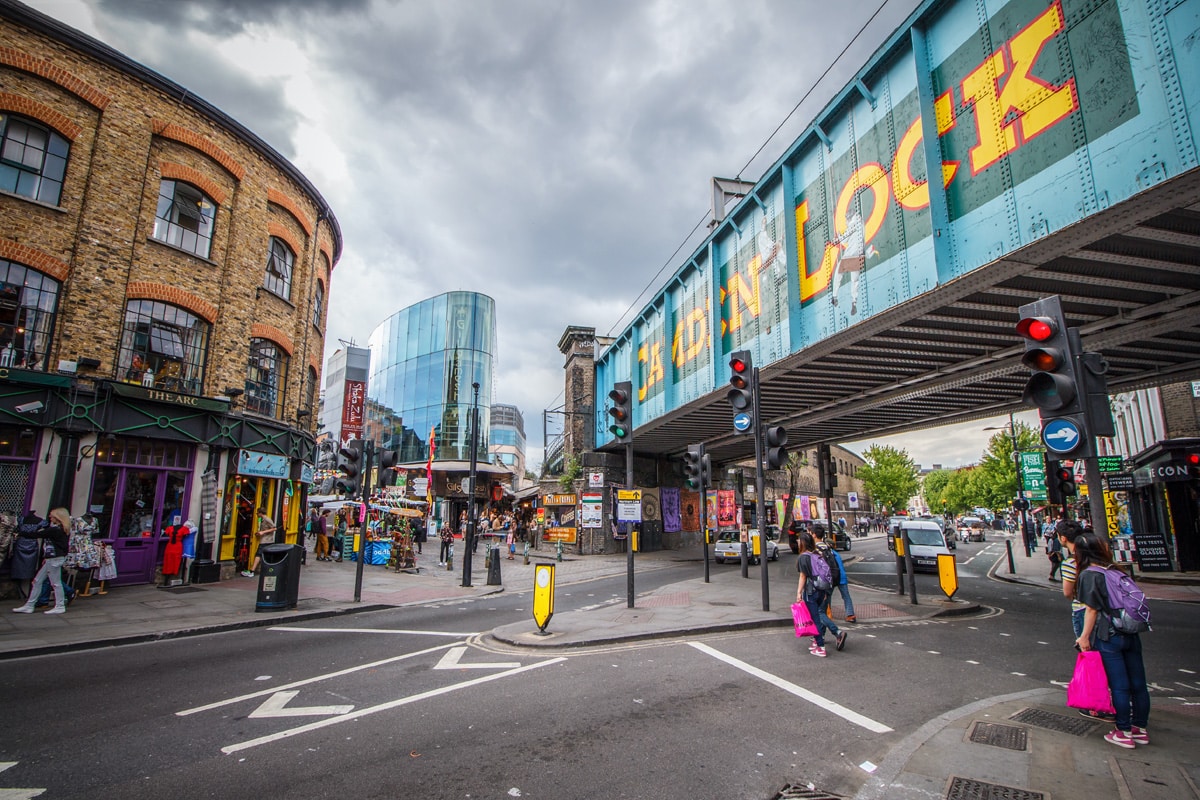
What the Camden Data Tells Buy-to-Let Investors
Camden splits into two markets, and the income case lives entirely in the cheaper one. The four lowest-priced postcodes, NW5, NW6, N1 and EC1, carry the borough's best yields at 4.3% to 5.2%, the lowest deposits from £194,146, the lowest price-to-earnings ratios, and the steadiest five-year price records. NW5 (Kentish Town) is the most accessible single entry point, pairing the lowest average asking price of £647,154 with a 5.0% yield. For an investor weighing up UK investment property in Camden, this is where the numbers actually work.
The central and West End postcodes are the other market. W1, WC2, WC1 and N6 sit at the bottom of the yield table at 2.5% to 3.7%, ask for deposits up to £602,099, and have fallen hardest over five years, W1 by 40.6%. They turn over as little as 1% of stock a year and carry up to 100 months of unsold inventory. These are capital and trophy positions bought with cash, not income plays, and the recent data has been unkind to them.
Underneath the two-speed picture, the rental side is the steadier story. Ten of the eleven postcodes read as a landlord's market to let into even as all eleven read as a buyer's market to buy into, with most homes finding a tenant in under two months. That tightness in lettings, against soft sales, is what keeps the income case alive in the residential north of the borough. Buyers chasing a discount to asking tend to work the BMV property and off-market properties routes, which matter more than usual in a buyer's market this slow.
How Camden Compares
Camden's mean asking price of £1,020,119 is the second-highest of six inner and north London locations compared here, behind only the City of Westminster, while its top yield of 5.2% sits in the middle of the group. The comparison below places Camden alongside five neighbouring boroughs, each with a different balance of price and yield. The mean asking price and mean monthly rent are simple averages across all postcodes with data. Top gross yield is the single highest postcode yield in each location.
| Location | Mean Asking Price | Mean Monthly Rent | Mean Gross Yield | Top Yield (postcode) |
|---|---|---|---|---|
| Brent | £554,541 | £2,103 | 4.6% | 5.6% (NW9) |
| Haringey | £608,827 | £2,145 | 4.2% | 6.1% (N17) |
| Barnet | £693,741 | £2,100 | 3.6% | 5.6% (NW9) |
| Islington | £699,752 | £2,753 | 4.7% | 5.3% (EC1, N19) |
| Camden | £1,020,119 | £3,414 | 4.0% | 5.2% (EC1) |
| City of Westminster | £1,260,026 | £4,107 | 3.9% | 5.4% (W2) |
Camden and the City of Westminster are the two seven-figure markets in this group, with the highest prices, the highest rents, and yields that sit no higher than the cheaper boroughs around them. Westminster is dearer still on both price and rent, but its top yield of 5.4% only just edges Camden's. The premium an investor pays in either borough is for prime-central exposure, not for income.
For investors prioritising yield, Haringey at 6.1% and Brent and Barnet at 5.6% deliver more income on materially lower prices, all three sitting under £700,000 mean asking. Islington at £699,752 is the nearest neighbour to Camden on price and shares much of its character, with a 5.3% top yield. Camden makes the most sense for a buyer who specifically wants its central, institutional, flat-led market and is content to take a lower yield for it. For a data-driven comparison across all UK locations, see our best buy-to-let areas guide. Camden's numbers sit inside our full property investment coverage, which runs to more than 160 UK towns and cities.
Frequently Asked Questions
Is Camden expensive for buy-to-let?
Yes, it is one of the most expensive boroughs in the country to buy into. The average sold price is £772,336, about 2.7 times the England average, and the mean asking price across the eleven postcodes is £1,020,119. Even the cheapest postcode, NW5 (Kentish Town), averages £647,154, which still needs a 30% deposit of close to £200,000.
The flip side is a deep, high-earning tenant base and rents that run from £2,428 to £4,867 a month. Camden is a high-capital, lower-yield borough, with central-London exposure rather than the strongest cash flow.
What are the best areas in Camden for property investment?
For income, the cheaper northern and eastern postcodes do the work. NW5 (Kentish Town) is the most accessible at a £647,154 average asking price on a 5.0% yield. EC1 (Clerkenwell) tops the yield table at 5.2%, while N1 (King's Cross) and NW6 (West Hampstead) pair reasonable yields with the borough's most active markets. These are flat-led lettings markets that have also held their value better through the recent cooling.
The central postcodes work differently. W1 (Fitzrovia) carries the highest average asking price at £2,006,996 and the lowest yield at 2.5%, alongside the steepest five-year price fall at 40.6%, so it serves as a capital position rather than an income one. If the goal is rental return, the answer in Camden points north, not central.
How does Camden compare to Islington for buy-to-let?
They are close neighbours and share a lot of character, but Islington comes in cheaper. Islington's mean asking price is £699,752 against Camden's £1,020,119, and its top yield of 5.3% edges Camden's 5.2%. Both are flat-heavy inner-London markets with strong professional tenant demand, and their postcodes even overlap, with N1 and EC1 appearing in both guides.
The practical difference is the central core. Camden carries the West End postcodes, W1, WC2 and WC1, which pull its average price up and its overall yield down. If you want a slightly cheaper entry without losing the inner-London location, Islington is the closer-priced option; Camden makes more sense if you specifically want its Hampstead-to-Bloomsbury spread.
Where are the highest rental yields in Camden?
EC1 (Clerkenwell, Hatton Garden) leads at 5.2%, followed by N1 (King's Cross), NW5 (Kentish Town) and NW8 (St John's Wood) at 5.0%. The pattern is the usual one: the cheaper the postcode, the higher the yield, because rents do not stretch as far as prices do at the top end. NW5 is the standout for an income buyer, since it reaches 5.0% on the lowest average asking price in the borough.
At the bottom, W1 (Fitzrovia) returns 2.5% and N6 (Highgate) 3.3%, where high prices and a house-heavy or trophy-flat stock compress the income. The yield map and the price map run in opposite directions across Camden.
What type of property is most common in Camden?
Flats, overwhelmingly, and in every postcode. They run from 57.3% of stock in N6 (Highgate) up to 97.2% in WC2 (Covent Garden), with the central postcodes almost entirely flats. Houses are scarce: only N6 has a real house market, at 20.4% detached, which is why Highgate's prices sit so high and its yield so low.
For a buy-to-let investor that simplifies the picture. Almost any purchase in Camden is going to be a flat, whether a period conversion, an ex-local-authority block or a new-build apartment around King's Cross. The choice is less about property type and more about which postcode and price band fits the strategy.
Will King's Cross regeneration affect Camden property prices?
Most of its effect is already in the prices. King's Cross Central is a 67-acre district of around 1,700 homes and 3.4 million square feet of offices, built over the past decade and substantially complete by early 2026. It has already reshaped tenant demand and comparables across NW1, N1 and WC1, anchored by occupiers like Google and a Central Saint Martins campus, so a buyer today is looking at a market that has mostly absorbed it.
The next chapter is the Euston HS2 programme, which proposes up to 2,500 new homes but is years from first delivery and tied to the pace of the HS2 terminus. That supply is a long-dated story, so it is not something to price in for the near term.
What are the Local Housing Allowance rates in Camden?
Camden spans two Broad Rental Market Areas, but the one-to-four-bedroom rates are the same in both. As of June 2026, Local Housing Allowance runs at £331.39 a week for a one-bed, £412.86 for two beds, £497.10 for three and £704.22 for four. The shared-accommodation rate differs by area, at £163.00 a week in the Inner North London part of the borough and £190.97 in the Central London part. Those figures are the most a tenant on housing support can claim, so a tenant renting above those figures tops up the difference from their own income, and they sit well below Camden's open-market rents.
How do I buy an investment property in Camden?
Start by deciding whether the goal is income or capital, because in Camden the two pull in opposite directions. For income, the cheaper northern postcodes lead: NW5 (Kentish Town) at a £647,154 average and a 5.0% yield, or EC1 (Clerkenwell) at the borough's top yield of 5.2%. For capital and central-London exposure, the West End postcodes carry the prestige but return as little as 2.5%. Budget for a 30% deposit, which runs from £194,146 in NW5 up to £602,099 in W1.
Beyond what is openly listed, the cheaper entry points in a slow buyer's market often come through off market properties and BMV properties. To see what is available now, browse investment properties or buy-to-let homes for sale.
Ready to buy property?
Browse investment properties with prices and gross yields shown for each opportunity.
See the latest deals