
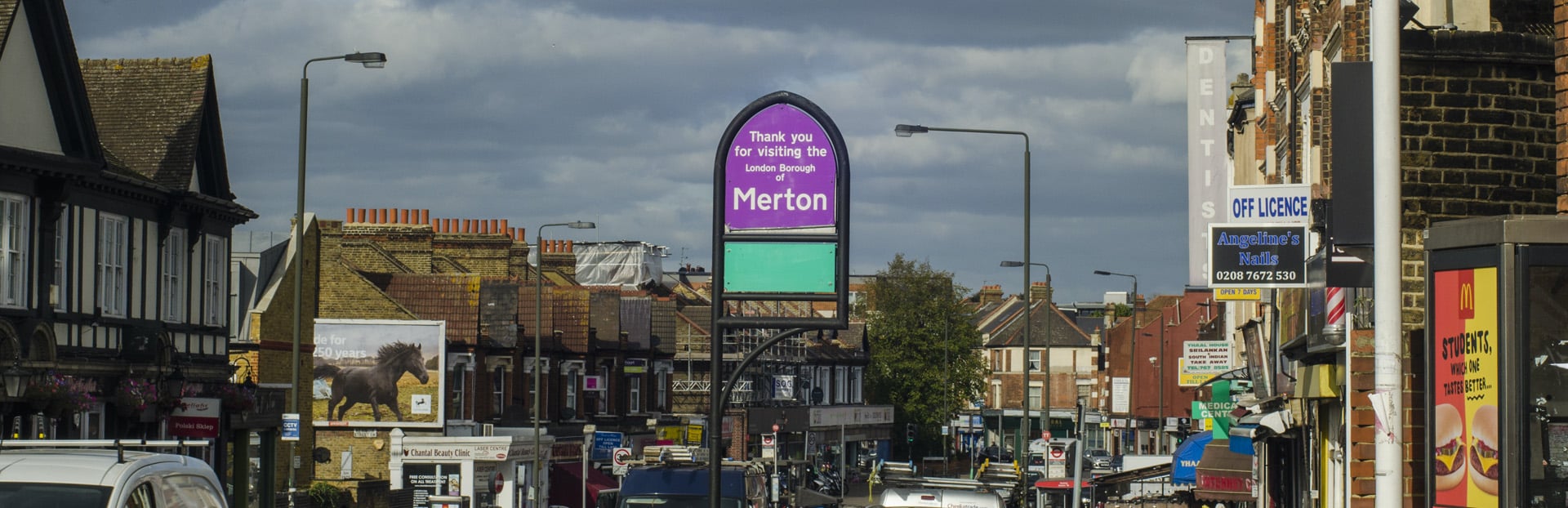
Merton is a London borough in the capital's south-west, taking in Wimbledon, Mitcham, Morden, Raynes Park and Colliers Wood. Average sold prices across the borough stand at £601,401 on the latest Land Registry reading, 107.4% above the England average of £289,946. It is also the only London borough served by tube, tram and National Rail, and that connectivity shows in what buyers pay: every property type carries a premium over its England equivalent, from 84.8% on flats to 359.9% on detached houses.
Gross rental yields across the seven postcodes run from 3.8% to 5.2%, with CR4 (Mitcham) at the top on the borough's lowest asking prices. Asking prices span £415,949 in CR4 to £736,528 in SW20 (Raynes Park, Wimbledon Chase), and average monthly rents range from £1,815 to £2,593. The two highest yields arrive by different routes: CR4 gets there on price, while SW18 reaches 5.1% on the strength of the borough's highest rents.
This guide covers the London Borough of Merton (ONS code E09000024) across all seven of its postcode districts: CR4, KT3, SM4, SW17, SW18, SW19 and SW20. Merton is an outer London borough, with Wimbledon, Mitcham, Morden, Raynes Park, and Colliers Wood as its five main centres. Several postcodes straddle borough boundaries: CR4 crosses into Croydon, SW17 and SW19 cross into Wandsworth, SW18 straddles Merton and Wandsworth, and KT3 extends into Kingston upon Thames. Data shown is for the full postcode district, not clipped to the Merton boundary. Investors comparing options across the capital may also consider Wandsworth, Croydon, or Lambeth, or browse all our London buy-to-let guides.
Article updated: July 2026

Why Invest in Merton?
Merton is commonly cited as the only London borough with tube, tram, and National Rail services. The Northern line serves Morden (the line's southern terminus), South Wimbledon, and Colliers Wood. The District line terminates at Wimbledon. Tramlink connects Wimbledon through Merton Park, Morden Road, and Mitcham to Croydon. And 11 National Rail stations provide overground links via Thameslink, South Western Railway, and Southern Railway. That level of connectivity across a single outer London borough is unusual, and it underpins the rental demand that drives the local property market.
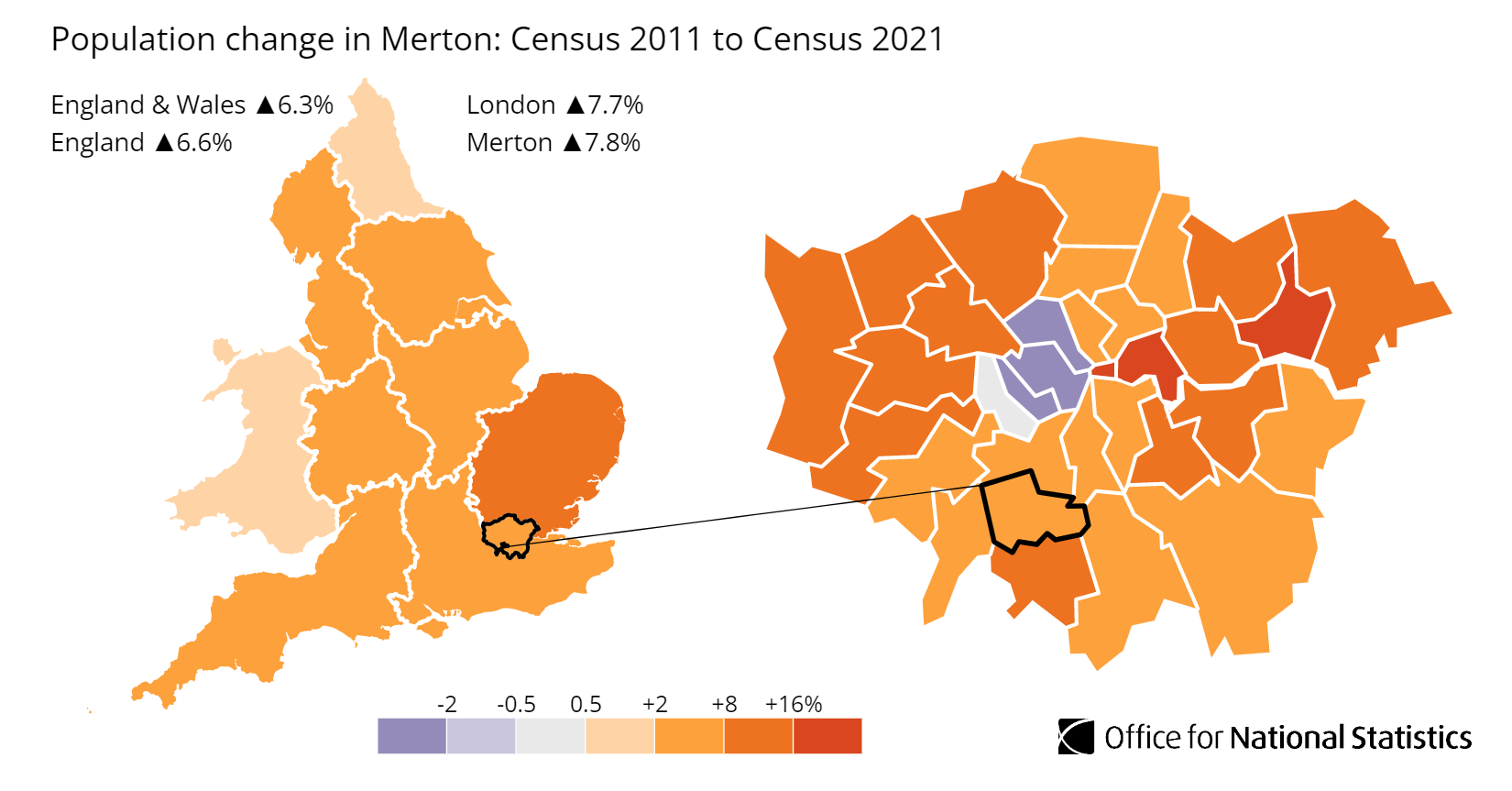
Between the 2011 and 2021 censuses, Merton's population grew from 199,693 to 215,186, a rise of 7.8%. Five town centres spread that population across the borough: Wimbledon in the west, Mitcham in the east, Morden in the centre, Raynes Park in the south-west, and Colliers Wood linking the two halves. Each has a distinct character and a different price profile for investors.
Merton's median annual salary of £50,844 is well above both the London regional median of £46,415 and the Great Britain median of £39,125. Higher local earnings support higher rents, which is reflected in the borough's monthly rent range of £1,815 to £2,593. The employment rate of 80.4% is above both the London average of 75.0% and the Great Britain average of 75.6%.
Healthcare here is a supporting point for tenant demand rather than the investment case itself. The nearest large hospital, St Helier, sits just over the Sutton border and is run by Epsom and St Helier University Hospitals NHS Trust, with local services at the Nelson Health Centre in Wimbledon and the Wilson Hospital in Mitcham. What that means in practice is a steady pool of NHS and care staff renting within the borough rather than a single dominant hospital employer inside it.
Merton Economic Summary
- Population: 215,186 (2021 Census). Growth of 7.8% from 2011.
- Median annual salary: £50,844 (Merton), £46,415 (London), £39,125 (Great Britain)
- Employment rate: 80.4% (Merton), 75.0% (London), 75.6% (Great Britain)
- Unemployment rate: 3.5% (Merton), 5.6% (London), 4.3% (Great Britain)
- Key employment sectors: Professional services, healthcare, retail and leisure, education, transport and logistics
Source: ONS Census 2021, Nomis Labour Market Profile (ASHE 2025, Employment Oct 2024-Sep 2025)
Merton's unemployment rate of 3.5% is well below the London average of 5.6% and the national 4.3%. Combined with an employment rate that exceeds both benchmarks, this points to a borough where the working population is securely employed.
For buy-to-let investors, the useful point is that Merton pairs low unemployment with earnings above the London median, so tenant affordability reads stronger here than the capital-wide picture. Merton's rental market draws tenants from professional services, healthcare, and education, three sectors with consistent London-wide demand.
Regeneration and Investment in Merton
More than £1 billion in regeneration investment is committed across Merton, with the largest schemes concentrated in the borough's eastern half. The three main projects span Morden town centre and three housing estates in Mitcham, Colliers Wood, and Morden, so the committed money is weighted towards the cheaper, higher-yielding eastern side of the borough rather than the Wimbledon end.
- Remaking Morden (£30 million council commitment, designs by summer 2026): Merton Council agreed £30 million in January 2026 to drive regeneration of Morden town centre, with plans for thousands of new homes, a revitalised high street, and an evening economy. A private-sector development partner is being appointed to bring additional investment. Updates at Merton Council News.
- Clarion Housing Estate Regeneration (£1 billion, 2,800 homes across three estates): Clarion Housing is replacing around 1,000 existing homes and building 1,800 new homes across Eastfields (800 homes, construction underway), High Path (1,704 homes), and Ravensbury (over 200 homes). The programme includes new retail, leisure, and community spaces alongside environmental improvements and district heat networks. Updates at Clarion Housing Merton.
- Future Wimbledon Masterplan (SPD adopted November 2020): Merton Council's long-term vision for Wimbledon town centre development, setting out guidance for public space improvements, new investment, and economic growth in the SW19 area through to the 2040s. The supplementary planning document followed extensive community consultation from 2014 to 2020. Updates at Merton Council.
Source: Office for National Statistics - Population for Merton
Merton Property Market Analysis
A Merton home that averaged £87,732 in January 1995 stood at £601,401 by March 2026, a rise of 585.5% across 31 years. The sections below trace that journey cycle by cycle, then break down the current postcode-level data: sold prices by property type, price per square foot, asking prices, growth, monthly sales, selling times and the stock mix.
When Was the Last House Price Crash in Merton?
Merton's full house price history from the HM Land Registry House Price Index runs from January 1995 to March 2026. The data covers one major crash, a fast recovery, a London-wide boom, a Brexit-era stagnation, and a pandemic surge to all-time highs. For further context on how property cycles work, see our guide to the 18-year property cycle.
- 1995-2000 (Early growth): Merton started 1995 at £87,732. Prices barely moved in the first year, dipping to £86,883 by January 1996. Then the London market accelerated. By January 2000, Merton had reached £147,185, a gain of 68% in five years. Annual growth hit 26.0% in 2000 as demand spread outward from inner London into well-connected outer boroughs.
- 2000-2007 (The boom): Prices continued climbing. Merton passed £200,000 by mid-2002 and £250,000 by early 2005. The sharpest growth came in 2002-2003 at over 20% per year. By October 2007, the average reached its pre-crash peak of £337,846. The borough had nearly quadrupled from its 1995 starting point.
- 2007-2009 (The financial crisis): From the pre-crash peak of £337,846 in October 2007 to the trough of £272,172 in June 2009, Merton lost 19.4% of its value in 20 months. The worst annual change reading was -18.4% in June 2009. All property types fell at similar rates: detached houses -18.7%, semi-detached -19.1%, terraced houses -19.4%, and flats -19.7%. Merton's decline was steeper than both England (-15.5%) and the London regional average (-15.1%) over the same October 2007 to June 2009 window, reflecting the sharper correction in outer London's premium markets.
Recovery, Boom, and New Highs
- 2009-2011 (Fast recovery): Merton bounced back quickly. Prices recovered to £341,783 by September 2011, surpassing the pre-crash peak just 27 months after the trough. That recovery speed was significantly faster than most UK cities outside London, where pre-crash levels took 8 to 12 years to regain.
- 2011-2015 (London boom): The capital's property surge hit Merton hard. Annual growth reached 20.2% in December 2014, and prices climbed from £320,129 in January 2011 to £513,158 by October 2015. Foreign investment, low interest rates, and constrained London supply all pushed prices well beyond pre-crash levels.
- 2016-2019 (Brexit stagnation): The London market cooled while the rest of the UK continued rising. Merton recorded -0.8% annual growth in January 2017 and ended 2019 at £529,125 with annual change of -4.8%. Four years of flat to negative returns marked this as the weakest period for London boroughs since the crash itself.
- 2020-2022 (Pandemic surge): The stamp duty holiday and demand for space reignited Merton's market. Prices jumped from £545,738 in March 2020 to £590,786 by December 2020, a single-year gain of 11.7%. Growth continued through 2022, reaching £616,849 by December. The borough's combination of green space, transport links, and relative affordability within London attracted pandemic-era buyers.
- 2023-2026 (Rate correction and new highs): Higher interest rates produced a modest correction. Prices dipped to £599,041 by December 2023, a decline of 2.9% from the previous year. Recovery followed: December 2024 hit £614,666 (+2.6%), and the all-time high of £628,093 came in September 2025. Since then the market has eased back. The latest reading of £601,401 in March 2026 is down 2.6% year on year, and sits 78.0% above the 2007 pre-crash peak. For broader context on where UK house prices may head next, see our analysis of where next for UK house prices.
Long-term growth summary:
- 5 years (March 2021 to March 2026): 4.9% growth (£573,553 to £601,401)
- 10 years (March 2016 to March 2026): 13.6% growth (£529,364 to £601,401)
- 15 years (March 2011 to March 2026): 87.1% growth (£321,407 to £601,401)
- 20 years (March 2006 to March 2026): 128.5% growth (£263,221 to £601,401)
- 30 years (January 1995 to March 2026): 585.5% growth (£87,732 to £601,401)
The 2008 crash is the reference point for Merton investors assessing downside risk: a 19.4% decline that took just 27 months to recover, far faster than the national average. The five-year figure of 4.9% is modest because the September 2025 all-time high has already given way to a softer market. Over longer timeframes, Merton's 585.5% return across 30 years shows what compounding through London's cycles has produced.
Source: HM Land Registry House Price Index for Merton
- All property types
- Detached
- Semi-detached
- Terraced
- Flats
- All property types
- Detached
- Semi-detached
- Terraced
- Flats
Source: HM Land Registry House Price Index for Merton, January 1995 to March 2026.
Sold House Prices in Merton
Merton's average sold price across all property types is £601,401, which is 107.4% above the England average of £289,946 as of March 2026. Detached houses average £2,164,006 compared with England's £470,492, while flats and maisonettes average £396,433 compared with England's £214,563.
| Property Type | Merton Average | England Average | Difference |
|---|---|---|---|
| Detached houses | £2,164,006 | £470,492 | +359.9% |
| Semi-detached houses | £919,251 | £288,185 | +219.0% |
| Terraced houses | £674,471 | £243,788 | +176.7% |
| Flats and maisonettes | £396,433 | £214,563 | +84.8% |
| All property types | £601,401 | £289,946 | +107.4% |
Detached houses in Merton sold for an average of £2,164,006, a premium of 359.9% over the England detached average. That gap reflects scarcity more than size. Detached stock is thin across south-west London, and the large family homes around Wimbledon Village and Raynes Park draw buyers from across the capital, with a small number of high-value streets pulling the average well above £2 million.
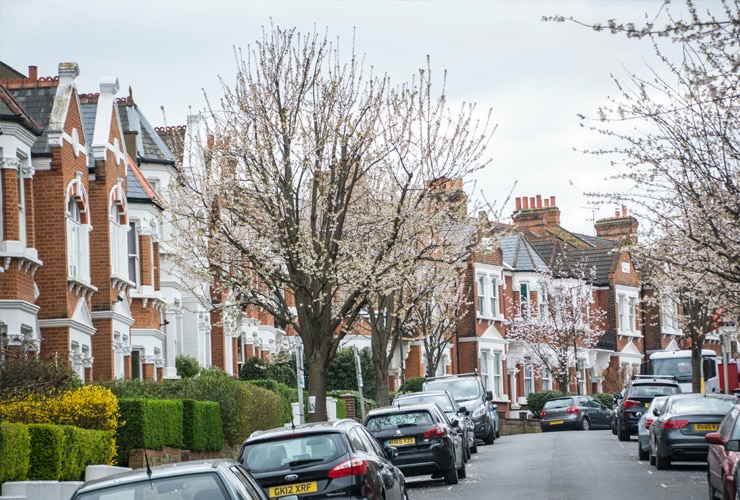
Semi-detached houses averaged £919,251, 219.0% above the England figure. These are the classic family homes of Merton's residential streets, concentrated in SW19, SW20 and KT3, and the premium narrows steadily as you move down the property ladder from here.
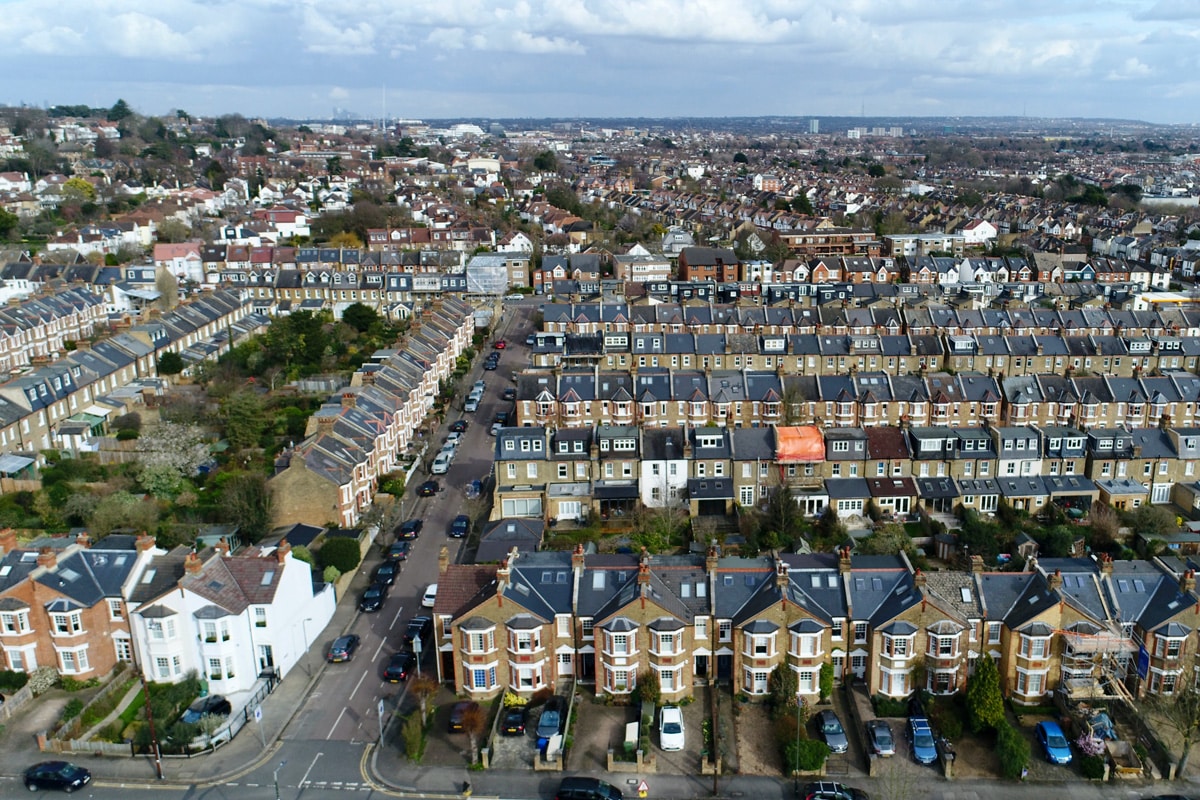
Terraced houses came in at £674,471, 176.7% above England. The terraced stock runs from Victorian terraces in Colliers Wood and Mitcham through to larger Edwardian houses closer to Wimbledon, and it is the most realistic route into a Merton house rather than a flat.
Flats and maisonettes averaged £396,433, the smallest premium at 84.8% above England. This is the cheapest way into the borough and the property type that underpins its rental market: flats account for around half of all homes in the SW postcodes, let to professionals commuting in on the District line from Wimbledon or the Northern line from Morden and Colliers Wood.
Price Per Square Foot in Merton
Sold prices per square foot range from £504 in CR4 (Mitcham) to £800 in SW18 (Wandsworth, Earlsfield), a spread of £296. Measuring by the square foot takes property size out of the comparison, so the table below shows what each location itself commands on transaction-based sold prices.
| Rank | Area | Price Per Sq Ft |
|---|---|---|
| 1 | CR4 (Mitcham) | £504 |
| 2 | SM4 (Morden) | £575 |
| 3 | KT3 (New Malden) | £613 |
| 4 | SW20 (Raynes Park, Wimbledon Chase) | £701 |
| 5 | SW17 (Tooting) | £730 |
| 6 | SW19 (Wimbledon, Colliers Wood) | £745 |
| 7 | SW18 (Wandsworth, Earlsfield) | £800 |
The per-square-foot ranking splits the borough east from west. CR4 and SM4, covering Mitcham and Morden in the east, are the only postcodes under £600, all four SW postcodes sit above £700, and KT3 (New Malden) lands between the two groups at £613. In practice, £504 per square foot in CR4 buys roughly 59% more space than the same money in SW18 at £800. Investors weighing up whether cheaper space is worth improving can browse our renovation property finder.
For Sale Asking Prices in Merton
The mean asking price across Merton's 7 postcodes is £596,108, with a £320,579 gap between CR4 (Mitcham) at £415,949 and SW20 (Raynes Park, Wimbledon Chase) at £736,528. CR4 is the only postcode with an average under £500,000.
| Rank | Area | Asking Price |
|---|---|---|
| 1 | CR4 (Mitcham) | £415,949 |
| 2 | SM4 (Morden) | £521,480 |
| 3 | SW17 (Tooting) | £590,300 |
| 4 | SW19 (Wimbledon, Colliers Wood) | £609,057 |
| 5 | SW18 (Wandsworth, Earlsfield) | £615,050 |
| 6 | KT3 (New Malden) | £684,394 |
| 7 | SW20 (Raynes Park, Wimbledon Chase) | £736,528 |
The £320,579 gap between CR4 and SW20 buys two very different propositions. CR4's £415,949 average sits below several inner London postcode averages, which is why investors comparing Merton against the cheapest areas of London often find Mitcham on both lists, and it is the natural place in the borough to hunt for below market value properties. At the other end, SW20's £736,528 average prices most buyers into flats or shared purchases. Those working with less capital up front can read our guide to investment property with no deposit.
House Price Growth in Merton
Five-year price growth in Merton runs from -1.9% in SW19 (Wimbledon, Colliers Wood) to 11.7% in KT3 (New Malden). The growth table tells a different story from the yield table: the postcode with the borough's weakest yield has grown the most.
| Area | 1 Year | 3 Years | 5 Years |
|---|---|---|---|
| KT3 (New Malden) | -0.1% | 17.2% | 11.7% |
| SM4 (Morden) | -4.6% | -0.5% | 7.5% |
| SW18 (Wandsworth, Earlsfield) | 5.8% | 4.1% | 6.3% |
| SW20 (Raynes Park, Wimbledon Chase) | 3.6% | 6.0% | 2.9% |
| SW17 (Tooting) | 2.8% | 3.1% | 1.8% |
| CR4 (Mitcham) | -3.3% | 0.9% | 0.8% |
| SW19 (Wimbledon, Colliers Wood) | -1.6% | -3.1% | -1.9% |
KT3's three-year growth of 17.2% is the standout number in the table. New Malden's family housing, on the Kingston border with direct rail into Waterloo, grew faster over three years than any other Merton postcode over five. SW18 posted the strongest one-year figure at 5.8% alongside 6.3% over five years, and its gross yield has held above 5% at the same time. SW17 and SW20 also rose across every window, at smaller magnitudes.
SW19 is the only Merton postcode that has fallen across all three windows: -1.6% over one year, -3.1% over three, -1.9% over five. Wimbledon's premium market peaked earlier than the borough's cheaper postcodes and has drifted since. CR4, SM4 and KT3 also recorded one-year falls, at -3.3%, -4.6% and -0.1%, even as their longer readings stayed close to flat or positive.
Monthly Property Sales in Merton
SW18 (Wandsworth, Earlsfield) handles 57 property sales per month, while CR4 (Mitcham) records 19. Turnover measures the percentage of housing stock that changes hands each year.
| Area | Sales Per Month | Turnover | Asking Price |
|---|---|---|---|
| SW18 (Wandsworth, Earlsfield) | 57 | 7% | £615,050 |
| SW19 (Wimbledon, Colliers Wood) | 48 | 5% | £609,057 |
| SW17 (Tooting) | 44 | 6% | £590,300 |
| KT3 (New Malden) | 25 | 7% | £684,394 |
| SW20 (Raynes Park, Wimbledon Chase) | 23 | 5% | £736,528 |
| SM4 (Morden) | 20 | 10% | £521,480 |
| CR4 (Mitcham) | 19 | 5% | £415,949 |
SW18 and SW19 between them account for 105 of the borough's 236 monthly sales, around 44% of everything that changes hands in Merton. That is where the flat-heavy stock and the professional turnover sit. SM4's 10% turnover is the highest in the borough despite Morden recording only 20 sales a month, because its housing stock is small, so a modest sales count still represents a high churn of what is there.
How Long Properties Take to Sell in Merton
A home in SW18 took around 435 days on average to find a buyer, the quickest in Merton, while CR4 sat on the market closest to 608 days. Days on market counts the time a property is listed before it sells, and months of unsold stock shows how much for-sale supply is waiting at the current rate of sales.
| Area | Avg Days to Sell | Months of Unsold Stock | Market |
|---|---|---|---|
| SW18 (Wandsworth, Earlsfield) | 435 | 14.3 | Buyer's market |
| KT3 (New Malden) | 507 | 16.7 | Buyer's market |
| SW17 (Tooting) | 507 | 16.7 | Buyer's market |
| SW19 (Wimbledon, Colliers Wood) | 507 | 16.7 | Buyer's market |
| CR4 (Mitcham) | 608 | 20.0 | Buyer's market |
| SM4 (Morden) | Not enough data | Not enough data | Not enough data |
| SW20 (Raynes Park, Wimbledon Chase) | Not enough data | Not enough data | Not enough data |
Every measured postcode carried more than a year of unsold stock, which is a real cost when the time comes to exit: a similar yield in SW18 and CR4 hides the difference between roughly 14 months and 20 months of supply waiting to clear. SM4 and SW20 did not have enough listings to produce a reliable reading, so their selling times are unmeasured rather than fast or slow.
What Type of Property Can You Buy in Merton?
Flats make up around half of all homes in Merton's SW postcodes, peaking at 55.8% in SW18, while KT3 (New Malden) is the borough's house heartland with detached and semi-detached stock at 55.6% combined. The mix matters because it sets what is actually available to buy in each postcode. The figures below come from 2021 Census records for each postcode district.
| Area | Detached | Semi-detached | Terraced | Flats |
|---|---|---|---|---|
| CR4 (Mitcham) | 4.4% | 19.5% | 34.5% | 41.5% |
| KT3 (New Malden) | 23.1% | 32.5% | 19.1% | 25.2% |
| SM4 (Morden) | Not enough data | Not enough data | Not enough data | Not enough data |
| SW17 (Tooting) | 2.4% | 13.2% | 34.6% | 49.8% |
| SW18 (Wandsworth, Earlsfield) | 3.4% | 13.6% | 27.1% | 55.8% |
| SW19 (Wimbledon, Colliers Wood) | 7.2% | 12.8% | 25.1% | 54.7% |
| SW20 (Raynes Park, Wimbledon Chase) | Not enough data | Not enough data | Not enough data | Not enough data |
CR4 and SW17 carry the borough's biggest terraced shares at 34.5% and 34.6%, stacked alongside flat shares of 41.5% and 49.8%. That smaller-unit stock is exactly where Merton's yields run highest, and in Mitcham it includes the lower-priced terraces that keep CR4's average under £420,000. SW18 and SW19 are even more flat-dominated, at 55.8% and 54.7%, which lines up with their high sales volumes and professional tenant base.
KT3 is the outlier: 23.1% detached and 32.5% semi-detached, the family-house profile of New Malden. That stock explains both its £684,394 average asking price and its 3.8% yield, since larger owner-occupier homes rent for proportionally less than they cost to buy. SM4 and SW20 do not have postcode-level stock figures available, so their rows are shown as unmeasured.
Flats include purpose-built blocks, conversions and flats above commercial premises. A small share of mobile and non-standard dwellings is excluded, so rows may not sum to 100%.
Merton Rental Market Analysis
Monthly rents in Merton range from £1,815 in CR4 (Mitcham) to £2,593 in SW18 (Wandsworth, Earlsfield), with gross rental yields from 3.8% to 5.2%. For investors weighing up whether buy-to-let is worth it in an outer London borough, the sections below break down rents, yields, and tenant affordability postcode by postcode.
The lettings stock is dominated by flats, which account for 55.8% of homes in SW18 and 54.7% in SW19, mostly purpose-built blocks and period conversions let to commuting professionals. If you are looking to build a property portfolio in London, Merton pairs above-average local earnings with tube, tram and rail links that keep tenant demand consistent across its price points.
Average Rent & Gross Rental Yields in Merton
Gross rental yields in Merton range from 3.8% in KT3 (New Malden) and SW20 to 5.2% in CR4 (Mitcham). To see how these figures are calculated, read our guide on how to work out rental yield, and for the wider picture see which areas of London deliver the highest rental yields.
| Area | Average Monthly Rent | Asking Price | Gross Yield |
|---|---|---|---|
| CR4 (Mitcham) | £1,815 | £415,949 | 5.2% |
| SW18 (Wandsworth, Earlsfield) | £2,593 | £615,050 | 5.1% |
| SW17 (Tooting) | £2,352 | £590,300 | 4.8% |
| SW19 (Wimbledon, Colliers Wood) | £2,416 | £609,057 | 4.8% |
| SM4 (Morden) | £1,879 | £521,480 | 4.3% |
| KT3 (New Malden) | £2,175 | £684,394 | 3.8% |
| SW20 (Raynes Park, Wimbledon Chase) | £2,328 | £736,528 | 3.8% |
CR4 tops the table at 5.2% with the borough's lowest rent, £1,815 a month. The maths works because Mitcham's £415,949 average asking price sits £105,531 under the next-cheapest postcode. It is a yield built on the purchase price, not the rent, and it comes with the borough's slowest selling times if you later need to get back out.
SW18 reaches 5.1% the opposite way: the highest rent in Merton at £2,593 a month against a £615,050 asking price. Earlsfield's rental demand holds the yield within a decimal point of CR4's while sitting in a postcode whose prices have also grown 6.3% over five years. SW17 and SW19 both read 4.8%, and the two most expensive postcodes for houses, KT3 and SW20, share the borough's lowest yield at 3.8%.
Is Merton Rent High?
Monthly rents in Merton range from 42.8% to 61.2% of the local median gross monthly income, with the area average sitting at 52.5%. The median gross weekly salary in Merton is £978, which equates to £4,237 per month or £50,844 per year. Data from the Nomis Labour Market Profile (ASHE 2025).
| Rank | Area | Rent as % of Income |
|---|---|---|
| 1 | SW18 (Wandsworth, Earlsfield) | 61.2% |
| 2 | SW19 (Wimbledon, Colliers Wood) | 57.0% |
| 3 | SW17 (Tooting) | 55.5% |
| 4 | SW20 (Raynes Park, Wimbledon Chase) | 55.0% |
| 5 | KT3 (New Malden) | 51.3% |
| 6 | SM4 (Morden) | 44.4% |
| 7 | CR4 (Mitcham) | 42.8% |
Every Merton postcode sits above the 30% rent-to-income level often used as an affordability benchmark, which is a London-wide pattern rather than a Merton one. The figures assume a single median earner paying the average rent alone; in practice most Merton tenancies are couples or sharers, which brings the effective share of income down substantially. SW18's 61.2% reading reflects Earlsfield's premium rents, while CR4 at 42.8% and SM4 at 44.4% leave the most headroom for a single earner.
How Big Is Merton's Private Rented Sector?
More than a third of SW17's households rent privately, at 35.9%, against 22.6% in KT3 (New Malden) at the other end of the borough. How much of a postcode's stock is already privately let tells you how established its tenant base is before you buy into it. The table below shows household tenure for the five postcodes with published figures.
| Area | Owned Outright | Owned with Mortgage | Private Rented | Social Rented |
|---|---|---|---|---|
| SW17 (Tooting) | 20.0% | 27.3% | 35.9% | 15.6% |
| SW19 (Wimbledon, Colliers Wood) | 24.2% | 26.8% | 34.4% | 12.9% |
| SW18 (Wandsworth, Earlsfield) | 20.6% | 32.4% | 32.4% | 13.0% |
| CR4 (Mitcham) | 20.0% | 25.9% | 28.3% | 24.2% |
| KT3 (New Malden) | 34.6% | 33.7% | 22.6% | 8.2% |
| SM4 (Morden) | Not enough data | Not enough data | Not enough data | Not enough data |
| SW20 (Raynes Park, Wimbledon Chase) | Not enough data | Not enough data | Not enough data | Not enough data |
The three deepest rented sectors, SW17, SW19 and SW18, are the same postcodes that dominate the borough's flat stock and sales volumes: roughly a third of households in each already rent from a private landlord. CR4 tells a different story, pairing a 28.3% private-rented share with the borough's largest social-rented sector at 24.2%, a legacy of Mitcham's estate housing. KT3 is the most owner-occupied of the measured postcodes, with 68.3% of households owning outright or with a mortgage, which matches its family-house stock. SM4 and SW20 have no published tenure breakdown at postcode-district level.
The lettings side moves quickly across all five measured postcodes. Homes to rent found a tenant in between 42 days in SW17 and 54 in CR4 on average, with only around six to eight weeks of rental stock available at the current pace of lettings. Set against sales times of 435 to 608 days, Merton's rental market clears roughly ten times faster than its sales market.
Tenure shares come from 2021 Census records. A small share of shared-ownership and rent-free households is not shown.
Local Housing Allowance Rates in Merton
The five Merton postcodes with published rates fall across three Broad Rental Market Areas, so Local Housing Allowance is not one figure here: a two-bed rate runs from £276.16 a week in CR4 to £391.23 in SW17 and SW18. LHA caps the housing support a tenant on benefits can claim, so tenants renting above the applicable rate cover the gap themselves. Rates for SM4 and SW20 are not shown; to check the current rate for any specific address, use the government's official Local Housing Allowance calculator.
| BRMA | Postcodes | Shared | 1 bed | 2 bed | 3 bed | 4 bed |
|---|---|---|---|---|---|---|
| Inner South West London BRMA | SW17, SW18 | £157.64/wk (£683/mo) | £326.79/wk (£1,416/mo) | £391.23/wk (£1,695/mo) | £497.10/wk (£2,154/mo) | £667.40/wk (£2,892/mo) |
| Outer South London BRMA | CR4 | £131.02/wk (£568/mo) | £218.63/wk (£947/mo) | £276.16/wk (£1,197/mo) | £345.21/wk (£1,496/mo) | £448.77/wk (£1,945/mo) |
| Outer South West London BRMA | KT3, SW19 | £136.13/wk (£590/mo) | £276.16/wk (£1,197/mo) | £344.05/wk (£1,491/mo) | £414.25/wk (£1,795/mo) | £586.85/wk (£2,543/mo) |
In every case the two-bed LHA rate sits below the postcode's open-market average rent, but the gap varies a lot. CR4's two-bed rate of roughly £1,197 a month compares with an average market rent of £1,815, a gap of around £600, while in SW18 the £1,695 rate sits nearly £900 under the £2,593 average. The benefit-backed end of the market therefore stretches furthest in Mitcham, where both prices and rents are the borough's lowest.
Buy-to-Let Considerations
Are House Prices High? Price-to-Earnings Ratios
Purchasing a property in Merton requires between 8.2 and 14.5 times the median annual salary. This is based on the Nomis Labour Market Profile for Merton showing the median gross annual income for local residents is £50,844.
The national benchmark is 7.4x (England's average sold price of £289,946 against the Great Britain median salary of £39,125). No Merton postcode gets under that line, but CR4 at 8.2x comes closest and is the borough's only single-digit reading.
| Rank | Area | Price-to-Earnings Ratio |
|---|---|---|
| 1 | CR4 (Mitcham) | 8.2x |
| 2 | SM4 (Morden) | 10.3x |
| 3 | SW17 (Tooting) | 11.6x |
| 4 | SW19 (Wimbledon, Colliers Wood) | 12.0x |
| 5 | SW18 (Wandsworth, Earlsfield) | 12.1x |
| 6 | KT3 (New Malden) | 13.5x |
| 7 | SW20 (Raynes Park, Wimbledon Chase) | 14.5x |
At a typical 4.5x lending multiple, a single median earner in Merton could borrow around £228,798, which covers 55% of CR4's average asking price and 31% of SW20's. That is why most Merton purchases involve dual incomes or substantial deposits, and why the spread from 8.2x to 14.5x matters more here than the borough average. The stamp duty calculator helps model the full acquisition cost on top.
Deposit Requirements in Merton
A 30% deposit on property in Merton ranges from £124,785 in CR4 (Mitcham) to £220,958 in SW20 (Raynes Park, Wimbledon Chase). The gap between the lowest and highest deposits is £96,174.
| Rank | Area | 30% Deposit Required |
|---|---|---|
| 1 | CR4 (Mitcham) | £124,785 |
| 2 | SM4 (Morden) | £156,444 |
| 3 | SW17 (Tooting) | £177,090 |
| 4 | SW19 (Wimbledon, Colliers Wood) | £182,717 |
| 5 | SW18 (Wandsworth, Earlsfield) | £184,515 |
| 6 | KT3 (New Malden) | £205,318 |
| 7 | SW20 (Raynes Park, Wimbledon Chase) | £220,958 |
The first step on the ladder is a big one everywhere in Merton: even CR4 needs £124,785 down at 30%. The £31,659 step from CR4 to SM4 buys into Morden and its Northern line terminus with the Remaking Morden programme attached, while the jump from CR4 to SW18 costs £59,730 more in deposit for the borough's highest rents. Investors browsing buy-to-let homes for sale across London can use these figures to size a realistic postcode shortlist.
What the Merton Data Tells Buy-to-Let Investors
Merton's income and growth stories sit in different postcodes. CR4 (Mitcham) posts the top gross yield at 5.2% on the borough's lowest asking price of £415,949 and lowest 30% deposit of £124,785, but its prices fell 3.3% over the past year and it is the slowest postcode to sell in. KT3 (New Malden) has grown the most, 11.7% over five years, on the borough's weakest yield of 3.8%.
SW18 (Wandsworth, Earlsfield) is where the two stories overlap. It pairs a 5.1% yield with price growth in every window, up 6.3% over five years. Its rents are the borough's highest at £2,593 a month, and no Merton postcode sells more homes or sells them faster. SW19's numbers point the other way: negative growth across all three windows on a mid-table 4.8% yield, though with 48 sales a month there is no shortage of transactions.
Merton runs selective licensing for single-household rentals in four wards in the borough's east around Mitcham (Figge's Marsh, Graveney, Longthornton and Pollards Hill), and additional HMO licensing across those plus Colliers Wood, Cricket Green and Lavender Fields, so whether a licence is needed depends on the ward as much as the property. Check the current schemes on the council's property licensing pages before purchasing. Beyond the open market, off-market property in London and investment properties sourced through an introduction service surface stock that never reaches the portals, and lender-owned homes appear periodically among repossessed houses for sale.
How Merton Compares
Merton is the second most expensive of the five south London boroughs compared here, £8,346 above Lambeth on mean asking price but £67,527 below Wandsworth. Its 4.5% mean gross yield sits mid-table: below Wandsworth's 5.0% and Lambeth's 4.8%, above Bromley's 4.0%. For a UK-wide view of where yields run highest, see our guide to the top buy-to-let locations.
| Location | Mean Asking Price | Mean Monthly Rent | Mean Gross Yield | Top Yield (postcode) |
|---|---|---|---|---|
| Croydon | £466,187 | £1,771 | 4.6% | 5.4% (SE20) |
| Bromley | £544,449 | £1,830 | 4.0% | 5.4% (SE20) |
| Lambeth | £587,762 | £2,368 | 4.8% | 5.6% (SE5) |
| Merton | £596,108 | £2,223 | 4.5% | 5.2% (CR4) |
| Wandsworth | £663,635 | £2,770 | 5.0% | 5.3% (SW11, SW4) |
Croydon is the cheapest of the group at £466,187, a full £129,921 under Merton, with a 5.4% top yield in SE20 and the lowest mean rent at £1,771. Its 4.6% mean yield sits just above Merton's 4.5% even though its rents run £452 a month lower, because the asking prices are so much further down.
Bromley sits between the two at £544,449 and matches Croydon's 5.4% top yield, but its 4.0% mean is the weakest in the table because it covers a large, house-heavy borough where rents of £1,830 chase higher average prices.
Lambeth is the nearest price match to Merton at £587,762 and has beaten it on both yield measures, a 4.8% mean and the group's highest top yield at 5.6% in SE5. Inner-London tenant demand pushes Lambeth's mean rent £145 above Merton's despite the similar prices.
Wandsworth costs the most at £663,635 and collects the highest rents at £2,770 a month, which is how it holds the group's best mean yield at 5.0%. Its 5.3% top yield in SW11 and SW4 is only a fraction above Merton's 5.2%, and because SW18 straddles the two boroughs, investors comparing them are often pricing the same streets.
Frequently Asked Questions
Where is Merton in London?
Merton is an outer London borough in the south-west of the capital, classified by the ONS under code E09000024 and covering approximately 14.7 square miles. It borders Wandsworth to the north, Lambeth to the north-east, Croydon to the east, Sutton to the south, and Kingston upon Thames to the west. The borough's five main centres are Wimbledon, Mitcham, Morden, Raynes Park, and Colliers Wood.
Is Wimbledon in Merton?
Wimbledon is in the London Borough of Merton. Wimbledon town centre, Wimbledon Village, and the All England Lawn Tennis Club all fall within Merton's boundaries. Wimbledon station provides interchange between the District line (Wimbledon is the western terminus of the Wimbledon branch), National Rail services via South Western Railway and Thameslink, and Tramlink services to Croydon. The SW19 postcode covers both Wimbledon and Colliers Wood within Merton.
Is Merton a county?
No. Merton is a London borough, formally the London Borough of Merton, and one of 32 London boroughs plus the City of London that make up Greater London. The name sometimes causes confusion because the historic parish of Merton predates the 1965 creation of the London boroughs, and Merton Priory was a significant medieval religious house. The current borough was formed from the merger of the former Municipal Borough of Wimbledon, the Municipal Borough of Mitcham, and the Merton and Morden Urban District.
Is Merton a good place to live?
Work and wages are the strongest part of the picture. Merton's employment rate of 80.4% is above both the London (75.0%) and Great Britain (75.6%) averages, and median earnings of £50,844 per year sit above the London regional median. The borough has tube, tram, and National Rail services, and its population grew 7.8% between the 2011 and 2021 censuses to 215,186. Average sold prices of £601,401 are 107.4% above the England average, which reflects sustained demand for housing in the area, and rents range from £1,815 to £2,593 per month across the 7 postcodes.
What are the best areas in Merton for property investment?
The answer changes with the goal. If income is the priority, CR4 (Mitcham) and SW18 (Earlsfield) lead on gross yield at 5.2% and 5.1%. If five-year price growth matters more, KT3 (New Malden) has delivered the most at 11.7%. SW18 has paired its 5.1% yield with positive growth over one, three and five years, while SW19 (Wimbledon) has recorded negative growth across all three windows on a 4.8% yield.
What type of property is most common in Merton?
Flats, in most of the borough. They account for 55.8% of homes in SW18, 54.7% in SW19 and 49.8% in SW17, mostly purpose-built blocks and period conversions. CR4 has the largest terraced share alongside SW17 at around 34.5%, and KT3 (New Malden) is the exception, where detached and semi-detached houses make up 55.6% of the stock. Postcode-level figures for SM4 and SW20 are not published.
How does Merton compare to Wandsworth for buy-to-let?
Closer than the postcodes suggest, not least because the two boroughs share one. Merton's mean asking price of £596,108 is £67,527 below Wandsworth's £663,635, with lower mean monthly rents (£2,223 against £2,770), and Wandsworth's top gross yield of 5.3% (SW11, SW4) edges Merton's 5.2% (CR4). The shared postcode is SW18: Merton's second-highest yield at 5.1%, its highest rent at £2,593 a month, and its busiest market at 57 sales per month, so investors comparing the two are often weighing the same streets.
What are average house prices in Wimbledon?
Wimbledon spans two postcodes, so there are two answers. SW19, which covers Wimbledon town and Colliers Wood, has an average asking price of £609,057 and sold prices of £745 per square foot, with a 4.8% gross yield on average monthly rents of £2,416. Five-year price growth in SW19 is -1.9%, making it the only Merton postcode with negative growth over that period. SW20, covering Raynes Park and Wimbledon Chase, is dearer at £736,528 with a gross yield of 3.8%.
How do I buy an investment property in Merton?
Start with the deposit, because it sets the postcode shortlist: 30% down runs from £124,785 in CR4 to £220,958 in SW20 on current averages, plus stamp duty at the additional-property rate. From there the routes are the open market, lender-owned stock, and introduced deals: our investment property service connects buyers to sourced opportunities, including some that never reach the portals. Check ward-level licensing on Merton Council's property licensing pages before committing, since the selective and additional HMO schemes only cover parts of the borough.
Ready to buy property?
Browse investment properties with prices and gross yields shown for each opportunity.
Get property alerts