

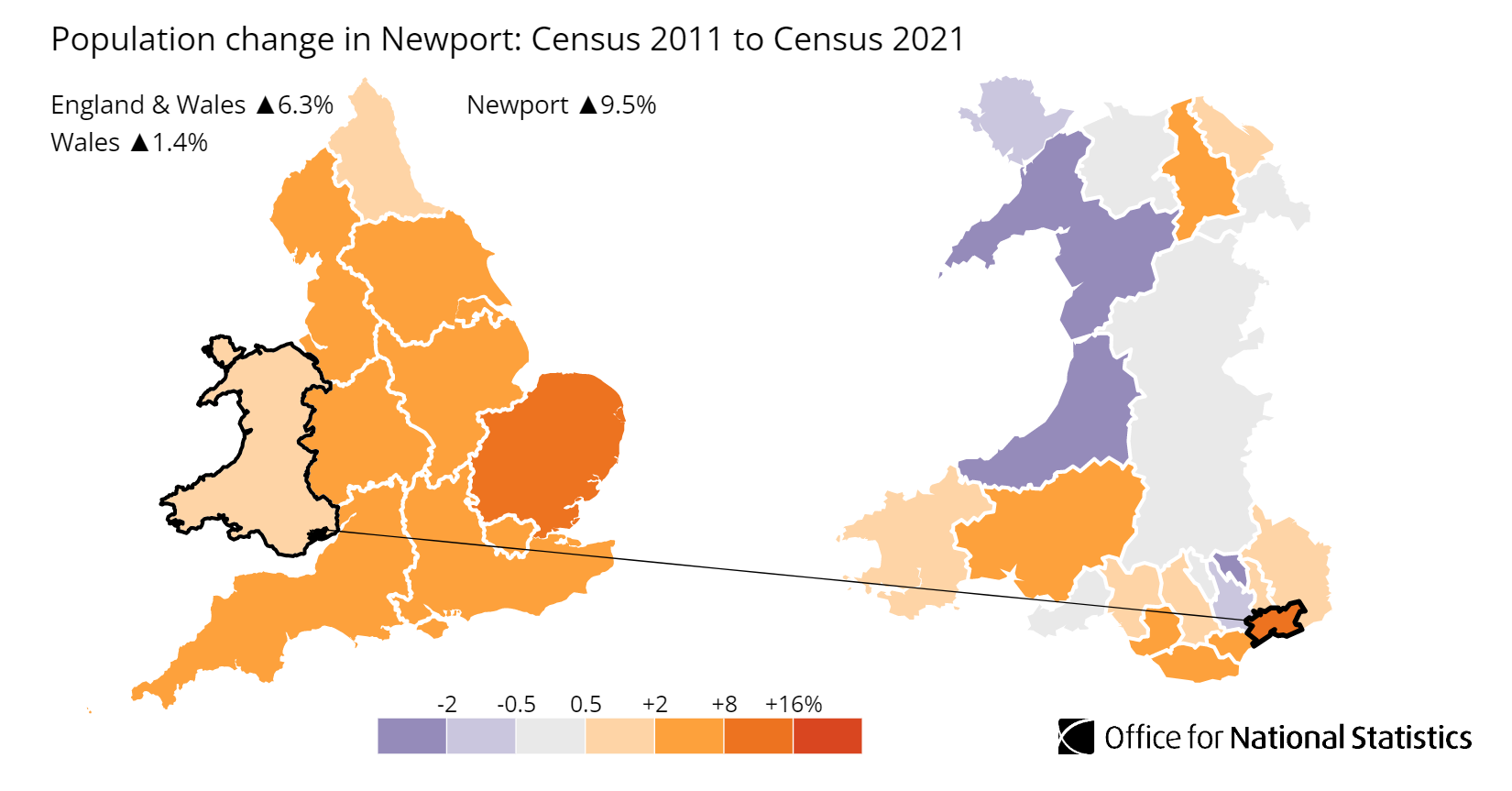
Newport is a city in south-east Wales. Average sold prices across Newport sit at £230,640 on the HM Land Registry House Price Index, 8.2% above the Wales average of £213,240. That positioning is the heart of Newport's case. It is the third-largest city in Wales and a regional centre on the M4 corridor between Cardiff and Bristol, priced a little above the wider Welsh market while staying affordable against the higher-priced cities just across the Severn in the South West of England. The city's population grew 9.51% between the 2011 and 2021 censuses, from 145,736 to 159,592 residents, one of the faster rates of any Welsh local authority.
Newport's draw is its location. It sits roughly 12 miles east of Cardiff and 25 miles west of Bristol, with fast rail links to both and direct trains to London Paddington. The median gross weekly salary of £702.60 runs just ahead of the Wales figure of £699.10, supporting a tenant base spread across all seven postcodes. For investors, the spread between NP11 at a £196,974 asking price and NP18 at £389,414 creates a two-tier market within a single postcode area, where the higher yields sit with the cheaper postcodes rather than the premium ones.
This guide covers the city of Newport (ONS code W06000022) and the wider NP postcode area across NP10, NP11, NP18, NP19, NP20, NP26, and NP44. Newport sits in South East Wales, between the capital and the English border. Investors comparing options in the region may also look at Cardiff to the west, Swansea further along the M4, or Bristol across the Severn.
Article updated: July 2026

Why Invest in Newport?
Newport grew its population 9.51% between the 2011 and 2021 censuses, from 145,736 to 159,592 residents, faster than the England and Wales average of 6.3%. That growth puts Newport among the quicker-expanding Welsh local authorities, helped by its position on the M4 and its mainline rail links. A new resident moving for work in Cardiff or Bristol can live in Newport for less, and that arithmetic keeps the city's housing in demand.
The local employment rate is 76.9%, above the Great Britain figure of 75.6%. Newport's economy carries a mix of public sector, logistics, and advanced manufacturing. The Office for National Statistics has a major site in the city, the steel and metals heritage of Llanwern has given way to distribution and engineering, and the city's position at the western end of the Severn crossing makes it a logistics base for firms serving both Wales and the South West of England.
Median gross weekly earnings in Newport are £702.60, which equates to £36,533 a year. That sits just above the Wales median of £699.10 a week but below the Great Britain figure of £752.40. Wages broadly in line with the Welsh average, combined with sold prices that run above the Welsh average, reflect Newport's role as a working regional city rather than a commuter dormitory. The tenant base leans towards local workers and households priced out of Cardiff and Bristol rather than a student-heavy market.
Newport Economic Summary
- Population: 159,592 (2021 Census). Growth of 9.51% from 2011.
- Median weekly salary: £702.60 (Newport), £699.10 (Wales), £752.40 (Great Britain)
- Median annual salary: £36,533 (Newport)
- Employment rate: 76.9% (Newport), 75.6% (Great Britain)
- Key employment sectors: Public administration, logistics and distribution, advanced manufacturing, retail, health and social work
Source: ONS Census 2021, Nomis Labour Market Profile (ASHE 2025, Employment Oct 2024-Sep 2025)
Regeneration and Investment in Newport
Newport's largest scheme is Glan Llyn, a £1 billion regeneration of the 600-acre former Llanwern Steelworks into a community of up to 4,000 homes. The investment is split between brownfield housing on the city's eastern edge and a Welsh Government-backed programme refreshing the city centre.
- Glan Llyn (in progress, £1 billion, 4,000 homes): The regeneration of the 600-acre former Llanwern Steelworks site into a mixed-use community with up to 4,000 homes and a million square feet of employment space. Over 850 homes have already been delivered alongside a primary school, parkland, and lakes. The current £105 million Locke Gardens phase, a Lovell and Pobl Group partnership, adds 500 homes by 2028, with St Modwen master-developing the wider site. Updates at Lovell.
- Transforming Towns city centre programme (ongoing, £17 million): Welsh Government funding to Newport City Council since 2018 through the Targeted Regeneration Investment and Transforming Towns programmes. The named projects include the Chartist Tower conversion to a four-star hotel, a £1.2 million restoration of the Grade II-listed Market Arcade, a £1.3 million refurbishment of the Central Library and Museum, and a £2 million loan towards the indoor market redevelopment. Updates at Welsh Government.
- Newport Leisure and Wellbeing Centre (under construction, £7 million Welsh Government grant): A net-zero leisure centre on the city centre riverfront, one of the first fully electric leisure facilities of its kind in the UK, backed by a £7 million Transforming Towns grant within the wider city centre programme. The waterfront location ties the scheme to Newport's riverside renewal and its growing population. Updates at Welsh Government.
Source: Office for National Statistics - Population for Newport
Newport Property Market Analysis
Average property prices in Newport have risen 401.6% since January 1995, from £45,977 to £230,640. The sections below trace that journey cycle by cycle, then drill into current postcode-level data for sold prices, price per square foot, asking prices, growth trends, and monthly transaction volumes.
When Was the Last House Price Crash in Newport?
Newport lost 24.1% of its value between June 2007 and June 2013, took ten and a half years to regain the peak, and now sits 50.5% above it. All sold prices come from the HM Land Registry House Price Index for Newport, which runs from January 1995 to the latest reading in March 2026.
- 1995 to 2000, the slow build: Newport began 1995 at £45,977. Prices climbed gently rather than sharply, reaching £60,345 by December 2000, a 31.3% rise over six years. The market was steady but unspectacular while the wider UK boom had yet to reach South Wales.
- 2000 to 2007, the boom: The pace quickened. Prices more than doubled from £60,345 in December 2000 to a peak of £153,271 in June 2007. Cheap credit and a national housing surge pulled Newport up with it, and by December 2005 the average had already reached £132,724.
- 2007 to 2009, the financial crisis: From the June 2007 peak of £153,271, prices fell hard. The worst annual reading was -18.0% in January 2009, and by March 2009 the average had dropped to £120,626. Newport's lower-value stock fell further in percentage terms than higher-priced markets, the mirror image of the buffer that protected places like Chester.
- 2009 to 2013, the long stagnation: Prices did not bounce. They ground sideways and lower, reaching their cycle trough of £116,354 in June 2013, a full 24.1% below the 2007 peak. Newport spent six years unable to find a floor, one of the deeper and longer corrections among UK cities.
- 2013 to 2019, the recovery: Growth finally returned. Prices climbed back to £153,370 by December 2017, the first time they had matched the June 2007 peak, ten and a half years after the crash. By December 2019 the average reached £171,493.
- 2020 to 2022, the pandemic surge: The stamp duty holiday and a shift towards more space and cheaper locations lifted Newport sharply. Prices rose from £183,153 in December 2020 to £201,108 by December 2021 (9.8% annual growth) and £220,790 by December 2022 (another 9.8%).
- 2023 to present: Higher mortgage rates cooled the market. Prices eased to £215,109 by December 2023 (-2.6%) and drifted to £214,945 by December 2024 before recovering to £230,640 by March 2026, a new all-time high. The current price is 50.5% above the June 2007 pre-crash peak.
Long-term growth summary:
- 5 years (March 2021 to March 2026): 23.7% growth (£186,392 to £230,640)
- 10 years (March 2016 to March 2026): 73.3% growth (£133,101 to £230,640)
- 15 years (March 2011 to March 2026): 97.4% growth (£116,865 to £230,640)
- 20 years (March 2006 to March 2026): 74.2% growth (£132,437 to £230,640)
- 30 years (January 1995 to March 2026): 401.6% growth (£45,977 to £230,640)
Newport's 24.1% crash was deeper than the England fall of around 18%, and its recovery took longer than most. That is the trade-off in a lower-value market: it can fall harder in a downturn, but the 401.6% return over 30 years and the 97.4% gain over the past 15 years show the long-run direction has been firmly upward. An investor who bought at the exact June 2007 peak would now be 50.5% ahead on the Land Registry average, though the wait to break even ran to a decade.
- All property types
- Detached
- Semi-detached
- Terraced
- Flats
Source: HM Land Registry House Price Index
| Year | All property types | Detached | Semi-detached | Terraced | Flats |
|---|---|---|---|---|---|
| 1995-01 | £45,977 | £82,248 | £47,264 | £36,054 | £29,465 |
| 1995-02 | £45,939 | £81,595 | £47,483 | £35,991 | £29,402 |
| 1995-03 | £46,046 | £81,515 | £47,560 | £36,155 | £29,469 |
| 1995-04 | £45,275 | £79,783 | £46,814 | £35,596 | £29,003 |
| 1995-05 | £45,036 | £79,173 | £46,538 | £35,468 | £28,827 |
| 1995-06 | £44,712 | £78,697 | £46,293 | £35,128 | £28,679 |
| 1995-07 | £44,909 | £79,312 | £46,520 | £35,233 | £28,629 |
| 1995-08 | £44,802 | £79,674 | £46,361 | £35,080 | £28,409 |
| 1995-09 | £45,213 | £80,474 | £46,737 | £35,437 | £28,501 |
| 1995-10 | £45,834 | £81,739 | £47,493 | £35,806 | £29,001 |
| 1995-11 | £45,727 | £81,609 | £47,446 | £35,646 | £29,135 |
| 1995-12 | £45,393 | £81,061 | £47,187 | £35,314 | £28,977 |
| 1996-01 | £44,525 | £79,834 | £46,248 | £34,608 | £28,299 |
| 1996-02 | £44,353 | £79,479 | £46,108 | £34,491 | £28,044 |
| 1996-03 | £44,311 | £79,710 | £46,138 | £34,379 | £27,910 |
| 1996-04 | £44,256 | £79,297 | £46,029 | £34,432 | £27,915 |
| 1996-05 | £44,818 | £80,056 | £46,494 | £34,994 | £28,231 |
| 1996-06 | £44,404 | £79,174 | £45,935 | £34,758 | £28,123 |
| 1996-07 | £45,312 | £80,958 | £46,893 | £35,432 | £28,576 |
| 1996-08 | £44,325 | £79,718 | £45,867 | £34,553 | £27,815 |
| 1996-09 | £44,310 | £80,032 | £45,804 | £34,507 | £27,581 |
| 1996-10 | £43,934 | £79,529 | £45,451 | £34,159 | £27,282 |
| 1996-11 | £44,829 | £80,965 | £46,420 | £34,867 | £27,931 |
| 1996-12 | £45,713 | £82,248 | £47,441 | £35,575 | £28,436 |
| 1997-01 | £46,635 | £83,880 | £48,357 | £36,327 | £28,939 |
| 1997-02 | £48,889 | £88,175 | £50,735 | £38,003 | £30,285 |
| 1997-03 | £49,497 | £89,408 | £51,265 | £38,484 | £30,683 |
| 1997-04 | £49,537 | £89,145 | £51,353 | £38,562 | £30,679 |
| 1997-05 | £48,232 | £86,398 | £50,021 | £37,635 | £29,726 |
| 1997-06 | £49,316 | £88,397 | £51,195 | £38,466 | £30,180 |
| 1997-07 | £50,551 | £90,766 | £52,442 | £39,455 | £30,652 |
| 1997-08 | £50,934 | £91,855 | £52,815 | £39,703 | £30,729 |
| 1997-09 | £50,569 | £91,392 | £52,415 | £39,397 | £30,460 |
| 1997-10 | £50,563 | £91,623 | £52,486 | £39,282 | £30,594 |
| 1997-11 | £51,541 | £93,437 | £53,536 | £40,008 | £31,245 |
| 1997-12 | £51,275 | £92,911 | £53,401 | £39,730 | £31,104 |
| 1998-01 | £51,663 | £93,991 | £53,691 | £40,022 | £31,297 |
| 1998-02 | £49,303 | £89,778 | £51,248 | £38,164 | £30,046 |
| 1998-03 | £49,609 | £90,440 | £51,519 | £38,421 | £30,163 |
| 1998-04 | £49,471 | £89,828 | £51,490 | £38,331 | £30,040 |
| 1998-05 | £50,806 | £91,915 | £52,834 | £39,473 | £30,672 |
| 1998-06 | £51,182 | £92,538 | £53,222 | £39,768 | £31,039 |
| 1998-07 | £50,740 | £91,889 | £52,735 | £39,409 | £30,741 |
| 1998-08 | £52,378 | £95,389 | £54,408 | £40,598 | £31,625 |
| 1998-09 | £52,417 | £95,670 | £54,391 | £40,627 | £31,491 |
| 1998-10 | £52,385 | £95,776 | £54,379 | £40,545 | £31,641 |
| 1998-11 | £51,359 | £94,115 | £53,448 | £39,623 | £31,197 |
| 1998-12 | £50,517 | £92,460 | £52,694 | £38,920 | £30,854 |
| 1999-01 | £51,320 | £94,071 | £53,555 | £39,502 | £31,294 |
| 1999-02 | £51,884 | £94,961 | £54,149 | £39,969 | £31,592 |
| 1999-03 | £51,397 | £94,346 | £53,612 | £39,553 | £31,293 |
| 1999-04 | £51,498 | £94,051 | £53,674 | £39,754 | £31,356 |
| 1999-05 | £50,192 | £91,474 | £52,250 | £38,822 | £30,507 |
| 1999-06 | £50,889 | £92,630 | £52,914 | £39,426 | £30,827 |
| 1999-07 | £50,552 | £92,468 | £52,502 | £39,116 | £30,456 |
| 1999-08 | £51,620 | £94,712 | £53,511 | £39,938 | £31,019 |
| 1999-09 | £51,900 | £95,607 | £53,706 | £40,127 | £31,121 |
| 1999-10 | £51,891 | £95,732 | £53,829 | £40,003 | £31,368 |
| 1999-11 | £54,173 | £99,816 | £56,281 | £41,733 | £32,885 |
| 1999-12 | £55,507 | £101,930 | £57,749 | £42,770 | £33,937 |
| 2000-01 | £55,614 | £102,467 | £57,840 | £42,810 | £33,809 |
| 2000-02 | £54,166 | £100,198 | £56,320 | £41,635 | £32,889 |
| 2000-03 | £56,050 | £103,950 | £58,388 | £43,021 | £33,805 |
| 2000-04 | £57,298 | £105,711 | £59,673 | £44,103 | £34,784 |
| 2000-05 | £58,238 | £107,331 | £60,767 | £44,784 | £35,523 |
| 2000-06 | £56,219 | £103,420 | £58,746 | £43,212 | £34,559 |
| 2000-07 | £55,626 | £103,042 | £58,213 | £42,556 | £33,981 |
| 2000-08 | £56,120 | £104,578 | £58,812 | £42,732 | £34,320 |
| 2000-09 | £56,471 | £106,043 | £59,076 | £42,849 | £34,430 |
| 2000-10 | £57,940 | £108,883 | £60,744 | £43,860 | £35,529 |
| 2000-11 | £58,252 | £109,576 | £61,011 | £44,085 | £35,826 |
| 2000-12 | £60,345 | £113,224 | £63,306 | £45,659 | £37,463 |
| 2001-01 | £60,825 | £114,251 | £63,627 | £46,072 | £37,761 |
| 2001-02 | £61,429 | £115,322 | £64,214 | £46,579 | £38,014 |
| 2001-03 | £60,583 | £113,775 | £63,311 | £45,971 | £37,158 |
| 2001-04 | £61,681 | £115,595 | £64,391 | £46,899 | £37,832 |
| 2001-05 | £61,954 | £115,393 | £64,758 | £47,240 | £38,097 |
| 2001-06 | £63,287 | £117,621 | £66,101 | £48,317 | £39,151 |
| 2001-07 | £63,520 | £118,095 | £66,426 | £48,445 | £39,301 |
| 2001-08 | £63,682 | £119,123 | £66,413 | £48,468 | £39,416 |
| 2001-09 | £63,982 | £120,397 | £66,535 | £48,617 | £39,496 |
| 2001-10 | £63,973 | £120,409 | £66,559 | £48,579 | £39,546 |
| 2001-11 | £64,794 | £121,785 | £67,601 | £49,141 | £40,184 |
| 2001-12 | £66,065 | £123,742 | £69,200 | £50,028 | £41,465 |
| 2002-01 | £66,303 | £124,424 | £69,457 | £50,125 | £41,778 |
| 2002-02 | £67,046 | £126,181 | £70,047 | £50,691 | £42,201 |
| 2002-03 | £66,933 | £125,760 | £69,901 | £50,703 | £41,861 |
| 2002-04 | £68,709 | £128,510 | £71,722 | £52,182 | £43,240 |
| 2002-05 | £70,761 | £131,325 | £74,127 | £53,858 | £44,704 |
| 2002-06 | £72,104 | £133,708 | £75,400 | £54,948 | £45,761 |
| 2002-07 | £73,768 | £136,733 | £77,151 | £56,252 | £46,605 |
| 2002-08 | £74,418 | £138,095 | £77,753 | £56,737 | £47,064 |
| 2002-09 | £76,099 | £141,207 | £79,751 | £57,912 | £48,072 |
| 2002-10 | £77,439 | £143,447 | £81,400 | £58,855 | £49,129 |
| 2002-11 | £80,685 | £149,260 | £84,866 | £61,326 | £51,379 |
| 2002-12 | £82,770 | £152,504 | £87,191 | £62,970 | £53,029 |
| 2003-01 | £85,303 | £156,774 | £89,675 | £65,068 | £54,832 |
| 2003-02 | £86,245 | £157,852 | £90,862 | £65,863 | £55,454 |
| 2003-03 | £89,281 | £163,507 | £93,906 | £68,240 | £57,299 |
| 2003-04 | £89,413 | £163,273 | £94,327 | £68,320 | £57,491 |
| 2003-05 | £90,033 | £164,170 | £95,008 | £68,842 | £57,897 |
| 2003-06 | £90,040 | £163,440 | £95,127 | £68,963 | £58,151 |
| 2003-07 | £93,339 | £169,004 | £98,580 | £71,639 | £60,097 |
| 2003-08 | £95,800 | £172,905 | £101,119 | £73,704 | £61,699 |
| 2003-09 | £98,879 | £178,070 | £104,338 | £76,234 | £63,317 |
| 2003-10 | £100,839 | £180,939 | £106,365 | £77,925 | £64,740 |
| 2003-11 | £103,549 | £185,284 | £109,265 | £80,137 | £66,503 |
| 2003-12 | £104,623 | £185,645 | £110,410 | £81,337 | £67,691 |
| 2004-01 | £106,294 | £188,601 | £111,944 | £82,771 | £68,592 |
| 2004-02 | £107,994 | £191,016 | £113,472 | £84,341 | £69,754 |
| 2004-03 | £109,504 | £193,868 | £114,747 | £85,606 | £70,417 |
| 2004-04 | £111,712 | £195,513 | £117,113 | £87,840 | £71,914 |
| 2004-05 | £112,733 | £195,317 | £118,048 | £89,175 | £72,698 |
| 2004-06 | £116,032 | £199,566 | £121,539 | £92,085 | £75,072 |
| 2004-07 | £117,603 | £201,694 | £123,236 | £93,460 | £76,028 |
| 2004-08 | £118,614 | £203,541 | £124,322 | £94,249 | £76,516 |
| 2004-09 | £122,333 | £210,210 | £128,088 | £97,250 | £78,599 |
| 2004-10 | £123,854 | £212,957 | £129,478 | £98,478 | £79,870 |
| 2004-11 | £128,738 | £221,255 | £134,464 | £102,413 | £83,221 |
| 2004-12 | £127,427 | £217,967 | £132,915 | £101,644 | £82,851 |
| 2005-01 | £128,583 | £220,197 | £133,785 | £102,677 | £83,574 |
| 2005-02 | £126,780 | £217,042 | £131,905 | £101,265 | £82,325 |
| 2005-03 | £125,842 | £215,797 | £130,904 | £100,447 | £81,534 |
| 2005-04 | £126,473 | £215,682 | £131,663 | £101,152 | £82,103 |
| 2005-05 | £130,102 | £221,531 | £135,093 | £104,261 | £84,687 |
| 2005-06 | £129,573 | £219,140 | £134,427 | £104,254 | £84,378 |
| 2005-07 | £129,286 | £218,890 | £134,081 | £104,044 | £83,963 |
| 2005-08 | £127,775 | £216,176 | £132,369 | £102,981 | £82,798 |
| 2005-09 | £131,128 | £222,591 | £135,643 | £105,639 | £84,819 |
| 2005-10 | £132,874 | £225,230 | £137,108 | £107,217 | £86,304 |
| 2005-11 | £133,353 | £225,599 | £137,577 | £107,683 | £86,791 |
| 2005-12 | £132,724 | £223,497 | £136,780 | £107,376 | £86,971 |
| 2006-01 | £131,409 | £221,382 | £135,326 | £106,415 | £85,776 |
| 2006-02 | £130,850 | £219,944 | £134,585 | £106,123 | £85,595 |
| 2006-03 | £132,437 | £223,335 | £136,334 | £107,283 | £86,089 |
| 2006-04 | £136,200 | £228,460 | £140,306 | £110,548 | £88,551 |
| 2006-05 | £138,709 | £232,504 | £143,043 | £112,579 | £90,004 |
| 2006-06 | £140,336 | £234,071 | £144,710 | £114,157 | £91,103 |
| 2006-07 | £140,597 | £234,830 | £144,773 | £114,495 | £90,886 |
| 2006-08 | £140,669 | £235,256 | £144,651 | £114,711 | £90,388 |
| 2006-09 | £141,834 | £238,282 | £145,790 | £115,551 | £90,684 |
| 2006-10 | £143,303 | £240,886 | £147,321 | £116,640 | £91,909 |
| 2006-11 | £145,904 | £245,007 | £150,066 | £118,773 | £93,592 |
| 2006-12 | £146,726 | £244,915 | £150,787 | £119,758 | £94,510 |
| 2007-01 | £146,172 | £244,039 | £150,110 | £119,405 | £93,926 |
| 2007-02 | £145,382 | £242,503 | £149,229 | £118,728 | £93,828 |
| 2007-03 | £143,766 | £240,250 | £147,553 | £117,421 | £92,381 |
| 2007-04 | £145,972 | £242,862 | £149,747 | £119,528 | £93,805 |
| 2007-05 | £148,509 | £246,088 | £152,195 | £121,959 | £95,375 |
| 2007-06 | £153,271 | £253,671 | £156,933 | £126,000 | £98,535 |
| 2007-07 | £153,179 | £254,577 | £156,702 | £125,811 | £98,229 |
| 2007-08 | £153,016 | £255,542 | £156,448 | £125,655 | £97,300 |
| 2007-09 | £151,554 | £254,265 | £154,853 | £124,306 | £96,076 |
| 2007-10 | £150,432 | £252,654 | £153,583 | £123,307 | £95,655 |
| 2007-11 | £149,474 | £251,228 | £152,678 | £122,330 | £95,405 |
| 2007-12 | £150,065 | £251,521 | £153,336 | £122,858 | £96,125 |
| 2008-01 | £149,125 | £250,193 | £152,359 | £122,043 | £95,508 |
| 2008-02 | £147,167 | £247,123 | £150,320 | £120,391 | £94,284 |
| 2008-03 | £144,683 | £243,762 | £148,052 | £118,253 | £92,109 |
| 2008-04 | £142,811 | £240,776 | £146,193 | £116,795 | £90,691 |
| 2008-05 | £143,136 | £240,933 | £146,577 | £117,189 | £90,767 |
| 2008-06 | £143,969 | £242,103 | £147,266 | £117,980 | £91,368 |
| 2008-07 | £145,390 | £244,786 | £148,949 | £118,999 | £92,165 |
| 2008-08 | £143,195 | £242,143 | £146,723 | £117,220 | £90,387 |
| 2008-09 | £138,623 | £236,661 | £141,807 | £113,163 | £87,524 |
| 2008-10 | £130,913 | £224,169 | £133,893 | £106,758 | £82,643 |
| 2008-11 | £127,061 | £217,742 | £130,110 | £103,439 | £80,277 |
| 2008-12 | £124,241 | £211,678 | £127,530 | £101,415 | £78,139 |
| 2009-01 | £122,309 | £209,191 | £125,505 | £99,772 | £76,819 |
| 2009-02 | £122,351 | £209,793 | £125,490 | £99,644 | £77,065 |
| 2009-03 | £120,626 | £207,496 | £123,613 | £97,899 | £76,554 |
| 2009-04 | £121,355 | £207,407 | £124,610 | £98,632 | £77,038 |
| 2009-05 | £122,110 | £207,922 | £125,586 | £99,481 | £77,167 |
| 2009-06 | £124,194 | £211,313 | £127,941 | £101,404 | £77,842 |
| 2009-07 | £125,905 | £214,881 | £129,801 | £102,969 | £78,164 |
| 2009-08 | £123,871 | £212,243 | £127,706 | £101,430 | £76,280 |
| 2009-09 | £120,549 | £207,140 | £124,387 | £98,772 | £73,707 |
| 2009-10 | £122,246 | £210,411 | £126,378 | £100,112 | £74,369 |
| 2009-11 | £120,777 | £208,044 | £124,875 | £99,062 | £73,101 |
| 2009-12 | £122,303 | £209,235 | £126,632 | £100,647 | £73,844 |
| 2010-01 | £119,569 | £205,967 | £123,889 | £98,510 | £71,271 |
| 2010-02 | £119,782 | £207,030 | £124,585 | £98,513 | £70,943 |
| 2010-03 | £123,629 | £216,155 | £128,648 | £101,248 | £73,003 |
| 2010-04 | £125,939 | £219,260 | £131,197 | £103,135 | £74,713 |
| 2010-05 | £127,987 | £222,751 | £133,190 | £104,909 | £75,932 |
| 2010-06 | £127,502 | £221,376 | £132,776 | £104,797 | £75,150 |
| 2010-07 | £130,605 | £227,714 | £135,992 | £107,365 | £76,414 |
| 2010-08 | £131,960 | £230,972 | £137,707 | £108,295 | £76,718 |
| 2010-09 | £133,626 | £235,203 | £139,441 | £109,404 | £77,545 |
| 2010-10 | £129,854 | £228,749 | £135,557 | £106,076 | £75,742 |
| 2010-11 | £127,124 | £224,372 | £132,536 | £103,681 | £74,529 |
| 2010-12 | £121,899 | £214,733 | £127,271 | £99,307 | £71,722 |
| 2011-01 | £120,266 | £212,312 | £125,558 | £97,832 | £70,855 |
| 2011-02 | £119,633 | £211,310 | £124,776 | £97,351 | £70,552 |
| 2011-03 | £116,865 | £207,458 | £121,825 | £94,935 | £68,842 |
| 2011-04 | £118,096 | £209,277 | £123,018 | £96,085 | £69,573 |
| 2011-05 | £119,322 | £210,784 | £124,460 | £97,067 | £70,620 |
| 2011-06 | £122,460 | £215,123 | £127,932 | £99,801 | £72,501 |
| 2011-07 | £122,869 | £215,525 | £128,461 | £100,102 | £72,932 |
| 2011-08 | £121,020 | £212,722 | £126,657 | £98,583 | £71,132 |
| 2011-09 | £120,563 | £212,628 | £126,032 | £98,234 | £70,416 |
| 2011-10 | £118,299 | £209,349 | £123,894 | £96,187 | £68,609 |
| 2011-11 | £118,339 | £209,425 | £123,998 | £96,062 | £69,091 |
| 2011-12 | £119,990 | £211,783 | £125,975 | £97,334 | £70,275 |
| 2012-01 | £121,012 | £213,128 | £127,095 | £98,256 | £70,855 |
| 2012-02 | £122,753 | £215,933 | £128,854 | £99,981 | £71,230 |
| 2012-03 | £119,756 | £209,920 | £125,618 | £97,815 | £69,568 |
| 2012-04 | £119,525 | £209,434 | £125,345 | £97,647 | £69,502 |
| 2012-05 | £117,039 | £204,772 | £122,733 | £95,625 | £68,310 |
| 2012-06 | £117,937 | £206,311 | £123,613 | £96,506 | £68,565 |
| 2012-07 | £119,452 | £208,735 | £125,029 | £98,035 | £69,173 |
| 2012-08 | £122,023 | £213,081 | £127,700 | £100,404 | £70,095 |
| 2012-09 | £123,306 | £216,279 | £128,917 | £101,273 | £70,787 |
| 2012-10 | £123,163 | £215,964 | £128,984 | £100,980 | £70,819 |
| 2012-11 | £123,051 | £216,012 | £128,911 | £100,690 | £71,011 |
| 2012-12 | £121,338 | £213,005 | £127,326 | £99,196 | £69,852 |
| 2013-01 | £121,527 | £213,613 | £127,709 | £99,251 | £69,638 |
| 2013-02 | £120,721 | £212,386 | £126,868 | £98,576 | £69,066 |
| 2013-03 | £123,233 | £217,366 | £129,453 | £100,518 | £70,467 |
| 2013-04 | £119,164 | £210,035 | £125,014 | £97,346 | £68,195 |
| 2013-05 | £119,310 | £209,885 | £125,265 | £97,468 | £68,397 |
| 2013-06 | £116,354 | £203,658 | £122,244 | £95,329 | £66,641 |
| 2013-07 | £119,478 | £209,098 | £125,410 | £97,995 | £68,404 |
| 2013-08 | £119,378 | £208,969 | £125,335 | £97,977 | £68,107 |
| 2013-09 | £122,663 | £215,663 | £128,735 | £100,439 | £69,937 |
| 2013-10 | £121,561 | £214,518 | £127,716 | £99,250 | £69,168 |
| 2013-11 | £121,596 | £214,866 | £127,832 | £99,111 | £69,239 |
| 2013-12 | £117,288 | £206,299 | £123,525 | £95,624 | £67,023 |
| 2014-01 | £120,366 | £211,177 | £126,658 | £98,263 | £69,062 |
| 2014-02 | £121,772 | £213,725 | £128,036 | £99,440 | £69,929 |
| 2014-03 | £126,038 | £221,469 | £132,595 | £102,853 | £72,310 |
| 2014-04 | £124,789 | £218,852 | £131,322 | £101,984 | £71,501 |
| 2014-05 | £127,773 | £223,390 | £134,526 | £104,549 | £73,391 |
| 2014-06 | £128,513 | £224,431 | £135,244 | £105,329 | £73,690 |
| 2014-07 | £130,881 | £228,600 | £137,714 | £107,340 | £74,865 |
| 2014-08 | £129,978 | £227,432 | £136,749 | £106,654 | £73,849 |
| 2014-09 | £129,566 | £227,023 | £136,186 | £106,325 | £73,541 |
| 2014-10 | £127,491 | £223,571 | £134,085 | £104,461 | £72,483 |
| 2014-11 | £126,469 | £221,956 | £133,105 | £103,449 | £72,036 |
| 2014-12 | £126,181 | £221,754 | £132,861 | £103,015 | £72,024 |
| 2015-01 | £129,158 | £227,243 | £136,056 | £105,306 | £73,755 |
| 2015-02 | £127,701 | £224,913 | £134,323 | £104,047 | £73,257 |
| 2015-03 | £127,766 | £225,571 | £134,532 | £103,835 | £73,292 |
| 2015-04 | £126,152 | £222,802 | £132,791 | £102,553 | £72,281 |
| 2015-05 | £128,686 | £226,814 | £135,731 | £104,613 | £73,673 |
| 2015-06 | £131,391 | £230,666 | £138,596 | £107,204 | £74,894 |
| 2015-07 | £132,667 | £232,518 | £140,119 | £108,257 | £75,632 |
| 2015-08 | £132,263 | £231,931 | £139,607 | £108,003 | £75,215 |
| 2015-09 | £131,531 | £231,608 | £138,659 | £107,167 | £74,916 |
| 2015-10 | £132,139 | £233,164 | £139,250 | £107,579 | £75,142 |
| 2015-11 | £132,535 | £234,171 | £139,780 | £107,765 | £75,282 |
| 2015-12 | £132,885 | £234,965 | £140,278 | £108,016 | £75,182 |
| 2016-01 | £131,939 | £233,215 | £139,461 | £107,175 | £74,604 |
| 2016-02 | £133,660 | £236,234 | £141,287 | £108,614 | £75,463 |
| 2016-03 | £133,101 | £234,976 | £140,672 | £108,097 | £75,635 |
| 2016-04 | £135,634 | £239,196 | £143,313 | £110,332 | £76,848 |
| 2016-05 | £136,999 | £241,216 | £144,610 | £111,571 | £77,869 |
| 2016-06 | £139,922 | £246,108 | £147,662 | £114,147 | £79,247 |
| 2016-07 | £140,820 | £247,710 | £148,417 | £114,938 | £79,909 |
| 2016-08 | £141,304 | £248,880 | £148,968 | £115,208 | £80,178 |
| 2016-09 | £141,121 | £248,853 | £148,917 | £114,874 | £80,084 |
| 2016-10 | £141,109 | £249,822 | £148,995 | £114,405 | £80,361 |
| 2016-11 | £141,130 | £251,056 | £149,093 | £114,016 | £80,333 |
| 2016-12 | £142,441 | £253,917 | £150,393 | £114,923 | £81,194 |
| 2017-01 | £143,472 | £256,147 | £151,486 | £115,677 | £81,640 |
| 2017-02 | £144,217 | £257,036 | £152,081 | £116,411 | £82,501 |
| 2017-03 | £144,134 | £257,183 | £152,083 | £116,175 | £82,534 |
| 2017-04 | £145,116 | £258,481 | £153,025 | £117,082 | £83,390 |
| 2017-05 | £146,060 | £259,390 | £154,373 | £117,837 | £84,005 |
| 2017-06 | £146,614 | £259,406 | £154,985 | £118,496 | £84,595 |
| 2017-07 | £146,525 | £258,612 | £155,036 | £118,502 | £84,649 |
| 2017-08 | £148,182 | £261,705 | £156,556 | £120,030 | £85,351 |
| 2017-09 | £150,089 | £265,735 | £158,490 | £121,519 | £86,116 |
| 2017-10 | £150,928 | £267,903 | £159,463 | £122,040 | £86,217 |
| 2017-11 | £151,558 | £269,374 | £160,358 | £122,324 | £86,436 |
| 2017-12 | £153,370 | £272,028 | £162,480 | £123,840 | £87,456 |
| 2018-01 | £154,275 | £273,906 | £163,524 | £124,412 | £88,008 |
| 2018-02 | £154,490 | £275,509 | £163,503 | £124,326 | £88,103 |
| 2018-03 | £155,998 | £278,925 | £165,042 | £125,435 | £88,769 |
| 2018-04 | £158,057 | £282,387 | £167,202 | £127,385 | £89,556 |
| 2018-05 | £161,266 | £287,066 | £170,971 | £130,417 | £90,773 |
| 2018-06 | £162,447 | £288,651 | £172,555 | £131,397 | £91,315 |
| 2018-07 | £163,851 | £291,413 | £174,090 | £132,513 | £91,885 |
| 2018-08 | £165,071 | £293,770 | £175,371 | £133,441 | £92,564 |
| 2018-09 | £167,078 | £297,885 | £177,377 | £135,102 | £93,389 |
| 2018-10 | £169,787 | £302,888 | £180,202 | £137,090 | £95,234 |
| 2018-11 | £169,050 | £301,875 | £179,609 | £136,449 | £94,430 |
| 2018-12 | £168,412 | £300,471 | £179,009 | £135,869 | £94,288 |
| 2019-01 | £166,221 | £297,112 | £176,906 | £133,941 | £92,662 |
| 2019-02 | £167,922 | £300,762 | £178,445 | £135,019 | £94,022 |
| 2019-03 | £169,428 | £304,065 | £180,249 | £136,043 | £94,404 |
| 2019-04 | £169,997 | £304,205 | £180,863 | £136,835 | £94,532 |
| 2019-05 | £171,038 | £305,081 | £182,204 | £138,030 | £94,666 |
| 2019-06 | £170,730 | £303,818 | £181,822 | £138,009 | £94,510 |
| 2019-07 | £173,287 | £308,341 | £184,332 | £140,096 | £96,164 |
| 2019-08 | £172,805 | £307,842 | £183,718 | £139,832 | £95,568 |
| 2019-09 | £173,027 | £308,373 | £183,560 | £140,195 | £95,734 |
| 2019-10 | £171,155 | £304,921 | £182,043 | £138,570 | £94,402 |
| 2019-11 | £173,694 | £309,455 | £185,210 | £140,360 | £95,753 |
| 2019-12 | £171,493 | £305,251 | £183,216 | £138,603 | £94,225 |
| 2020-01 | £174,663 | £311,598 | £186,587 | £141,067 | £95,779 |
| 2020-02 | £173,633 | £309,642 | £185,216 | £140,333 | £95,476 |
| 2020-03 | £176,456 | £315,312 | £188,285 | £142,384 | £97,159 |
| 2020-04 | £175,953 | £314,894 | £187,559 | £142,166 | £96,259 |
| 2020-05 | £177,086 | £317,380 | £189,044 | £142,841 | £96,660 |
| 2020-06 | £177,714 | £317,752 | £189,889 | £143,508 | £96,845 |
| 2020-07 | £178,266 | £317,757 | £190,615 | £143,971 | £97,694 |
| 2020-08 | £177,649 | £316,982 | £189,978 | £143,542 | £96,819 |
| 2020-09 | £177,895 | £318,710 | £190,114 | £143,640 | £96,361 |
| 2020-10 | £178,784 | £320,998 | £190,962 | £144,388 | £96,336 |
| 2020-11 | £180,315 | £323,383 | £192,231 | £145,885 | £97,412 |
| 2020-12 | £183,153 | £327,980 | £195,007 | £148,474 | £98,991 |
| 2021-01 | £184,200 | £327,197 | £196,144 | £149,697 | £100,774 |
| 2021-02 | £186,912 | £329,113 | £198,876 | £152,438 | £103,542 |
| 2021-03 | £186,392 | £325,464 | £198,130 | £152,447 | £104,760 |
| 2021-04 | £186,288 | £325,343 | £197,597 | £152,591 | £104,812 |
| 2021-05 | £183,648 | £321,345 | £194,705 | £150,379 | £103,155 |
| 2021-06 | £186,262 | £324,471 | £197,068 | £153,186 | £104,764 |
| 2021-07 | £188,803 | £329,175 | £200,127 | £155,052 | £105,908 |
| 2021-08 | £192,813 | £336,620 | £204,763 | £158,180 | £107,571 |
| 2021-09 | £193,911 | £339,385 | £206,329 | £158,715 | £107,756 |
| 2021-10 | £197,350 | £347,575 | £210,027 | £161,101 | £109,104 |
| 2021-11 | £198,586 | £350,643 | £211,391 | £161,905 | £109,575 |
| 2021-12 | £201,108 | £356,895 | £214,223 | £163,605 | £110,271 |
| 2022-01 | £202,013 | £356,869 | £215,371 | £164,783 | £110,526 |
| 2022-02 | £204,378 | £360,232 | £217,835 | £166,921 | £112,205 |
| 2022-03 | £205,712 | £363,042 | £219,714 | £167,711 | £112,550 |
| 2022-04 | £207,311 | £365,592 | £221,198 | £169,277 | £113,357 |
| 2022-05 | £209,263 | £368,606 | £223,466 | £171,076 | £113,729 |
| 2022-06 | £211,100 | £370,520 | £225,323 | £173,044 | £114,904 |
| 2022-07 | £213,952 | £374,608 | £228,590 | £175,607 | £116,208 |
| 2022-08 | £214,047 | £374,574 | £228,554 | £175,976 | £115,788 |
| 2022-09 | £214,495 | £375,600 | £228,963 | £176,471 | £115,437 |
| 2022-10 | £215,404 | £377,967 | £229,803 | £177,081 | £115,802 |
| 2022-11 | £218,176 | £383,487 | £232,710 | £179,163 | £117,324 |
| 2022-12 | £220,790 | £387,827 | £235,540 | £181,282 | £119,038 |
| 2023-01 | £218,603 | £384,829 | £233,479 | £179,106 | £117,549 |
| 2023-02 | £218,800 | £386,281 | £233,716 | £178,838 | £117,719 |
| 2023-03 | £215,112 | £382,019 | £230,118 | £174,952 | £115,458 |
| 2023-04 | £212,878 | £378,951 | £227,822 | £172,865 | £114,269 |
| 2023-05 | £213,006 | £378,333 | £228,203 | £173,024 | £114,396 |
| 2023-06 | £215,757 | £381,939 | £230,873 | £175,786 | £115,679 |
| 2023-07 | £218,810 | £386,273 | £234,224 | £178,591 | £117,030 |
| 2023-08 | £216,284 | £381,524 | £231,384 | £176,862 | £115,147 |
| 2023-09 | £215,590 | £380,173 | £230,595 | £176,438 | £114,534 |
| 2023-10 | £214,944 | £378,193 | £229,648 | £176,099 | £114,621 |
| 2023-11 | £215,437 | £380,055 | £230,371 | £176,100 | £115,037 |
| 2023-12 | £215,109 | £379,224 | £230,201 | £175,658 | £115,251 |
| 2024-01 | £212,964 | £376,068 | £227,838 | £173,860 | £113,903 |
| 2024-02 | £210,643 | £370,392 | £225,264 | £172,401 | £112,717 |
| 2024-03 | £208,886 | £367,178 | £223,281 | £170,962 | £112,070 |
| 2024-04 | £210,218 | £368,033 | £224,706 | £172,269 | £113,312 |
| 2024-05 | £210,490 | £367,730 | £224,982 | £172,520 | £114,001 |
| 2024-06 | £213,722 | £371,845 | £228,246 | £175,778 | £115,571 |
| 2024-07 | £214,762 | £373,313 | £229,345 | £176,953 | £115,544 |
| 2024-08 | £217,204 | £377,537 | £231,712 | £179,351 | £116,230 |
| 2024-09 | £216,827 | £378,320 | £231,511 | £178,755 | £115,377 |
| 2024-10 | £217,080 | £379,732 | £231,467 | £178,799 | £115,748 |
| 2024-11 | £215,518 | £377,215 | £230,160 | £177,295 | £114,741 |
| 2024-12 | £214,945 | £376,598 | £229,440 | £176,858 | £114,239 |
| 2025-01 | £215,714 | £378,515 | £230,641 | £177,409 | £113,815 |
| 2025-02 | £217,571 | £382,277 | £232,371 | £178,984 | £114,741 |
| 2025-03 | £218,934 | £381,728 | £233,621 | £180,637 | £116,714 |
| 2025-04 | £217,651 | £381,417 | £232,610 | £179,009 | £115,426 |
| 2025-05 | £218,971 | £384,742 | £234,339 | £179,947 | £115,261 |
| 2025-06 | £219,245 | £387,549 | £235,227 | £179,784 | £113,671 |
| 2025-07 | £224,693 | £394,210 | £240,908 | £185,185 | £116,734 |
| 2025-08 | £227,065 | £397,634 | £243,706 | £187,310 | £117,725 |
| 2025-09 | £226,264 | £396,947 | £242,919 | £186,615 | £116,777 |
| 2025-10 | £223,748 | £393,406 | £240,476 | £184,223 | £115,182 |
| 2025-11 | £223,976 | £394,160 | £240,613 | £184,391 | £115,255 |
| 2025-12 | £226,689 | £397,379 | £243,493 | £187,056 | £116,845 |
| 2026-01 | £228,043 | £398,307 | £245,017 | £188,783 | £117,119 |
| 2026-02 | £227,459 | £397,134 | £244,465 | £188,416 | £116,460 |
| 2026-03 | £230,640 | £403,508 | £248,237 | £190,957 | £117,123 |
- All property types
- Detached
- Semi-detached
- Terraced
- Flats
Source: HM Land Registry House Price Index
| Year | All property types | Detached | Semi-detached | Terraced | Flats |
|---|---|---|---|---|---|
| 1996-01 | -3.2% | -2.9% | -2.1% | -4.0% | -4.0% |
| 1996-02 | -3.5% | -2.6% | -2.9% | -4.2% | -4.6% |
| 1996-03 | -3.8% | -2.2% | -3.0% | -4.9% | -5.3% |
| 1996-04 | -2.3% | -0.6% | -1.7% | -3.3% | -3.8% |
| 1996-05 | -0.5% | +1.1% | -0.1% | -1.3% | -2.1% |
| 1996-06 | -0.7% | +0.6% | -0.8% | -1.1% | -1.9% |
| 1996-07 | +0.9% | +2.1% | +0.8% | +0.6% | -0.2% |
| 1996-08 | -1.1% | +0.1% | -1.1% | -1.5% | -2.1% |
| 1996-09 | -2.0% | -0.5% | -2.0% | -2.6% | -3.2% |
| 1996-10 | -4.1% | -2.7% | -4.3% | -4.6% | -5.9% |
| 1996-11 | -2.0% | -0.8% | -2.2% | -2.2% | -4.1% |
| 1996-12 | +0.7% | +1.5% | +0.5% | +0.7% | -1.9% |
| 1997-01 | +4.7% | +5.1% | +4.6% | +5.0% | +2.3% |
| 1997-02 | +10.2% | +10.9% | +10.0% | +10.2% | +8.0% |
| 1997-03 | +11.7% | +12.2% | +11.1% | +11.9% | +9.9% |
| 1997-04 | +11.9% | +12.4% | +11.6% | +12.0% | +9.9% |
| 1997-05 | +7.6% | +7.9% | +7.6% | +7.5% | +5.3% |
| 1997-06 | +11.1% | +11.6% | +11.5% | +10.7% | +7.3% |
| 1997-07 | +11.6% | +12.1% | +11.8% | +11.4% | +7.3% |
| 1997-08 | +14.9% | +15.2% | +15.1% | +14.9% | +10.5% |
| 1997-09 | +14.1% | +14.2% | +14.4% | +14.2% | +10.4% |
| 1997-10 | +15.1% | +15.2% | +15.5% | +15.0% | +12.1% |
| 1997-11 | +15.0% | +15.4% | +15.3% | +14.7% | +11.9% |
| 1997-12 | +12.2% | +13.0% | +12.6% | +11.7% | +9.4% |
| 1998-01 | +10.8% | +12.1% | +11.0% | +10.2% | +8.1% |
| 1998-02 | +0.8% | +1.8% | +1.0% | +0.4% | -0.8% |
| 1998-03 | +0.2% | +1.2% | +0.5% | -0.2% | -1.7% |
| 1998-04 | -0.1% | +0.8% | +0.3% | -0.6% | -2.1% |
| 1998-05 | +5.3% | +6.4% | +5.6% | +4.9% | +3.2% |
| 1998-06 | +3.8% | +4.7% | +4.0% | +3.4% | +2.8% |
| 1998-07 | +0.4% | +1.2% | +0.6% | -0.1% | +0.3% |
| 1998-08 | +2.8% | +3.8% | +3.0% | +2.3% | +2.9% |
| 1998-09 | +3.7% | +4.7% | +3.8% | +3.1% | +3.4% |
| 1998-10 | +3.6% | +4.5% | +3.6% | +3.2% | +3.4% |
| 1998-11 | -0.4% | +0.7% | -0.2% | -1.0% | -0.2% |
| 1998-12 | -1.5% | -0.5% | -1.3% | -2.0% | -0.8% |
| 1999-01 | -0.7% | +0.1% | -0.3% | -1.3% | 0.0% |
| 1999-02 | +5.2% | +5.8% | +5.7% | +4.7% | +5.1% |
| 1999-03 | +3.6% | +4.3% | +4.1% | +2.9% | +3.7% |
| 1999-04 | +4.1% | +4.7% | +4.2% | +3.7% | +4.4% |
| 1999-05 | -1.2% | -0.5% | -1.1% | -1.6% | -0.5% |
| 1999-06 | -0.6% | +0.1% | -0.6% | -0.9% | -0.7% |
| 1999-07 | -0.4% | +0.6% | -0.4% | -0.7% | -0.9% |
| 1999-08 | -1.4% | -0.7% | -1.6% | -1.6% | -1.9% |
| 1999-09 | -1.0% | -0.1% | -1.3% | -1.2% | -1.2% |
| 1999-10 | -0.9% | 0.0% | -1.0% | -1.3% | -0.9% |
| 1999-11 | +5.5% | +6.1% | +5.3% | +5.3% | +5.4% |
| 1999-12 | +9.9% | +10.2% | +9.6% | +9.9% | +10.0% |
| 2000-01 | +8.4% | +8.9% | +8.0% | +8.4% | +8.0% |
| 2000-02 | +4.4% | +5.5% | +4.0% | +4.2% | +4.1% |
| 2000-03 | +9.1% | +10.2% | +8.9% | +8.8% | +8.0% |
| 2000-04 | +11.3% | +12.4% | +11.2% | +10.9% | +10.9% |
| 2000-05 | +16.0% | +17.3% | +16.3% | +15.4% | +16.4% |
| 2000-06 | +10.5% | +11.6% | +11.0% | +9.6% | +12.1% |
| 2000-07 | +10.0% | +11.4% | +10.9% | +8.8% | +11.6% |
| 2000-08 | +8.7% | +10.4% | +9.9% | +7.0% | +10.6% |
| 2000-09 | +8.8% | +10.9% | +10.0% | +6.8% | +10.6% |
| 2000-10 | +11.7% | +13.7% | +12.8% | +9.6% | +13.3% |
| 2000-11 | +7.5% | +9.8% | +8.4% | +5.6% | +8.9% |
| 2000-12 | +8.7% | +11.1% | +9.6% | +6.8% | +10.4% |
| 2001-01 | +9.4% | +11.5% | +10.0% | +7.6% | +11.7% |
| 2001-02 | +13.4% | +15.1% | +14.0% | +11.9% | +15.6% |
| 2001-03 | +8.1% | +9.5% | +8.4% | +6.9% | +9.9% |
| 2001-04 | +7.7% | +9.4% | +7.9% | +6.3% | +8.8% |
| 2001-05 | +6.4% | +7.5% | +6.6% | +5.5% | +7.2% |
| 2001-06 | +12.6% | +13.7% | +12.5% | +11.8% | +13.3% |
| 2001-07 | +14.2% | +14.6% | +14.1% | +13.8% | +15.7% |
| 2001-08 | +13.5% | +13.9% | +12.9% | +13.4% | +14.8% |
| 2001-09 | +13.3% | +13.5% | +12.6% | +13.5% | +14.7% |
| 2001-10 | +10.4% | +10.6% | +9.6% | +10.8% | +11.3% |
| 2001-11 | +11.2% | +11.1% | +10.8% | +11.5% | +12.2% |
| 2001-12 | +9.5% | +9.3% | +9.3% | +9.6% | +10.7% |
| 2002-01 | +9.0% | +8.9% | +9.2% | +8.8% | +10.6% |
| 2002-02 | +9.1% | +9.4% | +9.1% | +8.8% | +11.0% |
| 2002-03 | +10.5% | +10.5% | +10.4% | +10.3% | +12.7% |
| 2002-04 | +11.4% | +11.2% | +11.4% | +11.3% | +14.3% |
| 2002-05 | +14.2% | +13.8% | +14.5% | +14.0% | +17.3% |
| 2002-06 | +13.9% | +13.7% | +14.1% | +13.7% | +16.9% |
| 2002-07 | +16.1% | +15.8% | +16.1% | +16.1% | +18.6% |
| 2002-08 | +16.9% | +15.9% | +17.1% | +17.1% | +19.4% |
| 2002-09 | +18.9% | +17.3% | +19.9% | +19.1% | +21.7% |
| 2002-10 | +21.1% | +19.1% | +22.3% | +21.2% | +24.2% |
| 2002-11 | +24.5% | +22.6% | +25.5% | +24.8% | +27.9% |
| 2002-12 | +25.3% | +23.2% | +26.0% | +25.9% | +27.9% |
| 2003-01 | +28.7% | +26.0% | +29.1% | +29.8% | +31.2% |
| 2003-02 | +28.6% | +25.1% | +29.7% | +29.9% | +31.4% |
| 2003-03 | +33.4% | +30.0% | +34.3% | +34.6% | +36.9% |
| 2003-04 | +30.1% | +27.1% | +31.5% | +30.9% | +33.0% |
| 2003-05 | +27.2% | +25.0% | +28.2% | +27.8% | +29.5% |
| 2003-06 | +24.9% | +22.2% | +26.2% | +25.5% | +27.1% |
| 2003-07 | +26.5% | +23.6% | +27.8% | +27.4% | +29.0% |
| 2003-08 | +28.7% | +25.2% | +30.1% | +29.9% | +31.1% |
| 2003-09 | +29.9% | +26.1% | +30.8% | +31.6% | +31.7% |
| 2003-10 | +30.2% | +26.1% | +30.7% | +32.4% | +31.8% |
| 2003-11 | +28.3% | +24.1% | +28.8% | +30.7% | +29.4% |
| 2003-12 | +26.4% | +21.7% | +26.6% | +29.2% | +27.6% |
| 2004-01 | +24.6% | +20.3% | +24.8% | +27.2% | +25.1% |
| 2004-02 | +25.2% | +21.0% | +24.9% | +28.1% | +25.8% |
| 2004-03 | +22.7% | +18.6% | +22.2% | +25.4% | +22.9% |
| 2004-04 | +24.9% | +19.7% | +24.2% | +28.6% | +25.1% |
| 2004-05 | +25.2% | +19.0% | +24.3% | +29.5% | +25.6% |
| 2004-06 | +28.9% | +22.1% | +27.8% | +33.5% | +29.1% |
| 2004-07 | +26.0% | +19.3% | +25.0% | +30.5% | +26.5% |
| 2004-08 | +23.8% | +17.7% | +22.9% | +27.9% | +24.0% |
| 2004-09 | +23.7% | +18.0% | +22.8% | +27.6% | +24.1% |
| 2004-10 | +22.8% | +17.7% | +21.7% | +26.4% | +23.4% |
| 2004-11 | +24.3% | +19.4% | +23.1% | +27.8% | +25.1% |
| 2004-12 | +21.8% | +17.4% | +20.4% | +25.0% | +22.4% |
| 2005-01 | +21.0% | +16.8% | +19.5% | +24.0% | +21.8% |
| 2005-02 | +17.4% | +13.6% | +16.2% | +20.1% | +18.0% |
| 2005-03 | +14.9% | +11.3% | +14.1% | +17.3% | +15.8% |
| 2005-04 | +13.2% | +10.3% | +12.4% | +15.2% | +14.2% |
| 2005-05 | +15.4% | +13.4% | +14.4% | +16.9% | +16.5% |
| 2005-06 | +11.7% | +9.8% | +10.6% | +13.2% | +12.4% |
| 2005-07 | +9.9% | +8.5% | +8.8% | +11.3% | +10.4% |
| 2005-08 | +7.7% | +6.2% | +6.5% | +9.3% | +8.2% |
| 2005-09 | +7.2% | +5.9% | +5.9% | +8.6% | +7.9% |
| 2005-10 | +7.3% | +5.8% | +5.9% | +8.9% | +8.1% |
| 2005-11 | +3.6% | +2.0% | +2.3% | +5.1% | +4.3% |
| 2005-12 | +4.2% | +2.5% | +2.9% | +5.6% | +5.0% |
| 2006-01 | +2.2% | +0.5% | +1.2% | +3.6% | +2.6% |
| 2006-02 | +3.2% | +1.3% | +2.0% | +4.8% | +4.0% |
| 2006-03 | +5.2% | +3.5% | +4.1% | +6.8% | +5.6% |
| 2006-04 | +7.7% | +5.9% | +6.6% | +9.3% | +7.9% |
| 2006-05 | +6.6% | +5.0% | +5.9% | +8.0% | +6.3% |
| 2006-06 | +8.3% | +6.8% | +7.6% | +9.5% | +8.0% |
| 2006-07 | +8.7% | +7.3% | +8.0% | +10.0% | +8.2% |
| 2006-08 | +10.1% | +8.8% | +9.3% | +11.4% | +9.2% |
| 2006-09 | +8.2% | +7.0% | +7.5% | +9.4% | +6.9% |
| 2006-10 | +7.8% | +7.0% | +7.4% | +8.8% | +6.5% |
| 2006-11 | +9.4% | +8.6% | +9.1% | +10.3% | +7.8% |
| 2006-12 | +10.5% | +9.6% | +10.2% | +11.5% | +8.7% |
| 2007-01 | +11.2% | +10.2% | +10.9% | +12.2% | +9.5% |
| 2007-02 | +11.1% | +10.3% | +10.9% | +11.9% | +9.6% |
| 2007-03 | +8.6% | +7.6% | +8.2% | +9.4% | +7.3% |
| 2007-04 | +7.2% | +6.3% | +6.7% | +8.1% | +5.9% |
| 2007-05 | +7.1% | +5.8% | +6.4% | +8.3% | +6.0% |
| 2007-06 | +9.2% | +8.4% | +8.4% | +10.4% | +8.2% |
| 2007-07 | +8.9% | +8.4% | +8.2% | +9.9% | +8.1% |
| 2007-08 | +8.8% | +8.6% | +8.2% | +9.5% | +7.6% |
| 2007-09 | +6.9% | +6.7% | +6.2% | +7.6% | +5.9% |
| 2007-10 | +5.0% | +4.9% | +4.3% | +5.7% | +4.1% |
| 2007-11 | +2.4% | +2.5% | +1.7% | +3.0% | +1.9% |
| 2007-12 | +2.3% | +2.7% | +1.7% | +2.6% | +1.7% |
| 2008-01 | +2.0% | +2.5% | +1.5% | +2.2% | +1.7% |
| 2008-02 | +1.2% | +1.9% | +0.7% | +1.4% | +0.5% |
| 2008-03 | +0.6% | +1.5% | +0.3% | +0.7% | -0.3% |
| 2008-04 | -2.2% | -0.9% | -2.4% | -2.3% | -3.3% |
| 2008-05 | -3.6% | -2.1% | -3.7% | -3.9% | -4.8% |
| 2008-06 | -6.1% | -4.6% | -6.2% | -6.4% | -7.3% |
| 2008-07 | -5.1% | -3.8% | -4.9% | -5.4% | -6.2% |
| 2008-08 | -6.4% | -5.2% | -6.2% | -6.7% | -7.1% |
| 2008-09 | -8.5% | -6.9% | -8.4% | -9.0% | -8.9% |
| 2008-10 | -13.0% | -11.3% | -12.8% | -13.4% | -13.6% |
| 2008-11 | -15.0% | -13.3% | -14.8% | -15.4% | -15.9% |
| 2008-12 | -17.2% | -15.8% | -16.8% | -17.5% | -18.7% |
| 2009-01 | -18.0% | -16.4% | -17.6% | -18.2% | -19.6% |
| 2009-02 | -16.9% | -15.1% | -16.5% | -17.2% | -18.3% |
| 2009-03 | -16.6% | -14.9% | -16.5% | -17.2% | -16.9% |
| 2009-04 | -15.0% | -13.9% | -14.8% | -15.6% | -15.1% |
| 2009-05 | -14.7% | -13.7% | -14.3% | -15.1% | -15.0% |
| 2009-06 | -13.7% | -12.7% | -13.1% | -14.0% | -14.8% |
| 2009-07 | -13.4% | -12.2% | -12.9% | -13.5% | -15.2% |
| 2009-08 | -13.5% | -12.3% | -13.0% | -13.5% | -15.6% |
| 2009-09 | -13.0% | -12.5% | -12.3% | -12.7% | -15.8% |
| 2009-10 | -6.6% | -6.1% | -5.6% | -6.2% | -10.0% |
| 2009-11 | -4.9% | -4.5% | -4.0% | -4.2% | -8.9% |
| 2009-12 | -1.6% | -1.2% | -0.7% | -0.8% | -5.5% |
| 2010-01 | -2.2% | -1.5% | -1.3% | -1.3% | -7.2% |
| 2010-02 | -2.1% | -1.3% | -0.7% | -1.1% | -7.9% |
| 2010-03 | +2.5% | +4.2% | +4.1% | +3.4% | -4.6% |
| 2010-04 | +3.8% | +5.7% | +5.3% | +4.6% | -3.0% |
| 2010-05 | +4.8% | +7.1% | +6.1% | +5.5% | -1.6% |
| 2010-06 | +2.7% | +4.8% | +3.8% | +3.3% | -3.5% |
| 2010-07 | +3.7% | +6.0% | +4.8% | +4.3% | -2.2% |
| 2010-08 | +6.5% | +8.8% | +7.8% | +6.8% | +0.6% |
| 2010-09 | +10.8% | +13.5% | +12.1% | +10.8% | +5.2% |
| 2010-10 | +6.2% | +8.7% | +7.3% | +6.0% | +1.8% |
| 2010-11 | +5.3% | +7.8% | +6.1% | +4.7% | +2.0% |
| 2010-12 | -0.3% | +2.6% | +0.5% | -1.3% | -2.9% |
| 2011-01 | +0.6% | +3.1% | +1.3% | -0.7% | -0.6% |
| 2011-02 | -0.1% | +2.1% | +0.2% | -1.2% | -0.6% |
| 2011-03 | -5.5% | -4.0% | -5.3% | -6.2% | -5.7% |
| 2011-04 | -6.2% | -4.6% | -6.2% | -6.8% | -6.9% |
| 2011-05 | -6.8% | -5.4% | -6.6% | -7.5% | -7.0% |
| 2011-06 | -4.0% | -2.8% | -3.6% | -4.8% | -3.5% |
| 2011-07 | -5.9% | -5.4% | -5.5% | -6.8% | -4.6% |
| 2011-08 | -8.3% | -7.9% | -8.0% | -9.0% | -7.3% |
| 2011-09 | -9.8% | -9.6% | -9.6% | -10.2% | -9.2% |
| 2011-10 | -8.9% | -8.5% | -8.6% | -9.3% | -9.4% |
| 2011-11 | -6.9% | -6.7% | -6.4% | -7.3% | -7.3% |
| 2011-12 | -1.6% | -1.4% | -1.0% | -2.0% | -2.0% |
| 2012-01 | +0.6% | +0.4% | +1.2% | +0.4% | 0.0% |
| 2012-02 | +2.6% | +2.2% | +3.3% | +2.7% | +1.0% |
| 2012-03 | +2.5% | +1.2% | +3.1% | +3.0% | +1.1% |
| 2012-04 | +1.2% | +0.1% | +1.9% | +1.6% | -0.1% |
| 2012-05 | -1.9% | -2.9% | -1.4% | -1.5% | -3.3% |
| 2012-06 | -3.7% | -4.1% | -3.4% | -3.3% | -5.4% |
| 2012-07 | -2.8% | -3.2% | -2.7% | -2.1% | -5.2% |
| 2012-08 | +0.8% | +0.2% | +0.8% | +1.8% | -1.5% |
| 2012-09 | +2.3% | +1.7% | +2.3% | +3.1% | +0.5% |
| 2012-10 | +4.1% | +3.2% | +4.1% | +5.0% | +3.2% |
| 2012-11 | +4.0% | +3.1% | +4.0% | +4.8% | +2.8% |
| 2012-12 | +1.1% | +0.6% | +1.1% | +1.9% | -0.6% |
| 2013-01 | +0.4% | +0.2% | +0.5% | +1.0% | -1.7% |
| 2013-02 | -1.7% | -1.6% | -1.5% | -1.4% | -3.0% |
| 2013-03 | +2.9% | +3.5% | +3.1% | +2.8% | +1.3% |
| 2013-04 | -0.3% | +0.3% | -0.3% | -0.3% | -1.9% |
| 2013-05 | +1.9% | +2.5% | +2.1% | +1.9% | +0.1% |
| 2013-06 | -1.3% | -1.3% | -1.1% | -1.2% | -2.8% |
| 2013-07 | 0.0% | +0.2% | +0.3% | 0.0% | -1.1% |
| 2013-08 | -2.2% | -1.9% | -1.9% | -2.4% | -2.8% |
| 2013-09 | -0.5% | -0.3% | -0.1% | -0.8% | -1.2% |
| 2013-10 | -1.3% | -0.7% | -1.0% | -1.7% | -2.3% |
| 2013-11 | -1.2% | -0.5% | -0.8% | -1.6% | -2.5% |
| 2013-12 | -3.3% | -3.1% | -3.0% | -3.6% | -4.1% |
| 2014-01 | -1.0% | -1.1% | -0.8% | -1.0% | -0.8% |
| 2014-02 | +0.9% | +0.6% | +0.9% | +0.9% | +1.2% |
| 2014-03 | +2.3% | +1.9% | +2.4% | +2.3% | +2.6% |
| 2014-04 | +4.7% | +4.2% | +5.0% | +4.8% | +4.8% |
| 2014-05 | +7.1% | +6.4% | +7.4% | +7.3% | +7.3% |
| 2014-06 | +10.5% | +10.2% | +10.6% | +10.5% | +10.6% |
| 2014-07 | +9.5% | +9.3% | +9.8% | +9.5% | +9.4% |
| 2014-08 | +8.9% | +8.8% | +9.1% | +8.9% | +8.4% |
| 2014-09 | +5.6% | +5.3% | +5.8% | +5.9% | +5.2% |
| 2014-10 | +4.9% | +4.2% | +5.0% | +5.3% | +4.8% |
| 2014-11 | +4.0% | +3.3% | +4.1% | +4.4% | +4.0% |
| 2014-12 | +7.6% | +7.5% | +7.6% | +7.7% | +7.5% |
| 2015-01 | +7.3% | +7.6% | +7.4% | +7.2% | +6.8% |
| 2015-02 | +4.9% | +5.2% | +4.9% | +4.6% | +4.8% |
| 2015-03 | +1.4% | +1.9% | +1.5% | +1.0% | +1.4% |
| 2015-04 | +1.1% | +1.8% | +1.1% | +0.6% | +1.1% |
| 2015-05 | +0.7% | +1.5% | +0.9% | +0.1% | +0.4% |
| 2015-06 | +2.2% | +2.8% | +2.5% | +1.8% | +1.6% |
| 2015-07 | +1.4% | +1.7% | +1.7% | +0.9% | +1.0% |
| 2015-08 | +1.8% | +2.0% | +2.1% | +1.3% | +1.8% |
| 2015-09 | +1.5% | +2.0% | +1.8% | +0.8% | +1.9% |
| 2015-10 | +3.6% | +4.3% | +3.9% | +3.0% | +3.7% |
| 2015-11 | +4.8% | +5.5% | +5.0% | +4.2% | +4.5% |
| 2015-12 | +5.3% | +6.0% | +5.6% | +4.9% | +4.4% |
| 2016-01 | +2.2% | +2.6% | +2.5% | +1.8% | +1.2% |
| 2016-02 | +4.7% | +5.0% | +5.2% | +4.4% | +3.0% |
| 2016-03 | +4.2% | +4.2% | +4.6% | +4.1% | +3.2% |
| 2016-04 | +7.5% | +7.4% | +7.9% | +7.6% | +6.3% |
| 2016-05 | +6.5% | +6.3% | +6.5% | +6.7% | +5.7% |
| 2016-06 | +6.5% | +6.7% | +6.5% | +6.5% | +5.8% |
| 2016-07 | +6.1% | +6.5% | +5.9% | +6.2% | +5.7% |
| 2016-08 | +6.8% | +7.3% | +6.7% | +6.7% | +6.6% |
| 2016-09 | +7.3% | +7.4% | +7.4% | +7.2% | +6.9% |
| 2016-10 | +6.8% | +7.1% | +7.0% | +6.3% | +6.9% |
| 2016-11 | +6.5% | +7.2% | +6.7% | +5.8% | +6.7% |
| 2016-12 | +7.2% | +8.1% | +7.2% | +6.4% | +8.0% |
| 2017-01 | +8.7% | +9.8% | +8.6% | +7.9% | +9.4% |
| 2017-02 | +7.9% | +8.8% | +7.6% | +7.2% | +9.3% |
| 2017-03 | +8.3% | +9.5% | +8.1% | +7.5% | +9.1% |
| 2017-04 | +7.0% | +8.1% | +6.8% | +6.1% | +8.5% |
| 2017-05 | +6.6% | +7.5% | +6.8% | +5.6% | +7.9% |
| 2017-06 | +4.8% | +5.4% | +5.0% | +3.8% | +6.7% |
| 2017-07 | +4.1% | +4.4% | +4.5% | +3.1% | +5.9% |
| 2017-08 | +4.9% | +5.2% | +5.1% | +4.2% | +6.5% |
| 2017-09 | +6.4% | +6.8% | +6.4% | +5.8% | +7.5% |
| 2017-10 | +7.0% | +7.2% | +7.0% | +6.7% | +7.3% |
| 2017-11 | +7.4% | +7.3% | +7.6% | +7.3% | +7.6% |
| 2017-12 | +7.7% | +7.1% | +8.0% | +7.8% | +7.7% |
| 2018-01 | +7.5% | +6.9% | +7.9% | +7.6% | +7.8% |
| 2018-02 | +7.1% | +7.2% | +7.5% | +6.8% | +6.8% |
| 2018-03 | +8.2% | +8.5% | +8.5% | +8.0% | +7.6% |
| 2018-04 | +8.9% | +9.2% | +9.3% | +8.8% | +7.4% |
| 2018-05 | +10.4% | +10.7% | +10.8% | +10.7% | +8.1% |
| 2018-06 | +10.8% | +11.3% | +11.3% | +10.9% | +7.9% |
| 2018-07 | +11.8% | +12.7% | +12.3% | +11.8% | +8.5% |
| 2018-08 | +11.4% | +12.3% | +12.0% | +11.2% | +8.5% |
| 2018-09 | +11.3% | +12.1% | +11.9% | +11.2% | +8.4% |
| 2018-10 | +12.5% | +13.1% | +13.0% | +12.3% | +10.5% |
| 2018-11 | +11.5% | +12.1% | +12.0% | +11.5% | +9.2% |
| 2018-12 | +9.8% | +10.5% | +10.2% | +9.7% | +7.8% |
| 2019-01 | +7.7% | +8.5% | +8.2% | +7.7% | +5.3% |
| 2019-02 | +8.7% | +9.2% | +9.1% | +8.6% | +6.7% |
| 2019-03 | +8.6% | +9.0% | +9.2% | +8.5% | +6.3% |
| 2019-04 | +7.6% | +7.7% | +8.2% | +7.4% | +5.6% |
| 2019-05 | +6.1% | +6.3% | +6.6% | +5.8% | +4.3% |
| 2019-06 | +5.1% | +5.3% | +5.4% | +5.0% | +3.5% |
| 2019-07 | +5.8% | +5.8% | +5.9% | +5.7% | +4.7% |
| 2019-08 | +4.7% | +4.8% | +4.8% | +4.8% | +3.2% |
| 2019-09 | +3.6% | +3.5% | +3.5% | +3.8% | +2.5% |
| 2019-10 | +0.8% | +0.7% | +1.0% | +1.1% | -0.9% |
| 2019-11 | +2.7% | +2.5% | +3.1% | +2.9% | +1.4% |
| 2019-12 | +1.8% | +1.6% | +2.3% | +2.0% | -0.1% |
| 2020-01 | +5.1% | +4.9% | +5.5% | +5.3% | +3.4% |
| 2020-02 | +3.4% | +3.0% | +3.8% | +3.9% | +1.5% |
| 2020-03 | +4.1% | +3.7% | +4.5% | +4.7% | +2.9% |
| 2020-04 | +3.5% | +3.5% | +3.7% | +3.9% | +1.8% |
| 2020-05 | +3.5% | +4.0% | +3.8% | +3.5% | +2.1% |
| 2020-06 | +4.1% | +4.6% | +4.4% | +4.0% | +2.5% |
| 2020-07 | +2.9% | +3.1% | +3.4% | +2.8% | +1.6% |
| 2020-08 | +2.8% | +3.0% | +3.4% | +2.7% | +1.3% |
| 2020-09 | +2.8% | +3.4% | +3.6% | +2.5% | +0.7% |
| 2020-10 | +4.5% | +5.3% | +4.9% | +4.2% | +2.0% |
| 2020-11 | +3.8% | +4.5% | +3.8% | +3.9% | +1.7% |
| 2020-12 | +6.8% | +7.4% | +6.4% | +7.1% | +5.1% |
| 2021-01 | +5.5% | +5.0% | +5.1% | +6.1% | +5.2% |
| 2021-02 | +7.6% | +6.3% | +7.4% | +8.6% | +8.4% |
| 2021-03 | +5.6% | +3.2% | +5.2% | +7.1% | +7.8% |
| 2021-04 | +5.9% | +3.3% | +5.4% | +7.3% | +8.9% |
| 2021-05 | +3.7% | +1.2% | +3.0% | +5.3% | +6.7% |
| 2021-06 | +4.8% | +2.1% | +3.8% | +6.7% | +8.2% |
| 2021-07 | +5.9% | +3.6% | +5.0% | +7.7% | +8.4% |
| 2021-08 | +8.5% | +6.2% | +7.8% | +10.2% | +11.1% |
| 2021-09 | +9.0% | +6.5% | +8.5% | +10.5% | +11.8% |
| 2021-10 | +10.4% | +8.3% | +10.0% | +11.6% | +13.3% |
| 2021-11 | +10.1% | +8.4% | +10.0% | +11.0% | +12.5% |
| 2021-12 | +9.8% | +8.8% | +9.9% | +10.2% | +11.4% |
| 2022-01 | +9.7% | +9.1% | +9.8% | +10.1% | +9.7% |
| 2022-02 | +9.3% | +9.5% | +9.5% | +9.5% | +8.4% |
| 2022-03 | +10.4% | +11.5% | +10.9% | +10.0% | +7.4% |
| 2022-04 | +11.3% | +12.4% | +11.9% | +10.9% | +8.2% |
| 2022-05 | +13.9% | +14.7% | +14.8% | +13.8% | +10.3% |
| 2022-06 | +13.3% | +14.2% | +14.3% | +13.0% | +9.7% |
| 2022-07 | +13.3% | +13.8% | +14.2% | +13.3% | +9.7% |
| 2022-08 | +11.0% | +11.3% | +11.6% | +11.3% | +7.6% |
| 2022-09 | +10.6% | +10.7% | +11.0% | +11.2% | +7.1% |
| 2022-10 | +9.1% | +8.7% | +9.4% | +9.9% | +6.1% |
| 2022-11 | +9.9% | +9.4% | +10.1% | +10.7% | +7.1% |
| 2022-12 | +9.8% | +8.7% | +10.0% | +10.8% | +8.0% |
| 2023-01 | +8.2% | +7.8% | +8.4% | +8.7% | +6.4% |
| 2023-02 | +7.1% | +7.2% | +7.3% | +7.1% | +4.9% |
| 2023-03 | +4.6% | +5.2% | +4.7% | +4.3% | +2.6% |
| 2023-04 | +2.7% | +3.7% | +3.0% | +2.1% | +0.8% |
| 2023-05 | +1.8% | +2.6% | +2.1% | +1.1% | +0.6% |
| 2023-06 | +2.2% | +3.1% | +2.5% | +1.6% | +0.7% |
| 2023-07 | +2.3% | +3.1% | +2.5% | +1.7% | +0.7% |
| 2023-08 | +1.0% | +1.9% | +1.2% | +0.5% | -0.6% |
| 2023-09 | +0.5% | +1.2% | +0.7% | 0.0% | -0.8% |
| 2023-10 | -0.2% | +0.1% | -0.1% | -0.6% | -1.0% |
| 2023-11 | -1.3% | -0.9% | -1.0% | -1.7% | -1.9% |
| 2023-12 | -2.6% | -2.2% | -2.3% | -3.1% | -3.2% |
| 2024-01 | -2.6% | -2.3% | -2.4% | -2.9% | -3.1% |
| 2024-02 | -3.7% | -4.1% | -3.6% | -3.6% | -4.2% |
| 2024-03 | -2.9% | -3.9% | -3.0% | -2.3% | -2.9% |
| 2024-04 | -1.2% | -2.9% | -1.4% | -0.3% | -0.8% |
| 2024-05 | -1.2% | -2.8% | -1.4% | -0.3% | -0.3% |
| 2024-06 | -0.9% | -2.6% | -1.1% | 0.0% | -0.1% |
| 2024-07 | -1.9% | -3.4% | -2.1% | -0.9% | -1.3% |
| 2024-08 | +0.4% | -1.0% | +0.1% | +1.4% | +0.9% |
| 2024-09 | +0.6% | -0.5% | +0.4% | +1.3% | +0.7% |
| 2024-10 | +1.0% | +0.4% | +0.8% | +1.5% | +1.0% |
| 2024-11 | 0.0% | -0.7% | -0.1% | +0.7% | -0.3% |
| 2024-12 | -0.1% | -0.7% | -0.3% | +0.7% | -0.9% |
| 2025-01 | +1.3% | +0.7% | +1.2% | +2.0% | -0.1% |
| 2025-02 | +3.3% | +3.2% | +3.2% | +3.8% | +1.8% |
| 2025-03 | +4.8% | +4.0% | +4.6% | +5.7% | +4.1% |
| 2025-04 | +3.5% | +3.6% | +3.5% | +3.9% | +1.9% |
| 2025-05 | +4.0% | +4.6% | +4.2% | +4.3% | +1.1% |
| 2025-06 | +2.6% | +4.2% | +3.1% | +2.3% | -1.6% |
| 2025-07 | +4.6% | +5.6% | +5.0% | +4.7% | +1.0% |
| 2025-08 | +4.5% | +5.3% | +5.2% | +4.4% | +1.3% |
| 2025-09 | +4.4% | +4.9% | +4.9% | +4.4% | +1.2% |
| 2025-10 | +3.1% | +3.6% | +3.9% | +3.0% | -0.5% |
| 2025-11 | +3.9% | +4.5% | +4.5% | +4.0% | +0.4% |
| 2025-12 | +5.5% | +5.5% | +6.1% | +5.8% | +2.3% |
| 2026-01 | +5.7% | +5.2% | +6.2% | +6.4% | +2.9% |
| 2026-02 | +4.5% | +3.9% | +5.2% | +5.3% | +1.5% |
| 2026-03 | +5.3% | +5.7% | +6.3% | +5.7% | +0.4% |
Source: HM Land Registry House Price Index for Newport, January 1995 to March 2026.
Sold House Prices in Newport
The average sold price across all property types in Newport is £230,640, which is 8.2% above the Wales average of £213,240 as of March 2026. That premium is carried entirely by the houses. Detached homes sit 20.5% above the Welsh average, semi-detached 16.6% above, and terraced 11.7% above, while flats run 7.2% below it. The pattern tells you where the value is: Newport's house stock sits above the Welsh average as a working regional city, while its flat market is the one segment priced below the national figure.
| Property Type | Newport Average | Wales Average | Difference |
|---|---|---|---|
| Detached houses | £403,508 | £334,744 | +20.5% |
| Semi-detached houses | £248,237 | £212,913 | +16.6% |
| Terraced houses | £190,957 | £170,907 | +11.7% |
| Flats and maisonettes | £117,123 | £126,165 | -7.2% |
| All property types | £230,640 | £213,240 | +8.2% |
Detached houses at £403,508 carry the largest premium at 20.5% above the Wales average of £334,744. Newport's detached stock concentrates in the outer postcodes, NP18 around Caerleon and Langstone and NP26 around Caldicot, where larger homes on the Monmouthshire fringe draw buyers who would otherwise pay more across the Severn. Annual growth of 5.7% shows steady rather than speculative demand.
Semi-detached houses at £248,237 sit 16.6% above the Wales average of £212,913 and run just above the city-wide average. This is the core of Newport's owner-occupier and family-let market, found across NP10, NP19, and NP20. Annual growth of 6.3% is the strongest of any property type in the city.
Terraced houses at £190,957 sit 11.7% above the Wales average of £170,907. The terraced stock is heaviest in NP20 around the city centre and Pillgwenlly and in NP19 around Ringland and Beechwood, where Victorian and inter-war terraces line the streets close to the railway station. Annual growth of 5.7% matches the detached market, making terraces one of the more reliable performers at a lower asking price.
Flats and maisonettes at £117,123 are the one type to sit below the national figure, 7.2% under the Wales average of £126,165. Newport has a modest flat market without the scale of city centre tower developments that inflate apartment values in Cardiff or Bristol. Annual growth of just 0.4% confirms a flat segment that has barely moved, where prices reflect local demand alone.
Price Per Square Foot in Newport
£120 per square foot separates Newport's cheapest postcode from its dearest, with NP11 at £187 and NP26 at £307. Measuring by the square foot strips out how big the homes are, so it compares the value of one location against another rather than one house type against another. NP26 around Caldicot commands the highest rate, reflecting the larger Monmouthshire-fringe homes, while NP11 around Newbridge and Blackwood is the most affordable space in the area.
| Rank | Area | Price Per Sq Ft |
|---|---|---|
| 1 | NP11 (Newbridge, Blackwood) | £187 |
| 2 | NP20 (City Centre, Pillgwenlly) | £220 |
| 3 | NP19 (Ringland, Beechwood) | £222 |
| 4 | NP44 (Cwmbran) | £233 |
| 5 | NP18 (Caerleon, Langstone) | £291 |
| 6 | NP10 (Duffryn, Bassaleg) | £293 |
| 7 | NP26 (Caldicot) | £307 |
NP11 at £187 per square foot is the cheapest bricks-and-mortar value in the area. Newbridge and Blackwood sit at the northern, valleys end of the NP postcodes, where prices reflect the former coalfield rather than the M4 corridor. Based on 570 transactions analysed, NP11's space costs 39% less than NP26's.
NP26 at £307 per square foot tops the table. Caldicot sits east of the city towards the Severn crossing, in Monmouthshire, where the housing draws buyers who want a foot in the lower-priced Welsh market while commuting towards Bristol. The 417 transactions analysed there show a consistent premium over the city-centre postcodes.
For Sale Asking Prices in Newport
NP11 at £196,974 and NP18 at £389,414 sit 97.7% apart, the widest asking-price gap in the Newport postcode area. That hierarchy follows the sold-price pattern, but the spread is wider still. The mean asking price across all seven Newport postcodes is £276,613.
| Rank | Area | Asking Price |
|---|---|---|
| 1 | NP11 (Newbridge, Blackwood) | £196,974 |
| 2 | NP44 (Cwmbran) | £222,101 |
| 3 | NP19 (Ringland, Beechwood) | £226,885 |
| 4 | NP20 (City Centre, Pillgwenlly) | £230,848 |
| 5 | NP10 (Duffryn, Bassaleg) | £300,374 |
| 6 | NP26 (Caldicot) | £369,697 |
| 7 | NP18 (Caerleon, Langstone) | £389,414 |
NP11 at £196,974 is the only postcode where the typical asking price falls below £200,000. It is also the cheapest entry into the area and, as the rental section shows, one of the two highest-yielding postcodes. For an investor working to a fixed budget, NP11 offers the most property for the money. The four lowest postcodes, NP11, NP44, NP19, and NP20, all sit within £34,000 of each other, the affordable core where most buy-to-let activity concentrates.
NP18's £389,414 and NP26's £369,697 are the outliers. Caerleon, Langstone, and Caldicot are the larger-home postcodes on the Monmouthshire edge, where detached stock and a more affluent buyer pool push asking prices close to twice the cheapest postcode. As owner-occupier territory, the yield data below confirms they sit at the bottom of the rental return table.

House Price Growth in Newport
Every Newport postcode posted positive five-year growth, led by NP19 at 28.0% and NP11 at 25.2%, though just two postcodes held positive readings across all three timeframes. The five-year picture is uniformly green. The one-year and three-year columns are where the postcodes diverge, with several of the dearer outer postcodes giving ground recently. NP10 and NP11 are the two that stayed positive over one, three, and five years.
| Area | 1 Year | 3 Years | 5 Years |
|---|---|---|---|
| NP19 (Ringland, Beechwood) | -1.3% | 6.0% | 28.0% |
| NP11 (Newbridge, Blackwood) | 1.0% | 6.1% | 25.2% |
| NP10 (Duffryn, Bassaleg) | 4.4% | 10.8% | 19.8% |
| NP18 (Caerleon, Langstone) | -0.7% | -8.1% | 14.4% |
| NP44 (Cwmbran) | -5.1% | 2.3% | 11.7% |
| NP20 (City Centre, Pillgwenlly) | -2.9% | 5.9% | 10.1% |
| NP26 (Caldicot) | -3.3% | -6.9% | 7.4% |
NP19 at 28.0% has the highest five-year return in the area. Ringland and Beechwood entered the period among the cheapest postcodes, and that low base, combined with steady local demand close to the city centre and station, has driven the strongest medium-term growth. The recent -1.3% one-year reading reflects the wider cooling, but the five-year run remains the best in Newport.
NP10 at 19.8% over five years is the only postcode positive across all three timeframes, at 4.4% over one year and 10.8% over three. Duffryn and Bassaleg sit on the western side of the city near the M4, and that location has held value better through the recent slowdown than the higher-priced outer postcodes.
NP18 and NP26 sit at the foot of the recent table, down 8.1% and 6.9% over three years. The premium Monmouthshire-fringe postcodes saw the sharpest pull-back after the pandemic surge, though both still hold positive five-year returns of 14.4% and 7.4%.
Monthly Property Sales in Newport
Monthly sales range from 17 in NP18 to 60 in NP19, with turnover rates from 10% to 20% across the area. NP19 is comfortably the busiest market in Newport, while the premium outer postcodes change hands far less often. Turnover, monthly sales as a share of the homes advertised for sale, is highest in NP10 at 20% and lowest in NP26 at 10%.
| Area | Sales Per Month | Turnover | Asking Price |
|---|---|---|---|
| NP19 (Ringland, Beechwood) | 60 | 17% | £226,885 |
| NP20 (City Centre, Pillgwenlly) | 43 | 14% | £230,848 |
| NP11 (Newbridge, Blackwood) | 30 | 18% | £196,974 |
| NP44 (Cwmbran) | 28 | 13% | £222,101 |
| NP10 (Duffryn, Bassaleg) | 27 | 20% | £300,374 |
| NP26 (Caldicot) | 20 | 10% | £369,697 |
| NP18 (Caerleon, Langstone) | 17 | 11% | £389,414 |
NP19 records the most transactions at 60 a month, double the city-centre NP20 and triple the quietest outer postcodes. Ringland and Beechwood combine a large affordable housing stock with steady demand, so homes move quickly through the market. For a buy-to-let investor, a deep and active market like this is the easiest place to buy into and, when the time comes, to sell out of.
NP10 at 20% turnover edges NP11 at 18% for the highest turnover, even though it sells fewer homes each month than NP19. The lower outright sales count reflects fewer homes advertised around Duffryn and Bassaleg rather than weaker demand. At the other end, in NP26 and NP18 a month's sales clear just 10% and 11% of the homes advertised, the premium postcodes where larger family homes sit longer before selling.
How Long Properties Take to Sell in Newport
NP10 around Duffryn and Bassaleg clears fastest at about 145 days, while NP26 around Caldicot is slowest at roughly 304 days, more than twice as long. Days on market is the typical time a home is listed before it sells, and the months of unsold stock shows how much for-sale supply is queued at the current rate of sales. The gap between a fast postcode and a slow one is a real holding cost when you come to exit.
| Area | Avg Days to Sell | Months of Unsold Stock | Market |
|---|---|---|---|
| NP10 (Duffryn, Bassaleg) | 145 | 4.8 | Seller's market |
| NP19 (Ringland, Beechwood) | 179 | 5.9 | Seller's market |
| NP11 (Newbridge, Blackwood) | 190 | 6.3 | Balanced market |
| NP44 (Cwmbran) | 217 | 7.1 | Balanced market |
| NP20 (City Centre, Pillgwenlly) | 217 | 7.1 | Balanced market |
| NP18 (Caerleon, Langstone) | 277 | 9.1 | Balanced market |
| NP26 (Caldicot) | 304 | 10.0 | Balanced market |
The two fastest postcodes are also two of the cheapest, NP10 at 4.8 months of unsold stock and NP19 at 5.9, both rated seller's markets. NP26 at the premium end sits on 10 months of supply, so a property there can take the better part of a year to move. For an investor, NP19 pairs that quick exit with the area's highest five-year growth, while NP26 ties up capital for longer at the point of sale.
What Type of Property Can You Buy in Newport?
The housing mix splits the area cleanly: detached homes dominate the outer postcodes, from 50.4% of stock in NP10 to 66.5% in NP18, while terraces lead the inner city in NP11 and NP20. That mix shapes which strategy fits where. The figures below are drawn from 2021 Census records for each postcode.
| Area | Detached | Semi-detached | Terraced | Flats |
|---|---|---|---|---|
| NP10 (Duffryn, Bassaleg) | 50.4% | 27.3% | 14.5% | 7.6% |
| NP11 (Newbridge, Blackwood) | 19.4% | 36.4% | 37.1% | 7.0% |
| NP18 (Caerleon, Langstone) | 66.5% | 20.4% | 8.7% | 4.0% |
| NP19 (Ringland, Beechwood) | 15.1% | 38.6% | 29.4% | 17.0% |
| NP20 (City Centre, Pillgwenlly) | 12.5% | 32.0% | 35.6% | 19.7% |
| NP26 (Caldicot) | 56.8% | 23.2% | 14.9% | 3.8% |
| NP44 (Cwmbran) | 46.2% | 20.9% | 25.0% | 7.6% |
NP20 holds the largest share of flats at 19.7% and a heavy 35.6% terraced share, the smaller-unit stock that typically forms the buy-to-let market. That lines up with the city centre and Pillgwenlly carrying lower prices and a deep rental pool. NP19 is similar, with the highest non-NP20 flat share at 17.0% and a terraced share of 29.4%, making both inner postcodes the natural home of single lets and lower-cost family lets.
NP18 is the most detached-dominated postcode at 66.5%, with flats at just 4.0%. Detached and semi-detached houses together make up more than 85% of the stock in Caerleon and Langstone, which matches its premium asking prices and its place at the bottom of the yield table. The housing here is weighted towards owner-occupier family homes rather than the smaller units that drive rental income.
Flats cover both purpose-built blocks and converted units, and a small share of mobile and temporary homes is left out, so the rows may not add up to exactly 100%.

Newport Rental Market Analysis
Monthly rents in Newport range from £836 in NP11 to £1,173 in NP18, with gross rental yields from 3.6% to 5.1% across all seven postcodes. For investors asking is buy to let worth it in Newport, the sections below break down rents, yields, and tenant affordability postcode by postcode. If you are weighing how to build a property portfolio in South Wales, Newport's mix of affordable asking prices and a working tenant base reads differently from the higher-priced capital next door. Browse the available buy-to-let property across the region.
Average Rent & Gross Rental Yields in Newport
Gross rental yields in Newport range from 3.6% in NP18 to 5.1% in NP11 and NP19. The two cheapest postcodes that carry solid rents deliver the highest returns, while the premium outer postcodes sit at the bottom. NP11 reaches 5.1% on the area's lowest asking price of £196,974, and NP19 matches it on a slightly higher price but a stronger rent.
| Area | Average Monthly Rent | Asking Price | Gross Yield |
|---|---|---|---|
| NP11 (Newbridge, Blackwood) | £836 | £196,974 | 5.1% |
| NP19 (Ringland, Beechwood) | £969 | £226,885 | 5.1% |
| NP44 (Cwmbran) | £934 | £222,101 | 5.0% |
| NP20 (City Centre, Pillgwenlly) | £905 | £230,848 | 4.7% |
| NP10 (Duffryn, Bassaleg) | £1,117 | £300,374 | 4.5% |
| NP26 (Caldicot) | £1,152 | £369,697 | 3.7% |
| NP18 (Caerleon, Langstone) | £1,173 | £389,414 | 3.6% |
NP11 at 5.1% pairs the lowest asking price with the lowest rent (£836) and still tops the yield table. A 30% deposit of £59,092 buys into the joint-highest-yielding postcode in the area, the cheapest way to reach a 5.1% return in Newport.
NP19 also reaches 5.1%, but on a different footing. Ringland and Beechwood pull a stronger £969 rent on a £226,885 asking price, and the postcode is the busiest market in the city with 60 sales a month. For an investor who wants the top yield alongside a deep, liquid market, NP19 is the one that combines both.
NP18 at 3.6% sits at the bottom of the table. The £1,173 monthly rent is the highest in the area, but the £389,414 asking price means the income return is still the lowest. In the premium postcodes, the higher price does more for the rent than for the yield.
Is Newport Rent High?
Monthly rents in Newport consume between 27.5% and 38.5% of the local median gross monthly salary. The widely cited threshold for rent affordability is 30% of gross income. Three of the seven postcodes fall below that line, with the cheaper inner postcodes the most affordable for tenants and the premium outer ones the most stretched.
The median gross weekly salary in Newport is £702.60, which equates to £3,044 per month or £36,533 per year. This sits just above the Wales median of £699.10 per week but below the Great Britain median of £752.40 per week. Data from the Nomis Labour Market Profile (ASHE 2025).
| Rank | Area | Rent as % of Income |
|---|---|---|
| 1 | NP18 (Caerleon, Langstone) | 38.5% |
| 2 | NP26 (Caldicot) | 37.8% |
| 3 | NP10 (Duffryn, Bassaleg) | 36.7% |
| 4 | NP19 (Ringland, Beechwood) | 31.8% |
| 5 | NP44 (Cwmbran) | 30.7% |
| 6 | NP20 (City Centre, Pillgwenlly) | 29.7% |
| 7 | NP11 (Newbridge, Blackwood) | 27.5% |
NP11 at 27.5% is the most affordable for tenants. A monthly rent of £836 against a monthly salary of £3,044 leaves headroom. That matters for landlords, because affordable rents tend to mean fewer voids and fewer arrears. A tenant who is not stretched is more likely to stay put.
NP18 at 38.5% is the least affordable, but the context fits the postcode. The £1,173 rent is the highest in Newport, and tenants in Caerleon and Langstone are more often dual-income or professional households than single earners on the median wage.
How Big Is Newport's Private Rented Sector?
The private rented sector is deepest in NP20 and NP19, where it accounts for 20.5% and 16.2% of households, and shallowest in NP18 and NP26 at 9.3% and 9.9%. With one in five homes already let privately in NP20, the city centre has a sizeable established tenant pool, while the premium outer postcodes are owner-occupier territory. The table below shows household tenure by postcode.
| Area | Owned Outright | Owned with Mortgage | Private Rented | Social Rented |
|---|---|---|---|---|
| NP20 (City Centre, Pillgwenlly) | 29.1% | 29.9% | 20.5% | 19.3% |
| NP19 (Ringland, Beechwood) | 26.9% | 37.4% | 16.2% | 18.5% |
| NP11 (Newbridge, Blackwood) | 37.8% | 33.0% | 13.0% | 16.0% |
| NP10 (Duffryn, Bassaleg) | 41.1% | 35.8% | 12.5% | 9.3% |
| NP44 (Cwmbran) | 41.8% | 34.8% | 10.3% | 12.7% |
| NP26 (Caldicot) | 41.1% | 41.4% | 9.9% | 7.0% |
| NP18 (Caerleon, Langstone) | 50.3% | 36.0% | 9.3% | 4.2% |
NP20 and NP19 have the largest private rented sectors in Newport, at 20.5% and 16.2% of households. A bigger rented share points to an active local lettings market and a deeper pool of existing tenants, and both inner postcodes pair that with the area's higher yields. NP18 sits at the opposite end, with the highest outright ownership at 50.3% and the smallest rented sector at 9.3%, the signature of an owner-occupier suburb rather than a lettings market.
On the rental side, NP19 and NP20 are the two postcodes with enough homes advertised to read the market with any confidence, and in both the balance currently sits with landlords rather than tenants. NP19 had around 46 homes on the rental market taking about 62 days to let, and NP20 around 75 homes letting in about 61 days, both quick turnarounds that point to firm tenant demand. The other five postcodes have too few rental listings at any one time to read reliably.
Local Housing Allowance Rates in Newport
Most of the city's postcodes fall in the Newport Broad Rental Market Area, where Local Housing Allowance runs from £77.65 a week for a shared room to £202.52 for a four-bedroom home, while three outlying postcodes sit in neighbouring market areas with their own rates. Local Housing Allowance is the most a tenant on housing benefit can claim towards rent, so rent above that level comes out of the tenant's own income. Because the NP postcode area spreads across several rental market areas, the housing support behind a benefit-backed tenancy depends on which one a property sits in. To check the current rate for a specific address, you can use the government's official Local Housing Allowance calculator.
| Property Size | Weekly LHA Rate | Monthly Equivalent |
|---|---|---|
| Shared accommodation | £77.65 | £336 |
| 1 bedroom | £101.26 | £439 |
| 2 bedrooms | £138.08 | £598 |
| 3 bedrooms | £149.59 | £648 |
| 4 bedrooms | £202.52 | £878 |
The Newport BRMA rates above apply to the core city postcodes, NP10, NP18, NP19, and NP20. The two-bedroom rate of £138.08 a week works out at about £598 a month, below the £836 to £1,173 open-market rents recorded across the area, so a benefit-backed tenancy sits some way under market rent. Three postcodes fall outside this area: NP11 around Newbridge is in the Caerphilly BRMA, where the two-bedroom rate is lower at £113.92 a week; NP44 around Cwmbran is in the Torfaen BRMA at £130.00 a week; and NP26 around Caldicot is in the Monmouthshire BRMA, the highest of the four at £161.10 a week for two bedrooms. An investor letting to the benefit-funded end of the market should check which area a specific property sits in before pricing a tenancy.
Buy-to-Let Considerations
Are House Prices High in Newport? Price-to-Earnings Ratios
Buying a property in Newport takes between 5.4 and 10.7 times the median annual salary. This is based on the Nomis Labour Market Profile for Newport, which puts the median gross annual income for Newport residents at £36,533.
The national benchmark for price-to-earnings is 5.5x (the Wales average sold price of £213,240 divided by the Great Britain median annual salary of £39,125). Only NP11, at 5.4x, sits below that national benchmark, which reflects sold prices across Newport that run a little above the wider Welsh average.
| Rank | Area | Price-to-Earnings Ratio |
|---|---|---|
| 1 | NP11 (Newbridge, Blackwood) | 5.4x |
| 2 | NP44 (Cwmbran) | 6.1x |
| 3 | NP19 (Ringland, Beechwood) | 6.2x |
| 4 | NP20 (City Centre, Pillgwenlly) | 6.3x |
| 5 | NP10 (Duffryn, Bassaleg) | 8.2x |
| 6 | NP26 (Caldicot) | 10.1x |
| 7 | NP18 (Caerleon, Langstone) | 10.7x |
NP11 at 5.4x is the most affordable postcode in Newport against local wages, just below the 5.5x national benchmark. A property at five and a half times local earnings is competitive with many of the higher-yielding markets across South Wales, and it pairs that affordability with the joint-top yield of 5.1%.
NP18 at 10.7x sits well above the national benchmark. At more than ten times the local median salary, Caerleon and Langstone are firmly owner-occupier territory, where buyers are more often dual-income households or those moving in from higher-priced markets. For an investor, that elevated ratio compresses the yield and stretches the payback period.
Deposit Requirements in Newport
A 30% deposit on a buy-to-let property in Newport runs from £59,092 in NP11 to £116,824 in NP18. The gap between the cheapest and dearest deposit is £57,732, almost enough to fund a second deposit in NP11. For investors comparing Newport with the rest of South Wales, these deposit levels sit below Cardiff across the board and broadly in line with Swansea.
Beyond the deposit, the stamp duty calculation and other buy-to-let running costs affect the total capital required.
| Rank | Area | 30% Deposit Required |
|---|---|---|
| 1 | NP11 (Newbridge, Blackwood) | £59,092 |
| 2 | NP44 (Cwmbran) | £66,630 |
| 3 | NP19 (Ringland, Beechwood) | £68,066 |
| 4 | NP20 (City Centre, Pillgwenlly) | £69,254 |
| 5 | NP10 (Duffryn, Bassaleg) | £90,112 |
| 6 | NP26 (Caldicot) | £110,909 |
| 7 | NP18 (Caerleon, Langstone) | £116,824 |
NP11 is the cheapest way into Newport, at a £59,092 deposit. Stepping up to NP19 costs roughly £9,000 more, and that buys a busier market and the joint-top yield rather than just a bigger number on the table. NP19 is Ringland and Beechwood, where the extra outlay reaches the area's strongest five-year growth at 28.0% and its deepest pool of monthly sales at 60. NP11 keeps the entry cost lowest; NP19 trades a little more for liquidity and growth.
At the other end, NP26 and NP18 ask for £110,909 and £116,824, close to twice the NP11 deposit. The extra capital buys into Caldicot and Caerleon, the larger-home Monmouthshire-fringe postcodes, where the appeal is owner-occupier quality and proximity to the Severn crossing rather than rental return. For income, the money works harder lower down the table.

What the Newport Data Tells Buy-to-Let Investors
In Newport the cheapest way in is also the joint-highest-yielding postcode. NP11 carries a top yield of 5.1%, the lowest asking price for an investment property in Newport at £196,974, and the most affordable prices against local earnings at 5.4 times income. A 30% deposit there is £59,092, the lowest in the area, on a home renting at £836 a month.
NP19 matches that 5.1% yield from a different angle. Ringland and Beechwood grew 28.0% over five years, the strongest in Newport, and the postcode is by far the busiest market with 60 sales a month and a 62-day average let. The deposit is a touch higher at £68,066, but the trade is a deeper, more liquid market and the area's best medium-term growth alongside the top yield.
NP44 around Cwmbran rounds out the affordable core at a 5.0% yield, while NP20 in the city centre offers the deepest private rented sector at 20.5% on a 4.7% yield. At the premium end, NP18 and NP26 carry the highest rents, £1,173 and £1,152 a month, but with yields of 3.6% and 3.7% and price-to-earnings ratios above ten, the price does more for the rent than the return. To come in below asking across any of these postcodes, investors tend to work the off-market property in Newport routes before a home is openly listed.
Wales does not use England's selective licensing model. Every private landlord letting a property in Newport must register, and those managing their own lets must be licensed, through Rent Smart Wales, while Newport City Council handles HMO licensing on top. With a fast-growing population, an employment rate above the national figure, and a position on the M4 between Cardiff and Bristol, it reads as a working regional city: lower asking prices than the capital, mid-table yields, and a tenant base built on local workers rather than students.
How Newport Compares
Newport's mean asking price of £276,613 is the second-lowest of five South Wales and South West locations compared here, yet its top yield of 5.1% sits at the bottom of the group. The comparison places Newport alongside four nearby cities, each with a different investor profile. The mean asking price and mean monthly rent are simple averages across all postcodes with data, and top gross yield is the single highest postcode yield in each location.
| Location | Mean Asking Price | Mean Monthly Rent | Mean Gross Yield | Top Yield (postcode) |
|---|---|---|---|---|
| Swansea | £251,779 | £1,057 | 5.0% | 8.6% (SA1) |
| Newport | £276,613 | £1,012 | 4.4% | 5.1% (NP11, NP19) |
| Gloucester | £299,777 | £1,194 | 4.8% | 6.1% (GL1) |
| Cardiff | £316,904 | £1,202 | 4.6% | 7.3% (CF10) |
| Bristol | £373,692 | £1,655 | 5.3% | 6.9% (BS7) |
Newport is the second-cheapest location in this comparison at £276,613 mean asking price, behind only Swansea at £251,779. What stands out is the yield: Newport's top of 5.1% is the lowest of the five, where Swansea reaches 8.6% and Cardiff 7.3% from a more expensive base. That gap reflects Newport's narrower range of high-yield stock rather than a weaker market overall.
For investors prioritising income, Swansea at 8.6% and Cardiff at 7.3% deliver the higher top-line yields in South Wales. Across the Severn, Bristol at 6.9% pairs the highest prices in the group with a much higher mean rent of £1,655, and Gloucester at 6.1% sits in the middle on price. Newport's case is affordability and location rather than headline yield: a regional city on the M4, priced below the capital, with a deep affordable core of postcodes. For a data-driven comparison across all UK locations, see our guide to the highest-yielding areas.
Frequently Asked Questions
Is Newport a good place to live for buy-to-let tenants?
It works for the kind of tenant who wants a city on the M4 without paying Cardiff or Bristol prices. Newport's employment rate is 76.9%, just above the Great Britain figure of 75.6%, and the typical wage is £702.60 a week, a touch ahead of the Welsh average. Tenants here are mostly local workers in public administration, logistics, and manufacturing rather than students, so the demand is steady rather than seasonal.
Its location is the main draw for renters. Fast trains reach Cardiff in around 15 minutes and Bristol in under 40, with direct services to London. That makes Newport workable for commuters priced out of the bigger cities on either side, and those tenants tend to stay put rather than move on each year.
What are the best areas in Newport for property investment?
It comes down to whether you want the lowest entry or the most active market. NP11 (Newbridge and Blackwood) is the cheapest way in at a £196,974 asking price and carries the joint-top yield at 5.1%, so it leans towards income on a small budget. NP19 (Ringland and Beechwood) matches that 5.1% yield, has grown fastest over five years at 28.0%, and is comfortably the busiest market with 60 sales a month, so it leans towards a deeper, more liquid investment.
At the other end, NP18 (Caerleon and Langstone) and NP26 (Caldicot) are the premium Monmouthshire-fringe postcodes at £389,414 and £369,697, with the lowest yields at 3.6% and 3.7%. So if income matters most, the affordable inner postcodes lead; if you want the easiest market to buy and sell in, NP19 is the one.
How does Newport compare to Cardiff for buy-to-let?
They sit a short hop apart on the M4 but offer different deals. Cardiff is the capital with a deeper, higher-yielding market: a top yield of 7.3% against Newport's 5.1%, three universities, and a student rental base Newport does not have. Its mean asking price of £316,904 is around 15% higher than Newport's £276,613.
Newport trades that yield and depth for a lower asking price and a working-city tenant base. For an investor on a tighter budget who wants exposure to the M4 corridor, Newport gets you in for less; for higher headline yields and a student market, Cardiff has more to offer. Many investors looking at South Wales weigh the two side by side.
Is there demand for student or HMO accommodation in Newport?
It is a smaller part of the market than in Cardiff or Swansea. Newport has a University of South Wales city centre campus and a further education presence, but it is not a student city in the way the capital is, so the rental base leans towards working households rather than student sharers. HMO demand exists, but the data is thin: among the seven postcodes, NP20 was the one with enough live room adverts to read, putting a double room with a shared bathroom at around £129 a week, with most between £115 and £144. For how the numbers work on a shared house, see our guide to investing in HMOs, and for the purpose-built end of the market, our guide to investing in student property.
Can I find buy-to-let property under £200,000 in Newport?
Yes, more easily than in most cities, because the cheapest postcode still averages under the threshold. NP11 (Newbridge and Blackwood) has a typical asking price of £196,974, the only postcode with an average below £200,000, and the next three postcodes, NP44, NP19, and NP20, all sit between £222,000 and £231,000. Below those averages, the way in is by property type: terraced houses across Newport average £190,957 on the Land Registry index and flats just £117,123. If a sub-£200,000 budget is the target, NP11, plus terraces and flats in the inner postcodes, is where to look, or explore below market value property.
When will the Glan Llyn development affect Newport property prices?
It is already a live market rather than a future one. Glan Llyn has delivered over 850 of its planned 4,000 homes on the former Llanwern Steelworks site, with the current £105 million Locke Gardens phase adding 500 more by 2028. That steady supply of new homes on the city's eastern edge supports demand over a long timeframe rather than moving prices in a single jump.
For an investor, the effect is gradual. A scheme delivering homes in phases through to 2028 and beyond adds population, amenities, and infrastructure that underpin the wider area's appeal, but it is the kind of slow-build regeneration that shows up over years, not months.
What are average house prices in Newport?
The average sold price across Newport is £230,640 on the Land Registry index, about 8.2% above the Wales average of £213,240 as of March 2026. Asking prices by postcode run from £196,974 in NP11 (Newbridge, Blackwood) up to £389,414 in NP18 (Caerleon, Langstone), with an area-wide mean of £276,613. By type, detached homes average £403,508, semi-detached £248,237, terraced £190,957, and flats £117,123.
Through a buy-to-let lens, NP11 is the cheapest entry and joint-highest-yielding at 5.1%, while NP18 is the dearest and lowest-yielding at 3.6%.
What are the Local Housing Allowance rates in Newport?
It depends which postcode, because the NP area crosses several rental market areas. The core city postcodes, NP10, NP18, NP19, and NP20, sit in the Newport Broad Rental Market Area, where as of June 2026 Local Housing Allowance runs at £77.65 a week for a shared room, £101.26 for a one-bed, £138.08 for two beds, £149.59 for three, and £202.52 for four. NP11, NP44, and NP26 fall in the neighbouring Caerphilly, Torfaen, and Monmouthshire areas with their own rates, with Monmouthshire the highest at £161.10 a week for a two-bed. That figure is the most a tenant on housing support can claim towards rent, so it describes the benefit's share of the rent, and tenants meet any gap above it themselves.
What type of property is most common in Newport?
It splits by postcode. Detached houses dominate the outer postcodes, from 50.4% of the stock in NP10 up to 66.5% in NP18. The smaller homes that usually suit buy-to-let, terraces and flats, are concentrated in the inner city: NP20 (City Centre, Pillgwenlly) is 35.6% terraced and 19.7% flats, and NP19 (Ringland, Beechwood) is 29.4% terraced and 17.0% flats. So the family-home stock sits on the edges, and the rental stock sits in the centre.
How do I buy an investment property in Newport?
Start by deciding whether you are buying for income or for growth, because that points you at a different postcode. NP11 (Newbridge, Blackwood) is the cheapest entry at £196,974 and the joint-highest yield at 5.1%. NP19 (Ringland, Beechwood) pairs that same 5.1% yield with the strongest five-year growth at 28.0% in the busiest market in the city. Budget for a 30% deposit, which runs from £59,092 in NP11 to £116,824 in NP18.
Beyond what is listed openly, plenty of experienced investors buy below asking through off market property and BMV property. To see what is available now, browse investment properties or current buy-to-let opportunities.
Ready to buy property?
Browse investment properties with prices and gross yields shown for each opportunity.
Get property alerts