
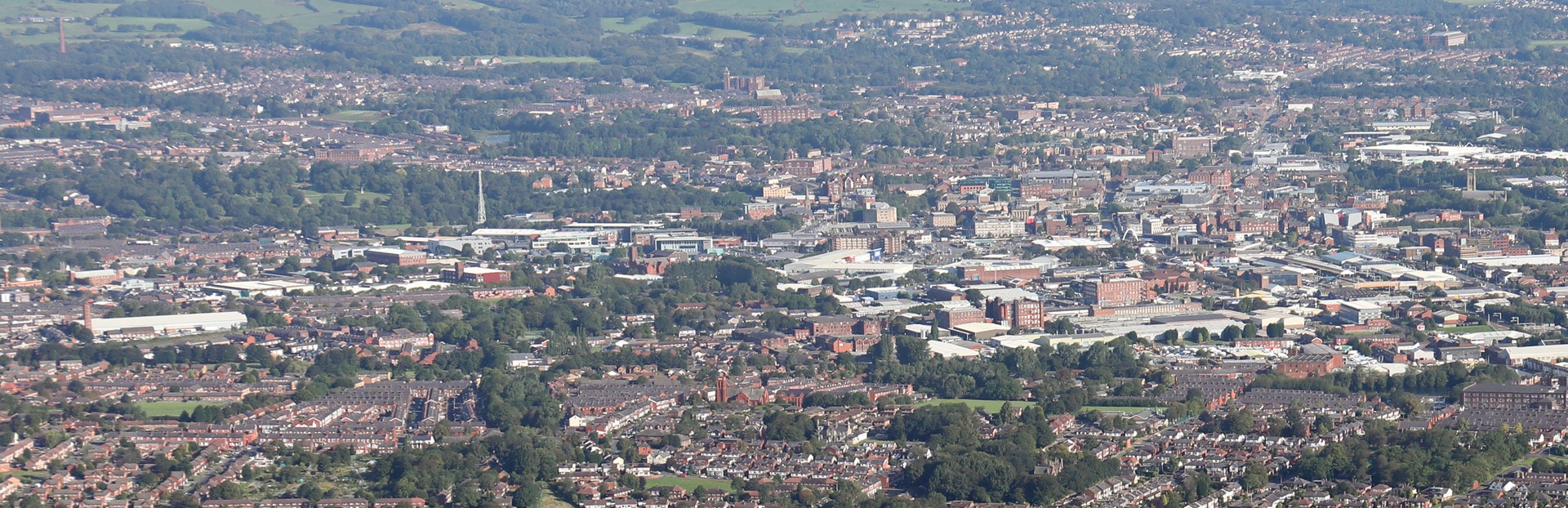
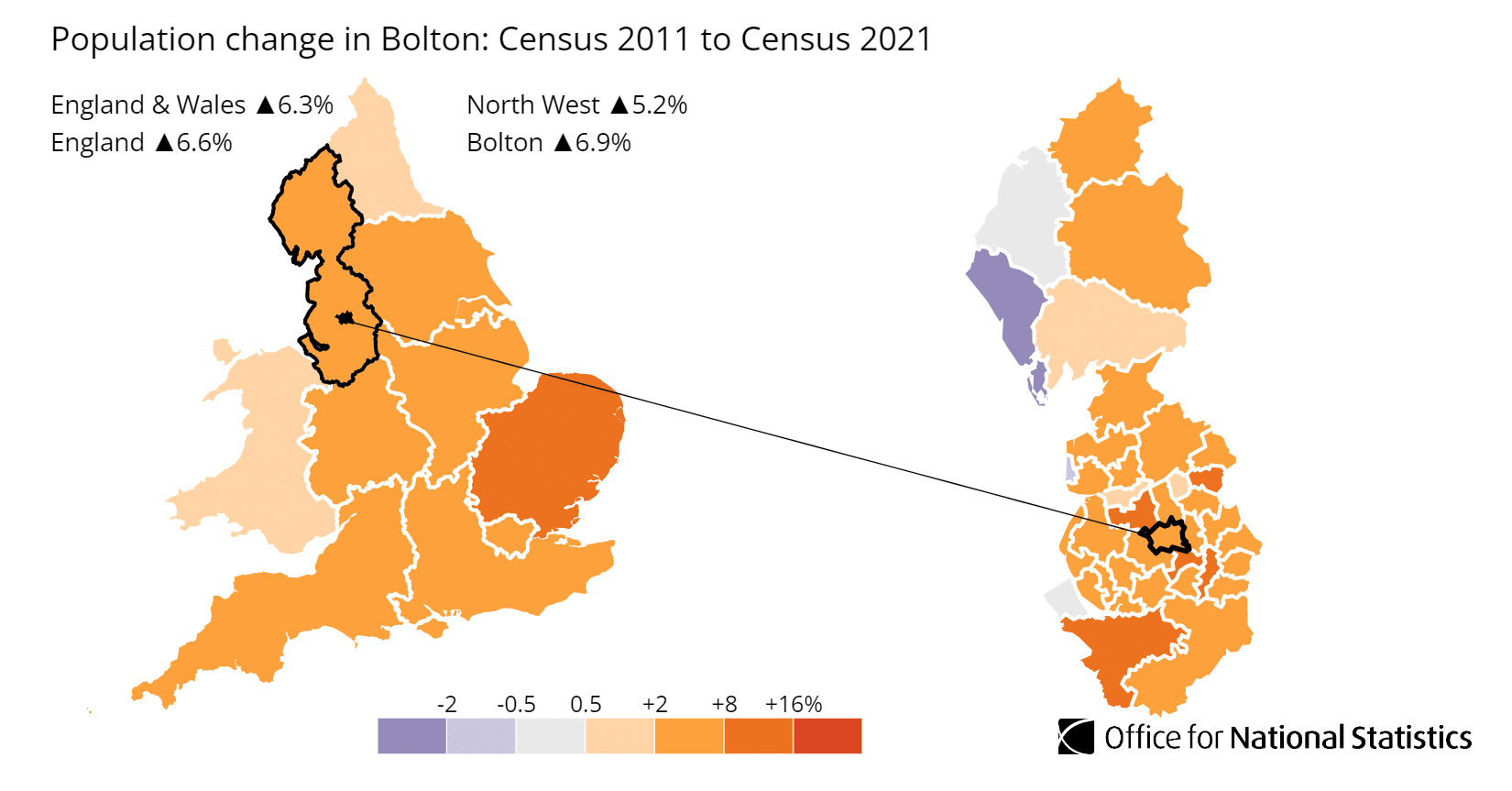
Bolton is a town in the metropolitan county of Greater Manchester, in north-west England. The average sold price across Bolton is £198,292 on the HM Land Registry House Price Index, 31.6% below the England average of £289,946 and 7.6% below the North West regional average of £214,678. That makes Bolton one of the lowest entry points anywhere in Greater Manchester, with a ten-mile commute into the city centre attached. The borough's population grew 6.93% between the 2011 and 2021 censuses, from 276,786 to 295,963 residents.
Affordability is Bolton's defining feature. The cheapest postcode, WN2 around Hindley and Westhoughton, has an average asking price of £198,873, while the dearest, BL7 around Bromley Cross and Egerton, runs to £339,047. That £140,174 spread across twelve postcodes gives an investor room to choose between low-cost income stock at one end and higher-value commuter housing at the other, inside a single borough. The highest yields sit with the cheaper, smaller-unit postcodes rather than the premium ones.
This guide covers Bolton Metropolitan Borough Council (ONS code E08000001) across postcodes BL1 to BL8, plus M26, M38, M46 and WN2. Bolton sits in the north-west corner of Greater Manchester, ten miles from the city centre, linked by the M61 and direct rail. Investors weighing the wider conurbation often look at Manchester buy-to-let alongside it.
Article updated: July 2026

Why Invest in Bolton?
Bolton Metropolitan Borough Council grew its population 6.93% between the 2011 and 2021 censuses, from 276,786 to 295,963 residents. That growth runs slightly ahead of the England and Wales average of 6.3%, a town adding people steadily rather than in a rush. Bolton's draw is its low cost base: a former cotton-spinning town with a working town-centre economy, its own university, and faster links into Manchester than the price tags suggest.
The local employment rate is 67.1%, below the North West average of 74.2% and Great Britain's 75.6%, and the unemployment rate is 4.2%. Bolton's economy leans on wholesale and retail, health and social care, manufacturing, and logistics drawing on the M61 corridor. The University of Bolton adds a student population that feeds the town-centre rental market, and the borough's lower wage base shapes a tenant pool that sits closer to the benefits-supported end of the market than higher-earning Cheshire towns nearby.
Median gross annual earnings across Bolton are £34,186, which is 8.7% below the North West regional median of £37,445 and 12.6% below the Great Britain median of £39,125. Lower local wages cap how far open-market rents can stretch, which is part of why Bolton's yields hold up: prices are held down more than rents are. The combination of below-average earnings and a sub-£200,000 asking price is the core of the Bolton investment case.
Bolton Economic Summary
- Population (Bolton): 295,963 (2021 Census). Growth of 6.93% from 2011.
- Median annual salary: £34,186 (local), £37,445 (North West), £39,125 (Great Britain)
- Employment rate: 67.1% (local), 74.2% (North West), 75.6% (Great Britain)
- Unemployment rate: 4.2% (local)
- Key employment sectors: Wholesale and retail, health and social care, manufacturing, transport and logistics, education
Source: ONS Census 2021, Nomis Labour Market Profile (ASHE 2025)
Regeneration and Investment in Bolton
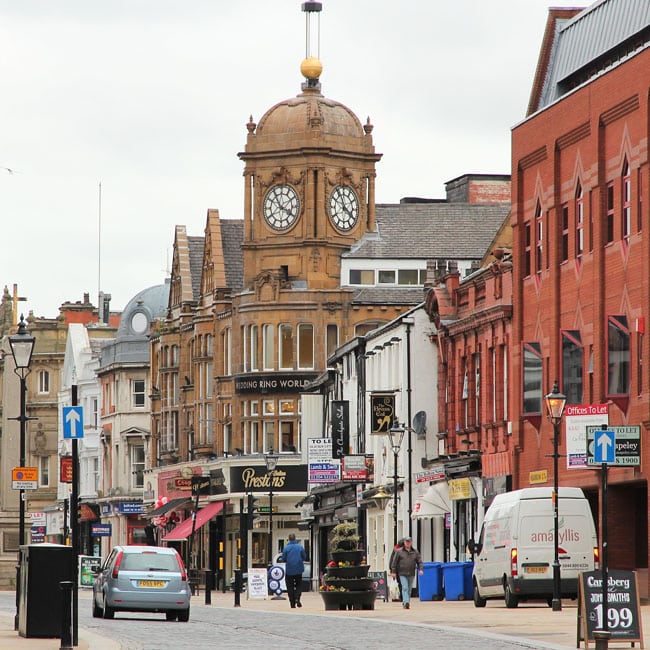
Bolton's town-centre regeneration is led by the £250 million Church Wharf scheme and the Crompton Place redevelopment, both reshaping the central core around the Octagon, the market and the transport interchange. The work concentrates investment in the BL1 town centre, where new homes are being added alongside leisure and commercial space rather than on the edge of the borough.
- Church Wharf (Under way, £250 million): A mixed-use riverside scheme on the edge of Bolton town centre delivering new homes, a hotel, offices and public realm across the River Croal. The development was given the green light to proceed and adds a significant residential component to the central core. Updates at Invest in Manchester.
- Crompton Place Redevelopment (Active): Bolton Council has appointed development partners to remodel the Crompton Place shopping centre into a town-centre destination mixing retail, leisure and homes, knitting the Octagon Theatre and the market into a single regenerated heart. Updates at Invest in Manchester.
- Greater Manchester transport investment (Active): Bolton sits on the Bee Network being brought under Greater Manchester Combined Authority control, with the bus interchange already integrated and rail electrification feeding faster services into Manchester city centre. Improved connectivity into the regional jobs market supports tenant demand across the BL postcodes.
Bolton Property Market Analysis
Average property prices in Bolton have risen 426.3% since January 1995, from £37,680 to £198,292. The sections below trace that path cycle by cycle, then drill into current postcode-level data for sold prices, price per square foot, asking prices, growth trends, and how the market is moving today.
When was the last house price crash in Bolton?
Bolton's sold prices are recorded by HM Land Registry at borough level for Bolton Metropolitan Borough Council. The Land Registry House Price Index runs from January 1995 to March 2026, covering 31 years of the local market.
The 1995 to 2007 climb: Bolton started at £37,680 in January 1995. By December 2000 the average had reached £45,095, a slow 19.7% gain across six years. The mid-2000s ran hotter on cheap credit and rising mortgage availability, and prices climbed to £107,797 by March 2006 before topping out at £130,642 in December 2007.
2008 to 2012, the financial crisis: Prices fell from the December 2007 peak of £130,642 to a trough of £98,914 in April 2012. That is a 24.2% decline spread over more than four years, deeper than Bolton's recovery would suggest at first glance. The worst year-on-year reading was -15.6% in February 2009. A lower-priced, higher-loan-to-value market like Bolton took a harder hit than the premium parts of the North West, where bigger equity cushions softened the fall.
The long stagnation, 2012 to 2017: Bolton bumped along the bottom for years. By March 2016 the average had only reached £113,205, still well short of the pre-crash peak. The town spent the best part of a decade unwinding the crash, a reminder that recovery time, not just the size of the fall, is what ties up an investor's money.
Recovery, 2018: Prices finally cleared the December 2007 peak of £130,642 in August 2018, when the average reached £130,850. That recovery took roughly ten and a half years from the peak, longer than higher-value markets needed and a direct consequence of the deeper trough.
2020 to 2022, the pandemic surge: The stamp duty holiday and a rush for more space lit up affordable commuter towns like Bolton. Prices moved from £134,875 in June 2020 to £146,018 by December 2020 (7.5% annual growth), then to £163,448 by December 2021 (11.9% annual) and £185,264 by December 2022 (13.3% annual). Bolton's affordability made it one of the bigger gainers of the period.
The 2023 rate shock: Higher mortgage rates cooled the run. Prices eased to £179,576 by June 2023 and £184,942 by December 2023, recording -0.2% annual growth. The dip was shallow, and momentum returned the following year.
2024 to present: Prices reached £191,429 by December 2024 (3.5% annual growth) and an all-time high of £200,686 in February 2026, before easing slightly to £198,292 by the latest March 2026 reading. The current price is 51.8% above the pre-crash peak of £130,642.
Long-term growth summary:
- 5 years (March 2021 to March 2026): 31.8% growth (£150,409 to £198,292)
- 10 years (March 2016 to March 2026): 75.2% growth (£113,205 to £198,292)
- 15 years (March 2011 to March 2026): 90.7% growth (£103,990 to £198,292)
- 20 years (March 2006 to March 2026): 83.9% growth (£107,797 to £198,292)
- 30 years (January 1995 to March 2026): 426.3% growth (£37,680 to £198,292)
Bolton's 24.2% crash was deeper than England's national fall, and the ten-and-a-half-year wait to clear the old peak was one of the longer recoveries in the North West. The flip side is the 30-year return of 426.3%, among the strongest in the region, and a price level still well within reach of an average investor. A buyer who bought at the exact peak in December 2007 would now be sitting 51.8% ahead on the Land Registry average.
- All property types
- Detached
- Semi-detached
- Terraced
- Flats
Source: HM Land Registry House Price Index
| Year | All property types | Detached | Semi-detached | Terraced | Flats |
|---|---|---|---|---|---|
| 1995-01 | £37,680 | £73,061 | £39,918 | £29,950 | £27,946 |
| 1995-02 | £38,205 | £73,678 | £40,746 | £30,298 | £28,302 |
| 1995-03 | £38,067 | £73,216 | £40,558 | £30,243 | £28,126 |
| 1995-04 | £38,645 | £74,106 | £41,225 | £30,712 | £28,543 |
| 1995-05 | £38,600 | £73,773 | £41,107 | £30,749 | £28,485 |
| 1995-06 | £38,062 | £72,821 | £40,637 | £30,252 | £28,205 |
| 1995-07 | £36,692 | £70,427 | £39,190 | £29,127 | £27,069 |
| 1995-08 | £35,963 | £69,618 | £38,404 | £28,472 | £26,386 |
| 1995-09 | £36,019 | £69,793 | £38,393 | £28,548 | £26,268 |
| 1995-10 | £36,356 | £70,566 | £38,870 | £28,734 | £26,641 |
| 1995-11 | £36,150 | £70,175 | £38,717 | £28,527 | £26,690 |
| 1995-12 | £36,226 | £70,375 | £38,909 | £28,522 | £26,804 |
| 1996-01 | £35,981 | £70,335 | £38,635 | £28,279 | £26,448 |
| 1996-02 | £35,753 | £70,006 | £38,440 | £28,069 | £26,130 |
| 1996-03 | £35,629 | £70,141 | £38,366 | £27,895 | £25,932 |
| 1996-04 | £36,340 | £71,182 | £39,058 | £28,538 | £26,506 |
| 1996-05 | £36,665 | £71,530 | £39,290 | £28,905 | £26,658 |
| 1996-06 | £37,197 | £72,418 | £39,755 | £29,387 | £27,189 |
| 1996-07 | £37,042 | £72,355 | £39,632 | £29,223 | £26,887 |
| 1996-08 | £37,860 | £74,537 | £40,519 | £29,783 | £27,321 |
| 1996-09 | £38,041 | £75,251 | £40,658 | £29,921 | £27,151 |
| 1996-10 | £38,026 | £75,320 | £40,667 | £29,888 | £27,080 |
| 1996-11 | £37,942 | £74,966 | £40,622 | £29,823 | £27,090 |
| 1996-12 | £38,006 | £74,806 | £40,783 | £29,878 | £27,082 |
| 1997-01 | £38,485 | £75,795 | £41,270 | £30,270 | £27,309 |
| 1997-02 | £38,381 | £75,834 | £41,191 | £30,143 | £27,155 |
| 1997-03 | £38,018 | £75,274 | £40,741 | £29,863 | £26,945 |
| 1997-04 | £37,817 | £74,567 | £40,543 | £29,744 | £26,847 |
| 1997-05 | £38,130 | £74,898 | £40,872 | £30,051 | £26,938 |
| 1997-06 | £38,401 | £75,488 | £41,164 | £30,269 | £26,911 |
| 1997-07 | £39,123 | £77,168 | £41,901 | £30,834 | £27,165 |
| 1997-08 | £39,328 | £77,937 | £42,089 | £30,957 | £27,229 |
| 1997-09 | £39,044 | £77,567 | £41,786 | £30,702 | £27,028 |
| 1997-10 | £38,977 | £77,564 | £41,781 | £30,588 | £27,053 |
| 1997-11 | £38,615 | £76,852 | £41,410 | £30,291 | £26,824 |
| 1997-12 | £39,020 | £77,601 | £41,967 | £30,556 | £27,079 |
| 1998-01 | £38,450 | £76,825 | £41,300 | £30,082 | £26,667 |
| 1998-02 | £38,630 | £77,286 | £41,573 | £30,156 | £26,980 |
| 1998-03 | £38,682 | £77,524 | £41,619 | £30,184 | £26,995 |
| 1998-04 | £39,446 | £78,624 | £42,523 | £30,812 | £27,494 |
| 1998-05 | £40,575 | £80,510 | £43,680 | £31,799 | £28,098 |
| 1998-06 | £40,809 | £80,935 | £43,906 | £31,997 | £28,349 |
| 1998-07 | £40,464 | £80,495 | £43,514 | £31,697 | £28,091 |
| 1998-08 | £39,511 | £79,141 | £42,451 | £30,884 | £27,333 |
| 1998-09 | £39,378 | £79,029 | £42,261 | £30,786 | £27,108 |
| 1998-10 | £39,693 | £79,859 | £42,614 | £30,984 | £27,437 |
| 1998-11 | £39,729 | £80,021 | £42,767 | £30,931 | £27,584 |
| 1998-12 | £39,813 | £80,061 | £42,970 | £30,947 | £27,861 |
| 1999-01 | £39,372 | £79,194 | £42,527 | £30,582 | £27,574 |
| 1999-02 | £39,232 | £78,930 | £42,386 | £30,467 | £27,444 |
| 1999-03 | £38,757 | £78,202 | £41,856 | £30,071 | £27,098 |
| 1999-04 | £39,709 | £79,698 | £42,851 | £30,905 | £27,727 |
| 1999-05 | £40,184 | £80,325 | £43,322 | £31,355 | £28,045 |
| 1999-06 | £41,169 | £82,226 | £44,328 | £32,170 | £28,657 |
| 1999-07 | £40,924 | £82,107 | £44,013 | £31,946 | £28,403 |
| 1999-08 | £41,810 | £84,187 | £44,881 | £32,635 | £28,936 |
| 1999-09 | £42,060 | £85,011 | £45,076 | £32,818 | £29,039 |
| 1999-10 | £42,471 | £85,998 | £45,635 | £33,035 | £29,509 |
| 1999-11 | £42,343 | £85,743 | £45,550 | £32,900 | £29,531 |
| 1999-12 | £42,562 | £85,922 | £45,861 | £33,064 | £29,871 |
| 2000-01 | £42,272 | £85,465 | £45,526 | £32,840 | £29,486 |
| 2000-02 | £41,839 | £84,808 | £45,099 | £32,439 | £29,205 |
| 2000-03 | £41,860 | £85,051 | £45,191 | £32,395 | £29,024 |
| 2000-04 | £42,660 | £86,387 | £46,034 | £33,058 | £29,775 |
| 2000-05 | £41,891 | £84,714 | £45,259 | £32,447 | £29,329 |
| 2000-06 | £42,335 | £85,483 | £45,786 | £32,773 | £29,843 |
| 2000-07 | £41,937 | £85,273 | £45,433 | £32,339 | £29,405 |
| 2000-08 | £42,868 | £87,740 | £46,521 | £32,913 | £30,158 |
| 2000-09 | £43,346 | £89,443 | £46,971 | £33,193 | £30,438 |
| 2000-10 | £43,836 | £90,608 | £47,600 | £33,482 | £30,948 |
| 2000-11 | £45,135 | £93,356 | £48,962 | £34,484 | £31,898 |
| 2000-12 | £45,095 | £92,987 | £49,030 | £34,423 | £32,185 |
| 2001-01 | £44,664 | £92,099 | £48,467 | £34,130 | £31,980 |
| 2001-02 | £44,626 | £91,970 | £48,405 | £34,114 | £31,961 |
| 2001-03 | £44,831 | £92,462 | £48,609 | £34,273 | £31,911 |
| 2001-04 | £46,224 | £95,071 | £50,040 | £35,410 | £32,916 |
| 2001-05 | £45,972 | £94,002 | £49,799 | £35,295 | £32,627 |
| 2001-06 | £46,824 | £95,547 | £50,698 | £35,959 | £33,486 |
| 2001-07 | £46,985 | £96,084 | £50,972 | £36,021 | £33,473 |
| 2001-08 | £47,989 | £98,718 | £51,950 | £36,744 | £34,308 |
| 2001-09 | £48,827 | £101,013 | £52,713 | £37,379 | £34,829 |
| 2001-10 | £49,092 | £101,496 | £52,992 | £37,557 | £35,320 |
| 2001-11 | £49,768 | £102,653 | £53,835 | £38,038 | £35,957 |
| 2001-12 | £49,195 | £101,008 | £53,382 | £37,532 | £36,007 |
| 2002-01 | £48,888 | £100,525 | £53,053 | £37,262 | £35,881 |
| 2002-02 | £49,245 | £101,360 | £53,313 | £37,545 | £36,420 |
| 2002-03 | £49,162 | £101,131 | £53,196 | £37,527 | £36,159 |
| 2002-04 | £50,475 | £103,274 | £54,572 | £38,598 | £37,393 |
| 2002-05 | £51,065 | £103,890 | £55,364 | £39,070 | £37,770 |
| 2002-06 | £52,910 | £107,554 | £57,296 | £40,507 | £39,300 |
| 2002-07 | £54,431 | £110,830 | £58,960 | £41,680 | £40,074 |
| 2002-08 | £55,792 | £113,747 | £60,415 | £42,721 | £40,983 |
| 2002-09 | £56,693 | £115,719 | £61,539 | £43,366 | £41,285 |
| 2002-10 | £56,607 | £115,346 | £61,595 | £43,248 | £41,323 |
| 2002-11 | £56,752 | £115,715 | £61,737 | £43,356 | £41,432 |
| 2002-12 | £57,468 | £116,703 | £62,584 | £43,903 | £42,253 |
| 2003-01 | £58,161 | £117,846 | £63,207 | £44,531 | £42,758 |
| 2003-02 | £59,494 | £119,933 | £64,771 | £45,568 | £43,907 |
| 2003-03 | £59,534 | £120,077 | £64,724 | £45,638 | £43,889 |
| 2003-04 | £61,317 | £123,247 | £66,859 | £46,956 | £45,366 |
| 2003-05 | £62,826 | £126,125 | £68,555 | £48,133 | £46,302 |
| 2003-06 | £66,205 | £132,145 | £72,235 | £50,805 | £49,078 |
| 2003-07 | £68,299 | £135,910 | £74,511 | £52,503 | £50,416 |
| 2003-08 | £69,204 | £137,180 | £75,446 | £53,306 | £51,051 |
| 2003-09 | £69,196 | £136,946 | £75,463 | £53,394 | £50,456 |
| 2003-10 | £70,806 | £139,643 | £77,136 | £54,751 | £51,619 |
| 2003-11 | £72,737 | £143,036 | £79,223 | £56,325 | £52,950 |
| 2003-12 | £74,397 | £144,869 | £80,925 | £57,839 | £54,501 |
| 2004-01 | £74,982 | £145,737 | £81,392 | £58,414 | £54,940 |
| 2004-02 | £76,797 | £148,575 | £83,154 | £59,999 | £56,416 |
| 2004-03 | £75,811 | £146,858 | £81,917 | £59,276 | £55,543 |
| 2004-04 | £78,161 | £149,485 | £84,375 | £61,414 | £57,151 |
| 2004-05 | £79,517 | £150,008 | £85,600 | £62,862 | £58,128 |
| 2004-06 | £85,253 | £159,455 | £91,740 | £67,575 | £62,513 |
| 2004-07 | £87,803 | £163,638 | £94,510 | £69,683 | £64,216 |
| 2004-08 | £92,358 | £172,538 | £99,433 | £73,259 | £67,318 |
| 2004-09 | £95,598 | £178,721 | £102,764 | £75,923 | £69,272 |
| 2004-10 | £97,434 | £182,369 | £104,539 | £77,400 | £70,972 |
| 2004-11 | £98,302 | £183,626 | £105,320 | £78,185 | £71,785 |
| 2004-12 | £99,309 | £184,652 | £106,236 | £79,133 | £72,900 |
| 2005-01 | £101,367 | £188,586 | £108,209 | £80,864 | £74,373 |
| 2005-02 | £101,803 | £189,458 | £108,787 | £81,153 | £74,725 |
| 2005-03 | £101,423 | £188,981 | £108,501 | £80,819 | £74,063 |
| 2005-04 | £102,021 | £188,890 | £109,304 | £81,435 | £74,281 |
| 2005-05 | £102,615 | £189,440 | £109,697 | £82,108 | £74,554 |
| 2005-06 | £104,298 | £190,920 | £111,238 | £83,774 | £75,776 |
| 2005-07 | £105,462 | £192,884 | £112,410 | £84,800 | £76,420 |
| 2005-08 | £106,657 | £194,858 | £113,499 | £85,900 | £77,106 |
| 2005-09 | £108,888 | £199,505 | £115,711 | £87,747 | £78,423 |
| 2005-10 | £108,722 | £198,929 | £115,180 | £87,761 | £78,449 |
| 2005-11 | £110,183 | £201,091 | £116,735 | £89,015 | £79,459 |
| 2005-12 | £109,470 | £198,711 | £115,798 | £88,530 | £79,567 |
| 2006-01 | £110,527 | £200,599 | £116,804 | £89,451 | £80,258 |
| 2006-02 | £108,674 | £196,378 | £114,588 | £88,085 | £79,355 |
| 2006-03 | £107,797 | £195,271 | £113,789 | £87,355 | £78,238 |
| 2006-04 | £108,203 | £194,827 | £114,243 | £87,845 | £78,469 |
| 2006-05 | £111,163 | £200,092 | £117,491 | £90,271 | £80,277 |
| 2006-06 | £113,672 | £203,728 | £120,078 | £92,459 | £82,081 |
| 2006-07 | £115,585 | £207,311 | £121,901 | £94,176 | £83,036 |
| 2006-08 | £117,089 | £210,377 | £123,408 | £95,515 | £83,513 |
| 2006-09 | £120,062 | £216,577 | £126,536 | £97,935 | £85,104 |
| 2006-10 | £120,743 | £218,214 | £127,326 | £98,347 | £85,848 |
| 2006-11 | £120,183 | £217,022 | £126,740 | £97,908 | £85,471 |
| 2006-12 | £120,067 | £215,510 | £126,428 | £98,007 | £85,735 |
| 2007-01 | £121,158 | £217,239 | £127,470 | £99,027 | £86,292 |
| 2007-02 | £122,927 | £220,343 | £129,230 | £100,419 | £87,956 |
| 2007-03 | £122,952 | £221,098 | £129,254 | £100,432 | £87,572 |
| 2007-04 | £122,229 | £219,010 | £128,422 | £100,029 | £86,886 |
| 2007-05 | £122,812 | £218,947 | £128,851 | £100,769 | £87,198 |
| 2007-06 | £124,338 | £221,094 | £130,267 | £102,149 | £88,417 |
| 2007-07 | £126,646 | £225,901 | £132,555 | £104,020 | £90,043 |
| 2007-08 | £127,378 | £228,344 | £133,384 | £104,662 | £89,756 |
| 2007-09 | £127,409 | £229,223 | £133,402 | £104,638 | £89,582 |
| 2007-10 | £128,489 | £231,876 | £134,470 | £105,434 | £90,441 |
| 2007-11 | £128,791 | £232,654 | £134,786 | £105,524 | £91,108 |
| 2007-12 | £130,642 | £235,557 | £136,741 | £107,009 | £92,715 |
| 2008-01 | £129,893 | £234,333 | £135,883 | £106,392 | £92,265 |
| 2008-02 | £127,827 | £230,992 | £133,633 | £104,668 | £90,887 |
| 2008-03 | £123,826 | £224,772 | £129,689 | £101,332 | £87,515 |
| 2008-04 | £122,100 | £222,123 | £127,983 | £99,947 | £85,941 |
| 2008-05 | £124,574 | £226,297 | £130,721 | £102,063 | £87,380 |
| 2008-06 | £126,947 | £230,316 | £133,116 | £104,059 | £89,126 |
| 2008-07 | £125,530 | £227,863 | £131,897 | £102,784 | £88,058 |
| 2008-08 | £124,160 | £226,012 | £130,429 | £101,635 | £86,989 |
| 2008-09 | £120,999 | £222,343 | £127,027 | £98,832 | £84,738 |
| 2008-10 | £117,963 | £217,280 | £123,851 | £96,234 | £82,729 |
| 2008-11 | £114,024 | £210,682 | £119,860 | £92,782 | £80,186 |
| 2008-12 | £111,631 | £205,106 | £117,516 | £90,978 | £78,309 |
| 2009-01 | £109,700 | £202,095 | £115,297 | £89,344 | £77,164 |
| 2009-02 | £107,950 | £198,864 | £113,392 | £87,890 | £76,169 |
| 2009-03 | £104,804 | £193,620 | £110,008 | £85,083 | £74,626 |
| 2009-04 | £106,722 | £196,106 | £112,273 | £86,695 | £75,933 |
| 2009-05 | £105,771 | £193,897 | £111,369 | £86,087 | £74,769 |
| 2009-06 | £108,562 | £198,803 | £114,405 | £88,544 | £76,014 |
| 2009-07 | £108,391 | £198,847 | £114,220 | £88,562 | £75,136 |
| 2009-08 | £109,766 | £202,178 | £115,694 | £89,690 | £75,532 |
| 2009-09 | £109,637 | £202,455 | £115,619 | £89,543 | £75,163 |
| 2009-10 | £108,976 | £201,609 | £115,072 | £88,935 | £74,428 |
| 2009-11 | £108,141 | £200,011 | £114,076 | £88,374 | £73,703 |
| 2009-12 | £108,128 | £198,585 | £114,095 | £88,702 | £73,313 |
| 2010-01 | £109,645 | £202,558 | £115,865 | £89,868 | £73,599 |
| 2010-02 | £110,645 | £204,914 | £117,307 | £90,501 | £73,985 |
| 2010-03 | £109,175 | £204,586 | £115,890 | £88,834 | £73,067 |
| 2010-04 | £105,249 | £196,428 | £111,740 | £85,688 | £70,798 |
| 2010-05 | £104,387 | £194,623 | £110,707 | £85,079 | £70,232 |
| 2010-06 | £106,106 | £197,019 | £112,518 | £86,709 | £71,001 |
| 2010-07 | £109,072 | £203,351 | £115,640 | £89,111 | £72,507 |
| 2010-08 | £110,647 | £207,236 | £117,602 | £90,171 | £73,150 |
| 2010-09 | £110,733 | £208,725 | £117,684 | £90,061 | £73,028 |
| 2010-10 | £111,291 | £210,083 | £118,344 | £90,358 | £73,711 |
| 2010-11 | £108,735 | £205,556 | £115,478 | £88,245 | £72,315 |
| 2010-12 | £107,187 | £202,387 | £113,987 | £86,882 | £71,581 |
| 2011-01 | £105,611 | £200,207 | £112,217 | £85,479 | £70,730 |
| 2011-02 | £105,506 | £200,633 | £111,879 | £85,362 | £70,849 |
| 2011-03 | £103,990 | £198,833 | £110,137 | £84,021 | £69,836 |
| 2011-04 | £104,086 | £198,475 | £110,162 | £84,224 | £69,923 |
| 2011-05 | £105,023 | £199,204 | £111,342 | £84,982 | £70,809 |
| 2011-06 | £105,621 | £198,975 | £112,196 | £85,565 | £71,221 |
| 2011-07 | £103,941 | £195,576 | £110,484 | £84,151 | £70,269 |
| 2011-08 | £102,791 | £193,999 | £109,445 | £83,258 | £68,641 |
| 2011-09 | £103,696 | £196,656 | £110,287 | £84,025 | £68,803 |
| 2011-10 | £104,969 | £199,694 | £111,847 | £84,951 | £69,255 |
| 2011-11 | £104,940 | £199,860 | £111,817 | £84,722 | £69,841 |
| 2011-12 | £104,415 | £197,893 | £111,429 | £84,268 | £69,830 |
| 2012-01 | £104,270 | £196,874 | £111,362 | £84,264 | £69,592 |
| 2012-02 | £102,126 | £192,174 | £108,977 | £82,826 | £67,696 |
| 2012-03 | £101,227 | £189,578 | £107,921 | £82,343 | £67,074 |
| 2012-04 | £98,914 | £185,315 | £105,403 | £80,395 | £65,891 |
| 2012-05 | £101,417 | £189,838 | £108,102 | £82,389 | £67,768 |
| 2012-06 | £102,597 | £192,285 | £109,366 | £83,381 | £68,232 |
| 2012-07 | £103,598 | £193,676 | £110,299 | £84,462 | £68,464 |
| 2012-08 | £103,926 | £193,937 | £110,629 | £84,945 | £68,095 |
| 2012-09 | £103,349 | £193,803 | £109,968 | £84,351 | £67,646 |
| 2012-10 | £103,878 | £194,870 | £110,673 | £84,624 | £68,251 |
| 2012-11 | £103,869 | £195,254 | £110,631 | £84,464 | £68,661 |
| 2012-12 | £105,507 | £198,093 | £112,457 | £85,779 | £69,789 |
| 2013-01 | £104,978 | £197,490 | £112,125 | £85,236 | £69,075 |
| 2013-02 | £104,209 | £196,091 | £111,343 | £84,544 | £68,625 |
| 2013-03 | £102,388 | £193,061 | £109,284 | £82,857 | £67,984 |
| 2013-04 | £103,695 | £195,234 | £110,414 | £83,963 | £69,324 |
| 2013-05 | £104,415 | £196,352 | £111,218 | £84,535 | £69,905 |
| 2013-06 | £104,213 | £195,246 | £111,194 | £84,624 | £69,163 |
| 2013-07 | £104,616 | £195,925 | £111,603 | £85,114 | £69,063 |
| 2013-08 | £105,081 | £196,770 | £112,177 | £85,573 | £69,031 |
| 2013-09 | £105,407 | £198,300 | £112,444 | £85,649 | £69,381 |
| 2013-10 | £105,906 | £199,879 | £113,048 | £85,797 | £69,937 |
| 2013-11 | £105,930 | £200,291 | £113,141 | £85,652 | £70,083 |
| 2013-12 | £106,609 | £200,574 | £114,047 | £86,173 | £70,873 |
| 2014-01 | £105,916 | £198,785 | £113,308 | £85,763 | £70,269 |
| 2014-02 | £106,057 | £198,852 | £113,411 | £85,970 | £70,290 |
| 2014-03 | £105,592 | £198,054 | £113,015 | £85,652 | £69,603 |
| 2014-04 | £105,698 | £197,690 | £113,123 | £85,867 | £69,624 |
| 2014-05 | £106,374 | £198,348 | £113,886 | £86,504 | £70,104 |
| 2014-06 | £108,169 | £201,468 | £115,750 | £88,088 | £71,135 |
| 2014-07 | £108,081 | £201,225 | £115,656 | £88,092 | £70,863 |
| 2014-08 | £108,830 | £202,870 | £116,454 | £88,752 | £71,014 |
| 2014-09 | £108,347 | £202,195 | £115,845 | £88,389 | £70,632 |
| 2014-10 | £109,422 | £204,449 | £117,064 | £89,133 | £71,475 |
| 2014-11 | £109,806 | £205,592 | £117,600 | £89,250 | £71,846 |
| 2014-12 | £109,020 | £204,439 | £116,852 | £88,442 | £71,509 |
| 2015-01 | £108,676 | £203,851 | £116,556 | £88,090 | £71,346 |
| 2015-02 | £108,931 | £204,106 | £116,637 | £88,373 | £71,841 |
| 2015-03 | £110,431 | £207,438 | £118,421 | £89,379 | £72,868 |
| 2015-04 | £111,066 | £208,943 | £119,082 | £89,868 | £73,177 |
| 2015-05 | £110,930 | £208,606 | £119,144 | £89,678 | £72,961 |
| 2015-06 | £111,284 | £208,620 | £119,480 | £90,218 | £72,737 |
| 2015-07 | £112,483 | £210,491 | £120,888 | £91,199 | £73,492 |
| 2015-08 | £113,112 | £211,922 | £121,529 | £91,744 | £73,614 |
| 2015-09 | £113,358 | £213,454 | £121,666 | £91,782 | £73,899 |
| 2015-10 | £113,779 | £214,937 | £122,130 | £92,023 | £73,968 |
| 2015-11 | £114,076 | £215,829 | £122,556 | £92,146 | £74,119 |
| 2015-12 | £113,332 | £214,043 | £121,833 | £91,602 | £73,510 |
| 2016-01 | £113,493 | £213,987 | £122,140 | £91,709 | £73,678 |
| 2016-02 | £112,902 | £212,798 | £121,465 | £91,293 | £73,197 |
| 2016-03 | £113,205 | £213,794 | £121,821 | £91,397 | £73,574 |
| 2016-04 | £113,985 | £214,776 | £122,517 | £92,213 | £74,056 |
| 2016-05 | £115,358 | £216,250 | £123,882 | £93,501 | £75,438 |
| 2016-06 | £118,301 | £220,846 | £126,984 | £96,110 | £77,319 |
| 2016-07 | £117,937 | £220,303 | £126,493 | £95,839 | £77,110 |
| 2016-08 | £117,904 | £221,037 | £126,489 | £95,682 | £76,881 |
| 2016-09 | £116,087 | £217,987 | £124,647 | £94,062 | £75,752 |
| 2016-10 | £116,767 | £220,124 | £125,549 | £94,276 | £76,507 |
| 2016-11 | £117,182 | £222,000 | £126,158 | £94,282 | £76,872 |
| 2016-12 | £118,991 | £225,812 | £128,063 | £95,640 | £78,282 |
| 2017-01 | £120,055 | £228,160 | £129,209 | £96,429 | £78,986 |
| 2017-02 | £120,107 | £227,633 | £129,073 | £96,595 | £79,563 |
| 2017-03 | £119,967 | £227,426 | £129,004 | £96,381 | £79,684 |
| 2017-04 | £120,195 | £227,440 | £129,123 | £96,653 | £80,156 |
| 2017-05 | £121,479 | £229,240 | £130,760 | £97,643 | £81,098 |
| 2017-06 | £122,273 | £229,810 | £131,620 | £98,423 | £81,821 |
| 2017-07 | £121,956 | £228,622 | £131,370 | £98,216 | £81,685 |
| 2017-08 | £123,667 | £231,926 | £133,002 | £99,741 | £82,623 |
| 2017-09 | £125,436 | £236,072 | £134,824 | £101,106 | £83,527 |
| 2017-10 | £127,429 | £240,348 | £137,097 | £102,607 | £84,493 |
| 2017-11 | £126,413 | £238,797 | £136,233 | £101,618 | £83,649 |
| 2017-12 | £125,929 | £237,257 | £135,916 | £101,254 | £83,228 |
| 2018-01 | £125,846 | £237,311 | £135,996 | £101,043 | £83,207 |
| 2018-02 | £125,200 | £236,293 | £135,286 | £100,571 | £82,456 |
| 2018-03 | £125,238 | £236,797 | £135,327 | £100,584 | £82,210 |
| 2018-04 | £124,513 | £234,817 | £134,421 | £100,302 | £81,287 |
| 2018-05 | £125,346 | £235,976 | £135,361 | £101,084 | £81,596 |
| 2018-06 | £128,505 | £241,730 | £138,886 | £103,590 | £83,700 |
| 2018-07 | £129,459 | £244,100 | £139,916 | £104,252 | £84,271 |
| 2018-08 | £130,850 | £247,145 | £141,449 | £105,287 | £85,085 |
| 2018-09 | £128,193 | £242,680 | £138,504 | £103,143 | £83,062 |
| 2018-10 | £128,019 | £242,532 | £138,381 | £102,925 | £82,955 |
| 2018-11 | £128,707 | £244,451 | £139,170 | £103,359 | £83,242 |
| 2018-12 | £130,164 | £246,644 | £140,846 | £104,552 | £84,334 |
| 2019-01 | £131,558 | £249,909 | £142,517 | £105,486 | £85,054 |
| 2019-02 | £131,087 | £248,832 | £142,041 | £105,095 | £84,881 |
| 2019-03 | £128,444 | £244,317 | £139,410 | £102,807 | £82,799 |
| 2019-04 | £128,500 | £243,434 | £139,452 | £103,101 | £82,662 |
| 2019-05 | £128,575 | £242,965 | £139,591 | £103,313 | £82,401 |
| 2019-06 | £132,518 | £249,929 | £143,781 | £106,612 | £85,042 |
| 2019-07 | £133,159 | £251,060 | £144,361 | £107,182 | £85,607 |
| 2019-08 | £133,614 | £251,938 | £144,783 | £107,632 | £85,693 |
| 2019-09 | £132,979 | £250,790 | £143,817 | £107,287 | £85,244 |
| 2019-10 | £133,659 | £252,094 | £144,916 | £107,649 | £85,503 |
| 2019-11 | £135,325 | £255,873 | £146,969 | £108,724 | £86,509 |
| 2019-12 | £135,802 | £256,832 | £147,680 | £109,040 | £86,516 |
| 2020-01 | £134,854 | £255,460 | £146,654 | £108,247 | £85,646 |
| 2020-02 | £134,385 | £254,372 | £146,074 | £107,974 | £85,288 |
| 2020-03 | £136,036 | £257,840 | £147,980 | £109,177 | £86,302 |
| 2020-04 | £136,334 | £258,826 | £148,182 | £109,556 | £85,828 |
| 2020-05 | £135,468 | £257,407 | £147,451 | £108,700 | £85,188 |
| 2020-06 | £134,875 | £256,072 | £146,904 | £108,257 | £84,560 |
| 2020-07 | £135,263 | £256,204 | £147,379 | £108,523 | £85,404 |
| 2020-08 | £137,958 | £261,652 | £150,388 | £110,673 | £86,634 |
| 2020-09 | £139,235 | £264,939 | £151,667 | £111,664 | £87,137 |
| 2020-10 | £143,140 | £273,220 | £155,787 | £114,830 | £89,049 |
| 2020-11 | £144,292 | £275,590 | £156,645 | £115,947 | £89,893 |
| 2020-12 | £146,018 | £278,637 | £158,295 | £117,552 | £90,862 |
| 2021-01 | £146,604 | £277,791 | £158,873 | £118,259 | £92,121 |
| 2021-02 | £148,453 | £278,946 | £160,696 | £120,140 | £94,166 |
| 2021-03 | £150,409 | £280,417 | £162,687 | £121,994 | £96,543 |
| 2021-04 | £152,759 | £284,676 | £164,901 | £124,128 | £98,038 |
| 2021-05 | £153,806 | £287,028 | £165,955 | £124,995 | £98,469 |
| 2021-06 | £157,733 | £293,274 | £169,728 | £128,715 | £100,887 |
| 2021-07 | £158,111 | £294,377 | £170,271 | £128,924 | £100,808 |
| 2021-08 | £161,281 | £300,898 | £173,808 | £131,432 | £102,245 |
| 2021-09 | £162,527 | £303,957 | £175,368 | £132,268 | £102,512 |
| 2021-10 | £164,325 | £309,388 | £177,331 | £133,393 | £103,268 |
| 2021-11 | £164,558 | £310,650 | £177,755 | £133,356 | £103,228 |
| 2021-12 | £163,448 | £310,125 | £176,633 | £132,206 | £101,995 |
| 2022-01 | £163,788 | £309,193 | £177,135 | £132,761 | £101,918 |
| 2022-02 | £165,886 | £312,315 | £179,305 | £134,617 | £103,534 |
| 2022-03 | £167,425 | £315,589 | £181,410 | £135,553 | £104,322 |
| 2022-04 | £170,391 | £320,892 | £184,444 | £138,152 | £106,102 |
| 2022-05 | £170,609 | £320,947 | £184,790 | £138,472 | £105,697 |
| 2022-06 | £171,906 | £322,501 | £186,049 | £139,794 | £106,602 |
| 2022-07 | £175,508 | £328,438 | £190,170 | £142,879 | £108,390 |
| 2022-08 | £179,953 | £336,320 | £194,870 | £146,786 | £110,678 |
| 2022-09 | £183,337 | £342,626 | £198,518 | £149,727 | £112,095 |
| 2022-10 | £185,225 | £346,933 | £200,453 | £151,167 | £113,223 |
| 2022-11 | £185,916 | £348,895 | £201,217 | £151,581 | £113,593 |
| 2022-12 | £185,264 | £347,401 | £200,564 | £151,006 | £113,480 |
| 2023-01 | £182,644 | £342,986 | £198,027 | £148,593 | £111,776 |
| 2023-02 | £180,741 | £340,475 | £196,144 | £146,680 | £110,696 |
| 2023-03 | £176,720 | £334,962 | £192,214 | £142,754 | £108,055 |
| 2023-04 | £177,371 | £336,965 | £192,996 | £143,082 | £108,536 |
| 2023-05 | £177,011 | £335,955 | £192,728 | £142,712 | £108,536 |
| 2023-06 | £179,576 | £339,590 | £195,177 | £145,239 | £109,939 |
| 2023-07 | £179,179 | £337,587 | £194,792 | £145,185 | £109,425 |
| 2023-08 | £181,818 | £342,022 | £197,496 | £147,692 | £110,418 |
| 2023-09 | £182,969 | £344,024 | £198,747 | £148,734 | £110,842 |
| 2023-10 | £183,223 | £343,919 | £198,772 | £149,108 | £111,273 |
| 2023-11 | £182,858 | £343,588 | £198,564 | £148,586 | £111,231 |
| 2023-12 | £184,942 | £346,841 | £200,918 | £150,223 | £112,904 |
| 2024-01 | £186,824 | £351,190 | £202,991 | £151,641 | £113,889 |
| 2024-02 | £184,851 | £346,125 | £200,718 | £150,356 | £112,718 |
| 2024-03 | £183,419 | £343,654 | £199,104 | £149,094 | £112,165 |
| 2024-04 | £183,352 | £342,087 | £198,913 | £149,219 | £112,630 |
| 2024-05 | £185,300 | £345,321 | £201,043 | £150,752 | £114,188 |
| 2024-06 | £188,225 | £349,625 | £203,998 | £153,550 | £115,788 |
| 2024-07 | £189,172 | £351,063 | £205,083 | £154,579 | £115,638 |
| 2024-08 | £190,855 | £354,076 | £206,778 | £156,270 | £116,014 |
| 2024-09 | £191,733 | £357,024 | £207,999 | £156,836 | £115,730 |
| 2024-10 | £192,620 | £359,589 | £208,712 | £157,486 | £116,468 |
| 2024-11 | £193,951 | £362,557 | £210,531 | £158,360 | £116,911 |
| 2024-12 | £191,429 | £358,106 | £207,789 | £156,343 | £115,121 |
| 2025-01 | £190,958 | £357,805 | £207,712 | £155,849 | £113,997 |
| 2025-02 | £191,880 | £359,827 | £208,532 | £156,689 | £114,598 |
| 2025-03 | £196,292 | £364,972 | £213,122 | £160,861 | £118,339 |
| 2025-04 | £196,069 | £366,636 | £213,216 | £160,107 | £117,719 |
| 2025-05 | £193,693 | £363,437 | £210,910 | £157,860 | £115,727 |
| 2025-06 | £192,824 | £364,308 | £210,480 | £156,652 | £113,755 |
| 2025-07 | £193,444 | £362,719 | £210,965 | £157,931 | £114,179 |
| 2025-08 | £195,279 | £364,925 | £213,096 | £159,798 | £114,778 |
| 2025-09 | £197,945 | £370,397 | £216,052 | £162,036 | £115,746 |
| 2025-10 | £200,306 | £374,910 | £218,906 | £163,883 | £116,730 |
| 2025-11 | £200,293 | £374,764 | £218,822 | £163,988 | £116,617 |
| 2025-12 | £200,021 | £372,692 | £218,610 | £164,101 | £116,413 |
| 2026-01 | £199,305 | £370,009 | £217,841 | £163,976 | £115,594 |
| 2026-02 | £200,686 | £372,756 | £219,422 | £165,090 | £116,013 |
| 2026-03 | £198,292 | £369,228 | £216,976 | £163,024 | £113,783 |
- All property types
- Detached
- Semi-detached
- Terraced
- Flats
Source: HM Land Registry House Price Index
| Year | All property types | Detached | Semi-detached | Terraced | Flats |
|---|---|---|---|---|---|
| 1996-01 | -4.5% | -3.7% | -3.2% | -5.6% | -5.4% |
| 1996-02 | -6.4% | -5.0% | -5.7% | -7.4% | -7.7% |
| 1996-03 | -6.4% | -4.2% | -5.4% | -7.8% | -7.8% |
| 1996-04 | -6.0% | -3.9% | -5.3% | -7.1% | -7.1% |
| 1996-05 | -5.0% | -3.0% | -4.4% | -6.0% | -6.4% |
| 1996-06 | -2.3% | -0.6% | -2.2% | -2.9% | -3.6% |
| 1996-07 | +1.0% | +2.7% | +1.1% | +0.3% | -0.7% |
| 1996-08 | +5.3% | +7.1% | +5.5% | +4.6% | +3.5% |
| 1996-09 | +5.6% | +7.8% | +5.9% | +4.8% | +3.4% |
| 1996-10 | +4.6% | +6.7% | +4.6% | +4.0% | +1.6% |
| 1996-11 | +5.0% | +6.8% | +4.9% | +4.5% | +1.5% |
| 1996-12 | +4.9% | +6.3% | +4.8% | +4.8% | +1.0% |
| 1997-01 | +7.0% | +7.8% | +6.8% | +7.0% | +3.3% |
| 1997-02 | +7.4% | +8.3% | +7.2% | +7.4% | +3.9% |
| 1997-03 | +6.7% | +7.3% | +6.2% | +7.1% | +3.9% |
| 1997-04 | +4.1% | +4.8% | +3.8% | +4.2% | +1.3% |
| 1997-05 | +4.0% | +4.7% | +4.0% | +4.0% | +1.0% |
| 1997-06 | +3.2% | +4.2% | +3.5% | +3.0% | -1.0% |
| 1997-07 | +5.6% | +6.7% | +5.7% | +5.5% | +1.0% |
| 1997-08 | +3.9% | +4.6% | +3.9% | +3.9% | -0.3% |
| 1997-09 | +2.6% | +3.1% | +2.8% | +2.6% | -0.5% |
| 1997-10 | +2.5% | +3.0% | +2.7% | +2.3% | -0.1% |
| 1997-11 | +1.8% | +2.5% | +1.9% | +1.6% | -1.0% |
| 1997-12 | +2.7% | +3.7% | +2.9% | +2.3% | 0.0% |
| 1998-01 | -0.1% | +1.4% | +0.1% | -0.6% | -2.3% |
| 1998-02 | +0.6% | +1.9% | +0.9% | 0.0% | -0.6% |
| 1998-03 | +1.7% | +3.0% | +2.2% | +1.1% | +0.2% |
| 1998-04 | +4.3% | +5.4% | +4.9% | +3.6% | +2.4% |
| 1998-05 | +6.4% | +7.5% | +6.9% | +5.8% | +4.3% |
| 1998-06 | +6.3% | +7.2% | +6.7% | +5.7% | +5.3% |
| 1998-07 | +3.4% | +4.3% | +3.9% | +2.8% | +3.4% |
| 1998-08 | +0.5% | +1.5% | +0.9% | -0.2% | +0.4% |
| 1998-09 | +0.9% | +1.9% | +1.1% | +0.3% | +0.3% |
| 1998-10 | +1.8% | +3.0% | +2.0% | +1.3% | +1.4% |
| 1998-11 | +2.9% | +4.1% | +3.3% | +2.1% | +2.8% |
| 1998-12 | +2.0% | +3.2% | +2.4% | +1.3% | +2.9% |
| 1999-01 | +2.4% | +3.1% | +3.0% | +1.7% | +3.4% |
| 1999-02 | +1.6% | +2.1% | +2.0% | +1.0% | +1.7% |
| 1999-03 | +0.2% | +0.9% | +0.6% | -0.4% | +0.4% |
| 1999-04 | +0.7% | +1.4% | +0.8% | +0.3% | +0.8% |
| 1999-05 | -1.0% | -0.2% | -0.8% | -1.4% | -0.2% |
| 1999-06 | +0.9% | +1.6% | +1.0% | +0.5% | +1.1% |
| 1999-07 | +1.1% | +2.0% | +1.1% | +0.8% | +1.1% |
| 1999-08 | +5.8% | +6.4% | +5.7% | +5.7% | +5.9% |
| 1999-09 | +6.8% | +7.6% | +6.7% | +6.6% | +7.1% |
| 1999-10 | +7.0% | +7.7% | +7.1% | +6.6% | +7.6% |
| 1999-11 | +6.6% | +7.2% | +6.5% | +6.4% | +7.1% |
| 1999-12 | +6.9% | +7.3% | +6.7% | +6.8% | +7.2% |
| 2000-01 | +7.4% | +7.9% | +7.1% | +7.4% | +6.9% |
| 2000-02 | +6.6% | +7.4% | +6.4% | +6.5% | +6.4% |
| 2000-03 | +8.0% | +8.8% | +8.0% | +7.7% | +7.1% |
| 2000-04 | +7.4% | +8.4% | +7.4% | +7.0% | +7.4% |
| 2000-05 | +4.2% | +5.5% | +4.5% | +3.5% | +4.6% |
| 2000-06 | +2.8% | +4.0% | +3.3% | +1.9% | +4.1% |
| 2000-07 | +2.5% | +3.9% | +3.2% | +1.2% | +3.5% |
| 2000-08 | +2.5% | +4.2% | +3.7% | +0.9% | +4.2% |
| 2000-09 | +3.1% | +5.2% | +4.2% | +1.1% | +4.8% |
| 2000-10 | +3.2% | +5.4% | +4.3% | +1.4% | +4.9% |
| 2000-11 | +6.6% | +8.9% | +7.5% | +4.8% | +8.0% |
| 2000-12 | +6.0% | +8.2% | +6.9% | +4.1% | +7.7% |
| 2001-01 | +5.7% | +7.8% | +6.5% | +3.9% | +8.5% |
| 2001-02 | +6.7% | +8.4% | +7.3% | +5.2% | +9.4% |
| 2001-03 | +7.1% | +8.7% | +7.6% | +5.8% | +9.9% |
| 2001-04 | +8.4% | +10.1% | +8.7% | +7.1% | +10.5% |
| 2001-05 | +9.7% | +11.0% | +10.0% | +8.8% | +11.2% |
| 2001-06 | +10.6% | +11.8% | +10.7% | +9.7% | +12.2% |
| 2001-07 | +12.0% | +12.7% | +12.2% | +11.4% | +13.8% |
| 2001-08 | +11.9% | +12.5% | +11.7% | +11.6% | +13.8% |
| 2001-09 | +12.6% | +12.9% | +12.2% | +12.6% | +14.4% |
| 2001-10 | +12.0% | +12.0% | +11.3% | +12.2% | +14.1% |
| 2001-11 | +10.3% | +10.0% | +10.0% | +10.3% | +12.7% |
| 2001-12 | +9.1% | +8.6% | +8.9% | +9.0% | +11.9% |
| 2002-01 | +9.5% | +9.1% | +9.5% | +9.2% | +12.2% |
| 2002-02 | +10.4% | +10.2% | +10.1% | +10.1% | +13.9% |
| 2002-03 | +9.7% | +9.4% | +9.4% | +9.5% | +13.3% |
| 2002-04 | +9.2% | +8.6% | +9.1% | +9.0% | +13.6% |
| 2002-05 | +11.1% | +10.5% | +11.2% | +10.7% | +15.8% |
| 2002-06 | +13.0% | +12.6% | +13.0% | +12.6% | +17.4% |
| 2002-07 | +15.8% | +15.3% | +15.7% | +15.7% | +19.7% |
| 2002-08 | +16.3% | +15.2% | +16.3% | +16.3% | +19.5% |
| 2002-09 | +16.1% | +14.6% | +16.7% | +16.0% | +18.5% |
| 2002-10 | +15.3% | +13.6% | +16.2% | +15.2% | +17.0% |
| 2002-11 | +14.0% | +12.7% | +14.7% | +14.0% | +15.2% |
| 2002-12 | +16.8% | +15.5% | +17.2% | +17.0% | +17.3% |
| 2003-01 | +19.0% | +17.2% | +19.1% | +19.5% | +19.2% |
| 2003-02 | +20.8% | +18.3% | +21.5% | +21.4% | +20.6% |
| 2003-03 | +21.1% | +18.7% | +21.7% | +21.6% | +21.4% |
| 2003-04 | +21.5% | +19.3% | +22.5% | +21.7% | +21.3% |
| 2003-05 | +23.0% | +21.4% | +23.8% | +23.2% | +22.6% |
| 2003-06 | +25.1% | +22.9% | +26.1% | +25.4% | +24.9% |
| 2003-07 | +25.5% | +22.6% | +26.4% | +26.0% | +25.8% |
| 2003-08 | +24.0% | +20.6% | +24.9% | +24.8% | +24.6% |
| 2003-09 | +22.1% | +18.3% | +22.6% | +23.1% | +22.2% |
| 2003-10 | +25.1% | +21.1% | +25.2% | +26.6% | +24.9% |
| 2003-11 | +28.2% | +23.6% | +28.3% | +29.9% | +27.8% |
| 2003-12 | +29.5% | +24.1% | +29.3% | +31.7% | +29.0% |
| 2004-01 | +28.9% | +23.7% | +28.8% | +31.2% | +28.5% |
| 2004-02 | +29.1% | +23.9% | +28.4% | +31.7% | +28.5% |
| 2004-03 | +27.3% | +22.3% | +26.6% | +29.9% | +26.6% |
| 2004-04 | +27.5% | +21.3% | +26.2% | +30.8% | +26.0% |
| 2004-05 | +26.6% | +18.9% | +24.9% | +30.6% | +25.5% |
| 2004-06 | +28.8% | +20.7% | +27.0% | +33.0% | +27.4% |
| 2004-07 | +28.6% | +20.4% | +26.8% | +32.7% | +27.4% |
| 2004-08 | +33.5% | +25.8% | +31.8% | +37.4% | +31.9% |
| 2004-09 | +38.2% | +30.5% | +36.2% | +42.2% | +37.3% |
| 2004-10 | +37.6% | +30.6% | +35.5% | +41.4% | +37.5% |
| 2004-11 | +35.1% | +28.4% | +32.9% | +38.8% | +35.6% |
| 2004-12 | +33.5% | +27.5% | +31.3% | +36.8% | +33.8% |
| 2005-01 | +35.2% | +29.4% | +32.9% | +38.4% | +35.4% |
| 2005-02 | +32.6% | +27.5% | +30.8% | +35.3% | +32.5% |
| 2005-03 | +33.8% | +28.7% | +32.5% | +36.3% | +33.3% |
| 2005-04 | +30.5% | +26.4% | +29.5% | +32.6% | +30.0% |
| 2005-05 | +29.0% | +26.3% | +28.2% | +30.6% | +28.3% |
| 2005-06 | +22.3% | +19.7% | +21.3% | +24.0% | +21.2% |
| 2005-07 | +20.1% | +17.9% | +18.9% | +21.7% | +19.0% |
| 2005-08 | +15.5% | +12.9% | +14.1% | +17.3% | +14.5% |
| 2005-09 | +13.9% | +11.6% | +12.6% | +15.6% | +13.2% |
| 2005-10 | +11.6% | +9.1% | +10.2% | +13.4% | +10.5% |
| 2005-11 | +12.1% | +9.5% | +10.8% | +13.9% | +10.7% |
| 2005-12 | +10.2% | +7.6% | +9.0% | +11.9% | +9.1% |
| 2006-01 | +9.0% | +6.4% | +7.9% | +10.6% | +7.9% |
| 2006-02 | +6.7% | +3.7% | +5.3% | +8.5% | +6.2% |
| 2006-03 | +6.3% | +3.3% | +4.9% | +8.1% | +5.6% |
| 2006-04 | +6.1% | +3.1% | +4.5% | +7.9% | +5.6% |
| 2006-05 | +8.3% | +5.6% | +7.1% | +9.9% | +7.7% |
| 2006-06 | +9.0% | +6.7% | +7.9% | +10.4% | +8.3% |
| 2006-07 | +9.6% | +7.5% | +8.4% | +11.1% | +8.7% |
| 2006-08 | +9.8% | +8.0% | +8.7% | +11.2% | +8.3% |
| 2006-09 | +10.3% | +8.6% | +9.4% | +11.6% | +8.5% |
| 2006-10 | +11.1% | +9.7% | +10.5% | +12.1% | +9.4% |
| 2006-11 | +9.1% | +7.9% | +8.6% | +10.0% | +7.6% |
| 2006-12 | +9.7% | +8.5% | +9.2% | +10.7% | +7.8% |
| 2007-01 | +9.6% | +8.3% | +9.1% | +10.7% | +7.5% |
| 2007-02 | +13.1% | +12.2% | +12.8% | +14.0% | +10.8% |
| 2007-03 | +14.1% | +13.2% | +13.6% | +15.0% | +11.9% |
| 2007-04 | +13.0% | +12.4% | +12.4% | +13.9% | +10.7% |
| 2007-05 | +10.5% | +9.4% | +9.7% | +11.6% | +8.6% |
| 2007-06 | +9.4% | +8.5% | +8.5% | +10.5% | +7.7% |
| 2007-07 | +9.6% | +9.0% | +8.7% | +10.5% | +8.4% |
| 2007-08 | +8.8% | +8.5% | +8.1% | +9.6% | +7.5% |
| 2007-09 | +6.1% | +5.8% | +5.4% | +6.8% | +5.3% |
| 2007-10 | +6.4% | +6.3% | +5.6% | +7.2% | +5.4% |
| 2007-11 | +7.2% | +7.2% | +6.3% | +7.8% | +6.6% |
| 2007-12 | +8.8% | +9.3% | +8.2% | +9.2% | +8.1% |
| 2008-01 | +7.2% | +7.9% | +6.6% | +7.4% | +6.9% |
| 2008-02 | +4.0% | +4.8% | +3.4% | +4.2% | +3.3% |
| 2008-03 | +0.7% | +1.7% | +0.3% | +0.9% | -0.1% |
| 2008-04 | -0.1% | +1.4% | -0.3% | -0.1% | -1.1% |
| 2008-05 | +1.4% | +3.4% | +1.5% | +1.3% | +0.2% |
| 2008-06 | +2.1% | +4.2% | +2.2% | +1.9% | +0.8% |
| 2008-07 | -0.9% | +0.9% | -0.5% | -1.2% | -2.2% |
| 2008-08 | -2.5% | -1.0% | -2.2% | -2.9% | -3.1% |
| 2008-09 | -5.0% | -3.0% | -4.8% | -5.5% | -5.4% |
| 2008-10 | -8.2% | -6.3% | -7.9% | -8.7% | -8.5% |
| 2008-11 | -11.5% | -9.4% | -11.1% | -12.1% | -12.0% |
| 2008-12 | -14.6% | -12.9% | -14.1% | -15.0% | -15.5% |
| 2009-01 | -15.5% | -13.8% | -15.2% | -16.0% | -16.4% |
| 2009-02 | -15.6% | -13.9% | -15.1% | -16.0% | -16.2% |
| 2009-03 | -15.4% | -13.9% | -15.2% | -16.0% | -14.7% |
| 2009-04 | -12.6% | -11.7% | -12.3% | -13.3% | -11.6% |
| 2009-05 | -15.1% | -14.3% | -14.8% | -15.7% | -14.4% |
| 2009-06 | -14.5% | -13.7% | -14.1% | -14.9% | -14.7% |
| 2009-07 | -13.7% | -12.7% | -13.4% | -13.8% | -14.7% |
| 2009-08 | -11.6% | -10.5% | -11.3% | -11.8% | -13.2% |
| 2009-09 | -9.4% | -8.9% | -9.0% | -9.4% | -11.3% |
| 2009-10 | -7.6% | -7.2% | -7.1% | -7.6% | -10.0% |
| 2009-11 | -5.2% | -5.1% | -4.8% | -4.8% | -8.1% |
| 2009-12 | -3.1% | -3.2% | -2.9% | -2.5% | -6.4% |
| 2010-01 | -0.1% | +0.2% | +0.5% | +0.6% | -4.6% |
| 2010-02 | +2.5% | +3.0% | +3.5% | +3.0% | -2.9% |
| 2010-03 | +4.2% | +5.7% | +5.3% | +4.4% | -2.1% |
| 2010-04 | -1.4% | +0.2% | -0.5% | -1.2% | -6.8% |
| 2010-05 | -1.3% | +0.4% | -0.6% | -1.2% | -6.1% |
| 2010-06 | -2.3% | -0.9% | -1.6% | -2.1% | -6.6% |
| 2010-07 | +0.6% | +2.3% | +1.2% | +0.6% | -3.5% |
| 2010-08 | +0.8% | +2.5% | +1.6% | +0.5% | -3.2% |
| 2010-09 | +1.0% | +3.1% | +1.8% | +0.6% | -2.8% |
| 2010-10 | +2.1% | +4.2% | +2.8% | +1.6% | -1.0% |
| 2010-11 | +0.5% | +2.8% | +1.2% | -0.1% | -1.9% |
| 2010-12 | -0.9% | +1.9% | -0.1% | -2.1% | -2.4% |
| 2011-01 | -3.7% | -1.2% | -3.1% | -4.9% | -3.9% |
| 2011-02 | -4.6% | -2.1% | -4.6% | -5.7% | -4.2% |
| 2011-03 | -4.7% | -2.8% | -5.0% | -5.4% | -4.4% |
| 2011-04 | -1.1% | +1.0% | -1.4% | -1.7% | -1.2% |
| 2011-05 | +0.6% | +2.4% | +0.6% | -0.1% | +0.8% |
| 2011-06 | -0.5% | +1.0% | -0.3% | -1.3% | +0.3% |
| 2011-07 | -4.7% | -3.8% | -4.5% | -5.6% | -3.1% |
| 2011-08 | -7.1% | -6.4% | -6.9% | -7.7% | -6.2% |
| 2011-09 | -6.4% | -5.8% | -6.3% | -6.7% | -5.8% |
| 2011-10 | -5.7% | -4.9% | -5.5% | -6.0% | -6.0% |
| 2011-11 | -3.5% | -2.8% | -3.2% | -4.0% | -3.4% |
| 2011-12 | -2.6% | -2.2% | -2.2% | -3.0% | -2.4% |
| 2012-01 | -1.3% | -1.7% | -0.8% | -1.4% | -1.6% |
| 2012-02 | -3.2% | -4.2% | -2.6% | -3.0% | -4.4% |
| 2012-03 | -2.7% | -4.7% | -2.0% | -2.0% | -4.0% |
| 2012-04 | -5.0% | -6.6% | -4.3% | -4.5% | -5.8% |
| 2012-05 | -3.4% | -4.7% | -2.9% | -3.1% | -4.3% |
| 2012-06 | -2.9% | -3.4% | -2.5% | -2.6% | -4.2% |
| 2012-07 | -0.3% | -1.0% | -0.2% | +0.4% | -2.6% |
| 2012-08 | +1.1% | 0.0% | +1.1% | +2.0% | -0.8% |
| 2012-09 | -0.3% | -1.5% | -0.3% | +0.4% | -1.7% |
| 2012-10 | -1.0% | -2.4% | -1.1% | -0.4% | -1.4% |
| 2012-11 | -1.0% | -2.3% | -1.1% | -0.3% | -1.7% |
| 2012-12 | +1.0% | +0.1% | +0.9% | +1.8% | -0.1% |
| 2013-01 | +0.7% | +0.3% | +0.7% | +1.2% | -0.7% |
| 2013-02 | +2.0% | +2.0% | +2.2% | +2.1% | +1.4% |
| 2013-03 | +1.1% | +1.8% | +1.3% | +0.6% | +1.4% |
| 2013-04 | +4.8% | +5.4% | +4.8% | +4.4% | +5.2% |
| 2013-05 | +3.0% | +3.4% | +2.9% | +2.6% | +3.2% |
| 2013-06 | +1.6% | +1.5% | +1.7% | +1.5% | +1.4% |
| 2013-07 | +1.0% | +1.2% | +1.2% | +0.8% | +0.9% |
| 2013-08 | +1.1% | +1.5% | +1.4% | +0.7% | +1.4% |
| 2013-09 | +2.0% | +2.3% | +2.3% | +1.5% | +2.6% |
| 2013-10 | +2.0% | +2.6% | +2.1% | +1.4% | +2.5% |
| 2013-11 | +2.0% | +2.6% | +2.3% | +1.4% | +2.1% |
| 2013-12 | +1.0% | +1.3% | +1.4% | +0.5% | +1.6% |
| 2014-01 | +0.9% | +0.7% | +1.1% | +0.6% | +1.7% |
| 2014-02 | +1.8% | +1.4% | +1.9% | +1.7% | +2.4% |
| 2014-03 | +3.1% | +2.6% | +3.4% | +3.4% | +2.4% |
| 2014-04 | +1.9% | +1.3% | +2.5% | +2.3% | +0.4% |
| 2014-05 | +1.9% | +1.0% | +2.4% | +2.3% | +0.3% |
| 2014-06 | +3.8% | +3.2% | +4.1% | +4.1% | +2.9% |
| 2014-07 | +3.3% | +2.7% | +3.6% | +3.5% | +2.6% |
| 2014-08 | +3.6% | +3.1% | +3.8% | +3.7% | +2.9% |
| 2014-09 | +2.8% | +2.0% | +3.0% | +3.2% | +1.8% |
| 2014-10 | +3.3% | +2.3% | +3.6% | +3.9% | +2.2% |
| 2014-11 | +3.7% | +2.6% | +3.9% | +4.2% | +2.5% |
| 2014-12 | +2.3% | +1.9% | +2.5% | +2.6% | +0.9% |
| 2015-01 | +2.6% | +2.5% | +2.9% | +2.7% | +1.5% |
| 2015-02 | +2.7% | +2.6% | +2.8% | +2.8% | +2.2% |
| 2015-03 | +4.6% | +4.7% | +4.8% | +4.4% | +4.7% |
| 2015-04 | +5.1% | +5.7% | +5.3% | +4.7% | +5.1% |
| 2015-05 | +4.3% | +5.2% | +4.6% | +3.7% | +4.1% |
| 2015-06 | +2.9% | +3.5% | +3.2% | +2.4% | +2.3% |
| 2015-07 | +4.1% | +4.6% | +4.5% | +3.5% | +3.7% |
| 2015-08 | +3.9% | +4.5% | +4.4% | +3.4% | +3.7% |
| 2015-09 | +4.6% | +5.6% | +5.0% | +3.8% | +4.6% |
| 2015-10 | +4.0% | +5.1% | +4.3% | +3.2% | +3.5% |
| 2015-11 | +3.9% | +5.0% | +4.2% | +3.2% | +3.2% |
| 2015-12 | +4.0% | +4.7% | +4.3% | +3.6% | +2.8% |
| 2016-01 | +4.4% | +5.0% | +4.8% | +4.1% | +3.3% |
| 2016-02 | +3.6% | +4.3% | +4.1% | +3.3% | +1.9% |
| 2016-03 | +2.5% | +3.1% | +2.9% | +2.3% | +1.0% |
| 2016-04 | +2.6% | +2.8% | +2.9% | +2.6% | +1.2% |
| 2016-05 | +4.0% | +3.7% | +4.0% | +4.3% | +3.4% |
| 2016-06 | +6.3% | +5.9% | +6.3% | +6.5% | +6.3% |
| 2016-07 | +4.8% | +4.7% | +4.6% | +5.1% | +4.9% |
| 2016-08 | +4.2% | +4.3% | +4.1% | +4.3% | +4.4% |
| 2016-09 | +2.4% | +2.1% | +2.5% | +2.5% | +2.5% |
| 2016-10 | +2.6% | +2.4% | +2.8% | +2.4% | +3.4% |
| 2016-11 | +2.7% | +2.9% | +2.9% | +2.3% | +3.7% |
| 2016-12 | +5.0% | +5.5% | +5.1% | +4.4% | +6.5% |
| 2017-01 | +5.8% | +6.6% | +5.8% | +5.1% | +7.2% |
| 2017-02 | +6.4% | +7.0% | +6.3% | +5.8% | +8.7% |
| 2017-03 | +6.0% | +6.4% | +5.9% | +5.5% | +8.3% |
| 2017-04 | +5.4% | +5.9% | +5.4% | +4.8% | +8.2% |
| 2017-05 | +5.3% | +6.0% | +5.6% | +4.4% | +7.5% |
| 2017-06 | +3.4% | +4.1% | +3.7% | +2.4% | +5.8% |
| 2017-07 | +3.4% | +3.8% | +3.9% | +2.5% | +5.9% |
| 2017-08 | +4.9% | +4.9% | +5.1% | +4.2% | +7.5% |
| 2017-09 | +8.1% | +8.3% | +8.2% | +7.5% | +10.3% |
| 2017-10 | +9.1% | +9.2% | +9.2% | +8.8% | +10.4% |
| 2017-11 | +7.9% | +7.6% | +8.0% | +7.8% | +8.8% |
| 2017-12 | +5.8% | +5.1% | +6.1% | +5.9% | +6.3% |
| 2018-01 | +4.8% | +4.0% | +5.3% | +4.8% | +5.3% |
| 2018-02 | +4.2% | +3.8% | +4.8% | +4.1% | +3.6% |
| 2018-03 | +4.4% | +4.1% | +4.9% | +4.4% | +3.2% |
| 2018-04 | +3.6% | +3.2% | +4.1% | +3.8% | +1.4% |
| 2018-05 | +3.2% | +2.9% | +3.5% | +3.5% | +0.6% |
| 2018-06 | +5.1% | +5.2% | +5.5% | +5.3% | +2.3% |
| 2018-07 | +6.2% | +6.8% | +6.5% | +6.1% | +3.2% |
| 2018-08 | +5.8% | +6.6% | +6.4% | +5.6% | +3.0% |
| 2018-09 | +2.2% | +2.8% | +2.7% | +2.0% | -0.6% |
| 2018-10 | +0.5% | +0.9% | +0.9% | +0.3% | -1.8% |
| 2018-11 | +1.8% | +2.4% | +2.2% | +1.7% | -0.5% |
| 2018-12 | +3.4% | +4.0% | +3.6% | +3.3% | +1.3% |
| 2019-01 | +4.5% | +5.3% | +4.8% | +4.4% | +2.2% |
| 2019-02 | +4.7% | +5.3% | +5.0% | +4.5% | +2.9% |
| 2019-03 | +2.6% | +3.2% | +3.0% | +2.2% | +0.7% |
| 2019-04 | +3.2% | +3.7% | +3.7% | +2.8% | +1.7% |
| 2019-05 | +2.6% | +3.0% | +3.1% | +2.2% | +1.0% |
| 2019-06 | +3.1% | +3.4% | +3.5% | +2.9% | +1.6% |
| 2019-07 | +2.9% | +2.9% | +3.2% | +2.8% | +1.6% |
| 2019-08 | +2.1% | +1.9% | +2.4% | +2.2% | +0.7% |
| 2019-09 | +3.7% | +3.3% | +3.8% | +4.0% | +2.6% |
| 2019-10 | +4.4% | +3.9% | +4.7% | +4.6% | +3.1% |
| 2019-11 | +5.1% | +4.7% | +5.6% | +5.2% | +3.9% |
| 2019-12 | +4.3% | +4.1% | +4.9% | +4.3% | +2.6% |
| 2020-01 | +2.5% | +2.2% | +2.9% | +2.6% | +0.7% |
| 2020-02 | +2.5% | +2.2% | +2.8% | +2.7% | +0.5% |
| 2020-03 | +5.9% | +5.5% | +6.1% | +6.2% | +4.2% |
| 2020-04 | +6.1% | +6.3% | +6.3% | +6.3% | +3.8% |
| 2020-05 | +5.4% | +5.9% | +5.6% | +5.2% | +3.4% |
| 2020-06 | +1.8% | +2.5% | +2.2% | +1.5% | -0.6% |
| 2020-07 | +1.6% | +2.0% | +2.1% | +1.3% | -0.2% |
| 2020-08 | +3.3% | +3.9% | +3.9% | +2.8% | +1.1% |
| 2020-09 | +4.7% | +5.6% | +5.5% | +4.1% | +2.2% |
| 2020-10 | +7.1% | +8.4% | +7.5% | +6.7% | +4.1% |
| 2020-11 | +6.6% | +7.7% | +6.6% | +6.6% | +3.9% |
| 2020-12 | +7.5% | +8.5% | +7.2% | +7.8% | +5.0% |
| 2021-01 | +8.7% | +8.7% | +8.3% | +9.2% | +7.6% |
| 2021-02 | +10.5% | +9.7% | +10.0% | +11.3% | +10.4% |
| 2021-03 | +10.6% | +8.8% | +9.9% | +11.7% | +11.9% |
| 2021-04 | +12.0% | +10.0% | +11.3% | +13.3% | +14.2% |
| 2021-05 | +13.5% | +11.5% | +12.5% | +15.0% | +15.6% |
| 2021-06 | +16.9% | +14.5% | +15.5% | +18.9% | +19.3% |
| 2021-07 | +16.9% | +14.9% | +15.5% | +18.8% | +18.0% |
| 2021-08 | +16.9% | +15.0% | +15.6% | +18.8% | +18.0% |
| 2021-09 | +16.7% | +14.7% | +15.6% | +18.5% | +17.6% |
| 2021-10 | +14.8% | +13.2% | +13.8% | +16.2% | +16.0% |
| 2021-11 | +14.0% | +12.7% | +13.5% | +15.0% | +14.8% |
| 2021-12 | +11.9% | +11.3% | +11.6% | +12.5% | +12.3% |
| 2022-01 | +11.7% | +11.3% | +11.5% | +12.3% | +10.6% |
| 2022-02 | +11.7% | +12.0% | +11.6% | +12.1% | +9.9% |
| 2022-03 | +11.3% | +12.5% | +11.5% | +11.1% | +8.1% |
| 2022-04 | +11.5% | +12.7% | +11.9% | +11.3% | +8.2% |
| 2022-05 | +10.9% | +11.8% | +11.3% | +10.8% | +7.3% |
| 2022-06 | +9.0% | +10.0% | +9.6% | +8.6% | +5.7% |
| 2022-07 | +11.0% | +11.6% | +11.7% | +10.8% | +7.5% |
| 2022-08 | +11.6% | +11.8% | +12.1% | +11.7% | +8.2% |
| 2022-09 | +12.8% | +12.7% | +13.2% | +13.2% | +9.3% |
| 2022-10 | +12.7% | +12.1% | +13.0% | +13.3% | +9.6% |
| 2022-11 | +13.0% | +12.3% | +13.2% | +13.7% | +10.0% |
| 2022-12 | +13.3% | +12.0% | +13.5% | +14.2% | +11.3% |
| 2023-01 | +11.5% | +10.9% | +11.8% | +11.9% | +9.7% |
| 2023-02 | +9.0% | +9.0% | +9.4% | +9.0% | +6.9% |
| 2023-03 | +5.6% | +6.1% | +6.0% | +5.3% | +3.6% |
| 2023-04 | +4.1% | +5.0% | +4.6% | +3.6% | +2.3% |
| 2023-05 | +3.8% | +4.7% | +4.3% | +3.1% | +2.7% |
| 2023-06 | +4.5% | +5.3% | +4.9% | +3.9% | +3.1% |
| 2023-07 | +2.1% | +2.8% | +2.4% | +1.6% | +1.0% |
| 2023-08 | +1.0% | +1.7% | +1.3% | +0.6% | -0.2% |
| 2023-09 | -0.2% | +0.4% | +0.1% | -0.7% | -1.1% |
| 2023-10 | -1.1% | -0.9% | -0.8% | -1.4% | -1.7% |
| 2023-11 | -1.6% | -1.5% | -1.3% | -2.0% | -2.1% |
| 2023-12 | -0.2% | -0.2% | +0.2% | -0.5% | -0.5% |
| 2024-01 | +2.3% | +2.4% | +2.5% | +2.1% | +1.9% |
| 2024-02 | +2.3% | +1.7% | +2.3% | +2.5% | +1.8% |
| 2024-03 | +3.8% | +2.6% | +3.6% | +4.4% | +3.8% |
| 2024-04 | +3.4% | +1.5% | +3.1% | +4.3% | +3.8% |
| 2024-05 | +4.7% | +2.8% | +4.3% | +5.6% | +5.2% |
| 2024-06 | +4.8% | +3.0% | +4.5% | +5.7% | +5.3% |
| 2024-07 | +5.6% | +4.0% | +5.3% | +6.5% | +5.7% |
| 2024-08 | +5.0% | +3.5% | +4.7% | +5.8% | +5.1% |
| 2024-09 | +4.8% | +3.8% | +4.7% | +5.4% | +4.4% |
| 2024-10 | +5.1% | +4.6% | +5.0% | +5.6% | +4.7% |
| 2024-11 | +6.1% | +5.5% | +6.0% | +6.6% | +5.1% |
| 2024-12 | +3.5% | +3.2% | +3.4% | +4.1% | +2.0% |
| 2025-01 | +2.2% | +1.9% | +2.3% | +2.8% | +0.1% |
| 2025-02 | +3.8% | +4.0% | +3.9% | +4.2% | +1.7% |
| 2025-03 | +7.0% | +6.2% | +7.0% | +7.9% | +5.5% |
| 2025-04 | +6.9% | +7.2% | +7.2% | +7.3% | +4.5% |
| 2025-05 | +4.5% | +5.2% | +4.9% | +4.7% | +1.4% |
| 2025-06 | +2.4% | +4.2% | +3.2% | +2.0% | -1.7% |
| 2025-07 | +2.3% | +3.3% | +2.9% | +2.2% | -1.3% |
| 2025-08 | +2.3% | +3.1% | +3.1% | +2.3% | -1.1% |
| 2025-09 | +3.2% | +3.7% | +3.9% | +3.3% | 0.0% |
| 2025-10 | +4.0% | +4.3% | +4.9% | +4.1% | +0.2% |
| 2025-11 | +3.3% | +3.4% | +3.9% | +3.6% | -0.3% |
| 2025-12 | +4.5% | +4.1% | +5.2% | +5.0% | +1.1% |
| 2026-01 | +4.4% | +3.4% | +4.9% | +5.2% | +1.4% |
| 2026-02 | +4.6% | +3.6% | +5.2% | +5.4% | +1.2% |
| 2026-03 | +1.0% | +1.2% | +1.8% | +1.3% | -3.8% |
Sold House Prices in Bolton
The average sold price across all property types in Bolton is £198,292, which is 31.6% below the England average of £289,946 as of March 2026. The discount is real across every property type, but it widens as the homes get smaller. Detached houses sit 21.5% below England, while flats are 47.0% below. That pattern tells you what Bolton is: a town of houses, where the affordable family stock does the work and the flat market is thin.
| Property Type | Bolton Average | England Average | Difference |
|---|---|---|---|
| Detached houses | £369,228 | £470,492 | -21.5% |
| Semi-detached houses | £216,976 | £288,185 | -24.7% |
| Terraced houses | £163,024 | £243,788 | -33.1% |
| Flats and maisonettes | £113,783 | £214,563 | -47.0% |
| All property types | £198,292 | £289,946 | -31.6% |
Detached houses at £369,228 carry the smallest discount at 21.5% below England's £470,492. The detached stock concentrates in the greener northern postcodes, BL6 around Horwich and BL7 around Bromley Cross, where commuter families buy. Annual growth of 1.2% points to a steady, owner-occupier-led market rather than one moving on investor money.
Semi-detached houses at £216,976 sit 24.7% below England's £288,185. This is the backbone of Bolton's rental stock, the inter-war and post-war semis that fill BL2, BL4 and M26. Annual growth of 1.8% is the strongest of any property type in the borough, which lines up with where tenant demand and owner demand overlap most.
Terraced houses at £163,024 offer a 33.1% discount to England's £243,788. The terraced rows are densest in the central and southern postcodes, BL3 around Daubhill and Great Lever and WN2 towards Hindley, and at this price they are the entry rung for income-focused buyers. Annual growth of 1.3% keeps pace with the wider market.
Flats and maisonettes at £113,783 show the deepest discount at 47.0% below England's £214,563. Bolton is not a flat market. There is little purpose-built town-centre apartment stock, so flat prices reflect a small pool of local demand only, and the annual change of -3.8% confirms a soft, thin segment best treated with caution.
Price Per Square Foot in Bolton
At £77 per square foot, the gap between Bolton's cheapest and dearest postcode is wide for a single borough: M38 sits at £195 and BL7 at £272. Measuring by the square foot takes house size out of the comparison and shows what each location's space is actually worth. BL7 around Bromley Cross commands the top rate, reflecting the larger detached homes and the green-belt setting north of the town.
| Rank | Area | Price Per Sq Ft |
|---|---|---|
| 1 | M38 (Little Hulton) | £195 |
| 2 | BL4 (Farnworth, Kearsley) | £203 |
| 3 | WN2 (Hindley, Westhoughton) | £203 |
| 4 | BL1 (Town Centre, Heaton) | £211 |
| 5 | M46 (Atherton) | £214 |
| 6 | BL3 (Daubhill, Great Lever) | £215 |
| 7 | M26 (Radcliffe) | £221 |
| 8 | BL2 (Tonge, Breightmet) | £231 |
| 9 | BL6 (Horwich, Blackrod) | £249 |
| 10 | BL5 (Westhoughton) | £257 |
| 11 | BL8 (Bury edge, Bradshaw) | £265 |
| 12 | BL7 (Bromley Cross, Egerton) | £272 |
M38 at £195 per square foot is the cheapest space in the borough, based on 173 transactions analysed. Little Hulton is a predominantly social and ex-council estate area on Bolton's southern fringe, and its low per-foot rate pairs with the highest gross yield in this guide. For an income buyer, cheap floor space and strong rent are the combination that drives the return.
BL7 at £272 per square foot tops the table, 39% above M38, from 325 transactions analysed. When buyers pay this much per foot they are paying for Bromley Cross and Egerton: larger detached homes, green-belt edges and the strongest school catchments in the borough. The per-foot premium and the lowest yields in Bolton go together here.
For Sale Asking Prices in Bolton
WN2 at £198,873 and BL7 at £339,047 sit 70.5% apart, the full span of a borough with twelve postcodes. That hierarchy follows sold prices closely. The mean asking price across all twelve Bolton postcodes is £255,835.
| Rank | Area | Asking Price |
|---|---|---|
| 1 | WN2 (Hindley, Westhoughton) | £198,873 |
| 2 | BL4 (Farnworth, Kearsley) | £210,621 |
| 3 | M46 (Atherton) | £228,462 |
| 4 | BL3 (Daubhill, Great Lever) | £229,873 |
| 5 | M26 (Radcliffe) | £233,709 |
| 6 | BL2 (Tonge, Breightmet) | £238,829 |
| 7 | BL1 (Town Centre, Heaton) | £241,920 |
| 8 | M38 (Little Hulton) | £242,654 |
| 9 | BL5 (Westhoughton) | £288,466 |
| 10 | BL6 (Horwich, Blackrod) | £297,923 |
| 11 | BL8 (Bury edge, Bradshaw) | £319,645 |
| 12 | BL7 (Bromley Cross, Egerton) | £339,047 |
WN2 at £198,873 is the only Bolton postcode where the average asking price sits below the £200,000 mark, and it is the lowest barrier to entry in the borough. Hindley and Westhoughton offer terraced and semi-detached stock at prices that open the door to a first buy-to-let without a large deposit. The next step up, BL4, is only £11,748 dearer.
BL7's £339,047 is the top of the Bolton market and the only postcode above £320,000. To put it in context, the borough mean is £255,835, so BL7 carries a 32.5% premium over the average Bolton home. Bromley Cross and Egerton are owner-occupier territory of detached family houses, and the rental yield data further down confirms it.

House Price Growth in Bolton
Every Bolton postcode is positive over five years, from 12.2% in BL7 to 53.0% in M38, but the one-year picture splits sharply between the southern postcodes still rising and the northern ones giving ground. BL4 leads the recent reading at 6.7% over a year, while BL6 and BL7 are the weakest at -6.5%. The table sorts on the five-year column, the most stable signal.
| Area | 1 Year | 3 Years | 5 Years |
|---|---|---|---|
| M38 (Little Hulton) | 1.7% | 8.4% | 53.0% |
| BL3 (Daubhill, Great Lever) | 4.5% | 25.9% | 45.3% |
| BL4 (Farnworth, Kearsley) | 6.7% | 13.3% | 43.4% |
| BL2 (Tonge, Breightmet) | 2.4% | 9.9% | 38.5% |
| WN2 (Hindley, Westhoughton) | -3.6% | 6.5% | 31.2% |
| BL1 (Town Centre, Heaton) | 4.7% | 19.7% | 29.7% |
| M46 (Atherton) | 0.9% | 7.9% | 27.2% |
| BL5 (Westhoughton) | -5.6% | -3.4% | 19.6% |
| BL8 (Bury edge, Bradshaw) | -0.7% | 2.2% | 18.1% |
| M26 (Radcliffe) | 3.2% | 12.3% | 16.2% |
| BL6 (Horwich, Blackrod) | -6.5% | 3.1% | 15.3% |
| BL7 (Bromley Cross, Egerton) | -6.5% | 1.7% | 12.2% |
M38 at 53.0% five-year growth leads the borough, the cheapest space per square foot turning into the strongest five-year capital return. Little Hulton came off a very low base, and the affordable end of Greater Manchester saw the largest proportional gains through the pandemic surge. Its one-year figure has flattened to 1.7%, so the heavy lifting is in the rear-view mirror.
BL3 at 45.3% over five years pairs strong long-run growth with a still-positive 4.5% over the past year, the only northern-borough postcode holding both. Daubhill and Great Lever sit close to the town centre with dense terraced stock, and demand there has stayed firm where the greener postcodes have softened.
The premium northern postcodes tell the opposite story. BL7 at 12.2%, BL6 at 15.3% and BL5 at 19.6% have the weakest five-year returns and the softest one-year readings, with BL7 and BL6 both down 6.5% over the year. The higher-value commuter stock has cooled hardest as mortgage rates bit, where the cheaper southern postcodes kept moving.
Monthly Property Sales in Bolton
Monthly sales in Bolton run from 5 in M38 up to 57 in BL1. Turnover is each month's sales as a share of the homes advertised for sale. A higher monthly transaction count means more comparable evidence when valuing. The table sorts by sales per month, busiest first.
| Area | Sales Per Month | Turnover | Asking Price |
|---|---|---|---|
| BL1 (Town Centre, Heaton) | 57 | 15% | £241,920 |
| WN2 (Hindley, Westhoughton) | 48 | 19% | £198,873 |
| BL6 (Horwich, Blackrod) | 41 | 15% | £297,923 |
| BL2 (Tonge, Breightmet) | 41 | 30% | £238,829 |
| BL3 (Daubhill, Great Lever) | 36 | 20% | £229,873 |
| BL8 (Bury edge, Bradshaw) | 33 | 15% | £319,645 |
| M26 (Radcliffe) | 32 | 19% | £233,709 |
| BL4 (Farnworth, Kearsley) | 29 | 28% | £210,621 |
| M46 (Atherton) | 26 | 24% | £228,462 |
| BL5 (Westhoughton) | 23 | 11% | £288,466 |
| BL7 (Bromley Cross, Egerton) | 17 | 16% | £339,047 |
| M38 (Little Hulton) | 5 | 11% | £242,654 |
BL1 records the most transactions at 57 a month, which fits its role as the town-centre postcode with the largest and most varied housing stock. BL2's 30% turnover is the highest in the borough, so although its monthly count is lower than BL1's, those sales clear a bigger share of the homes advertised for sale there, which points to a shorter wait when the time comes to sell.
M38 sits at the other end with just 5 sales a month and 11% turnover. Little Hulton has a smaller private market and a large social-rented share, so the pool of homes coming up for open-market sale is thin. That is worth weighing against its headline yield: a high return on paper means less if reselling takes longer because so few comparable homes trade.
How Long Properties Take to Sell in Bolton
How quickly you can sell varies by more than five months across Bolton: BL2 around Tonge and Breightmet clears fastest at about 109 days, while BL5 in Westhoughton is slowest at roughly 277 days. Days on market is the typical time a home sits listed before it sells, and the months of unsold stock shows how much for-sale supply is waiting at the current pace of sales. The table sorts fastest first.
| Area | Avg Days to Sell | Months of Unsold Stock | Market |
|---|---|---|---|
| BL2 (Tonge, Breightmet) | 109 | 3.6 | Seller's market |
| BL4 (Farnworth, Kearsley) | 113 | 3.7 | Seller's market |
| M46 (Atherton) | 132 | 4.3 | Seller's market |
| BL3 (Daubhill, Great Lever) | 145 | 4.8 | Seller's market |
| WN2 (Hindley, Westhoughton) | 145 | 4.8 | Seller's market |
| M26 (Radcliffe) | 160 | 5.3 | Seller's market |
| BL7 (Bromley Cross, Egerton) | 179 | 5.9 | Seller's market |
| BL1 (Town Centre, Heaton) | 203 | 6.7 | Balanced market |
| BL6 (Horwich, Blackrod) | 203 | 6.7 | Balanced market |
| BL8 (Bury edge, Bradshaw) | 217 | 7.1 | Balanced market |
| M38 (Little Hulton) | 234 | 7.7 | Balanced market |
| BL5 (Westhoughton) | 277 | 9.1 | Balanced market |
The split here matters because it cuts against the yield table. M38 carries Bolton's highest yield at 6.1%, but at 234 days on market and 7.7 months of unsold stock it is also one of the slowest postcodes to sell out of. BL2 and BL4, with the fastest sales at 109 and 113 days, pair quicker exits with mid-table yields, so the income looks a touch smaller on paper but the money is easier to free up.
What Type of Property Can You Buy in Bolton?
Semi-detached and terraced houses dominate most of Bolton, but the mix flips by postcode: detached homes make up 46.6% of stock in BL6, while M38 is just 6.7% detached and BL3 is 32.3% terraced. Which property types sit where shapes the strategy that fits each postcode. The shares quoted here and in the table are the housing-type breakdown a commercial property-data provider reports for each postcode, which it describes as Census-based. The Census release and the areas behind each figure are not specified in the data we hold, so read the percentages as the provider's reported figures rather than verified proportions of all the homes in the postcode.
| Area | Detached | Semi-detached | Terraced | Flats |
|---|---|---|---|---|
| BL1 (Town Centre, Heaton) | 28.2% | 32.2% | 25.2% | 13.9% |
| BL2 (Tonge, Breightmet) | 26.8% | 35.6% | 29.9% | 6.8% |
| BL3 (Daubhill, Great Lever) | 15.4% | 40.2% | 32.3% | 12.1% |
| BL4 (Farnworth, Kearsley) | 20.3% | 42.6% | 28.0% | 9.0% |
| BL5 (Westhoughton) | 27.4% | 30.9% | 31.1% | 10.5% |
| BL6 (Horwich, Blackrod) | 46.6% | 17.9% | 29.6% | 5.8% |
| BL7 (Bromley Cross, Egerton) | 40.5% | 17.1% | 37.9% | 4.4% |
| BL8 (Bury edge, Bradshaw) | 39.4% | 27.6% | 26.1% | 6.9% |
| M26 (Radcliffe) | 20.3% | 43.1% | 25.9% | 10.6% |
| M38 (Little Hulton) | 6.7% | 43.4% | 36.4% | 13.3% |
| M46 (Atherton) | 21.9% | 34.3% | 32.1% | 10.5% |
| WN2 (Hindley, Westhoughton) | 25.0% | 34.5% | 32.4% | 7.8% |
M38 holds the borough's smallest detached share at 6.7% and the largest combined terraced-and-flat share, the smaller-unit stock that usually drives buy-to-let income. That mix lines up with M38 carrying the lowest entry per square foot and the highest gross yield in Bolton. BL1 and BL3 also lean towards flats and terraces, the postcodes where single lets and town-centre tenancies cluster.
BL6 is the most detached-dominated postcode at 46.6%, with one of the smallest flat shares at 5.8%. Detached and semi-detached houses together make up close to two-thirds of BL6's stock, matching its high asking prices and the softest recent growth in the borough. The housing here skews towards owner-occupier family homes rather than the smaller units that generate rental yield.
Flats combine purpose-built and converted units, and a small share of mobile and temporary dwellings is not shown, so rows may not total 100%.
Bolton Rental Market Analysis
Monthly rents in Bolton range from £832 in WN2 to £1,241 in M38, with gross rental yields from 3.8% to 6.1% across the eleven postcodes that carry rental data. For investors asking whether buy-to-let is worth it in Bolton, the sections below break down rents, yields and tenant affordability postcode by postcode. If you are looking at how to build a property portfolio uk in the North West, Bolton's sub-£200,000 asking prices give it one of the lowest capital barriers in Greater Manchester. Browse current buy-to-let property for sale across the region.
Average Rent & Gross Rental Yields in Bolton
Gross rental yields in Bolton run from 3.8% in BL8 to 6.1% in M38. The highest yield sits with the affordable southern stock and the lowest with the premium northern commuter postcodes. M38 charges the highest rent in the borough at £1,241 a month against a £242,654 asking price, the rare case where a strong rent and a mid-table price meet.
| Area | Average Monthly Rent | Asking Price | Gross Yield |
|---|---|---|---|
| M38 (Little Hulton) | £1,241 | £242,654 | 6.1% |
| BL4 (Farnworth, Kearsley) | £986 | £210,621 | 5.6% |
| M46 (Atherton) | £1,020 | £228,462 | 5.4% |
| WN2 (Hindley, Westhoughton) | £832 | £198,873 | 5.0% |
| BL3 (Daubhill, Great Lever) | £933 | £229,873 | 4.9% |
| M26 (Radcliffe) | £933 | £233,709 | 4.8% |
| BL2 (Tonge, Breightmet) | £926 | £238,829 | 4.7% |
| BL1 (Town Centre, Heaton) | £911 | £241,920 | 4.5% |
| BL5 (Westhoughton) | £982 | £288,466 | 4.1% |
| BL6 (Horwich, Blackrod) | £1,020 | £297,923 | 4.1% |
| BL8 (Bury edge, Bradshaw) | £1,008 | £319,645 | 3.8% |
| BL7 (Bromley Cross, Egerton) | Not enough data | £339,047 | Not enough data |
M38 at 6.1% leads the borough on yield. The £1,241 rent reflects strong tenant demand on the southern Greater Manchester fringe, while the £242,654 price sits in the middle of the pack, so the income return runs ahead of the rest. A 30% deposit of £72,796 buys into the highest-yielding postcode in Bolton.
BL8 at 3.8% sits at the bottom of the yield table. The £1,008 rent is healthy, but the £319,645 asking price, second-highest in the borough, compresses the return. In BL8, as in BL7, the money is doing more for the price than for the rent. BL7 has too few comparable rental listings to publish a reliable rent or yield, so it appears in the price tables but not here.

Is Bolton Rent High?
Monthly rents in Bolton take between 29.2% and 43.6% of the local median gross monthly salary. The widely cited affordability line is 30% of gross income. Only WN2 sits below it, and the borough's lower wage base is the reason rents press harder against income here than in higher-earning parts of Greater Manchester. The table sorts highest rent burden first.
The median gross weekly salary in Bolton is £674.50, and the median annual salary is £34,186, about £2,849 a month. That is below the North West regional median of £734.80 a week and the Great Britain median of £766.60 a week. Data from the Nomis Labour Market Profile (ASHE 2025).
| Rank | Area | Rent as % of Income |
|---|---|---|
| 1 | M38 (Little Hulton) | 43.6% |
| 2 | BL6 (Horwich, Blackrod) | 35.8% |
| 3 | M46 (Atherton) | 35.8% |
| 4 | BL8 (Bury edge, Bradshaw) | 35.4% |
| 5 | BL4 (Farnworth, Kearsley) | 34.6% |
| 6 | BL5 (Westhoughton) | 34.5% |
| 7 | BL3 (Daubhill, Great Lever) | 32.8% |
| 8 | M26 (Radcliffe) | 32.7% |
| 9 | BL2 (Tonge, Breightmet) | 32.5% |
| 10 | BL1 (Town Centre, Heaton) | 32.0% |
| 11 | WN2 (Hindley, Westhoughton) | 29.2% |
| — | BL7 (Bromley Cross, Egerton) | Not enough data |
WN2 at 29.2% is the most affordable for tenants and the only postcode below the 30% line. A £832 rent against a £2,849 monthly salary leaves real headroom, and rents that tenants can comfortably carry tend to mean fewer arrears and longer tenancies. For a landlord, that stability is worth as much as the headline yield.
M38 at 43.6% is the most stretched against the local median, though the figure needs context. M38's higher rents reflect demand from tenants commuting into central Manchester rather than relying on the Bolton wage, so the local-salary comparison overstates the squeeze for that particular tenant group. It still flags M38 as a postcode where rent sits at the edge of the benefit-supported market.
How Big Is Bolton's Private Rented Sector?
The private rented sector is deepest in BL3 at 20.6% of households and thinnest in BL7 and BL8 at 12.2% and 12.4%. The share of homes already let privately is a read on the size of the established tenant pool and how active the local lettings market is. The table shows household tenure by postcode, sorted by private-rented share.
| Area | Owned Outright | Owned with Mortgage | Private Rented | Social Rented |
|---|---|---|---|---|
| BL3 (Daubhill, Great Lever) | 33.3% | 25.3% | 20.6% | 19.9% |
| M46 (Atherton) | 35.2% | 34.6% | 17.6% | 11.3% |
| M26 (Radcliffe) | 36.7% | 34.7% | 17.4% | 10.7% |
| WN2 (Hindley, Westhoughton) | 36.9% | 31.0% | 17.2% | 14.4% |
| BL5 (Westhoughton) | 36.9% | 35.1% | 16.8% | 10.6% |
| M38 (Little Hulton) | 18.1% | 20.6% | 16.6% | 43.7% |
| BL4 (Farnworth, Kearsley) | 36.4% | 28.6% | 16.2% | 18.1% |
| BL1 (Town Centre, Heaton) | 38.0% | 34.1% | 15.3% | 12.2% |
| BL6 (Horwich, Blackrod) | 46.5% | 35.4% | 15.0% | 2.9% |
| BL2 (Tonge, Breightmet) | 42.4% | 31.3% | 13.4% | 12.4% |
| BL8 (Bury edge, Bradshaw) | 46.9% | 36.3% | 12.4% | 4.2% |
| BL7 (Bromley Cross, Egerton) | 44.7% | 41.8% | 12.2% | 1.3% |
BL3 has the borough's largest private rented sector at one in five households, and it pairs that depth with one of the higher yields at 4.9%, a sign of an active lettings market in Daubhill and Great Lever. M38 stands apart: its private rented share is mid-table at 16.6%, but its 43.7% social-rented share is by far the highest in Bolton, the legacy of Little Hulton's council-built estates. An investor there is buying into a small private market sitting alongside a large social one.
The northern postcodes show the pattern in reverse. BL7, BL8 and BL6 have the smallest private rented sectors, all at or below 15%, and the highest outright ownership, with BL8 at 46.9%. These are settled owner-occupier areas where rental stock is scarcer, a profile closer to capital stability than a deep tenant pool.
Among the postcodes with enough rental listings to read, BL1, BL3 and WN2 all show a landlord's market, with homes letting in roughly 36 to 50 days. That points to demand outrunning rental supply in the central and southern parts of the borough, though the other postcodes have too few live listings at any one time to judge reliably.
Local Housing Allowance Rates in Bolton
Bolton's postcodes split across three Broad Rental Market Areas, so Local Housing Allowance is not one rate across the borough: most postcodes fall in the Bolton and Bury BRMA, M38 falls in Central Greater Manchester, and M46 and WN2 fall in the Wigan BRMA. Local Housing Allowance is the most a tenant on benefits can claim towards rent, so rent above that level comes out of the tenant's own income. Because the rate depends on where a property sits, it is worth checking the exact figure by address using the government's official Local Housing Allowance calculator.
| Property Size | Bolton and Bury BRMA | Central Greater Manchester BRMA | Wigan BRMA |
|---|---|---|---|
| Shared accommodation | £78.59 | £94.72 | £78.21 |
| 1 bedroom | £109.32 | £178.36 | £92.05 |
| 2 bedrooms | £132.33 | £201.37 | £115.07 |
| 3 bedrooms | £161.10 | £218.63 | £136.93 |
| 4 bedrooms | £218.63 | £310.68 | £178.36 |
The three areas pull in different directions for a benefits-backed let. The Bolton and Bury rate covers the bulk of the borough, where a two-bedroom claim of £132.33 a week works out at about £573 a month, below the £832 to £1,241 open-market rents recorded across Bolton. M38 in the Central Greater Manchester area carries a markedly higher one and two-bedroom rate, £178.36 and £201.37 a week, which helps explain its strong rents at the affordable end. The Wigan rate covering M46 and WN2 is the lowest of the three, so a benefits-led strategy there leans on the cheapest prices to make the numbers work.
Buy-to-Let Considerations
Are House Prices High in Bolton? Price-to-Earnings Ratios
Buying a property in Bolton takes between 5.8 and 9.9 times the median annual salary. This uses the Nomis Labour Market Profile for Bolton, which puts the median gross annual income for Bolton residents at £34,186. The table sorts most affordable first.
The national benchmark for price-to-earnings is 7.4x (England's average sold price of £289,946 divided by the Great Britain median annual salary of £39,125). Seven of Bolton's twelve postcodes sit below that national benchmark, so most of the borough is more affordable against local incomes than England is against national incomes, even though Bolton's wages are lower.
| Rank | Area | Price-to-Earnings Ratio |
|---|---|---|
| 1 | WN2 (Hindley, Westhoughton) | 5.8x |
| 2 | BL4 (Farnworth, Kearsley) | 6.2x |
| 3 | M46 (Atherton) | 6.7x |
| 4 | BL3 (Daubhill, Great Lever) | 6.7x |
| 5 | M26 (Radcliffe) | 6.8x |
| 6 | BL2 (Tonge, Breightmet) | 7.0x |
| 7 | BL1 (Town Centre, Heaton) | 7.1x |
| 8 | M38 (Little Hulton) | 7.1x |
| 9 | BL5 (Westhoughton) | 8.4x |
| 10 | BL6 (Horwich, Blackrod) | 8.7x |
| 11 | BL8 (Bury edge, Bradshaw) | 9.4x |
| 12 | BL7 (Bromley Cross, Egerton) | 9.9x |
WN2 at 5.8x is the most affordable entry in Bolton and sits well below the national benchmark of 7.4x. At under six times local earnings, Hindley and Westhoughton give an income buyer the lowest capital barrier in the borough, on stock that still lets readily.
BL7 at 9.9x is the least affordable, the only postcode approaching ten times local earnings. Bromley Cross and Egerton are firmly owner-occupier, bought by households on dual incomes or trading in from dearer parts of Greater Manchester. The high ratio is the price-to-earnings face of the same story the yield table tells: in BL7 the return comes from holding the asset, not the rent it earns.
Deposit Requirements in Bolton
A 30% deposit on a buy-to-let property in Bolton runs from £59,662 in WN2 to £101,714 in BL7. The gap between the cheapest and dearest deposit is £42,052, enough to put down the full WN2 deposit again with money to spare. The table sorts lowest deposit first.
Beyond the deposit, the buy to let stamp duty calculator and other buy to let costs add to the total capital required.
| Rank | Area | 30% Deposit Required |
|---|---|---|
| 1 | WN2 (Hindley, Westhoughton) | £59,662 |
| 2 | BL4 (Farnworth, Kearsley) | £63,186 |
| 3 | M46 (Atherton) | £68,538 |
| 4 | BL3 (Daubhill, Great Lever) | £68,962 |
| 5 | M26 (Radcliffe) | £70,113 |
| 6 | BL2 (Tonge, Breightmet) | £71,649 |
| 7 | BL1 (Town Centre, Heaton) | £72,576 |
| 8 | M38 (Little Hulton) | £72,796 |
| 9 | BL5 (Westhoughton) | £86,540 |
| 10 | BL6 (Horwich, Blackrod) | £89,377 |
| 11 | BL8 (Bury edge, Bradshaw) | £95,894 |
| 12 | BL7 (Bromley Cross, Egerton) | £101,714 |
WN2 is the cheapest way into Bolton at a £59,662 deposit, and it is the only deposit under £60,000 in the borough. The next two rungs, BL4 at £63,186 and M46 at £68,538, sit close behind. For a first buy-to-let or a budget-led second purchase, the southern and western postcodes keep the capital outlay low while still letting readily.
The deposit ladder splits the borough cleanly. The eight postcodes up to M38 all need between £59,662 and £72,796, a tight band of affordable stock. Then BL5, BL6, BL8 and BL7 jump to between £86,540 and £101,714, the premium northern belt where the deposit buys a larger, higher-value home rather than a higher yield. M38 is the outlier in the affordable band: a £72,796 deposit there buys the highest yield in Bolton at 6.1%.
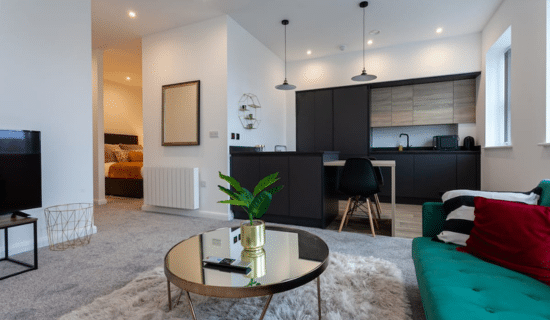
What the Bolton Data Tells Buy-to-Let Investors
In Bolton the income and the capital outlay both point south, away from the premium commuter belt. M38 has the top yield at 6.1% and the cheapest space per square foot at £195, while WN2 has the lowest asking price for buying an investment property at £198,873, the lowest deposit at £59,662, and the most affordable prices against local earnings at 5.8 times income. The affordable southern and western postcodes carry the higher yields; the dearer northern ones carry the prices.
Every Bolton postcode is positive over five years, from 12.2% in BL7 to 53.0% in M38, but the recent split is real. BL3 and BL4 are still rising over the past year at 4.5% and 6.7%, while BL5, BL6 and BL7 are all down between 5.6% and 6.5%. The cheaper central and southern stock has held momentum where the higher-value northern belt cooled hardest under higher mortgage rates.
The yield leader comes with a catch worth pricing in. M38 at 6.1% is the strongest income on paper, but with just 5 sales a month, 234 days on market and a 43.7% social-rented surround, it is one of the harder postcodes to trade in and out of. BL2 and BL4 trade quicker, at 109 and 113 days, on yields of 4.7% and 5.6%. Buyers who want to come in below asking often work the off market properties route in a borough where so much stock is owner-occupied.
Bolton's lower wage base, at £34,186 against the North West's £37,445, is the engine of the yield story: prices are held down further than rents, which is why returns hold up where higher-earning Cheshire towns nearby cannot match them. It reads as a value-and-income market with modest headline growth, rather than the steadier, lower-yielding profile of the premium North West.
How Bolton Compares
Bolton's mean asking price of £255,835 is the second-lowest of five North West locations compared here, and its top yield of 6.1% sits in the middle of the table. The comparison places Bolton alongside four nearby locations, each with a different investor profile. Mean asking price and mean monthly rent are simple averages across the postcodes with data, and top gross yield is the single highest postcode yield in each location.
| Location | Mean Asking Price | Mean Monthly Rent | Mean Gross Yield | Top Yield (postcode) |
|---|---|---|---|---|
| Liverpool | £210,314 | £904 | 5.2% | 8.0% (L2) |
| Bolton | £255,835 | £981 | 4.6% | 6.1% (M38) |
| Manchester | £268,032 | £1,312 | 5.9% | 8.1% (M14) |
| Warrington | £311,729 | £1,068 | 4.1% | 4.7% (WA5) |
| Chester | £339,728 | £1,204 | 4.3% | 4.7% (CH1) |
Bolton at £255,835 is the second-cheapest location in this comparison and its top yield of 6.1% comes in behind Liverpool's 8.0% and Manchester's 8.1% but well ahead of Warrington and Chester at 4.7%. Bolton occupies the affordable-yield middle ground of Greater Manchester: cheaper than the regional city itself, with a yield ceiling between the high-yield centres and the premium Cheshire belt.
Liverpool at 8.0% and buy-to-let in Manchester at 8.1% lead this group on top yield, while Warrington and Chester occupy its lower-yielding, higher-value Cheshire end. Bolton combines the group's second-lowest mean asking price with a 6.1% top yield and direct rail links to the Manchester jobs market. The UK buy-to-let location comparison applies the same measures across the full dataset.
Frequently Asked Questions
What are buy-to-let prices, yields and growth in Bolton?
The average sold price is £198,292, around 31.6% below the England average, and the borough's top gross yield reaches 6.1% in M38. Bolton's sold-price index increased 31.8% over the five years from March 2021 to March 2026.
The honest counterweight is the local economy. Bolton's employment rate is 67.1% and the typical wage is £674.50 a week, both below the regional and national figures. That lower wage base is exactly why yields hold up, because prices are suppressed more than rents, but it also means open-market rents have less room to climb. It is a value-and-income market, not a wage-growth one.
What are the best areas in Bolton for property investment?
The split runs north to south. If income is the priority, the southern and western postcodes lead. M38 (Little Hulton) tops the yield table at 6.1% and WN2 (Hindley, Westhoughton) is the cheapest entry at £198,873 on a 5.0% yield, with BL4 (Farnworth, Kearsley) in between at 5.6%. If capital stability matters more, the northern belt of BL6, BL7 and BL8 carries the higher prices and a deeper owner-occupier base, though its lower yields of 3.8% to 4.1% come as part of the deal.
If you are weighing one postcode against another, M38 leads on raw yield but is slow to sell, while BL3 (Daubhill, Great Lever) pairs a 4.9% yield with the borough's deepest private rented sector and still-positive recent growth.
How does Bolton compare to Manchester for buy-to-let?
They sit at different points on the same map. Manchester is the higher-yield, higher-rent city: top gross yields around 8.1% against Bolton's 6.1%, and a mean monthly rent of £1,312 against Bolton's £981. It also offers far more stock and a much deeper student and young-professional market.
Bolton trades that for a lower price, with a mean asking price of £255,835 against Manchester's £268,032, and a ten-mile commute into the same jobs market. An investor priced out of central Manchester yields, or wanting a lower capital outlay, is the natural Bolton buyer. The two work as a pair rather than direct rivals.
What are average house prices in Bolton?
The average sold price across Bolton is £198,292 on the Land Registry index, about 31.6% below the England average of £289,946 as of March 2026. Asking prices by postcode run from £198,873 in WN2 (Hindley, Westhoughton) up to £339,047 in BL7 (Bromley Cross, Egerton), with a borough-wide mean of £255,835. By type, detached homes average £369,228, semi-detached £216,976, terraced £163,024 and flats £113,783.
Through a buy-to-let lens, the cheaper southern postcodes carry the higher yields, with M38 leading at 6.1%, while the dearer northern postcodes such as BL8 sit lowest at 3.8%.
What are the Local Housing Allowance rates in Bolton?
Bolton spreads across three Broad Rental Market Areas, so there is no single rate. Most postcodes fall in the Bolton and Bury BRMA, where the June 2026 rates run at £78.59 a week for a shared room, £109.32 for a one-bed, £132.33 for two beds, £161.10 for three and £218.63 for four. M38 falls in the Central Greater Manchester area, which pays more for smaller properties (£178.36 for a one-bed, £201.37 for two), while M46 and WN2 fall in the lower-paying Wigan area. The rate caps how much housing support can contribute towards rent; it does not set a floor for the open market, and it depends on exactly where the property sits.
What type of property is most common in Bolton?
Semi-detached and terraced houses, with the balance shifting by postcode. Semi-detached homes are the single largest type in most of the borough, peaking at 43.4% of stock in M38 and 43.1% in M26. Terraced houses are densest in the central and southern postcodes, reaching 37.9% in BL7 and 36.4% in M38. Detached houses concentrate in the greener north, topping out at 46.6% in BL6, while flats are a small share everywhere, highest in BL1 at 13.9%.
Is there demand for student accommodation in Bolton?
There is, centred on the town-centre postcodes. The University of Bolton sits near the BL3 boundary just south of the centre, and the affordable stock in BL1 and BL3, where rents run around £911 and £933 a month, suits shared student lets within walking distance of campus. BL3 also has the borough's deepest private rented sector at 20.6%, so the lettings infrastructure is already there.
Student lets come with summer voids and heavier management than a standard tenancy, so they are not a hands-off option. For the purpose-built end of the market, see our guide to student accommodation for sale, and for the shared-house route, our complete guide to investing in HMOs.
How do I buy an investment property in Bolton?
Decide first whether you are buying for income or for capital stability, because in Bolton that points you to opposite ends of the borough. For yield, look south to M38, BL4 and WN2, where prices are lowest and returns highest. For a settled owner-occupier area and steadier value, the northern BL6, BL7 and BL8 postcodes carry the higher prices. Budget for a 30% deposit, which runs from £59,662 in WN2 up to £101,714 in BL7.
Beyond the openly listed stock, experienced buyers often come in below asking through off-market property sales and below market value. To see what is available now, browse investment properties or buy-to-let homes for sale.
Ready to buy property?
Browse investment properties with prices and gross yields shown for each opportunity.
Get property alerts