
Where to Buy Property Investments in Middlesbrough: Yields of 8.3%
Middlesbrough's gross rental yields range from 3.2% to 8.3% across postcodes with rental data, with TS3 delivering the highest returns. Average sold prices sit 51.3% below the England average, and the town's population grew 4.0% to 143,926 between the 2011 and 2021 censuses.
Middlesbrough's average sold price of £142,647 makes it one of the cheapest places to buy in England. That is 14.4% below the North East regional average and creates entry points that few English towns can match. Asking prices start from £83,441 in TS1, and rental data is available for 8 of the town's 10 postcodes.
This guide covers all 10 Middlesbrough postcodes from TS1 to TS9 and TS17 under the Middlesbrough unitary authority (ONS code E06000002). Middlesbrough sits on the south bank of the River Tees in the North East, anchored by Teesside University and the expanding Teesworks industrial zone. Investors comparing options in the region may also consider Sunderland, Durham, or York. Browse all our North East location guides.
Article updated: February 2026
Middlesbrough Buy-to-Let Market Overview 2026
Middlesbrough offers some of the lowest entry prices in England, backed by Teesworks Freeport employment and a growing university town economy.
- Average sold price: £142,647 (51.3% below England's £293,131)
- Asking price range: £83,441 (TS1) to £305,225 (TS7)
- Rental yields: 3.2% (TS7) to 8.3% (TS3) across postcodes with rental data
- Rental income: Monthly rents from £560.70 (TS1) to £801.70 (TS7)
- Price per sq ft: Sold prices from £85/sq ft (TS1) to £267/sq ft (TS9)
- Market activity: Sales ranging from 12 per month (TS9) to 53 per month (TS17)
- Deposit requirements: 30% deposits range from £25,032 (TS1) to £91,568 (TS7)
- Affordability ratios: Property prices from 2.4 to 8.7 times Middlesbrough's median annual salary of £35,177
Contents

-
by Robert Jones, Founder of Property Investments UK
With two decades in UK property, Rob has been investing in buy-to-let since 2005, and uses property data to develop tools for property market analysis.

Property Data Sources
Our location guide relies on diverse, authoritative datasets including:
- HM Land Registry UK House Price Index
- Ministry of Housing, Communities and Local Government
- Ordnance Survey Data Hub
- Propertydata.co.uk
We update our property data quarterly to ensure accuracy. Last update: February 2026. All data is presented as provided by our sources without adjustments or amendments.
Why Invest in Middlesbrough?
Middlesbrough's economy is in the middle of a structural shift. The town that lost its steelworks in 2015 is now home to the UK's largest Freeport site at Teesworks, with £2 billion of private investment secured and thousands of jobs arriving across clean energy manufacturing, logistics, and data centres. That is a different employment base to the one that collapsed a decade ago.
Teesside University is the second major demand driver. Around 18,000 students study on a town centre campus that has received £300 million of investment since 2018. The university was named Modern University of the Year 2026. Students and graduates create reliable rental demand in TS1 and the surrounding postcodes, and the ongoing campus expansion is reshaping the town centre streetscape.
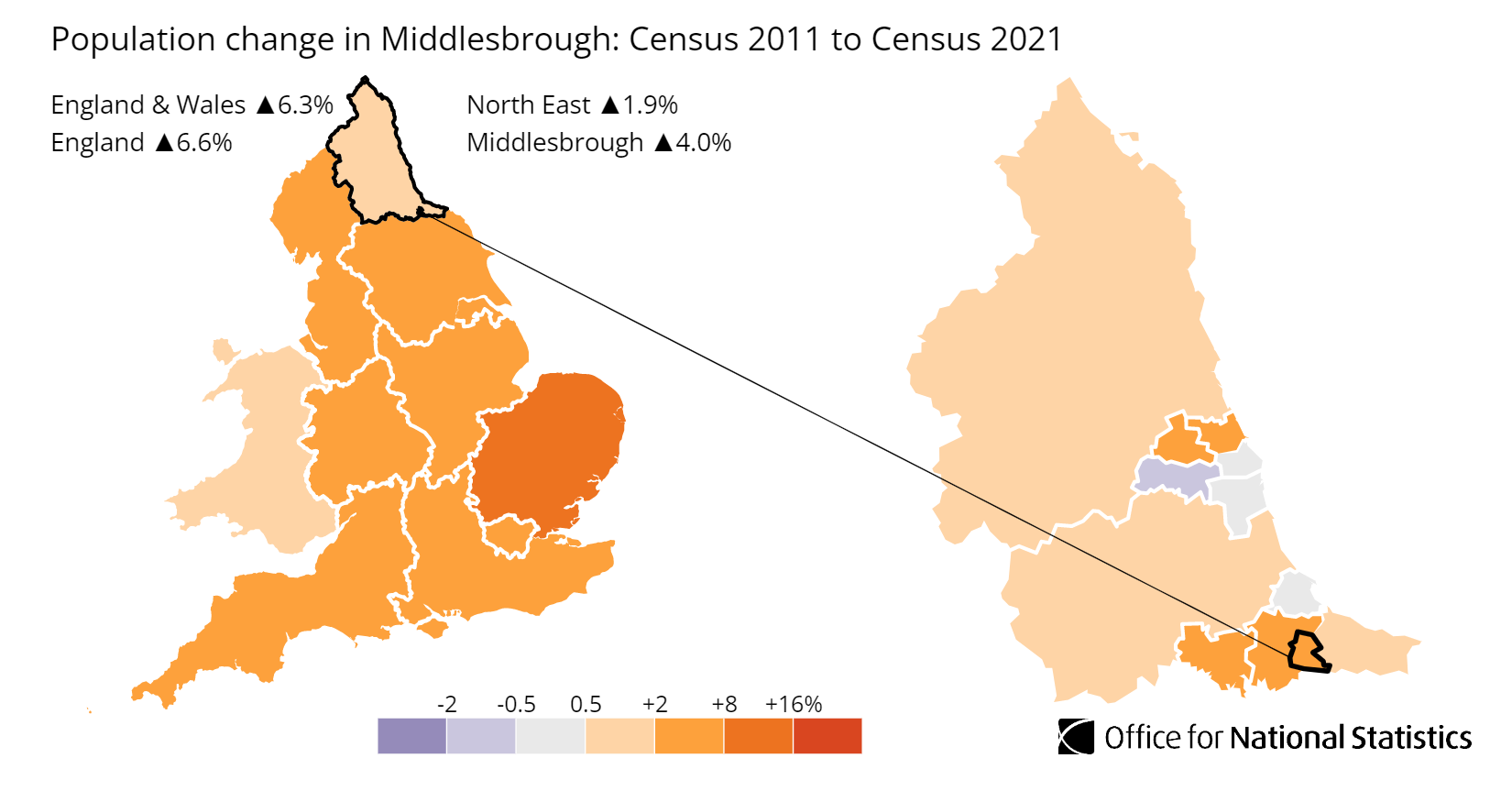
Between the 2011 and 2021 censuses, Middlesbrough's population grew from 138,412 to 143,926, a rise of 4.0%. That is slightly above the England average of 3.5%. The population growth is concentrated in the southern suburbs and the Ingleby Barwick area of TS17, where new housing development has attracted young families.
Earnings in Middlesbrough sit slightly above the North East regional average but well below national figures. The median annual salary is £35,177, compared to £34,835 across the North East and £39,125 for Great Britain. Lower local wages combined with very affordable house prices create a market where rental yields are among the highest in the country.
James Cook University Hospital is the area's major acute hospital and one of the largest employers in the Tees Valley. The hospital runs a regional trauma centre and specialist services that draw healthcare workers from across the North East. Healthcare employment creates steady rental demand in TS4 and TS8, the postcodes closest to the hospital site.
Middlesbrough Economic Summary
- Population: 143,926 (2021 Census). Growth of 4.0% from 2011.
- Median annual salary: £35,177 (Middlesbrough), £34,835 (North East), £39,125 (Great Britain)
- Employment rate: 67.0% (Middlesbrough), 70.6% (North East), 75.6% (Great Britain)
- Unemployment rate: 6.9% (Middlesbrough), 5.4% (North East), 4.3% (Great Britain)
- Key employment sectors: Process and clean energy (Teesworks), healthcare (James Cook Hospital), higher education (Teesside University), digital and creative, logistics
Source: ONS Census 2021, Nomis Labour Market Profile (ASHE 2025)
Middlesbrough's employment rate of 67.0% is below both the North East average of 70.6% and the national 75.6%. The unemployment rate of 6.9% is the highest of the four North East cities covered in our guides. That gap is real and investors should acknowledge it. But the direction matters. Teesworks has created 2,725 long-term jobs so far with thousands more in the pipeline. The employment picture in 2028 will look different to 2025. For buy-to-let investors, the combination of low entry prices and improving employment prospects is the core of the Middlesbrough case.
Regeneration and Investment in Middlesbrough
Middlesbrough's regeneration is anchored by the UK's largest Freeport development. The scale of investment at Teesworks is changing the employment profile of the entire Tees Valley, and rail infrastructure upgrades are improving connectivity to London and the wider North East.
- Teesworks Freeport (operational, £2bn private investment secured): The 4,500-acre former steelworks site is now the UK's largest Freeport, attracting clean energy manufacturing including the £900m SeAH Wind monopile facility. 2,725 long-term jobs created so far with an AI data centre in advanced planning. For investors, Freeport employment means higher-skilled tenants within commuting distance of Middlesbrough. Updates at Teesworks.
- Teesside University Campus Masterplan (ongoing, £300m self-funded): Nine buildings completed since 2018 including the £41.4m Digital Life building opened April 2025. The programme runs to 2027 and is reshaping the town centre. For investors, sustained campus investment anchors student housing demand and improves the streetscape in surrounding residential areas. Updates at Teesside University.
- Middlesbrough Railway Station Improvement (underway, £50m+): A three-phase overhaul adding a third platform, new entrance, and extended platforms enabling direct LNER Azuma services to London for the first time in over 30 years. Phase 2 underway with Phase 3 completion targeted for 2028. For investors, direct London connectivity makes Middlesbrough more attractive to employers and commuters. Updates at Tees Valley Combined Authority.
Middlesbrough Property Market Analysis
When Was the Last House Price Crash in Middlesbrough?
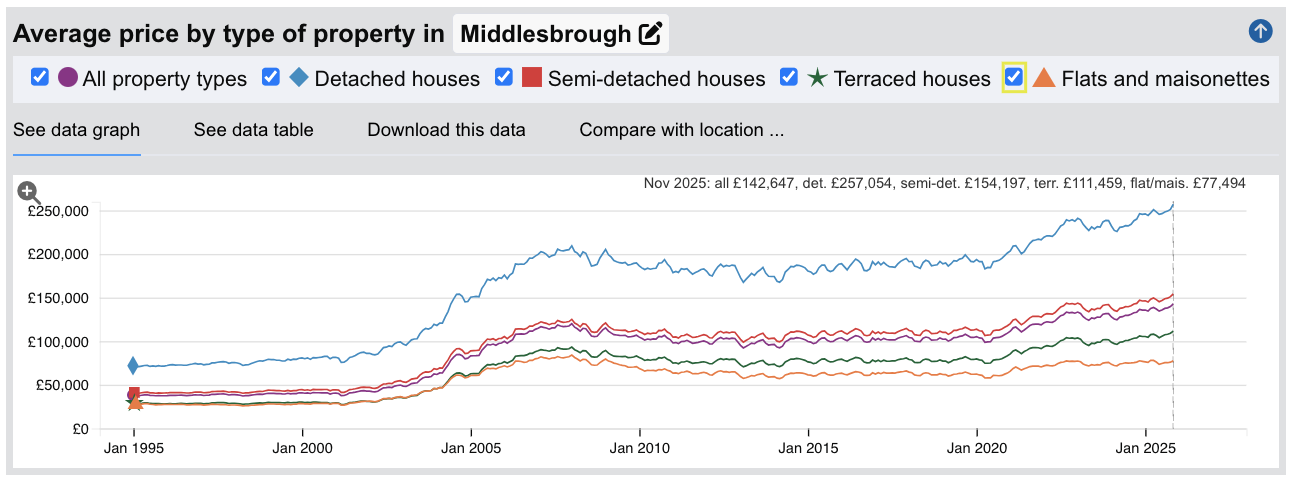
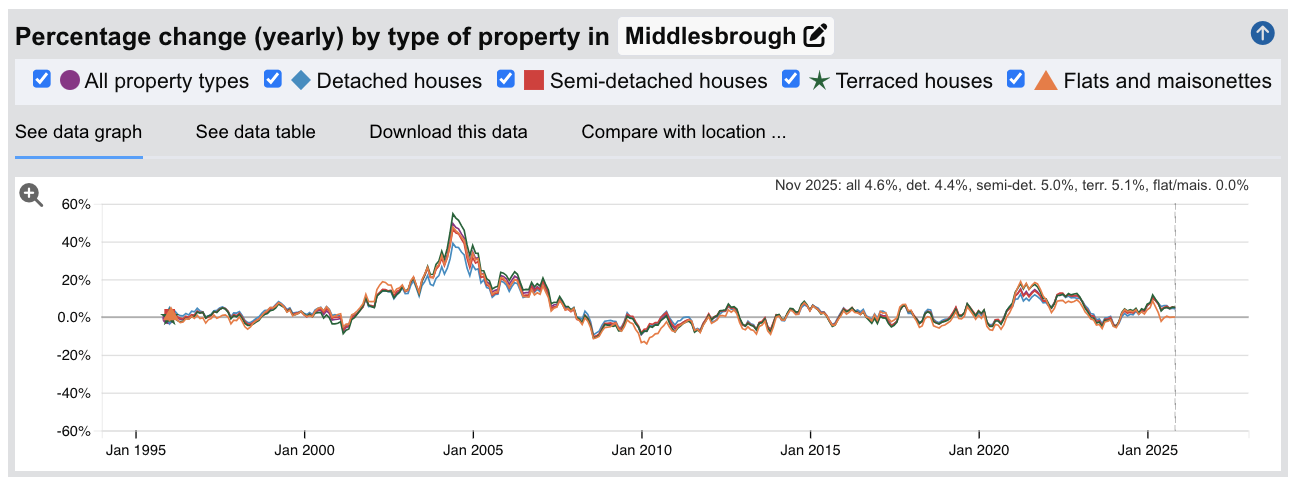
Middlesbrough's full house price history from the HM Land Registry House Price Index runs from January 1995 to November 2025. The data shows one major crash, a prolonged stagnation, and a slow recovery that only recently pushed prices to new highs.
- 1995-2000 (Flat start): Middlesbrough began 1995 at £37,933. Five years later, prices had barely moved. By January 2000, the average was £38,766. While London and the South East surged, Middlesbrough sat still. The industrial economy was shrinking and there was no catalyst for residential demand.
- 2000-2008 (The boom): Prices tripled in eight years. From £38,766 in January 2000 to a peak of £119,946 in January 2008. The sharpest growth came between 2002 and 2005, when cheap credit pushed prices beyond what local wages could justify. By the peak, the average house cost 3.4 times what it had cost in 2000.
- 2008-2013 (The financial crisis and stagnation): From the peak of £119,946 in January 2008 to the trough of £92,181 in February 2013, Middlesbrough lost 23.1% of its value over five years. The worst annual change reading was -10.7% in August 2008. Flats were hit hardest, falling 31.8% from £83,976 to £57,296. Terraced houses dropped 24.4%, semi-detached 20.9%, and detached 20.0%. Middlesbrough's decline of 23.1% was deeper than both the North East region (-19.6%) and England overall (-18.2%). The town's reliance on industrial employment made it more vulnerable to economic contraction.
- 2013-2019 (False starts): Recovery was painfully slow. Prices bounced off the 2013 trough but struggled to gain momentum. By December 2015, the average was £101,846. By December 2019, it had only reached £107,405. Six years of marginal growth. Middlesbrough was still 10.5% below its pre-crash peak while southern cities had long since recovered.
- 2020-2022 (Pandemic surge): The stamp duty holiday and shifting demand patterns finally reached Middlesbrough. Prices climbed from £107,405 in December 2019 to £126,331 by June 2022. That is 17.6% growth in two and a half years. Middlesbrough's extreme affordability made it a target for investors chasing yield as prices in southern cities stretched further out of reach.
- 2022-2023 (Rate shock): Interest rate rises cooled the market briefly. Prices dipped to £121,003 in January 2022 before resuming growth. The correction was shallow and short-lived compared to what happened in 2008.
- 2024-2025 (New highs): Prices finally surpassed the pre-crash peak in early 2022 and have continued climbing. By November 2025, the average reached £142,647 with annual growth of 4.6%. It took approximately 14 years from the January 2008 peak for Middlesbrough to set new price records. That recovery was one of the slowest in England.
Long-Term Property Value Growth in Middlesbrough
- 5 years (2020-2025): +32.8% (£107,405 to £142,647)
- 10 years (2015-2025): +40.1% (£101,846 to £142,647)
- 15 years (2010-2025): +37.7% (£103,563 to £142,647)
- 20 years (2005-2025): +46.5% (£97,346 to £142,647)
- 30 years (1995-2025): +281.7% (£37,376 to £142,647)
The 2008 crash hit Middlesbrough harder than most. A 23.1% decline and a 14-year recovery tells you this is a market that can fall fast and take a long time to come back. But the structural picture has changed. Teesworks did not exist in 2008. The university had not invested £300 million in its campus. The railway station was not being rebuilt for direct London services. The downside risk is real, but the demand drivers supporting prices today are more diversified than the industrial economy that collapsed in the financial crisis.
Source: HM Land Registry House Price Index for Middlesbrough

Thinking of Buying?
We have off-market investment properties averaging 8%+ annual yield.
View Property DealsSold House Prices in Middlesbrough
The latest sold house price index from the Land Registry confirms what the headline numbers suggest. Middlesbrough is one of the cheapest places to buy in England. The average sold price of £142,647 is 51.3% below England's £293,131 and 14.4% below the North East's £166,568. That is not a marginal discount. Middlesbrough is roughly half the price of an average English property.
Flats in Middlesbrough average £77,494. That is 65.0% below the England average of £221,565. No other property type shows a discount that large. Flat stock in Middlesbrough is predominantly ex-local authority and older converted properties. There is very little premium new-build apartment development of the kind that inflates flat averages in cities like Newcastle or Leeds.
| Property Type | Middlesbrough Average | England Average | Difference |
|---|---|---|---|
| Detached houses | £257,054 | £474,400 | -45.8% |
| Semi-detached houses | £154,197 | £290,004 | -46.8% |
| Terraced houses | £111,459 | £245,002 | -54.5% |
| Flats and maisonettes | £77,494 | £221,565 | -65.0% |
| All property types | £142,647 | £293,131 | -51.3% |
Terraced houses at £111,459 are 54.5% below the England average. Middlesbrough's Victorian and Edwardian terraces in TS1, TS3, and TS4 form the backbone of the town's rental stock. These are the property types generating the headline yields of 8%+. At prices this far below national averages, even modest rental income produces strong percentage returns.
Semi-detached houses show a 46.8% discount at £154,197. Semis are the core family housing in the suburban postcodes. TS5 (Acklam, Linthorpe) and TS17 (Thornaby, Ingleby Barwick) are where most semi-detached stock sits. Owner-occupier demand is stronger here, which is why the discount to England is slightly narrower than for terraces and flats.
Detached houses at £257,054 carry the narrowest discount at 45.8%. The detached market in Middlesbrough is concentrated in TS7 (Marton, Nunthorpe) and TS9 (Stokesley, Great Ayton), the two most expensive postcodes. These areas attract executive buyers and families who could afford to live elsewhere but choose the quality of life that comes with larger properties in greener settings.
The flat market at 65.0% below England tells a clear story about Middlesbrough's housing stock. There is no high-end apartment market here. For investors, that deep discount means flats can deliver exceptional yields. But it also means capital growth depends on local demand improving, not on a rising national tide lifting all boats.
Property Data Sources
Our location guide relies on diverse, authoritative datasets including:
- HM Land Registry UK House Price Index
- Ministry of Housing, Communities and Local Government
- Ordnance Survey Data Hub
- Propertydata.co.uk
We update our property data quarterly to ensure accuracy. Last update: February 2026. All data is presented as provided by our sources without adjustments or amendments.
Price Per Square Foot in Middlesbrough
Average asking prices can mislead. A postcode might look expensive simply because it has larger properties. Price per square foot strips out that size bias and shows what you are actually paying for space.
Middlesbrough's price per square foot ranges from £85 in TS1 to £267 in TS9, a spread of more than 3x across the postcodes with data. That is one of the widest ranges we have seen in any location guide and it reflects the gulf between Middlesbrough's affordable town centre and the rural villages at its southern fringe. TS2 (Middlehaven, Port) has insufficient data for a reliable figure.
| Rank | Area | Price Per Sq Ft |
|---|---|---|
| 1 | TS1 (Town Centre) | £85 |
| 2 | TS3 (North Ormesby, Park End) | £102 |
| 3 | TS4 (Grove Hill, Acklam) | £133 |
| 4 | TS6 (Eston, South Bank) | £155 |
| 5 | TS5 (Acklam, Linthorpe) | £164 |
| 6 | TS17 (Thornaby, Ingleby Barwick) | £194 |
| 7 | TS7 (Marton, Nunthorpe) | £209 |
| 8 | TS8 (Coulby Newham, Hemlington) | £209 |
| 9 | TS9 (Stokesley, Great Ayton) | £267 |
| — | TS2 (Middlehaven, Port) | Not enough data |
TS1 at £85 per square foot is among the cheapest space in the entire North East. This is the town centre, where Teesside University creates student and graduate rental demand. Older terraced housing stock keeps per-foot costs low. For landlords buying for yield, TS1 offers the most space per pound anywhere in Middlesbrough.
TS7 and TS8 both sit at £209 per square foot despite very different asking prices. TS7 (Marton, Nunthorpe) averages £305,225 while TS8 (Coulby Newham, Hemlington) averages £216,299. The identical price per square foot tells you the difference is property size, not underlying value. TS7 has larger detached homes. TS8 has more compact family housing. Investors paying £209 per square foot in either postcode are getting the same quality of space.
TS9 at £267 is the premium outlier. Stokesley and Great Ayton are semi-rural villages with period properties and larger plots. The stock is weighted towards detached family homes, which pushes per-foot costs higher. Read this alongside the sales volume data. TS9 averages just 12 sales per month, the lowest in Middlesbrough.
Figures reflect averages across all property types and ages. Individual values depend on condition, location within the postcode, and building age.
For Sale Asking Prices in Middlesbrough
Asking prices reflect what sellers and agents think the market will pay. They run ahead of sold prices in a rising market and sit above what actually transacts in a cooling one. The gap between asking and sold matters, but for comparing postcodes within the same town, asking prices show where the market positions each area.
Middlesbrough's asking prices range from £83,441 in TS1 to £305,225 in TS7. That is a spread of more than 3.5x. Strip out the two most expensive postcodes (TS7 and TS9) and the range narrows to £83,441 to £216,299. Nine of the ten postcodes have price data. TS2 (Middlehaven, Port) has insufficient data.
| Rank | Area | Average Asking Price |
|---|---|---|
| 1 | TS1 (Town Centre) | £83,441 |
| 2 | TS3 (North Ormesby, Park End) | £93,246 |
| 3 | TS4 (Grove Hill, Acklam) | £133,255 |
| 4 | TS6 (Eston, South Bank) | £157,451 |
| 5 | TS5 (Acklam, Linthorpe) | £195,607 |
| 6 | TS17 (Thornaby, Ingleby Barwick) | £206,753 |
| 7 | TS8 (Coulby Newham, Hemlington) | £216,299 |
| 8 | TS9 (Stokesley, Great Ayton) | £292,922 |
| 9 | TS7 (Marton, Nunthorpe) | £305,225 |
| — | TS2 (Middlehaven, Port) | Not enough data |
Three postcodes sit below £100,000: TS1 at £83,441 and TS3 at £93,246. These are the high-yield postcodes. Average asking prices under £100,000 are rare in England. TS1 and TS3 are where the 8%+ yields come from. The trade-off is that these are also the most deprived areas of Middlesbrough, with higher tenant turnover and more intensive management requirements.
TS4 to TS6 form a middle tier between £133,000 and £157,000. This is where the balance shifts. Yields are still strong (5.0% to 6.9%) but the tenant profile improves. TS4 (Grove Hill, Acklam) straddles both social housing areas and established residential streets. TS5 (Acklam, Linthorpe) is the classic Middlesbrough family suburb. TS6 (Eston, South Bank) sits closest to Teesworks and may benefit most directly from Freeport employment growth.
TS7, TS8, TS9, and TS17 are the £200,000+ postcodes. These attract owner-occupiers and lifestyle buyers. Yields compress below 4.5% but tenant quality is high and void periods are shorter. TS17 at £206,753 is interesting because it sits at the bottom of this premium tier but still delivers 4.1% yield. Ingleby Barwick is one of the largest private housing estates in Europe and the new-build stock attracts professional tenants.
The mean asking price across all nine Middlesbrough postcodes with data is £187,133. That figure appears in the comparison section, where Middlesbrough is measured against Sunderland, Newcastle, and Durham.

House Price Growth in Middlesbrough
Growth data shows where prices have moved over 1, 3, and 5 years. For buy-to-let investors, the five-year figure matters most. It captures a full market cycle and filters out short-term noise. One-year growth can swing on a handful of transactions in a town where some postcodes average just 12 to 18 sales per month.
All nine Middlesbrough postcodes with data delivered positive five-year growth, with TS6 leading at 35.5%. An investor who bought a £116,000 property in TS6 (Eston, South Bank) five years ago would be looking at a property now asking £157,451. That is £41,000 in equity growth from one of the postcodes closest to the Teesworks Freeport site.
| Area | 1 Year | 3 Years | 5 Years |
|---|---|---|---|
| TS6 (Eston, South Bank) | 6.2% | 12.1% | 35.5% |
| TS1 (Town Centre) | -3.6% | 4.9% | 34.5% |
| TS3 (North Ormesby, Park End) | 2.8% | 2.1% | 28.4% |
| TS5 (Acklam, Linthorpe) | 6.6% | 7.2% | 19.6% |
| TS9 (Stokesley, Great Ayton) | 8.5% | 9.0% | 16.3% |
| TS4 (Grove Hill, Acklam) | 2.4% | -4.1% | 15.2% |
| TS8 (Coulby Newham, Hemlington) | 4.1% | 3.7% | 8.7% |
| TS17 (Thornaby, Ingleby Barwick) | -0.2% | 2.2% | 7.4% |
| TS7 (Marton, Nunthorpe) | -0.1% | -6.1% | 3.5% |
| — | TS2 (Middlehaven, Port): Not enough data | ||
The cheapest postcodes delivered the strongest growth. TS6 (35.5%), TS1 (34.5%), and TS3 (28.4%) all sit below £160,000 average asking price. That pattern is typical of recovery markets where the most affordable stock gets repriced first as investor demand arrives. These are also the three postcodes closest to Teesworks and the town centre, where regeneration spending is concentrated.
TS7 (Marton, Nunthorpe) at 3.5% five-year growth is the weakest performer. It is also the most expensive postcode at £305,225. Negative three-year growth of -6.1% suggests prices ran ahead of local demand during the pandemic surge and have since corrected. TS7 attracts executive buyers, not yield-driven investors. The growth data confirms that. If you are buying in TS7, you are buying for lifestyle tenants and long-term holds, not short-term appreciation.
TS4 shows an unusual pattern: positive five-year growth (15.2%) but negative three-year growth (-4.1%). That means most of the gains came early in the five-year window. The area may be adjusting to a new price level. Grove Hill includes some of Middlesbrough's most challenging housing stock alongside established residential streets in Acklam. The mixed character of the postcode makes it harder to read than more uniform areas.
Monthly Property Sales in Middlesbrough
Transaction volumes reveal which areas have the deepest buyer pools. For buy-to-let investors, this is an exit strategy question. If you need to sell, can you? High volume and high turnover mean a liquid market. Low volume means you may wait.
Middlesbrough's monthly sales range from 12 in TS9 to 53 in TS17, with a combined total of 242 transactions per month across the nine postcodes with data. TS6 stands out with a turnover rate of 51%, the highest in Middlesbrough.
| Area | Sales Per Month | Turnover | Asking Price |
|---|---|---|---|
| TS17 (Thornaby, Ingleby Barwick) | 53 | 37% | £206,753 |
| TS5 (Acklam, Linthorpe) | 46 | 28% | £195,607 |
| TS6 (Eston, South Bank) | 32 | 51% | £157,451 |
| TS8 (Coulby Newham, Hemlington) | 25 | 40% | £216,299 |
| TS3 (North Ormesby, Park End) | 21 | 42% | £93,246 |
| TS7 (Marton, Nunthorpe) | 20 | 25% | £305,225 |
| TS1 (Town Centre) | 18 | 27% | £83,441 |
| TS4 (Grove Hill, Acklam) | 15 | 30% | £133,255 |
| TS9 (Stokesley, Great Ayton) | 12 | 19% | £292,922 |
| TS2 (Middlehaven, Port) | Not enough data | Not enough data | Not enough data |
TS17 leads on volume with 53 sales per month. Ingleby Barwick's large private housing estate generates consistent transaction flow. Combined with a 37% turnover rate, this is the most liquid market in Middlesbrough. If exit strategy matters to you, TS17 is the safest bet for finding a buyer when you need one.
TS6 at 51% turnover is the standout for market velocity. Properties in Eston and South Bank change hands faster than stock comes to market. Combined with 32 sales per month and the strongest five-year growth at 35.5%, TS6 is attracting active investor interest. Proximity to Teesworks is likely driving some of that demand.
TS9 at 12 sales and 19% turnover is the least liquid postcode. Stokesley and Great Ayton are villages where properties are held long-term by owner-occupiers. When something does come to market, the small buyer pool means it may take longer to sell. This is not a postcode for investors who might need to exit quickly.
Property Data Sources
Our location guide relies on diverse, authoritative datasets including:
- HM Land Registry UK House Price Index
- Ministry of Housing, Communities and Local Government
- Ordnance Survey Data Hub
- Propertydata.co.uk
We update our property data quarterly to ensure accuracy. Last update: February 2026. All data is presented as provided by our sources without adjustments or amendments.
Middlesbrough Rental Market Analysis
For investors weighing up whether rental property is a worthwhile investment in Middlesbrough, the data below breaks down average monthly rents and gross rental yields across the town's postcodes.
Rental data is available for 8 of 10 postcodes. TS2 (Middlehaven, Port) has no data at all and TS9 (Stokesley, Great Ayton) has insufficient current listings for reliable rent and yield figures. For the eight with data, monthly rents range from £560.70 in TS1 to £801.70 in TS7 and gross yields range from 3.2% to 8.3%. If you are looking to build a property business in the North East, Middlesbrough's combination of sub-£100,000 entry prices and yields above 8% is hard to match.

Average Rent & Gross Rental Yields in Middlesbrough
Gross rental yield is calculated from the average asking price and average monthly rent for each postcode. It does not account for void periods, maintenance, management fees, or mortgage costs. It is a starting point for comparison, not a profit forecast.
TS3 delivers Middlesbrough's highest gross yield at 8.3%, where monthly rents of £641.80 meet asking prices of £93,246. At the other end, TS7 Marton at 3.2% reflects asking prices of £305,225 absorbing relatively modest rents. The yield spread across Middlesbrough is 5.1 percentage points. That gap is one of the widest in any location we cover and it reflects the extreme price range within a single town.
| Area | Avg Monthly Rent | Avg Asking Price | Gross Yield |
|---|---|---|---|
| TS3 (North Ormesby, Park End) | £641.80 | £93,246 | 8.3% |
| TS1 (Town Centre) | £560.70 | £83,441 | 8.1% |
| TS4 (Grove Hill, Acklam) | £770.90 | £133,255 | 6.9% |
| TS6 (Eston, South Bank) | £660.00 | £157,451 | 5.0% |
| TS5 (Acklam, Linthorpe) | £793.40 | £195,607 | 4.9% |
| TS8 (Coulby Newham, Hemlington) | £797.30 | £216,299 | 4.4% |
| TS17 (Thornaby, Ingleby Barwick) | £712.40 | £206,753 | 4.1% |
| TS7 (Marton, Nunthorpe) | £801.70 | £305,225 | 3.2% |
| TS9 (Stokesley, Great Ayton) | Not enough data | £292,922 | Not enough data |
| TS2 (Middlehaven, Port) | Not enough data | Not enough data | Not enough data |
Two postcodes sit above 8% gross yield: TS3 (8.3%) and TS1 (8.1%). Both are in central Middlesbrough where asking prices sit below £100,000. TS3 draws from a mix of working tenants and housing benefit recipients. TS1 benefits from student demand generated by Teesside University. Yields above 8% are exceptional by any national standard, but they come with higher management intensity. These are not set-and-forget postcodes.
TS4 at 6.9% occupies a middle ground. Monthly rents of £770.90 are among the highest in Middlesbrough and the asking price of £133,255 is still well below what similar yields would cost in most English towns. Grove Hill and Acklam offer a mix of tenant profiles, from families in the established residential streets to tenants in the social housing areas closer to the town centre.
TS7 commands Middlesbrough's highest absolute rent at £801.70 per month but delivers the lowest yield at 3.2%. Marton and Nunthorpe attract professional tenants willing to pay a premium for detached homes in a suburban setting. Asking prices of £305,225 absorb that rental income and compress the yield. Investors here are buying for tenant quality and hold value, not for cash flow.
Is Middlesbrough Rent High?
Rent affordability matters from both sides. For tenants, it determines whether they can sustain payments long-term without falling into arrears. For landlords, areas where rent consumes a lower share of income tend to produce more reliable tenants and fewer problems.
The median gross weekly salary in Middlesbrough is £676.50, which equates to £2,931 per month or £35,177 per year. This is slightly above the North East regional median of £669.90 per week but below the Great Britain median of £752.40 per week. Data from the Nomis Labour Market Profile (ASHE 2025).
Across Middlesbrough's eight postcodes with rental data, rent ranges from 19.1% to 27.3% of the local median gross monthly salary. Every single postcode sits below the 30% affordability threshold. That is unusual. In most towns we cover, at least some postcodes breach the 30% mark. Middlesbrough's low rents relative to local wages mean tenants are under less financial pressure, which translates to lower arrears risk for landlords.
| Rank | Area | Rent as % of Income |
|---|---|---|
| 1 | TS7 (Marton, Nunthorpe) | 27.3% |
| 2 | TS8 (Coulby Newham, Hemlington) | 27.2% |
| 3 | TS5 (Acklam, Linthorpe) | 27.1% |
| 4 | TS4 (Grove Hill, Acklam) | 26.3% |
| 5 | TS17 (Thornaby, Ingleby Barwick) | 24.3% |
| 6 | TS6 (Eston, South Bank) | 22.5% |
| 7 | TS3 (North Ormesby, Park End) | 21.9% |
| 8 | TS1 (Town Centre) | 19.1% |
| — | TS9 (Stokesley, Great Ayton) | Not enough data |
| — | TS2 (Middlehaven, Port) | Not enough data |
TS1 at 19.1% is the most affordable postcode for tenants. Monthly rent of £560.70 against a median gross monthly salary of £2,931 leaves substantial room for other living costs. Student tenants in TS1 may not earn the median salary, but the headline figure shows the wider market can absorb these rents comfortably. Low affordability pressure is one reason why TS1 sustains yields above 8%.
Even the most stretched postcodes sit well below 30%. TS7, TS8, and TS5 at 27.1% to 27.3% are the highest, and those areas attract tenants who earn above the Middlesbrough median. Hospital staff in TS8, families in TS5, and professionals in TS7 are not on £35,177. The median salary is a town-wide figure that understates what tenants in these postcodes actually earn.
The complete picture is positive. Middlesbrough rents are affordable by any measure. For landlords, that means tenants can pay. For the market, it means there is room for rents to grow without creating affordability pressure.
Thinking of Buying?
We have off-market investment properties averaging 8%+ annual yield.
View Property DealsBuy-to-Let Considerations
Are Middlesbrough House Prices High? Price-to-Earnings Ratios
The price-to-earnings ratio compares a postcode's average asking price to the local median annual salary. Lower ratios mean more affordable entry points relative to local wages. The national benchmark is 7.5x, calculated from England's average sold price of £293,131 against Great Britain's median annual salary of £39,125.
Purchasing a property in Middlesbrough requires between 2.4 and 8.7 times the median annual salary. This is based on the Nomis Labour Market Profile for Middlesbrough showing the median gross annual income for Middlesbrough residents is £35,177.
Seven of Middlesbrough's nine postcodes with data sit below the national benchmark of 7.5x. Only TS7 at 8.7x and TS9 at 8.3x exceed it. The two cheapest postcodes, TS1 at 2.4x and TS3 at 2.7x, are among the most affordable in any location we cover.
| Rank | Area | Price-to-Earnings Ratio |
|---|---|---|
| 1 | TS1 (Town Centre) | 2.4x |
| 2 | TS3 (North Ormesby, Park End) | 2.7x |
| 3 | TS4 (Grove Hill, Acklam) | 3.8x |
| 4 | TS6 (Eston, South Bank) | 4.5x |
| 5 | TS5 (Acklam, Linthorpe) | 5.6x |
| 6 | TS17 (Thornaby, Ingleby Barwick) | 5.9x |
| 7 | TS8 (Coulby Newham, Hemlington) | 6.2x |
| 8 | TS9 (Stokesley, Great Ayton) | 8.3x |
| 9 | TS7 (Marton, Nunthorpe) | 8.7x |
| — | TS2 (Middlehaven, Port) | Not enough data |
TS1 at 2.4x and TS3 at 2.7x are remarkable. A property costing less than three times the local annual salary is almost unheard of in England outside a few northern industrial towns. These ratios explain why yields are so high. The entry price is so low relative to local wages that even modest rents generate strong percentage returns.
The middle tier from TS4 (3.8x) to TS8 (6.2x) all sit comfortably below the national benchmark. Every one of these postcodes offers entry prices that are affordable relative to what local people earn. For buy-to-let investors, that matters because affordable purchase prices support sustainable mortgages, and affordable rents (relative to wages) support reliable tenant payments.
TS7 at 8.7x is the only postcode significantly above the national benchmark. TS9 at 8.3x sits just above it. Both are the premium residential areas of Middlesbrough where buyers pay for lifestyle rather than just shelter. For investors comparing across the North East, Middlesbrough's price-to-earnings ratios are more favourable than Newcastle and Durham, where higher prices and similar regional salaries push ratios higher.
Deposit Requirements in Middlesbrough
Most buy-to-let mortgage lenders require a minimum 25% deposit. The table below uses a more conservative 30% to reflect the rates and products available at higher loan-to-value ratios. A 30% deposit typically unlocks better interest rates, which matters for cash flow in any market.
Middlesbrough's entry costs range from £25,032 in TS1 to £91,568 in TS7. Five postcodes require deposits under £50,000. That puts buy-to-let within reach for investors who might be priced out of most English towns.
| Rank | Area | 30% Deposit Required |
|---|---|---|
| 1 | TS1 (Town Centre) | £25,032 |
| 2 | TS3 (North Ormesby, Park End) | £27,974 |
| 3 | TS4 (Grove Hill, Acklam) | £39,977 |
| 4 | TS6 (Eston, South Bank) | £47,235 |
| 5 | TS5 (Acklam, Linthorpe) | £58,682 |
| 6 | TS17 (Thornaby, Ingleby Barwick) | £62,026 |
| 7 | TS8 (Coulby Newham, Hemlington) | £64,890 |
| 8 | TS9 (Stokesley, Great Ayton) | £87,877 |
| 9 | TS7 (Marton, Nunthorpe) | £91,568 |
| — | TS2 (Middlehaven, Port) | Not enough data |
TS1 at £25,032 is one of the lowest buy-to-let entry points in any location we cover. A deposit of £25,000 for a property yielding 8.1% gross. That ratio of capital outlay to rental return is the fundamental appeal of Middlesbrough for income-focused investors. TS3 at £27,974 offers an even higher yield at 8.3%. Both sit below £30,000 deposit.
A clear gap separates the sub-£50,000 tier from the rest. TS1 through TS6 all require deposits under £48,000. Step up to TS5 and the deposit jumps to £58,682 but the yield drops to 4.9%. The extra capital does not deliver proportionally higher income. For investors with limited capital targeting maximum yield, the four cheapest postcodes (TS1, TS3, TS4, TS6) all deliver yields between 5.0% and 8.3% with deposits under £48,000.
Deposit is only part of the upfront cost. Budget for stamp duty (use our stamp duty calculator for an accurate figure), legal fees, and survey costs. For a full breakdown, see our guide to buy-to-let costs.

What the Middlesbrough Data Tells Buy-to-Let Investors
The postcode-level data across this guide points to two distinct approaches for property investment in Middlesbrough, depending on whether you are optimising for income or for balanced returns.
For yield, the numbers favour TS3 (8.3%), TS1 (8.1%), and TS4 (6.9%). All three sit below 3.8x price-to-earnings with 30% deposits between £25,000 and £40,000. TS3 and TS1 are central Middlesbrough, where student and working tenant demand is strongest.
Management intensity is higher in these postcodes. Budget for a local letting agent and be realistic about void periods. These are not hands-off investments.
For balanced returns, TS6 (5.0% yield, 35.5% five-year growth) stands out. Eston and South Bank sit closest to Teesworks. The combination of decent yield, the strongest five-year growth in Middlesbrough, and proximity to the UK's largest Freeport site makes TS6 the most interesting postcode for investors who want both income and appreciation. A deposit of £47,235 keeps the entry price manageable.
TS7 and TS9 suit a different investor entirely. TS7 at £305,225 with 3.2% yield and just 3.5% five-year growth is not a yield play. TS9 at £292,922 with no rental data and 12 sales per month is not a liquidity play. Both attract executive tenants and lifestyle buyers. If that is your market, the properties are high quality. But most buy-to-let investors looking at Middlesbrough are here for the yield, and that story is in TS1 to TS6.
Middlesbrough operates a selective licensing scheme in parts of the town. Check whether your target postcode falls within a designated area before committing. Licensing adds cost but also improves stock quality across the area, which supports long-term rental values.
How Middlesbrough Buy-to-Let Compares to Nearby Areas
Middlesbrough's mean asking price of £187,133 sits almost identically to Durham (£187,881) but £67,000 below Newcastle (£254,411). Investors looking at Middlesbrough are typically also considering other North East locations. The table below compares Middlesbrough against three nearby cities using the same methodology: mean asking price across all postcodes, mean monthly rent across postcodes with data, and top single-postcode gross yield.
| Location | Mean Asking Price | Mean Monthly Rent | Top Gross Yield |
|---|---|---|---|
| Middlesbrough | £187,133 | £717 | 8.3% |
| Sunderland | £164,426 | £691 | 9.7% |
| Newcastle | £254,411 | £1,166 | 9.7% |
| Durham | £187,881 | £774 | 5.5% |
Middlesbrough and Durham sit almost identically on mean asking price (£187,133 vs £187,881). But the yield story is completely different. Middlesbrough's top yield of 8.3% is 2.8 percentage points above Durham's 5.5%. The difference is the price floor. Middlesbrough has postcodes below £100,000. Durham does not. That low-price, high-yield stock is what separates Middlesbrough from its North East neighbours.
Sunderland is the closest comparison: cheaper mean price (£164,426), similar rents (£691), and a higher top yield (9.7%). Sunderland edges Middlesbrough on headline yield. But Middlesbrough has the Teesworks regeneration pipeline, which Sunderland cannot match. Investors choosing between the two are weighing current yield (Sunderland) against growth potential (Middlesbrough).
Newcastle is a different proposition entirely. Mean asking prices of £254,411 put it 36% above Middlesbrough. Rents are proportionally higher at £1,166 but the top yield matches Sunderland at 9.7%. Newcastle offers deeper tenant demand, better infrastructure, and more diverse employment. The trade-off is higher capital outlay per property. For investors with limited capital, Middlesbrough delivers more yield per pound deployed.
Frequently Asked Questions
What are the best areas to live in Middlesbrough?
TS7 (Marton, Nunthorpe) and TS5 (Acklam, Linthorpe) are the most popular residential areas. TS7 (Marton, Nunthorpe) and TS9 (Stokesley, Great Ayton) are the most desirable residential areas with asking prices above £290,000, low crime, and good schools. TS5 (Acklam, Linthorpe) is the established family suburb with a mix of housing types and strong local amenities. TS17 (Thornaby, Ingleby Barwick) is one of the largest private housing estates in Europe and attracts young families with newer-build stock. For investors, the "best" areas depend on whether you are targeting yield (TS1, TS3) or tenant quality (TS5, TS7, TS17).
Is Middlesbrough a good place to live?
It depends where. The southern suburbs (TS5, TS7, TS8) offer a very different quality of life to the town centre. On the positive side, housing costs are among the lowest in England, rents are affordable relative to local wages (all postcodes sit below 30% of median income), and the town is in the middle of significant regeneration through Teesworks and the railway station rebuild. On the negative side, unemployment at 6.9% is above the national average, and parts of central Middlesbrough face deprivation challenges. The southern suburbs (TS5, TS7, TS8) offer a different quality of life to the town centre. Investors should visit before buying and speak to local agents about specific streets, not just postcodes.
Is student accommodation a good investment in Middlesbrough?
Student lets in TS1 deliver 8.1% gross yield with an average asking price of £83,441. Teesside University has around 18,000 students studying on a town centre campus. That creates consistent rental demand in TS1 and surrounding postcodes. TS1 delivers 8.1% gross yield with an average asking price of £83,441. Student lets typically generate higher per-room income through shared houses, though they carry seasonal void risk during summer months and require more active management. For a broader view of the sector, see our guide to purpose-built student accommodation.
How does Middlesbrough compare to Sunderland for buy-to-let?
Sunderland has the edge on current yield (9.7% top vs 8.3%) and entry price (£164,426 mean vs £187,133). Sunderland offers a lower mean asking price (£164,426 vs £187,133), similar average rents (£691 vs £717), and a higher top yield (9.7% vs 8.3%). On current numbers, Sunderland edges Middlesbrough for pure yield investors. But Middlesbrough has the Teesworks Freeport pipeline creating thousands of new jobs, a £300m university campus investment, and a £50m+ railway station rebuild bringing direct London services. The growth potential is different. Investors choosing between the two are weighing today's income (Sunderland) against tomorrow's demand drivers (Middlesbrough).
What is the average rent in Middlesbrough?
The mean monthly rent across Middlesbrough postcodes with data is £717. Monthly rents across Middlesbrough's eight postcodes with rental data range from £560.70 in TS1 (Town Centre) to £801.70 in TS7 (Marton, Nunthorpe). The mean monthly rent across all postcodes with data is £717. That sits slightly above the North East average. Rents in every Middlesbrough postcode are below 30% of the local median gross monthly salary, making Middlesbrough one of the most affordable rental markets in England for tenants.
When will Teesworks affect Middlesbrough property prices?
It already is, but the biggest effects are still ahead. TS6 (Eston, South Bank), the postcode closest to the Teesworks site, has delivered 35.5% five-year growth, the highest in Middlesbrough. The site has 2,725 long-term jobs in place with an AI data centre in advanced planning and SeAH Wind's £900m monopile factory now in commercial production. The employment impact is building. But Teesworks is a generational project. Full build-out will take a decade or more. Investors positioning now may benefit from price growth as the job numbers ramp up, but this is a long-term structural play. The biggest effects on residential demand are likely still several years away.