

Plymouth is a coastal city in Devon, in South West England. Average sold prices in Plymouth sit at £217,381 on the HM Land Registry House Price Index, 25.0% below the England average of £289,946 and 27.7% below the £300,849 the wider South West records. That makes Plymouth one of the cheapest major cities in the South West to buy in, a big-city rental market priced well below the Devon and Cornwall coast that pulls the regional average up. The city's population grew 3.2% between the 2011 and 2021 censuses, from 256,384 to 264,695 residents.
Plymouth's affordability is the headline an investor notices first. The cheapest postcode, PL4 (Mutley, Lipson), carries a £202,054 average asking price, and four of the nine postcodes sit below £212,000. Those are not the figures of a small town; this is a city of more than a quarter of a million people with a naval base, a university and a regional teaching hospital underpinning the tenant base. The spread runs from PL4 at £202,054 up to PL8 (Yealmpton, Brixton) at £571,310, so a single city holds both terraced city-centre stock and the detached rural fringe of the South Hams.
This guide covers the unitary authority of Plymouth (ONS code E06000026) across postcodes PL1 to PL9. Plymouth sits on the Devon coast at the mouth of the Tamar, 45 miles south-west of Exeter and bordering Cornwall to the west. The wider South West region also takes in Exeter buy-to-let to the north-east and the Cornish market beyond the river.
Article updated: July 2026

Why Invest in Plymouth?
Plymouth's population grew 3.2% between the 2011 and 2021 censuses, from 256,384 to 264,695 residents, slower than the England and Wales average of 6.3% but underpinned by employment that does not ride the property cycle. The biggest of those employers is HMNB Devonport, the largest naval base in Western Europe, run by Babcock International and supporting a long supply chain of local firms. A naval dockyard is the kind of anchor most cities do not have, and it keeps a floor under tenant demand through downturns that would thin out a more speculative market.
The second engine is the University of Plymouth, with a student body in the high tens of thousands and a medical school run jointly with Exeter. Students and healthcare trainees keep the city-centre and traditional letting areas such as Mutley, Lipson and Greenbank turning over. Derriford Hospital, the region's major acute hospital in PL6, adds another large and stable payroll to the north of the city. The combination of defence, higher education and healthcare gives Plymouth a tenant base spread across three sectors that rarely contract at the same time.
Median gross annual earnings in Plymouth are £35,186, which is below both the South West median of £37,544 and the Great Britain median of £39,125. Lower local wages would normally cap rents, and they do hold rents below the South West average here. The offset is that house prices are lower still, so yields hold up. The headline reading that matters for a landlord is the unemployment rate of 2.8%, below the South West, which points to a workforce that is securely employed even where average pay is modest.
Plymouth Economic Summary
- Population: 264,695 (2021 Census). Growth of 3.2% from 2011.
- Median annual salary: £35,186 (Plymouth), £37,544 (South West), £39,125 (Great Britain)
- Employment rate: 73.4% (Plymouth)
- Unemployment rate: 2.8% (Plymouth)
- Key employment sectors: Defence and naval, healthcare, higher education, marine technology, advanced manufacturing
Source: ONS Census 2021, Nomis Labour Market Profile (ASHE 2025, Employment Oct 2024-Sep 2025)
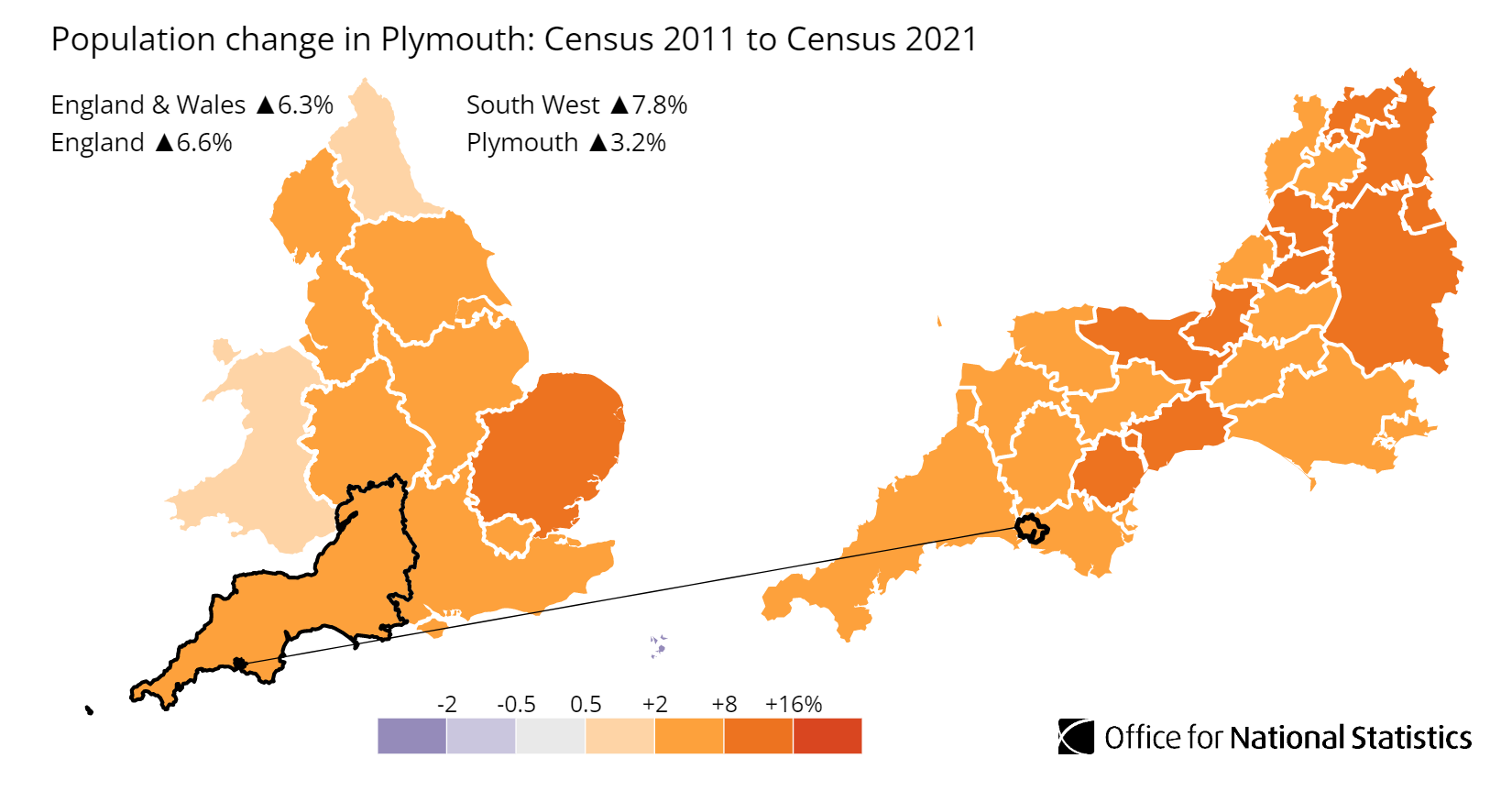
Source: Office for National Statistics - Population for Plymouth
Regeneration and Investment in Plymouth
Plymouth's regeneration is anchored by a generation of defence investment at Devonport, with the AUKUS submarine programme and a major dockyard upgrade tying thousands of skilled jobs to the city for decades. Most regeneration stories rest on commercial developers and a hoped-for footfall; Plymouth's rests on a government commitment to submarine building and maintenance, which is a different kind of certainty.
- AUKUS Submarine Programme and Devonport Dockyard Upgrade (underway): The UK has committed to building a new class of nuclear-powered submarines with maintenance based at Devonport, and Babcock International is part-way through a long upgrade of the dockyard's nuclear-licensed facilities. For a landlord, the relevant point is that this secures highly skilled, well-paid employment in PL1, PL2 and PL5 for decades, not years. Updates at GOV.UK Submarine Delivery Agency.
- Plymouth and South Devon Freeport (operational): One of England's freeports, bringing tax incentives and customs zones focused on marine and defence industries around Devonport and South Yard. The employment it draws in is weighted towards higher-skilled tenants in the western postcodes. Updates at Plymouth City Council.
- Sherford New Town (under construction, 5,500 homes): A new town on Plymouth's eastern edge being built out by national housebuilders, planned to house around 12,000 people. It adds housing supply, but the scale of new community and the jobs that come with it also build their own rental demand on the PL7 and PL9 side of the city. Updates at Sherford.
- Millbay Waterfront (substantially complete): The English Cities Fund scheme that turned the derelict Millbay docks into around 600 new homes, commercial space and a working marina, reconnecting the city centre to the waterfront in PL1. A completed scheme rather than a promised one, which is what gives the rest of the pipeline credibility. Updates at English Cities Fund.
Plymouth Property Market Analysis
Average property prices in Plymouth have risen 417.1% since January 1995, from £42,036 to £217,381. The sections below trace that path cycle by cycle, then drop into postcode-level data for sold prices, price per square foot, asking prices, growth trends and monthly transaction volumes.
When was the last house price crash in Plymouth?
Plymouth is a unitary authority, so all sold prices from HM Land Registry are recorded at city level. The Land Registry House Price Index tracks average prices from January 1995 to March 2026, covering 31 years of market cycles.
The slow 1990s: Plymouth started 1995 at £42,036, and the early years were flat. Prices actually slipped through 1996 and did not recover meaningfully until the end of the decade, reaching £55,113 by December 2000. While London raced ahead, Plymouth spent the late 1990s going almost nowhere.
The 2000 to 2007 boom: Then it caught up sharply. Prices climbed from £55,113 in December 2000 to £128,337 by December 2005 and peaked at £150,527 in August 2007. The fastest growth came in 2004 and 2005, when annual change ran above 20%, pushing prices well past what local wages alone could support.
2007 to 2009, the financial crisis: From the August 2007 peak of £150,527, prices fell to a trough of £121,771 in March 2009, a decline of 19.1% over 19 months. The worst year-on-year reading was -16.9% in March 2009. Plymouth's fall was close to the England decline of 18.2% and broadly in step with the wider South West, without the deeper buffer that higher-value markets enjoyed.
2009 to 2013 stagnation: Prices bounced off the trough but then went sideways. The average traded in a narrow band through the early 2010s, reaching £132,832 by December 2010 and only £137,709 by December 2013, still 8.5% below the pre-crash peak. Plymouth spent four years stuck below where it had been in 2007.
Recovery, 2014 to 2016: Growth returned at a modest pace. Prices rose to £145,834 by December 2014 and finally passed the August 2007 peak in October 2015, at £150,705. That recovery took just over eight years, slower than London and the South East, where prices had cleared their pre-crash highs a year or two earlier.
The 2017 to 2019 steady run: Prices moved up at 1% to 3% a year, from £160,526 in December 2017 to £165,816 in December 2018 and £166,394 by December 2019. Unspectacular but stable, with the naval base providing a floor that more speculative cities lacked.
2020 to 2022, the pandemic surge: The stamp duty holiday and the shift to remote working suited a coastal, relatively affordable city. Prices jumped from £173,447 in December 2020 (4.2% annual) to £190,202 by December 2021 (9.7% annual) and £212,433 by December 2022 (11.7% annual). Plymouth's lifestyle appeal and lower price base made it a clear beneficiary of the relocation trend.
The 2023 rate shock: Higher mortgage rates cooled things. Prices eased to £204,471 by June 2023 and £204,369 by December 2023. The correction was shallow set against the 2008 fall.
2024 to present: Prices recovered, reaching £211,243 by December 2024 and an all-time high of £220,264 in November 2025, before easing slightly to £217,381 by the latest reading in March 2026. The current price is 44.4% above the pre-crash peak of £150,527.
Long-term growth summary:
- 5 years (March 2021 to March 2026): 22.8% growth (£177,046 to £217,381)
- 10 years (March 2016 to March 2026): 44.3% growth (£150,667 to £217,381)
- 15 years (March 2011 to March 2026): 66.7% growth (£130,425 to £217,381)
- 20 years (March 2006 to March 2026): 65.0% growth (£131,717 to £217,381)
- 30 years (January 1995 to March 2026): 417.1% growth (£42,036 to £217,381)
Plymouth's 19.1% crash was about the same depth as the England fall, and the eight-year recovery was on the longer side, reflecting how slowly the South West climbed back between 2010 and 2013. The 30-year return of 417.1% still points to strong long-term capital growth. An investor who bought at the exact peak in August 2007 would be sitting on a 44.4% gain on the Land Registry average today.
- All property types
- Detached
- Semi-detached
- Terraced
- Flats
Source: HM Land Registry House Price Index
| Year | All property types | Detached | Semi-detached | Terraced | Flats |
|---|---|---|---|---|---|
| 1995-01 | £42,036 | £83,486 | £49,712 | £39,841 | £31,173 |
| 1995-02 | £40,946 | £80,769 | £48,628 | £38,794 | £30,302 |
| 1995-03 | £40,768 | £80,111 | £48,410 | £38,664 | £30,156 |
| 1995-04 | £40,415 | £79,018 | £48,028 | £38,346 | £29,917 |
| 1995-05 | £41,131 | £80,197 | £48,791 | £39,074 | £30,491 |
| 1995-06 | £41,302 | £80,621 | £49,010 | £39,179 | £30,744 |
| 1995-07 | £40,645 | £79,625 | £48,228 | £38,571 | £30,117 |
| 1995-08 | £40,265 | £79,447 | £47,805 | £38,196 | £29,668 |
| 1995-09 | £39,670 | £78,376 | £47,058 | £37,701 | £29,037 |
| 1995-10 | £40,129 | £79,365 | £47,707 | £38,048 | £29,478 |
| 1995-11 | £39,256 | £77,642 | £46,735 | £37,135 | £29,011 |
| 1995-12 | £39,022 | £77,238 | £46,556 | £36,846 | £28,891 |
| 1996-01 | £38,540 | £76,455 | £46,051 | £36,374 | £28,441 |
| 1996-02 | £38,644 | £76,555 | £46,261 | £36,488 | £28,408 |
| 1996-03 | £38,676 | £76,720 | £46,404 | £36,496 | £28,347 |
| 1996-04 | £38,517 | £76,082 | £46,096 | £36,426 | £28,300 |
| 1996-05 | £38,577 | £76,006 | £46,034 | £36,600 | £28,259 |
| 1996-06 | £38,994 | £76,579 | £46,389 | £37,053 | £28,722 |
| 1996-07 | £39,348 | £77,486 | £46,857 | £37,375 | £28,860 |
| 1996-08 | £39,791 | £78,743 | £47,368 | £37,768 | £29,137 |
| 1996-09 | £40,350 | £80,425 | £48,055 | £38,270 | £29,354 |
| 1996-10 | £40,478 | £80,883 | £48,260 | £38,358 | £29,388 |
| 1996-11 | £40,629 | £81,008 | £48,476 | £38,497 | £29,524 |
| 1996-12 | £40,309 | £80,083 | £48,156 | £38,220 | £29,223 |
| 1997-01 | £40,689 | £80,808 | £48,588 | £38,623 | £29,410 |
| 1997-02 | £40,841 | £81,363 | £48,830 | £38,706 | £29,520 |
| 1997-03 | £41,137 | £81,969 | £49,122 | £39,026 | £29,716 |
| 1997-04 | £41,162 | £81,669 | £49,163 | £39,089 | £29,739 |
| 1997-05 | £41,281 | £81,633 | £49,327 | £39,272 | £29,684 |
| 1997-06 | £41,408 | £82,062 | £49,500 | £39,403 | £29,620 |
| 1997-07 | £42,297 | £84,093 | £50,518 | £40,286 | £30,088 |
| 1997-08 | £42,682 | £85,229 | £50,931 | £40,644 | £30,298 |
| 1997-09 | £42,916 | £85,726 | £51,189 | £40,875 | £30,457 |
| 1997-10 | £42,896 | £85,909 | £51,263 | £40,764 | £30,474 |
| 1997-11 | £43,069 | £86,408 | £51,571 | £40,875 | £30,537 |
| 1997-12 | £43,101 | £86,567 | £51,781 | £40,815 | £30,512 |
| 1998-01 | £42,497 | £85,566 | £51,001 | £40,262 | £30,020 |
| 1998-02 | £42,839 | £86,050 | £51,411 | £40,561 | £30,427 |
| 1998-03 | £43,779 | £87,859 | £52,471 | £41,489 | £31,092 |
| 1998-04 | £44,116 | £88,163 | £52,928 | £41,835 | £31,292 |
| 1998-05 | £43,946 | £87,633 | £52,628 | £41,788 | £30,982 |
| 1998-06 | £43,228 | £86,223 | £51,699 | £41,111 | £30,549 |
| 1998-07 | £43,809 | £87,553 | £52,338 | £41,665 | £30,979 |
| 1998-08 | £43,993 | £88,331 | £52,510 | £41,813 | £31,126 |
| 1998-09 | £44,139 | £88,878 | £52,693 | £41,958 | £31,111 |
| 1998-10 | £44,059 | £89,009 | £52,693 | £41,785 | £31,142 |
| 1998-11 | £44,105 | £89,434 | £52,915 | £41,705 | £31,238 |
| 1998-12 | £44,053 | £89,068 | £52,893 | £41,626 | £31,338 |
| 1999-01 | £43,573 | £87,932 | £52,299 | £41,199 | £30,988 |
| 1999-02 | £43,415 | £87,297 | £52,110 | £41,086 | £30,863 |
| 1999-03 | £44,612 | £89,792 | £53,590 | £42,186 | £31,727 |
| 1999-04 | £45,520 | £91,160 | £54,619 | £43,129 | £32,323 |
| 1999-05 | £46,156 | £92,135 | £55,273 | £43,800 | £32,784 |
| 1999-06 | £45,905 | £91,527 | £54,877 | £43,637 | £32,506 |
| 1999-07 | £46,325 | £92,756 | £55,308 | £44,053 | £32,712 |
| 1999-08 | £46,742 | £93,821 | £55,722 | £44,491 | £32,894 |
| 1999-09 | £46,737 | £94,122 | £55,629 | £44,477 | £32,938 |
| 1999-10 | £47,018 | £94,955 | £56,114 | £44,604 | £33,329 |
| 1999-11 | £47,254 | £95,425 | £56,505 | £44,756 | £33,608 |
| 1999-12 | £47,601 | £95,841 | £56,943 | £45,061 | £34,000 |
| 2000-01 | £47,589 | £95,968 | £56,905 | £45,080 | £33,869 |
| 2000-02 | £48,221 | £97,597 | £57,677 | £45,651 | £34,264 |
| 2000-03 | £49,081 | £99,604 | £58,846 | £46,458 | £34,617 |
| 2000-04 | £50,375 | £101,726 | £60,265 | £47,741 | £35,660 |
| 2000-05 | £51,006 | £102,681 | £61,035 | £48,336 | £36,200 |
| 2000-06 | £52,034 | £104,514 | £62,214 | £49,283 | £37,156 |
| 2000-07 | £52,515 | £106,203 | £62,926 | £49,650 | £37,390 |
| 2000-08 | £52,701 | £107,099 | £63,200 | £49,720 | £37,640 |
| 2000-09 | £52,842 | £108,266 | £63,344 | £49,768 | £37,766 |
| 2000-10 | £52,854 | £108,471 | £63,543 | £49,664 | £37,869 |
| 2000-11 | £54,240 | £111,620 | £65,202 | £50,931 | £38,888 |
| 2000-12 | £55,113 | £113,091 | £66,348 | £51,719 | £39,608 |
| 2001-01 | £55,513 | £113,891 | £66,688 | £52,136 | £39,935 |
| 2001-02 | £55,861 | £114,251 | £67,087 | £52,530 | £40,087 |
| 2001-03 | £55,963 | £114,583 | £67,244 | £52,644 | £40,001 |
| 2001-04 | £57,265 | £116,977 | £68,612 | £53,967 | £40,937 |
| 2001-05 | £58,612 | £119,206 | £70,096 | £55,291 | £42,017 |
| 2001-06 | £60,117 | £121,734 | £71,715 | £56,709 | £43,417 |
| 2001-07 | £61,723 | £125,038 | £73,690 | £58,175 | £44,632 |
| 2001-08 | £62,559 | £127,284 | £74,633 | £58,909 | £45,304 |
| 2001-09 | £64,700 | £132,343 | £77,038 | £60,931 | £46,818 |
| 2001-10 | £66,027 | £135,156 | £78,693 | £62,102 | £47,888 |
| 2001-11 | £67,041 | £137,378 | £80,130 | £62,922 | £48,713 |
| 2001-12 | £66,796 | £136,344 | £79,968 | £62,559 | £48,892 |
| 2002-01 | £66,804 | £136,430 | £79,954 | £62,490 | £49,112 |
| 2002-02 | £66,293 | £135,212 | £79,092 | £62,101 | £48,796 |
| 2002-03 | £68,615 | £139,683 | £81,916 | £64,333 | £50,356 |
| 2002-04 | £70,407 | £142,576 | £83,886 | £66,047 | £51,947 |
| 2002-05 | £74,226 | £149,510 | £88,515 | £69,609 | £54,935 |
| 2002-06 | £75,760 | £152,322 | £90,110 | £71,066 | £56,337 |
| 2002-07 | £78,487 | £157,836 | £93,293 | £73,698 | £58,219 |
| 2002-08 | £81,077 | £163,121 | £96,268 | £76,141 | £60,201 |
| 2002-09 | £81,908 | £165,166 | £97,495 | £76,889 | £60,560 |
| 2002-10 | £84,033 | £169,684 | £100,428 | £78,700 | £62,149 |
| 2002-11 | £84,542 | £171,052 | £101,091 | £79,091 | £62,617 |
| 2002-12 | £86,489 | £174,225 | £103,491 | £80,851 | £64,347 |
| 2003-01 | £86,900 | £174,432 | £103,588 | £81,384 | £64,816 |
| 2003-02 | £87,816 | £175,382 | £104,832 | £82,198 | £65,683 |
| 2003-03 | £89,147 | £178,217 | £106,379 | £83,431 | £66,714 |
| 2003-04 | £90,580 | £180,565 | £108,455 | £84,615 | £67,960 |
| 2003-05 | £92,330 | £183,824 | £110,558 | £86,343 | £69,071 |
| 2003-06 | £93,165 | £184,473 | £111,284 | £87,250 | £69,900 |
| 2003-07 | £95,218 | £187,735 | £113,634 | £89,352 | £71,257 |
| 2003-08 | £98,330 | £192,915 | £117,161 | £92,393 | £73,697 |
| 2003-09 | £98,516 | £192,995 | £117,496 | £92,691 | £73,446 |
| 2003-10 | £98,838 | £193,207 | £117,722 | £93,073 | £73,747 |
| 2003-11 | £97,976 | £191,380 | £116,805 | £92,257 | £73,036 |
| 2003-12 | £100,927 | £195,344 | £120,075 | £95,167 | £75,620 |
| 2004-01 | £101,055 | £195,386 | £120,176 | £95,321 | £75,734 |
| 2004-02 | £101,152 | £194,522 | £120,130 | £95,559 | £75,859 |
| 2004-03 | £102,706 | £197,695 | £121,849 | £97,078 | £76,921 |
| 2004-04 | £105,431 | £200,231 | £124,824 | £100,061 | £78,919 |
| 2004-05 | £109,722 | £206,014 | £129,390 | £104,501 | £82,300 |
| 2004-06 | £113,783 | £211,474 | £133,967 | £108,569 | £85,565 |
| 2004-07 | £117,835 | £218,679 | £138,847 | £112,520 | £88,433 |
| 2004-08 | £120,441 | £223,740 | £142,016 | £115,016 | £90,257 |
| 2004-09 | £121,525 | £226,608 | £143,390 | £116,140 | £90,648 |
| 2004-10 | £123,616 | £230,623 | £145,591 | £118,041 | £92,571 |
| 2004-11 | £124,510 | £232,002 | £146,522 | £118,874 | £93,433 |
| 2004-12 | £125,597 | £232,506 | £147,498 | £119,954 | £94,718 |
| 2005-01 | £123,729 | £228,556 | £144,923 | £118,342 | £93,375 |
| 2005-02 | £124,627 | £229,550 | £146,001 | £119,256 | £94,043 |
| 2005-03 | £126,692 | £233,503 | £148,608 | £121,308 | £95,280 |
| 2005-04 | £129,162 | £236,808 | £151,764 | £123,771 | £97,017 |
| 2005-05 | £129,528 | £237,255 | £151,857 | £124,256 | £97,347 |
| 2005-06 | £128,583 | £233,525 | £150,302 | £123,730 | £96,677 |
| 2005-07 | £129,722 | £235,599 | £151,584 | £124,946 | £97,381 |
| 2005-08 | £130,157 | £236,150 | £151,935 | £125,594 | £97,499 |
| 2005-09 | £130,454 | £237,635 | £152,273 | £125,889 | £97,555 |
| 2005-10 | £129,632 | £236,007 | £150,904 | £125,136 | £97,175 |
| 2005-11 | £129,004 | £234,645 | £150,285 | £124,467 | £96,764 |
| 2005-12 | £128,337 | £232,086 | £149,097 | £123,827 | £96,762 |
| 2006-01 | £129,062 | £233,259 | £149,824 | £124,749 | £97,065 |
| 2006-02 | £130,450 | £234,646 | £151,073 | £126,313 | £98,192 |
| 2006-03 | £131,717 | £238,136 | £152,984 | £127,598 | £98,552 |
| 2006-04 | £132,877 | £239,299 | £154,369 | £128,819 | £99,392 |
| 2006-05 | £133,380 | £240,208 | £155,050 | £129,326 | £99,671 |
| 2006-06 | £134,353 | £240,557 | £156,019 | £130,479 | £100,399 |
| 2006-07 | £134,639 | £240,947 | £156,156 | £131,057 | £100,290 |
| 2006-08 | £137,874 | £247,239 | £159,958 | £134,506 | £102,116 |
| 2006-09 | £138,963 | £250,171 | £161,182 | £135,614 | £102,719 |
| 2006-10 | £140,298 | £253,080 | £162,792 | £136,759 | £103,833 |
| 2006-11 | £139,758 | £252,232 | £162,334 | £136,203 | £103,347 |
| 2006-12 | £141,739 | £254,419 | £164,403 | £138,335 | £104,873 |
| 2007-01 | £141,329 | £253,532 | £163,971 | £138,054 | £104,379 |
| 2007-02 | £142,157 | £254,355 | £164,661 | £138,711 | £105,468 |
| 2007-03 | £143,480 | £257,435 | £166,411 | £140,027 | £106,170 |
| 2007-04 | £147,037 | £262,684 | £170,245 | £143,809 | £108,734 |
| 2007-05 | £148,503 | £264,179 | £171,707 | £145,563 | £109,701 |
| 2007-06 | £150,132 | £266,362 | £173,226 | £147,317 | £111,034 |
| 2007-07 | £150,314 | £267,361 | £173,430 | £147,489 | £111,080 |
| 2007-08 | £150,527 | £269,301 | £173,809 | £147,915 | £110,613 |
| 2007-09 | £149,471 | £268,288 | £172,663 | £146,865 | £109,673 |
| 2007-10 | £149,679 | £269,353 | £172,797 | £146,866 | £110,072 |
| 2007-11 | £150,491 | £271,119 | £173,798 | £147,406 | £110,933 |
| 2007-12 | £150,297 | £270,737 | £173,421 | £147,140 | £111,002 |
| 2008-01 | £149,293 | £269,455 | £172,313 | £146,083 | £110,251 |
| 2008-02 | £147,154 | £265,666 | £169,890 | £143,898 | £108,785 |
| 2008-03 | £146,498 | £265,601 | £169,840 | £143,207 | £107,835 |
| 2008-04 | £146,563 | £266,087 | £170,154 | £143,439 | £107,516 |
| 2008-05 | £145,907 | £264,225 | £169,425 | £143,068 | £106,765 |
| 2008-06 | £144,242 | £260,175 | £167,163 | £141,644 | £105,578 |
| 2008-07 | £141,244 | £254,359 | £163,938 | £138,680 | £103,337 |
| 2008-08 | £139,169 | £251,253 | £161,443 | £136,678 | £101,742 |
| 2008-09 | £135,948 | £247,629 | £157,694 | £133,277 | £99,422 |
| 2008-10 | £135,186 | £246,858 | £156,692 | £132,372 | £99,041 |
| 2008-11 | £133,231 | £243,647 | £154,786 | £130,248 | £97,645 |
| 2008-12 | £132,547 | £241,353 | £154,100 | £129,829 | £96,912 |
| 2009-01 | £126,462 | £230,875 | £146,980 | £123,810 | £92,484 |
| 2009-02 | £124,562 | £227,705 | £144,582 | £121,886 | £91,265 |
| 2009-03 | £121,771 | £222,806 | £141,230 | £118,854 | £89,726 |
| 2009-04 | £124,623 | £226,885 | £144,727 | £121,789 | £91,678 |
| 2009-05 | £124,672 | £226,182 | £144,795 | £122,152 | £91,383 |
| 2009-06 | £126,352 | £229,060 | £146,944 | £124,162 | £91,919 |
| 2009-07 | £127,076 | £230,897 | £147,852 | £125,265 | £91,685 |
| 2009-08 | £128,475 | £234,404 | £149,622 | £126,803 | £92,129 |
| 2009-09 | £129,381 | £236,759 | £150,882 | £127,768 | £92,354 |
| 2009-10 | £130,304 | £238,962 | £152,267 | £128,641 | £92,714 |
| 2009-11 | £132,113 | £242,929 | £154,481 | £130,621 | £93,496 |
| 2009-12 | £133,669 | £244,404 | £156,423 | £132,469 | £94,328 |
| 2010-01 | £134,051 | £247,076 | £157,193 | £132,995 | £93,731 |
| 2010-02 | £132,764 | £245,473 | £156,209 | £131,696 | £92,288 |
| 2010-03 | £133,760 | £249,913 | £157,547 | £132,350 | £92,805 |
| 2010-04 | £134,085 | £249,288 | £157,872 | £132,653 | £93,342 |
| 2010-05 | £135,567 | £252,075 | £159,386 | £134,122 | £94,543 |
| 2010-06 | £135,857 | £252,052 | £159,786 | £134,744 | £94,305 |
| 2010-07 | £136,873 | £255,016 | £160,999 | £135,965 | £94,471 |
| 2010-08 | £137,001 | £256,033 | £161,687 | £136,020 | £94,102 |
| 2010-09 | £136,482 | £256,529 | £161,211 | £135,405 | £93,498 |
| 2010-10 | £136,635 | £257,099 | £161,596 | £135,279 | £93,805 |
| 2010-11 | £135,425 | £255,521 | £160,021 | £133,905 | £93,214 |
| 2010-12 | £132,832 | £250,198 | £157,084 | £131,234 | £91,572 |
| 2011-01 | £130,994 | £247,051 | £154,730 | £129,439 | £90,352 |
| 2011-02 | £130,775 | £246,429 | £154,224 | £129,357 | £90,261 |
| 2011-03 | £130,425 | £247,127 | £153,796 | £128,912 | £89,911 |
| 2011-04 | £129,313 | £244,895 | £152,486 | £127,832 | £89,145 |
| 2011-05 | £129,020 | £243,565 | £152,177 | £127,472 | £89,222 |
| 2011-06 | £131,602 | £246,592 | £155,169 | £130,185 | £91,237 |
| 2011-07 | £131,716 | £246,015 | £155,269 | £130,306 | £91,534 |
| 2011-08 | £131,760 | £246,744 | £155,608 | £130,533 | £90,815 |
| 2011-09 | £131,512 | £247,407 | £155,351 | £130,373 | £90,177 |
| 2011-10 | £130,820 | £247,283 | £154,885 | £129,587 | £89,257 |
| 2011-11 | £129,928 | £245,372 | £153,808 | £128,486 | £89,100 |
| 2011-12 | £127,314 | £239,954 | £150,892 | £125,756 | £87,513 |
| 2012-01 | £130,753 | £245,538 | £154,935 | £129,381 | £89,734 |
| 2012-02 | £131,716 | £246,943 | £156,065 | £130,691 | £89,883 |
| 2012-03 | £134,148 | £250,089 | £158,821 | £133,397 | £91,522 |
| 2012-04 | £131,823 | £245,853 | £155,958 | £131,009 | £90,159 |
| 2012-05 | £132,639 | £247,472 | £156,925 | £131,668 | £90,969 |
| 2012-06 | £133,265 | £248,759 | £157,433 | £132,538 | £91,139 |
| 2012-07 | £134,784 | £250,851 | £159,072 | £134,386 | £91,911 |
| 2012-08 | £134,637 | £250,034 | £158,857 | £134,622 | £91,301 |
| 2012-09 | £132,635 | £247,387 | £156,619 | £132,453 | £89,840 |
| 2012-10 | £131,156 | £244,850 | £155,044 | £130,866 | £88,815 |
| 2012-11 | £130,843 | £244,775 | £154,737 | £130,415 | £88,656 |
| 2012-12 | £132,528 | £248,015 | £156,870 | £132,133 | £89,572 |
| 2013-01 | £134,600 | £252,210 | £159,655 | £134,128 | £90,695 |
| 2013-02 | £134,758 | £252,550 | £159,796 | £134,347 | £90,726 |
| 2013-03 | £133,407 | £250,533 | £158,348 | £132,820 | £89,849 |
| 2013-04 | £132,699 | £249,001 | £157,266 | £132,249 | £89,417 |
| 2013-05 | £134,403 | £251,576 | £159,300 | £133,978 | £90,660 |
| 2013-06 | £136,206 | £253,644 | £161,273 | £136,125 | £91,783 |
| 2013-07 | £136,191 | £253,298 | £161,128 | £136,223 | £91,785 |
| 2013-08 | £136,440 | £253,946 | £161,438 | £136,549 | £91,765 |
| 2013-09 | £136,106 | £254,703 | £161,140 | £135,990 | £91,469 |
| 2013-10 | £136,631 | £256,966 | £162,052 | £136,263 | £91,657 |
| 2013-11 | £136,711 | £257,900 | £162,453 | £136,096 | £91,643 |
| 2013-12 | £137,709 | £258,564 | £163,908 | £137,018 | £92,498 |
| 2014-01 | £138,748 | £260,064 | £165,002 | £138,075 | £93,396 |
| 2014-02 | £139,075 | £260,667 | £165,264 | £138,429 | £93,694 |
| 2014-03 | £139,201 | £261,226 | £165,409 | £138,535 | £93,724 |
| 2014-04 | £141,199 | £264,117 | £167,688 | £140,779 | £94,951 |
| 2014-05 | £141,986 | £264,511 | £168,536 | £141,767 | £95,482 |
| 2014-06 | £143,403 | £267,107 | £170,270 | £143,273 | £96,260 |
| 2014-07 | £143,783 | £268,058 | £170,780 | £143,711 | £96,321 |
| 2014-08 | £145,676 | £272,411 | £173,165 | £145,608 | £97,281 |
| 2014-09 | £146,460 | £274,188 | £173,913 | £146,439 | £97,808 |
| 2014-10 | £145,782 | £273,255 | £173,249 | £145,573 | £97,456 |
| 2014-11 | £145,364 | £273,007 | £172,944 | £144,853 | £97,367 |
| 2014-12 | £145,834 | £274,233 | £173,571 | £145,129 | £97,843 |
| 2015-01 | £145,404 | £273,344 | £173,136 | £144,623 | £97,635 |
| 2015-02 | £144,090 | £270,095 | £171,082 | £143,498 | £97,021 |
| 2015-03 | £144,898 | £272,128 | £172,263 | £144,092 | £97,601 |
| 2015-04 | £147,344 | £277,144 | £175,168 | £146,547 | £99,123 |
| 2015-05 | £149,101 | £280,587 | £177,708 | £148,128 | £100,192 |
| 2015-06 | £148,436 | £278,640 | £177,072 | £147,832 | £99,225 |
| 2015-07 | £148,592 | £278,385 | £177,416 | £148,020 | £99,285 |
| 2015-08 | £149,128 | £279,693 | £178,068 | £148,717 | £99,323 |
| 2015-09 | £149,916 | £282,461 | £178,892 | £149,283 | £99,981 |
| 2015-10 | £150,705 | £285,173 | £180,103 | £149,908 | £100,288 |
| 2015-11 | £150,869 | £286,070 | £180,511 | £149,913 | £100,351 |
| 2015-12 | £151,700 | £287,765 | £181,695 | £150,731 | £100,752 |
| 2016-01 | £151,611 | £287,023 | £181,740 | £150,627 | £100,729 |
| 2016-02 | £150,899 | £285,329 | £180,865 | £149,935 | £100,324 |
| 2016-03 | £150,667 | £284,364 | £180,442 | £149,605 | £100,544 |
| 2016-04 | £150,689 | £284,764 | £180,315 | £149,711 | £100,464 |
| 2016-05 | £153,528 | £289,541 | £183,403 | £152,537 | £102,706 |
| 2016-06 | £155,706 | £293,817 | £185,892 | £154,800 | £104,059 |
| 2016-07 | £156,681 | £294,963 | £186,734 | £155,891 | £104,913 |
| 2016-08 | £155,807 | £293,815 | £185,821 | £154,964 | £104,209 |
| 2016-09 | £154,796 | £292,123 | £184,897 | £153,827 | £103,481 |
| 2016-10 | £154,404 | £292,938 | £184,781 | £152,869 | £103,487 |
| 2016-11 | £154,038 | £294,010 | £184,606 | £152,064 | £103,343 |
| 2016-12 | £152,801 | £292,125 | £182,926 | £150,644 | £102,861 |
| 2017-01 | £154,062 | £294,808 | £184,283 | £151,901 | £103,739 |
| 2017-02 | £155,509 | £296,792 | £185,518 | £153,335 | £105,232 |
| 2017-03 | £157,450 | £300,657 | £187,850 | £155,105 | £106,713 |
| 2017-04 | £157,470 | £299,989 | £187,523 | £155,186 | £107,036 |
| 2017-05 | £157,881 | £299,941 | £188,274 | £155,515 | £107,413 |
| 2017-06 | £159,134 | £300,974 | £189,496 | £156,983 | £108,393 |
| 2017-07 | £160,062 | £302,233 | £190,769 | £157,825 | £109,115 |
| 2017-08 | £162,317 | £306,426 | £193,221 | £160,478 | £110,188 |
| 2017-09 | £164,450 | £311,425 | £195,861 | £162,569 | £111,385 |
| 2017-10 | £164,163 | £311,614 | £195,830 | £162,348 | £110,715 |
| 2017-11 | £162,639 | £309,751 | £194,614 | £160,519 | £109,519 |
| 2017-12 | £160,526 | £305,523 | £192,561 | £158,413 | £107,821 |
| 2018-01 | £161,300 | £306,976 | £193,644 | £159,042 | £108,435 |
| 2018-02 | £162,383 | £309,057 | £194,768 | £160,310 | £108,981 |
| 2018-03 | £162,597 | £309,929 | £195,035 | £160,597 | £108,896 |
| 2018-04 | £161,624 | £308,140 | £193,945 | £160,019 | £107,580 |
| 2018-05 | £162,609 | £310,075 | £195,320 | £161,163 | £107,815 |
| 2018-06 | £164,439 | £313,414 | £197,771 | £162,914 | £108,962 |
| 2018-07 | £165,957 | £316,657 | £199,516 | £164,372 | £110,030 |
| 2018-08 | £165,872 | £316,430 | £199,448 | £164,243 | £110,029 |
| 2018-09 | £165,891 | £316,891 | £199,331 | £164,393 | £109,859 |
| 2018-10 | £166,544 | £318,313 | £200,362 | £164,872 | £110,328 |
| 2018-11 | £165,808 | £318,078 | £199,769 | £164,040 | £109,541 |
| 2018-12 | £165,816 | £318,040 | £199,977 | £163,867 | £109,691 |
| 2019-01 | £165,606 | £318,489 | £199,963 | £163,550 | £109,368 |
| 2019-02 | £164,860 | £316,793 | £198,957 | £162,775 | £109,089 |
| 2019-03 | £163,680 | £315,033 | £197,918 | £161,675 | £107,817 |
| 2019-04 | £168,247 | £322,716 | £203,324 | £166,500 | £110,664 |
| 2019-05 | £168,508 | £322,409 | £203,895 | £167,029 | £110,383 |
| 2019-06 | £168,431 | £321,527 | £203,698 | £167,016 | £110,481 |
| 2019-07 | £163,513 | £311,660 | £197,552 | £162,223 | £107,390 |
| 2019-08 | £165,087 | £314,532 | £199,147 | £164,057 | £108,268 |
| 2019-09 | £164,917 | £313,858 | £198,410 | £164,238 | £108,108 |
| 2019-10 | £163,696 | £311,827 | £197,527 | £162,894 | £106,973 |
| 2019-11 | £164,068 | £313,408 | £198,747 | £162,824 | £107,102 |
| 2019-12 | £166,394 | £318,792 | £202,319 | £164,850 | £108,253 |
| 2020-01 | £167,453 | £321,457 | £203,643 | £165,982 | £108,638 |
| 2020-02 | £168,522 | £323,061 | £204,578 | £167,327 | £109,328 |
| 2020-03 | £166,959 | £319,810 | £202,541 | £165,906 | £108,327 |
| 2020-04 | £167,937 | £322,454 | £203,769 | £167,112 | £108,359 |
| 2020-05 | £167,313 | £322,181 | £203,397 | £166,189 | £107,844 |
| 2020-06 | £169,405 | £325,531 | £206,135 | £168,385 | £109,002 |
| 2020-07 | £169,709 | £324,733 | £206,356 | £168,671 | £109,710 |
| 2020-08 | £170,450 | £325,984 | £207,326 | £169,835 | £109,503 |
| 2020-09 | £169,686 | £325,675 | £206,346 | £169,215 | £108,536 |
| 2020-10 | £171,657 | £330,270 | £208,795 | £171,325 | £109,317 |
| 2020-11 | £172,471 | £331,383 | £209,366 | £172,250 | £110,156 |
| 2020-12 | £173,447 | £332,726 | £210,269 | £173,478 | £110,781 |
| 2021-01 | £174,135 | £330,931 | £210,597 | £174,309 | £112,272 |
| 2021-02 | £174,396 | £328,179 | £210,205 | £174,827 | £113,524 |
| 2021-03 | £177,046 | £329,763 | £212,631 | £177,657 | £116,554 |
| 2021-04 | £177,215 | £329,900 | £212,390 | £177,993 | £116,843 |
| 2021-05 | £177,331 | £330,690 | £212,610 | £178,080 | £116,733 |
| 2021-06 | £179,245 | £333,315 | £214,496 | £180,443 | £117,868 |
| 2021-07 | £181,267 | £337,333 | £217,411 | £182,221 | £119,115 |
| 2021-08 | £184,958 | £345,053 | £222,364 | £185,915 | £120,840 |
| 2021-09 | £186,917 | £349,560 | £225,306 | £187,690 | £121,659 |
| 2021-10 | £188,815 | £356,238 | £227,846 | £189,425 | £122,098 |
| 2021-11 | £191,272 | £362,066 | £230,953 | £191,731 | £123,509 |
| 2021-12 | £190,202 | £362,512 | £229,956 | £190,477 | £122,172 |
| 2022-01 | £193,171 | £366,382 | £233,689 | £193,868 | £123,697 |
| 2022-02 | £193,387 | £365,806 | £233,889 | £194,087 | £124,127 |
| 2022-03 | £195,789 | £370,538 | £237,423 | £196,235 | £125,491 |
| 2022-04 | £197,060 | £372,514 | £238,651 | £197,742 | £126,297 |
| 2022-05 | £202,534 | £382,564 | £245,383 | £203,615 | £129,166 |
| 2022-06 | £205,202 | £386,448 | £248,403 | £206,596 | £130,849 |
| 2022-07 | £207,877 | £390,522 | £251,946 | £209,610 | £132,019 |
| 2022-08 | £209,224 | £392,634 | £253,353 | £211,538 | £132,246 |
| 2022-09 | £211,219 | £396,531 | £255,644 | £214,005 | £132,841 |
| 2022-10 | £211,251 | £397,905 | £255,767 | £213,794 | £132,853 |
| 2022-11 | £210,188 | £396,621 | £254,689 | £212,474 | £132,222 |
| 2022-12 | £212,433 | £400,579 | £257,535 | £214,551 | £133,910 |
| 2023-01 | £210,550 | £397,195 | £255,503 | £212,575 | £132,594 |
| 2023-02 | £207,482 | £392,351 | £251,806 | £209,095 | £130,916 |
| 2023-03 | £204,350 | £388,604 | £248,586 | £205,262 | £128,936 |
| 2023-04 | £206,038 | £392,664 | £250,791 | £206,748 | £130,056 |
| 2023-05 | £205,748 | £391,370 | £250,623 | £206,316 | £130,041 |
| 2023-06 | £204,471 | £387,540 | £248,547 | £205,638 | £128,981 |
| 2023-07 | £205,570 | £388,118 | £249,853 | £207,215 | £129,336 |
| 2023-08 | £206,461 | £389,407 | £250,855 | £208,842 | £129,139 |
| 2023-09 | £206,264 | £388,969 | £250,726 | £208,819 | £128,763 |
| 2023-10 | £204,053 | £383,942 | £247,609 | £206,519 | £127,793 |
| 2023-11 | £204,407 | £385,748 | £248,422 | £206,347 | £128,280 |
| 2023-12 | £204,369 | £385,533 | £248,497 | £206,036 | £128,529 |
| 2024-01 | £204,051 | £385,717 | £248,290 | £205,768 | £128,068 |
| 2024-02 | £203,573 | £382,756 | £247,467 | £205,663 | £127,765 |
| 2024-03 | £203,236 | £381,310 | £246,753 | £205,395 | £127,846 |
| 2024-04 | £204,501 | £381,958 | £248,054 | £206,752 | £129,012 |
| 2024-05 | £204,055 | £380,404 | £247,288 | £206,194 | £129,153 |
| 2024-06 | £205,987 | £383,310 | £249,492 | £208,446 | £130,204 |
| 2024-07 | £206,051 | £383,316 | £249,546 | £208,964 | £129,692 |
| 2024-08 | £206,982 | £385,326 | £250,590 | £210,404 | £129,631 |
| 2024-09 | £210,449 | £393,249 | £255,294 | £213,944 | £131,181 |
| 2024-10 | £212,934 | £399,010 | £258,203 | £216,117 | £133,050 |
| 2024-11 | £213,190 | £400,377 | £259,133 | £216,071 | £133,042 |
| 2024-12 | £211,243 | £397,618 | £256,775 | £214,113 | £131,637 |
| 2025-01 | £208,491 | £393,166 | £254,113 | £211,456 | £129,178 |
| 2025-02 | £210,642 | £397,032 | £256,452 | £213,824 | £130,506 |
| 2025-03 | £211,279 | £393,786 | £256,490 | £214,622 | £132,076 |
| 2025-04 | £210,370 | £394,092 | £255,962 | £213,347 | £131,193 |
| 2025-05 | £211,071 | £396,242 | £257,254 | £214,198 | £131,002 |
| 2025-06 | £213,422 | £404,093 | £261,387 | £216,591 | £130,919 |
| 2025-07 | £218,618 | £411,221 | £267,422 | £222,579 | £133,921 |
| 2025-08 | £216,812 | £407,078 | £265,623 | £220,904 | £132,461 |
| 2025-09 | £215,963 | £406,040 | £264,836 | £220,340 | £131,300 |
| 2025-10 | £215,897 | £405,990 | £265,052 | £220,257 | £131,060 |
| 2025-11 | £220,264 | £414,083 | £270,352 | £224,867 | £133,587 |
| 2025-12 | £219,707 | £411,724 | £269,473 | £224,503 | £133,362 |
| 2026-01 | £218,208 | £408,601 | £267,789 | £223,338 | £131,956 |
| 2026-02 | £217,269 | £407,462 | £266,966 | £222,377 | £131,061 |
| 2026-03 | £217,381 | £408,423 | £267,828 | £222,687 | £130,222 |
- All property types
- Detached
- Semi-detached
- Terraced
- Flats
Source: HM Land Registry House Price Index
| Year | All property types | Detached | Semi-detached | Terraced | Flats |
|---|---|---|---|---|---|
| 1996-01 | -8.3% | -8.4% | -7.4% | -8.7% | -8.8% |
| 1996-02 | -5.6% | -5.2% | -4.9% | -5.9% | -6.3% |
| 1996-03 | -5.1% | -4.2% | -4.1% | -5.6% | -6.0% |
| 1996-04 | -4.7% | -3.7% | -4.0% | -5.0% | -5.4% |
| 1996-05 | -6.2% | -5.2% | -5.6% | -6.3% | -7.3% |
| 1996-06 | -5.6% | -5.0% | -5.3% | -5.4% | -6.6% |
| 1996-07 | -3.2% | -2.7% | -2.8% | -3.1% | -4.2% |
| 1996-08 | -1.2% | -0.9% | -0.9% | -1.1% | -1.8% |
| 1996-09 | +1.7% | +2.6% | +2.1% | +1.5% | +1.1% |
| 1996-10 | +0.9% | +1.9% | +1.2% | +0.8% | -0.3% |
| 1996-11 | +3.5% | +4.3% | +3.7% | +3.7% | +1.8% |
| 1996-12 | +3.3% | +3.7% | +3.4% | +3.7% | +1.1% |
| 1997-01 | +5.6% | +5.7% | +5.5% | +6.2% | +3.4% |
| 1997-02 | +5.7% | +6.3% | +5.6% | +6.1% | +3.9% |
| 1997-03 | +6.4% | +6.8% | +5.9% | +6.9% | +4.8% |
| 1997-04 | +6.9% | +7.3% | +6.7% | +7.3% | +5.1% |
| 1997-05 | +7.0% | +7.4% | +7.2% | +7.3% | +5.0% |
| 1997-06 | +6.2% | +7.2% | +6.7% | +6.3% | +3.1% |
| 1997-07 | +7.5% | +8.5% | +7.8% | +7.8% | +4.3% |
| 1997-08 | +7.3% | +8.2% | +7.5% | +7.6% | +4.0% |
| 1997-09 | +6.4% | +6.6% | +6.5% | +6.8% | +3.8% |
| 1997-10 | +6.0% | +6.2% | +6.2% | +6.3% | +3.7% |
| 1997-11 | +6.0% | +6.7% | +6.4% | +6.2% | +3.4% |
| 1997-12 | +6.9% | +8.1% | +7.5% | +6.8% | +4.4% |
| 1998-01 | +4.4% | +5.9% | +5.0% | +4.2% | +2.1% |
| 1998-02 | +4.9% | +5.8% | +5.3% | +4.8% | +3.1% |
| 1998-03 | +6.4% | +7.2% | +6.8% | +6.3% | +4.6% |
| 1998-04 | +7.2% | +8.0% | +7.7% | +7.0% | +5.2% |
| 1998-05 | +6.5% | +7.3% | +6.7% | +6.4% | +4.4% |
| 1998-06 | +4.4% | +5.1% | +4.4% | +4.3% | +3.1% |
| 1998-07 | +3.6% | +4.1% | +3.6% | +3.4% | +3.0% |
| 1998-08 | +3.1% | +3.6% | +3.1% | +2.9% | +2.7% |
| 1998-09 | +2.9% | +3.7% | +2.9% | +2.6% | +2.1% |
| 1998-10 | +2.7% | +3.6% | +2.8% | +2.5% | +2.2% |
| 1998-11 | +2.4% | +3.5% | +2.6% | +2.0% | +2.3% |
| 1998-12 | +2.2% | +2.9% | +2.1% | +2.0% | +2.7% |
| 1999-01 | +2.5% | +2.8% | +2.5% | +2.3% | +3.2% |
| 1999-02 | +1.3% | +1.4% | +1.4% | +1.3% | +1.4% |
| 1999-03 | +1.9% | +2.2% | +2.1% | +1.7% | +2.0% |
| 1999-04 | +3.2% | +3.4% | +3.2% | +3.1% | +3.3% |
| 1999-05 | +5.0% | +5.1% | +5.0% | +4.8% | +5.8% |
| 1999-06 | +6.2% | +6.2% | +6.1% | +6.1% | +6.4% |
| 1999-07 | +5.7% | +5.9% | +5.7% | +5.7% | +5.6% |
| 1999-08 | +6.2% | +6.2% | +6.1% | +6.4% | +5.7% |
| 1999-09 | +5.9% | +5.9% | +5.6% | +6.0% | +5.9% |
| 1999-10 | +6.7% | +6.7% | +6.5% | +6.7% | +7.0% |
| 1999-11 | +7.1% | +6.7% | +6.8% | +7.3% | +7.6% |
| 1999-12 | +8.1% | +7.6% | +7.7% | +8.3% | +8.5% |
| 2000-01 | +9.2% | +9.1% | +8.8% | +9.4% | +9.3% |
| 2000-02 | +11.1% | +11.8% | +10.7% | +11.1% | +11.0% |
| 2000-03 | +10.0% | +10.9% | +9.8% | +10.1% | +9.1% |
| 2000-04 | +10.7% | +11.6% | +10.3% | +10.7% | +10.3% |
| 2000-05 | +10.5% | +11.4% | +10.4% | +10.4% | +10.4% |
| 2000-06 | +13.4% | +14.2% | +13.4% | +12.9% | +14.3% |
| 2000-07 | +13.4% | +14.5% | +13.8% | +12.7% | +14.3% |
| 2000-08 | +12.7% | +14.2% | +13.4% | +11.8% | +14.4% |
| 2000-09 | +13.1% | +15.0% | +13.9% | +11.9% | +14.7% |
| 2000-10 | +12.4% | +14.2% | +13.2% | +11.3% | +13.6% |
| 2000-11 | +14.8% | +17.0% | +15.4% | +13.8% | +15.7% |
| 2000-12 | +15.8% | +18.0% | +16.5% | +14.8% | +16.5% |
| 2001-01 | +16.7% | +18.7% | +17.2% | +15.7% | +17.9% |
| 2001-02 | +15.8% | +17.1% | +16.3% | +15.1% | +17.0% |
| 2001-03 | +14.0% | +15.0% | +14.3% | +13.3% | +15.6% |
| 2001-04 | +13.7% | +15.0% | +13.8% | +13.0% | +14.8% |
| 2001-05 | +14.9% | +16.1% | +14.8% | +14.4% | +16.1% |
| 2001-06 | +15.5% | +16.5% | +15.3% | +15.1% | +16.8% |
| 2001-07 | +17.5% | +17.7% | +17.1% | +17.2% | +19.4% |
| 2001-08 | +18.7% | +18.8% | +18.1% | +18.5% | +20.4% |
| 2001-09 | +22.4% | +22.2% | +21.6% | +22.4% | +24.0% |
| 2001-10 | +24.9% | +24.6% | +23.8% | +25.0% | +26.5% |
| 2001-11 | +23.6% | +23.1% | +22.9% | +23.5% | +25.3% |
| 2001-12 | +21.2% | +20.6% | +20.5% | +21.0% | +23.4% |
| 2002-01 | +20.3% | +19.8% | +19.9% | +19.9% | +23.0% |
| 2002-02 | +18.7% | +18.3% | +17.9% | +18.2% | +21.7% |
| 2002-03 | +22.6% | +21.9% | +21.8% | +22.2% | +25.9% |
| 2002-04 | +23.0% | +21.9% | +22.3% | +22.4% | +26.9% |
| 2002-05 | +26.6% | +25.4% | +26.3% | +25.9% | +30.7% |
| 2002-06 | +26.0% | +25.1% | +25.7% | +25.3% | +29.8% |
| 2002-07 | +27.2% | +26.2% | +26.6% | +26.7% | +30.4% |
| 2002-08 | +29.6% | +28.2% | +29.0% | +29.3% | +32.9% |
| 2002-09 | +26.6% | +24.8% | +26.6% | +26.2% | +29.4% |
| 2002-10 | +27.3% | +25.5% | +27.6% | +26.7% | +29.8% |
| 2002-11 | +26.1% | +24.5% | +26.2% | +25.7% | +28.5% |
| 2002-12 | +29.5% | +27.8% | +29.4% | +29.2% | +31.6% |
| 2003-01 | +30.1% | +27.9% | +29.6% | +30.2% | +32.0% |
| 2003-02 | +32.5% | +29.7% | +32.5% | +32.4% | +34.6% |
| 2003-03 | +29.9% | +27.6% | +29.9% | +29.7% | +32.5% |
| 2003-04 | +28.7% | +26.6% | +29.3% | +28.1% | +30.8% |
| 2003-05 | +24.4% | +23.0% | +24.9% | +24.0% | +25.7% |
| 2003-06 | +23.0% | +21.1% | +23.5% | +22.8% | +24.1% |
| 2003-07 | +21.3% | +18.9% | +21.8% | +21.2% | +22.4% |
| 2003-08 | +21.3% | +18.3% | +21.7% | +21.3% | +22.4% |
| 2003-09 | +20.3% | +16.8% | +20.5% | +20.6% | +21.3% |
| 2003-10 | +17.6% | +13.9% | +17.2% | +18.3% | +18.7% |
| 2003-11 | +15.9% | +11.9% | +15.5% | +16.6% | +16.6% |
| 2003-12 | +16.7% | +12.1% | +16.0% | +17.7% | +17.5% |
| 2004-01 | +16.3% | +12.0% | +16.0% | +17.1% | +16.8% |
| 2004-02 | +15.2% | +10.9% | +14.6% | +16.3% | +15.5% |
| 2004-03 | +15.2% | +10.9% | +14.5% | +16.4% | +15.3% |
| 2004-04 | +16.4% | +10.9% | +15.1% | +18.3% | +16.1% |
| 2004-05 | +18.8% | +12.1% | +17.0% | +21.0% | +19.2% |
| 2004-06 | +22.1% | +14.6% | +20.4% | +24.4% | +22.4% |
| 2004-07 | +23.8% | +16.5% | +22.2% | +25.9% | +24.1% |
| 2004-08 | +22.5% | +16.0% | +21.2% | +24.5% | +22.5% |
| 2004-09 | +23.4% | +17.4% | +22.0% | +25.3% | +23.4% |
| 2004-10 | +25.1% | +19.4% | +23.7% | +26.8% | +25.5% |
| 2004-11 | +27.1% | +21.2% | +25.4% | +28.9% | +27.9% |
| 2004-12 | +24.4% | +19.0% | +22.8% | +26.0% | +25.3% |
| 2005-01 | +22.4% | +17.0% | +20.6% | +24.2% | +23.3% |
| 2005-02 | +23.2% | +18.0% | +21.5% | +24.8% | +24.0% |
| 2005-03 | +23.4% | +18.1% | +22.0% | +25.0% | +23.9% |
| 2005-04 | +22.5% | +18.3% | +21.6% | +23.7% | +22.9% |
| 2005-05 | +18.1% | +15.2% | +17.4% | +18.9% | +18.3% |
| 2005-06 | +13.0% | +10.4% | +12.2% | +14.0% | +13.0% |
| 2005-07 | +10.1% | +7.7% | +9.2% | +11.0% | +10.1% |
| 2005-08 | +8.1% | +5.5% | +7.0% | +9.2% | +8.0% |
| 2005-09 | +7.3% | +4.9% | +6.2% | +8.4% | +7.6% |
| 2005-10 | +4.9% | +2.3% | +3.6% | +6.0% | +5.0% |
| 2005-11 | +3.6% | +1.1% | +2.6% | +4.7% | +3.6% |
| 2005-12 | +2.2% | -0.2% | +1.1% | +3.2% | +2.2% |
| 2006-01 | +4.3% | +2.1% | +3.4% | +5.4% | +4.0% |
| 2006-02 | +4.7% | +2.2% | +3.5% | +5.9% | +4.4% |
| 2006-03 | +4.0% | +2.0% | +2.9% | +5.2% | +3.4% |
| 2006-04 | +2.9% | +1.1% | +1.7% | +4.1% | +2.4% |
| 2006-05 | +3.0% | +1.2% | +2.1% | +4.1% | +2.4% |
| 2006-06 | +4.5% | +3.0% | +3.8% | +5.5% | +3.8% |
| 2006-07 | +3.8% | +2.3% | +3.0% | +4.9% | +3.0% |
| 2006-08 | +5.9% | +4.7% | +5.3% | +7.1% | +4.7% |
| 2006-09 | +6.5% | +5.3% | +5.9% | +7.7% | +5.3% |
| 2006-10 | +8.2% | +7.2% | +7.9% | +9.3% | +6.9% |
| 2006-11 | +8.3% | +7.5% | +8.0% | +9.4% | +6.8% |
| 2006-12 | +10.4% | +9.6% | +10.3% | +11.7% | +8.4% |
| 2007-01 | +9.5% | +8.7% | +9.4% | +10.7% | +7.5% |
| 2007-02 | +9.0% | +8.4% | +9.0% | +9.8% | +7.4% |
| 2007-03 | +8.9% | +8.1% | +8.8% | +9.7% | +7.7% |
| 2007-04 | +10.7% | +9.8% | +10.3% | +11.6% | +9.4% |
| 2007-05 | +11.3% | +10.0% | +10.7% | +12.6% | +10.1% |
| 2007-06 | +11.7% | +10.7% | +11.0% | +12.9% | +10.6% |
| 2007-07 | +11.6% | +11.0% | +11.1% | +12.5% | +10.8% |
| 2007-08 | +9.2% | +8.9% | +8.7% | +10.0% | +8.3% |
| 2007-09 | +7.6% | +7.2% | +7.1% | +8.3% | +6.8% |
| 2007-10 | +6.7% | +6.4% | +6.1% | +7.4% | +6.0% |
| 2007-11 | +7.7% | +7.5% | +7.1% | +8.2% | +7.3% |
| 2007-12 | +6.0% | +6.4% | +5.5% | +6.4% | +5.8% |
| 2008-01 | +5.6% | +6.3% | +5.1% | +5.8% | +5.6% |
| 2008-02 | +3.5% | +4.4% | +3.2% | +3.7% | +3.1% |
| 2008-03 | +2.1% | +3.2% | +2.1% | +2.3% | +1.6% |
| 2008-04 | -0.3% | +1.3% | -0.1% | -0.3% | -1.1% |
| 2008-05 | -1.7% | 0.0% | -1.3% | -1.7% | -2.7% |
| 2008-06 | -3.9% | -2.3% | -3.5% | -3.9% | -4.9% |
| 2008-07 | -6.0% | -4.9% | -5.5% | -6.0% | -7.0% |
| 2008-08 | -7.5% | -6.7% | -7.1% | -7.6% | -8.0% |
| 2008-09 | -9.0% | -7.7% | -8.7% | -9.3% | -9.3% |
| 2008-10 | -9.7% | -8.4% | -9.3% | -9.9% | -10.0% |
| 2008-11 | -11.5% | -10.1% | -10.9% | -11.6% | -12.0% |
| 2008-12 | -11.8% | -10.9% | -11.1% | -11.8% | -12.7% |
| 2009-01 | -15.3% | -14.3% | -14.7% | -15.2% | -16.1% |
| 2009-02 | -15.4% | -14.3% | -14.9% | -15.3% | -16.1% |
| 2009-03 | -16.9% | -16.1% | -16.8% | -17.0% | -16.8% |
| 2009-04 | -15.0% | -14.7% | -14.9% | -15.1% | -14.7% |
| 2009-05 | -14.6% | -14.4% | -14.5% | -14.6% | -14.4% |
| 2009-06 | -12.4% | -12.0% | -12.1% | -12.3% | -12.9% |
| 2009-07 | -10.0% | -9.2% | -9.8% | -9.7% | -11.3% |
| 2009-08 | -7.7% | -6.7% | -7.3% | -7.2% | -9.4% |
| 2009-09 | -4.8% | -4.4% | -4.3% | -4.1% | -7.1% |
| 2009-10 | -3.6% | -3.2% | -2.8% | -2.8% | -6.4% |
| 2009-11 | -0.8% | -0.3% | -0.2% | +0.3% | -4.2% |
| 2009-12 | +0.8% | +1.3% | +1.5% | +2.0% | -2.7% |
| 2010-01 | +6.0% | +7.0% | +6.9% | +7.4% | +1.3% |
| 2010-02 | +6.6% | +7.8% | +8.0% | +8.0% | +1.1% |
| 2010-03 | +9.8% | +12.2% | +11.6% | +11.4% | +3.4% |
| 2010-04 | +7.6% | +9.9% | +9.1% | +8.9% | +1.8% |
| 2010-05 | +8.7% | +11.4% | +10.1% | +9.8% | +3.5% |
| 2010-06 | +7.5% | +10.0% | +8.7% | +8.5% | +2.6% |
| 2010-07 | +7.7% | +10.4% | +8.9% | +8.5% | +3.0% |
| 2010-08 | +6.6% | +9.2% | +8.1% | +7.3% | +2.1% |
| 2010-09 | +5.5% | +8.4% | +6.8% | +6.0% | +1.2% |
| 2010-10 | +4.9% | +7.6% | +6.1% | +5.2% | +1.2% |
| 2010-11 | +2.5% | +5.2% | +3.6% | +2.5% | -0.3% |
| 2010-12 | -0.6% | +2.4% | +0.4% | -0.9% | -2.9% |
| 2011-01 | -2.3% | 0.0% | -1.6% | -2.7% | -3.6% |
| 2011-02 | -1.5% | +0.4% | -1.3% | -1.8% | -2.2% |
| 2011-03 | -2.5% | -1.1% | -2.4% | -2.6% | -3.1% |
| 2011-04 | -3.6% | -1.8% | -3.4% | -3.6% | -4.5% |
| 2011-05 | -4.8% | -3.4% | -4.5% | -5.0% | -5.6% |
| 2011-06 | -3.1% | -2.2% | -2.9% | -3.4% | -3.3% |
| 2011-07 | -3.8% | -3.5% | -3.6% | -4.2% | -3.1% |
| 2011-08 | -3.8% | -3.6% | -3.8% | -4.0% | -3.5% |
| 2011-09 | -3.6% | -3.6% | -3.6% | -3.7% | -3.6% |
| 2011-10 | -4.3% | -3.8% | -4.2% | -4.2% | -4.8% |
| 2011-11 | -4.1% | -4.0% | -3.9% | -4.0% | -4.4% |
| 2011-12 | -4.2% | -4.1% | -3.9% | -4.2% | -4.4% |
| 2012-01 | -0.2% | -0.6% | +0.1% | 0.0% | -0.7% |
| 2012-02 | +0.7% | +0.2% | +1.2% | +1.0% | -0.4% |
| 2012-03 | +2.9% | +1.2% | +3.3% | +3.5% | +1.8% |
| 2012-04 | +1.9% | +0.4% | +2.3% | +2.5% | +1.1% |
| 2012-05 | +2.8% | +1.6% | +3.1% | +3.3% | +2.0% |
| 2012-06 | +1.3% | +0.9% | +1.5% | +1.8% | -0.1% |
| 2012-07 | +2.3% | +2.0% | +2.4% | +3.1% | +0.4% |
| 2012-08 | +2.2% | +1.3% | +2.1% | +3.1% | +0.5% |
| 2012-09 | +0.9% | 0.0% | +0.8% | +1.6% | -0.4% |
| 2012-10 | +0.3% | -1.0% | +0.1% | +1.0% | -0.5% |
| 2012-11 | +0.7% | -0.2% | +0.6% | +1.5% | -0.5% |
| 2012-12 | +4.1% | +3.4% | +4.0% | +5.1% | +2.4% |
| 2013-01 | +2.9% | +2.7% | +3.0% | +3.7% | +1.1% |
| 2013-02 | +2.3% | +2.3% | +2.4% | +2.8% | +0.9% |
| 2013-03 | -0.6% | +0.2% | -0.3% | -0.4% | -1.8% |
| 2013-04 | +0.7% | +1.3% | +0.8% | +0.9% | -0.8% |
| 2013-05 | +1.3% | +1.7% | +1.5% | +1.8% | -0.3% |
| 2013-06 | +2.2% | +2.0% | +2.4% | +2.7% | +0.7% |
| 2013-07 | +1.0% | +1.0% | +1.3% | +1.4% | -0.1% |
| 2013-08 | +1.3% | +1.6% | +1.6% | +1.4% | +0.5% |
| 2013-09 | +2.6% | +3.0% | +2.9% | +2.7% | +1.8% |
| 2013-10 | +4.2% | +4.9% | +4.5% | +4.1% | +3.2% |
| 2013-11 | +4.5% | +5.4% | +5.0% | +4.4% | +3.4% |
| 2013-12 | +3.9% | +4.3% | +4.5% | +3.7% | +3.3% |
| 2014-01 | +3.1% | +3.1% | +3.3% | +2.9% | +3.0% |
| 2014-02 | +3.2% | +3.2% | +3.4% | +3.0% | +3.3% |
| 2014-03 | +4.3% | +4.3% | +4.5% | +4.3% | +4.3% |
| 2014-04 | +6.4% | +6.1% | +6.6% | +6.4% | +6.2% |
| 2014-05 | +5.6% | +5.1% | +5.8% | +5.8% | +5.3% |
| 2014-06 | +5.3% | +5.3% | +5.6% | +5.3% | +4.9% |
| 2014-07 | +5.6% | +5.8% | +6.0% | +5.5% | +4.9% |
| 2014-08 | +6.8% | +7.3% | +7.3% | +6.6% | +6.0% |
| 2014-09 | +7.6% | +7.7% | +7.9% | +7.7% | +6.9% |
| 2014-10 | +6.7% | +6.3% | +6.9% | +6.8% | +6.3% |
| 2014-11 | +6.3% | +5.9% | +6.5% | +6.4% | +6.2% |
| 2014-12 | +5.9% | +6.1% | +5.9% | +5.9% | +5.8% |
| 2015-01 | +4.8% | +5.1% | +4.9% | +4.7% | +4.5% |
| 2015-02 | +3.6% | +3.6% | +3.5% | +3.7% | +3.6% |
| 2015-03 | +4.1% | +4.2% | +4.1% | +4.0% | +4.1% |
| 2015-04 | +4.4% | +4.9% | +4.5% | +4.1% | +4.4% |
| 2015-05 | +5.0% | +6.1% | +5.4% | +4.5% | +4.9% |
| 2015-06 | +3.5% | +4.3% | +4.0% | +3.2% | +3.1% |
| 2015-07 | +3.3% | +3.9% | +3.9% | +3.0% | +3.1% |
| 2015-08 | +2.4% | +2.7% | +2.8% | +2.1% | +2.1% |
| 2015-09 | +2.4% | +3.0% | +2.9% | +1.9% | +2.2% |
| 2015-10 | +3.4% | +4.4% | +4.0% | +3.0% | +2.9% |
| 2015-11 | +3.8% | +4.8% | +4.4% | +3.5% | +3.1% |
| 2015-12 | +4.0% | +4.9% | +4.7% | +3.9% | +3.0% |
| 2016-01 | +4.3% | +5.0% | +5.0% | +4.2% | +3.2% |
| 2016-02 | +4.7% | +5.6% | +5.7% | +4.5% | +3.4% |
| 2016-03 | +4.0% | +4.5% | +4.7% | +3.8% | +3.0% |
| 2016-04 | +2.3% | +2.7% | +2.9% | +2.2% | +1.4% |
| 2016-05 | +3.0% | +3.2% | +3.2% | +3.0% | +2.5% |
| 2016-06 | +4.9% | +5.4% | +5.0% | +4.7% | +4.9% |
| 2016-07 | +5.4% | +6.0% | +5.3% | +5.3% | +5.7% |
| 2016-08 | +4.5% | +5.0% | +4.4% | +4.2% | +4.9% |
| 2016-09 | +3.3% | +3.4% | +3.4% | +3.0% | +3.5% |
| 2016-10 | +2.5% | +2.7% | +2.6% | +2.0% | +3.2% |
| 2016-11 | +2.1% | +2.8% | +2.3% | +1.4% | +3.0% |
| 2016-12 | +0.7% | +1.5% | +0.7% | -0.1% | +2.1% |
| 2017-01 | +1.6% | +2.7% | +1.4% | +0.8% | +3.0% |
| 2017-02 | +3.1% | +4.0% | +2.6% | +2.3% | +4.9% |
| 2017-03 | +4.5% | +5.7% | +4.1% | +3.7% | +6.1% |
| 2017-04 | +4.5% | +5.3% | +4.0% | +3.7% | +6.5% |
| 2017-05 | +2.8% | +3.6% | +2.7% | +2.0% | +4.6% |
| 2017-06 | +2.2% | +2.4% | +1.9% | +1.4% | +4.2% |
| 2017-07 | +2.2% | +2.5% | +2.2% | +1.2% | +4.0% |
| 2017-08 | +4.2% | +4.3% | +4.0% | +3.6% | +5.7% |
| 2017-09 | +6.2% | +6.6% | +5.9% | +5.7% | +7.6% |
| 2017-10 | +6.3% | +6.4% | +6.0% | +6.2% | +7.0% |
| 2017-11 | +5.6% | +5.4% | +5.4% | +5.6% | +6.0% |
| 2017-12 | +5.1% | +4.6% | +5.3% | +5.2% | +4.8% |
| 2018-01 | +4.7% | +4.1% | +5.1% | +4.7% | +4.5% |
| 2018-02 | +4.4% | +4.1% | +5.0% | +4.5% | +3.6% |
| 2018-03 | +3.3% | +3.1% | +3.8% | +3.5% | +2.0% |
| 2018-04 | +2.6% | +2.7% | +3.4% | +3.1% | +0.5% |
| 2018-05 | +3.0% | +3.4% | +3.7% | +3.6% | +0.4% |
| 2018-06 | +3.3% | +4.1% | +4.4% | +3.8% | +0.5% |
| 2018-07 | +3.7% | +4.8% | +4.6% | +4.1% | +0.8% |
| 2018-08 | +2.2% | +3.3% | +3.2% | +2.3% | -0.1% |
| 2018-09 | +0.9% | +1.8% | +1.8% | +1.1% | -1.4% |
| 2018-10 | +1.5% | +2.1% | +2.3% | +1.6% | -0.4% |
| 2018-11 | +1.9% | +2.7% | +2.6% | +2.2% | 0.0% |
| 2018-12 | +3.3% | +4.1% | +3.9% | +3.4% | +1.7% |
| 2019-01 | +2.7% | +3.8% | +3.3% | +2.8% | +0.9% |
| 2019-02 | +1.5% | +2.5% | +2.2% | +1.5% | +0.1% |
| 2019-03 | +0.7% | +1.6% | +1.5% | +0.7% | -1.0% |
| 2019-04 | +4.1% | +4.7% | +4.8% | +4.1% | +2.9% |
| 2019-05 | +3.6% | +4.0% | +4.4% | +3.6% | +2.4% |
| 2019-06 | +2.4% | +2.6% | +3.0% | +2.5% | +1.4% |
| 2019-07 | -1.5% | -1.6% | -1.0% | -1.3% | -2.4% |
| 2019-08 | -0.5% | -0.6% | -0.2% | -0.1% | -1.6% |
| 2019-09 | -0.6% | -1.0% | -0.5% | -0.1% | -1.6% |
| 2019-10 | -1.7% | -2.0% | -1.4% | -1.2% | -3.0% |
| 2019-11 | -1.0% | -1.5% | -0.5% | -0.7% | -2.2% |
| 2019-12 | +0.3% | +0.2% | +1.2% | +0.6% | -1.3% |
| 2020-01 | +1.1% | +0.9% | +1.8% | +1.5% | -0.7% |
| 2020-02 | +2.2% | +2.0% | +2.8% | +2.8% | +0.2% |
| 2020-03 | +2.0% | +1.5% | +2.3% | +2.6% | +0.5% |
| 2020-04 | -0.2% | -0.1% | +0.2% | +0.4% | -2.1% |
| 2020-05 | -0.7% | -0.1% | -0.2% | -0.5% | -2.3% |
| 2020-06 | +0.6% | +1.2% | +1.2% | +0.8% | -1.3% |
| 2020-07 | +3.8% | +4.2% | +4.5% | +4.0% | +2.2% |
| 2020-08 | +3.2% | +3.6% | +4.1% | +3.5% | +1.1% |
| 2020-09 | +2.9% | +3.8% | +4.0% | +3.0% | +0.4% |
| 2020-10 | +4.9% | +5.9% | +5.7% | +5.2% | +2.2% |
| 2020-11 | +5.1% | +5.7% | +5.3% | +5.8% | +2.9% |
| 2020-12 | +4.2% | +4.4% | +3.9% | +5.2% | +2.3% |
| 2021-01 | +4.0% | +2.9% | +3.4% | +5.0% | +3.3% |
| 2021-02 | +3.5% | +1.6% | +2.8% | +4.5% | +3.8% |
| 2021-03 | +6.0% | +3.1% | +5.0% | +7.1% | +7.6% |
| 2021-04 | +5.5% | +2.3% | +4.2% | +6.5% | +7.8% |
| 2021-05 | +6.0% | +2.6% | +4.5% | +7.2% | +8.2% |
| 2021-06 | +5.8% | +2.4% | +4.1% | +7.2% | +8.1% |
| 2021-07 | +6.8% | +3.9% | +5.4% | +8.0% | +8.6% |
| 2021-08 | +8.5% | +5.8% | +7.3% | +9.5% | +10.4% |
| 2021-09 | +10.2% | +7.3% | +9.2% | +10.9% | +12.1% |
| 2021-10 | +10.0% | +7.9% | +9.1% | +10.6% | +11.7% |
| 2021-11 | +10.9% | +9.3% | +10.3% | +11.3% | +12.1% |
| 2021-12 | +9.7% | +9.0% | +9.4% | +9.8% | +10.3% |
| 2022-01 | +10.9% | +10.7% | +11.0% | +11.2% | +10.2% |
| 2022-02 | +10.9% | +11.5% | +11.3% | +11.0% | +9.3% |
| 2022-03 | +10.6% | +12.4% | +11.7% | +10.5% | +7.7% |
| 2022-04 | +11.2% | +12.9% | +12.4% | +11.1% | +8.1% |
| 2022-05 | +14.2% | +15.7% | +15.4% | +14.3% | +10.7% |
| 2022-06 | +14.5% | +15.9% | +15.8% | +14.5% | +11.0% |
| 2022-07 | +14.7% | +15.8% | +15.9% | +15.0% | +10.8% |
| 2022-08 | +13.1% | +13.8% | +13.9% | +13.8% | +9.4% |
| 2022-09 | +13.0% | +13.4% | +13.5% | +14.0% | +9.2% |
| 2022-10 | +11.9% | +11.7% | +12.3% | +12.9% | +8.8% |
| 2022-11 | +9.9% | +9.5% | +10.3% | +10.8% | +7.1% |
| 2022-12 | +11.7% | +10.5% | +12.0% | +12.6% | +9.6% |
| 2023-01 | +9.0% | +8.4% | +9.3% | +9.6% | +7.2% |
| 2023-02 | +7.3% | +7.3% | +7.7% | +7.7% | +5.5% |
| 2023-03 | +4.4% | +4.9% | +4.7% | +4.6% | +2.7% |
| 2023-04 | +4.6% | +5.4% | +5.1% | +4.6% | +3.0% |
| 2023-05 | +1.6% | +2.3% | +2.1% | +1.3% | +0.7% |
| 2023-06 | -0.4% | +0.3% | +0.1% | -0.5% | -1.4% |
| 2023-07 | -1.1% | -0.6% | -0.8% | -1.1% | -2.0% |
| 2023-08 | -1.3% | -0.8% | -1.0% | -1.3% | -2.3% |
| 2023-09 | -2.3% | -1.9% | -1.9% | -2.4% | -3.1% |
| 2023-10 | -3.4% | -3.5% | -3.2% | -3.4% | -3.8% |
| 2023-11 | -2.8% | -2.7% | -2.5% | -2.9% | -3.0% |
| 2023-12 | -3.8% | -3.8% | -3.5% | -4.0% | -4.0% |
| 2024-01 | -3.1% | -2.9% | -2.8% | -3.2% | -3.4% |
| 2024-02 | -1.9% | -2.4% | -1.7% | -1.6% | -2.4% |
| 2024-03 | -0.5% | -1.9% | -0.7% | +0.1% | -0.8% |
| 2024-04 | -0.7% | -2.7% | -1.1% | 0.0% | -0.8% |
| 2024-05 | -0.8% | -2.8% | -1.3% | -0.1% | -0.7% |
| 2024-06 | +0.7% | -1.1% | +0.4% | +1.4% | +0.9% |
| 2024-07 | +0.2% | -1.2% | -0.1% | +0.8% | +0.3% |
| 2024-08 | +0.3% | -1.0% | -0.1% | +0.7% | +0.4% |
| 2024-09 | +2.0% | +1.1% | +1.8% | +2.5% | +1.9% |
| 2024-10 | +4.4% | +3.9% | +4.3% | +4.6% | +4.1% |
| 2024-11 | +4.3% | +3.8% | +4.3% | +4.7% | +3.7% |
| 2024-12 | +3.4% | +3.1% | +3.3% | +3.9% | +2.4% |
| 2025-01 | +2.2% | +1.9% | +2.3% | +2.8% | +0.9% |
| 2025-02 | +3.5% | +3.7% | +3.6% | +4.0% | +2.1% |
| 2025-03 | +4.0% | +3.3% | +3.9% | +4.5% | +3.3% |
| 2025-04 | +2.9% | +3.2% | +3.2% | +3.2% | +1.7% |
| 2025-05 | +3.4% | +4.2% | +4.0% | +3.9% | +1.4% |
| 2025-06 | +3.6% | +5.4% | +4.8% | +3.9% | +0.6% |
| 2025-07 | +6.1% | +7.3% | +7.2% | +6.5% | +3.3% |
| 2025-08 | +4.7% | +5.6% | +6.0% | +5.0% | +2.2% |
| 2025-09 | +2.6% | +3.3% | +3.7% | +3.0% | +0.1% |
| 2025-10 | +1.4% | +1.7% | +2.7% | +1.9% | -1.5% |
| 2025-11 | +3.3% | +3.4% | +4.3% | +4.1% | +0.4% |
| 2025-12 | +4.0% | +3.5% | +4.9% | +4.9% | +1.3% |
| 2026-01 | +4.7% | +3.9% | +5.4% | +5.6% | +2.1% |
| 2026-02 | +3.1% | +2.6% | +4.1% | +4.0% | +0.4% |
| 2026-03 | +2.9% | +3.7% | +4.4% | +3.8% | -1.4% |
Sold House Prices in Plymouth
The average sold price across all property types in Plymouth is £217,381, which is 25.0% below the England average of £289,946 as of March 2026. That discount runs across every property type, but it is deepest at the flat end and shallowest among detached homes. Flats sell for 39.3% less than the England average, while detached houses are only 13.2% below. The pattern reflects what Plymouth's stock actually is: a city built mainly of terraces and flats, with detached homes pushed out to the rural eastern fringe where they hold their value against the rest of Devon.
| Property Type | Plymouth Average | England Average | Difference |
|---|---|---|---|
| Detached houses | £408,423 | £470,492 | -13.2% |
| Semi-detached houses | £267,828 | £288,185 | -7.1% |
| Terraced houses | £222,687 | £243,788 | -8.7% |
| Flats and maisonettes | £130,222 | £214,563 | -39.3% |
| All property types | £217,381 | £289,946 | -25.0% |
Detached houses at £408,423 carry the smallest discount, 13.2% below England's £470,492. These are concentrated in the eastern and outer postcodes, PL6 (Derriford, Estover), PL7 (Plympton) and PL9 (Plymstock, Wembury), and out at PL8 (Yealmpton, Brixton) in the South Hams, where they compete with the wider rural Devon market rather than with the city. Annual growth of 3.7% is the firmest of the four types, a sign of steady family-buyer demand at the top of the stock.
Semi-detached houses at £267,828 sit 7.1% below England's £288,185, the narrowest discount of any house type. This is the family workhorse of Plymouth's suburbs, common across PL3 (Peverell, Hartley), PL5 (Crownhill, Ernesettle) and PL9, and it posted the strongest annual growth of all at 4.4%. For a landlord, the semi is the stock that draws the longer-staying tenant household.
Terraced houses at £222,687 are 8.7% below England's £243,788. The terraced stock is the backbone of the inner city, concentrated in PL1 (City Centre, Devonport), PL2 (Keyham, Beacon Park) and PL4 (Mutley, Lipson), and it grew 3.8% over the year. These are the streets that feed the student and young-professional lettings market closest to the university and the dockyard.
Flats and maisonettes at £130,222 show the deepest discount, 39.3% below England's £214,563, and were the only type to fall over the year, down 1.4%. Plymouth's flat stock is heavily weighted to PL1 and PL4, where conversions and purpose-built blocks make up the bulk of the smaller-unit market. The low absolute price is what lets a flat in those postcodes produce the city's higher yields, but the soft annual reading is a reminder that the capital growth case sits with houses, not flats.
Price Per Square Foot in Plymouth
£180 per square foot separates Plymouth's cheapest postcode from its most expensive, with PL4 at £196 and PL8 at £376. Measuring by the square foot controls for how big the homes are, so it compares the underlying value of one location against another rather than the size of its houses. PL8 commands the highest rate, reflecting the rural South Hams premium on the eastern edge of the PL area, while the inner-city terraced postcodes sit at the bottom.
| Rank | Area | Price Per Sq Ft |
|---|---|---|
| 1 | PL4 (Mutley, Lipson) | £196 |
| 2 | PL2 (Keyham, Beacon Park) | £210 |
| 3 | PL1 (City Centre, Devonport) | £225 |
| 4 | PL5 (Crownhill, Ernesettle) | £237 |
| 5 | PL3 (Peverell, Hartley) | £245 |
| 6 | PL6 (Derriford, Estover) | £274 |
| 7 | PL7 (Plympton) | £304 |
| 8 | PL9 (Plymstock, Wembury) | £307 |
| 9 | PL8 (Yealmpton, Brixton) | £376 |
PL4 at £196 per square foot is the cheapest bricks-and-mortar value in Plymouth. Mutley and Lipson are dense, terraced, student-and-professional territory just north of the city centre, and the low rate per foot is what makes the area work for a buy-to-let on a modest budget. PL2 and PL1 sit close behind in the low £200s, completing the cluster of affordable inner-city postcodes.
PL8 at £376 per square foot tops the table by a wide margin. This is Yealmpton and Brixton, the rural South Hams villages east of the city, where buyers pay for space, setting and the coast rather than for proximity to the dockyard or the university. PL9 and PL7 follow at £307 and £304, the established suburban postcodes of Plymstock and Plympton, where the larger detached and semi-detached stock commands a clear premium over the inner city.
For Sale Asking Prices in Plymouth
PL4 at £202,054 and PL8 at £571,310 sit 182.8% apart, the widest asking-price gap among Plymouth's nine postcodes. The mean asking price across all nine is £286,818. Four of the nine sit below £212,000, clustered in the inner city, while the top of the range is set by the rural fringe.
| Rank | Area | Asking Price |
|---|---|---|
| 1 | PL4 (Mutley, Lipson) | £202,054 |
| 2 | PL5 (Crownhill, Ernesettle) | £205,764 |
| 3 | PL2 (Keyham, Beacon Park) | £211,545 |
| 4 | PL1 (City Centre, Devonport) | £221,146 |
| 5 | PL6 (Derriford, Estover) | £256,987 |
| 6 | PL3 (Peverell, Hartley) | £282,152 |
| 7 | PL7 (Plympton) | £284,279 |
| 8 | PL9 (Plymstock, Wembury) | £346,125 |
| 9 | PL8 (Yealmpton, Brixton) | £571,310 |
PL4 at £202,054 is the lowest asking price in the city and the cheapest way into Plymouth buy-to-let. Mutley and Lipson combine the terraced and flat stock that suits letting with walking distance to the university and the city centre. PL5, PL2 and PL1 fill out the sub-£222,000 band, so an investor working to a fixed budget has four genuinely different inner-city postcodes to choose between rather than one.
PL8 at £571,310 is an outlier driven by the rural South Hams. Yealmpton and Brixton are village postcodes more than three times the price of PL4, set well outside the daily rental machinery of the city. For a buy-to-let investor these are owner-occupier and second-home territory rather than letting stock, and the rental data below has too few listings there to read at all.

House Price Growth in Plymouth
Seven of Plymouth's nine postcodes posted positive five-year growth, led by PL5 at 24.8% and PL6 at 24.2%, while PL1 sits at the other end with negative readings across all three timeframes. The outer suburban postcodes carried the strongest medium-term returns; the inner-city stock has been the softest. The table below ranks by five-year growth.
| Area | 1 Year | 3 Years | 5 Years |
|---|---|---|---|
| PL5 (Crownhill, Ernesettle) | 2.8% | 4.1% | 24.8% |
| PL6 (Derriford, Estover) | 3.1% | -0.9% | 24.2% |
| PL2 (Keyham, Beacon Park) | -0.2% | 0.5% | 17.1% |
| PL7 (Plympton) | -2.0% | 5.1% | 16.6% |
| PL4 (Mutley, Lipson) | 0.3% | 8.4% | 16.2% |
| PL9 (Plymstock, Wembury) | -0.2% | 4.5% | 15.2% |
| PL3 (Peverell, Hartley) | 2.8% | 6.0% | 14.5% |
| PL8 (Yealmpton, Brixton) | -12.5% | 2.2% | -4.0% |
| PL1 (City Centre, Devonport) | -8.2% | -4.4% | -4.4% |
PL5 at 24.8% over five years tops the growth table and pairs it with the city's highest yield. Crownhill and Ernesettle are settled residential suburbs to the north-west, close to Derriford and the A38, where steady owner-occupier demand has pushed values up without the volatility of the city centre. PL6 sits right behind at 24.2%, the Derriford and Estover postcode anchored by the hospital and the northern growth corridor.
PL4 stands out for its 8.4% three-year growth, the strongest medium-term reading in the city, on the back of the cheapest stock in Plymouth. Mutley and Lipson have firmed up as the university market has held, which is the kind of pattern that rewards an early, low-cost entry. At the other end, PL1's negative readings across one, three and five years mark the city-centre and Devonport stock as the weakest recent performer, while PL8's -12.5% one-year drop reflects how thinly the rural South Hams trades rather than a city-wide trend.
Monthly Property Sales in Plymouth
Monthly sales across Plymouth's nine postcodes run from just 5 in PL8 up to 40 in PL5, with 279 city-wide and turnover ranging from 6% to 32%. The inner and suburban postcodes sell steadily; the rural fringe barely moves. Turnover, monthly sales as a share of the homes advertised for sale, is the cleaner read on how active each local market is relative to what is on the market.
| Area | Sales Per Month | Turnover | Asking Price |
|---|---|---|---|
| PL5 (Crownhill, Ernesettle) | 40 | 32% | £205,764 |
| PL9 (Plymstock, Wembury) | 39 | 14% | £346,125 |
| PL6 (Derriford, Estover) | 36 | 27% | £256,987 |
| PL2 (Keyham, Beacon Park) | 35 | 24% | £211,545 |
| PL7 (Plympton) | 35 | 26% | £284,279 |
| PL4 (Mutley, Lipson) | 33 | 14% | £202,054 |
| PL3 (Peverell, Hartley) | 31 | 22% | £282,152 |
| PL1 (City Centre, Devonport) | 25 | 10% | £221,146 |
| PL8 (Yealmpton, Brixton) | 5 | 6% | £571,310 |
PL5's 32% turnover is the highest in the city, well ahead of the rest. Crownhill and Ernesettle combine steady demand with a deep pool of mid-priced suburban stock, so homes change hands often. For a landlord, a high turnover rate signals an easier exit when the time comes to sell. PL6 and PL7 follow in the mid-20s, the other busy suburban markets.
PL1 and PL8 sit at the bottom on turnover, at 10% and 6%. In PL1 the city-centre flats sit longer before selling; in PL8 the rural South Hams simply trades very little, with only five sales a month against a high asking price. Both are slower to exit, for different reasons, and that matters as much as any yield figure when you come to sell.
How Long Properties Take to Sell in Plymouth
How fast you can sell splits Plymouth wide open: PL6 (Derriford, Estover) and PL7 (Plympton) clear in about 113 days, while PL8 (Yealmpton, Brixton) takes roughly 507. Time on market is the typical run a home spends listed before it sells, and the months of unsold stock shows how much for-sale supply is queued at the current rate of sale. The gap between the fastest and slowest postcode here is a real holding cost, not a rounding error.
| Area | Avg Days to Sell | Months of Unsold Stock | Market |
|---|---|---|---|
| PL6 (Derriford, Estover) | 113 | 3.7 | Seller's market |
| PL7 (Plympton) | 113 | 3.7 | Seller's market |
| PL5 (Crownhill, Ernesettle) | 122 | 4.0 | Seller's market |
| PL2 (Keyham, Beacon Park) | 132 | 4.3 | Seller's market |
| PL3 (Peverell, Hartley) | 152 | 5.0 | Seller's market |
| PL4 (Mutley, Lipson) | 217 | 7.1 | Balanced market |
| PL9 (Plymstock, Wembury) | 217 | 7.1 | Balanced market |
| PL1 (City Centre, Devonport) | 380 | 12.5 | Buyer's market |
| PL8 (Yealmpton, Brixton) | 507 | 16.7 | Buyer's market |
The suburban northern postcodes are where Plymouth moves fastest. PL6 and PL7 clear in around 113 days with under four months of stock on the market, which is genuinely a seller's market. PL1 and PL8 are the slow ends of the city: PL1's city-centre flats take about 380 days and PL8's rural homes around 507, with more than a year of unsold stock sitting on the market in both. A yield reading says nothing about that. Two postcodes can show a similar return, but the months of unsold stock tells you which one ties your money up longest at the end.
What Type of Property Can You Buy in Plymouth?
Plymouth's housing splits cleanly by geography: the inner city is built of terraces and flats, while detached homes dominate the outer postcodes, from 44.5% of stock in PL9 up to 55.0% in PL7. The mix shapes which strategy fits where. The shares quoted here and in the table are the housing-type breakdown a commercial property-data provider reports for each postcode, which it describes as Census-based. The Census release and the areas behind each figure are not specified in the data we hold, so read the percentages as the provider's reported figures rather than verified proportions of all the homes in the postcode.
| Area | Detached | Semi-detached | Terraced | Flats |
|---|---|---|---|---|
| PL1 (City Centre, Devonport) | 1.9% | 4.7% | 26.6% | 66.5% |
| PL2 (Keyham, Beacon Park) | 4.3% | 24.5% | 39.6% | 31.6% |
| PL3 (Peverell, Hartley) | 10.0% | 31.6% | 34.9% | 23.3% |
| PL4 (Mutley, Lipson) | 2.0% | 6.4% | 34.1% | 57.3% |
| PL5 (Crownhill, Ernesettle) | 7.3% | 39.9% | 37.7% | 15.1% |
| PL6 (Derriford, Estover) | 47.0% | 20.0% | 23.5% | 7.2% |
| PL7 (Plympton) | 55.0% | 27.5% | 10.2% | 4.8% |
| PL8 (Yealmpton, Brixton) | 49.8% | 30.0% | 15.7% | 4.2% |
| PL9 (Plymstock, Wembury) | 44.5% | 30.1% | 17.4% | 6.7% |
PL1 is the most flat-heavy postcode in the city at 66.5%, with PL4 close behind at 57.3%. That is the smaller-unit stock that drives the buy-to-let market, and it lines up with both postcodes carrying the lowest asking prices and, in PL5's company, the higher yields. City-centre flats in PL1 suit single lets and student sharers; the terraces of PL4 feed the same university and young-professional demand.
PL7 is the most detached-dominated postcode at 55.0%, with the smallest flat share at 4.8%. Detached and semi-detached houses together make up more than 80% of the stock in Plympton, PL8 and PL9, which matches their premium asking prices and lower yields. The housing out here is weighted to owner-occupier family homes rather than the smaller units that drive rental income.
The flats figure covers both purpose-built blocks and conversions; a small share of mobile and temporary dwellings is not shown, so rows may not total 100%.

Plymouth Rental Market Analysis
Monthly rents in Plymouth run from £758 in PL4 to £1,070 in PL5, with gross rental yields from 3.2% to 6.2% across the seven postcodes that carry rental data. For investors asking is buy to let worth it in Plymouth, the sections below break down rents, yields and tenant affordability postcode by postcode. If you are weighing the best places to invest in buy-to-let across the South West, Plymouth's appeal is a low asking price under a tenant base anchored by the dockyard, the university and the hospital. You can also browse available buy-to-let property across the region.
Average Rent & Gross Rental Yields in Plymouth
Gross rental yields in Plymouth range from 3.2% in PL9 to 6.2% in PL5. The pattern is the familiar one: the cheaper inner and north-western postcodes deliver the strongest yields, and the dearer suburban stock the weakest. PL5 leads on 6.2% because it pairs the city's highest sub-suburban rent of £1,070 with an asking price of just £205,764. Two postcodes, PL7 and PL8, have too little rental listing data to publish a reliable yield and are left out of the table.
| Area | Average Monthly Rent | Asking Price | Gross Yield |
|---|---|---|---|
| PL5 (Crownhill, Ernesettle) | £1,070 | £205,764 | 6.2% |
| PL2 (Keyham, Beacon Park) | £892 | £211,545 | 5.1% |
| PL6 (Derriford, Estover) | £1,034 | £256,987 | 4.8% |
| PL1 (City Centre, Devonport) | £866 | £221,146 | 4.7% |
| PL3 (Peverell, Hartley) | £1,056 | £282,152 | 4.5% |
| PL4 (Mutley, Lipson) | £758 | £202,054 | 4.5% |
| PL9 (Plymstock, Wembury) | £914 | £346,125 | 3.2% |
| PL7 (Plympton) | Not enough data | £284,279 | Not enough data |
| PL8 (Yealmpton, Brixton) | Not enough data | £571,310 | Not enough data |
PL5 at 6.2% is the clear yield leader, combining the highest rent of the affordable postcodes with the second-lowest asking price. A 30% deposit of £61,729 buys into the top-yielding postcode in the city, in a settled suburb close to Derriford and the A38 rather than in the harder-to-let city centre. PL2 follows on 5.1%, the Keyham and Beacon Park terraces near the dockyard, where rents are lower but so is the £211,545 asking price.
PL9 at 3.2% sits at the bottom of the yield table. Plymstock and Wembury command a £914 rent, but the £346,125 asking price means the income return is compressed. As with PL3 and the suburban stock generally, the premium price does more for the headline value of the property than for the rental return.
Is Plymouth Rent High?
Monthly rents in Plymouth take between 25.8% and 36.5% of the local median gross salary. The widely cited affordability line is 30% of gross income. Three of the seven postcodes with rent data fall below it and four sit above, a spread driven more by the rent charged than by any difference in local wages, since the salary figure is the same city-wide.
The median gross weekly salary in Plymouth is £680.70, and the median annual salary is £35,186, about £2,932 a month. That is below the South West regional median of £734.00 a week and the Great Britain median of £766.60. Data from the Nomis Labour Market Profile (ASHE 2025).
| Rank | Area | Rent as % of Income |
|---|---|---|
| 1 | PL5 (Crownhill, Ernesettle) | 36.5% |
| 2 | PL3 (Peverell, Hartley) | 36.0% |
| 3 | PL6 (Derriford, Estover) | 35.3% |
| 4 | PL9 (Plymstock, Wembury) | 31.2% |
| 5 | PL2 (Keyham, Beacon Park) | 30.4% |
| 6 | PL1 (City Centre, Devonport) | 29.5% |
| 7 | PL4 (Mutley, Lipson) | 25.8% |
| - | PL7 (Plympton) | Not enough data |
| - | PL8 (Yealmpton, Brixton) | Not enough data |
PL4 at 25.8% is the most affordable for tenants, with a £758 rent against a £2,932 monthly salary leaving real headroom. That matters for a landlord because affordable rents correlate with fewer arrears and longer tenancies; a tenant who is not stretched tends to stay. PL1 and PL2 also sit at or below the 30% line, so the cheaper inner-city postcodes are the easiest places to keep a tenancy stable.
PL5 at 36.5% is the least affordable on paper, but it pairs the highest rent with the highest yield, and the tenant who can carry £1,070 a month in a suburb like Crownhill is typically a working household rather than a single earner on the median wage. The figures flag where to look harder at a tenant's income, not where to avoid.
How Big Is Plymouth's Private Rented Sector?
Plymouth's private rented sector is deepest in the inner city, at 39.2% of households in PL4 and 33.4% in PL1, and shallowest in the suburbs, where PL9 and PL5 sit at 13.3% and 13.4%. The share of homes already let privately is a read on how big and how tested the local tenant market already is. The table below shows household tenure by postcode.
| Area | Owned Outright | Owned with Mortgage | Private Rented | Social Rented |
|---|---|---|---|---|
| PL4 (Mutley, Lipson) | 17.4% | 17.9% | 39.2% | 24.0% |
| PL1 (City Centre, Devonport) | 18.4% | 16.0% | 33.4% | 30.1% |
| PL2 (Keyham, Beacon Park) | 25.6% | 27.7% | 29.9% | 15.6% |
| PL3 (Peverell, Hartley) | 25.3% | 34.0% | 23.3% | 15.5% |
| PL8 (Yealmpton, Brixton) | 43.7% | 26.3% | 20.3% | 8.6% |
| PL7 (Plympton) | 45.1% | 31.8% | 18.1% | 4.8% |
| PL6 (Derriford, Estover) | 34.2% | 31.5% | 17.7% | 11.5% |
| PL5 (Crownhill, Ernesettle) | 26.7% | 25.7% | 13.4% | 31.6% |
| PL9 (Plymstock, Wembury) | 42.9% | 36.4% | 13.3% | 5.5% |
PL4 and PL1 have the largest private rented sectors in Plymouth, with around a third or more of all households already renting from a private landlord. A deep rented sector points to an active lettings market and a wide pool of existing tenants, which is a different signal from yield. PL4 is the standout: the cheapest stock, the strongest three-year growth and the largest established tenant base sit together in one inner-city postcode.
The suburban postcodes tell the opposite story. PL9, PL5, PL6 and PL7 are owner-occupier territory, with private renting down at 13% to 18% and outright ownership often above 40%. PL5 is worth flagging: it leads the city on yield and growth, but its private rented sector is shallow at 13.4% and its social rented share high at 31.6%, so the lettings market there is smaller and less tested than the headline yield alone suggests.
Two of the inner-city postcodes have enough homes advertised to rent to read the lettings market with any confidence. PL1 had around 88 homes on the rental market and PL4 around 307, and in both the balance currently sits with tenants rather than landlords, with PL4's stock taking about 363 days to let on average. That points to steady, even ample, rental supply in the inner city rather than a shortage, so a new let there competes on price and condition.
Local Housing Allowance Rates in Plymouth
All nine Plymouth postcodes fall within the Plymouth Broad Rental Market Area, where Local Housing Allowance runs from £92.05 a week for a shared room to £224.38 a week for a four-bedroom home. For a tenant on housing support, the LHA rate is the ceiling on what the state will pay towards rent, so any rent above it is met from the tenant's own income. The rates below apply across the whole city. To check the current rate for a specific address, you can use the government's official Local Housing Allowance calculator.
| Property Size | Weekly LHA Rate | Monthly Equivalent |
|---|---|---|
| Shared accommodation | £92.05 | £399 |
| 1 bedroom | £126.58 | £549 |
| 2 bedrooms | £155.34 | £673 |
| 3 bedrooms | £184.11 | £798 |
| 4 bedrooms | £224.38 | £972 |
The two-bedroom LHA rate of £155.34 a week comes to about £673 a month, which sits below most of Plymouth's open-market rents of £758 to £1,070 but lands close to the cheapest stock in PL4. A benefit-backed tenancy at the LHA rate therefore works best against the lower-priced inner-city terraces and flats, where the gap between the allowance and the market rent is smallest. The rates are identical in every Plymouth postcode because they are set across the single citywide market area.
Buy-to-Let Considerations
Are House Prices High in Plymouth? Price-to-Earnings Ratios
Buying in Plymouth takes between 5.7 and 16.2 times the local median annual salary, depending on the postcode. This is based on the Nomis Labour Market Profile for Plymouth showing the median gross annual income for Plymouth residents is £35,186.
The national benchmark for price-to-earnings is 7.4x (England's average sold price of £289,946 divided by the Great Britain median annual salary of £39,125). Four of Plymouth's nine postcodes sit below that benchmark, meaning they are more affordable against local incomes than the England average is against national incomes.
| Rank | Area | Price-to-Earnings Ratio |
|---|---|---|
| 1 | PL4 (Mutley, Lipson) | 5.7x |
| 2 | PL5 (Crownhill, Ernesettle) | 5.8x |
| 3 | PL2 (Keyham, Beacon Park) | 6.0x |
| 4 | PL1 (City Centre, Devonport) | 6.3x |
| 5 | PL6 (Derriford, Estover) | 7.3x |
| 6 | PL3 (Peverell, Hartley) | 8.0x |
| 7 | PL7 (Plympton) | 8.1x |
| 8 | PL9 (Plymstock, Wembury) | 9.8x |
| 9 | PL8 (Yealmpton, Brixton) | 16.2x |
PL4 at 5.7x is the most affordable entry in Plymouth, comfortably below the 7.4x national benchmark. Property at under six times local earnings is competitive with many of the country's higher-yielding postcodes, and PL5, PL2 and PL1 sit close behind in the same affordable band. This cluster of sub-benchmark inner-city postcodes is the core of the Plymouth buy-to-let case.
PL8 at 16.2x is in a different market entirely. At more than sixteen times the local median salary, the rural South Hams stock is bought by buyers from outside the local wage economy, second-home owners and down-sizers rather than working households. For an investor the elevated ratio compresses yields and stretches the payback period, which is why the rental data thins out at that end of the table.
Deposit Requirements in Plymouth
A 30% deposit on a buy-to-let in Plymouth runs from £60,616 in PL4 to £171,393 in PL8. The gap between the cheapest and dearest deposit is £110,777, enough to fund most of a second purchase in the inner city. Across the affordable band, the deposit barely moves: PL4, PL5, PL2 and PL1 all sit between £60,616 and £66,344, so the choice between them is about postcode character rather than capital outlay.
Beyond the deposit, the stamp duty calculation and other buy to let running costs shape the total capital you need.
| Rank | Area | 30% Deposit Required |
|---|---|---|
| 1 | PL4 (Mutley, Lipson) | £60,616 |
| 2 | PL5 (Crownhill, Ernesettle) | £61,729 |
| 3 | PL2 (Keyham, Beacon Park) | £63,464 |
| 4 | PL1 (City Centre, Devonport) | £66,344 |
| 5 | PL6 (Derriford, Estover) | £77,096 |
| 6 | PL3 (Peverell, Hartley) | £84,646 |
| 7 | PL7 (Plympton) | £85,284 |
| 8 | PL9 (Plymstock, Wembury) | £103,838 |
| 9 | PL8 (Yealmpton, Brixton) | £171,393 |
PL4 is the cheapest way into Plymouth at a £60,616 deposit, and it earns its keep on more than price: it has the city's strongest three-year growth at 8.4% and its deepest private rented sector at 39.2%. PL5 costs just over £1,000 more in deposit terms but buys the top yield at 6.2% and the strongest five-year growth at 24.8%, in a settled suburb rather than the inner city. For barely any difference in capital, those two postcodes offer two distinct investment cases.
Stepping up to the suburban band roughly doubles the deposit. PL9 at £103,838 brings owner-occupier stability and detached-house stock, but its 3.2% yield is the lowest in the city, so the extra capital is buying property quality and resale appeal rather than rental return. The trade between PL4 or PL5 and PL9 is the clearest income-versus-character decision in Plymouth.
What the Plymouth Data Tells Buy-to-Let Investors
In Plymouth the cheapest way in is not the highest-yielding postcode, but the two sit right next to each other. PL4 (Mutley, Lipson) has the lowest asking price for buying an investment property in Plymouth at £202,054, the lowest deposit at £60,616, the most affordable rents against local earnings at 5.7 times income, and the deepest tenant pool at 39.2% privately rented. PL5 (Crownhill, Ernesettle) costs barely £1,000 more in deposit but carries the top yield at 6.2% and the strongest five-year growth at 24.8%.
The split across the city is geographic. The four inner and north-western postcodes, PL4, PL5, PL2 and PL1, are the buy-to-let core: low prices, sub-benchmark price-to-earnings ratios, the terraces and flats that let easily, and yields from 4.5% to 6.2%. The suburban ring of PL3, PL6, PL7 and PL9 brings stronger capital growth and owner-occupier stability but lower yields, down to 3.2% in Plymstock. PL8 in the rural South Hams is owner-occupier and second-home territory rather than letting stock.
Exit speed varies as much as yield. PL6 and PL7 clear in about 113 days, but PL1's city-centre flats take around 380 and PL8's rural homes around 507, so where you buy decides how quickly you can sell. Buyers who want to come in below asking, especially in the slower-moving postcodes, often work the off-market property in Plymouth route before stock reaches the portals.
Plymouth has no selective licensing scheme for private landlords across these postcodes, though HMOs still need a licence, so check Plymouth City Council's property licensing pages before letting room by room. The tenant base is anchored by the dockyard, the university and Derriford Hospital, and unemployment of 2.8% sits below the regional average. Rents are lower than elsewhere in the South West, but prices are lower still.
How Plymouth Compares
Plymouth's mean asking price of £286,818 is the second-lowest of five South West locations compared here, yet it records the lowest mean rent of the group at £941. The comparison places Plymouth alongside four nearby cities, each with a different investor profile. The mean asking price and mean monthly rent are simple averages across all postcodes with data; top gross yield is the single highest postcode yield in each location.
| Location | Mean Asking Price | Mean Monthly Rent | Mean Gross Yield | Top Yield (postcode) |
|---|---|---|---|---|
| Southampton | £260,743 | £1,270 | 5.8% | 7.7% (SO17) |
| Plymouth | £286,818 | £941 | 3.9% | 6.2% (PL5) |
| Gloucester | £299,777 | £1,194 | 4.8% | 6.1% (GL1) |
| Bournemouth | £357,582 | £1,385 | 4.6% | 7.4% (BH9) |
| Exeter | £398,902 | £1,268 | 3.8% | 5.0% (EX1, EX4) |
Plymouth's £941 mean rent is the lowest in this group, a reflection of its below-average local wages, but its 6.2% top yield still beats Gloucester's 6.1% and Exeter's 5.0% because its prices are lower again. The story that the table tells is consistency: low rents, but low prices to match, so the income return holds where pricier neighbours give it away.
For investors chasing the highest headline yields, Southampton at 7.7% and Bournemouth at 7.4% top the table, both on the back of strong student and coastal-rental demand. Exeter is the premium end at £398,902 and a 5.0% top yield, a city where capital values have outrun rents. Gloucester sits closest to Plymouth on both price and yield. Plymouth's distinction is being the most affordable major city of the five with a yield that holds its own. For a data-driven comparison across every UK location, see our highest-yielding areas guide.
Frequently Asked Questions
Is Plymouth a good place to live for buy-to-let tenants?
It works well at the affordable end, and the reason is the jobs. Plymouth's tenant base is anchored by three large, stable employers that rarely contract together: HMNB Devonport, the biggest naval base in Western Europe; the University of Plymouth; and Derriford Hospital. Unemployment is 2.8%, below the South West average, so even with local wages under the regional and national medians, the people in work tend to be securely employed.
For tenants it is also a city that is cheap to rent in relative to its size, with rents from £758 a month in PL4 up to around £1,070 in the suburbs. That low base, under a broad and steady set of employers, is what keeps voids and arrears manageable across the inner-city postcodes.
What are the best areas in Plymouth for property investment?
It comes down to whether you want income or growth, and Plymouth splits cleanly along that line. If income matters most, the inner and north-western postcodes lead. PL4 (Mutley, Lipson) is the cheapest way in at £202,054 and has the deepest tenant base, while PL5 (Crownhill, Ernesettle) next door carries the top yield at 6.2% and the strongest five-year growth at 24.8%. PL2 (Keyham, Beacon Park) sits alongside them on a 5.1% yield.
For capital growth with owner-occupier stability, the suburban ring of PL6 (Derriford), PL7 (Plympton) and PL9 (Plymstock) has carried steadier values, but yields there run lower, down to 3.2% in PL9. So if income matters most, PL5 and PL4 lead; if you want the more settled family-home market and can take a thinner return, the eastern and northern suburbs are the place to look.
How does Plymouth compare to Exeter for buy-to-let?
They are the two big Devon markets, and they sit at opposite ends on price. Exeter's mean asking price is £398,902 against Plymouth's £286,818, so Plymouth is around 28% cheaper to buy into. On yield, Plymouth's top reading of 6.2% comfortably beats Exeter's 5.0%, because Exeter's capital values have run ahead of its rents.
Exeter trades that lower yield for a wealthier, more service-sector tenant base and a track record of stronger price growth. Plymouth offers the cheaper entry, a defence-and-healthcare tenant base, and a stronger income return. Which fits depends on whether you are buying mainly for cash flow or mainly for the long-run capital story.
Is there demand for student accommodation in Plymouth?
Yes, and it sits mostly around the city centre and the postcodes next to the university. The University of Plymouth's main campus is in the centre, feeding the shared-house and flat market in PL1 (City Centre, Devonport) and the terraced streets of PL4 (Mutley, Lipson), which is the traditional student letting area. The low asking prices in those postcodes, from around £202,054 in PL4, are what make a student let stack up.
Student lets come with summer voids and more hands-on management than a standard tenancy, so factor that in. On the HMO side, a sample of current PL4 room adverts puts a double with an ensuite at around £147 a week and a double with a shared bathroom at about £124, from a reasonable pool of listings; PL1 shows a double with a shared bathroom at around £131. For the purpose-built end of the market, see our guide to PBSA investment, and for how the numbers work on a shared house, our guide to HMO property.
Can I find buy-to-let property under £210,000 in Plymouth?
Yes, and across more than one postcode, which is unusual for a city this size. Three of Plymouth's nine postcodes carry an average asking price under £212,000: PL4 (Mutley, Lipson) at £202,054, PL5 (Crownhill, Ernesettle) at £205,764 and PL2 (Keyham, Beacon Park) at £211,545. PL1 (City Centre, Devonport) sits just above at £221,146.
Below those averages, the flat stock goes lower still: flats across Plymouth average £130,222 on the Land Registry index, so a city-centre or inner-city flat can come in well under £200,000. If a sub-£210,000 entry is the target, the inner-city terraces of PL4 and the suburban semis of PL5 are the first places to look, or explore below market value properties.
What are average house prices in Plymouth?
The average sold price across Plymouth is £217,381 on the Land Registry index, about 25.0% below the England average of £289,946 as of March 2026. Asking prices by postcode run from £202,054 in PL4 (Mutley, Lipson) up to £571,310 in PL8 (Yealmpton, Brixton), with a citywide mean of £286,818. By type, detached homes average £408,423, semi-detached £267,828, terraced £222,687 and flats £130,222.
Through a buy-to-let lens, PL4 is the cheapest entry and PL5 the highest-yielding at 6.2%, while the rural PL8 is the dearest and least relevant to letting.
What are the Local Housing Allowance rates in Plymouth?
All nine Plymouth postcodes fall in the single Plymouth Broad Rental Market Area, so they share one set of rates. As of June 2026, Local Housing Allowance runs at £92.05 a week for a shared room, £126.58 for a one-bed, £155.34 for two beds, £184.11 for three and £224.38 for four. That figure is the most a tenant on housing support can claim towards rent, so it is a reference point for the benefit-supported end of local demand, not a limit on the rent, and it sits closest to the open market in the cheaper inner-city postcodes.
What type of property is most common in Plymouth?
It depends which half of the city you are in. The inner city is built of terraces and flats: flats make up 66.5% of the stock in PL1 (City Centre, Devonport) and 57.3% in PL4 (Mutley, Lipson). The outer postcodes flip to detached houses, which run from 44.5% of the stock in PL9 (Plymstock) up to 55.0% in PL7 (Plympton). So the smaller units that usually suit buy-to-let are concentrated in the inner city, while the suburbs are family-home territory.
How do I buy an investment property in Plymouth?
Start by deciding whether you are buying for income or for growth, because in Plymouth that points you at a different half of the city. PL4 (Mutley, Lipson) is the cheapest entry at £202,054 with the deepest tenant base, and PL5 (Crownhill, Ernesettle) carries the top yield at 6.2% and the strongest five-year growth. Budget for a 30% deposit, which runs from £60,616 in PL4 up to £171,393 in the rural PL8.
Beyond what is openly listed, experienced investors often buy below asking through off market property and BMV property, which is especially worth doing in the slower-selling postcodes like PL1. To see what is available now, browse investment properties or buy-to-let homes for sale.
Ready to buy property?
Browse investment properties with prices and gross yields shown for each opportunity.
See the latest deals