
Where to Buy Property Investments in Birmingham: Yields of 7.0%
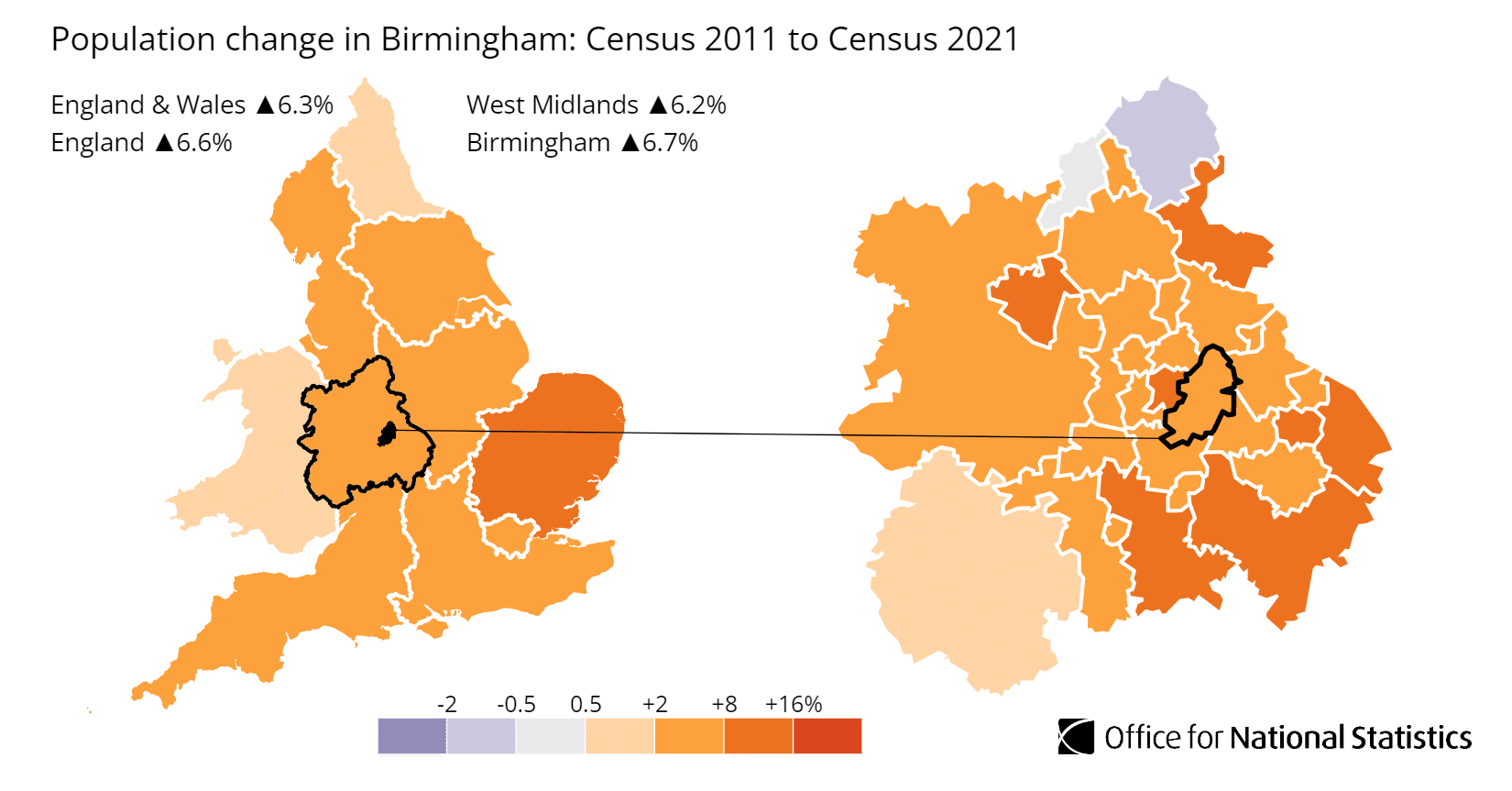
Birmingham's top postcode yields reach 7.0% in B18 (Hockley, Jewellery Quarter), with average sold prices sitting 20.5% below the England average. The city's population reached 1,144,919 at the 2021 Census, a 6.7% increase from 2011, making it the UK's second largest city and one of its strongest rental markets.
Average asking prices across Birmingham's 45 postcodes range from £186,154 in B2 (City Centre, New Street) to £494,871 in B74 (Four Oaks, Little Aston). That spread gives investors multiple entry points. A 30% deposit starts from £55,846 in B2, while rental income across the 33 postcodes with data ranges from £914 to £1,495 per month. The city's combination of below-average prices, strong rental demand from a population of over a million, and billions in active regeneration investment makes it one of the most watched Midlands investment markets.
This guide covers all 45 Birmingham postcodes within the Birmingham local authority (ONS code E08000025). That includes the city centre districts (B1 through B5), inner suburbs from Aston to Sparkhill, the southern corridor through Moseley, Kings Heath and Bournville, and the northern Sutton Coldfield postcodes (B72 through B76). Neighbouring areas such as Solihull, Walsall, and Dudley have their own separate guides.
Article updated: February 2026
Birmingham Buy-to-Let Market Overview 2026
England's second city offers investors a full spectrum of price points, from city centre flats under £190,000 to Sutton Coldfield family homes approaching £500,000, all within a single local authority.
- Average sold price: £233,023 (20.5% below England's £293,131)
- Asking price range: £186,154 (B2, City Centre) to £494,871 (B74, Four Oaks)
- Rental yields: 3.3% (B20, Handsworth Wood) to 7.0% (B18, Hockley) across 33 postcodes with rental data
- Rental income: Monthly rents from £914 (B20, Handsworth Wood) to £1,495 (B74, Four Oaks)
- Price per sq ft: House prices from £180/sq ft (B6, Aston) to £412/sq ft (B3, City Centre)
- Market activity: Sales ranging from 2 per month (B19, B35) to 48 per month (B31, Northfield)
- Deposit requirements: 30% deposits range from £55,846 (B2) to £148,461 (B74)
- Affordability ratios: Property prices from 5.2 to 13.8 times Birmingham's median annual salary of £35,989
Contents

-
by Robert Jones, Founder of Property Investments UK
With two decades in UK property, Rob has been investing in buy-to-let since 2005, and uses property data to develop tools for property market analysis.
Property Data Sources
Our location guide relies on diverse, authoritative datasets including:
- HM Land Registry UK House Price Index
- Ministry of Housing, Communities and Local Government
- Ordnance Survey Data Hub
- Propertydata.co.uk
We update our property data quarterly to ensure accuracy. Last update: February 2026. All data is presented as provided by our sources without adjustments or amendments.
Why Invest in Birmingham?
Birmingham is the UK's second largest city with a population of 1,144,919 at the 2021 Census, up 6.7% from 1,073,045 in 2011. That growth rate puts real pressure on housing supply. More people need somewhere to live, and the private rented sector absorbs a significant share of that demand. The city's population is also young. The median age sits below the national average, which matters because younger demographics are more likely to rent.
The economic base is broad. Birmingham has historically been a manufacturing city, but the shift toward professional services, financial services, healthcare, and education has accelerated over the past two decades. The city centre's transformation from the Bullring redevelopment onwards has attracted employers including HSBC (which relocated its UK headquarters to Birmingham in 2018), Goldman Sachs, PwC, and the BBC (relocating to Digbeth). Five universities bring around 80,000 students to the city each academic year.
The median gross weekly salary in Birmingham is £692.10, which equates to £2,999 per month or £35,989 per year. This is below the West Midlands regional median of £712.50 per week and the Great Britain median of £752.40 per week. Lower local earnings mean that affordability ratios are more favourable for investors. Property prices are lower relative to the national average, but rents hold up because of strong tenant demand from the large working population.
Employment in Birmingham runs at 68.9%, with unemployment at 7.8%. The unemployment figure is above the national average, which reflects the city's ongoing economic transition and the concentration of deprived wards in inner-city postcodes. For investors, the practical impact is that tenant demand is strongest in the suburban postcodes with good transport links to employment centres rather than in the most deprived inner-city areas.
Birmingham Economic Summary
- Population: 1,144,919 (2021 Census). Growth of 6.7% from 2011.
- Median annual salary: £35,989 (local), £37,050 (West Midlands), £39,125 (Great Britain)
- Employment rate: 68.9% (local)
- Unemployment rate: 7.8% (local)
- Key employment sectors: Professional services, financial services, healthcare, education, advanced manufacturing, public administration
Source: ONS Census 2021, Nomis Labour Market Profile (ASHE 2025)
Regeneration and Investment in Birmingham
Billions of pounds in committed regeneration investment are reshaping the city centre and inner suburbs. The programme is the largest outside London, with direct implications for property values and rental demand in surrounding postcodes.
- Birmingham Smithfield (Under construction, £1.9 billion): A 17-hectare mixed-use development on the former wholesale markets site south of the Bullring, delivered by Lendlease. Phase 1 includes 408 build-to-rent homes with the full scheme targeting 3,000+ homes, retail, leisure and workspaces. Transforms B5 and surrounding postcodes. Updates at Invest West Midlands.
- HS2 Curzon Street Station (Under construction, £816 million in local contracts): The first new intercity terminus built in Britain since the 19th century, connecting Birmingham to London. Seven platforms, net-zero design. Drives regeneration across Eastside and Digbeth in the B4, B5 and B9 postcodes. Updates at HS2.
- Ladywood Estate Regeneration (Masterplanning, £2.5 billion): Partnership between Birmingham City Council and Berkeley St Joseph to deliver up to 12,000 new homes over 20 years. At least 20% affordable. Early-stage investment opportunity in B16 and B1 postcodes before construction uplift. Updates at Berkeley Group.
Birmingham Property Market Analysis
When Was the Last House Price Crash in Birmingham?
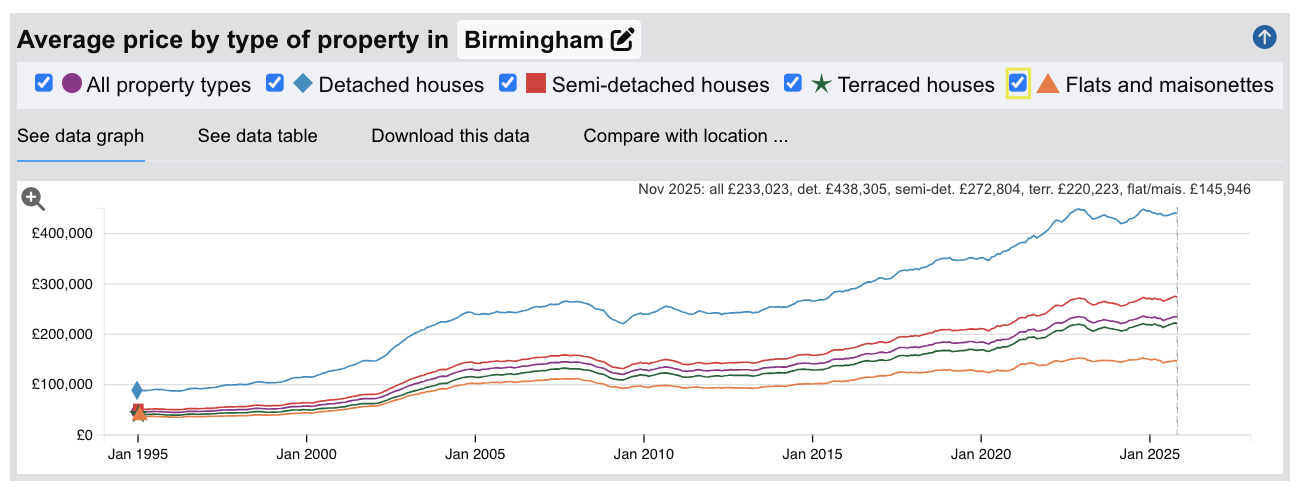
Birmingham house prices have risen from £43,407 in January 1995 to £233,023 in November 2025. That 30-year journey includes one major crash, a prolonged stagnation period, and a recovery that took nearly eight years to reach pre-crash levels. Here is how each cycle played out.
1995 to 2007 (The Boom): Prices rose from £43,407 to a peak of £144,135 in September 2007. That is a 232% increase over 12 years, driven by easy credit, population growth and the wider UK housing boom. Birmingham's growth broadly tracked the national pattern but started from a much lower base than London and the South East.
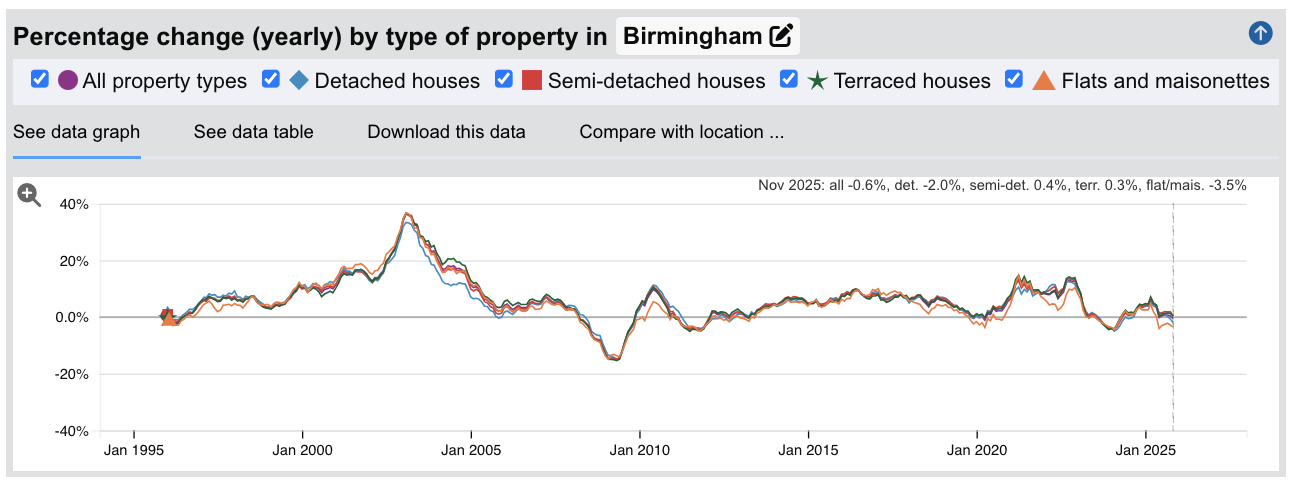
2008 to 2009 (The Financial Crisis): Birmingham's peak-to-trough decline was 17.4%, falling from £144,135 in September 2007 to £119,101 in June 2009. The worst annual change reading hit -14.9% in May 2009. Terraced houses were hardest hit at -15.4% annual change, while flats fell -13.7%. For context, the West Midlands region declined 14.7% at its worst, while England fell 15.5%. Birmingham's crash was slightly less severe than the national average.
2010 to 2013 (Stagnation): Prices bounced initially to around £130,000 by mid-2010 but then drifted back down. The market effectively went sideways for four years, fluctuating between £125,000 and £133,000. The floor was reached around mid-2011 at £125,849 before a slow, grinding recovery began.
2014 to 2016 (Turning Point): Annual growth turned firmly positive, running between 4% and 10% per year. By January 2016, prices had reached £150,631. Prices finally passed the September 2007 pre-crash peak in July 2015 at £144,376. That is nearly eight years from peak to recovery.
2017 to 2019 (Pre-pandemic Growth): Consistent 5-8% annual growth pushed prices from £162,864 in January 2017 to £182,379 by December 2019. This period was driven by HS2 announcement effects, city centre regeneration, and growing investor activity as northern and Midlands cities attracted buyers priced out of London.
2020 to 2022 (Pandemic Surge): The stamp duty holiday and a race for space accelerated growth. Prices jumped from £184,007 in June 2020 to £233,948 by December 2022, a 27% increase in two and a half years. The annual change reading peaked at 12.7% in December 2022.
2023 (Rate Shock): Rising interest rates cooled the market. Prices dipped to £222,515 by June 2023, with the annual change turning negative at -3.9% in December 2023. The correction was relatively mild compared to the 2008 crash.
2024 to present: Recovery resumed through 2024, with prices reaching £233,023 by November 2025. Annual change sits at -0.6% as at November 2025, suggesting a flat market that is digesting the previous years' gains.
Long-term growth summary:
- 5 years (Nov 2020 to Nov 2025): 23.1% growth (£189,247 to £233,023)
- 10 years (Nov 2015 to Nov 2025): 55.8% growth (£149,543 to £233,023)
- 15 years (Nov 2010 to Nov 2025): 76.1% growth (£132,299 to £233,023)
- 20 years (Nov 2005 to Nov 2025): 76.9% growth (£131,732 to £233,023)
- 30 years (Nov 1995 to Nov 2025): 426.6% growth (£44,254 to £233,023)
The 20-year figure is almost identical to the 15-year figure because Birmingham's prices were essentially flat between 2005 and 2010. The financial crisis erased five years of growth. An investor who bought in 2005 at £131,732 waited a full decade before seeing meaningful capital appreciation. The lesson: Birmingham delivers strong long-term growth, but entry timing matters. The 2008 crash took nearly eight years to recover from, and the city's recovery was slower than London and the South East. Current prices at -0.6% annual change suggest a stable market with limited downside risk compared to 2007.

Thinking of Buying?
We have off-market investment properties averaging 8%+ annual yield.
View Property DealsSold House Prices in Birmingham
The average sold price across all property types in Birmingham is £233,023, which is 20.5% below the England average of £293,131. That £60,108 discount applies across the board, but the size of the gap varies by property type. Flats show the largest discount at 34.1% below England, while semi-detached properties sit closest at 5.9% below. Data from HM Land Registry, November 2025.
| Property Type | Birmingham Avg | England Avg | Difference |
|---|---|---|---|
| Detached | £438,305 | £474,400 | -7.6% |
| Semi-detached | £272,804 | £290,004 | -5.9% |
| Terraced | £220,223 | £245,002 | -10.1% |
| Flat / Maisonette | £145,946 | £221,565 | -34.1% |
| All Types | £233,023 | £293,131 | -20.5% |
Detached homes in Birmingham average £438,305, a 7.6% discount to the England figure. The relatively small gap reflects Birmingham's wealthy northern suburbs. Postcodes like B74 (Four Oaks), B47 (Hollywood) and B72 (Sutton Coldfield) pull the detached average up significantly. These are not investment postcodes for most buy-to-let buyers, but they matter because they show how the city's average is shaped by its extremes.
Semi-detached properties at £272,804 sit 5.9% below England. This is the tightest discount of the four types. Semi-detached homes are the backbone of Birmingham's suburban housing stock, particularly through the B14 to B31 belt running south and west of the city centre. They tend to attract working families and long-term tenants.
Terraced houses at £220,223 sit 10.1% below England. These are concentrated in the inner-city postcodes: B8, B9, B10, B11, B19, B21. For investors, this is where the yield play typically sits. Lower purchase prices against rents that track the wider market create more favourable gross yields.
Flats and maisonettes show the largest discount at 34.1% below England, averaging £145,946. Birmingham's flat stock is heavily concentrated in the city centre (B1, B3, B5) and inner ring. The steep discount partly reflects the volume of new-build apartments delivered during the 2000s and 2010s, many of which were marketed to investors. City centre flats attract young professionals and students, keeping void periods short in the right locations.
The 20.5% discount on the "all types" figure sits between the individual property type discounts. The West Midlands regional average is £233,751, which puts Birmingham almost exactly in line with its region.
Property Data Sources
Our location guide relies on diverse, authoritative datasets including:
- HM Land Registry UK House Price Index
- Ministry of Housing, Communities and Local Government
- Ordnance Survey Data Hub
- Propertydata.co.uk
We update our property data quarterly to ensure accuracy. Last update: February 2026. All data is presented as provided by our sources without adjustments or amendments.
Price Per Square Foot in Birmingham
Sold prices per square foot range from £180 in B6 (Aston) to £412 in B3 (City Centre, Snow Hill). Price per square foot strips out the effect of property size and gives a cleaner read on where land values are highest. In Birmingham, the pattern is straightforward: city centre postcodes command the highest rates per square foot because the stock is predominantly apartments, while the outer suburbs offer more space for less per foot. Data covers 43 of 45 Birmingham postcodes. B2 and B4 have insufficient recent sales data.
| Rank | Area | Price Per Sq Ft |
|---|---|---|
| 1 | B6 (Aston) | £180 |
| 2 | B19 (Lozells, Newtown) | £182 |
| 3 | B7 (Nechells) | £183 |
| 4 | B21 (Handsworth) | £187 |
| 5 | B8 (Alum Rock, Ward End) | £205 |
| 6 | B10 (Small Heath) | £209 |
| 7 | B9 (Bordesley Green) | £210 |
| 8 | B11 (Sparkhill, Tyseley) | £213 |
| 9 | B35 (Castle Vale) | £218 |
| 10 | B18 (Hockley, Jewellery Quarter) | £219 |
| 11 | B23 (Erdington, Short Heath) | £221 |
| 12 | B20 (Handsworth Wood) | £222 |
| 13 | B25 (Yardley) | £244 |
| 14 | B33 (Stechford, Kitts Green) | £244 |
| 15 | B44 (Kingstanding) | £245 |
| 16 | B16 (Ladywood) | £250 |
| 17 | B34 (Shard End) | £253 |
| 18 | B27 (Acocks Green) | £254 |
| 19 | B24 (Erdington, Tyburn) | £256 |
| 20 | B32 (Woodgate, Bartley Green) | £256 |
| 21 | B38 (Kings Norton) | £266 |
| 22 | B42 (Perry Barr) | £269 |
| 23 | B43 (Great Barr, Hamstead) | £270 |
| 24 | B31 (Northfield) | £273 |
| 25 | B26 (Sheldon, Yardley) | £280 |
| 26 | B13 (Moseley) | £282 |
| 27 | B14 (Kings Heath) | £284 |
| 28 | B29 (Selly Oak) | £291 |
| 29 | B45 (Rednal, Rubery) | £292 |
| 30 | B30 (Bournville, Stirchley) | £294 |
| 31 | B5 (City Centre (Digbeth/Markets)) | £302 |
| 32 | B28 (Hall Green) | £302 |
| 33 | B15 (Edgbaston) | £321 |
| 34 | B17 (Harborne) | £323 |
| 35 | B1 (City Centre) | £327 |
| 36 | B73 (Boldmere, Wylde Green) | £333 |
| 37 | B72 (Sutton Coldfield (Town Centre)) | £335 |
| 38 | B76 (Walmley, Minworth) | £350 |
| 39 | B74 (Four Oaks, Little Aston) | £356 |
| 40 | B75 (Mere Green, Roughley) | £360 |
| 41 | B47 (Hollywood, Wythall) | £362 |
| 42 | B12 (Balsall Heath, Highgate) | £379 |
| 43 | B3 (City Centre (Snow Hill)) | £412 |
B6 (Aston) at £180 per square foot is the cheapest in Birmingham, followed by B19 (Lozells, Newtown) at £182. These inner-city postcodes have larger terraced houses and ex-council stock where the space is generous relative to the price. At the other end, B3 (City Centre, Snow Hill) commands £412 per foot and B12 (Balsall Heath, Highgate) reaches £379. B12 is the surprise: an inner-city residential postcode ranking second most expensive per foot, driven by Victorian terraces and converted properties that sell at a premium due to smaller lot sizes.
The Sutton Coldfield postcodes (B72 to B76) cluster between £333 and £360 per square foot. These are Birmingham's premium residential areas, but they do not top the table because the properties are larger. A £494,871 detached house in B74 spread over 1,400 square feet works out cheaper per foot than a £210,000 city centre flat over 500 square feet.
For buy-to-let investors, the sweet spot tends to be in the £200 to £270 per square foot range. That covers postcodes like B23, B24, B33, B38, B42, and B44, where property sizes are reasonable, prices are moderate, and rental demand is consistent from working tenants.
For Sale Asking Prices in Birmingham
Asking prices across Birmingham's 44 postcodes with data range from £186,154 in B2 (City Centre, New Street) to £494,871 in B74 (Four Oaks, Little Aston). That £308,717 gap within a single local authority is wider than you will find in most UK cities. It reflects Birmingham's geographic scale and the distinct character of its neighbourhoods. The mean asking price across all postcodes is £272,648. B7 (Nechells) has insufficient current listing data and is excluded from this table.
| Rank | Area | Asking Price |
|---|---|---|
| 1 | B2 (City Centre, New Street) | £186,154 |
| 2 | B35 (Castle Vale) | £193,667 |
| 3 | B18 (Hockley, Jewellery Quarter) | £193,828 |
| 4 | B6 (Aston) | £208,929 |
| 5 | B3 (City Centre, Snow Hill) | £209,780 |
| 6 | B16 (Ladywood) | £213,693 |
| 7 | B1 (City Centre) | £214,289 |
| 8 | B9 (Bordesley Green) | £214,967 |
| 9 | B21 (Handsworth) | £215,694 |
| 10 | B23 (Erdington, Short Heath) | £217,503 |
| 11 | B33 (Stechford, Kitts Green) | £220,544 |
| 12 | B34 (Shard End) | £221,151 |
| 13 | B5 (City Centre, Digbeth/Markets) | £221,179 |
| 14 | B44 (Kingstanding) | £225,783 |
| 15 | B19 (Lozells, Newtown) | £225,879 |
| 16 | B11 (Sparkhill, Tyseley) | £226,553 |
| 17 | B12 (Balsall Heath, Highgate) | £227,125 |
| 18 | B42 (Perry Barr) | £233,435 |
| 19 | B15 (Edgbaston) | £235,144 |
| 20 | B8 (Alum Rock, Ward End) | £235,673 |
| 21 | B25 (Yardley) | £238,302 |
| 22 | B10 (Small Heath) | £247,643 |
| 23 | B26 (Sheldon, Yardley) | £251,125 |
| 24 | B32 (Woodgate, Bartley Green) | £253,896 |
| 25 | B27 (Acocks Green) | £253,902 |
| 26 | B31 (Northfield) | £259,915 |
| 27 | B38 (Kings Norton) | £262,015 |
| 28 | B24 (Erdington, Tyburn) | £264,634 |
| 29 | B30 (Bournville, Stirchley) | £274,238 |
| 30 | B14 (Kings Heath) | £278,220 |
| 31 | B4 (City Centre, Corporation St) | £280,797 |
| 32 | B13 (Moseley) | £282,797 |
| 33 | B43 (Great Barr, Hamstead) | £284,214 |
| 34 | B29 (Selly Oak) | £301,296 |
| 35 | B45 (Rednal, Rubery) | £320,420 |
| 36 | B20 (Handsworth Wood) | £330,534 |
| 37 | B28 (Hall Green) | £337,819 |
| 38 | B76 (Walmley, Minworth) | £376,499 |
| 39 | B73 (Boldmere, Wylde Green) | £377,145 |
| 40 | B17 (Harborne) | £406,513 |
| 41 | B75 (Mere Green, Roughley) | £411,808 |
| 42 | B47 (Hollywood, Wythall) | £420,684 |
| 43 | B72 (Sutton Coldfield Town Centre) | £446,274 |
| 44 | B74 (Four Oaks, Little Aston) | £494,871 |
| — | B7 (Nechells) | Not enough data |
Twenty-two of Birmingham's 44 postcodes with data have asking prices below £250,000. That is half the city offering entry points under the quarter-million mark. The cheapest cluster is the city centre and inner ring: B1, B2, B3, B5, B6, B16, B18, and B35 all sit below £215,000. These are predominantly apartment-heavy postcodes where new-build and off-plan developments have pushed supply up and per-unit prices down.
The suburban belt from B23 through B44 offers the broadest range of family housing between £217,000 and £284,000. These are the postcodes that typically attract working families as tenants. Properties here tend to be two and three-bedroom semis and terraces with gardens. B31 (Northfield) is the busiest at 48 sales per month, which signals an active, liquid market.
Above £300,000, the market shifts to owner-occupier territory. B17 (Harborne), B28 (Hall Green), B29 (Selly Oak), and the Sutton Coldfield postcodes are desirable residential areas where rental yields compress because purchase prices are high relative to achievable rents. These postcodes suit investors looking for capital appreciation over income.
House Price Growth in Birmingham
Five-year growth across Birmingham ranges from -11.6% in B1 (City Centre) to 43.1% in B9 (Bordesley Green). Growth data is available for 42 of 45 postcodes. B2, B4, and B7 have insufficient transaction data for reliable growth figures. The pattern is clear: inner-city residential postcodes with lower starting prices have delivered the strongest percentage gains, while city centre apartment districts and some premium suburbs have underperformed.
| Area | 1 Year | 3 Year | 5 Year |
|---|---|---|---|
| B9 (Bordesley Green) | 9.9% | 12.5% | 43.1% |
| B38 (Kings Norton) | 11.7% | 10.7% | 37.2% |
| B35 (Castle Vale) | 14.8% | 5.4% | 37.0% |
| B21 (Handsworth) | 0.4% | 5.6% | 36.0% |
| B44 (Kingstanding) | 4.4% | 8.6% | 35.1% |
| B26 (Sheldon, Yardley) | 5.8% | 9.0% | 34.6% |
| B8 (Alum Rock, Ward End) | 2.4% | 2.8% | 33.0% |
| B10 (Small Heath) | 4.9% | 16.0% | 31.6% |
| B33 (Stechford, Kitts Green) | 3.1% | 6.4% | 31.1% |
| B6 (Aston) | -12.1% | -0.6% | 29.8% |
| B43 (Great Barr, Hamstead) | 5.7% | 5.3% | 28.8% |
| B25 (Yardley) | 1.9% | 9.0% | 28.1% |
| B32 (Woodgate, Bartley Green) | 5.4% | 5.7% | 27.9% |
| B24 (Erdington, Tyburn) | -1.1% | 10.8% | 27.0% |
| B42 (Perry Barr) | 1.3% | 10.9% | 26.8% |
| B72 (Sutton Coldfield Town Centre) | 0.8% | 6.7% | 26.7% |
| B14 (Kings Heath) | 4.2% | 4.3% | 26.3% |
| B31 (Northfield) | -3.5% | 3.2% | 25.0% |
| B47 (Hollywood, Wythall) | 2.6% | 5.4% | 25.0% |
| B23 (Erdington, Short Heath) | 2.3% | 4.0% | 24.5% |
| B28 (Hall Green) | 3.6% | 3.1% | 23.8% |
| B34 (Shard End) | -0.2% | 5.6% | 22.3% |
| B19 (Lozells, Newtown) | -13.6% | -10.0% | 19.9% |
| B13 (Moseley) | 1.2% | 7.9% | 19.3% |
| B11 (Sparkhill, Tyseley) | 4.0% | 8.7% | 19.0% |
| B27 (Acocks Green) | -1.5% | -0.3% | 17.9% |
| B30 (Bournville, Stirchley) | -0.1% | 5.7% | 17.7% |
| B29 (Selly Oak) | 1.0% | 5.0% | 16.0% |
| B18 (Hockley, Jewellery Quarter) | -2.9% | 1.8% | 15.8% |
| B76 (Walmley, Minworth) | 2.6% | 0.4% | 15.2% |
| B17 (Harborne) | 10.6% | -3.0% | 12.7% |
| B75 (Mere Green, Roughley) | 0.8% | 6.0% | 12.2% |
| B74 (Four Oaks, Little Aston) | 2.0% | 5.3% | 10.4% |
| B45 (Rednal, Rubery) | -3.2% | 2.0% | 9.2% |
| B20 (Handsworth Wood) | 5.9% | 1.7% | 8.9% |
| B16 (Ladywood) | 2.3% | 13.8% | 7.1% |
| B15 (Edgbaston) | -7.5% | -9.0% | 5.8% |
| B5 (City Centre, Digbeth/Markets) | -10.5% | -14.6% | 5.2% |
| B73 (Boldmere, Wylde Green) | -4.7% | -5.5% | 1.4% |
| B12 (Balsall Heath, Highgate) | -0.4% | 3.5% | 0.4% |
| B3 (City Centre, Snow Hill) | -22.8% | -4.2% | -2.3% |
| B1 (City Centre) | -10.7% | -10.1% | -11.6% |
| B2 (City Centre, New Street) | Not enough data | Not enough data | Not enough data |
| B4 (City Centre, Corporation St) | Not enough data | Not enough data | Not enough data |
| B7 (Nechells) | Not enough data | Not enough data | Not enough data |
B9 (Bordesley Green) leads with 43.1% five-year growth, turning a £150,000 purchase in 2021 into roughly £215,000 today. The driver is simple: Bordesley Green was deeply undervalued five years ago, with terraced houses and ex-council stock selling at some of Birmingham's lowest prices. As surrounding regeneration activity raised the area's profile, prices responded. B38 (Kings Norton) and B35 (Castle Vale) follow at 37.2% and 37.0% respectively. Both are outer suburban postcodes that benefited from the pandemic-era demand for houses with gardens.
The city centre tells a different story. B1 has lost 11.6% over five years and B3 has dropped 2.3%. City centre apartment values have been hit by a wave of new-build supply, particularly build-to-rent schemes that have softened resale values. B5 (Digbeth) is only up 5.2% despite being at the heart of the Smithfield and HS2 regeneration zone. For investors holding city centre flats, rental income has been the return, not capital growth.
The middle ground is where most buy-to-let investors will focus. Postcodes like B44 (35.1%), B26 (34.6%), B33 (31.1%), and B43 (28.8%) have all delivered strong five-year growth while also offering reasonable yields. These are established suburban markets with consistent demand.
Monthly Property Sales in Birmingham
Monthly sales volume across Birmingham ranges from 2 transactions per month in B19 (Lozells) and B35 (Castle Vale) to 48 per month in B31 (Northfield). Sales data is available for 42 of 45 postcodes. B2, B4, and B7 have insufficient data. High sales volume matters for investors because it indicates market liquidity. A property that can be bought and sold quickly in a liquid market is less risky than one in a low-volume postcode where finding a buyer takes months.
| Area | Sales/Month | Turnover | Asking Price |
|---|---|---|---|
| B31 (Northfield) | 48 | 51% | £259,915 |
| B23 (Erdington, Short Heath) | 37 | 43% | £217,503 |
| B14 (Kings Heath) | 34 | 65% | £278,220 |
| B26 (Sheldon, Yardley) | 30 | 53% | £251,125 |
| B45 (Rednal, Rubery) | 29 | 99% | £320,420 |
| B30 (Bournville, Stirchley) | 27 | 80% | £274,238 |
| B44 (Kingstanding) | 27 | 53% | £225,783 |
| B29 (Selly Oak) | 26 | 47% | £301,296 |
| B74 (Four Oaks, Little Aston) | 25 | 63% | £494,871 |
| B75 (Mere Green, Roughley) | 24 | 70% | £411,808 |
| B24 (Erdington, Tyburn) | 23 | 54% | £264,634 |
| B73 (Boldmere, Wylde Green) | 23 | 60% | £377,145 |
| B13 (Moseley) | 22 | 35% | £282,797 |
| B43 (Great Barr, Hamstead) | 22 | 83% | £284,214 |
| B17 (Harborne) | 21 | 52% | £406,513 |
| B27 (Acocks Green) | 21 | 67% | £253,902 |
| B32 (Woodgate, Bartley Green) | 21 | 53% | £253,896 |
| B28 (Hall Green) | 20 | 81% | £337,819 |
| B76 (Walmley, Minworth) | 20 | 60% | £376,499 |
| B11 (Sparkhill, Tyseley) | 18 | 46% | £226,553 |
| B42 (Perry Barr) | 18 | 71% | £233,435 |
| B38 (Kings Norton) | 17 | 72% | £262,015 |
| B33 (Stechford, Kitts Green) | 14 | 37% | £220,544 |
| B34 (Shard End) | 14 | 105% | £221,151 |
| B16 (Ladywood) | 13 | 10% | £213,693 |
| B72 (Sutton Coldfield Town Centre) | 11 | 65% | £446,274 |
| B20 (Handsworth Wood) | 10 | 36% | £330,534 |
| B21 (Handsworth) | 10 | 32% | £215,694 |
| B25 (Yardley) | 9 | 64% | £238,302 |
| B8 (Alum Rock, Ward End) | 9 | 38% | £235,673 |
| B9 (Bordesley Green) | 9 | 85% | £214,967 |
| B1 (City Centre) | 8 | 3% | £214,289 |
| B15 (Edgbaston) | 8 | 7% | £235,144 |
| B12 (Balsall Heath, Highgate) | 7 | 8% | £227,125 |
| B47 (Hollywood, Wythall) | 7 | 233% | £420,684 |
| B18 (Hockley, Jewellery Quarter) | 6 | 13% | £193,828 |
| B3 (City Centre, Snow Hill) | 6 | 9% | £209,780 |
| B5 (City Centre, Digbeth/Markets) | 6 | 4% | £221,179 |
| B10 (Small Heath) | 5 | 133% | £247,643 |
| B6 (Aston) | 3 | 27% | £208,929 |
| B19 (Lozells, Newtown) | 2 | 13% | £225,879 |
| B35 (Castle Vale) | 2 | 78% | £193,667 |
| B2 (City Centre, New Street) | Not enough data | — | £186,154 |
| B4 (City Centre, Corporation St) | Not enough data | — | £280,797 |
| B7 (Nechells) | Not enough data | — | Not enough data |
B31 (Northfield) dominates with 48 sales per month, making it Birmingham's most liquid residential market. The combination of £259,915 average asking price, 51% turnover, and consistent family demand makes it the kind of postcode where investors can buy and sell with confidence. B23 (Erdington) follows at 37 sales per month at a lower price point of £217,503.
The city centre postcodes (B1, B3, B5, B12, B15) all sit below 10 sales per month with turnover under 10%. Low turnover in these postcodes does not mean weak demand. It reflects the nature of the stock: apartments in managed blocks trade less frequently than suburban houses. But it does mean that exit timing matters more for city centre investors. Selling quickly at the right price is harder when monthly transaction volumes are in single figures.
Some turnover figures look unusually high. B47 at 233% and B10 at 133% are artefacts of the PropertyData calculation method, where turnover compares monthly sales to current for-sale stock. In postcodes with very few active listings, even modest sales volumes produce inflated turnover percentages. These figures are less meaningful than the raw sales-per-month numbers.
Property Data Sources
Our location guide relies on diverse, authoritative datasets including:
- HM Land Registry UK House Price Index
- Ministry of Housing, Communities and Local Government
- Ordnance Survey Data Hub
- Propertydata.co.uk
We update our property data quarterly to ensure accuracy. Last update: February 2026. All data is presented as provided by our sources without adjustments or amendments.
Birmingham Rental Market Analysis
For investors weighing up whether is buy-to-let worth it in Birmingham, the data below breaks down average monthly rents and gross rental yields across the city's postcodes.
Rental data is available for 33 of Birmingham's 45 postcodes. Twelve postcodes have insufficient current rental listings for PropertyData to calculate reliable figures. If you are looking to build a property portfolio in the Midlands, Birmingham's combination of strong tenant demand from a million-plus population and below-average prices creates multiple entry points.
Average Rent and Gross Rental Yields in Birmingham
Gross rental yields across Birmingham's 33 postcodes with data range from 3.3% in B20 (Handsworth Wood) to 7.0% in B18 (Hockley, Jewellery Quarter). Monthly rents run from £914 in B20 to £1,495 in B74. The yield spread is wide because asking prices vary so much more than rents. A cheap inner-city property pulling £1,100 per month generates a much higher percentage yield than a £400,000 suburban house pulling the same rent.
| Area | Monthly Rent | Asking Price | Gross Yield |
|---|---|---|---|
| B18 (Hockley, Jewellery Quarter) | £1,124 | £193,828 | 7.0% |
| B2 (City Centre, New Street) | £1,044 | £186,154 | 6.7% |
| B3 (City Centre, Snow Hill) | £1,170 | £209,780 | 6.7% |
| B1 (City Centre) | £1,085 | £214,289 | 6.1% |
| B11 (Sparkhill, Tyseley) | £1,150 | £226,553 | 6.1% |
| B33 (Stechford, Kitts Green) | £1,099 | £220,544 | 6.0% |
| B44 (Kingstanding) | £1,123 | £225,783 | 6.0% |
| B5 (City Centre, Digbeth/Markets) | £1,104 | £221,179 | 6.0% |
| B16 (Ladywood) | £1,050 | £213,693 | 5.9% |
| B15 (Edgbaston) | £1,141 | £235,144 | 5.8% |
| B42 (Perry Barr) | £1,122 | £233,435 | 5.8% |
| B12 (Balsall Heath, Highgate) | £1,079 | £227,125 | 5.7% |
| B23 (Erdington, Short Heath) | £978 | £217,503 | 5.4% |
| B32 (Woodgate, Bartley Green) | £1,152 | £253,896 | 5.4% |
| B26 (Sheldon, Yardley) | £1,108 | £251,125 | 5.3% |
| B4 (City Centre, Corporation St) | £1,229 | £280,797 | 5.3% |
| B29 (Selly Oak) | £1,307 | £301,296 | 5.2% |
| B43 (Great Barr, Hamstead) | £1,233 | £284,214 | 5.2% |
| B19 (Lozells, Newtown) | £933 | £225,879 | 5.0% |
| B38 (Kings Norton) | £1,076 | £262,015 | 4.9% |
| B24 (Erdington, Tyburn) | £1,066 | £264,634 | 4.8% |
| B28 (Hall Green) | £1,337 | £337,819 | 4.8% |
| B14 (Kings Heath) | £1,071 | £278,220 | 4.6% |
| B30 (Bournville, Stirchley) | £1,053 | £274,238 | 4.6% |
| B31 (Northfield) | £1,008 | £259,915 | 4.7% |
| B27 (Acocks Green) | £933 | £253,902 | 4.4% |
| B13 (Moseley) | £992 | £282,797 | 4.2% |
| B45 (Rednal, Rubery) | £1,120 | £320,420 | 4.2% |
| B73 (Boldmere, Wylde Green) | £1,197 | £377,145 | 3.8% |
| B75 (Mere Green, Roughley) | £1,265 | £411,808 | 3.7% |
| B17 (Harborne) | £1,235 | £406,513 | 3.6% |
| B74 (Four Oaks, Little Aston) | £1,495 | £494,871 | 3.6% |
| B20 (Handsworth Wood) | £914 | £330,534 | 3.3% |
| B6 (Aston) | Not enough data | £208,929 | — |
| B7 (Nechells) | Not enough data | Not enough data | — |
| B8 (Alum Rock, Ward End) | Not enough data | £235,673 | — |
| B9 (Bordesley Green) | Not enough data | £214,967 | — |
| B10 (Small Heath) | Not enough data | £247,643 | — |
| B21 (Handsworth) | Not enough data | £215,694 | — |
| B25 (Yardley) | Not enough data | £238,302 | — |
| B34 (Shard End) | Not enough data | £221,151 | — |
| B35 (Castle Vale) | Not enough data | £193,667 | — |
| B47 (Hollywood, Wythall) | Not enough data | £420,684 | — |
| B72 (Sutton Coldfield Town Centre) | Not enough data | £446,274 | — |
| B76 (Walmley, Minworth) | Not enough data | £376,499 | — |
B18 (Hockley, Jewellery Quarter) tops the yield table at 7.0%, combining £1,124 monthly rent with a £193,828 asking price. This is one of Birmingham's most interesting investment postcodes. The Jewellery Quarter has been a creative and professional hub for years, and its proximity to the city centre drives consistent rental demand from young professionals. At under £200,000, the entry price is accessible for most buy-to-let investors.
The city centre postcodes (B1, B2, B3, B5) cluster between 6.0% and 6.7% yield. These are apartment-led markets where rents hold up well against relatively low asking prices. The trade-off, as the growth table shows, is capital appreciation. Yields are strong, but five-year price growth in the city centre has been weak or negative. Investors here are buying income, not growth.
Twelve postcodes have no rental data. These include several inner-city areas (B6, B7, B8, B9, B10, B21) and some suburban/outer postcodes (B25, B34, B35, B47, B72, B76). The absence of data does not mean there is no rental market. It means there are too few current rental listings for PropertyData to produce a statistically reliable figure. Many of these postcodes have active rental markets that are dominated by local lettings agents rather than online listings.
Is Birmingham Rent High?
Rent as a percentage of the median gross monthly income ranges from 30.5% in B20 (Handsworth Wood) to 49.8% in B74 (Four Oaks, Little Aston). This tells you how much of a local worker's pay packet goes on rent in each postcode. A ratio above 40% is generally considered high. In Birmingham, 6 of 33 postcodes with rental data cross that 40% threshold, all in the more expensive suburbs and city centre premium areas.
The median gross weekly salary in Birmingham is £692.10, which equates to £2,999 per month or £35,989 per year. This is below the West Midlands regional median of £712.50 per week and the Great Britain median of £752.40 per week. Data from the Nomis Labour Market Profile (ASHE 2025).
| Rank | Area | Rent as % of Income |
|---|---|---|
| 1 | B74 (Four Oaks, Little Aston) | 49.8% |
| 2 | B28 (Hall Green) | 44.6% |
| 3 | B29 (Selly Oak) | 43.6% |
| 4 | B75 (Mere Green, Roughley) | 42.2% |
| 5 | B17 (Harborne) | 41.2% |
| 6 | B43 (Great Barr, Hamstead) | 41.1% |
| 7 | B4 (City Centre (Corporation St)) | 41.0% |
| 8 | B73 (Boldmere, Wylde Green) | 39.9% |
| 9 | B3 (City Centre (Snow Hill)) | 39.0% |
| 10 | B32 (Woodgate, Bartley Green) | 38.4% |
| 11 | B11 (Sparkhill, Tyseley) | 38.3% |
| 12 | B15 (Edgbaston) | 38.0% |
| 13 | B18 (Hockley, Jewellery Quarter) | 37.5% |
| 14 | B44 (Kingstanding) | 37.4% |
| 15 | B42 (Perry Barr) | 37.4% |
| 16 | B45 (Rednal, Rubery) | 37.3% |
| 17 | B26 (Sheldon, Yardley) | 36.9% |
| 18 | B5 (City Centre (Digbeth/Markets)) | 36.8% |
| 19 | B33 (Stechford, Kitts Green) | 36.6% |
| 20 | B1 (City Centre) | 36.2% |
| 21 | B12 (Balsall Heath, Highgate) | 36.0% |
| 22 | B38 (Kings Norton) | 35.9% |
| 23 | B14 (Kings Heath) | 35.7% |
| 24 | B24 (Erdington, Tyburn) | 35.5% |
| 25 | B30 (Bournville, Stirchley) | 35.1% |
| 26 | B16 (Ladywood) | 35.0% |
| 27 | B2 (City Centre (New Street)) | 34.8% |
| 28 | B31 (Northfield) | 33.6% |
| 29 | B13 (Moseley) | 33.1% |
| 30 | B23 (Erdington, Short Heath) | 32.6% |
| 31 | B19 (Lozells, Newtown) | 31.1% |
| 32 | B27 (Acocks Green) | 31.1% |
| 33 | B20 (Handsworth Wood) | 30.5% |
Twenty-seven of Birmingham's 33 postcodes with rental data have rent-to-income ratios below 40%. That means the majority of the city is affordable relative to local earnings. The most affordable postcodes for tenants cluster in the north and east: B20 (30.5%), B19 (31.1%), B27 (31.1%), and B23 (32.6%). For landlords, these ratios suggest sustainable rent levels that tenants can consistently afford. Rent that exceeds 40% of income creates higher arrears risk.
B74 at 49.8% and B28 at 44.6% reflect the mismatch between local earnings and property values in affluent suburbs. Tenants in these postcodes tend to earn above the local authority median, so the ratio overstates the affordability pressure. But it does explain why yields compress at the top end of the market.
Thinking of Buying?
We have off-market investment properties averaging 8%+ annual yield.
View Property DealsBuy-to-Let Considerations
Are House Prices High? Price-to-Earnings Ratios
Purchasing a property in Birmingham requires between 5.2 and 13.8 times the median annual salary. This is based on the Nomis Labour Market Profile for Birmingham showing the median gross annual income for Birmingham residents is £35,989. The England benchmark sits at 7.5x (£293,131 / £39,125).
| Rank | Area | Price-to-Earnings Ratio |
|---|---|---|
| 1 | B2 (City Centre, New Street) | 5.2x |
| 2 | B18 (Hockley, Jewellery Quarter) | 5.4x |
| 2 | B35 (Castle Vale) | 5.4x |
| 4 | B3 (City Centre, Snow Hill) | 5.8x |
| 4 | B6 (Aston) | 5.8x |
| 6 | B16 (Ladywood) | 5.9x |
| 7 | B1 (City Centre) | 6.0x |
| 7 | B9 (Bordesley Green) | 6.0x |
| 7 | B21 (Handsworth) | 6.0x |
| 7 | B23 (Erdington, Short Heath) | 6.0x |
| 11 | B33 (Stechford, Kitts Green) | 6.1x |
| 11 | B34 (Shard End) | 6.1x |
| 11 | B5 (City Centre, Digbeth/Markets) | 6.1x |
| 14 | B11 (Sparkhill, Tyseley) | 6.3x |
| 14 | B12 (Balsall Heath, Highgate) | 6.3x |
| 14 | B19 (Lozells, Newtown) | 6.3x |
| 14 | B44 (Kingstanding) | 6.3x |
| 18 | B15 (Edgbaston) | 6.5x |
| 18 | B42 (Perry Barr) | 6.5x |
| 18 | B8 (Alum Rock, Ward End) | 6.5x |
| 21 | B25 (Yardley) | 6.6x |
| 22 | B10 (Small Heath) | 6.9x |
| 23 | B26 (Sheldon, Yardley) | 7.0x |
| 24 | B27 (Acocks Green) | 7.1x |
| 24 | B32 (Woodgate, Bartley Green) | 7.1x |
| 26 | B31 (Northfield) | 7.2x |
| 27 | B38 (Kings Norton) | 7.3x |
| 28 | B24 (Erdington, Tyburn) | 7.4x |
| 29 | B30 (Bournville, Stirchley) | 7.6x |
| 30 | B14 (Kings Heath) | 7.7x |
| 31 | B4 (City Centre, Corporation St) | 7.8x |
| 32 | B13 (Moseley) | 7.9x |
| 32 | B43 (Great Barr, Hamstead) | 7.9x |
| 34 | B29 (Selly Oak) | 8.4x |
| 35 | B45 (Rednal, Rubery) | 8.9x |
| 36 | B20 (Handsworth Wood) | 9.2x |
| 37 | B28 (Hall Green) | 9.4x |
| 38 | B73 (Boldmere, Wylde Green) | 10.5x |
| 38 | B76 (Walmley, Minworth) | 10.5x |
| 40 | B17 (Harborne) | 11.3x |
| 41 | B75 (Mere Green, Roughley) | 11.4x |
| 42 | B47 (Hollywood, Wythall) | 11.7x |
| 43 | B72 (Sutton Coldfield Town Centre) | 12.4x |
| 44 | B74 (Four Oaks, Little Aston) | 13.8x |
| — | B7 (Nechells) | Not enough data |
Twenty-nine of Birmingham's 44 postcodes with price data sit below the England benchmark of 7.5x. That is two-thirds of the city priced more affordably than the national average relative to local earnings. The most affordable postcodes are B2 (5.2x), B18 (5.4x), and B35 (5.4x). For investors, lower price-to-earnings ratios typically correlate with stronger rental demand because more local workers can afford to live in the area.
The Sutton Coldfield postcodes (B72 to B76) range from 10.5x to 13.8x. These are premium owner-occupier areas where prices reflect lifestyle choices rather than local earning power. Buyers in B74 and B72 are typically dual-income professional households or people with equity from previous property sales.
Deposit Requirements in Birmingham
A 30% deposit for a buy-to-let property in Birmingham ranges from £55,846 in B2 (City Centre, New Street) to £148,461 in B74 (Four Oaks, Little Aston). The 30% deposit is the standard assumption for buy-to-let mortgage lending. Some lenders offer 75% LTV products, and specialist lenders may go to 80%, but 30% remains the most commonly used figure for investment planning. Read more about the full breakdown in our guide to buy-to-let costs. Stamp duty on a second property can be calculated using our stamp duty calculator.
| Rank | Area | 30% Deposit |
|---|---|---|
| 1 | B2 (City Centre, New Street) | £55,846 |
| 2 | B35 (Castle Vale) | £58,100 |
| 3 | B18 (Hockley, Jewellery Quarter) | £58,148 |
| 4 | B6 (Aston) | £62,679 |
| 5 | B3 (City Centre, Snow Hill) | £62,934 |
| 6 | B16 (Ladywood) | £64,108 |
| 7 | B1 (City Centre) | £64,287 |
| 8 | B9 (Bordesley Green) | £64,490 |
| 9 | B21 (Handsworth) | £64,708 |
| 10 | B23 (Erdington, Short Heath) | £65,251 |
| 11 | B33 (Stechford, Kitts Green) | £66,163 |
| 12 | B34 (Shard End) | £66,345 |
| 13 | B5 (City Centre, Digbeth/Markets) | £66,354 |
| 14 | B44 (Kingstanding) | £67,735 |
| 15 | B19 (Lozells, Newtown) | £67,764 |
| 16 | B11 (Sparkhill, Tyseley) | £67,966 |
| 17 | B12 (Balsall Heath, Highgate) | £68,138 |
| 18 | B42 (Perry Barr) | £70,031 |
| 19 | B15 (Edgbaston) | £70,543 |
| 20 | B8 (Alum Rock, Ward End) | £70,702 |
| 21 | B25 (Yardley) | £71,491 |
| 22 | B10 (Small Heath) | £74,293 |
| 23 | B26 (Sheldon, Yardley) | £75,337 |
| 24 | B32 (Woodgate, Bartley Green) | £76,169 |
| 25 | B27 (Acocks Green) | £76,171 |
| 26 | B31 (Northfield) | £77,974 |
| 27 | B38 (Kings Norton) | £78,604 |
| 28 | B24 (Erdington, Tyburn) | £79,390 |
| 29 | B30 (Bournville, Stirchley) | £82,271 |
| 30 | B14 (Kings Heath) | £83,466 |
| 31 | B4 (City Centre, Corporation St) | £84,239 |
| 32 | B13 (Moseley) | £84,839 |
| 33 | B43 (Great Barr, Hamstead) | £85,264 |
| 34 | B29 (Selly Oak) | £90,389 |
| 35 | B45 (Rednal, Rubery) | £96,126 |
| 36 | B20 (Handsworth Wood) | £99,160 |
| 37 | B28 (Hall Green) | £101,346 |
| 38 | B76 (Walmley, Minworth) | £112,950 |
| 39 | B73 (Boldmere, Wylde Green) | £113,143 |
| 40 | B17 (Harborne) | £121,954 |
| 41 | B75 (Mere Green, Roughley) | £123,542 |
| 42 | B47 (Hollywood, Wythall) | £126,205 |
| 43 | B72 (Sutton Coldfield Town Centre) | £133,882 |
| 44 | B74 (Four Oaks, Little Aston) | £148,461 |
| — | B7 (Nechells) | Not enough data |
Seventeen postcodes require a 30% deposit under £68,000. That is a realistic entry point for investors who do not need to stretch to six figures. The cheapest three postcodes (B2, B35, B18) all require deposits between £55,846 and £58,148. B18 is particularly notable because it combines the third-lowest deposit requirement with the highest yield in the city at 7.0%.
At the other end, the seven Sutton Coldfield and premium postcodes (B17, B47, B72 to B76) all require deposits above £112,000. These are capital growth plays where the deposit requirement alone exceeds the total asking price in some northern English cities.
What the Birmingham Data Tells Buy-to-Let Investors
The yield numbers favour B18 (Hockley, Jewellery Quarter) at 7.0%, B2 (City Centre) at 6.7%, and B3 (City Centre, Snow Hill) at 6.7%. These are city centre and city fringe postcodes where asking prices sit below £210,000 and rents hold above £1,000 per month. A 30% deposit of £58,148 in B18 buys exposure to a postcode with strong professional tenant demand from the Jewellery Quarter creative and business community. B11 (Sparkhill) at 6.1% and B44 (Kingstanding) at 6.0% offer suburban alternatives with larger properties and family tenants.
For capital growth, the data points to the eastern and southern suburban belt. B9 (43.1% over five years), B38 (37.2%), B44 (35.1%), and B26 (34.6%) have all outperformed. These are postcodes where prices started low and have been catching up to the city average. B38 is particularly interesting: 37.2% five-year growth combined with a 4.9% yield and 17 sales per month suggests a well-functioning market with both income and appreciation potential.
Caution is warranted in several areas. City centre postcodes B1, B3, and B5 show negative or flat five-year growth despite reasonable yields. Oversupply of new-build apartments is the primary factor. B19 (Lozells) has just 2 sales per month, making it difficult to buy or sell quickly. B6 (Aston) has lost 12.1% in the past year and has no rental data. Low-volume postcodes with volatile pricing require more careful due diligence.
Birmingham operates a selective licensing schemes in several wards. Landlords in designated areas must hold a property licence, which adds an ongoing cost. Check whether your target postcode falls within a licensing zone before committing to a purchase. Browse current investment properties listings to see what is available in and around Birmingham.
How Birmingham Compares
Birmingham's mean asking price of £272,648 sits in the middle of its Midlands neighbours. It is cheaper than Coventry (£295,504) and Leicester (£294,580), roughly on par with Nottingham (£244,881) and Wolverhampton (£252,562), and significantly below Solihull (£468,702). The comparison below uses the mean of all postcode asking prices for each location, which provides a like-for-like measure across cities with different numbers of postcodes.
| Location | Mean Asking Price | Mean Monthly Rent | Top Gross Yield |
|---|---|---|---|
| Birmingham | £272,648 | £1,121 | 7.0% |
| Coventry | £295,504 | £1,137 | 7.3% |
| Nottingham | £244,881 | £1,089 | 9.2% |
| Wolverhampton | £252,562 | £981 | 5.4% |
| Solihull | £468,702 | £1,327 | 5.3% |
Birmingham's top yield of 7.0% is competitive but not market-leading. Nottingham achieves 9.2% from lower asking prices, while Coventry edges Birmingham at 7.3%. Wolverhampton, just 15 miles north-west, offers cheaper prices but lower yields at 5.4%, suggesting weaker rental demand relative to prices. Solihull, Birmingham's affluent neighbour, commands significantly higher prices with a 5.3% top yield that reflects its owner-occupier character.
Where Birmingham stands out is scale. With 45 postcodes and 33 with rental data, it offers more diversification options within a single local authority than any of its neighbours. An investor can hold a high-yield city centre flat in B18 and a growth-oriented suburban house in B38 within the same city, something Coventry or Wolverhampton cannot replicate with their smaller postcode counts.
Frequently Asked Questions
What are the best areas in Birmingham for property investment?
B18 (Hockley, Jewellery Quarter) delivers the highest yield at 7.0% with asking prices under £194,000. For capital growth, B9 (Bordesley Green) has returned 43.1% over five years. B38 (Kings Norton) offers the best all-round balance: 4.9% yield, 37.2% five-year growth, and 17 sales per month. The suburban belt from B23 through B44 provides the most consistent combination of affordable prices, decent yields, and active markets.
Why invest in Birmingham property?
Birmingham offers prices 20.5% below the England average in a city with 1.14 million residents and billions in active regeneration. HS2, Smithfield (£1.9bn), and Ladywood (£2.5bn) are reshaping entire districts. Five universities bring around 80,000 students. HSBC relocated its UK headquarters here, and the BBC is moving to Digbeth. These are structural demand drivers, not cyclical trends.
Is Birmingham a good place to invest in property?
The data varies significantly by postcode. Yields reach 7.0%, prices sit 20.5% below England, and 30-year growth of 426.6% shows a market that has rewarded long-term holders. The trade-offs are real: city centre apartments have seen weak or negative growth in recent years, some inner-city postcodes have very low transaction volumes, and the 2008 crash took nearly eight years to recover. Postcode selection matters more than the city-wide average.
What are the best areas for property investment in Birmingham?
The strongest postcodes by the data differ depending on what you prioritise. B18 for yield (7.0%), B9 for growth (43.1% five-year), B31 for liquidity (48 sales/month), and B38 for the best all-round balance. The Erdington corridor (B23, B24) offers affordable entry under £265,000 with 5.4% and 4.8% yields respectively. B1 and B3 have both shown negative five-year returns, so the data there favours income over growth.
Should I invest in property in Birmingham?
Birmingham has the fundamentals, but the range of outcomes is wide. An investor in B9 five years ago has seen 43.1% growth. An investor in B1 has seen prices drop 11.6%. The city offers genuine opportunity, but it demands careful postcode-level analysis rather than a blanket bet on the city name. Always take professional advice before committing to any investment decision.