
Where to Buy Property Investments in Bury: Yields of 4.9%
Bury's gross rental yields range from 3.8% to 4.9% across postcodes with rental data, with BL2 delivering the highest returns. Average sold prices sit 18.6% below the England average, and the borough's population grew 4.75% to 193,851 between the 2011 and 2021 censuses.
Bury's average sold price of £237,721 places it above the North West regional average of £217,428 but well below England's £291,865. That creates a split personality for investors: traditional BL postcodes in the north of the borough start from £235,981 in BL2, while Manchester-edge M postcodes like M25 (Prestwich) command £326,325. Rental data is available for 8 of the borough's 9 postcodes.
This guide covers all 9 Bury postcodes from BL0 to M45 under the Metropolitan Borough of Bury (ONS code E08000002), part of Greater Manchester. Bury sits between Bolton to the west, Rochdale to the east, and Manchester to the south. Investors comparing options across the conurbation may also consider Bolton, Rochdale, or Manchester. Browse all our North West location guides.
Article updated: March 2026
Bury Buy-to-Let Market Overview 2026
Bury offers a two-tier market within one borough: affordable BL postcodes in the north with stronger yields, and premium Manchester-edge M postcodes in the south with higher rents and capital values.
- Average sold price: £237,721 (18.6% below England's £291,865)
- Asking price range: £235,981 (BL2) to £326,325 (M25)
- Rental yields: 3.8% (BL8) to 4.9% (BL2) across postcodes with rental data
- Rental income: Monthly rents from £892 (BL9) to £1,191 (M45)
- Price per sq ft: Sold prices from £223/sq ft (M26) to £303/sq ft (M25)
- Market activity: Sales ranging from 22 per month (BL0, M44, M45) to 47 per month (BL9)
- Deposit requirements: 30% deposits range from £70,794 (BL2) to £97,898 (M25)
- Affordability ratios: Property prices from 6.6 to 9.1 times Bury's median annual salary of £35,767
Contents

-
by Robert Jones, Founder of Property Investments UK
With two decades in UK property, Rob has been investing in buy-to-let since 2005, and uses property data to develop tools for property market analysis.
Property Data Sources
Our location guide relies on diverse, authoritative datasets including:
- HM Land Registry UK House Price Index
- Ministry of Housing, Communities and Local Government
- Ordnance Survey Data Hub
- Propertydata.co.uk
We update our property data quarterly to ensure accuracy. Last update: March 2026. All data is presented as provided by our sources without adjustments or amendments.
Why Invest in Bury?
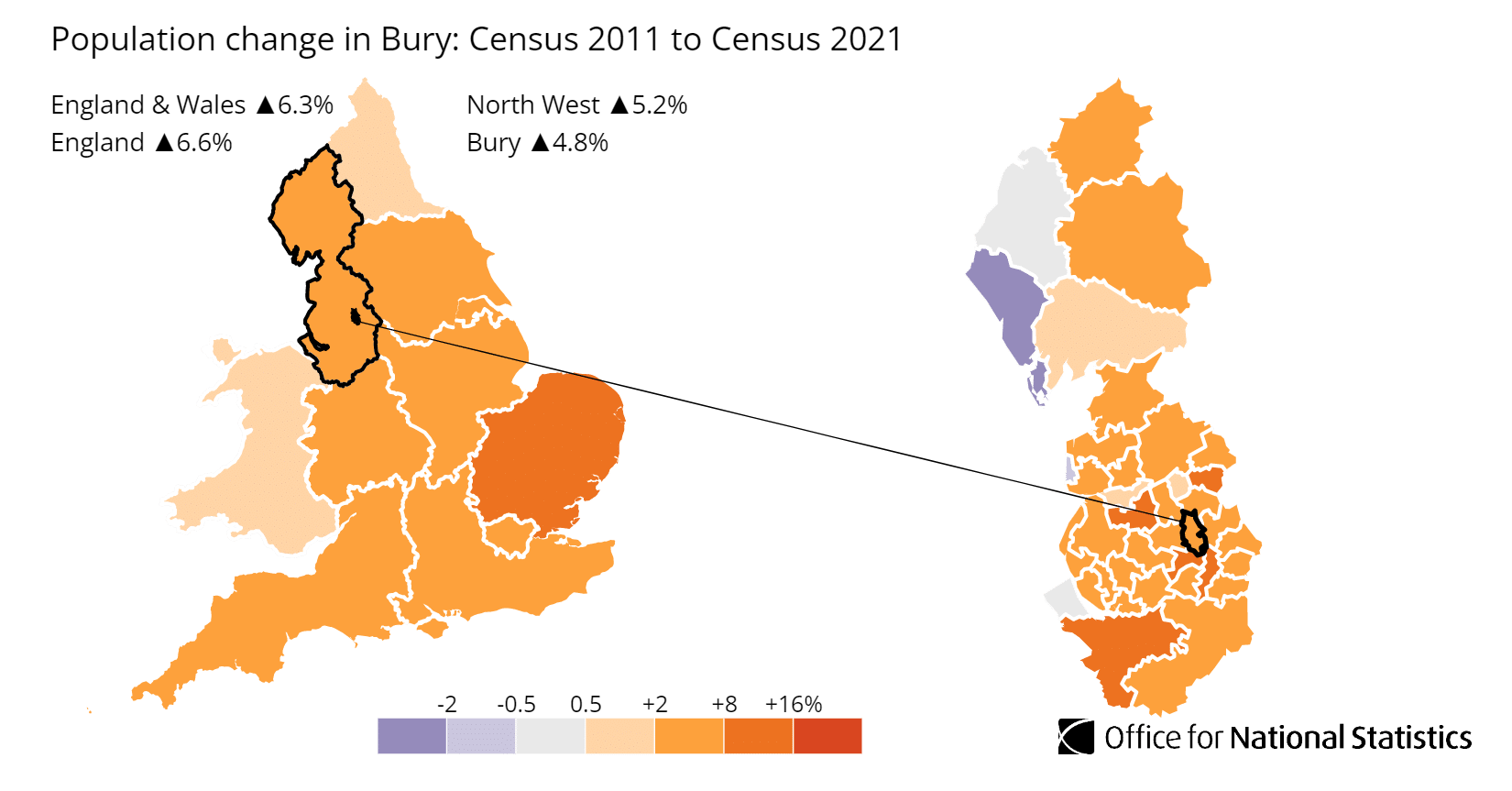
Bury's population grew 4.75% from 185,060 to 193,851 between the 2011 and 2021 censuses. That growth sits below the England and Wales average of 6.3%, sustained by the borough's position on Manchester's northern commuter belt. Metrolink tram services connect Bury town centre to Manchester city centre in around 25 minutes, and M66 motorway access links the borough to the wider North West motorway network.
The borough's economy draws on both local employment and Manchester commuter income. Key sectors include health and social care, retail, manufacturing, and public administration. The University of Bolton's Bury campus and the borough's proximity to Manchester's university corridor support a mixed tenant base of professionals, families, and students.
Employment and Earnings
The median gross annual salary for Bury residents is £35,767. This is below the North West regional median of £37,445 (£720.10 per week) and the Great Britain median of £39,125 (£752.40 per week). The employment rate stands at 70.2% with unemployment at 5.4%.
Bury Economic Summary
- Population: 193,851 (2021 Census). Growth of 4.75% from 2011.
- Median annual salary: £35,767 (local), £37,445 (North West), £39,125 (Great Britain)
- Employment rate: 70.2% (local)
- Unemployment rate: 5.4% (local)
- Key employment sectors: Health and social care, retail, manufacturing, public administration, education
Source: ONS Census 2021, Nomis Labour Market Profile (ASHE 2025)
Regeneration and Investment in Bury
Bury has a combined regeneration pipeline of over £160 million in public investment across three major projects. The largest, Atom Valley, is part of a £400 million Greater Manchester programme that will deliver 21,000 jobs. Additional private sector commitments in housing and employment development sit alongside these public schemes.
- Atom Valley Northern Gateway (under construction, part of £400m GM programme): Major employment and housing development spanning Bury and Rochdale, delivering 21,000 jobs, 13 million sq ft of employment space, and 3,000 homes. Balfour Beatty has been appointed as main contractor for the Western Access infrastructure scheme, confirming delivery is progressing. Updates at Atom Valley.
- Bury Market and Town Centre Regeneration (under construction, £20m LUF + £140m pipeline): A £20 million Levelling Up Fund grant is funding a new flexi-hall and market improvements, with the oversailing canopy reaching full structural steel completion. Part of a £140 million wider pipeline including town centre living and transport improvements. Updates at Bury Council.
- Prestwich Village Centre Redevelopment (under construction, £6.8m + private): A £6.8 million revitalisation of Prestwich village centre including a VINCI-led 275-space travel hub due for completion in July 2026, plus plans for up to 200 homes across three blocks. Prestwich is one of Greater Manchester's most desirable suburbs for professionals working in the city centre. Updates at Bury Council.
Bury Property Market Analysis
When was the last house price crash in Bury?
Bury is a metropolitan borough within Greater Manchester, so all sold property prices from HM Land Registry are available at the local authority level.
Bury's average property price has risen from £40,013 in January 1995 to £237,721 in December 2025, a total increase of 494.1%. That three-decade journey includes one major crash, a prolonged recovery that lagged the national pattern, and a pandemic-era surge that reset the borough's price ceiling.
- 1995 to 2007 (The Boom): Bury's average price rose from £40,013 in January 1995 to a pre-crash peak of £141,530 in December 2007. Affordable housing stock, growing Manchester commuter demand, and the Metrolink extension drove sustained price growth across the borough.
- 2008 to 2009 (The Financial Crisis): Prices fell sharply following the credit crunch. The worst annual change reading hit -13.0% in July 2009. England's overall decline was 18.2% peak-to-trough (September 2007 to March 2009), and the North West saw an 18.2% decline over the same period (December 2007 to March 2009). Bury's correction was initially less severe than the national and regional figures.
- 2010 to 2013 (Double-Dip Stagnation): Unlike England, which bottomed out in 2009 and began recovering, Bury experienced a double-dip. Prices partially recovered in 2010 before sliding again. The borough's actual trough came in February 2012 at £113,638, a decline of 19.7% from the December 2007 peak. This delayed trough is typical of northern towns where recovery momentum took longer to build.
The nine-year recovery gap tells you something about Bury's market. England recovered its pre-crash peak by May 2014. Bury did not cross that threshold until October 2016, when prices reached £142,139.
- 2014 to 2016 (Turning Point): Recovery was slow and steady. Prices climbed from £113,638 to £139,767 by June 2016 but had still not regained the pre-crash peak. The breakthrough came in October 2016 at £142,139.
- 2017 to 2019 (Pre-Pandemic Growth): With the crash fully recovered, Bury entered a period of consistent growth. Prices rose from £142,139 in October 2016 to £169,051 by January 2020. Manchester's expanding economy and the affordability gap between Bury and southern Manchester suburbs attracted both owner-occupiers and investors.
- 2020 to 2022 (Pandemic Surge): The stamp duty holiday and remote working trends accelerated demand for Bury's larger suburban homes. Prices jumped from £169,051 in January 2020 to £226,493 by December 2022, a 34.0% increase in under three years.
- 2023 (Rate Shock): Rising mortgage rates briefly cooled the market. Price growth slowed but Bury did not see a sustained correction, unlike some southern markets.
- 2024 to 2025 (Current): Bury's average price stands at £237,721 in December 2025, with year-on-year growth of 2.4%. This is below the North West regional growth of 4.5% but above the England rate of 1.7%.
Long-Term Growth Summary
- 5 years (2020-2025): 29.5% growth (£183,552 to £237,721)
- 10 years (2015-2025): 76.8% growth (£134,470 to £237,721)
- 20 years (2005-2025): Prices have more than doubled from the mid-boom era
- 30 years (1995-2025): 494.1% growth (£40,013 to £237,721)
Bury's crash experience carries a specific lesson for investors. The borough's delayed trough (February 2012 vs England's March 2009) and nine-year recovery period show that northern towns can take longer to recover than the national average suggests. The current price of £237,721 is 68% above the pre-crash peak, and the borough has benefited from Manchester's wider economic growth since 2016.
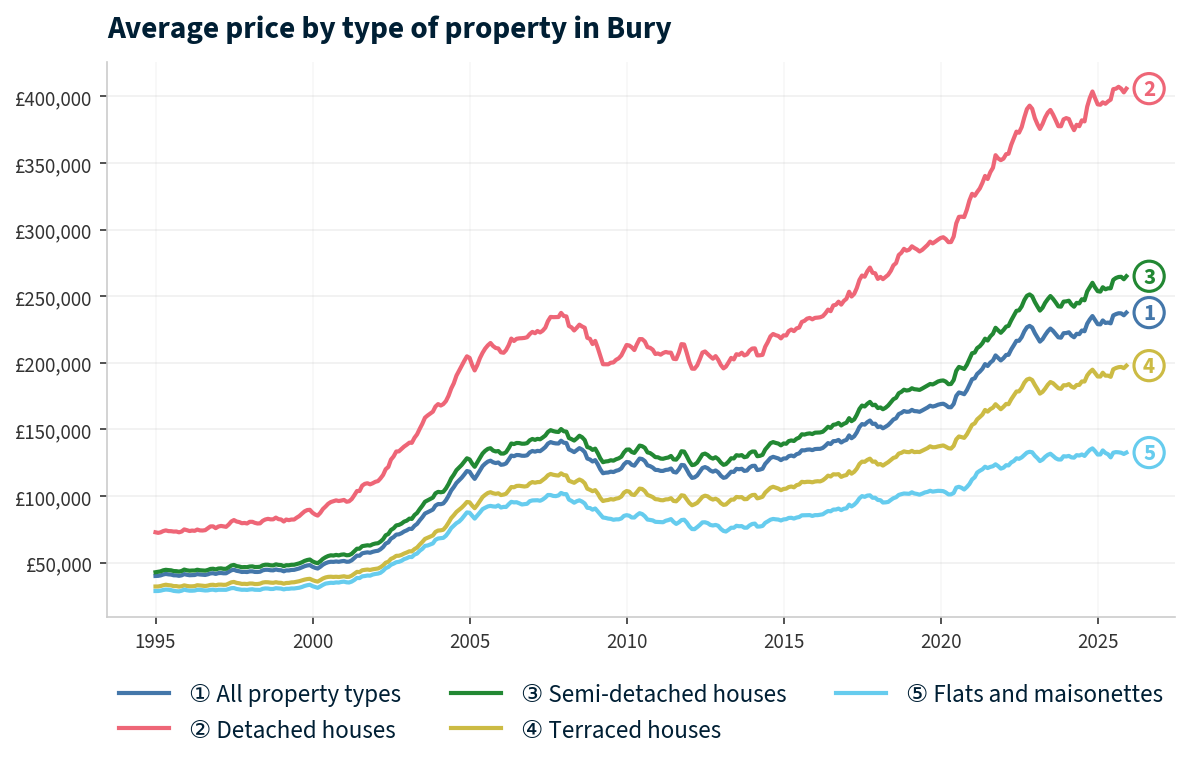
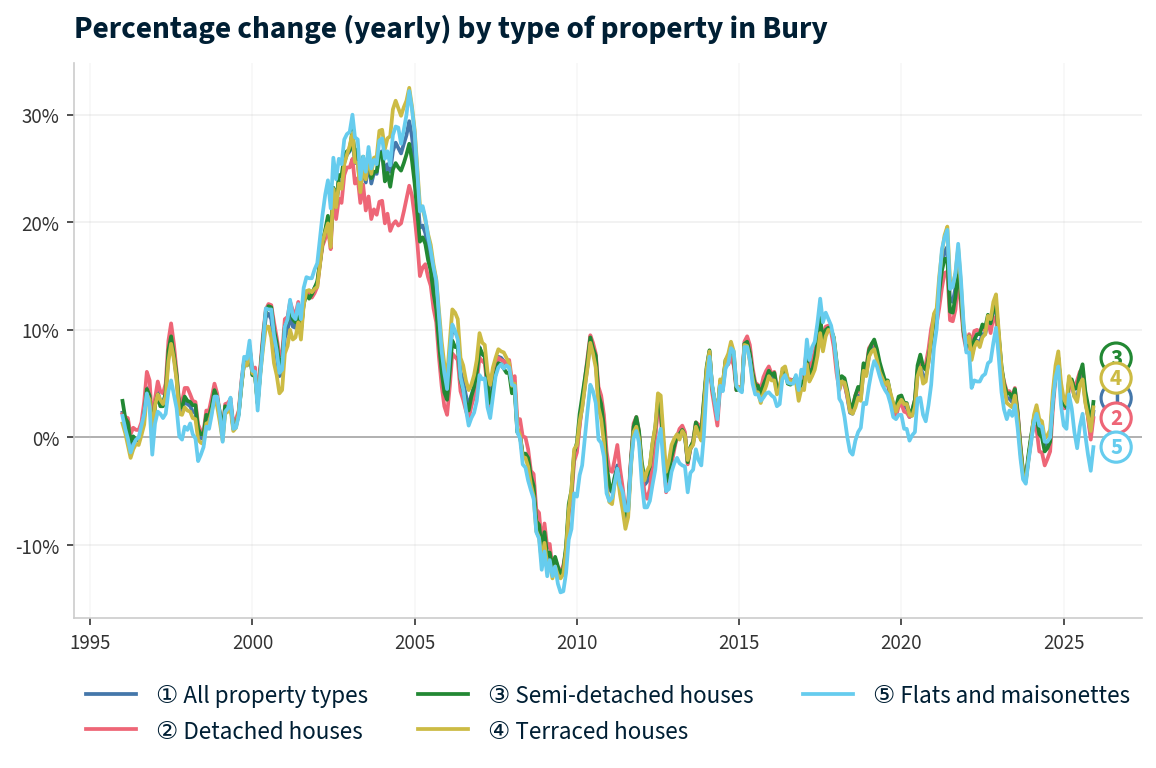
Source: HM Land Registry House Price Index for Bury, January 1995 to December 2025.

Thinking of Buying?
We have off-market investment properties averaging 8%+ annual yield.
View Property DealsSold House Prices in Bury
Bury's average sold price of £237,721 is 18.6% below England's £291,865. That gap narrows significantly for terraced houses, where Bury's discount is smaller, and widens for detached properties where the borough's stock trades at a premium relative to its own averages.
| Property type | Bury Average | England Average | Difference |
|---|---|---|---|
| Detached houses | £405,832 | £471,667 | -14.0% |
| Semi-detached houses | £265,007 | £289,135 | -8.3% |
| Terraced houses | £197,886 | £244,830 | -19.2% |
| Flats and maisonettes | £132,638 | £219,340 | -39.5% |
| All property types | £237,721 | £291,865 | -18.6% |
Detached houses in Bury average £405,832, 14.0% below England's £471,667. This is one of the narrower gaps across property types and reflects the borough's stock of larger family homes in areas like M25 (Prestwich) and BL0 (Ramsbottom), which attract Manchester commuters paying close to national rates.
Semi-detached houses at £265,007 sit 8.3% below the England average of £289,135. Semi-detached properties are Bury's dominant housing type and represent the core buy-to-let stock across BL2, BL9, and M24. The relatively small discount reflects consistent demand from families who need more space than a terraced property offers.
Terraced houses at £197,886 trade at a 19.2% discount to England's £244,830. For investors, this is the entry-level price point. Terraced stock is concentrated in BL2 (Bury East) and BL9 (town centre), which are also the postcodes with the strongest yields.
Flats and maisonettes show the deepest discount at 39.5% below England's £219,340. Bury's flat price of £132,638 reflects a limited and older stock of purpose-built apartments. There is no large-scale city centre apartment market comparable to Manchester or Salford, which keeps flat values well below the national average.
Property Data Sources
Our location guide relies on diverse, authoritative datasets including:
- HM Land Registry UK House Price Index
- Ministry of Housing, Communities and Local Government
- Ordnance Survey Data Hub
- Propertydata.co.uk
We update our property data quarterly to ensure accuracy. Last update: March 2026. All data is presented as provided by our sources without adjustments or amendments.
Price Per Square Foot in Bury
Price per square foot strips out the effect of property size and reveals where buyers are paying the most (and least) for each unit of space. Bury's sold price per square foot ranges from £223 in M26 (Radcliffe) to £303 in M25 (Prestwich), a £80 spread.
The pattern is clear: Manchester-edge postcodes command higher values per square foot than the traditional BL postcodes further north. That premium reflects proximity to Manchester city centre and the commuter demand it generates.
| Rank | Area | Price per sq ft |
|---|---|---|
| 1 | M26 (Radcliffe) | £223 |
| 2 | BL2 (Bury East, Fairfield) | £228 |
| 3 | BL9 (Bury Town Centre, Heap Bridge) | £229 |
| 4 | M24 (Middleton) | £246 |
| 5 | M44 (Irlam) | £255 |
| 6 | BL8 (Tottington, Greenmount) | £267 |
| 7 | BL0 (Ramsbottom) | £271 |
| 8 | M45 (Whitefield) | £287 |
| 9 | M25 (Prestwich) | £303 |
M25 (Prestwich) tops the table at £303 per square foot. Prestwich has established itself as one of Greater Manchester's most sought-after suburbs, with a village centre, independent shops, and direct Metrolink access to Manchester. Buyers pay a 36% premium per square foot compared to the cheapest postcodes.
BL2 (Bury East) and M26 (Radcliffe) sit at the bottom at £228 and £223 respectively. These postcodes represent the best value per square foot in the borough. For investors, lower price per square foot typically translates to higher yields because rents do not fall proportionally with prices. BL2's position at the bottom of this table and the top of the yield table is not a coincidence.
For Sale Asking Prices in Bury
The mean asking price across all 9 Bury postcodes is £279,435, with a £90,344 gap between the cheapest and most expensive areas. That gap matters because it marks the boundary between Bury's two distinct markets: the premium M25/M45/BL0/BL8 tier above £300,000 and the affordable BL2/M26/M24 tier below £265,000. For investors searching for houses for sale in Bury, the entry point varies dramatically by postcode.
| Rank | Area | Asking price |
|---|---|---|
| 1 | M25 (Prestwich) | £326,325 |
| 2 | M45 (Whitefield) | £311,456 |
| 3 | BL0 (Ramsbottom) | £305,081 |
| 4 | BL8 (Tottington, Greenmount) | £302,939 |
| 5 | BL9 (Bury Town Centre, Heap Bridge) | £265,491 |
| 6 | M24 (Middleton) | £263,983 |
| 7 | M44 (Irlam) | £262,247 |
| 8 | M26 (Radcliffe) | £241,413 |
| 9 | BL2 (Bury East, Fairfield) | £235,981 |
The top four postcodes all exceed £300,000. M25 (Prestwich), M45 (Whitefield), BL0 (Ramsbottom), and BL8 (Tottington) form a premium tier. These are established residential areas with good schools, green space, and strong owner-occupier demand. They are not the natural territory for yield-focused investors.
The affordable tier starts at BL2 (£235,981) and includes M26 (£241,413), M44 (£262,247), and M24 (£263,983). BL2 offers the lowest entry point in the borough. Combined with its position as the highest-yielding postcode, BL2 is where the numbers align most clearly for buy-to-let.
House Price Growth in Bury
Which postcodes have grown fastest, and do they overlap with the cheapest areas? In Bury, the answer is yes. BL2 (Bury East) has delivered 41.4% asking price growth over five years, the highest in the borough by a wide margin. BL2 is also the cheapest and highest-yielding postcode. Growth and yield do not always align, but in Bury they converge in the same area.
| Area | 1 Year | 3 Years | 5 Years |
|---|---|---|---|
| BL2 (Bury East, Fairfield) | 6.3% | 12.4% | 41.4% |
| M44 (Irlam) | 5.5% | 10.2% | 38.2% |
| BL9 (Bury Town Centre, Heap Bridge) | -0.9% | 11.2% | 31.2% |
| M45 (Whitefield) | 3.7% | 10.0% | 28.5% |
| M24 (Middleton) | 3.4% | 9.2% | 27.4% |
| M25 (Prestwich) | 2.0% | 3.9% | 23.4% |
| BL8 (Tottington, Greenmount) | -0.1% | 2.2% | 22.0% |
| M26 (Radcliffe) | 6.7% | 13.4% | 18.7% |
| BL0 (Ramsbottom) | 2.1% | 4.4% | 14.6% |
M26 (Radcliffe) leads the one-year growth at 6.7%, followed by BL2 at 6.3%. These are the two cheapest postcodes in the borough, and they are now growing fastest. Radcliffe's recent momentum may reflect the Prestwich Village Centre regeneration spilling northward and the general trend of buyers being priced out of M25 and M45.
BL8 (Tottington) and BL0 (Ramsbottom) show the weakest five-year growth at 22.0% and 14.6%. Both are premium, semi-rural postcodes with higher entry prices. Their slower growth reflects the fact that they were already relatively expensive within Bury's market. BL9 (Bury Town Centre) posted negative one-year growth of -0.9%, though its five-year figure of 31.2% remains strong.
Monthly Property Sales in Bury
A postcode can have strong yields and growth on paper, but if nothing sells there, the numbers are academic. BL9 (Bury Town Centre) leads Bury with 47 sales per month, and BL2 follows at 44. Those are the two postcodes that also top the yield and growth tables. M45 (Whitefield) has the highest turnover rate at 181%, meaning stock sells faster than the average listing duration.
| Area | Sales per month | Turnover | Asking price |
|---|---|---|---|
| BL9 (Bury Town Centre, Heap Bridge) | 47 | 21% | £265,491 |
| BL2 (Bury East, Fairfield) | 44 | 101% | £235,981 |
| M24 (Middleton) | 40 | 20% | £263,983 |
| BL8 (Tottington, Greenmount) | 32 | 15% | £302,939 |
| M26 (Radcliffe) | 32 | 20% | £241,413 |
| M25 (Prestwich) | 23 | 67% | £326,325 |
| BL0 (Ramsbottom) | 22 | 21% | £305,081 |
| M44 (Irlam) | 22 | 85% | £262,247 |
| M45 (Whitefield) | 22 | 181% | £311,456 |
BL2 stands out with 44 sales per month and 101% turnover. A turnover rate above 100% means stock is moving faster than the average listing duration. Combined with BL2's position as the cheapest and highest-yielding postcode, this high liquidity confirms active investor and first-time buyer demand.
M45 (Whitefield) at 181% turnover with only 22 sales per month is a different kind of signal. Low volume with extreme turnover suggests limited stock that sells very quickly when it comes to market. Investors targeting M45 may need to act fast when properties become available.
Property Data Sources
Our location guide relies on diverse, authoritative datasets including:
- HM Land Registry UK House Price Index
- Ministry of Housing, Communities and Local Government
- Ordnance Survey Data Hub
- Propertydata.co.uk
We update our property data quarterly to ensure accuracy. Last update: March 2026. All data is presented as provided by our sources without adjustments or amendments.

Bury Rental Market Analysis
For investors weighing up whether rental property is a worthwhile investment in Bury, the data below breaks down average monthly rents and gross rental yields across the borough's postcodes.
Rental data is available for 8 of 9 postcodes, with M44 (Irlam) excluded due to insufficient data. Rents range from £892 (BL9) to £1,191 (M45). If you are looking to build a property portfolio in the North West, Bury's combination of Manchester commuter demand and prices below the England average creates a clear entry point.
Average Rent and Gross Rental Yields in Bury
Bury's yield spread tells a different story to most Greater Manchester boroughs. The gap between the highest yield (4.9% in BL2) and the lowest (3.8% in BL8) is just 1.1 percentage points. BL2 (Bury East) generates its 4.9% from a monthly rent of £954 against the borough's lowest asking price of £235,981. Yields across the rest of the borough cluster tightly between 3.8% and 4.8%.
| Area | Average rent (monthly) | Asking price | Gross yield |
|---|---|---|---|
| BL2 (Bury East, Fairfield) | £954 | £235,981 | 4.9% |
| M26 (Radcliffe) | £959 | £241,413 | 4.8% |
| M24 (Middleton) | £1,039 | £263,983 | 4.7% |
| M45 (Whitefield) | £1,191 | £311,456 | 4.6% |
| M25 (Prestwich) | £1,157 | £326,325 | 4.3% |
| BL9 (Bury Town Centre, Heap Bridge) | £892 | £265,491 | 4.0% |
| BL0 (Ramsbottom) | £980 | £305,081 | 3.9% |
| BL8 (Tottington, Greenmount) | £963 | £302,939 | 3.8% |
| M44 (Irlam) | Not enough data | £262,247 | Not enough data |
That compressed spread has a practical implication. There is no single postcode dramatically outperforming the others. In many Greater Manchester boroughs, the yield spread is double or triple Bury's 1.1 percentage points. Here, the rental market is relatively consistent across the borough.
The three highest-yielding postcodes (BL2, M26, M24) are also the three most affordable. This is the classic yield pattern: lower asking prices push yields higher when rents hold steady. Rents across these three postcodes range from £954 to £1,039 per month, while asking prices range from £235,981 to £263,983.
At the other end, M25 (Prestwich) and M45 (Whitefield) command Bury's highest rents at £1,157 and £1,191 per month. Their yields are lower (4.3% and 4.6%) because asking prices are proportionally higher. These are premium areas where capital growth and tenant quality tend to be the primary draw rather than yield.
Is Bury Rent High?
Bury rents absorb between 29.9% and 40.0% of the local median gross monthly income, depending on postcode. Rent as a percentage of local income shows how affordable or stretched the rental market is. Higher percentages indicate stronger landlord pricing power relative to local earnings.
The median gross weekly salary in Bury is £687.80, which equates to £2,981 per month or £35,767 per year. This is below the North West regional median of £720.10 per week and the Great Britain median of £752.40 per week. Data from the Nomis Labour Market Profile (ASHE 2025).
| Rank | Area | Rent as % of income |
|---|---|---|
| 1 | M45 (Whitefield) | 40.0% |
| 2 | M25 (Prestwich) | 38.8% |
| 3 | M24 (Middleton) | 34.9% |
| 4 | BL0 (Ramsbottom) | 32.9% |
| 5 | BL8 (Tottington, Greenmount) | 32.3% |
| 6 | M26 (Radcliffe) | 32.2% |
| 7 | BL2 (Bury East, Fairfield) | 32.0% |
| 8 | BL9 (Bury Town Centre, Heap Bridge) | 29.9% |
| 9 | M44 (Irlam) | Not enough data |
M45 (Whitefield) has the highest rent-to-income ratio at 40.0%. This reflects Whitefield's premium rents of £1,191 per month measured against Bury's borough-wide median salary. In practice, many Whitefield tenants earn above the local median, working in Manchester's professional services sector. The ratio overstates affordability pressure for the actual tenant pool.
BL9 (Bury Town Centre) has the lowest ratio at 29.9%. Bury's cheapest rents at £892 per month keep this well within affordable territory. For investors, lower rent-to-income ratios generally mean more sustainable tenancies and lower void risk.
Thinking of Buying?
We have off-market investment properties averaging 8%+ annual yield.
View Property DealsBuy-to-Let Considerations
Are House Prices High in Bury? Price-to-Earnings Ratios
Purchasing a property in Bury requires between 6.6 and 9.1 times the median annual salary. This is based on the Nomis Labour Market Profile for Bury showing the median gross annual income for Bury residents is £35,767.
For context, the national benchmark is 7.5x (England's average sold price of £291,865 divided by the Great Britain median salary of £39,125). Five of Bury's nine postcodes sit below this benchmark.
| Rank | Area | Price-to-earnings ratio |
|---|---|---|
| 1 | BL2 (Bury East, Fairfield) | 6.6x |
| 2 | M26 (Radcliffe) | 6.7x |
| 3 | M44 (Irlam) | 7.3x |
| 4 | M24 (Middleton) | 7.4x |
| 5 | BL9 (Bury Town Centre, Heap Bridge) | 7.4x |
| 6 | BL8 (Tottington, Greenmount) | 8.5x |
| 7 | BL0 (Ramsbottom) | 8.5x |
| 8 | M45 (Whitefield) | 8.7x |
| 9 | M25 (Prestwich) | 9.1x |
BL2 (Bury East) is the most affordable postcode at 6.6 times earnings. M26 (Radcliffe) follows at 6.7x. Both sit well below the national benchmark of 7.5x, confirming their position as Bury's most accessible entry points. M24 (Middleton) and BL9 (Bury Town Centre) also come in under the benchmark at 7.4x each.
M25 (Prestwich) at 9.1x is the least affordable postcode in the borough. Prestwich's premium pricing pushes it above the national benchmark. Investors here are paying for location quality, commuter convenience, and the strength of the local tenant pool rather than outright affordability.
Deposit Requirements in Bury
Buy-to-let mortgages typically require a minimum 25% deposit, though many lenders prefer 30% for better rates. The table below uses a 30% deposit calculation. For a full breakdown of acquisition costs, see our guide to buy-to-let costs.
| Rank | Area | 30% deposit required |
|---|---|---|
| 1 | BL2 (Bury East, Fairfield) | £70,794 |
| 2 | M26 (Radcliffe) | £72,424 |
| 3 | M44 (Irlam) | £78,674 |
| 4 | M24 (Middleton) | £79,195 |
| 5 | BL9 (Bury Town Centre, Heap Bridge) | £79,647 |
| 6 | BL8 (Tottington, Greenmount) | £90,882 |
| 7 | BL0 (Ramsbottom) | £91,524 |
| 8 | M45 (Whitefield) | £93,437 |
| 9 | M25 (Prestwich) | £97,898 |
The deposit spread from £70,794 (BL2) to £97,898 (M25) is £27,104. That is a relatively narrow range for a borough with 9 postcodes. An additional £27,000 in capital buys a significantly different location profile: M25 (Prestwich) offers higher rents, stronger tenant quality, and premium capital values compared to BL2. Whether that premium is worth it depends on the investor's strategy. For those looking to reduce entry costs further, below market value properties can reduce the deposit requirement.
For investors focused on stamp duty efficiency, all 9 Bury postcodes have average asking prices above the £250,000 threshold (except BL2 at £235,981 and M26 at £241,413), so additional rate stamp duty will apply on most purchases at the higher band.
What the Bury Data Tells Buy-to-Let Investors
BL2 (Bury East) tops three separate rankings: highest yield at 4.9%, lowest asking price at £235,981, and highest five-year growth at 41.4%. That combination is unusual. In most boroughs, the cheapest postcode underperforms on growth or the highest-yielding area lacks liquidity. BL2 delivers both, with 44 sales per month confirming active demand. A 30% deposit of £70,794 generates £954 per month in rent from a mix of families and young professionals drawn to affordable housing within the Bury Metrolink corridor. See our current investment property listings for available stock near Bury.
M26 (Radcliffe) and M24 (Middleton) form a middle tier at 4.8% and 4.7% yield respectively. Radcliffe is the fastest-growing postcode over one year at 6.7% and benefits from spillover demand as Prestwich and Whitefield prices increase. Middleton offers the highest rents of the affordable trio at £1,039 per month, and its 40 sales per month show a deep, liquid market. Both require deposits under £80,000.
M44 (Irlam) has no rental data, which means yield and rent-to-income ratios cannot be calculated. Its 38.2% five-year growth and 85% turnover suggest an active market, but the data gap makes it difficult to assess buy-to-let returns. BL8 (Tottington) and BL0 (Ramsbottom) show the weakest price growth, the lowest yields, and the highest entry costs. Their data profiles are consistent with owner-occupier markets rather than investment areas.
Bury does not currently operate a selective licensing scheme for private rented properties. Investors should check Bury Council's latest position as licensing arrangements can change.
How Bury Compares
Bury's mean asking price of £279,435 sits above Bolton (£248,685) and Rochdale (£255,610) but below Stockport (£371,546). Its top yield of 4.9% trails the 6.6% available in Salford and 6.2% in Stockport. Across Greater Manchester, Bury occupies a middle position: more expensive than the cheapest boroughs but with lower yields to match.
| Location | Mean asking price | Mean monthly rent | Top gross yield |
|---|---|---|---|
| Salford | £247,746 | £1,163 | 6.6% |
| Bolton | £248,685 | £936 | 5.1% |
| Rochdale | £255,610 | £956 | 5.1% |
| Bury | £279,435 | £1,017 | 4.9% |
| Stockport | £371,546 | £1,314 | 6.2% |
Salford offers the highest yields in this comparison at 6.6%, with a mean asking price of £247,746. Manchester city centre spillover demand drives Salford's mean rent to £1,163 per month. Bolton and Rochdale both top out at 5.1%, still above Bury's 4.9% but at lower average prices and rents.
Stockport offers higher yields (6.2%) at a significantly higher price point (£371,546), reflecting its established south Manchester position. Of the five boroughs compared, Bury sits in the middle on price and at the bottom on yield.
Bury's relative strength is its combination of moderate yields with strong recent growth. BL2's 41.4% five-year price growth is difficult to match across any of these comparison boroughs. Investors who weight capital appreciation alongside income may find that trade-off compelling.
Frequently Asked Questions
Is Bury a good place to live and invest?
Bury combines prices 18.6% below the England average with Metrolink tram access to Manchester city centre. The borough's population grew 4.75% to 193,851 between the 2011 and 2021 censuses. Gross rental yields range from 3.8% to 4.9%, with BL2 (Bury East) delivering the highest returns. A £140 million town centre regeneration pipeline and the Atom Valley employment scheme are adding new infrastructure and jobs across the borough.
What are the demographics of Bury?
Bury has a population of 193,851 (2021 Census) with a median annual salary of £35,767 (ASHE 2025). The employment rate is 70.2% and unemployment stands at 5.4%. The borough spans from semi-rural areas like Ramsbottom (BL0) in the north to suburban Manchester-edge postcodes like Prestwich (M25) and Whitefield (M45) in the south. Key employment sectors include health and social care, retail, manufacturing, and public administration. See the full data in our Why Invest in Bury section above.
What is the average rent in Bury?
The mean monthly rent across Bury is £1,017, with a range from £892 in BL9 (Bury Town Centre) to £1,191 in M45 (Whitefield), based on March 2026 data from PropertyData. Rents are highest in the Manchester-edge postcodes (M25, M45) where commuter demand from professionals working in the city centre drives pricing above £1,150 per month. Rental data is available for 8 of 9 postcodes, with M44 (Irlam) excluded. For the full postcode breakdown, see our rental yields table.
How does Bury compare to Bolton for buy-to-let?
Bolton offers a slightly higher top yield (5.1% vs 4.9%) at a lower mean asking price (£248,685 vs £279,435). Bolton's mean rents are lower at £936 per month compared to Bury's £1,017. The yield difference is narrow, but Bolton's lower entry prices give it a small edge for income-focused investors. Bury's strongest card is capital growth: BL2 has delivered 41.4% five-year price growth, which is difficult to match in Bolton. Both boroughs are northern Greater Manchester commuter towns with Metrolink access. Read our Bolton buy-to-let guide for the full comparison.
What are house prices like in Bury?
Bury's average sold price is £237,721 (December 2025, HM Land Registry), which is 18.6% below the England average of £291,865 and 9.3% above the North West regional average of £217,428. Asking prices range from £235,981 in BL2 (Bury East) to £326,325 in M25 (Prestwich). Detached houses average £405,832, semi-detached £265,007, terraced £197,886, and flats £132,638. Prices have grown 29.5% over five years and 494.1% since January 1995. See the full analysis in our sold house prices section.
Are there HMO and student accommodation opportunities in Bury?
Bury does not currently operate a borough-wide selective licensing scheme for private rented properties, though mandatory HMO licensing applies to larger properties (5+ occupants from 2+ households) under national rules. The University of Bolton's Bury campus and proximity to Manchester's university corridor create some student tenant demand. BL2 and BL9, with Bury's lowest asking prices and closest proximity to the town centre, are the postcodes where HMO conversions are most likely to stack up financially. Check Bury Council's planning portal for Article 4 directions that may restrict conversions in specific areas.
Are there new build homes for sale in Bury?
The Atom Valley Northern Gateway scheme includes plans for 3,000 new homes across Bury and Rochdale, with Balfour Beatty appointed as main contractor. The Prestwich Village Centre redevelopment includes up to 200 new build homes across three blocks. Bury town centre's £140 million regeneration pipeline also includes town centre living schemes. New builds typically carry a premium over existing stock. Bury's existing housing market averages £237,721 (Land Registry, December 2025). For investors, new builds offer lower maintenance costs and modern EPC ratings, but the higher purchase price can compress yields compared to older terraced and semi-detached stock in postcodes like BL2 and BL9.