
Where to Buy Property Investments in Northampton: Yields of 5.4%
Northampton's gross rental yields range from 3.7% to 5.4% across all 10 postcodes, with NN1 Town Centre delivering the highest returns. The average sold price of £293,580 sits almost exactly at the England average of £293,131, and the population grew 13.5% to 425,700 between the 2011 and 2021 censuses.
That headline figure hides a wide split across the postcodes. Asking prices start from £202,227 in NN1 and stretch to £463,682 in NN12 Towcester. The town centre offers entry-level buy-to-let at 5.3 times the local median salary. The market towns and villages surrounding Northampton command prices above 10 times earnings. All 10 postcodes have rental data, which is uncommon across the East Midlands portfolio.
This guide covers 10 postcodes from NN1 to NN13 under the West Northamptonshire unitary authority (ONS code E06000062). The area spans Northampton town itself and surrounding settlements including Daventry (NN11), Towcester (NN12), and Brackley (NN13). Investors comparing options in the region may also consider Leicester, Coventry, or Milton Keynes. Browse all our Midlands location guides.
Article updated: February 2026
Northampton Buy-to-Let Market Overview 2026
Northampton's sold prices match the England average, but entry-level postcodes in the town centre offer yields and affordability ratios that outperform most East Midlands locations.
- Average sold price: £293,580 (0.2% above England's £293,131)
- Asking price range: £202,227 (NN1) to £463,682 (NN12)
- Rental yields: 3.7% (NN4, NN6) to 5.4% (NN1) across all 10 postcodes
- Rental income: Monthly rents from £911 (NN1) to £1,541 (NN7)
- Price per sq ft: Sold prices from £231/sq ft (NN1) to £365/sq ft (NN12)
- Market activity: Sales ranging from 29 per month (NN7) to 67 per month (NN3)
- Deposit requirements: 30% deposits range from £60,668 (NN1) to £139,105 (NN12)
- Affordability ratios: Property prices from 5.3 to 12.2 times Northampton's median annual salary of £38,000
Contents

-
by Robert Jones, Founder of Property Investments UK
With two decades in UK property, Rob has been investing in buy-to-let since 2005, and uses property data to develop tools for property market analysis.

Property Data Sources
Our location guide relies on diverse, authoritative datasets including:
- HM Land Registry UK House Price Index
- Ministry of Housing, Communities and Local Government
- Ordnance Survey Data Hub
- Propertydata.co.uk
We update our property data quarterly to ensure accuracy. Last update: February 2026. All data is presented as provided by our sources without adjustments or amendments.
Why Invest in Northampton?
Northampton sits at a crossroads that property investors in the Midlands often overlook. It is 60 miles from London, 50 from Birmingham, and connected to both by the M1 and the West Coast Main Line. That positioning drives a commuter economy that pushes local wages above the East Midlands average while keeping house prices below the South East threshold.
The University of Northampton relocated to its Waterside Campus in the town centre in 2018. The £330 million campus brought 12,000 students into NN1 and NN2, replacing a suburban campus that contributed little to central rental demand. That move fundamentally changed the lettings market in the town centre postcodes.
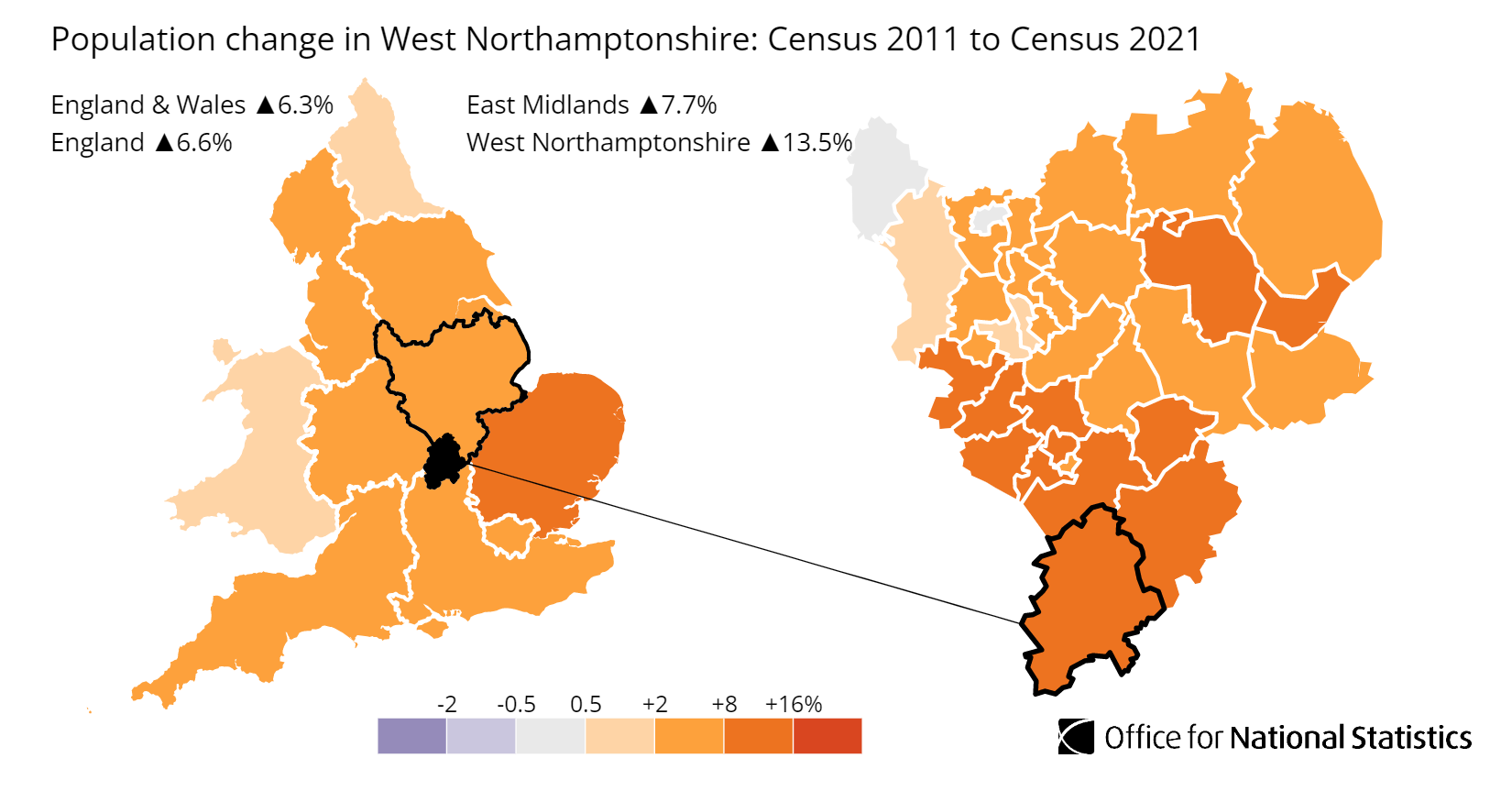
Between the 2011 and 2021 censuses, the population of West Northamptonshire grew from 375,100 to 425,700, a rise of 13.5%. That is more than four times the England average population growth rate over the same period. The growth reflects both new housing development and the area's attractiveness to families priced out of the South East corridor.
Earnings in Northampton sit above the regional average but below the national figure. The median annual salary is £38,000, compared to £36,192 across the East Midlands and £39,125 for Great Britain. Higher local wages relative to the region support rental demand at the upper end. The gap below the national figure means house prices face less upward pressure from local buyers than in equivalent commuter towns closer to London.
The logistics sector dominates the employment base. Northampton is the home of the Royal Mail's national letters hub, and distribution centres for major retailers line the A45 and M1 corridors. Brackmills Industrial Estate and Swan Valley Business Park together employ thousands. The warehouse and distribution workforce creates consistent demand for two- and three-bedroom rental properties in NN3, NN4, and NN5.
Northampton Economic Summary
- Population: 425,700 (2021 Census). Growth of 13.5% from 2011.
- Median annual salary: £38,000 (Northampton), £36,192 (East Midlands), £39,125 (Great Britain)
- Employment rate: 78.4% (Northampton)
- Key employment sectors: Logistics and distribution, financial services, higher education, public sector, advanced manufacturing
Source: ONS Census 2021, Nomis Labour Market Profile (ASHE 2025)
Northampton's employment rate of 78.4% sits above the Great Britain average of 75.6%. The unemployment rate data is suppressed for this authority due to a small sample size in the Annual Population Survey. That suppression is common in newer unitary authorities where the survey boundaries have not yet caught up to the 2021 reorganisation. The employment rate itself is a more reliable indicator here, and it shows a healthy labour market.
Regeneration and Investment in Northampton
Northampton's town centre is in the middle of its most significant transformation in decades. Government funding, private development, and a £1 billion masterplan are reshaping the NN1 postcode and the streets around it.
- Abington Street Redevelopment (demolition commenced 2025, £9.7m): The former M&S, BHS, and Job Centre buildings on Abington Street are being demolished to make way for over 200 build-to-rent homes above modern retail and leisure. This is Northampton's first institutional-quality BTR scheme, funded through the Government's Town Fund. Updates at West Northamptonshire Council.
- Market Walk and STACK Food Hall (construction 2025, opening 2026/27, £12.2m): A new leisure and dining destination anchored by STACK, the national street food and entertainment operator. The £4.2 million Town Fund allocation is supplemented by £8 million from STACK. For investors, this creates a leisure anchor that changes the tenant appeal of surrounding NN1 properties. Updates at West Northamptonshire Council.
- Greyfriars Masterplan (planning stage, £1bn estimated): A 25-acre regeneration covering central Northampton, targeting over 1,000 new homes alongside retail, leisure, cultural spaces, and infrastructure. The scheme is projected to generate approximately 7,000 full-time equivalent jobs. This is a long-term play spanning 10-15 years, but the scale of investment signals institutional confidence in Northampton's town centre. Updates at TheBusinessDesk.
West Northamptonshire Property Market Analysis
When Was the Last House Price Crash in Northampton?
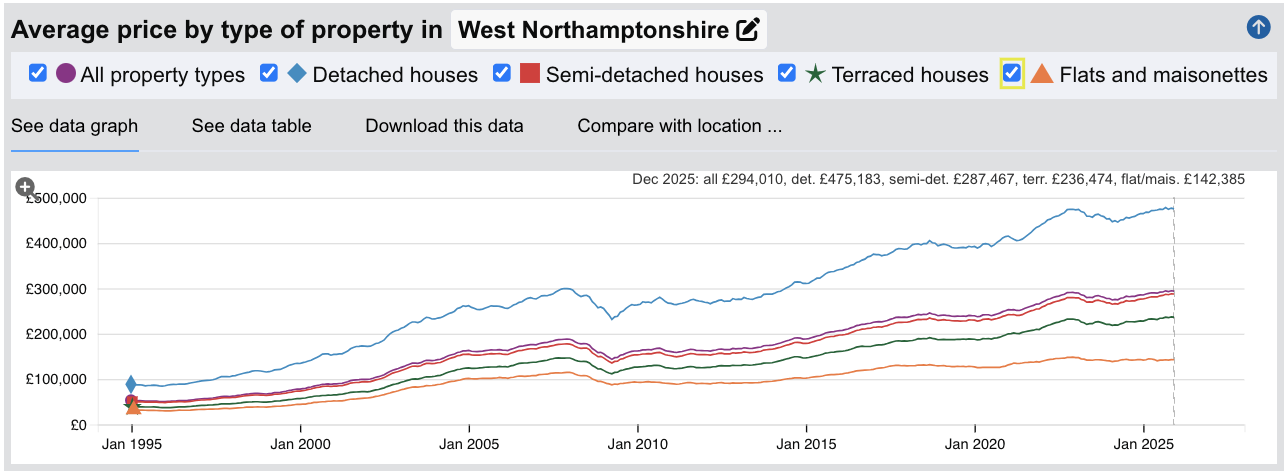
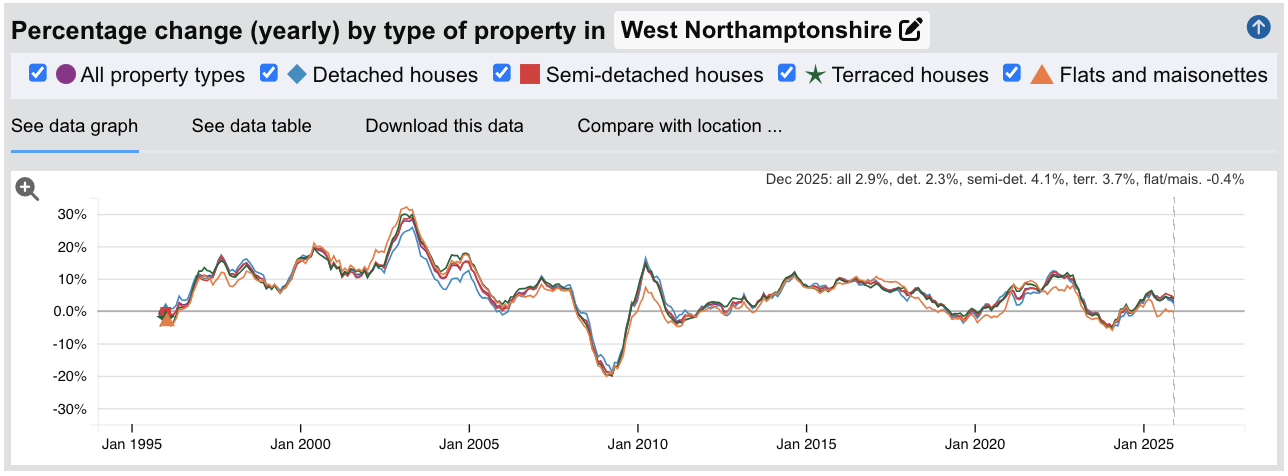
Northampton's full house price history from the HM Land Registry House Price Index runs from January 1995 to November 2025. The data shows one major crash, a relatively fast recovery, and a strong pandemic-era surge.
- 1995-2000 (Early growth): West Northamptonshire started 1995 at £50,588. By January 2000, prices had risen to £77,697, an increase of 53.6%. Annual growth hit 16.0% in January 2000. Proximity to London and improving M1 connections drove demand earlier than many Midlands towns.
- 2000-2007 (The boom): Prices more than doubled from £77,697 in January 2000 to a peak of £187,961 in December 2007. The sharpest growth came in 2002-2004, when annual change routinely exceeded 15%. Cheap credit and London overspill pushed Northampton prices well beyond what local wages could sustain.
- 2008-2009 (The financial crisis): From the peak of £187,961 in December 2007 to the trough of £143,311 in April 2009, Northampton lost 23.8% of its value in 16 months. The worst annual change reading was -19.9% in April 2009. All property types fell almost uniformly: detached -18.9%, semi-detached -20.0%, terraced -20.0%, flats -19.5%. Northampton's decline of 23.8% was significantly worse than England overall (18.2%) and the East Midlands region (18.6%).
- 2009-2013 (Recovery): Unlike many Midlands towns that stagnated for years, Northampton bounced relatively quickly. Prices returned to positive annual growth by November 2009 at +1.7%. By December 2013, the average had recovered to around £167,000. Still 11.1% below the pre-crash peak, but the trajectory was clearly upward.
Recovery and Growth (2014-Present)
- 2014-2016 (Passing the peak): Annual growth accelerated to 7-9% through this period. Prices passed the pre-crash peak in September 2014 at £190,539, a recovery time of approximately 6 years and 9 months. By December 2016, prices had reached £219,000. The recovery was driven by London commuter demand and the emergence of Northampton as an affordable alternative to Milton Keynes and Luton.
- 2017-2019 (Steady growth): Prices rose from approximately £222,000 in January 2017 to £240,000 by December 2019. Consistent growth of 2-4% per year. The logistics sector expanded significantly during this period, with new distribution centres adding employment and rental demand.
- 2020-2022 (Pandemic surge): Prices jumped from £238,230 in March 2020 to £290,999 by December 2022. That is 22.2% growth in under three years. The stamp duty holiday and the shift to remote working made Northampton's commuter positioning even more attractive. Annual growth peaked at 11.2% in June 2022.
- 2023 (Rate shock): Interest rate rises reversed the gains. Prices fell from £290,999 in December 2022 to £277,620 by December 2023. A decline of 4.6%. Terraced houses and flats were hit hardest, with annual changes of -5.1% and -5.2% respectively.
- 2024-2025 (Recovery): Prices stabilised through 2024 and returned to growth. By November 2025, the average reached £293,580 with annual growth of 3.2%. Semi-detached houses led the recovery at 4.3% annual growth. Flats remain the weakest type at -0.3%.
Long-Term Property Value Growth in Northampton
- 5 years (2020-2025): +18.1% (£248,587 to £293,580)
- 10 years (2015-2025): +43.6% (£204,401 to £293,580)
- 15 years (2010-2025): +80.5% (£162,665 to £293,580)
- 20 years (2005-2025): +78.8% (£164,223 to £293,580)
- 30 years (1995-2025): +481.8% (£50,455 to £293,580)
The 2008 crash is the reference point for Northampton investors assessing downside. A 23.8% decline was steeper than both England and the East Midlands, reflecting the pressure that London commuter demand had built into local prices. But recovery came within 7 years, and the structural drivers are different now. The university campus relocation, the logistics sector expansion, and the regeneration pipeline did not exist in 2007. Prices have quintupled since 1995.
Source: HM Land Registry House Price Index for West Northamptonshire

Thinking of Buying?
We have off-market investment properties averaging 8%+ annual yield.
View Property DealsSold House Prices in Northampton
West Northamptonshire's average sold price of £293,580 is almost exactly at the England average of £293,131. That 0.2% difference is the smallest gap of any location in our Midlands portfolio. It sits 21.2% above the East Midlands regional average of £242,180. But the headline masks a significant split by property type. Flats in Northampton cost 35.9% less than the England average. Detached houses are virtually identical.
| Property Type | Northampton Average | England Average | Difference |
|---|---|---|---|
| Detached houses | £474,919 | £474,400 | +0.1% |
| Semi-detached houses | £287,017 | £290,004 | -1.0% |
| Terraced houses | £235,960 | £245,002 | -3.7% |
| Flats and maisonettes | £142,118 | £221,565 | -35.9% |
| All property types | £293,580 | £293,131 | +0.2% |
Flats at £142,118 are the standout value play, sitting 35.9% below the England average of £221,565. That discount reflects the mix of ex-council stock, older town centre conversions, and the absence of premium new-build apartment schemes that inflate flat averages in cities like Oxford or Cambridge. For investors, it creates sub-£150,000 entry points with strong yield potential.
Detached houses at £474,919 are within £519 of the England average. This is the commuter premium at work. Families relocating from London and the South East are willing to pay national-level prices for detached stock with better space and a faster commute than alternatives further from the M1. These are owner-occupier properties, not typical buy-to-let targets.
Semi-detached houses at £287,017 sit 1.0% below England. Semis are the backbone of the suburban rental market in NN3, NN4, and NN5. The near-parity with national prices confirms that demand for family-sized rental stock in Northampton is strong enough to support values close to the national benchmark.
Terraced houses at £235,960 are 3.7% below England. The terraced stock in NN1 and NN2 represents the core buy-to-let market for investors targeting the student and young professional tenant pool near the university campus. The discount is modest, reflecting Northampton's overall price alignment with England.
Property Data Sources
Our location guide relies on diverse, authoritative datasets including:
- HM Land Registry UK House Price Index
- Ministry of Housing, Communities and Local Government
- Ordnance Survey Data Hub
- Propertydata.co.uk
We update our property data quarterly to ensure accuracy. Last update: February 2026. All data is presented as provided by our sources without adjustments or amendments.
Price Per Square Foot in Northampton
Northampton's sold prices range from £231 to £365 per square foot across ten postcodes. Average asking prices can mislead because a postcode might look expensive simply because it has larger properties. Price per square foot strips out that size bias and shows what you are actually paying for space.
Northampton's price per square foot ranges from £231 in NN1 to £365 in NN12, a spread of £134 across ten postcodes. The cheapest space sits in the town centre. The most expensive is in Towcester, one of the most affluent market towns in the county. The urban postcodes (NN1 through NN5) cluster between £231 and £291. The rural and market town postcodes (NN6, NN7, NN12, NN13) jump to £318 and above.
| Rank | Area | Price Per Sq Ft |
|---|---|---|
| 1 | NN1 (Town Centre) | £231 |
| 2 | NN2 (Kingsthorpe) | £283 |
| 3 | NN5 (Duston) | £288 |
| 4 | NN11 (Daventry) | £289 |
| 5 | NN3 (Weston Favell, Abington) | £291 |
| 6 | NN6 (Earls Barton, Brixworth) | £318 |
| 7 | NN4 (Wootton, Hunsbury) | £323 |
| 8 | NN7 (Weedon Bec, Roade) | £327 |
| 9 | NN13 (Brackley) | £363 |
| 10 | NN12 (Towcester) | £365 |
NN1 Town Centre at £231 per square foot is the cheapest space in the Northampton area. This is the postcode that also delivers the highest gross yield at 5.4%. Older terraced housing and town centre conversions keep per-foot costs low. The Waterside Campus relocation brought 12,000 students within walking distance, creating rental demand that the per-square-foot value alone would not predict.
NN12 Towcester and NN13 Brackley at £363 and £365 per square foot sit in a different market. These are sought-after market towns where period properties and village stock command a premium. The price per square foot is 58% higher than NN1, but the yields compress to 3.8%. The space costs more, and the rental income does not rise proportionally.
The mid-range cluster of NN2 through NN5 (£283 to £291) is where most buy-to-let activity concentrates. Read this alongside the yield data. NN5 Duston ranks third for price per square foot at £288 but delivers 4.3% yield with the strongest five-year growth at 23.8%. That combination of reasonable space costs and appreciation makes it stand out in the middle of the table.
Figures reflect averages across all property types and ages. Individual values depend on condition, location within the postcode, and building age.
For Sale Asking Prices in Northampton
Seven of ten Northampton postcodes have asking prices below £350,000. Asking prices reflect what sellers and agents think the market will pay, and in Northampton the gap between the urban core and the surrounding market towns is the story.
Northampton's asking prices range from £202,227 in NN1 to £463,682 in NN12. That is a 2.3x spread between the cheapest and most expensive postcodes. Strip out the three most rural postcodes (NN6, NN7, NN12) and the urban range narrows to £202,227 to £341,093. Seven postcodes sit below £350,000.
| Rank | Area | Average Asking Price |
|---|---|---|
| 1 | NN1 (Town Centre) | £202,227 |
| 2 | NN2 (Kingsthorpe) | £262,632 |
| 3 | NN3 (Weston Favell, Abington) | £283,137 |
| 4 | NN11 (Daventry) | £313,266 |
| 5 | NN4 (Wootton, Hunsbury) | £332,699 |
| 6 | NN5 (Duston) | £341,093 |
| 7 | NN13 (Brackley) | £400,058 |
| 8 | NN7 (Weedon Bec, Roade) | £407,620 |
| 9 | NN6 (Earls Barton, Brixworth) | £449,388 |
| 10 | NN12 (Towcester) | £463,682 |
NN1 Town Centre at £202,227 is the only postcode below £250,000. It is also the only postcode with a yield above 5%. The next cheapest entry is NN2 Kingsthorpe at £262,632, a step up of £60,000 that buys a different kind of postcode. Kingsthorpe is a residential suburb north of the town centre with period housing and family tenants. The yield drops from 5.4% to 4.8%.
Compare rows 1 and 10. NN1 at £202,227 delivers 5.4% yield. NN12 at £463,682 delivers 3.8%. The difference in deposit is £78,437. An investor choosing NN1 over NN12 gets a higher yield on less than half the capital outlay. The trade-off is tenant profile: town centre tenants versus affluent market town families.
The mean asking price across all ten postcodes is £345,580. That figure appears in the comparison section later, where Northampton is measured against Leicester, Coventry, Milton Keynes, and Luton.
House Price Growth in Northampton
Five-year growth across Northampton's postcodes ranges from 7.5% in NN12 to 23.8% in NN5. One-year growth can swing on a handful of transactions. Five years captures a full market cycle, and Northampton's five-year figures tell a clear story about where capital has been made.
All ten postcodes delivered positive five-year growth, led by NN5 Duston at 23.8%. An investor who bought a property in NN5 five years ago at approximately £275,000 would now be looking at asking prices of £341,093. That is £66,000 in equity growth. But the one-year figures show that the market has cooled. Four postcodes show negative one-year growth, and the strongest one-year performer (NN3 at 3.3%) is modest by historical standards.
| Area | 1 Year | 3 Years | 5 Years |
|---|---|---|---|
| NN5 (Duston) | -0.8% | 0.4% | 23.8% |
| NN3 (Weston Favell, Abington) | 3.3% | -0.8% | 15.7% |
| NN7 (Weedon Bec, Roade) | 0.4% | -4.3% | 13.4% |
| NN4 (Wootton, Hunsbury) | -0.6% | 0.0% | 12.3% |
| NN11 (Daventry) | 0.2% | -0.2% | 12.3% |
| NN6 (Earls Barton, Brixworth) | 1.7% | 0.6% | 12.2% |
| NN1 (Town Centre) | -0.3% | -2.6% | 11.7% |
| NN13 (Brackley) | -2.5% | 3.1% | 10.6% |
| NN2 (Kingsthorpe) | -3.6% | -8.5% | 9.7% |
| NN12 (Towcester) | 0.6% | -2.2% | 7.5% |
NN5 Duston stands alone at 23.8% five-year growth. No other postcode comes within 8 percentage points. NN5 is a suburban postcode west of the town centre, with a mix of 1950s-70s housing and newer estates. The growth reflects sustained demand from families and key workers priced out of the more established areas to the south and east.
NN2 Kingsthorpe at -3.6% one-year and -8.5% three-year is the weakest performer in the table. Despite a five-year gain of 9.7%, the recent trajectory is firmly downward. The three-year figure of -8.5% is the steepest decline across all ten postcodes. This may reflect a correction after the pandemic-era surge, when prices in established residential areas were bid up fastest and have since retreated.
The three-year column reveals widespread softness. Seven of ten postcodes show negative or flat three-year growth. Only NN13 Brackley (3.1%), NN6 Earls Barton (0.6%), and NN5 Duston (0.4%) are positive. The market gained most of its five-year growth during the pandemic period (2020-2022) and has given some back since. That pattern is consistent with the Land Registry data showing a 4.6% decline in 2023 across West Northamptonshire.
Monthly Property Sales in Northampton
Northampton records 427 property sales per month across its ten postcodes. Transaction volumes reveal which areas have the deepest buyer pools. For buy-to-let investors, this is an exit strategy question. High volume and high turnover mean a liquid market. Low volume means you may wait.
Northampton's monthly sales range from 29 in NN7 to 67 in NN3, with a combined total of 427 transactions per month across all ten postcodes. NN13 Brackley's turnover rate of 80% is the highest, meaning properties change hands faster than new stock comes to market. NN1 Town Centre at 18% turnover is the lowest, despite healthy sales of 34 per month.
| Area | Sales Per Month | Turnover | Asking Price |
|---|---|---|---|
| NN3 (Weston Favell, Abington) | 67 | 63% | £283,137 |
| NN4 (Wootton, Hunsbury) | 59 | 38% | £332,699 |
| NN11 (Daventry) | 48 | 71% | £313,266 |
| NN2 (Kingsthorpe) | 47 | 33% | £262,632 |
| NN5 (Duston) | 42 | 21% | £341,093 |
| NN6 (Earls Barton, Brixworth) | 37 | 41% | £449,388 |
| NN1 (Town Centre) | 34 | 18% | £202,227 |
| NN12 (Towcester) | 34 | 35% | £463,682 |
| NN13 (Brackley) | 30 | 80% | £400,058 |
| NN7 (Weedon Bec, Roade) | 29 | 33% | £407,620 |
NN3 Weston Favell leads with 67 sales per month at 63% turnover. This is the largest residential postcode in the Northampton area, stretching east from the town centre through Abington and Weston Favell to the A45 corridor. The volume confirms a deep buyer pool. For exit strategy, NN3 offers the most liquid market in the table.
NN1 Town Centre at 18% turnover tells you that landlords hold. Despite 34 monthly sales, the low turnover suggests a large rental stock that rarely comes to market. Long-term landlords sit on properties near the university campus and town centre amenities. Low turnover in a high-yield postcode is a signal that experienced investors have already identified the value here.
NN13 Brackley at 80% turnover is the fastest-moving market. Properties change hands quickly in this small market town on the Oxfordshire border. The F1 connection (Silverstone Circuit is nearby) and proximity to the M40 create demand from a specific buyer pool. The combination of 30 monthly sales and 80% turnover means stock does not sit on the market for long.
Property Data Sources
Our location guide relies on diverse, authoritative datasets including:
- HM Land Registry UK House Price Index
- Ministry of Housing, Communities and Local Government
- Ordnance Survey Data Hub
- Propertydata.co.uk
We update our property data quarterly to ensure accuracy. Last update: February 2026. All data is presented as provided by our sources without adjustments or amendments.
Northampton Rental Market Analysis
For investors weighing up whether rental property is a worthwhile investment in Northampton, the data below breaks down average monthly rents and gross rental yields across the area's postcodes.
Rental data is available for all 10 postcodes. Monthly rents range from £911 in NN1 to £1,541 in NN7 and gross yields range from 3.7% to 5.4%. If you are looking to build a property portfolio in the East Midlands, Northampton's complete rental data coverage and the wide spread between yield tiers makes it straightforward to model returns before committing capital.

Average Rent & Gross Rental Yields in Northampton
Gross rental yield is calculated from the average asking price and average monthly rent for each postcode. It does not account for void periods, maintenance, management fees, or mortgage costs. It is a starting point for comparison, not a profit forecast.
NN1 Town Centre delivers Northampton's highest gross yield at 5.4%, where monthly rents of £911 meet asking prices of £202,227. The yield spread across the ten postcodes is 1.7 percentage points. That gap separates the town centre from the surrounding market towns and villages, where higher property values dilute the rental return.
| Area | Average Monthly Rent | Average Asking Price | Gross Yield |
|---|---|---|---|
| NN1 (Town Centre) | £911 | £202,227 | 5.4% |
| NN2 (Kingsthorpe) | £1,053 | £262,632 | 4.8% |
| NN3 (Weston Favell, Abington) | £1,124 | £283,137 | 4.8% |
| NN7 (Weedon Bec, Roade) | £1,541 | £407,620 | 4.5% |
| NN5 (Duston) | £1,220 | £341,093 | 4.3% |
| NN11 (Daventry) | £1,005 | £313,266 | 3.8% |
| NN12 (Towcester) | £1,463 | £463,682 | 3.8% |
| NN13 (Brackley) | £1,252 | £400,058 | 3.8% |
| NN4 (Wootton, Hunsbury) | £1,019 | £332,699 | 3.7% |
| NN6 (Earls Barton, Brixworth) | £1,395 | £449,388 | 3.7% |
Three postcodes sit at or above 4.5% yield: NN1 (5.4%), NN2 (4.8%), NN3 (4.8%), and NN7 (4.5%). NN1 and NN2 tap into the student and young professional tenant pool near the university campus. NN3 benefits from its position as the largest residential postcode with the most active sales market. NN7 is the outlier in this group. Its 4.5% yield comes from high absolute rents of £1,541 against asking prices of £407,620. Weedon Bec and Roade attract village tenants willing to pay a premium for rural living within commuting distance of Northampton and the M1.
Five postcodes cluster at 3.7% to 3.8%. NN11 Daventry, NN12 Towcester, NN13 Brackley, NN4 Wootton, and NN6 Earls Barton. These are the market towns and suburban villages where owner-occupier demand sets the price. Rents are strong in absolute terms (£1,005 to £1,463) but the asking prices absorb the income. Investors here are buying for tenant quality and capital appreciation rather than yield.
NN7 commands the highest absolute rent in the table at £1,541 per month. That is £630 more than NN1's £911. But the asking price is double. The absolute rent number alone does not determine investment returns. The yield table shows NN1 generating 5.4% from £911, while NN7 generates 4.5% from £1,541. The cheaper property works harder per pound invested.
Is Northampton Rent High?
Northampton rents consume between 28.8% and 48.7% of the local median gross salary. Rent affordability matters from both sides. For tenants, it determines whether they can sustain payments long-term. For landlords, areas where rent consumes a lower share of income tend to produce more reliable tenants and fewer arrears.
The median gross weekly salary in Northampton is £730.80, which equates to £3,167 per month or £38,000 per year. This is above the East Midlands regional median of £696.00 per week and below the Great Britain median of £752.40 per week. Data from the Nomis Labour Market Profile (ASHE 2025).
Across all 10 Northampton postcodes, rent ranges from 28.8% to 48.7% of the local median gross monthly salary. The general benchmark is that rent becomes stretched above 30% of gross income. Seven of the ten postcodes sit above that level. The rural and market town postcodes push the ratio highest, reflecting property values set by lifestyle demand rather than local wages.
| Rank | Area | Rent as % of Income |
|---|---|---|
| 1 | NN7 (Weedon Bec, Roade) | 48.7% |
| 2 | NN12 (Towcester) | 46.2% |
| 3 | NN6 (Earls Barton, Brixworth) | 44.0% |
| 4 | NN13 (Brackley) | 39.5% |
| 5 | NN5 (Duston) | 38.5% |
| 6 | NN3 (Weston Favell, Abington) | 35.5% |
| 7 | NN2 (Kingsthorpe) | 33.3% |
| 8 | NN4 (Wootton, Hunsbury) | 32.2% |
| 9 | NN11 (Daventry) | 31.7% |
| 10 | NN1 (Town Centre) | 28.8% |
NN7, NN12, and NN6 at 44% to 48.7% look stretched on paper. But these are the rural and market town postcodes where tenants typically earn above the Northampton median. Professional households renting in Towcester or Earls Barton are often dual-income commuters, not single earners on the local median wage. The city-wide salary figure understates what tenants in these postcodes actually earn.
NN1 Town Centre at 28.8% is the only postcode below the 30% benchmark. That is the most affordable postcode for tenants and the one that also delivers the highest yield. Rent of £911 against a monthly median salary of £3,167 leaves headroom for tenants. Lower affordability pressure here means arrears are less likely, which supports consistent rental income for landlords.
Thinking of Buying?
We have off-market investment properties averaging 8%+ annual yield.
View Property DealsBuy-to-Let Considerations
Are Northampton House Prices High? Price-to-Earnings Ratios
The price-to-earnings ratio compares a postcode's average asking price to the local median annual salary. Lower ratios mean more affordable entry points relative to local wages. The national benchmark is 7.5x, calculated from England's average sold price of £293,131 against Great Britain's median annual salary of £39,125.
Purchasing a property in Northampton requires between 5.3 and 12.2 times the median annual salary. This is based on the Nomis Labour Market Profile for Northampton showing the median gross annual income for Northampton residents is £38,000.
Two of Northampton's ten postcodes sit below the national benchmark of 7.5x. NN1 at 5.3x and NN2 at 6.9x. NN3 sits right at the benchmark at 7.5x. The remaining seven postcodes range from 8.2x to 12.2x, reflecting the premium pricing of the suburban and market town postcodes.
| Rank | Area | Price-to-Earnings Ratio |
|---|---|---|
| 1 | NN1 (Town Centre) | 5.3x |
| 2 | NN2 (Kingsthorpe) | 6.9x |
| 3 | NN3 (Weston Favell, Abington) | 7.5x |
| 4 | NN11 (Daventry) | 8.2x |
| 5 | NN4 (Wootton, Hunsbury) | 8.8x |
| 6 | NN5 (Duston) | 9.0x |
| 7 | NN13 (Brackley) | 10.5x |
| 8 | NN7 (Weedon Bec, Roade) | 10.7x |
| 9 | NN6 (Earls Barton, Brixworth) | 11.8x |
| 10 | NN12 (Towcester) | 12.2x |
NN1 at 5.3x is the most affordable entry point by a significant margin. It is also where the highest yield (5.4%) and the lowest deposit (£60,668) sit. Three metrics pointing to the same postcode. NN2 at 6.9x is the next most affordable, with a yield of 4.8%. For investors prioritising capital efficiency, the data consistently points to the town centre postcodes.
NN12 Towcester at 12.2x and NN6 Earls Barton at 11.8x are priced for lifestyle buyers, not local wages. These ratios reflect demand from commuters and families relocating from more expensive areas. Property values are set by external demand, and the rental income does not compensate for the premium. Yields in these postcodes sit at 3.7% to 3.8%.
Deposit Requirements in Northampton
Most buy-to-let mortgage lenders require a minimum 25% deposit. The table below uses a more conservative 30% to reflect the rates and products available at higher loan-to-value ratios. A 30% deposit typically unlocks better interest rates, which matters for cash flow in a yield-driven market.
Northampton's entry costs range from £60,668 in NN1 to £139,105 in NN12. The difference between the cheapest and most expensive deposit is £78,437. That additional capital buys a different type of property in a different market, but it does not buy a higher yield. NN12's yield is 3.8% versus NN1's 5.4%.
| Rank | Area | 30% Deposit Required |
|---|---|---|
| 1 | NN1 (Town Centre) | £60,668 |
| 2 | NN2 (Kingsthorpe) | £78,789 |
| 3 | NN3 (Weston Favell, Abington) | £84,941 |
| 4 | NN11 (Daventry) | £93,980 |
| 5 | NN4 (Wootton, Hunsbury) | £99,810 |
| 6 | NN5 (Duston) | £102,328 |
| 7 | NN13 (Brackley) | £120,017 |
| 8 | NN7 (Weedon Bec, Roade) | £122,286 |
| 9 | NN6 (Earls Barton, Brixworth) | £134,816 |
| 10 | NN12 (Towcester) | £139,105 |
Three postcodes require deposits under £85,000: NN1, NN2, and NN3. Between them, they cover yields from 4.8% to 5.4% and five-year growth from 9.7% to 15.7%. For investors with limited capital, the strongest yield-per-pound performance sits in this entry-level tier.
The jump from NN3 at £84,941 to NN11 at £93,980 is £9,039. That extra capital buys access to Daventry, a standalone town with its own employment base, but the yield drops from 4.8% to 3.8%. Each step up the deposit table takes you further from the town centre and further from the highest yields.
Deposit is only part of the upfront cost. Budget for stamp duty (use our stamp duty calculator for an accurate figure), legal fees, and survey costs. For a full breakdown, see our guide to buy-to-let costs.
What the Northampton Data Tells Buy-to-Let Investors
For yield, the numbers favour NN1 Town Centre (5.4%), NN2 Kingsthorpe (4.8%), and NN3 Weston Favell (4.8%). NN1 leads on yield, affordability (5.3x price-to-earnings), and deposit (£60,668). NN2 and NN3 offer marginally lower yields but tap into different tenant pools. NN2 attracts families and young professionals in established residential streets. NN3 has the deepest buyer pool (67 sales per month) for exit planning.
For growth, NN5 Duston stands alone at 23.8% over five years. No other postcode comes within 8 percentage points. NN5 sits at a higher price point (£341,093) and a 4.3% yield. It is a growth play rather than an income play. The combination of strong appreciation and a suburban tenant base makes it the standout for investors with larger deposits who are holding for the long term.
The rural and market town postcodes (NN6, NN7, NN12, NN13) show a consistent pattern. Asking prices above £400,000, yields between 3.7% and 3.8%, and price-to-earnings ratios above 10x. Rents are high in absolute terms (£1,252 to £1,541) but the property values absorb the income. These postcodes attract professional tenants and dual-income households. The data shows a different investment profile: lower yield, higher tenant quality, and reliance on capital growth over rental income. For investors comparing these profiles against properties already on the market, browse our investment property listings.
NN2 Kingsthorpe shows the weakest recent trajectory: -3.6% one-year growth and -8.5% over three years. The five-year figure (9.7%) is positive but the lowest in the table alongside NN12. The data shows a postcode where pandemic-era gains have been given back. For investors buying now, the question is whether NN2's price correction creates a new entry point or signals ongoing softness.
How Northampton Buy-to-Let Compares to Nearby Areas
Northampton's mean asking price of £345,580 sits £51,000 above Leicester but £69,000 below Luton. Investors considering Northampton are typically also looking at other Midlands and commuter-belt locations. The table below compares Northampton against four nearby areas using the same methodology: mean asking price across all postcodes, mean monthly rent across postcodes with data, and top single-postcode gross yield.
| Location | Mean Asking Price | Mean Monthly Rent | Top Gross Yield |
|---|---|---|---|
| Leicester | £294,580 | £1,041 | 7.3% |
| Coventry | £295,504 | £1,137 | 7.3% |
| Northampton | £345,580 | £1,198 | 5.4% |
| Milton Keynes | £392,748 | £1,394 | 6.5% |
| Luton | £414,718 | £1,391 | 4.9% |
Northampton's mean asking price of £345,580 sits in the middle of this peer group. It is £51,000 above Leicester and Coventry, but £47,000 below Milton Keynes and £69,000 below Luton. That positioning reflects its geography. Leicester and Coventry are core Midlands cities. Milton Keynes and Luton sit closer to London with stronger commuter premiums.
Leicester and Coventry both deliver 7.3% top yields at lower mean prices. For investors purely focused on yield, those two cities offer better headline returns from cheaper entry points. Northampton's 5.4% top yield reflects the inclusion of market town postcodes (NN6, NN7, NN12, NN13) that pull the mean price up. Comparing NN1 alone (£202,227, 5.4% yield) against Leicester and Coventry's cheapest postcodes would narrow the gap.
Milton Keynes delivers 6.5% top yield but from a mean asking price of £392,748. Northampton offers a similar commuter proposition at £47,000 less. For investors looking for Midlands-to-London commuter exposure without Milton Keynes pricing, Northampton is the direct alternative. The rent-to-buy market is also active in West Northamptonshire for investors considering alternative tenant arrangements.
Frequently Asked Questions
What are the best areas in Northampton for buy-to-let?
The data points to NN1 Town Centre for yield-focused investors (5.4% gross yield, £60,668 deposit, 5.3x price-to-earnings) and NN5 Duston for growth-focused investors (23.8% five-year growth, highest in the table). NN2 Kingsthorpe and NN3 Weston Favell sit in between, with 4.8% yields and deposits under £85,000. The market town postcodes (NN11, NN12, NN13) suit investors prioritising tenant quality over yield, with professional tenants paying £1,000 to £1,463 per month.
What is the average rent in Northampton?
Average monthly rents range from £911 in NN1 Town Centre to £1,541 in NN7 Weedon Bec and Roade. The mean across all 10 postcodes is £1,198 per month. The urban postcodes (NN1 to NN5) range from £911 to £1,220. The market towns and villages (NN6, NN7, NN11 to NN13) range from £1,005 to £1,541. All 10 postcodes have rental data, which gives complete coverage for modelling returns.
How does Northampton compare to Milton Keynes for property investment?
Northampton's mean asking price of £345,580 is £47,168 below Milton Keynes at £392,748. Milton Keynes delivers a higher top yield (6.5% vs 5.4%) but from a higher capital base. Both towns offer London commuter access via the M1 and West Coast Main Line. Northampton's advantage is a lower entry price and an active regeneration pipeline (£1bn+ Greyfriars, STACK food hall, 200+ BTR homes). Milton Keynes has a more established new-build market and stronger brand recognition among London relocators. The choice depends on capital available and risk appetite.
Is student accommodation a good investment in Northampton?
Northampton has a concentrated student market in one postcode. The University of Northampton relocated to its Waterside Campus in NN1 in 2018, bringing approximately 12,000 students into the town centre. That creates consistent demand for shared houses and HMOs in NN1 and the fringes of NN2. The headline single-let rent of £911 in NN1 understates what HMO landlords achieve per room. Student lets typically generate higher per-room income but carry summer void periods. For a broader view of the sector, see our guide to purpose-built student accommodation.
What types of houses for sale in Northampton suit buy-to-let investors?
Terraced houses and flats in NN1 and NN2 offer the strongest yield potential, with asking prices from £202,227 and gross yields up to 5.4%. Semi-detached houses in NN3, NN4, and NN5 suit family-let investors at price points between £283,137 and £341,093. The market town postcodes (NN11, NN12, NN13) list detached and period properties above £313,000, attracting professional tenants at lower yields of 3.7% to 3.8%. New apartments in the town centre are limited, with most stock being older conversions and ex-council flats priced at 35.9% below the England average for the type.
What areas of Northampton are covered in this guide?
This guide covers 10 postcodes under the West Northamptonshire unitary authority: NN1 (Town Centre), NN2 (Kingsthorpe), NN3 (Weston Favell, Abington), NN4 (Wootton, Hunsbury), NN5 (Duston), NN6 (Earls Barton, Brixworth), NN7 (Weedon Bec, Roade), NN11 (Daventry), NN12 (Towcester), and NN13 (Brackley). The area extends beyond Northampton town itself to include the surrounding market towns and villages within the local authority boundary.