
Where to Buy Property Investments in Solihull: Yields of 5.3%
Solihull's gross rental yields range from 3.5% to 5.3% across postcodes with rental data, with B37 (Chelmsley Wood, Marston Green) delivering the highest returns. Average sold prices sit 15.9% above the England average, and the borough's population grew 4.6% to 216,240 between the 2011 and 2021 censuses.
Solihull's average sold price of £339,811 places it well above the West Midlands regional average of £233,751. That 45.4% premium reflects the borough's position as one of the region's most affluent areas. But the postcode-level data tells a different story. Asking prices start from £234,936 in B37, where yields of 5.3% compete with neighbouring Birmingham postcodes. Rental data is available for 6 of the borough's 8 postcodes.
This guide covers all 8 Solihull postcodes from B37 to CV7 under the Solihull Metropolitan Borough Council (ONS code E08000029). Solihull sits between Birmingham and the rural fringe of Warwickshire, anchored by the NEC, Birmingham Airport, and Jaguar Land Rover. Investors comparing options in the region may also consider Coventry or Wolverhampton. Browse all our Midlands location guides.
Article updated: February 2026
Solihull Buy-to-Let Market Overview 2026
Solihull commands a premium within the West Midlands, but its northern postcodes offer entry points and yields that match the wider region, backed by the HS2 Interchange and Arden Cross development pipeline.
- Average sold price: £339,811 (15.9% above England's £293,131)
- Asking price range: £234,936 (B37) to £785,729 (B94)
- Rental yields: 3.5% (B93) to 5.3% (B37) across postcodes with rental data
- Rental income: Monthly rents from £1,034 (B37) to £1,794 (B93)
- Price per sq ft: Sold prices from £237/sq ft (B37) to £469/sq ft (B93)
- Market activity: Sales ranging from 5 per month (B94, B95) to 48 per month (B90)
- Deposit requirements: 30% deposits range from £70,481 (B37) to £235,719 (B94)
- Affordability ratios: Property prices from 5.0 to 16.8 times Solihull's median annual salary of £46,896
Contents

-
by Robert Jones, Founder of Property Investments UK
With two decades in UK property, Rob has been investing in buy-to-let since 2005, and uses property data to develop tools for property market analysis.
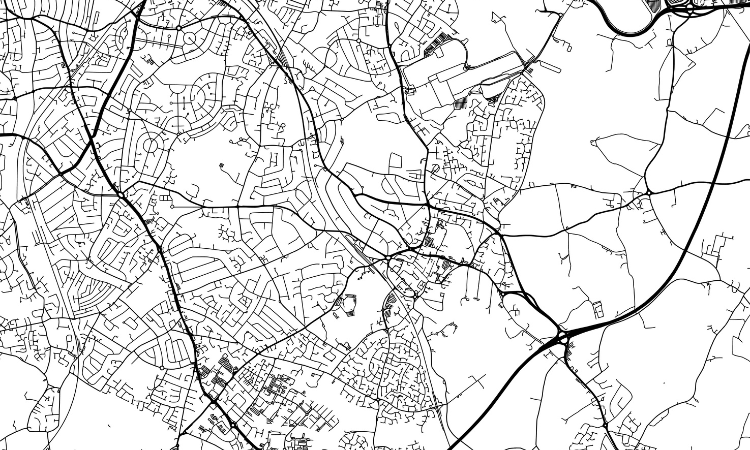
Property Data Sources
Our location guide relies on diverse, authoritative datasets including:
- HM Land Registry UK House Price Index
- Ministry of Housing, Communities and Local Government
- Ordnance Survey Data Hub
- Propertydata.co.uk
We update our property data quarterly to ensure accuracy. Last update: February 2026. All data is presented as provided by our sources without adjustments or amendments.
Why Invest in Solihull?
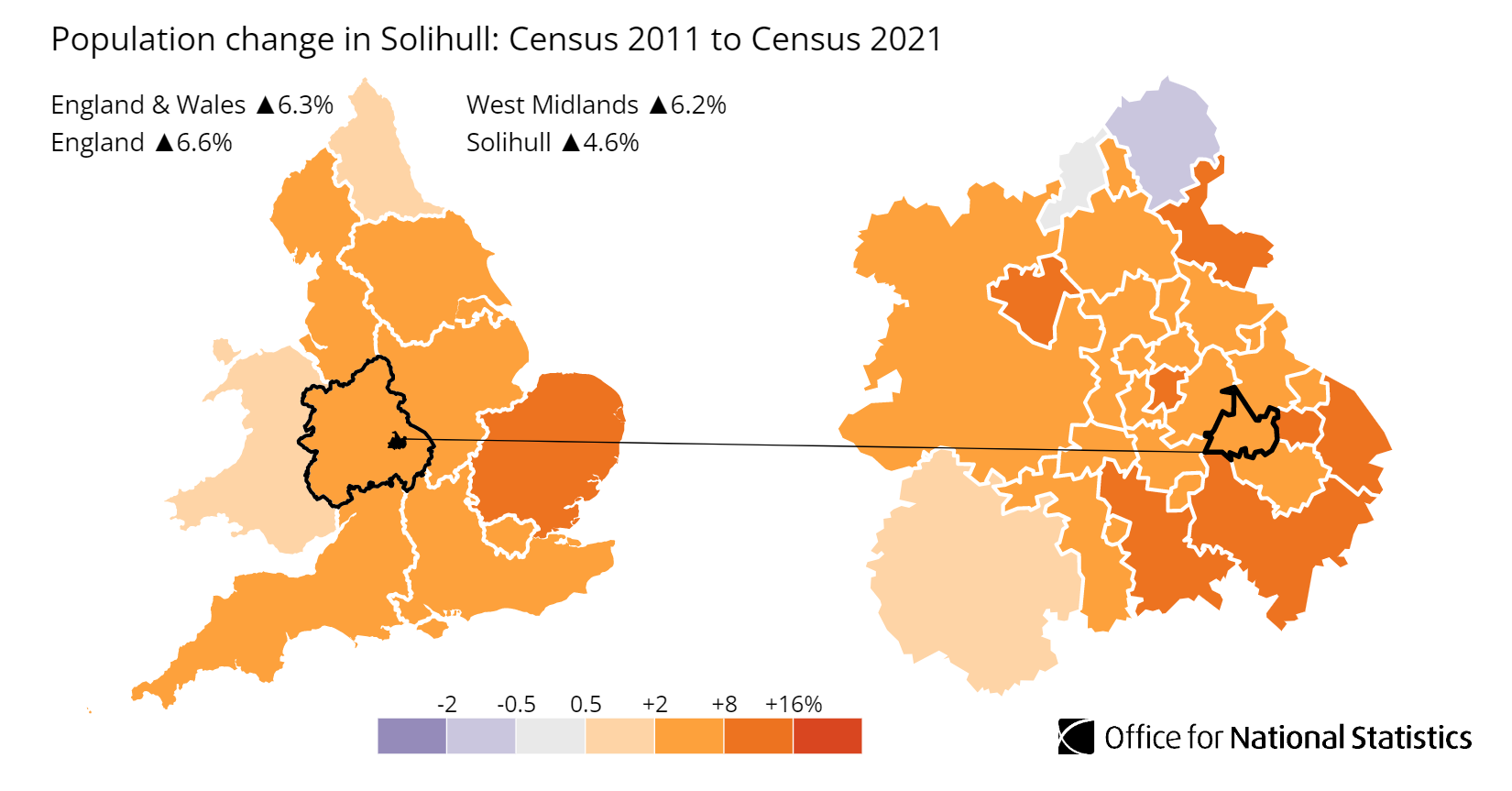
Solihull's population reached 216,240 in the 2021 Census, a 4.6% increase from 206,674 in 2011. That growth rate sits above the England average and reflects a borough that continues to draw residents. Solihull consistently ranks among the best places to live in the UK, combining suburban living with direct access to Birmingham's employment market and international transport links.
The borough's median annual salary of £46,896 is the highest in the West Midlands region. That is 26.6% above the regional median of £37,050 and 19.9% above the Great Britain median of £39,125. Solihull's earnings premium reflects the concentration of high-skilled employers including Jaguar Land Rover (its global headquarters sits in the borough), the NEC Group, and Birmingham Airport. The employment rate of 75.0% sits below the regional and national averages, with an unemployment rate of 5.8%.
The combination of high local earnings and proximity to major employers creates strong tenant demand, particularly in the northern postcodes closest to the airport, NEC, and the incoming HS2 Interchange. B37 (Chelmsley Wood, Marston Green) and B92 (Olton, Elmdon) provide the bulk of rental stock for workers at these employment centres.
Solihull Economic Summary
- Population: 216,240 (2021 Census). Growth of 4.6% from 2011.
- Median annual salary: £46,896 (local), £37,050 (West Midlands), £39,125 (Great Britain)
- Employment rate: 75.0% (local)
- Unemployment rate: 5.8% (local)
- Key employment sectors: Automotive (Jaguar Land Rover), Aviation (Birmingham Airport), Events and hospitality (NEC Group), Professional services
Source: ONS Census 2021, Nomis Labour Market Profile (ASHE 2025)
Regeneration and Investment in Solihull
Solihull sits at the centre of one of the largest infrastructure programmes in the UK. The convergence of HS2, metro expansion, and town centre regeneration makes this a borough where investment is being directed at scale.
- Arden Cross / HS2 Interchange (Enabling works commenced, £3.2 billion+): The UK's new HS2 Interchange Station at Arden Cross brings 3,000 new homes, a £3.2 billion Health Technology Campus with the University of Warwick, and an Automated People Mover connecting to the NEC, Birmingham International, and Birmingham Airport. Muse Places submitted planning for 1,600 homes in a new mixed-use neighbourhood in March 2025. Updates at Construction Wave.
- East Birmingham to Solihull Metro Extension (Government-backed, part of £2.4 billion transport package): A new tram route connecting East Birmingham through to North Solihull, the airport, NEC, and HS2 Interchange. The initial phase targets 8,000 jobs and 1,500 homes, with the full extension projected to unlock 55,000 jobs and 7,700 homes across the corridor. Updates at West Midlands Combined Authority.
- Mell Square / Holbeche Place (Planning approved February 2026, £350 million): Solihull Council approved plans for up to 1,600 new homes, retail, and public spaces in the town centre. Developed by Muse Places in partnership with the council, Phase 1 construction begins Summer 2026 with delivery over 10 years. Updates at Solihull Council.
Solihull Property Market Analysis
When Was the Last House Price Crash in Solihull?
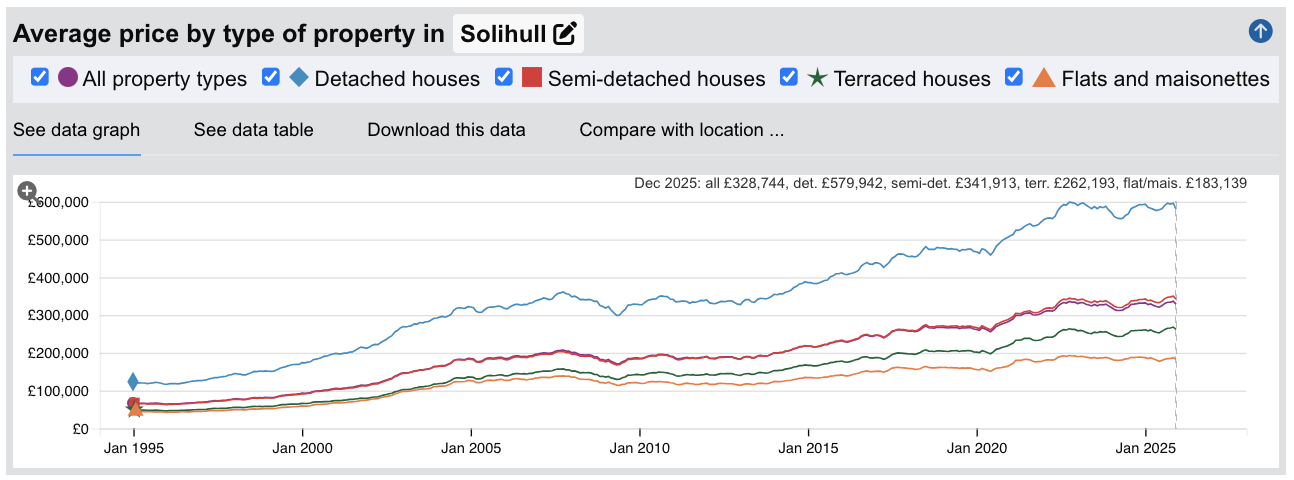
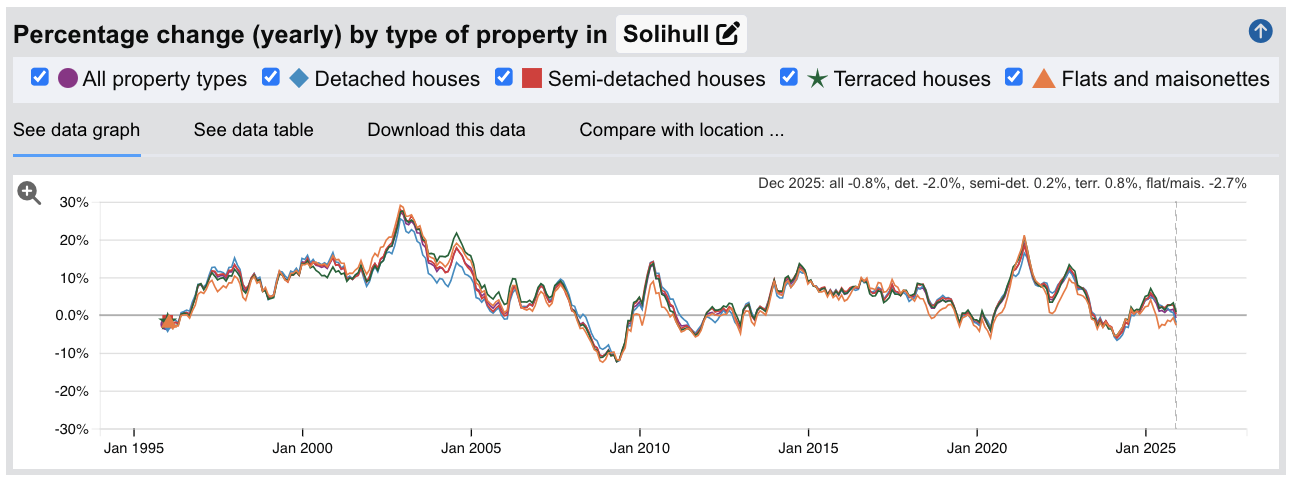
Solihull's average sold price has risen from £65,777 in January 1995 to £339,811 in November 2025, a total gain of 416.6% over 30 years. That growth has not been smooth. The Land Registry data records 64 months of negative annual price change across four distinct periods. Here is how each cycle played out.
- 1995-2007 (The Boom): Prices rose from £65,777 to a peak of £207,128 in October 2007, a gain of 215% over 12 years. Solihull's affluent reputation and proximity to Birmingham's employment base drove demand throughout this period. By the mid-2000s, detached homes averaged £360,970.
- 2008-2009 (The Financial Crisis): Prices fell 17.6% from the October 2007 peak of £207,128 to a trough of £170,714 in May 2009. The worst single reading was -12.3% annual change in May 2009. Flats were hit hardest, recording -12.5% in December 2008. England fell 18.2% and the West Midlands fell 16.9% over the same period. Solihull's decline was broadly in line with both benchmarks.
- 2010-2013 (Stagnation): Prices bounced initially but then dipped again. A second wave of negative readings ran from February 2011 to June 2013, with the worst month at -5.8% (September 2011). Prices hovered between £183,000 and £195,000 for most of this period, unable to sustain a recovery.
- 2014-2016 (Recovery): Solihull passed its pre-crash peak in August 2014 when prices reached £210,495. That is a 5-year recovery from trough to new highs. Owner-occupier demand in the southern postcodes (B93, B94, B91) drove the recovery, while northern postcodes lagged.
- 2017-2019 (Pre-pandemic growth): Prices climbed steadily from £230,000 to £270,000. A brief softening in mid-2019 saw 7 months of negative annual change (June 2019 to February 2020), with the worst reading at -4.2% in June 2020. Brexit uncertainty and stamp duty changes weighed on the premium end of the market.
- 2020-2022 (Pandemic surge): After a sharp dip to £255,694 in June 2020, Solihull surged. Stamp duty holiday demand and the race for space pushed prices 31% from that June 2020 low to £335,813 by October 2022. Detached houses led the recovery. Annual growth peaked at 18.8% in June 2021.
- 2023 (Rate shock): Rising mortgage rates triggered 12 months of consecutive declines from July 2023 to July 2024. The worst reading was -6.0% in March 2024. Prices fell from £335,813 to a low of £311,937 in April 2024, a correction of 7.1%.
- 2024-2025 (Current recovery): Prices turned positive in August 2024 and have climbed back to £339,811 by November 2025. Year-on-year growth stands at 2.5%. Terraced houses are leading the current recovery at 4.2% annual growth, while flats trail at 0.5%.
Long-term growth summary:
- 5 years (2020-2025): 21.8% growth (£278,984 to £339,811)
- 10 years (2015-2025): 48.0% growth (£229,651 to £339,811)
- 15 years (2010-2025): 74.9% growth (£194,300 to £339,811)
- 20 years (2005-2025): 80.8% growth (£187,984 to £339,811)
- 30 years (1995-2025): 419.9% growth (£65,364 to £339,811)
The 2008 crash took 5 years to recover. The 2023 correction took less than 18 months. Solihull's housing market has shown a consistent pattern of sharper declines at the premium end (detached and flats) and faster recovery in the middle market (semi-detached and terraced). The incoming HS2 Interchange introduces a factor that has no precedent in the borough's price history.

Thinking of Buying?
We have off-market investment properties averaging 8%+ annual yield.
View Property DealsSold House Prices in Solihull
Solihull's average sold price of £339,811 sits 15.9% above England's £293,131. That premium is unusual for a West Midlands location. Most Midlands boroughs sit below the national average. Solihull sits above it, and the gap varies dramatically by property type.
Look at the detached column. Detached houses in Solihull average £600,113, a 26.5% premium over the England average of £474,400. That is the widest gap in the table and reflects Solihull's concentration of executive housing in postcodes like B93 (Knowle, Dorridge) and B94 (Hockley Heath).
| Property Type | Solihull Average | England Average | Difference |
|---|---|---|---|
| Detached houses | £600,113 | £474,400 | +26.5% |
| Semi-detached houses | £353,347 | £290,004 | +21.8% |
| Terraced houses | £270,694 | £245,002 | +10.5% |
| Flats and maisonettes | £189,277 | £221,565 | -14.6% |
| All property types | £339,811 | £293,131 | +15.9% |
Flats are the only property type priced below the England average, at £189,277 (14.6% below). Solihull does not have the volume of purpose-built apartment stock that drives flat prices in larger cities. The flats that do exist are concentrated in B91 (Solihull town centre) and B92 (Olton), and they represent the most accessible entry point for investors looking at the borough.
Semi-detached houses show a 21.8% premium at £353,347. Semis dominate the housing stock in B90 (Shirley), B92 (Olton), and B37 (Chelmsley Wood). These are the core family rental properties and account for the bulk of buy-to-let activity in the borough.
Terraced houses at £270,694 carry the smallest premium at 10.5%. Terraced stock is more limited in Solihull than in most cities, concentrated in the older streets of B92 and parts of B37. The narrower premium means terraced properties offer the closest entry prices to the national market within the houses category.
Detached houses at £600,113 are the most expensive in the borough and carry the largest premium. These are overwhelmingly owner-occupier properties in the southern postcodes. Few appear in the rental market, and their price-to-rent ratios make them poor candidates for buy-to-let.
Price Per Square Foot in Solihull
Average asking prices can mislead. A postcode might look expensive simply because it has larger properties. Price per square foot strips out that size bias, and in Solihull the range runs from £237 in B37 to £469 in B93. That almost 2x spread across 8 postcodes shows what you are actually paying for space.
The split between Solihull's northern and southern postcodes is clear in this table. B37, the most affordable postcode on every other metric, is also the cheapest per square foot. B93 (Knowle, Dorridge) commands the highest price per square foot, reflecting the concentration of premium detached and period properties.
| Rank | Area | Price Per Sq Ft |
|---|---|---|
| 1 | B37 (Chelmsley Wood, Marston Green) | £237 |
| 2 | CV7 (Balsall Common, Meriden) | £302 |
| 3 | B92 (Olton, Elmdon) | £331 |
| 4 | B90 (Shirley, Cheswick Green) | £364 |
| 5 | B91 (Solihull Town Centre) | £379 |
| 6 | B95 (Henley-in-Arden) | £411 |
| 7 | B94 (Hockley Heath) | £442 |
| 8 | B93 (Knowle, Dorridge) | £469 |
B37 at £237/sq ft is the clear value entry point. For context, the England median price per square foot is approximately £280. B37 sits below that, making it one of the few Solihull postcodes where you are paying less per square foot than the national market. CV7 at £302 is the next most affordable.
The premium southern postcodes (B93, B94, B95) all sit above £400/sq ft. These are established affluent areas where the underlying land value and property quality command a sustained premium. The gap between B37 at £237 and B93 at £469 means you pay nearly double per square foot at the top end of the borough.
For Sale Asking Prices in Solihull
Asking prices in Solihull range from £234,936 in B37 (Chelmsley Wood, Marston Green) to £785,729 in B94 (Hockley Heath), a £550,793 spread across a single borough. That gap is larger than the total asking price in many northern cities. It is wider than most investors expect from one local authority area.
The mean asking price across all 8 Solihull postcodes is £468,702. That figure is pulled up by B93, B94, and B95. Remove those three premium postcodes, and the mean of the remaining five drops to £354,147, which is much closer to the national average.
| Rank | Area | Asking Price |
|---|---|---|
| 1 | B37 (Chelmsley Wood, Marston Green) | £234,936 |
| 2 | B90 (Shirley, Cheswick Green) | £343,809 |
| 3 | B92 (Olton, Elmdon) | £345,333 |
| 4 | CV7 (Balsall Common, Meriden) | £385,028 |
| 5 | B91 (Solihull Town Centre) | £461,627 |
| 6 | B95 (Henley-in-Arden) | £580,587 |
| 7 | B93 (Knowle, Dorridge) | £612,568 |
| 8 | B94 (Hockley Heath) | £785,729 |
B37 at £234,936 is the only postcode in Solihull priced below the England average sold price of £293,131. It is also the only postcode with a yield above 5%. That combination of lowest price and highest yield is not a coincidence. B37 covers Chelmsley Wood (a large estate originally built as social housing in the 1960s) and Marston Green (closer to the airport and NEC). The incoming HS2 Interchange and Arden Cross development sit on B37's eastern boundary. Investors searching for investment property in the Midlands will find B37's entry price competitive with neighbouring Birmingham postcodes.
B90 and B92 cluster tightly at £343,809 and £345,333. These are the established suburban buy-to-let postcodes in Solihull. Both deliver yields above 4% and have strong monthly sales volumes, which means properties move. The £109,000 jump from B37 to this pair is the step-up from estate housing to suburban family homes.
House Price Growth in Solihull
Five-year growth across Solihull's postcodes ranges from -6.8% in B94 to 22.3% in B37. The pattern is striking. The three cheapest postcodes delivered the strongest 5-year growth, while the three most expensive postcodes all returned negative figures. B37, which has the lowest entry price, also has the strongest growth over every time period where data is available.
| Area | 1 Year | 3 Years | 5 Years |
|---|---|---|---|
| B37 (Chelmsley Wood, Marston Green) | 1.2% | 4.1% | 22.3% |
| B92 (Olton, Elmdon) | 2.7% | 4.5% | 14.9% |
| B91 (Solihull Town Centre) | 1.3% | 3.7% | 14.4% |
| B90 (Shirley, Cheswick Green) | 2.8% | 2.5% | 10.2% |
| CV7 (Balsall Common, Meriden) | 1.2% | -1.1% | 4.8% |
| B93 (Knowle, Dorridge) | -7.2% | -7.2% | 2.5% |
| B95 (Henley-in-Arden) | -8.9% | -17.5% | 1.3% |
| B94 (Hockley Heath) | -22.5% | -15.2% | -6.8% |
B37 delivered 22.3% growth over five years on the lowest entry price in the borough. That is the combination investors look for: affordable entry and capital appreciation. B92 and B91 follow at 14.9% and 14.4% respectively. These three postcodes cover Solihull's urban core and are closest to the major employment centres.
B94 (Hockley Heath) shows -22.5% over one year and -6.8% over five. B95 (Henley-in-Arden) shows -8.9% over one year and -17.5% over three. Both are rural postcodes with very low transaction volumes (5 sales per month each). At that volume, individual large-property sales can move the average significantly. These figures reflect the volatility of thin markets, not a structural decline.
Monthly Property Sales in Solihull
B90 (Shirley, Cheswick Green) leads Solihull with 48 sales per month and a turnover rate of 62%. That is more than double the next postcode. High turnover means properties sell quickly, which matters for investors who need to exit. A postcode with strong sales volume and high turnover signals an active, liquid market.
| Area | Sales Per Month | Turnover | Asking Price |
|---|---|---|---|
| B90 (Shirley, Cheswick Green) | 48 | 62% | £343,809 |
| B91 (Solihull Town Centre) | 34 | 69% | £461,627 |
| B92 (Olton, Elmdon) | 32 | 46% | £345,333 |
| CV7 (Balsall Common, Meriden) | 24 | 36% | £385,028 |
| B37 (Chelmsley Wood, Marston Green) | 21 | 67% | £234,936 |
| B93 (Knowle, Dorridge) | 15 | 300% | £612,568 |
| B94 (Hockley Heath) | 5 | 156% | £785,729 |
| B95 (Henley-in-Arden) | 5 | 31% | £580,587 |
B37's 67% turnover on just 21 sales per month is notable. The lower absolute volume reflects a smaller for-sale stock in Chelmsley Wood, but the high turnover rate means properties sell fast relative to what is available. For an investor, that combination of low price and fast turnover reduces holding risk.
B93's 300% turnover figure needs context. PropertyData's turnover metric compares monthly sales to the current for-sale stock. When only a handful of properties are listed for sale in a premium postcode, even moderate sales numbers produce extreme turnover percentages. The underlying 15 sales per month is a healthy figure for a postcode of this size.
Property Data Sources
Our location guide relies on diverse, authoritative datasets including:
- HM Land Registry UK House Price Index
- Ministry of Housing, Communities and Local Government
- Ordnance Survey Data Hub
- Propertydata.co.uk
We update our property data quarterly to ensure accuracy. Last update: February 2026. All data is presented as provided by our sources without adjustments or amendments.
Solihull Rental Market Analysis
For investors weighing up whether rental property is a worthwhile investment in Solihull, the data below breaks down average monthly rents and gross rental yields across the borough's postcodes.
Rental data is available for 6 of Solihull's 8 postcodes. B94 (Hockley Heath) and B95 (Henley-in-Arden) have insufficient rental listings for PropertyData to calculate reliable figures. Monthly rents range from £1,034 (B37) to £1,794 (B93), with gross yields from 3.5% to 5.3%. If you are looking to build a property portfolio in the Midlands, Solihull's combination of high local earnings and HS2-driven infrastructure gives landlords a tenant base with above-average spending power.
Average Rent & Gross Rental Yields in Solihull
Compare rows 1 and 6 in this table. B37 (Chelmsley Wood, Marston Green) delivers the highest yield at 5.3% on the lowest asking price of £234,936 and a monthly rent of £1,034. B93 (Knowle, Dorridge) charges the highest rent at £1,794 per month but produces only 3.5% yield because the asking price is £612,568. The yield equation is driven by price, not rent.
| Area | Monthly Rent | Asking Price | Gross Yield |
|---|---|---|---|
| B37 (Chelmsley Wood, Marston Green) | £1,034 | £234,936 | 5.3% |
| B90 (Shirley, Cheswick Green) | £1,315 | £343,809 | 4.6% |
| B92 (Olton, Elmdon) | £1,228 | £345,333 | 4.3% |
| B91 (Solihull Town Centre) | £1,406 | £461,627 | 3.7% |
| CV7 (Balsall Common, Meriden) | £1,184 | £385,028 | 3.7% |
| B93 (Knowle, Dorridge) | £1,794 | £612,568 | 3.5% |
| B94 (Hockley Heath) | Not enough data | £785,729 | Not enough data |
| B95 (Henley-in-Arden) | Not enough data | £580,587 | Not enough data |
Only B37 breaks the 5% yield mark. B90 at 4.6% is the next closest. Solihull is not a high-yield borough in the way that Birmingham or Wolverhampton are. Its yields reflect the premium pricing. Investors here are typically buying for a combination of income and capital growth, with the HS2 catalyst as the differentiator.
B94 and B95 have no rental data. Both are rural postcodes with minimal rental market activity. B94 averages just 5 sales per month, and B95 likewise. These postcodes function primarily as owner-occupier markets for high-value detached homes.
Is Solihull Rent High?
Rent in Solihull absorbs between 26.5% and 45.9% of the local median gross income, depending on the postcode. That is a wide range. B37 (Chelmsley Wood, Marston Green) at 26.5% sits comfortably below the 30% threshold that most affordability benchmarks use. B93 (Knowle, Dorridge) at 45.9% sits well above it.
The median gross weekly salary in Solihull is £901.80, which equates to £3,908 per month or £46,896 per year. This is above the West Midlands regional median of £712.50 per week and the Great Britain median of £752.40 per week. Data from the Nomis Labour Market Profile (ASHE 2025).
| Rank | Area | Rent as % of Income |
|---|---|---|
| 1 | B93 (Knowle, Dorridge) | 45.9% |
| 2 | B91 (Solihull Town Centre) | 36.0% |
| 3 | B90 (Shirley, Cheswick Green) | 33.6% |
| 4 | B92 (Olton, Elmdon) | 31.4% |
| 5 | CV7 (Balsall Common, Meriden) | 30.3% |
| 6 | B37 (Chelmsley Wood, Marston Green) | 26.5% |
| 7 | B94 (Hockley Heath) | Not enough data |
| 8 | B95 (Henley-in-Arden) | Not enough data |
B37 at 26.5% stands out as the most affordable postcode for tenants in Solihull. That figure reflects the combination of relatively low rents (£1,034/month) and high local earnings. For landlords, affordable rent-to-income ratios reduce the risk of tenant default and void periods.
B93's 45.9% figure reflects the mismatch between premium rents (£1,794/month) and the borough-wide median salary. In practice, tenants in B93 are likely earning above the Solihull median. The tenant profile in Knowle and Dorridge skews towards professionals and corporate relocations, not the average earner this ratio assumes.
Thinking of Buying?
We have off-market investment properties averaging 8%+ annual yield.
View Property DealsBuy-to-Let Considerations
Are House Prices High? Price-to-Earnings Ratios
Purchasing a property in Solihull requires between 5.0 and 16.8 times the median annual salary. This is based on the Nomis Labour Market Profile for Solihull showing the median gross annual income for Solihull residents is £46,896.
The national benchmark (England average price divided by GB median salary) is 7.5. The West Midlands regional benchmark is 6.3. Only B37 at 5.0x sits below both benchmarks. Every other Solihull postcode exceeds the national ratio, with B94 stretching to 16.8 times local earnings.
| Rank | Area | Price-to-Earnings Ratio |
|---|---|---|
| 1 | B37 (Chelmsley Wood, Marston Green) | 5.0 |
| 2 | B90 (Shirley, Cheswick Green) | 7.3 |
| 3 | B92 (Olton, Elmdon) | 7.4 |
| 4 | CV7 (Balsall Common, Meriden) | 8.2 |
| 5 | B91 (Solihull Town Centre) | 9.8 |
| 6 | B95 (Henley-in-Arden) | 12.4 |
| 7 | B93 (Knowle, Dorridge) | 13.1 |
| 8 | B94 (Hockley Heath) | 16.8 |
B37 at 5.0 times earnings is among the most affordable ratios in the entire Midlands. For perspective, the cheapest Birmingham postcodes sit around 4-5 times earnings. B37 matches that affordability while sitting inside a borough with significantly higher average earnings and a major infrastructure programme.
The jump from B92 (7.4x) to B91 (9.8x) marks the dividing line. Below that line, the numbers are workable for buy-to-let. Above it, the ratios reflect owner-occupier markets where capital growth, not rental income, drives the investment case.
Deposit Requirements in Solihull
A 30% deposit on the cheapest Solihull postcode (B37) requires £70,481. That is the entry point. At the top end, B94 demands £235,719. The full range of deposit requirements across all 8 postcodes shows the scale of the financial commitment at each level.
These deposits are calculated at 30%, reflecting the typical buy-to-let mortgage requirement. For a full breakdown of purchase costs including stamp duty, legal fees, and ongoing expenses, see our buy-to-let costs guide.
| Rank | Area | 30% Deposit Required |
|---|---|---|
| 1 | B37 (Chelmsley Wood, Marston Green) | £70,481 |
| 2 | B90 (Shirley, Cheswick Green) | £103,143 |
| 3 | B92 (Olton, Elmdon) | £103,600 |
| 4 | CV7 (Balsall Common, Meriden) | £115,508 |
| 5 | B91 (Solihull Town Centre) | £138,488 |
| 6 | B95 (Henley-in-Arden) | £174,176 |
| 7 | B93 (Knowle, Dorridge) | £183,770 |
| 8 | B94 (Hockley Heath) | £235,719 |
The £32,662 step-up from B37 (£70,481) to B90 (£103,143) buys access to a very different postcode. B90 delivers 4.6% yield (vs 5.3% in B37) but sits in Shirley, a more established suburban area with higher sales volume (48 per month vs 21). Whether that premium is worth it depends on the investor's priority: maximum yield or broader market liquidity.

What the Solihull Data Tells Buy-to-Let Investors
B37 (Chelmsley Wood, Marston Green) leads on yield (5.3%), 5-year growth (22.3%), and affordability (5.0x earnings). No other Solihull postcode tops more than one of those metrics. A 30% deposit of £70,481 generates monthly rent of £1,034. The tenant base draws on airport workers, NEC staff, and the logistics corridor along the A45. The HS2 Interchange and Arden Cross development sit on B37's eastern boundary.
B90 (Shirley) and B92 (Olton) occupy the middle ground at 4.6% and 4.3% yields respectively. Both posted positive growth across all three time periods and average 40+ sales per month between them. These postcodes attract family tenants and young professionals priced out of Solihull town centre. The yields are modest but the combination of capital growth, market liquidity, and tenant demand is consistent.
B93, B94, and B95 show negative growth over one and three years, no rental data for two of the three, and asking prices above £580,000. Transaction volumes of 5-15 per month mean the data is volatile. These postcodes serve the owner-occupier market. The numbers do not support a buy-to-let case at current price levels.
Solihull does not operate a selective licensing scheme at the time of writing. Landlords in the borough are subject to standard HMO licensing requirements.
How Solihull Compares
Solihull's mean asking price of £468,702 is 72% above Birmingham's £272,648 and 86% above Wolverhampton's £252,562. The premium is clear. The question is whether the infrastructure pipeline and tenant quality justify it, or whether neighbouring boroughs offer better value for buy-to-let investors.
| Location | Mean Asking Price | Mean Monthly Rent | Top Gross Yield |
|---|---|---|---|
| Wolverhampton | £252,562 | £981 | 5.4% |
| Dudley | £265,834 | £990 | 5.3% |
| Birmingham | £272,648 | £1,121 | 7.0% |
| Coventry | £295,504 | £1,137 | 7.3% |
| Lichfield | £376,978 | £1,169 | 4.3% |
| Solihull | £468,702 | £1,327 | 5.3% |
Birmingham and Coventry both offer top yields above 7%, significantly above Solihull's 5.3%. For pure income investors, those locations deliver more rental return per pound invested. But Solihull's yield figure is a borough-wide top. Its cheapest postcode (B37) competes directly with the neighbouring Birmingham postcodes on both price and yield, while sitting inside a borough with higher average earnings and the HS2 development pipeline.
Lichfield is the closest comparison by price profile. Both are affluent West Midlands boroughs that sit above most Midlands locations on price. Lichfield's 4.3% top yield is lower than Solihull's 5.3%. For a broader view of property investment in the UK, compare these figures against locations outside the Midlands. Coventry and Wolverhampton offer higher yields at significantly lower entry prices. Walsall and Birmingham's cheapest areas are also worth comparing for value-focused investors.
Frequently Asked Questions
What are the main areas in Solihull?
Solihull covers 8 postcode areas from B37 to CV7. The northern postcodes (B37, B92) include Chelmsley Wood, Marston Green, Olton, and Elmdon, close to Birmingham Airport and the NEC. The central postcodes (B90, B91) cover Shirley and Solihull town centre. The southern postcodes (B93, B94, B95) include Knowle, Dorridge, Hockley Heath, and Henley-in-Arden, which are semi-rural and predominantly high-value owner-occupier areas. CV7 covers Balsall Common and Meriden to the east. Each area has a distinct price profile and tenant base.
Is Solihull a good place to live?
Solihull consistently ranks among the best places to live in the UK. The borough has above-average earnings (£46,896 median annual salary), a population that grew 4.6% between 2011 and 2021, and direct access to Birmingham Airport, the NEC, and the M42. The incoming HS2 Interchange will add a further transport link. Schools, green spaces, and the town centre (which is undergoing a £350 million regeneration) are the most commonly cited draws. The northern postcodes around Chelmsley Wood and Marston Green are more affordable, while the southern villages attract higher earners.
What are the best areas to live in Solihull?
That depends on the budget. B93 (Knowle, Dorridge) and B91 (Solihull town centre) are the established premium areas, with asking prices of £612,568 and £461,627 respectively. B90 (Shirley) offers suburban family living at £343,809, with the highest sales volume in the borough (48 per month). B37 (Chelmsley Wood, Marston Green) is the most affordable at £234,936 and sits closest to the HS2 Interchange, Birmingham Airport, and the NEC. Each postcode serves a different segment of the market.
What areas are near Solihull?
Solihull borders Birmingham to the west and north, Coventry to the east, and the rural Warwickshire districts to the south. B37 (Chelmsley Wood, Marston Green) sits adjacent to Birmingham's B26 and B33 postcodes. B92 (Olton, Elmdon) borders Birmingham's Acocks Green (B27). CV7 (Balsall Common) is closer to Coventry than to Solihull town centre. Investors often compare Solihull with neighbouring Birmingham postcodes, particularly in the B37 corridor where prices and yields are similar but the local authority boundaries differ.
Is Solihull the best place to live in the West Midlands?
Solihull's median annual salary of £46,896 is the highest in the West Midlands. Its population grew 4.6% between censuses. The borough has direct access to Birmingham Airport, the NEC, M42, and will have the HS2 Interchange. Average sold prices of £339,811 sit 45.4% above the West Midlands regional average of £233,751. For buy-to-let investors, the data shows a premium borough where B37 delivers yields (5.3%) and growth (22.3% over five years) that compete with more affordable Midlands locations, while the premium postcodes serve a different market entirely.