
Where to Buy Property Investments in Stoke-on-Trent: Yields of 6.6%
Stoke-on-Trent's gross rental yields range from 4.0% to 6.6% across postcodes with rental data, with ST1 (Hanley) delivering the highest returns. Average sold prices sit 49.3% below the England average, and the city's population grew 3.8% to 258,366 between the 2011 and 2021 censuses.
Stoke-on-Trent's average sold price of £148,757 makes it one of the cheapest cities in England for buy-to-let investors. That is 36.4% below the West Midlands regional average and creates entry points that most English cities cannot match. Asking prices start from £137,497 in ST1 (Hanley), and rental data is available for 7 of the city's 10 postcodes.
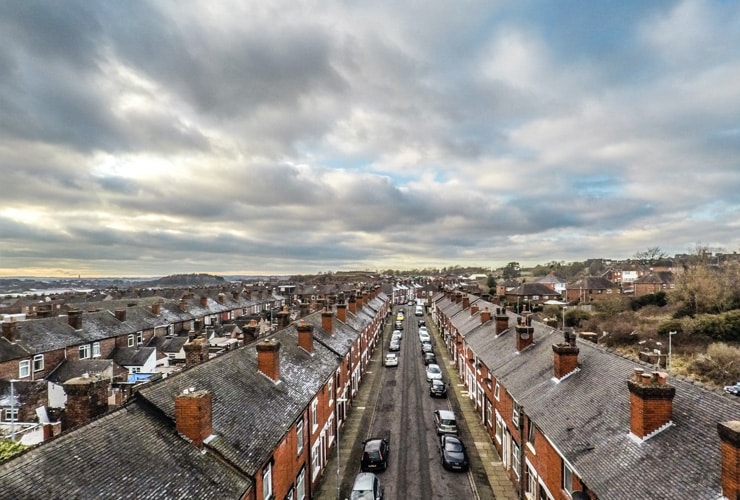
This guide covers all 10 Stoke-on-Trent postcodes from ST1 to ST12 under the Stoke-on-Trent unitary authority (ONS code E06000021). Stoke-on-Trent sits in north Staffordshire, formed from six pottery towns: Hanley, Stoke, Burslem, Tunstall, Longton, and Fenton. Investors comparing options in the region may also consider Wolverhampton, Derby, or Nottingham. Browse all our Midlands location guides.
Article updated: February 2026
Stoke-on-Trent Buy-to-Let Market Overview 2026
Stoke-on-Trent offers some of the lowest entry prices in England, backed by ongoing city centre regeneration and an affordable housing market that delivers strong gross yields.
- Average sold price: £148,757 (49.3% below England's £293,131)
- Asking price range: £137,497 (ST1) to £420,520 (ST9)
- Rental yields: 4.0% (ST7) to 6.6% (ST1) across postcodes with rental data
- Rental income: Monthly rents from £745 (ST4) to £1,043 (ST5)
- Price per sq ft: Sold prices from £144/sq ft (ST1) to £285/sq ft (ST12)
- Market activity: Sales ranging from 3 per month (ST12) to 83 per month (ST5)
- Deposit requirements: 30% deposits range from £41,249 (ST1) to £126,156 (ST9)
- Affordability ratios: Property prices from 4.2 to 12.9 times Stoke-on-Trent's median annual salary of £32,622
Contents

-
by Robert Jones, Founder of Property Investments UK
With two decades in UK property, Rob has been investing in buy-to-let since 2005, and uses property data to develop tools for property market analysis.
Property Data Sources
Our location guide relies on diverse, authoritative datasets including:
- HM Land Registry UK House Price Index
- Ministry of Housing, Communities and Local Government
- Ordnance Survey Data Hub
- Propertydata.co.uk
We update our property data quarterly to ensure accuracy. Last update: February 2026. All data is presented as provided by our sources without adjustments or amendments.
Why Invest in Stoke-on-Trent?
Stoke-on-Trent's economy has shifted from its pottery heritage into a mix of distribution, advanced manufacturing, and public sector employment. The city sits on the West Coast Main Line with direct trains to London Euston in 90 minutes and Manchester Piccadilly in 45 minutes. That connectivity, combined with house prices 49.3% below the England average, has attracted attention from investors and developers who see the gap between Stoke's prices and the cities around it.
Staffordshire University and Keele University between them bring around 20,000 students to the area. Keele sits just outside the city boundary but its students live across Stoke-on-Trent postcodes, particularly ST4 and ST5. The Royal Stoke University Hospital is the city's largest single employer and a major teaching hospital serving North Staffordshire and beyond.
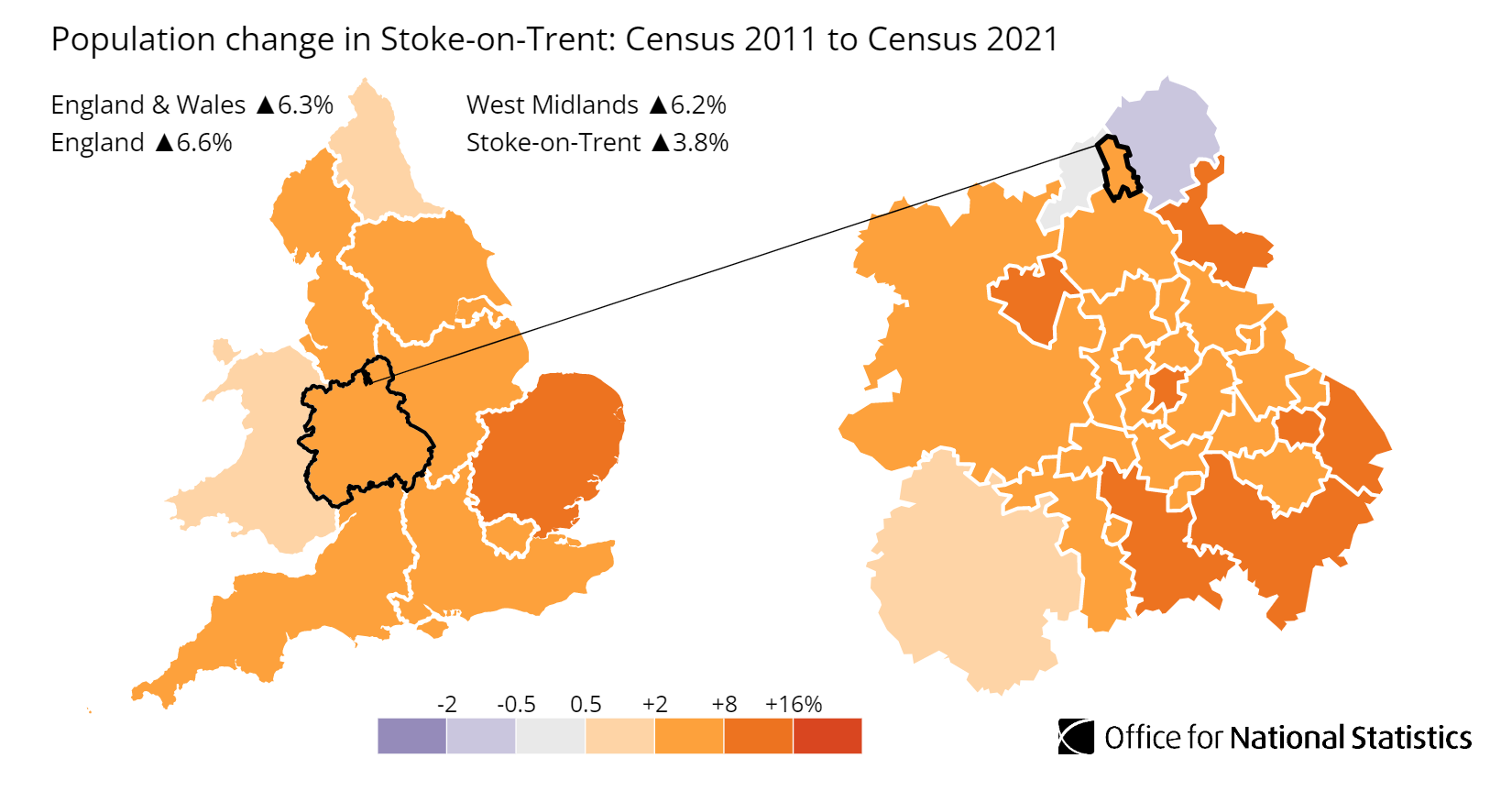
Between the 2011 and 2021 censuses, Stoke-on-Trent's population grew from 249,008 to 258,366, a rise of 3.8%. The city has a younger-than-average population, partly driven by its two universities and partly by affordable family housing that attracts people priced out of Manchester, Birmingham, and the South East.
Earnings in Stoke-on-Trent sit below both the regional and national averages. The median annual salary is £32,622, compared to £37,050 across the West Midlands and £39,125 for Great Britain. Lower local wages combined with some of the cheapest house prices in England create a market where rental yields hold up well even though rents are modest in absolute terms.
Stoke-on-Trent Economic Summary
- Population: 258,366 (2021 Census). Growth of 3.8% from 2011.
- Median annual salary: £32,622 (Stoke-on-Trent), £37,050 (West Midlands), £39,125 (Great Britain)
- Employment rate: 74.7% (Stoke-on-Trent), 74.2% (West Midlands), 75.6% (Great Britain)
- Key employment sectors: Healthcare, distribution and logistics, advanced manufacturing, ceramics, higher education
Source: ONS Census 2021, Nomis Labour Market Profile (ASHE 2025, Employment Oct 2024-Sep 2025)
Stoke-on-Trent's employment rate of 74.7% sits broadly in line with the West Midlands average of 74.2%. Unemployment data is suppressed for Stoke-on-Trent in the Annual Population Survey due to sample size limitations. For buy-to-let investors, the city's combination of a large hospital, two universities, and major distribution centres creates multiple tenant pools that are less dependent on a single employer.
Regeneration and Investment in Stoke-on-Trent
Stoke-on-Trent has secured significant government funding for city centre regeneration. The projects below represent the three largest confirmed investments currently reshaping the city's built environment.
- Goods Yard (Complete, £60 million including £16m Levelling Up Fund): Capital&Centric transformed a derelict Victorian goods warehouse beside Stoke station into 174 rental apartments, 30,000 sq ft of workspace, and independent food and drink venues. The Sunday Times called it the biggest symbol of a Potteries renaissance. Updates at Capital&Centric.
- Etruscan Square (Preferred developer selected, £20 million government funding): One of the Midlands' largest cleared city centre regeneration sites spanning seven acres in Hanley. The development will deliver a mix of residential housing, leisure, and commercial space on the former bus station and East-West Precinct site. Site surveys in 2025, construction from 2027. Updates at Stoke-on-Trent City Council.
- 5,000 Homes Programme (Plans submitted, part of £56 million Levelling Up allocation): Stoke-on-Trent City Council plans to deliver nearly 5,000 new homes across 23 sites over three years, with 37% designated as affordable housing. The programme responds to a 41% increase in the housing waiting list in a single year. Updates at Stoke-on-Trent City Council.
Stoke-on-Trent Property Market Analysis
When Was the Last House Price Crash in Stoke-on-Trent?
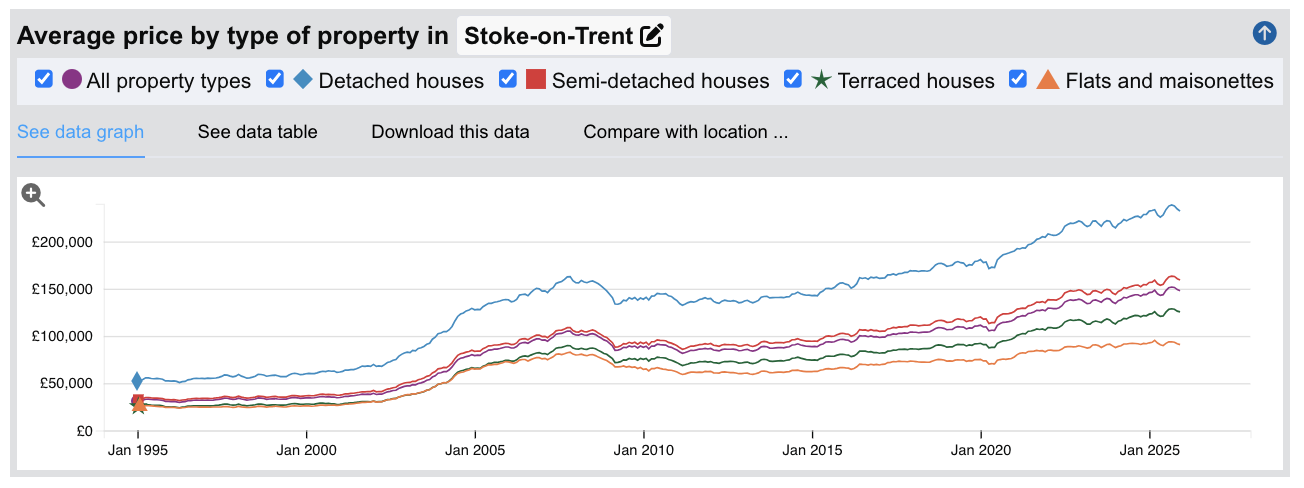
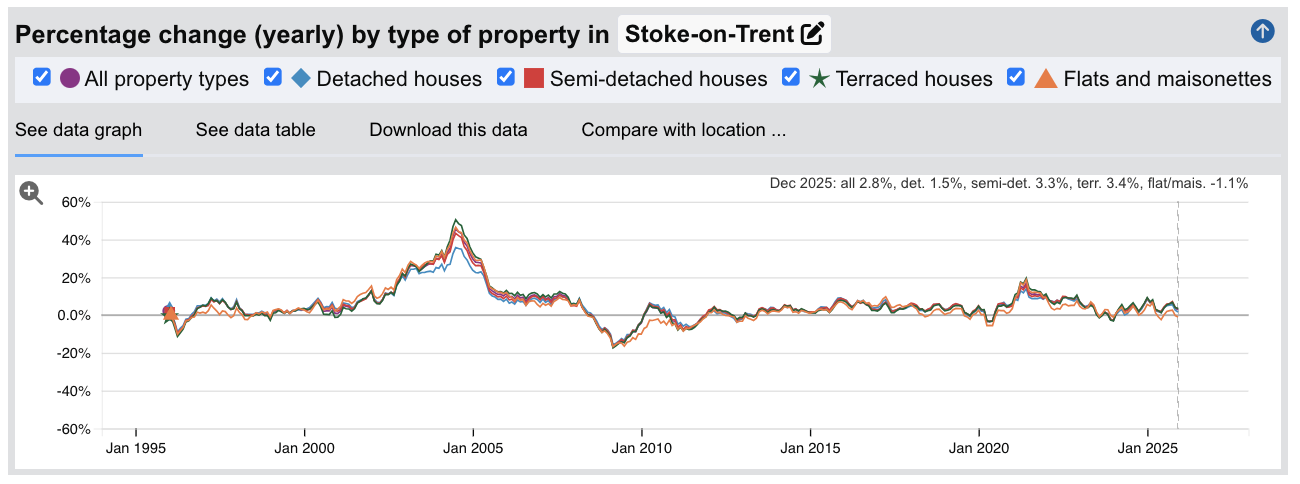
Stoke-on-Trent's full house price history from the HM Land Registry House Price Index runs from January 1995 to November 2025. The data shows a city that boomed hard, crashed harder than the national average, and took nearly 11 years to recover.
- 1995-2000 (Slow start): Stoke-on-Trent began 1995 at £29,876. Growth was minimal through the late 1990s. By January 2000, the average had only reached £34,431. Five years of near-stagnation while southern England boomed.
- 2000-2007 (The boom): Stoke caught up rapidly. Prices tripled from £34,431 in January 2000 to a peak of £105,100 in October 2007. The sharpest growth came in 2003-2005, when annual change exceeded 29%. Cheap credit drove prices well beyond what local wages could support.
- 2007-2011 (The crash and extended decline): From the peak of £105,100 in October 2007 to the trough of £81,517 in March 2011, Stoke-on-Trent lost 22.4% of its value. The worst annual change reading was -17.0% in March 2009. Stoke's decline of 22.4% was deeper than both the West Midlands region (-16.9%) and England overall (-18.2%). The city's reliance on manufacturing and ceramics, both hit hard during the recession, extended the decline into 2011 while most of England began recovering in 2009.
- 2011-2013 (Stagnation): Prices bounced off the March 2011 trough but made no real progress. By June 2013, the average sat at £86,085. Negative annual change returned several times during this period. The market was essentially flat for two years.
- 2014-2016 (Slow recovery): Annual growth turned consistently positive from late 2013. Prices rose from £87,538 in January 2014 to £95,740 by January 2016. Still well below the pre-crash peak of £105,100.
- 2017-2018 (Recovery completes): Growth accelerated. Prices finally passed the pre-crash peak in August 2018 at £105,987. That recovery took nearly 11 years from the October 2007 peak. Stoke was one of the last cities in England to reclaim pre-crash levels.
- 2019-2022 (Pandemic surge): The stamp duty holiday and the shift to remote working pushed prices from £111,348 in January 2020 to £138,918 by December 2022. That is 24.8% growth in under three years. Stoke's affordability made it a beneficiary as buyers searched for value.
- 2023 (Rate shock): Interest rate rises cooled the market. Prices dipped from £138,918 in December 2022 to £135,803 by December 2023. A decline of 2.2%. Brief and mild compared to the 2008 crash.
- 2024-2025 (Current): Prices recovered quickly. By November 2025, the average reached £148,757 with annual growth of 3.3%. Stoke-on-Trent now sits 41.5% above its pre-crash peak.
Long-Term Property Value Growth in Stoke-on-Trent
- 5 years (2020-2025): +29.3% (£115,059 to £148,757)
- 10 years (2015-2025): +54.7% (£96,135 to £148,757)
- 15 years (2010-2025): +69.3% (£87,848 to £148,757)
- 20 years (2005-2025): +70.1% (£87,464 to £148,757)
- 30 years (1995-2025): +385.0% (£30,670 to £148,757)
The 20-year and 15-year growth figures are almost identical. That tells you how long Stoke spent going nowhere after the crash. An investor who bought in 2005 at £87,464 saw the same return as someone who bought in 2010 at £87,848. The real gains came in the last decade, and particularly in the last five years.
The 2008 crash is the reference point for Stoke investors assessing downside. A 22.4% decline took nearly 11 years to recover. That is longer than most English cities. But the structural picture is different now. Regeneration investment has arrived. The pandemic repriced northern cities. And Stoke's £148,757 average still sits at barely half the England average.
Source: HM Land Registry House Price Index for Stoke-on-Trent

Thinking of Buying?
We have off-market investment properties averaging 8%+ annual yield.
View Property DealsSold House Prices in Stoke-on-Trent
Stoke-on-Trent's average sold price of £148,757 sits 49.3% below the England average of £293,131. That is the discount based on Land Registry data to November 2025. The table below breaks down how Stoke compares to England for each property type.
| Property Type | Stoke-on-Trent Average | England Average | Difference |
|---|---|---|---|
| Detached houses | £233,824 | £474,400 | -50.7% |
| Semi-detached houses | £160,349 | £290,004 | -44.7% |
| Terraced houses | £125,962 | £245,002 | -48.6% |
| Flats and maisonettes | £91,618 | £221,565 | -58.6% |
| All property types | £148,757 | £293,131 | -49.3% |
Flats and maisonettes show the deepest discount at 58.6% below the England average. Stoke's flat market is dominated by converted Victorian terraces and purpose-built blocks near Hanley and Stoke town centres. At £91,618, a Stoke flat costs less than 42% of the England average for the same property type. For investors targeting the lowest entry price with the highest potential yield, flats in central postcodes represent the sharpest end of the market.
Detached houses at £233,824 are 50.7% below the England average of £474,400. The detached market in Stoke is concentrated in the outer postcodes: ST9 (Endon, Werrington), ST11 (Blythe Bridge), and ST12 (Barlaston). These postcodes account for the higher asking prices in the data and have limited rental market activity.
Terraced houses at £125,962 are 48.6% below England's average. Terraces are the dominant housing stock across Stoke-on-Trent's six towns. The pottery industry built thousands of terraced houses for workers in the 19th century, and this housing stock defines the inner postcodes. For buy-to-let investors, terraces in ST1, ST3, and ST6 offer the combination of low purchase price and established rental demand.
Semi-detached houses show a 44.7% discount at £160,349. This is the narrowest gap of the four types, reflecting stronger demand for family-sized housing in areas like ST3 (Longton, Meir), ST5 (Newcastle-under-Lyme), and ST7 (Kidsgrove, Alsager).
Property Data Sources
Our location guide relies on diverse, authoritative datasets including:
- HM Land Registry UK House Price Index
- Ministry of Housing, Communities and Local Government
- Ordnance Survey Data Hub
- Propertydata.co.uk
We update our property data quarterly to ensure accuracy. Last update: February 2026. All data is presented as provided by our sources without adjustments or amendments.
Price Per Square Foot in Stoke-on-Trent
Sold prices per square foot in Stoke-on-Trent range from £144 in ST1 (Hanley) to £285 in ST12 (Barlaston). This data comes from PropertyData's analysis of actual sold transactions, not listing prices. The range reveals a near-double spread between the cheapest and most expensive postcodes.
| Rank | Area | Price Per Sq Ft |
|---|---|---|
| 1 | ST1 (Hanley) | £144 |
| 2 | ST6 (Tunstall, Burslem) | £157 |
| 3 | ST4 (Stoke, Fenton, Trentham) | £177 |
| 4 | ST2 (Bentilee, Bucknall) | £189 |
| 5 | ST5 (Newcastle-under-Lyme) | £213 |
| 6 | ST3 (Longton, Meir) | £214 |
| 7 | ST11 (Blythe Bridge) | £241 |
| 8 | ST7 (Kidsgrove, Alsager) | £243 |
| 9 | ST9 (Endon, Werrington) | £264 |
| 10 | ST12 (Barlaston) | £285 |
The four cheapest postcodes per square foot are all inner-city areas with strong rental markets. ST1, ST6, ST4, and ST2 sit below £190/sq ft and all four return rental yield data. At £144/sq ft, ST1 offers the most space for the money. Compare that to ST12 at £285/sq ft and you are paying almost double per square foot for a rural-fringe location that has no rental yield data and averages just 3 sales per month.
For Sale Asking Prices in Stoke-on-Trent
The mean asking price across all 10 Stoke-on-Trent postcodes is £246,714. Asking prices range from £137,497 in ST1 (Hanley) to £420,520 in ST9 (Endon, Werrington). That is a £283,023 spread. The table below ranks every postcode from cheapest to most expensive.
| Rank | Area | Asking Price |
|---|---|---|
| 1 | ST1 (Hanley) | £137,497 |
| 2 | ST6 (Tunstall, Burslem) | £155,614 |
| 3 | ST4 (Stoke, Fenton, Trentham) | £174,153 |
| 4 | ST2 (Bentilee, Bucknall) | £186,322 |
| 5 | ST3 (Longton, Meir) | £206,520 |
| 6 | ST5 (Newcastle-under-Lyme) | £237,572 |
| 7 | ST7 (Kidsgrove, Alsager) | £256,727 |
| 8 | ST11 (Blythe Bridge) | £309,646 |
| 9 | ST12 (Barlaston) | £382,568 |
| 10 | ST9 (Endon, Werrington) | £420,520 |
The seven postcodes with rental data all sit below £257,000. Every postcode above that threshold (ST11, ST12, ST9) has no rental yield data from PropertyData, reflecting a market dominated by owner-occupiers rather than landlords. The split is clear: the inner-city and suburban postcodes serve the rental market, the rural fringe does not.
ST1 at £137,497 is less than a third of ST9 at £420,520. That range within a single local authority area is wider than many investors expect. ST1 covers Hanley city centre, where the housing stock is predominantly terraces and conversions. ST9 covers the Staffordshire Moorlands fringe, where detached houses on large plots are the norm.
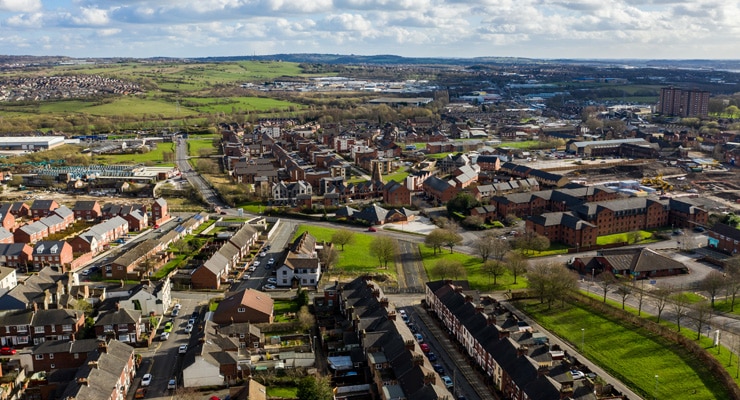
House Price Growth in Stoke-on-Trent
Five-year growth ranges from 4.2% in ST12 (Barlaston) to 27.8% in ST3 (Longton, Meir). The table below shows 1-year, 3-year, and 5-year growth for all 10 postcodes, ranked by 5-year performance.
| Area | 1 Year | 3 Years | 5 Years |
|---|---|---|---|
| ST3 (Longton, Meir) | 4.8% | 8.6% | 27.8% |
| ST6 (Tunstall, Burslem) | 4.0% | 4.3% | 25.8% |
| ST5 (Newcastle-under-Lyme) | 2.6% | 13.7% | 25.4% |
| ST7 (Kidsgrove, Alsager) | 7.9% | 2.9% | 25.3% |
| ST2 (Bentilee, Bucknall) | -0.6% | 3.4% | 19.5% |
| ST1 (Hanley) | 5.4% | 10.7% | 19.0% |
| ST11 (Blythe Bridge) | -5.1% | -4.9% | 10.6% |
| ST9 (Endon, Werrington) | -4.4% | -6.6% | 10.0% |
| ST4 (Stoke, Fenton, Trentham) | -2.4% | 11.6% | 4.9% |
| ST12 (Barlaston) | -6.1% | 4.8% | 4.2% |
The four strongest 5-year performers (ST3, ST6, ST5, ST7) all grew between 25.3% and 27.8%. These are mid-priced postcodes with active sales markets. ST3 leads with 27.8% five-year growth and also delivers a 5.0% gross yield, making it one of the postcodes where both growth and income are working together.
The three most expensive postcodes (ST9, ST11, ST12) all show negative 1-year growth. ST12 dropped 6.1% in the past year, ST11 dropped 5.1%, and ST9 dropped 4.4%. These rural-fringe postcodes have very low sales volumes (3 to 12 per month), so individual sales can move the average significantly. Five-year growth in this group ranges from 4.2% to 10.6%, well below the inner-city postcodes.
Monthly Property Sales in Stoke-on-Trent
Monthly property sales across Stoke-on-Trent range from 3 in ST12 (Barlaston) to 83 in ST5 (Newcastle-under-Lyme). Turnover rates, which measure sales as a percentage of for-sale stock, add a second dimension. High turnover means properties sell quickly relative to the stock available.
| Area | Sales Per Month | Turnover | Asking Price |
|---|---|---|---|
| ST5 (Newcastle-under-Lyme) | 83 | 79% | £237,572 |
| ST7 (Kidsgrove, Alsager) | 65 | 120% | £256,727 |
| ST3 (Longton, Meir) | 58 | 101% | £206,520 |
| ST4 (Stoke, Fenton, Trentham) | 57 | 52% | £174,153 |
| ST6 (Tunstall, Burslem) | 52 | 88% | £155,614 |
| ST1 (Hanley) | 32 | 69% | £137,497 |
| ST2 (Bentilee, Bucknall) | 29 | 119% | £186,322 |
| ST11 (Blythe Bridge) | 12 | 47% | £309,646 |
| ST9 (Endon, Werrington) | 9 | 54% | £420,520 |
| ST12 (Barlaston) | 3 | 89% | £382,568 |
ST7 and ST2 both show turnover rates above 100%, meaning more properties are selling each month than are listed for sale. In ST7 (Kidsgrove, Alsager), 65 sales per month against a turnover of 120% indicates strong demand that outstrips available stock. ST2 (Bentilee, Bucknall) shows 119% turnover on 29 monthly sales. These are markets where properties move fast.
ST4 has the lowest turnover at 52% despite averaging 57 sales per month. That combination of high volume but slow turnover suggests a larger stock of available properties relative to buyer demand. ST4 covers Stoke town itself, Fenton, and Trentham, and the mixed housing stock (from inner-city terraces to suburban estates) creates a broad range of listing types.
Property Data Sources
Our location guide relies on diverse, authoritative datasets including:
- HM Land Registry UK House Price Index
- Ministry of Housing, Communities and Local Government
- Ordnance Survey Data Hub
- Propertydata.co.uk
We update our property data quarterly to ensure accuracy. Last update: February 2026. All data is presented as provided by our sources without adjustments or amendments.
Stoke-on-Trent Rental Market Analysis
For investors weighing up whether rental property is a worthwhile investment in Stoke-on-Trent, the data below breaks down average monthly rents and gross rental yields across the city's postcodes.
Rental data is available for 7 of 10 Stoke-on-Trent postcodes. Monthly rents range from £745 (ST4) to £1,043 (ST5), and gross yields range from 4.0% (ST7) to 6.6% (ST1). If you are looking to build a property portfolio in the Midlands, Stoke-on-Trent's combination of sub-£140,000 entry prices and yields above 5% across five postcodes is difficult to match in the region.
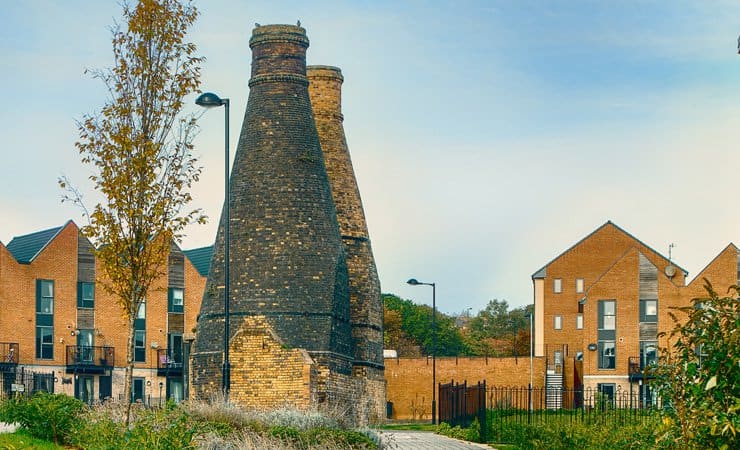
Average Rent & Gross Rental Yields in Stoke-on-Trent
ST1 (Hanley) delivers the highest gross rental yield at 6.6%, combining a monthly rent of £752 with the lowest asking price of £137,497. The table below ranks all 10 postcodes by yield, with 7 of 10 returning rental data.
| Area | Monthly Rent | Asking Price | Gross Yield |
|---|---|---|---|
| ST1 (Hanley) | £752 | £137,497 | 6.6% |
| ST6 (Tunstall, Burslem) | £760 | £155,614 | 5.9% |
| ST2 (Bentilee, Bucknall) | £823 | £186,322 | 5.3% |
| ST5 (Newcastle-under-Lyme) | £1,043 | £237,572 | 5.3% |
| ST4 (Stoke, Fenton, Trentham) | £745 | £174,153 | 5.1% |
| ST3 (Longton, Meir) | £858 | £206,520 | 5.0% |
| ST7 (Kidsgrove, Alsager) | £848 | £256,727 | 4.0% |
| ST9 (Endon, Werrington) | Not enough data | £420,520 | Not enough data |
| ST11 (Blythe Bridge) | Not enough data | £309,646 | Not enough data |
| ST12 (Barlaston) | Not enough data | £382,568 | Not enough data |
Five of the seven postcodes with rental data deliver yields of 5.0% or above. Only ST7 (4.0%) falls below that mark. The highest rents come from ST5 (Newcastle-under-Lyme) at £1,043 per month, driven by demand from Keele University staff and students and the town's own employment base. But ST5's higher asking price of £237,572 brings the yield down to 5.3%.
The three postcodes without rental data (ST9, ST11, ST12) are all priced above £300,000. PropertyData requires a minimum number of current rental listings to calculate figures. These outer postcodes are predominantly owner-occupied, with limited landlord activity. Their absence from the rental data is itself a signal about the type of market they represent.
Is Stoke-on-Trent Rent High?
Rent as a percentage of income ranges from 38.4% in ST5 (Newcastle-under-Lyme) down to 27.4% in ST4 (Stoke, Fenton, Trentham). This measures how much of a local tenant's gross income goes on rent, based on Stoke-on-Trent's median salary.
The median gross weekly salary in Stoke-on-Trent is £627.30, which equates to £2,719 per month or £32,622 per year. This is below the West Midlands regional median of £712.50 per week and the Great Britain median of £752.40 per week. Data from the Nomis Labour Market Profile (ASHE 2025).
| Rank | Area | Rent as % of Income |
|---|---|---|
| 1 | ST5 (Newcastle-under-Lyme) | 38.4% |
| 2 | ST3 (Longton, Meir) | 31.6% |
| 3 | ST7 (Kidsgrove, Alsager) | 31.2% |
| 4 | ST2 (Bentilee, Bucknall) | 30.3% |
| 5 | ST6 (Tunstall, Burslem) | 28.0% |
| 6 | ST1 (Hanley) | 27.7% |
| 7 | ST4 (Stoke, Fenton, Trentham) | 27.4% |
| — | ST9 (Endon, Werrington) | Not enough data |
| — | ST11 (Blythe Bridge) | Not enough data |
| — | ST12 (Barlaston) | Not enough data |
Three postcodes (ST4, ST1, ST6) all cluster below 28% of income, making them the most affordable areas for tenants. Lower rent-to-income ratios generally mean fewer void periods and lower tenant turnover, because renters are not stretching to afford their home. For landlords, this is a practical advantage.
ST5 stands apart at 38.4%. Its monthly rent of £1,043 is the highest in Stoke-on-Trent, driven by Newcastle-under-Lyme's proximity to Keele University and its role as a separate town centre with its own amenities. The higher ratio reflects a different tenant profile: university-linked professionals and students sharing larger properties, where individual contributions per room bring the effective per-person cost well below the headline figure.
Thinking of Buying?
We have off-market investment properties averaging 8%+ annual yield.
View Property DealsBuy-to-Let Considerations
Are House Prices High? Price-to-Earnings Ratios
Purchasing a property in Stoke-on-Trent requires between 4.2 and 12.9 times the median annual salary. This is based on the Nomis Labour Market Profile for Stoke-on-Trent showing the median gross annual income for Stoke-on-Trent residents is £32,622.
For context, the England benchmark is approximately 9.0 times the Great Britain median salary (England average sold price £293,131 / GB median annual salary £39,125 = 7.5x). Six of Stoke-on-Trent's 10 postcodes sit below this benchmark.
| Rank | Area | Price-to-Earnings Ratio |
|---|---|---|
| 1 | ST1 (Hanley) | 4.2x |
| 2 | ST6 (Tunstall, Burslem) | 4.8x |
| 3 | ST4 (Stoke, Fenton, Trentham) | 5.3x |
| 4 | ST2 (Bentilee, Bucknall) | 5.7x |
| 5 | ST3 (Longton, Meir) | 6.3x |
| 6 | ST5 (Newcastle-under-Lyme) | 7.3x |
| 7 | ST7 (Kidsgrove, Alsager) | 7.9x |
| 8 | ST11 (Blythe Bridge) | 9.5x |
| 9 | ST12 (Barlaston) | 11.7x |
| 10 | ST9 (Endon, Werrington) | 12.9x |
ST1 at 4.2 times earnings is one of the lowest price-to-income ratios of any postcode in the PIUK database. A property priced at 4.2 times the local median salary is within reach of a single-income buyer with a standard mortgage. For investors, low ratios like this indicate a market where owner-occupiers can compete with landlords, which generally supports house prices over time.
The outer postcodes push into double-digit ratios. ST12 at 11.7x and ST9 at 12.9x are pricing relative to Stoke-on-Trent earnings, but the buyers in these postcodes are typically commuting professionals earning above the local median. These are not traditional buy-to-let markets.
Deposit Requirements in Stoke-on-Trent
Buy-to-let mortgages typically require a 30% deposit. At that rate, deposits in Stoke-on-Trent range from £41,249 in ST1 (Hanley) to £126,156 in ST9 (Endon, Werrington). The full stamp duty and buying costs sit on top of these figures.
| Rank | Area | 30% Deposit Required |
|---|---|---|
| 1 | ST1 (Hanley) | £41,249 |
| 2 | ST6 (Tunstall, Burslem) | £46,684 |
| 3 | ST4 (Stoke, Fenton, Trentham) | £52,246 |
| 4 | ST2 (Bentilee, Bucknall) | £55,897 |
| 5 | ST3 (Longton, Meir) | £61,956 |
| 6 | ST5 (Newcastle-under-Lyme) | £71,272 |
| 7 | ST7 (Kidsgrove, Alsager) | £77,018 |
| 8 | ST11 (Blythe Bridge) | £92,894 |
| 9 | ST12 (Barlaston) | £114,770 |
| 10 | ST9 (Endon, Werrington) | £126,156 |
The deposit for ST1 (£41,249) is less than a third of what ST9 requires (£126,156). For an investor with £55,000 available, four postcodes are within reach: ST1, ST6, ST4, and ST2. All four deliver gross yields of 5.1% or above. That is the practical appeal of Stoke-on-Trent's price structure. Low deposits combined with strong yields mean more of the investor's capital is working from day one.

What the Stoke-on-Trent Data Tells Buy-to-Let Investors
ST1 (Hanley) leads on yield at 6.6%, price-to-earnings at 4.2x, and lowest deposit at £41,249. It also has the lowest price per square foot at £144. The data consistently points to ST1 as the strongest income-focused postcode for investment property buyers. Tenants here include city centre workers, students, and hospital staff within easy reach of Royal Stoke University Hospital.
The strongest growth postcodes are ST3 (27.8% over five years), ST6 (25.8%), ST5 (25.4%), and ST7 (25.3%). ST3 stands out because it combines top growth with a 5.0% yield, 58 monthly sales, and 101% turnover. That is a postcode delivering on multiple metrics. ST6 pairs 25.8% five-year growth with a 5.9% yield, making it the second strongest all-round performer after ST1.
Three postcodes (ST9, ST11, ST12) show no rental yield data, negative 1-year growth, and sales volumes below 12 per month. These are rural-fringe markets priced between £309,646 and £420,520. The data shows owner-occupier territory with limited rental activity and volatile pricing driven by low transaction volumes.
Stoke-on-Trent operates under selective licensing schemes in designated areas. Landlords operating in these zones need to factor in licensing fees and property standards requirements.
How Stoke-on-Trent Compares
Stoke-on-Trent has the lowest mean asking price (£246,714) and the highest top yield (6.6%) of the seven Midlands cities compared below. The comparison includes locations at different price points across the region.
| Location | Mean Asking Price | Mean Monthly Rent | Top Gross Yield |
|---|---|---|---|
| Nottingham | £244,881 | £1,089 | 9.2% |
| Stoke-on-Trent | £246,714 | £833 | 6.6% |
| Wolverhampton | £252,562 | £981 | 5.4% |
| Birmingham | £272,648 | £1,121 | 7.0% |
| Derby | £276,761 | £946 | 5.9% |
| Leicester | £294,580 | £1,041 | 7.3% |
| Coventry | £295,504 | £1,137 | 7.3% |
Stoke-on-Trent's mean rent of £833 is the lowest in this comparison. That reflects lower local wages rather than a weak rental market. The trade-off is clear in the yield column: Stoke's 6.6% top yield sits above Wolverhampton (5.4%) and Derby (5.9%) because of the low purchase prices, even though absolute rents are lower.
Nottingham leads on yield at 9.2% with similar mean asking prices. Birmingham offers higher rents (£1,121) and stronger yields (7.0%) at a £26,000 price premium. Leicester and Coventry both deliver 7.3% top yields but at asking prices approaching £295,000.
For investors prioritising the best buy-to-let locations with the lowest capital outlay, Stoke-on-Trent's deposit requirements are the most accessible in this group. The £41,249 entry point via ST1 is roughly half the deposit needed for comparable yields in Leicester or Coventry.
Frequently Asked Questions
What are the main areas of Stoke-on-Trent?
Stoke-on-Trent is formed from six historic pottery towns: Hanley (the city centre, covered by ST1), Stoke (ST4), Burslem and Tunstall (ST6), Longton (ST3), and Fenton (ST4). Beyond the six towns, the wider authority area includes Newcastle-under-Lyme (ST5), Kidsgrove (ST7), Bentilee (ST2), and rural-fringe villages in ST9, ST11, and ST12. For buy-to-let investors, the inner postcodes (ST1, ST2, ST3, ST4, ST6) have the strongest rental markets, while the outer postcodes (ST9, ST11, ST12) are predominantly owner-occupied.
What are the best places to live in Stoke-on-Trent?
Newcastle-under-Lyme (ST5) offers the highest rents at £1,043 per month and strong five-year growth of 25.4%, making it popular with professionals and families. ST3 (Longton, Meir) delivered the strongest five-year growth at 27.8% alongside a 5.0% yield. For affordability, ST1 (Hanley) has the lowest asking prices at £137,497 and the highest yield at 6.6%. The rural postcodes (ST9, ST11, ST12) suit owner-occupiers with larger budgets, but have limited rental market data.
What are the best areas to invest in Stoke-on-Trent?
The data points to ST1 (Hanley) and ST6 (Tunstall, Burslem) as the two strongest performers across multiple metrics. ST1 (Hanley) leads on yield (6.6%), affordability (4.2x price-to-earnings), and entry price (£137,497). ST6 (Tunstall, Burslem) pairs a 5.9% yield with 25.8% five-year growth at an asking price of £155,614. ST3 (Longton, Meir) offers the best combination of growth (27.8% over five years) and yield (5.0%) among the mid-priced postcodes.
Is Stoke-on-Trent a nice place to live?
Stoke-on-Trent has undergone significant change since the decline of its pottery industry. The city centre has seen major regeneration including the £60 million Goods Yard development and the planned Etruscan Square project. The wider area includes the Staffordshire Moorlands countryside on its eastern fringe, the market town of Newcastle-under-Lyme, and a population of 258,366 that grew 3.8% between the 2011 and 2021 censuses. Transport links include direct trains to London (90 minutes), Manchester (45 minutes), and Birmingham (50 minutes).
How does Stoke-on-Trent compare to Nottingham for investment?
Both cities have similar mean asking prices (Stoke £246,714 vs Nottingham £244,881), but Nottingham delivers higher yields at 9.2% versus 6.6% and higher mean rents at £1,089 versus £833. Stoke-on-Trent's advantage is the lower inner-city entry price: ST1 at £137,497 requires a 30% deposit of just £41,249. Nottingham has a larger student population and a more established city centre rental market. Stoke has lower absolute rents but stronger affordability ratios, with three postcodes below 28% of local income.