
Where to Buy Property Investments in Blackpool: Yields of 7.0%
Gross rental yields in Blackpool reach 7.0% in FY1 (Town Centre, North Shore), with average asking prices starting from £112,145. Land Registry data puts the average sold price across Blackpool at £136,485, which is 53.2% below the England average of £291,865. The population stands at 141,036 according to the 2021 Census.
Blackpool is one of the most affordable entry points for buy-to-let investors in the North West. A 30% deposit on the cheapest postcode starts at £33,644, and six of the seven postcodes covered in this guide deliver gross yields above 3.4%. The data spans seven postcode districts, each with different price points, rental income levels, and growth trajectories. The inner resort postcodes (FY1 to FY4) offer the lowest prices and highest yields, while the suburban and coastal postcodes (FY5, FY6, FY8) command higher prices, stronger rents, and steadier long-term growth.
This guide covers the Blackpool unitary authority (ONS code E06000009), including the town centre, seafront, and surrounding residential areas. The wider Fylde Coast includes neighbouring areas covered in our Preston buy-to-let guide. Blackpool sits within the North West property investment region, alongside Liverpool, Manchester, and Bolton.
Article updated: March 2026
Blackpool Buy-to-Let Market Overview 2026
Blackpool offers some of the lowest entry prices and highest gross yields in the North West, with £740 million in active regeneration reshaping the town centre.
- Average sold price: £136,485 (53.2% below England's £291,865)
- Asking price range: £112,145 (FY1) to £305,377 (FY8) across 7 postcodes
- Rental yields: 3.4% (FY8) to 7.0% (FY1) across all 7 postcodes
- Rental income: Monthly rents from £650 (FY1) to £889 (FY6)
- Price per sq ft: House prices from £100/sq ft (FY1) to £245/sq ft (FY8)
- Market activity: Sales ranging from 27 per month (FY2) to 68 per month (FY5)
- Deposit requirements: 30% deposits range from £33,644 (FY1) to £91,613 (FY8)
- Affordability ratios: Property prices from 3.5 to 9.6 times Blackpool's median annual salary of £31,858
Contents

-
by Robert Jones, Founder of Property Investments UK
With two decades in UK property, Rob has been investing in buy-to-let since 2005, and uses property data to develop tools for property market analysis.
Property Data Sources
Our location guide relies on diverse, authoritative datasets including:
- HM Land Registry UK House Price Index
- Ministry of Housing, Communities and Local Government
- Ordnance Survey Data Hub
- Propertydata.co.uk
We update our property data quarterly to ensure accuracy. Last update: March 2026. All data is presented as provided by our sources without adjustments or amendments.
Why Invest in Blackpool?
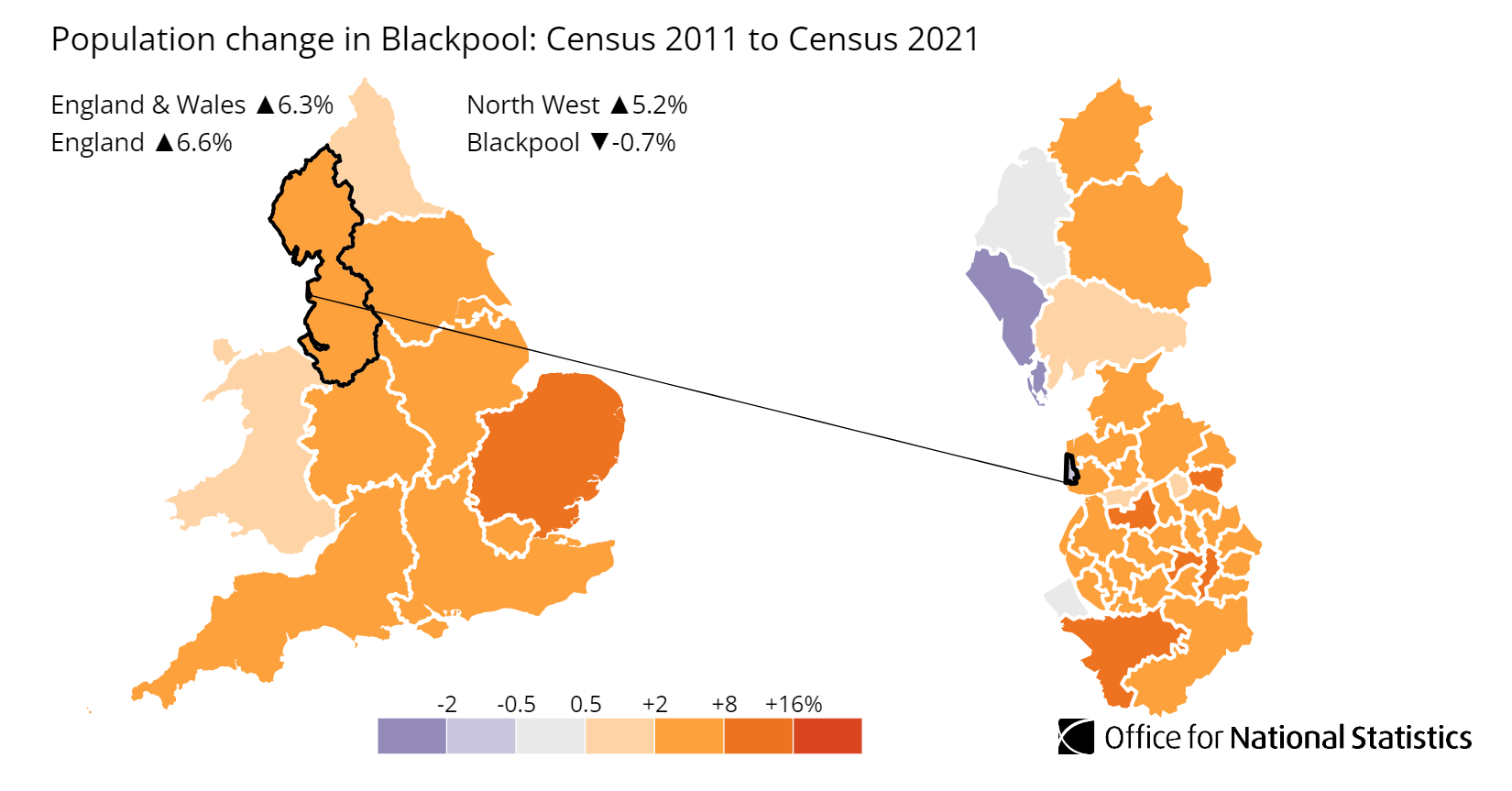
Blackpool's population of 141,036 (2021 Census) represents a slight decline of 1,029 residents (-0.72%) from 142,065 in 2011. That population figure understates the demand picture. Blackpool is the UK's most visited seaside resort, drawing over 18 million visitors per year. The town centre is undergoing its largest transformation in decades, with over £740 million in regeneration investment currently in delivery or planning. For investors looking for property tips in the North West, Blackpool's combination of low entry prices and high gross yields creates a distinct opportunity.
The median gross annual salary for Blackpool residents is £31,858, which sits below both the North West regional median and the Great Britain median. Lower local earnings are reflected in the affordability data: property prices range from just 3.5 to 9.6 times the median salary, compared to a national benchmark of 7.5 times. Employment in Blackpool is concentrated in tourism, hospitality, health and social care, retail, and the growing public sector presence driven by government office relocations.
Blackpool Economic Summary
- Population: 141,036 (2021 Census). Decline of 0.72% from 2011.
- Median annual salary: £31,858 (Blackpool), £37,445 (North West), £39,125 (Great Britain)
- Employment rate: 69.4% (Blackpool), 74.2% (North West), 75.6% (Great Britain)
- Unemployment rate: 4.4% (Blackpool), 4.1% (North West), 4.3% (Great Britain)
- Key employment sectors: Tourism and hospitality, health and social care, retail, public sector (civil service hub)
Source: ONS Census 2021, Nomis Labour Market Profile (ASHE 2025, Employment Oct 2024-Sep 2025)
Regeneration and Investment in Blackpool
Over £740 million in committed investment is reshaping Blackpool's town centre. Three major projects are either under construction or in active delivery, each with direct implications for rental demand and property values in surrounding postcodes.
- Blackpool Central (Site clearance underway, £300 million): A 10-acre leisure and entertainment destination at the foot of Blackpool Tower, being marketed to international investors and developers in 2025 following demolition of the former courts. This is the resort's most significant development opportunity in a generation, designed to transform visitor numbers and spending in the town centre. Updates at Business in Blackpool.
- Talbot Gateway Phase 3 (Under construction, part of £350 million programme): A £100 million civil service hub delivering 215,000 sq ft of office space, bringing over 3,000 government employees into the town centre daily. Phases 1 and 2 already delivered a new tram terminus, hotel, and office buildings. Updates at Business in Blackpool.
- Central Housing Regeneration Area (Planning stage, £90 million): Government-funded demolition of up to 400 poor-quality properties and replacement with up to 230 new energy-efficient homes in inner Blackpool, delivered by Blackpool Housing Company and Lumen affordable housing provider through Homes England's Brownfield Infrastructure Land Fund. Updates at GOV.UK.
Blackpool Property Market Analysis
When was the last house price crash in Blackpool?
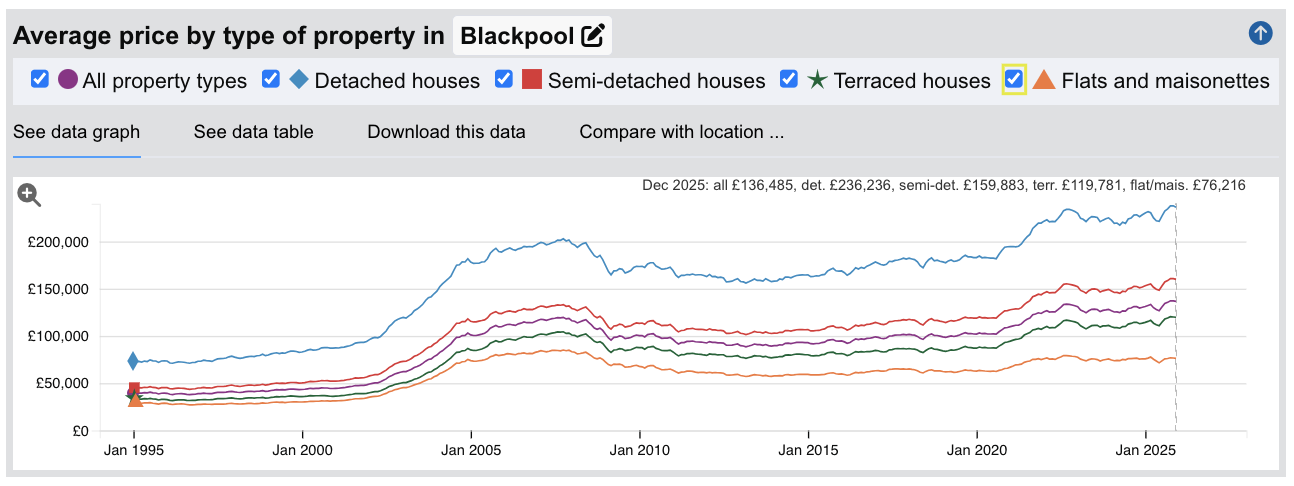
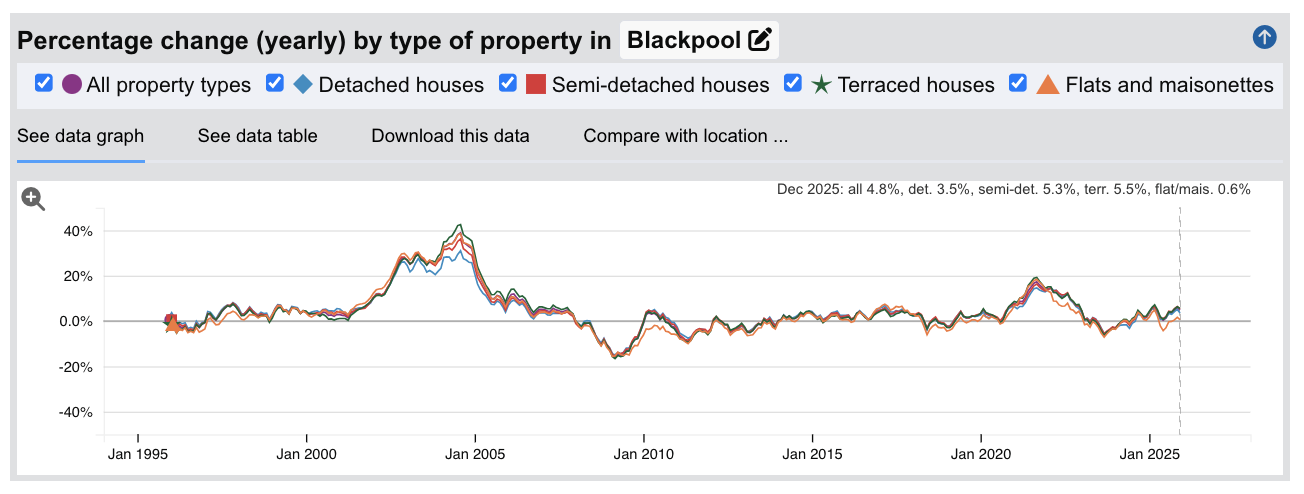
Blackpool's average sold price fell 26.1% from a peak of £119,650 in October 2007 to a trough of £88,456 in March 2013. That decline was deeper than the England average of 18.2% and the North West regional decline of 18.3%. Flats were hit hardest, losing 32.9% of their value, while detached houses fell 23.1%. Blackpool recorded 60 consecutive months of negative annual price change between 2007 and 2013, and the worst single reading was -15.9% in March 2009.
Prices did not return to their pre-crash peak until September 2021, a full 14 years after the October 2007 high. Here is how Blackpool's property market has moved through each major cycle since Land Registry records began:
- 1995-2007 (The Boom): Blackpool's average sold price rose from £39,105 in January 1995 to £119,650 by October 2007. The sharpest growth came between 2001 and 2004, with annual increases exceeding 20%. By December 2003, prices had already doubled from £44,321 in December 2000 to £78,041.
- 2008-2009 (The Financial Crisis): Peak price of £119,650 in October 2007. Trough of £99,932 by June 2009 (a 16.5% fall in 20 months). The worst annual change reading hit -15.9% in March 2009. Flats fell furthest at -32.9% peak to trough, followed by terraced houses at -26.9%.
- 2010-2013 (Prolonged Stagnation): Unlike many English cities that bottomed out in 2009, Blackpool continued to slide. The true trough did not arrive until March 2013 at £88,456. The annual change remained negative throughout this period, with a -5.0% reading still recorded in March 2013.
- 2014-2016 (Slow Recovery): Prices began a tentative recovery, reaching £92,815 by December 2014. Growth was modest at around 4% per year, and by June 2016 the average had only recovered to £96,770. Still well below the 2007 peak of £119,650.
- 2017-2019 (Steady Growth): Prices ground higher to £102,032 by December 2019, recording consistent positive annual change but at a pace well below the national average. Blackpool passed the £100,000 mark again but remained 15% below its pre-crash peak.
- 2020-2022 (Pandemic Surge): The stamp duty holiday and shifting demand for coastal properties accelerated Blackpool's recovery. Prices rose from £108,915 in December 2020 to £131,925 by December 2022, with a peak annual change of 17.3% recorded in September 2021. This was the period when Blackpool finally recovered to its 2007 levels.
- 2023 (Rate Shock): Higher mortgage rates briefly reversed momentum. The average dropped from £131,925 to £128,091 by December 2023, a decline of 2.9%.
- 2024-2025 (Current): Prices have rebounded to £136,485 as of December 2025, recording 4.8% annual growth. This is 14.1% above the 2007 pre-crash peak.
Blackpool Long-Term House Price Growth
- 5 years (2020-2025): 25.3% growth (£108,915 to £136,485)
- 10 years (2015-2025): 44.6% growth (£94,342 to £136,485)
- 15 years (2010-2025): 38.8% growth (£98,317 to £136,485)
- 20 years (2005-2025): 24.4% growth (£109,715 to £136,485)
- 30 years (1995-2025): 246.6% growth (£39,375 to £136,485)
The 14-year recovery period is the headline number. Blackpool took longer than most English towns to recover from the 2008 crash, largely because its economy was more exposed to tourism and seasonal employment than cities with diversified economic bases. The current cycle looks different. The Talbot Gateway civil service hub is adding thousands of permanent, salaried jobs to the town centre, and the £300 million Blackpool Central development is designed to reduce seasonal dependency. These structural changes were not present during the 2007 peak. Browse current investment properties sourced by our partners.

Thinking of Buying?
We have off-market investment properties averaging 8%+ annual yield.
View Property DealsSold House Prices in Blackpool
The average sold price across all property types in Blackpool is £136,485, which is £155,380 less than the England average of £291,865. That 53.2% discount applies across every property type. The table below breaks down how Blackpool's Land Registry sold prices compare to England for detached houses, semi-detached houses, terraced houses, and flats.
| Property Type | Blackpool Average | England Average | Difference |
|---|---|---|---|
| Detached houses | £236,236 | £471,667 | -49.9% |
| Semi-detached houses | £159,883 | £289,135 | -44.7% |
| Terraced houses | £119,781 | £244,830 | -51.1% |
| Flats and maisonettes | £76,216 | £219,340 | -65.3% |
| All property types | £136,485 | £291,865 | -53.2% |
Flats show the deepest discount at 65.3% below the England average. Blackpool has a high concentration of converted Victorian and Edwardian guest houses, many of which have been split into flats. This legacy housing stock keeps flat prices low at £76,216. These properties are also where the highest gross yields tend to concentrate, because rental income holds up despite the low purchase price.
Terraced houses in Blackpool average £119,781, which is 51.1% below the England figure. Terraces make up the largest share of Blackpool's housing stock, particularly in the inner postcodes (FY1 to FY4). The discount narrows as you move to semi-detached (44.7% below) and detached (49.9% below), reflecting the higher-value suburban stock in FY5, FY6, and FY8.
Detached houses at £236,236 represent the highest average price in Blackpool. These are concentrated in the outer postcodes. At 49.9% below the England average, even Blackpool's premium housing stock costs less than half the national figure.
Property Data Sources
Our location guide relies on diverse, authoritative datasets including:
- HM Land Registry UK House Price Index
- Ministry of Housing, Communities and Local Government
- Ordnance Survey Data Hub
- Propertydata.co.uk
We update our property data quarterly to ensure accuracy. Last update: March 2026. All data is presented as provided by our sources without adjustments or amendments.
Price Per Square Foot in Blackpool
How much does location matter within Blackpool? Sold prices per square foot range from £100 in FY1 (Town Centre, North Shore) to £245 in FY8 (Lytham St Annes). That is a £145 per square foot gap, a 145% difference based on transaction data from actual sold prices. Lytham St Annes commands that premium through larger detached stock and a coastal village character distinct from the resort centre.
| Rank | Area | Price per sq ft |
|---|---|---|
| 1 | FY1 (Town Centre, North Shore) | £100 |
| 2 | FY3 (Layton, Stanley Park) | £151 |
| 3 | FY4 (South Shore, Marton) | £157 |
| 4 | FY2 (Bispham) | £162 |
| 5 | FY5 (Cleveleys, Thornton) | £200 |
| 6 | FY6 (Poulton-le-Fylde) | £237 |
| 7 | FY8 (Lytham St Annes) | £245 |
FY1 at £100 per square foot is the lowest in Blackpool by a significant margin. The next cheapest (FY3 at £151) costs 51% more per square foot. This gap confirms that FY1's headline prices reflect genuine value per square foot, not just smaller properties. For investors comparing like-for-like floor space, FY1 offers the most square footage per pound spent.
The three most expensive postcodes (FY5, FY6, FY8) are all outside the Blackpool town boundary in practical terms. Cleveleys, Poulton-le-Fylde, and Lytham St Annes are separate communities with their own high streets and identities. Their higher price per square foot reflects lower density housing, better school catchments, and a more residential character.
Houses for Sale: Asking Prices in Blackpool
Look at the spread between FY1 and FY8 in the table below. The cheapest postcode (FY1 at £112,145) costs just 36.7% of the most expensive (FY8 at £305,377). The mean asking price across all seven Blackpool postcodes is £199,639, which is lower than the North West regional average of £217,428. Four of seven postcodes sit below £175,000.
| Rank | Area | Asking Price |
|---|---|---|
| 1 | FY1 (Town Centre, North Shore) | £112,145 |
| 2 | FY3 (Layton, Stanley Park) | £155,258 |
| 3 | FY4 (South Shore, Marton) | £160,331 |
| 4 | FY2 (Bispham) | £173,998 |
| 5 | FY5 (Cleveleys, Thornton) | £201,471 |
| 6 | FY6 (Poulton-le-Fylde) | £288,896 |
| 7 | FY8 (Lytham St Annes) | £305,377 |
The four inner postcodes (FY1 to FY4) range from £112,145 to £173,998. These are the postcodes that deliver the strongest gross yields, because rents hold up while prices stay low. Investors focused on income will find their entry point here.
FY6 (Poulton-le-Fylde) and FY8 (Lytham St Annes) sit at £288,896 and £305,377 respectively. These are affluent residential areas with limited rental stock and lower yields. The premium is driven by owner-occupier demand, proximity to good schools, and a village or small-town character that contrasts with central Blackpool.
House Price Growth in Blackpool
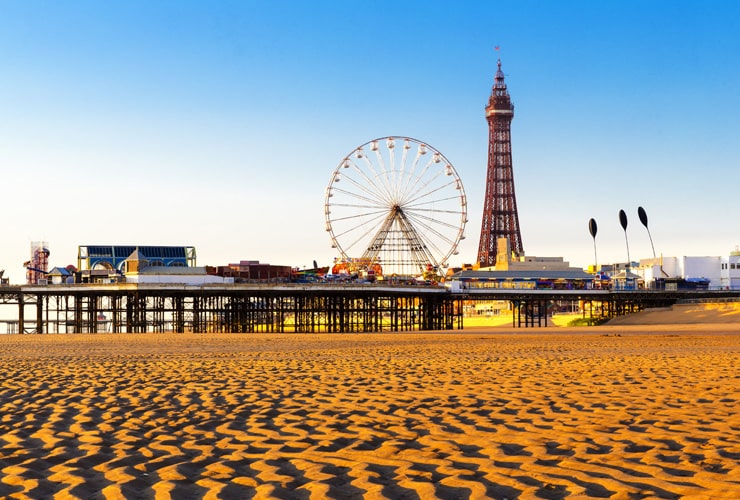
Growth in Blackpool does not follow a simple cheap-equals-fast pattern. Five-year growth ranges from 9.1% in FY4 (South Shore, Marton) to 18.2% in FY2 (Bispham). FY2 leads on 5-year growth despite sitting mid-table on price, while FY1 (the cheapest and highest-yielding postcode) delivered 15.3% over five years but recorded negative 3-year growth of -3.6%. Two postcodes (FY1 and FY4) show negative 3-year figures, suggesting short-term price corrections after the pandemic surge.
| Area | 1 Year | 3 Years | 5 Years |
|---|---|---|---|
| FY2 (Bispham) | 6.5% | 3.9% | 18.2% |
| FY3 (Layton, Stanley Park) | 3.6% | 6.1% | 17.1% |
| FY5 (Cleveleys, Thornton) | 3.8% | 0.3% | 16.8% |
| FY1 (Town Centre, North Shore) | 3.9% | -3.6% | 15.3% |
| FY8 (Lytham St Annes) | 1.2% | 5.7% | 13.8% |
| FY6 (Poulton-le-Fylde) | -4.3% | 2.2% | 13.8% |
| FY4 (South Shore, Marton) | 2.2% | -0.5% | 9.1% |
FY2 (Bispham) leads with 18.2% five-year growth and the strongest one-year figure at 6.5%. This is a residential postcode north of the town centre with a mix of semi-detached and terraced housing. The growth pattern suggests sustained demand from owner-occupiers pricing out of Poulton-le-Fylde and Cleveleys.
FY6 (Poulton-le-Fylde) is the only postcode recording negative one-year growth at -4.3%. After strong pandemic-era gains, prices have corrected. The 3-year and 5-year figures remain positive (2.2% and 13.8%), suggesting a temporary pullback rather than a structural decline. FY4 shows a similar pattern with -0.5% over three years and the weakest five-year figure at 9.1%.
Monthly Property Sales in Blackpool
Blackpool recorded 1,577 property sales across the first 10 months of 2025 with available data, averaging 158 transactions per month across all seven postcodes. FY5 (Cleveleys, Thornton) is the most active postcode with 68 sales per month and a turnover rate of 44%. The least active is FY2 (Bispham) at 27 sales per month. Total annual sales in 2024 reached 2,121, up from 1,977 in 2023.
| Area | Sales per Month | Turnover | Asking Price |
|---|---|---|---|
| FY5 (Cleveleys, Thornton) | 68 | 44% | £201,471 |
| FY8 (Lytham St Annes) | 59 | 29% | £305,377 |
| FY4 (South Shore, Marton) | 52 | 31% | £160,331 |
| FY6 (Poulton-le-Fylde) | 38 | 26% | £288,896 |
| FY1 (Town Centre, North Shore) | 35 | 18% | £112,145 |
| FY3 (Layton, Stanley Park) | 34 | 32% | £155,258 |
| FY2 (Bispham) | 27 | 26% | £173,998 |
FY1 has the lowest turnover rate at 18%, despite being the cheapest postcode. Lower turnover in FY1 is consistent with a high proportion of buy-to-let and holiday let properties. Investors tend to hold rather than sell, which keeps the turnover figure low relative to the number of transactions.
FY5 (Cleveleys, Thornton) combines the highest sales volume (68 per month) with the highest turnover (44%). This is an active market where properties move quickly. The asking price of £201,471 sits in the middle of Blackpool's range, making FY5 accessible to both owner-occupiers and investors.
Property Data Sources
Our location guide relies on diverse, authoritative datasets including:
- HM Land Registry UK House Price Index
- Ministry of Housing, Communities and Local Government
- Ordnance Survey Data Hub
- Propertydata.co.uk
We update our property data quarterly to ensure accuracy. Last update: March 2026. All data is presented as provided by our sources without adjustments or amendments.
Blackpool Rental Market Analysis
For investors weighing up whether rental property is a worthwhile investment in Blackpool, the data below breaks down average monthly rents and gross rental yields across the town's postcodes.
All seven Blackpool postcodes have rental data available. Monthly rents range from £650 (FY1) to £889 (FY6), and gross yields range from 3.4% (FY8) to 7.0% (FY1). If you are looking to build a property portfolio in the North West, Blackpool's combination of low purchase prices and consistent rental income creates some of the strongest yield figures in the region.
Average Rent, Flats to Rent & Gross Rental Yields in Blackpool
FY1 (Town Centre, North Shore) delivers the highest gross yield at 7.0%, driven by the lowest asking price in Blackpool (£112,145) paired with a monthly rent of £650. All seven postcodes have rental data. The yield spread from 3.4% to 7.0% reflects the two-speed market: inner resort postcodes deliver income, suburban postcodes deliver growth. Blackpool is a strong location for investors looking at holiday let opportunities alongside traditional buy-to-let.
| Area | Monthly Rent | Asking Price | Gross Yield |
|---|---|---|---|
| FY1 (Town Centre, North Shore) | £650 | £112,145 | 7.0% |
| FY3 (Layton, Stanley Park) | £734 | £155,258 | 5.7% |
| FY2 (Bispham) | £738 | £173,998 | 5.1% |
| FY4 (South Shore, Marton) | £653 | £160,331 | 4.9% |
| FY5 (Cleveleys, Thornton) | £792 | £201,471 | 4.7% |
| FY6 (Poulton-le-Fylde) | £889 | £288,896 | 3.7% |
| FY8 (Lytham St Annes) | £855 | £305,377 | 3.4% |
The top three postcodes by yield (FY1, FY3, FY2) all sit in the inner Blackpool area, with yields from 5.1% to 7.0%. FY1 stands out because its rent of £650 per month, while the lowest in absolute terms, represents 7.0% of its asking price. The gap between FY1 and the second-highest yield (FY3 at 5.7%) is 1.3 percentage points.
FY6 delivers the highest monthly rent at £889 but the second-lowest yield at 3.7%. FY8 (Lytham St Annes) follows a similar pattern: high absolute rent (£855) but the lowest yield (3.4%) because the asking price is £305,377. Investors in these postcodes are buying for capital growth and tenant quality rather than headline yields.
Is Blackpool Rent High?
Monthly rents in Blackpool range from 24.5% to 33.5% of the median gross monthly income. The table below ranks each postcode by rent as a proportion of income. Four of seven postcodes sit below 30%, which is generally considered the affordability threshold. Three postcodes exceed it.
The median gross weekly salary in Blackpool is £612.70, which equates to £2,655 per month or £31,858 per year. This is below the North West regional median of £720.10 per week and the Great Britain median of £752.40 per week. Data from the Nomis Labour Market Profile (ASHE 2025).
| Rank | Area | Rent as % of Income |
|---|---|---|
| 1 | FY6 (Poulton-le-Fylde) | 33.5% |
| 2 | FY8 (Lytham St Annes) | 32.2% |
| 3 | FY5 (Cleveleys, Thornton) | 29.8% |
| 4 | FY2 (Bispham) | 27.8% |
| 5 | FY3 (Layton, Stanley Park) | 27.6% |
| 6 | FY4 (South Shore, Marton) | 24.6% |
| 7 | FY1 (Town Centre, North Shore) | 24.5% |
FY6 and FY8 are the only postcodes where rent exceeds 30% of the median income. These are also the highest-priced areas, attracting tenants with above-average earnings who choose to live in Poulton-le-Fylde or Lytham St Annes for lifestyle reasons. The 33.5% figure in FY6 reflects £889 monthly rent against the Blackpool median income. In practice, many tenants in these postcodes earn above the local median.
FY1 and FY4 are the most affordable for tenants, both sitting below 25% of income. FY1's rent of £650 per month absorbs just 24.5% of the median gross monthly salary. Lower rent-to-income ratios generally mean lower void risk, because a wider pool of tenants can afford the property.
Thinking of Buying?
We have off-market investment properties averaging 8%+ annual yield.
View Property DealsBuy-to-Let Considerations
Are House Prices High? Price-to-Earnings Ratios
Purchasing a property in Blackpool requires between 3.5 and 9.6 times the median annual salary. This is based on the Nomis Labour Market Profile for Blackpool showing the median gross annual income for Blackpool residents is £31,858.
The national benchmark (England average sold price divided by Great Britain median salary) is 7.5 times. Five of Blackpool's seven postcodes fall below this benchmark, confirming that the majority of Blackpool's housing market is more affordable than the national average.
| Rank | Area | Price-to-Earnings Ratio |
|---|---|---|
| 1 | FY1 (Town Centre, North Shore) | 3.5x |
| 2 | FY3 (Layton, Stanley Park) | 4.9x |
| 3 | FY4 (South Shore, Marton) | 5.0x |
| 4 | FY2 (Bispham) | 5.5x |
| 5 | FY5 (Cleveleys, Thornton) | 6.3x |
| 6 | FY6 (Poulton-le-Fylde) | 9.1x |
| 7 | FY8 (Lytham St Annes) | 9.6x |
FY1 at 3.5 times earnings is one of the most affordable postcodes in the North West. A property in FY1 costs less than four years of the local median salary. For context, the average across England is 7.5 times, and many southern postcodes exceed 10 times. The five postcodes from FY1 to FY5 (3.5x to 6.3x) all sit comfortably below the national benchmark.
FY6 and FY8 are the only postcodes exceeding the national benchmark. At 9.1x and 9.6x respectively, these reflect the premium residential character of Poulton-le-Fylde and Lytham St Annes. The same postcodes also show the lowest gross yields (3.7% and 3.4%), confirming the trade-off between affordability and income return.
Deposit Requirements in Blackpool
A 30% deposit on a buy-to-let property in Blackpool ranges from £33,644 in FY1 (Town Centre, North Shore) to £91,613 in FY8 (Lytham St Annes). The difference between the cheapest and most expensive deposit is £57,969. For investors calculating the full cost of entry, our stamp duty calculator and guide to buy-to-let costs cover the additional fees.
| Rank | Area | 30% Deposit Required |
|---|---|---|
| 1 | FY1 (Town Centre, North Shore) | £33,644 |
| 2 | FY3 (Layton, Stanley Park) | £46,577 |
| 3 | FY4 (South Shore, Marton) | £48,099 |
| 4 | FY2 (Bispham) | £52,200 |
| 5 | FY5 (Cleveleys, Thornton) | £60,441 |
| 6 | FY6 (Poulton-le-Fylde) | £86,669 |
| 7 | FY8 (Lytham St Annes) | £91,613 |
The four inner postcodes (FY1 to FY4) all require deposits under £53,000. FY1 at £33,644 is the lowest entry point. The jump from FY4 (£48,099) to FY5 (£60,441) marks the transition from inner Blackpool to the suburban Fylde Coast postcodes. From FY5 upward, deposits exceed £60,000.
An extra £12,933 in deposit (the gap between FY1 at £33,644 and FY3 at £46,577) buys a postcode with stronger 3-year growth (6.1% vs -3.6%) and a rent of £734 vs £650 per month. FY3 yields 5.7% compared to FY1's 7.0%, but the growth profile is more balanced. This is the kind of trade-off the deposit table reveals when read alongside the yield and growth data.
What the Blackpool Data Tells Buy-to-Let Investors
FY1 (Town Centre, North Shore) delivers the highest gross yield at 7.0% with the lowest entry deposit at £33,644. This is the postcode closest to the £300 million Blackpool Central development and the Talbot Gateway civil service hub. The 3,000+ government employees relocating to the town centre create a new tenant pool that was not present when FY1 last recorded these price levels. Demand from this source is year-round, not seasonal.
FY3 (Layton, Stanley Park) and FY2 (Bispham) offer the strongest balance of yield and growth. FY3 combines a 5.7% yield with the second-highest 3-year growth (6.1%) and 5-year growth (17.1%). FY2 leads the 5-year growth table at 18.2% with a 5.1% yield. Both postcodes serve a mix of families and working professionals, with lower exposure to the seasonal tourism fluctuations that affect FY1.
FY6 (Poulton-le-Fylde) recorded the only negative 1-year growth (-4.3%) and FY8 (Lytham St Annes) delivered the weakest 1-year growth at 1.2%. Both postcodes have the lowest yields (3.7% and 3.4%) and the highest entry costs. FY1 recorded -3.6% over three years and has the lowest sales turnover at 18%. These data points sit alongside strong 5-year growth (15.3%) and the highest yield in the dataset. Blackpool Council operates a selective licensing scheme in parts of inner Blackpool, which applies to certain private rented properties.
How Blackpool Compares
Blackpool has the lowest mean asking price (£199,639) of the five North West locations compared below, while its top yield of 7.0% sits between Liverpool (7.5%) and Manchester (7.9%) at the top and Preston (6.9%) and Bolton (6.7%) below. The comparison table uses mean asking prices across all postcodes and the highest single-postcode gross yield for each location.
| Location | Mean Asking Price | Mean Monthly Rent | Top Gross Yield |
|---|---|---|---|
| Blackpool | £199,639 | £759 | 7.0% |
| Liverpool | £206,849 | £872 | 7.5% |
| Preston | £247,593 | £1,001 | 6.9% |
| Bolton | £254,422 | £954 | 6.7% |
| Manchester | £265,494 | £1,314 | 7.9% |
Blackpool's mean asking price is £7,210 below Liverpool and £65,855 below Manchester. That price advantage is Blackpool's primary differentiator. Liverpool and Manchester both deliver higher top yields (7.5% and 7.9%) and higher mean rents (£872 and £1,314), but their entry costs are correspondingly higher. Blackpool's lower mean rent (£759) reflects both lower local earnings and a smaller proportion of high-rent city centre stock.
Preston sits closest to Blackpool geographically and in yield terms (6.9% vs 7.0%). Preston's mean asking price is £247,593, which is 24% higher than Blackpool. For investors comparing the two Fylde Coast options, Blackpool offers lower entry costs and marginally higher top yields, while Preston delivers stronger rents (£1,001 vs £759) and proximity to the M6 motorway corridor. Read more in our Preston buy-to-let guide.
For a wider view of how these locations rank nationally, see our best buy-to-let locations tracker. Location guides for Liverpool, Bolton, and Manchester break down the data for each city.
Frequently Asked Questions
Is Blackpool a good place for property investment?
Blackpool's numbers tell a clear story: average sold prices 53.2% below the England average, gross yields up to 7.0%, and entry deposits from £33,644. The town is mid-way through over £740 million of regeneration investment, including a £100 million civil service hub that will bring 3,000+ government employees into the town centre.
The 14-year recovery from the 2008 crash is the main historical signal. Prices did not return to their 2007 peak until September 2021, which was significantly slower than the national recovery. Since then, five-year growth has reached 25.3%. The investment case rests on whether the current regeneration cycle breaks the historical pattern of slow, tourism-dependent growth.
What is the average rent in Blackpool?
Monthly rents across Blackpool's seven postcodes range from £650 in FY1 (Town Centre, North Shore) to £889 in FY6 (Poulton-le-Fylde). The mean monthly rent across all postcodes is £759. Rents in the inner postcodes (FY1 to FY4) range from £650 to £738. The outer postcodes (FY5, FY6, FY8) command higher rents from £792 to £889, reflecting larger properties and higher tenant incomes. Rent as a proportion of the median gross monthly salary ranges from 24.5% in FY1 to 33.5% in FY6.
What are the best areas to invest in Blackpool?
The data points to three postcodes with distinct investment profiles. FY1 (Town Centre, North Shore) leads on yield at 7.0% with the lowest entry price at £112,145. FY3 (Layton, Stanley Park) offers a balanced profile: 5.7% yield, 17.1% five-year growth, and £155,258 asking price. FY2 (Bispham) leads the growth table at 18.2% over five years with a 5.1% yield. The choice depends on whether income (FY1), balance (FY3), or growth (FY2) is the priority. The suburban postcodes (FY5, FY6, FY8) deliver lower yields but attract longer-tenancy professionals and families.
What are Blackpool seafront property asking prices?
Seafront properties fall primarily within FY1 (Town Centre, North Shore) and FY4 (South Shore, Marton). FY1 has an average asking price of £112,145 and FY4 averages £160,331. The price per square foot data shows FY1 at £100/sq ft and FY4 at £157/sq ft. Individual seafront properties, particularly those with sea views or holiday let licences, can trade above these postcode averages. The Blackpool Central development, a £300 million project on a 10-acre site at the foot of Blackpool Tower, is expected to increase footfall and spending along the seafront once delivered.
Is Blackpool good for holiday let investment?
Blackpool attracts over 18 million visitors per year, making it the UK's most visited seaside resort. This visitor volume creates demand for short-term accommodation, particularly during the Illuminations season (September to November) and the summer months. FY1 (Town Centre, North Shore) and FY4 (South Shore, Marton) are the main postcodes for holiday lets due to their proximity to the seafront, Tower, and Pleasure Beach. The gross yields in these postcodes (7.0% in FY1, 4.9% in FY4) are based on long-term rental data. Holiday let income can exceed these figures during peak periods but carries higher void risk in the off-season. For a broader view of UK holiday let locations, see our guide to the best areas for holiday let investment.