
Where to Buy Property Investments in Coventry: Yields of 7.3%
Coventry's gross rental yields reach 7.3% in CV1, with average sold prices sitting 22.8% below the England average. Asking prices start from £165,590 in CV1 and the city's population grew 8.95% to 345,325 between the 2011 and 2021 censuses. All 8 postcodes have rental data.
Coventry's average sold price of £226,319 places it 3.2% below the West Midlands regional average and £66,812 below England's £293,131. Entry-level deposits start from £49,677 in CV1 at 30%, and monthly rents range from £1,012 to £1,304 across the city's 8 postcodes.
This guide covers all 8 Coventry postcodes from CV1 to CV8 under the Coventry metropolitan borough (ONS code E08000026). Coventry sits in the heart of the West Midlands, midway between Birmingham and Leicester on the M6/M69 corridor. Investors comparing options in the region may also consider Leicester, Wolverhampton, or Stoke-on-Trent. Browse all our Midlands location guides.
Article updated: February 2026
Coventry Buy-to-Let Market Overview 2026
Coventry offers entry prices 22.8% below the England average, backed by two major universities, a £1.35 billion regeneration pipeline, and a population that grew nearly 9% in the last census decade.
- Average sold price: £226,319 (22.8% below England's £293,131)
- Asking price range: £165,590 (CV1) to £433,502 (CV8)
- Rental yields: 3.5% (CV8) to 7.3% (CV1) across all 8 postcodes
- Rental income: Monthly rents from £1,012 (CV1) to £1,304 (CV4)
- Price per sq ft: Sold prices from £202/sq ft (CV1) to £397/sq ft (CV8)
- Market activity: Sales ranging from 14 per month (CV1) to 64 per month (CV6)
- Deposit requirements: 30% deposits range from £49,677 (CV1) to £130,051 (CV8)
- Affordability ratios: Property prices from 4.4 to 11.5 times Coventry's median annual salary of £37,759
Contents

-
by Robert Jones, Founder of Property Investments UK
With two decades in UK property, Rob has been investing in buy-to-let since 2005, and uses property data to develop tools for property market analysis.

Property Data Sources
Our location guide relies on diverse, authoritative datasets including:
- HM Land Registry UK House Price Index
- Ministry of Housing, Communities and Local Government
- Ordnance Survey Data Hub
- Propertydata.co.uk
We update our property data quarterly to ensure accuracy. Last update: February 2026. All data is presented as provided by our sources without adjustments or amendments.
Why Invest in Coventry?
Coventry's two universities bring over 50,000 students into the city each year, creating a rental demand base that few Midlands cities can match. Coventry University has grown aggressively over the past decade and now enrols around 31,000 students, while the University of Warwick on the city's southern boundary adds another 29,000. That combined student population supports rental markets across CV1, CV4, and CV5 in particular.
The city's economy has shifted substantially since the decline of car manufacturing. Jaguar Land Rover's research and development centre at Whitley employs thousands and anchors the advanced manufacturing sector. The UK Battery Industrialisation Centre in nearby Blythe Valley is positioning Coventry as a hub for electric vehicle technology. These are not short-term employers.
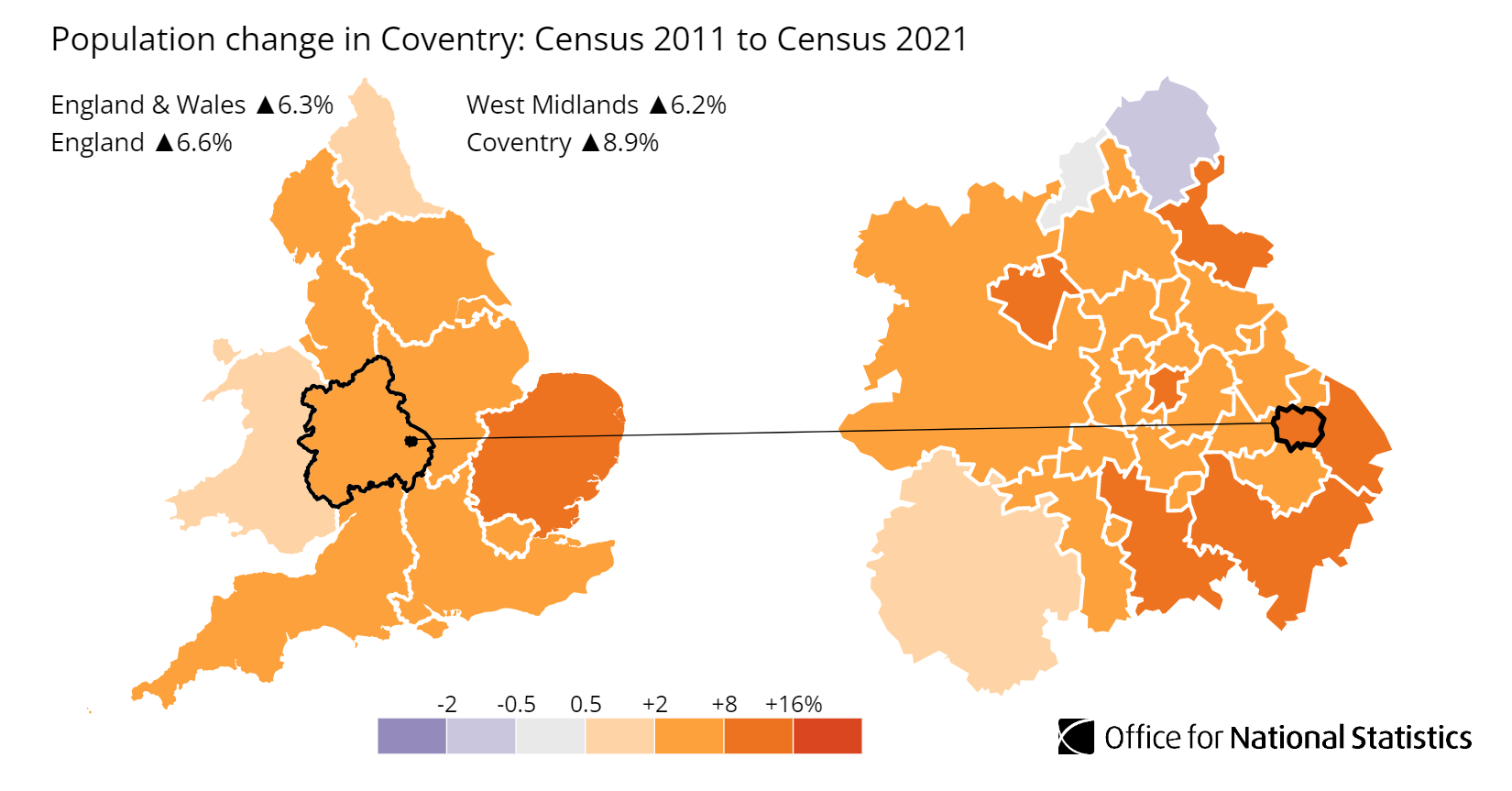
Between the 2011 and 2021 censuses, Coventry's population grew from 316,960 to 345,325, a rise of 8.95%. That growth rate outpaces most Midlands cities and reflects both student retention and inward migration. More people needing homes in a city where new supply has lagged behind demand puts upward pressure on rents.
Earnings in Coventry sit slightly below the national average but above the West Midlands regional figure. The median annual salary is £37,759, compared to £37,050 across the West Midlands and £39,125 for Great Britain. Higher local wages than the regional average mean tenants can sustain rents more comfortably than in neighbouring cities where pay is lower.
University Hospital Coventry and Warwickshire is one of the largest teaching hospitals in the region, employing over 9,000 staff. The hospital campus in CV2 generates rental demand from healthcare workers at all levels, from student nurses to consultants. This is a 24/7 employer that does not follow economic cycles.
Coventry Economic Summary
- Population: 345,325 (2021 Census). Growth of 8.95% from 2011.
- Median annual salary: £37,759 (Coventry), £37,050 (West Midlands), £39,125 (Great Britain)
- Employment rate: 71.2% (Coventry), 74.4% (West Midlands), 75.6% (Great Britain)
- Unemployment rate: 8.4% (Coventry), 5.3% (West Midlands), 4.3% (Great Britain)
- Key employment sectors: Advanced manufacturing, automotive R&D, higher education, healthcare, logistics
Source: ONS Census 2021, Nomis Labour Market Profile (ASHE 2025, Employment Oct 2024-Sep 2025)
Coventry's employment rate of 71.2% sits below both the West Midlands average of 74.4% and the national 75.6%. The unemployment rate of 8.4% is notably higher than both regional and national figures. That reflects the city's younger demographic profile. A large student population depresses employment statistics without indicating economic weakness. For buy-to-let investors, the combination of strong employer anchors and a large student population matters more than the headline employment rate.
Regeneration and Investment in Coventry
Coventry's regeneration pipeline totals over £1.35 billion across three major schemes. The city's year as UK City of Culture in 2021 accelerated investment that is now translating into construction and job creation.
- Friargate Business District (two buildings complete, £700 million full masterplan): International commercial district next to Coventry railway station delivering up to 2.35 million sq ft of office, hotel, residential, and retail space. One Friargate and Two Friargate are operational with tenants including Octopus Energy, Segro, and the Financial Ombudsman Service. Employment here creates a professional tenant base for surrounding CV1 postcodes. Updates at Friargate Coventry.
- City Centre South (demolition underway, £450 million): Coventry's largest city-centre residential scheme, delivering 991 new homes plus 8,000 sqm of commercial space across the former City Arcade and Barracks Car Park sites. Shearer Property Group and Hill are delivering Phase 1 from 2026 with full completion by 2034. The scale of new housing creates a seven-year investment horizon for surrounding postcodes. Updates at City Centre South.
- Spirit Quarters (final phase under construction, £200 million): Keepmoat delivering 1,200+ new multi-tenure homes across six phases in Wood End, Manor Farm, and Henley Green (CV2). The final phase of 190 homes, including 90 affordable units, is due for completion in 2030. Two decades of estate regeneration transforming housing stock and neighbourhood quality in east Coventry. Updates at Coventry City Council.
Coventry Property Market Analysis
When Was the Last House Price Crash in Coventry?
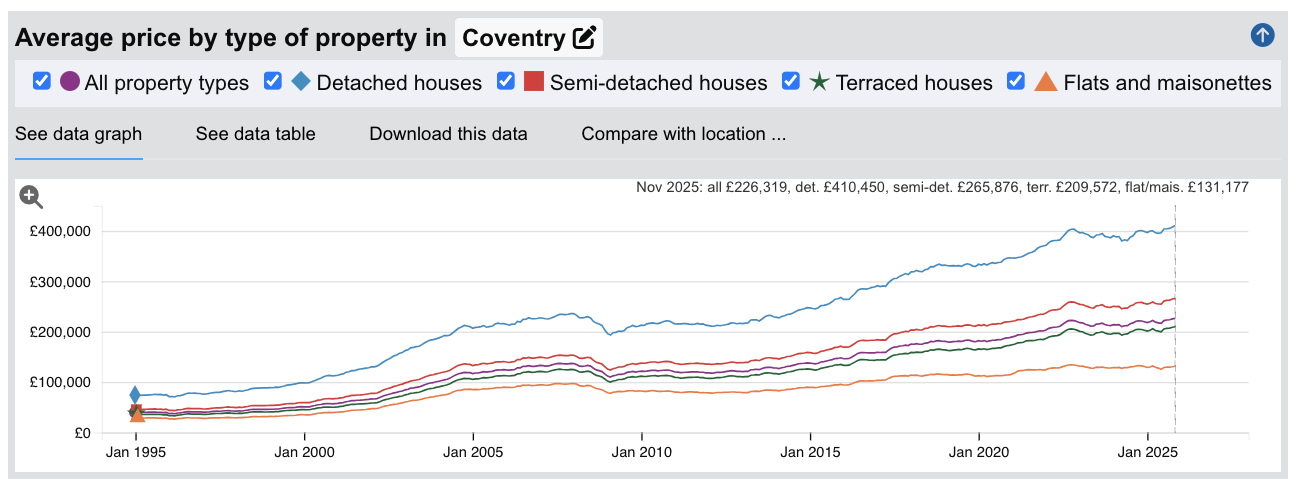
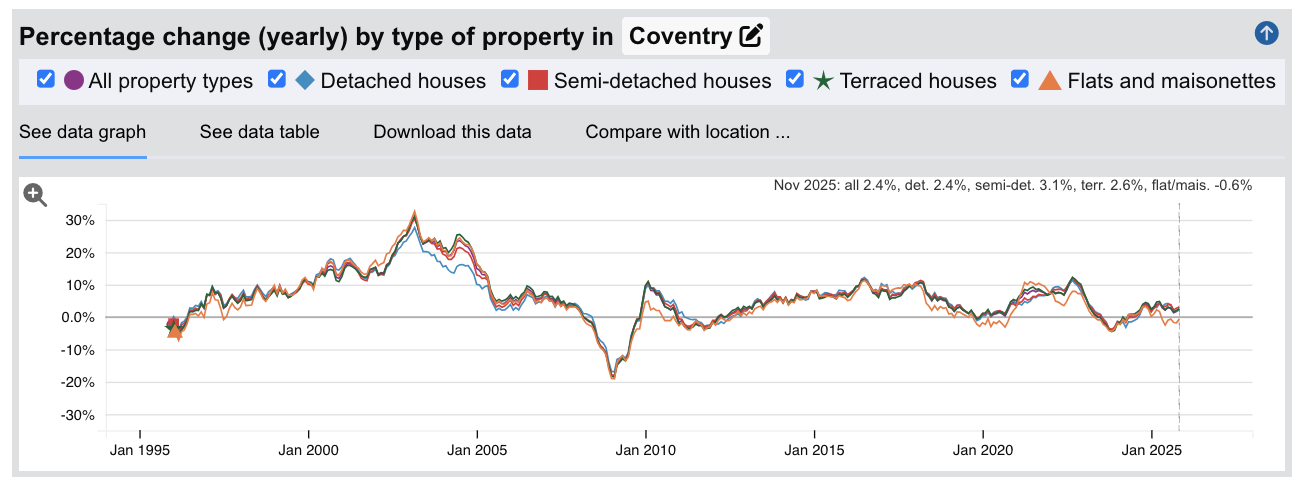
Coventry's full house price history from the HM Land Registry House Price Index runs from January 1995 to November 2025. The data shows one major crash, a long stagnation, and a sharp post-pandemic acceleration.
- 1995-2000 (Slow build): Coventry began 1995 at £38,455. Prices dipped briefly in 1996 to £37,448 before recovering. By January 2000, the average had reached £50,687. Growth was steady but unremarkable at roughly 5-10% per year.
- 2000-2007 (The boom): Prices more than doubled from £50,687 in January 2000 to a peak of £136,968 in August 2007. The sharpest growth came in 2002-2004, when annual changes exceeded 20%. Cheap credit and strong manufacturing employment pushed prices well beyond what local wages could support.
- 2007-2009 (The financial crisis): From the peak of £136,968 in August 2007 to the trough of £109,809 in February 2009, Coventry lost 19.8% of its value in 18 months. The worst annual change reading was -18.3% in February 2009. Terraced houses fell hardest at -20.3%, followed by flats at -20.1%, semi-detached at -19.4%, and detached at -17.5%. Coventry's decline of 19.8% was worse than both England overall (-18.2%) and the West Midlands region (-16.9%).
- 2009-2013 (Stagnation): Prices recovered quickly off the trough to £120,798 by December 2009. Then growth stalled. The average traded between £118,000 and £128,000 for four years. By December 2013, prices stood at £127,881. Still 6.6% below the pre-crash peak.
- 2014-2016 (Recovery): Growth returned with annual changes of 6-8%. Prices passed the pre-crash peak in November 2014 at £137,105. That recovery took 7.3 years from the August 2007 peak. Coventry recovered slightly faster than the West Midlands average but slower than London and the South East.
- 2017-2019 (Strong growth): Coventry outperformed many Midlands cities in this period. Prices rose from £159,037 in January 2017 to £179,851 by December 2019. Annual growth consistently exceeded 3%, peaking at 10.2% in January 2018. The city was catching up with regional neighbours after years of underperformance.
- 2020-2022 (Pandemic surge): The stamp duty holiday and remote working trends accelerated growth. Prices jumped from £182,168 in March 2020 to £219,996 by December 2022. That is 20.8% growth in under three years. Coventry's relative affordability and central location made it a beneficiary of the Midlands property boom.
Recovery and Beyond (2023-2025)
- 2023 (Rate shock): Interest rate rises cooled the market. Prices fell from £219,996 in December 2022 to £211,971 by December 2023, a decline of 3.6%. Brief and contained compared to the 2008 crash.
- 2024-2025 (Recovery): Prices stabilised and resumed growth. By November 2025, the average reached £226,319 with annual growth of 2.4%. Coventry now sits 65.2% above its pre-crash peak.
Long-Term Property Value Growth in Coventry
- 5 years (2020-2025): +20.6% (£187,620 to £226,319)
- 10 years (2015-2025): +54.3% (£146,687 to £226,319)
- 15 years (2010-2025): +83.7% (£123,195 to £226,319)
- 20 years (2005-2025): +83.0% (£123,685 to £226,319)
- 30 years (1995-2025): +479.5% (£39,057 to £226,319)
The 2008 crash is the reference point for Coventry investors assessing downside exposure. A 19.8% decline took 7.3 years to recover. Terraced houses and flats took the largest hits.
The city's economy has diversified since then. Coventry was more dependent on traditional manufacturing in 2007. Today's employer mix of universities, hospital, and advanced R&D provides a broader base. Property prices are never guaranteed, but the structural foundations are different.

Thinking of Buying?
We have off-market investment properties averaging 8%+ annual yield.
View Property DealsSold House Prices in Coventry
Sold prices from the Land Registry place Coventry's overall average at £226,319, which is 22.8% below England's £293,131. The discount varies significantly by property type, from 8.3% for semi-detached homes to 40.8% for flats.
Coventry flats show the deepest discount at 40.8% below the England average, while semi-detached homes sit just 8.3% below. That spread tells you where the pricing gap is widest and where investors are getting the most value relative to the national market.
| Property Type | Coventry Avg | England Avg | Difference |
|---|---|---|---|
| Detached | £410,450 | £474,400 | -13.5% |
| Semi-detached | £265,876 | £290,004 | -8.3% |
| Terraced | £209,572 | £245,002 | -14.5% |
| Flat | £131,177 | £221,565 | -40.8% |
| All Types | £226,319 | £293,131 | -22.8% |
Coventry's flat discount of 40.8% is the standout figure. England's average flat price of £221,565 reflects London and the South East pulling the national figure upward. Coventry's £131,177 average is closer to what flats cost across the Midlands, but the gap creates an entry point for investors targeting below market value properties in the student and young professional market.
Semi-detached homes at just 8.3% below England are the most nationally competitive property type in Coventry. At £265,876, they reflect Coventry's large stock of 1930s-1960s semis that form the backbone of the city's housing in CV2, CV3, CV5, and CV6. Demand for this type is consistently strong from family tenants.
Terraced houses at £209,572 sit 14.5% below England's £245,002. These are the traditional buy-to-let workhorses in Coventry, concentrated in CV1 and CV6. The discount against national prices gives investors a lower entry point while rents in these areas remain competitive.
Detached homes at £410,450 carry a 13.5% discount against England's £474,400. These are concentrated in CV5, CV7, and CV8. The detached market is primarily owner-occupier territory, though some investors target larger detached properties for HMO conversions in areas near the universities.
Source: HM Land Registry UK House Price Index (November 2025 data)
Property Data Sources
Our location guide relies on diverse, authoritative datasets including:
- HM Land Registry UK House Price Index
- Ministry of Housing, Communities and Local Government
- Ordnance Survey Data Hub
- Propertydata.co.uk
We update our property data quarterly to ensure accuracy. Last update: February 2026. All data is presented as provided by our sources without adjustments or amendments.
Price Per Square Foot in Coventry
Price per square foot strips out the effect of property size and gives a cleaner comparison between postcodes. A terraced house in CV1 costs less than a detached house in CV8, but per square foot reveals where the land and build value is highest.
How much does a square foot of property cost across Coventry? The range spans from £202 in CV1 to £397 in CV8, a spread of £195 across the city's 8 postcodes. That gap reflects the difference between city-centre flats and ex-student housing in CV1 and the premium detached stock around Kenilworth in CV8.
| Rank | Area | Price Per Sq Ft |
|---|---|---|
| 1 | CV1 (City Centre, Gosford Green) | £202 |
| 2 | CV2 (Walsgrave, Wyken) | £243 |
| 3 | CV6 (Foleshill, Longford) | £249 |
| 4 | CV4 (Tile Hill, Canley) | £273 |
| 5 | CV5 (Earlsdon, Allesley) | £278 |
| 6 | CV3 (Cheylesmore, Willenhall) | £282 |
| 7 | CV7 (Balsall Common, Meriden) | £302 |
| 8 | CV8 (Kenilworth) | £397 |
CV1 at £202 per square foot is the lowest in Coventry and one of the lowest city-centre figures in the Midlands. City-centre flats and converted properties dominate the sales here. The low per-square-foot cost is what allows CV1 to deliver the city's highest yield at 7.3%. Investors are paying less per unit of space and extracting more per unit of rent.
CV8 Kenilworth at £397 per square foot sits in a different market entirely. This is a semi-rural market town with period properties and substantial detached homes. The £195 gap between CV1 and CV8 illustrates the range within a single local authority area. For buy-to-let purposes, the action sits in the £202-£282 band covering CV1 through CV3.
CV4 and CV5 at £273 and £278 per square foot occupy the middle ground. Both border the University of Warwick campus. CV4 includes Tile Hill and Canley, traditional student letting areas where the per-square-foot cost reflects a mix of family homes and purpose-built student stock. CV5 Earlsdon commands a slight premium as one of Coventry's most desirable residential areas.
For Sale Asking Prices in Coventry
Asking prices in Coventry range from £165,590 in CV1 to £433,502 in CV8, based on current PropertyData listings. These are not sold prices. The gap between asking and sold can vary by 5-15% depending on the market and property type.
Asking prices in Coventry range from £165,590 in CV1 to £433,502 in CV8. The mean asking price across all 8 postcodes is £295,504. That mean figure appears in the comparison table later in this guide, where Coventry is benchmarked against four other Midlands cities.
| Rank | Area | Avg Asking Price |
|---|---|---|
| 1 | CV1 (City Centre, Gosford Green) | £165,590 |
| 2 | CV2 (Walsgrave, Wyken) | £220,399 |
| 3 | CV6 (Foleshill, Longford) | £236,471 |
| 4 | CV5 (Earlsdon, Allesley) | £288,325 |
| 5 | CV3 (Cheylesmore, Willenhall) | £290,862 |
| 6 | CV4 (Tile Hill, Canley) | £343,852 |
| 7 | CV7 (Balsall Common, Meriden) | £385,028 |
| 8 | CV8 (Kenilworth) | £433,502 |
CV1 at £165,590 is the cheapest entry point in the city by a significant margin. It is £54,809 cheaper than CV2, the next most affordable postcode. City-centre stock here is dominated by flats and converted properties. The low average reflects a market shaped by student demand and first-time buyers.
A natural break separates the sub-£250,000 tier from the rest. CV1, CV2, and CV6 all sit below £237,000. These three postcodes also deliver the three highest yields (7.3%, 5.6%, and 5.3% respectively). The alignment between lower asking prices and higher yields is consistent. It also reflects the housing mix in these areas: more terraced homes, more flats, and higher tenant density.
CV7 and CV8 at £385,028 and £433,502 are semi-rural markets within the Coventry local authority boundary. Balsall Common, Meriden, and Kenilworth attract owner-occupiers from both Coventry and Birmingham. Their inclusion in Coventry's postcode figures pulls the city mean upward. The urban core is more affordable than the headline average suggests.

House Price Growth in Coventry
Growth data from PropertyData shows 6 of 8 Coventry postcodes delivered double-digit five-year gains, led by CV2 at 23.8%. Short-term growth is more muted, with one-year figures ranging from -2.0% in CV3 to 4.3% in CV2.
Coventry's five-year growth ranges from 3.0% in CV1 to 23.8% in CV2, with 6 of 8 postcodes showing double-digit five-year gains. The one-year figures are more muted, ranging from -2.0% in CV3 to 4.3% in CV2. The market has shifted from the rapid growth of 2020-2022 into a steadier phase.
| Area | 1 Year | 3 Year | 5 Year |
|---|---|---|---|
| CV2 (Walsgrave, Wyken) | 4.3% | 5.4% | 23.8% |
| CV6 (Foleshill, Longford) | 1.7% | 4.0% | 21.9% |
| CV3 (Cheylesmore, Willenhall) | -2.0% | 3.3% | 18.9% |
| CV5 (Earlsdon, Allesley) | 0.9% | 1.9% | 14.0% |
| CV4 (Tile Hill, Canley) | 2.9% | 0.2% | 12.4% |
| CV8 (Kenilworth) | 2.6% | 1.9% | 9.5% |
| CV7 (Balsall Common, Meriden) | 1.2% | -1.1% | 4.8% |
| CV1 (City Centre, Gosford Green) | 1.4% | -8.4% | 3.0% |
CV2 Walsgrave leads on every time horizon: 4.3% over one year, 5.4% over three years, and 23.8% over five. This east Coventry postcode benefits from proximity to University Hospital and the A46/M6 junction. The Spirit Quarters regeneration is adding over 1,200 new homes to this area, and the data shows buyers have responded. An investor who purchased at the five-year-ago average would be sitting on gains of nearly a quarter.
CV1 tells a different story: 3.0% over five years and -8.4% over three years. City-centre prices dropped during the post-pandemic correction when interest rates rose and the city-centre flat market cooled nationally. The one-year figure of 1.4% suggests a turnaround is underway, but CV1's growth profile suits income-focused investors who can capture 7.3% yield while waiting for capital values to recover.
CV7 Balsall Common at 4.8% five-year growth and -1.1% over three years shows a semi-rural market that surged during the pandemic and has since plateaued. The remote working premium that boosted village locations in 2020-2021 has faded. Current growth depends on the M42 corridor employment base rather than lifestyle relocation.
Monthly Property Sales in Coventry
Transaction volumes reveal where buyer pools are deepest, and Coventry records 313 sales per month across its 8 postcodes. For buy-to-let investors, this is an exit strategy question. High volume and turnover mean you can sell when you need to. Low volume means waiting.
Monthly sales across Coventry range from 14 in CV1 to 64 in CV6, with a combined total of 313 transactions per month across all 8 postcodes. CV6 Foleshill stands out with the highest volume and a turnover rate of 41%, reflecting the churn in one of Coventry's most active rental and sales markets.
| Area | Sales Per Month | Turnover | Asking Price |
|---|---|---|---|
| CV6 (Foleshill, Longford) | 64 | 41% | £236,471 |
| CV3 (Cheylesmore, Willenhall) | 53 | 46% | £290,862 |
| CV5 (Earlsdon, Allesley) | 52 | 39% | £288,325 |
| CV2 (Walsgrave, Wyken) | 49 | 49% | £220,399 |
| CV8 (Kenilworth) | 33 | 32% | £433,502 |
| CV4 (Tile Hill, Canley) | 24 | 36% | £343,852 |
| CV7 (Balsall Common, Meriden) | 24 | 36% | £385,028 |
| CV1 (City Centre, Gosford Green) | 14 | 15% | £165,590 |
CV2 Walsgrave shows the highest turnover at 49% despite sitting fourth in volume. That means properties are changing hands frequently relative to the area's total housing stock. For investors, high turnover signals a liquid market where exit options exist. Combined with CV2's 23.8% five-year growth, this is a postcode where both entry and exit are straightforward.
CV1 at 14 sales per month and 15% turnover is the thinnest market in Coventry. City-centre stock is predominantly rental, which means fewer sales. When properties do come to market, the buyer pool is smaller. Sourcing off-market property can help investors access CV1 stock before it reaches the open market. The 7.3% yield compensates for limited exit liquidity.
CV6 and CV3 together account for 117 sales per month, over a third of the city's total. These are deep markets with consistent buyer demand. CV6 at £236,471 average asking price offers the combination of high volume, reasonable prices, and a 5.3% yield. For investors who weight exit strategy heavily, these two postcodes provide the deepest buyer pools.
Property Data Sources
Our location guide relies on diverse, authoritative datasets including:
- HM Land Registry UK House Price Index
- Ministry of Housing, Communities and Local Government
- Ordnance Survey Data Hub
- Propertydata.co.uk
We update our property data quarterly to ensure accuracy. Last update: February 2026. All data is presented as provided by our sources without adjustments or amendments.
Coventry Rental Market Analysis
For investors considering if owning a rental property is worth it in Coventry, the data below breaks down average monthly rents and gross rental yields across the city's postcodes.
Rental data is available for all 8 Coventry postcodes. Monthly rents range from £1,012 in CV1 to £1,304 in CV4, and gross yields range from 3.5% to 7.3%. If you are looking to build a residential property portfolio in the Midlands, Coventry's combination of full postcode rental coverage and a 7.3% top yield makes it a strong contender alongside neighbouring Leicester and Birmingham.

Average Rent & Gross Rental Yields in Coventry
Gross rental yield is calculated from the average asking price and average monthly rent for each postcode. It does not account for void periods, maintenance, management fees, or mortgage costs. It is a starting point for comparison, not a profit forecast.
CV1 delivers Coventry's highest gross yield at 7.3%, where monthly rents of £1,012 meet asking prices of just £165,590. At the other end, CV8 Kenilworth at 3.5% reflects premium asking prices absorbing higher rents. The yield spread across Coventry is 3.8 percentage points. That is a wider gap than most Midlands cities, driven by the contrast between the city centre and the semi-rural fringe.
| Area | Avg Monthly Rent | Avg Asking Price | Gross Yield |
|---|---|---|---|
| CV1 (City Centre, Gosford Green) | £1,012 | £165,590 | 7.3% |
| CV2 (Walsgrave, Wyken) | £1,034 | £220,399 | 5.6% |
| CV6 (Foleshill, Longford) | £1,053 | £236,471 | 5.3% |
| CV5 (Earlsdon, Allesley) | £1,123 | £288,325 | 4.7% |
| CV3 (Cheylesmore, Willenhall) | £1,131 | £290,862 | 4.7% |
| CV4 (Tile Hill, Canley) | £1,304 | £343,852 | 4.5% |
| CV7 (Balsall Common, Meriden) | £1,184 | £385,028 | 3.7% |
| CV8 (Kenilworth) | £1,255 | £433,502 | 3.5% |
Three postcodes sit above 5% gross yield: CV1, CV2, and CV6. Each draws from a different tenant pool. CV1 City Centre serves students and young professionals. CV2 Walsgrave taps into hospital workers and families near the A46 corridor. CV6 Foleshill has Coventry's highest sales volume and a diverse tenant base of key workers and families. That diversity of demand across the three highest-yielding postcodes is a strength.
CV4 commands Coventry's highest absolute rent at £1,304 per month but delivers a yield of only 4.5%. Tile Hill and Canley sit adjacent to the University of Warwick campus. The rent reflects the student HMO market where per-room income pushes the headline figure higher. Asking prices of £343,852 compress the gross yield. Investors here are typically targeting student lets where actual per-room returns exceed the single-let yield shown.
CV5 and CV3 both deliver 4.7% yields with similar rent levels (£1,123 and £1,131). Earlsdon in CV5 attracts professional tenants who value the restaurants, independent shops, and proximity to the city centre. Cheylesmore in CV3 draws families wanting good schools and Cheylesmore's quiet residential streets. Same yield, different tenant profiles. The choice depends on which demand you want to serve.
Is Coventry Rent High?
Rent affordability across Coventry ranges from 32.2% to 41.4% of local median gross income. For tenants, this determines whether they can sustain payments long-term. For landlords, areas where rent consumes a lower share of income tend to produce more reliable tenants and fewer arrears.
The median gross weekly salary in Coventry is £726.10, which equates to £3,147 per month or £37,759 per year. This is above the West Midlands regional median of £712.50 per week but below the Great Britain median of £752.40 per week. Data from the Nomis Labour Market Profile (ASHE 2025).
Across all 8 Coventry postcodes, rent ranges from 32.2% to 41.4% of the local median gross monthly salary. The general benchmark is that rent becomes stretched above 30% of gross income. All 8 postcodes sit above that level. This reflects Coventry's combination of relatively low wages and rents that track the Midlands average rather than being particularly high.
| Rank | Area | Rent as % of Income |
|---|---|---|
| 1 | CV4 (Tile Hill, Canley) | 41.4% |
| 2 | CV8 (Kenilworth) | 39.9% |
| 3 | CV7 (Balsall Common, Meriden) | 37.6% |
| 4 | CV3 (Cheylesmore, Willenhall) | 35.9% |
| 5 | CV5 (Earlsdon, Allesley) | 35.7% |
| 6 | CV6 (Foleshill, Longford) | 33.5% |
| 7 | CV2 (Walsgrave, Wyken) | 32.9% |
| 8 | CV1 (City Centre, Gosford Green) | 32.2% |
CV4 at 41.4% looks stretched, but this figure needs context. CV4 includes Tile Hill and Canley, adjacent to the University of Warwick. The £1,304 average rent reflects the student HMO market where costs are shared across multiple occupants. Individual tenants in a four-bed HMO are not paying £1,304 each. The headline affordability ratio overstates the pressure on any single tenant.
CV1, CV2, and CV6 at 32.2%, 32.9%, and 33.5% sit closest to the 30% benchmark. These are the three postcodes where the gap between rent and income is most manageable. They are also the three highest-yielding postcodes. That alignment matters. Affordable rents relative to local wages mean tenants are less likely to fall behind on payments. Lower arrears translate directly to more reliable cash flow for landlords.
Thinking of Buying?
We have off-market investment properties averaging 8%+ annual yield.
View Property DealsBuy-to-Let Considerations
Are Coventry House Prices High? Price-to-Earnings Ratios
The price-to-earnings ratio compares a postcode's average asking price to the local median annual salary. Lower ratios mean more affordable entry points relative to local wages. The national benchmark is 7.5x, calculated from England's average sold price of £293,131 against Great Britain's median annual salary of £39,125.
Purchasing a property in Coventry requires between 4.4 and 11.5 times the median annual salary. This is based on the Nomis Labour Market Profile for Coventry showing the median gross annual income for Coventry residents is £37,759.
Four of Coventry's 8 postcodes sit below the national benchmark of 7.5x. CV1, CV2, CV6, and CV5 all come in at 7.6x or below. That puts half of Coventry's postcodes at or below the national affordability threshold. Exclude the semi-rural CV7 and CV8 and the urban range narrows to 4.4x to 9.1x.
| Rank | Area | Price-to-Earnings Ratio |
|---|---|---|
| 1 | CV1 (City Centre, Gosford Green) | 4.4x |
| 2 | CV2 (Walsgrave, Wyken) | 5.8x |
| 3 | CV6 (Foleshill, Longford) | 6.3x |
| 4 | CV5 (Earlsdon, Allesley) | 7.6x |
| 5 | CV3 (Cheylesmore, Willenhall) | 7.7x |
| 6 | CV4 (Tile Hill, Canley) | 9.1x |
| 7 | CV7 (Balsall Common, Meriden) | 10.2x |
| 8 | CV8 (Kenilworth) | 11.5x |
CV1 at 4.4x is one of the most affordable postcodes in the Midlands relative to local wages. That ratio means a property costs just over four years' gross salary. Combined with the 7.3% yield, CV1 offers the kind of affordability-yield combination that few Midlands city centres can match. The trade-off is limited five-year growth (3.0%) and thin liquidity (14 sales per month).
CV2 and CV6 at 5.8x and 6.3x sit well below the national benchmark with above-average yields. Both postcodes combine affordable entry with strong rental returns and healthy transaction volumes. For investors weighing up where the data is strongest across multiple metrics, these two postcodes consistently appear near the top of every table in this guide.
CV7 and CV8 at 10.2x and 11.5x are priced for owner-occupiers rather than yield-focused investors. Balsall Common and Kenilworth attract buyers from both Coventry and the wider West Midlands commuter belt. Their price-to-earnings ratios exceed the national benchmark by 36% and 53% respectively. Yields at 3.7% and 3.5% confirm that capital appreciation, not income, is the investment case for these postcodes.
Deposit Requirements in Coventry
Most buy-to-let mortgage lenders require a minimum 25% deposit. The table below uses a more conservative 30% to reflect the rates and products available at higher loan-to-value ratios. A 30% deposit typically unlocks better interest rates, which matters for cash flow in a yield-driven market.
Coventry's entry costs range from £49,677 in CV1 to £130,051 in CV8. Three postcodes require deposits under £71,000, putting buy-to-let within reach for investors who might be priced out of Birmingham or Solihull.
| Rank | Area | 30% Deposit Required |
|---|---|---|
| 1 | CV1 (City Centre, Gosford Green) | £49,677 |
| 2 | CV2 (Walsgrave, Wyken) | £66,120 |
| 3 | CV6 (Foleshill, Longford) | £70,941 |
| 4 | CV5 (Earlsdon, Allesley) | £86,498 |
| 5 | CV3 (Cheylesmore, Willenhall) | £87,258 |
| 6 | CV4 (Tile Hill, Canley) | £103,156 |
| 7 | CV7 (Balsall Common, Meriden) | £115,508 |
| 8 | CV8 (Kenilworth) | £130,051 |
CV1 at £49,677 is the lowest deposit in Coventry and one of the lowest city-centre entry points in the Midlands. Sub-£50,000 deposits for a 7.3% yielding postcode are rare in any English city. The next step up is CV2 at £66,120, which delivers 5.6% yield and the strongest five-year growth in Coventry (23.8%). An additional £16,443 of deposit buys a significantly stronger growth profile.
A clear gap separates the sub-£71,000 tier from the rest. CV1, CV2, and CV6 all require deposits under £71,000 and all deliver yields above 5.3%. CV5 and CV3 step up into the £86,000-£87,000 range. CV4 at £103,156 crosses the £100,000 threshold.
For investors with limited capital, the three cheapest postcodes all deliver the three highest yields. The correlation between lower deposits and higher yields in Coventry is consistent.
Deposit is only part of the upfront cost. Budget for stamp duty (use our stamp duty calculator for an accurate figure), legal fees, and survey costs. For a full breakdown, see our guide to buy-to-let costs.

What the Coventry Data Tells Buy-to-Let Investors
For yield, the numbers favour CV1 (7.3%), CV2 (5.6%), and CV6 (5.3%). All three sit below 6.3x price-to-earnings with 30% deposits between £49,677 and £70,941. CV1 delivers the headline yield but comes with thin liquidity (14 sales per month) and limited five-year growth (3.0%). CV2 and CV6 offer a more balanced profile: above-5% yields, strong transaction volumes, and solid growth. Investors looking at current investment property for sale in the Midlands will find Coventry's entry points among the most accessible.
For growth, the data points to CV2 (23.8%), CV6 (21.9%), and CV3 (18.9%) over five years. CV2 leads on every time horizon. That convergence of yield and growth in the same postcodes is unusual. In most cities, the highest-yielding areas show weaker capital appreciation. Coventry's east side is the exception, with both yield and growth concentrated in CV2 and CV6.
CV7 and CV8 show different data profiles: yields below 3.7%, five-year growth below 10%, and asking prices above £385,000. These semi-rural postcodes serve a different market segment. Transaction volumes of 24 and 33 per month are lower than the urban core. The data shows higher entry costs producing lower income returns.
Coventry operates a selective licensing scheme in parts of the city. Landlords in designated areas must obtain a licence. Factor this into running cost calculations for properties in affected postcodes.
CV2 Walsgrave delivers the strongest all-round numbers in Coventry: 5.6% yield, 23.8% five-year growth, the highest turnover rate at 49%, and a 30% deposit of £66,120. The data points to an east Coventry postcode benefiting from hospital employment, the Spirit Quarters regeneration, and strong transport links on the A46/M6 corridor.
How Coventry Buy-to-Let Compares to Nearby Areas
Investors considering Coventry are typically also looking at other Midlands cities within an hour's drive. The table below compares Coventry against four nearby locations using the same methodology: mean asking price across all postcodes, mean monthly rent across postcodes with data, and top single-postcode gross yield.
| Location | Mean Asking Price | Mean Monthly Rent | Top Gross Yield |
|---|---|---|---|
| Coventry | £295,504 | £1,137 | 7.3% |
| Leicester | £294,580 | £1,041 | 7.3% |
| Birmingham | £330,306 | £1,233 | 11.7% |
| Stoke-on-Trent | £290,111 | £908 | 6.6% |
| Wolverhampton | £290,988 | £974 | 5.4% |
Coventry and Leicester are near-identical on paper. Mean asking prices within £1,000 of each other, identical top yields of 7.3%, and both in the same Midlands corridor. The difference is in the rental income. Coventry's mean rent of £1,137 exceeds Leicester's £1,041 by 9.2%. For investors choosing between the two, Coventry delivers more rental income for an almost identical purchase price.
Birmingham shows a higher top yield at 11.7%, but the mean asking price of £330,306 requires £35,000 more capital than Coventry. Birmingham's headline yield comes from its most affordable inner-city postcodes. The broader city profile is more expensive. For investors with limited capital, Coventry achieves a 7.3% top yield with a £49,677 entry deposit. Birmingham's equivalent entry points are higher.
Stoke-on-Trent and Wolverhampton offer slightly lower entry prices but significantly lower rents. Stoke's mean rent of £908 and Wolverhampton's £974 are both below Coventry's £1,137. The top yields at 6.6% and 5.4% also trail Coventry's 7.3%. Coventry's combination of university-driven demand and stronger employment anchors supports both higher rents and better yields than either city.
Frequently Asked Questions
What are the best areas in Coventry to invest in property?
The postcode data in this guide highlights three areas that perform well across multiple metrics. CV1 (City Centre, Gosford Green) delivers the highest gross yield at 7.3% with the lowest entry price. CV2 (Walsgrave, Wyken) combines a 5.6% yield with 23.8% five-year growth, the highest turnover rate, and proximity to University Hospital. CV6 (Foleshill, Longford) has the highest sales volume at 64 per month and a 5.3% yield. Each serves a different tenant base: students and young professionals in CV1, hospital workers and families in CV2, and key workers in CV6.
What is the average rent in Coventry?
Monthly rents across Coventry's 8 postcodes range from £1,012 in CV1 to £1,304 in CV4. The mean across all postcodes is £1,137 per month. Rents are highest in CV4 (Tile Hill, Canley) near the University of Warwick campus, where the student HMO market pushes average rents above other postcodes. The most affordable rents are in CV1 (£1,012) and CV2 (£1,034), both of which also deliver the highest gross yields.
Is student accommodation a good investment in Coventry?
Coventry University enrols around 31,000 students and the University of Warwick adds another 29,000. That combined 60,000 students creates demand across CV1, CV4, and CV5. Warwick's campus straddles the CV4/CV7 border, and Coventry University is in the city centre (CV1). Student lets in shared houses generate per-room income that can significantly exceed the headline single-let yields shown in this guide. Void periods during summer months and higher management costs are the trade-offs. Some landlords offset summer voids by listing on short-let platforms. For a broader view, see our guide to purpose-built student accommodation.
How does Coventry compare to Birmingham for buy-to-let?
Birmingham shows a higher top yield (11.7% vs Coventry's 7.3%) but at a higher mean asking price (£330,306 vs £295,504). Coventry's entry deposit from £49,677 is lower than Birmingham's cheapest postcodes. Birmingham offers more postcodes, deeper transaction volumes, and a bigger city economy. Coventry offers lower entry costs, full rental data across all postcodes, and university-driven demand that is more concentrated. For investors with under £70,000 deposit, Coventry's numbers are more accessible. For those with larger capital, Birmingham provides more options.
Are there property investment companies operating in Coventry?
Several firms market buy-to-let properties in Coventry, particularly new-build apartments and off-plan developments near the city centre. Be cautious with any company offering guaranteed yields or sourcing fees above 2-3% of purchase price. The data in this guide covers the open market. Any property sold through an investment company can be benchmarked against these figures, but that does not guarantee a market value as these are average values.
Which Coventry postcodes are the posh areas?
CV8 (Kenilworth) and CV5 (Earlsdon, Allesley) command the highest price per square foot at £397 and £278 respectively. CV8's average asking price of £433,502 is more than double the city average. Kenilworth has its own high street, castle, and a commuter rail link. Earlsdon in CV5 is Coventry's equivalent of a village within the city, with independent shops and Victorian terraces. Both areas attract professional tenants willing to pay above-average rents, though the yields of 3.5% and 4.7% reflect the premium pricing.