
Where to Buy Property Investments in Hereford: Yields of 3.7%
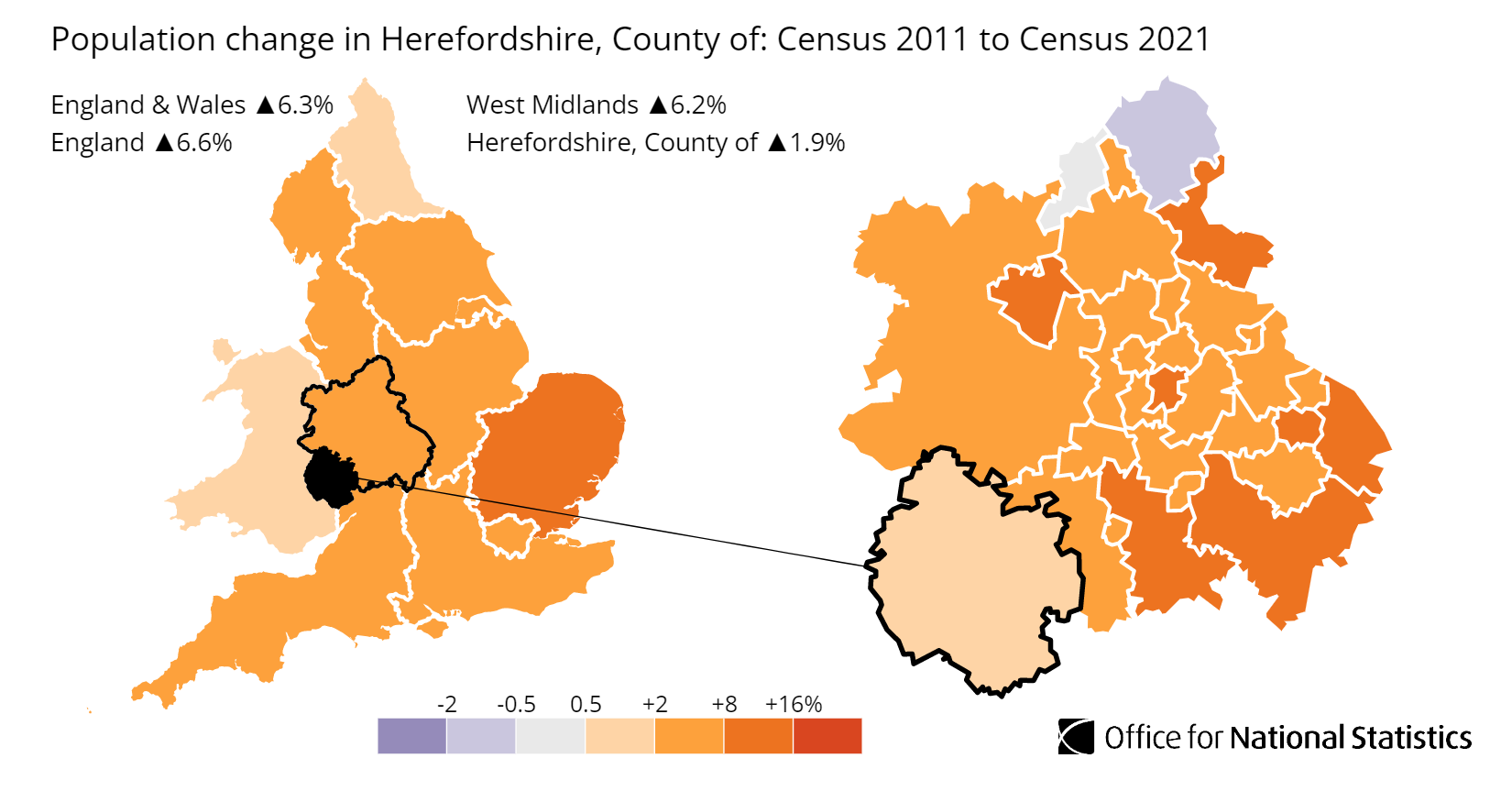
Hereford's gross rental yields range from 3.4% to 3.7% across all three postcodes, with HR2 and HR4 sharing the top returns. Average sold prices sit 0.4% above the England average, and the county's population grew 1.9% to 187,034 between the 2011 and 2021 censuses.
Hereford's average sold price of £294,307 places it almost exactly at the England average of £293,131. That is 25.9% above the West Midlands regional average and positions Hereford as a premium market within its region. Asking prices start from £332,527 in HR4, and rental data is available for all 3 postcodes.
This guide covers all 3 Hereford postcodes: HR1, HR2, and HR4 under Herefordshire County Council (ONS code E06000019). Hereford is a cathedral city on the River Wye near the Welsh border, anchored by agriculture, food production, and the defence sector. Investors comparing options in the region may also consider Worcester, Gloucester, or Cheltenham. Browse all our Midlands location guides.
Article updated: February 2026
Hereford Buy-to-Let Market Overview 2026
Hereford is a rural cathedral city with sold prices tracking the England average, modest yields, and a tight spread across just three postcodes.
- Average sold price: £294,307 (0.4% above England's £293,131)
- Asking price range: £332,527 (HR4) to £371,215 (HR1)
- Rental yields: 3.4% (HR1) to 3.7% (HR2 and HR4) across all 3 postcodes
- Rental income: Monthly rents from £1,031 (HR4) to £1,078 (HR2)
- Price per sq ft: Sold prices from £274/sq ft (HR2) to £298/sq ft (HR1)
- Market activity: Sales ranging from 32 per month (HR2) to 37 per month (HR4)
- Deposit requirements: 30% deposits range from £99,758 (HR4) to £111,365 (HR1)
- Affordability ratios: Property prices from 9.6 to 10.7 times Hereford's median annual salary of £34,731
Contents

-
by Robert Jones, Founder of Property Investments UK
With two decades in UK property, Rob has been investing in buy-to-let since 2005, and uses property data to develop tools for property market analysis.

Property Data Sources
Our location guide relies on diverse, authoritative datasets including:
- HM Land Registry UK House Price Index
- Ministry of Housing, Communities and Local Government
- Ordnance Survey Data Hub
- Propertydata.co.uk
We update our property data quarterly to ensure accuracy. Last update: February 2026. All data is presented as provided by our sources without adjustments or amendments.
Why Invest in Hereford?
Hereford is a cathedral city of 187,034 people on the River Wye, 16 miles from the Welsh border, with a median annual salary of £34,731. It is not a metro centre. There is no motorway. The nearest mainline railway connection is at Newport or Worcester. That isolation shapes everything about its property market: lower wages, lower tenant turnover, and a housing stock dominated by houses rather than flats.
The economy centres on agriculture, food manufacturing, and the defence sector. Hereford is home to the headquarters of the Special Air Service (SAS), which brings military and defence-related employment that does not appear in public statistics. The city also supports a cluster of food and drink producers including Tyrrells, Bulmers (now part of Heineken), and a number of specialist agricultural businesses.
Between the 2011 and 2021 censuses, Herefordshire's population grew from 183,477 to 187,034, a rise of 1.9%. That is below the England average, reflecting the county's rural character and limited new housing delivery. Population growth in Herefordshire is driven more by inward migration from higher-cost areas than by natural growth or large-scale development.
Earnings sit below both the regional and national averages. The median annual salary is £34,731, compared to £37,050 across the West Midlands and £39,125 for Great Britain. Lower local wages combined with sold prices tracking the England average create an affordability pressure that is reflected in the price-to-earnings ratios later in this guide.
Hereford Economic Summary
- Population: 187,034 (2021 Census). Growth of 1.9% from 2011.
- Median annual salary: £34,731 (Herefordshire), £37,050 (West Midlands), £39,125 (Great Britain)
- Employment rate: 78.2% (Herefordshire), 74.3% (West Midlands), 75.6% (Great Britain)
- Unemployment rate: 5.9% (Herefordshire), 5.4% (West Midlands), 4.3% (Great Britain)
- Key employment sectors: Agriculture and food production, defence, public services, manufacturing
Source: ONS Census 2021, Nomis Labour Market Profile (ASHE 2025, Employment Oct 2024-Sep 2025)
Herefordshire's employment rate of 78.2% sits above both the West Midlands average of 74.3% and the national 75.6%. The unemployment rate of 5.9% is above the West Midlands (5.4%) and the national figure (4.3%). That pattern is typical of rural economies: most people who live here work, but fewer jobs exist per head of population compared to urban centres.
Regeneration and Investment in Hereford
Hereford has over £142m in confirmed public investment across transport, infrastructure, and town centre projects. The city's relative isolation has made connectivity the focus of public spending rather than large-scale commercial regeneration.
- Herefordshire £100m Highways and Public Realm Framework (approved, £100m including £58m confirmed): A four-year framework from April 2026 covering road resurfacing, bridge enhancements, traffic signals, cycleways, and public spaces. Includes the Western Bypass Phase 1 (3.6km, £42m contract, construction January 2026 to December 2028) and a requirement to deliver 6,815 new homes over five years. Updates at Herefordshire Council.
- Hereford Transport Hub (Levelling Up funded, £19.99m): A multi-modal transport hub providing integrated bus, rail, cycling, and walking connectivity with new bus stands, taxi ranks, and commuter parking. Funded through £19.99m in Levelling Up funding plus £4.5m from the council and Active Travel funds. Updates at Herefordshire Council.
- Stronger Hereford Towns Fund (in delivery, £22.4m): Government Towns Fund investment supporting 15 projects including a new library and cultural hub at Maylord Orchard, the NMITE Skills Hub, electric City Zipper buses, and Castle Green Pavilion restoration. These projects create footfall and amenity improvements that support rental demand in the city centre HR1 postcode. Updates at Stronger Hereford.
Herefordshire Property Market Analysis
When Was the Last House Price Crash in Hereford?
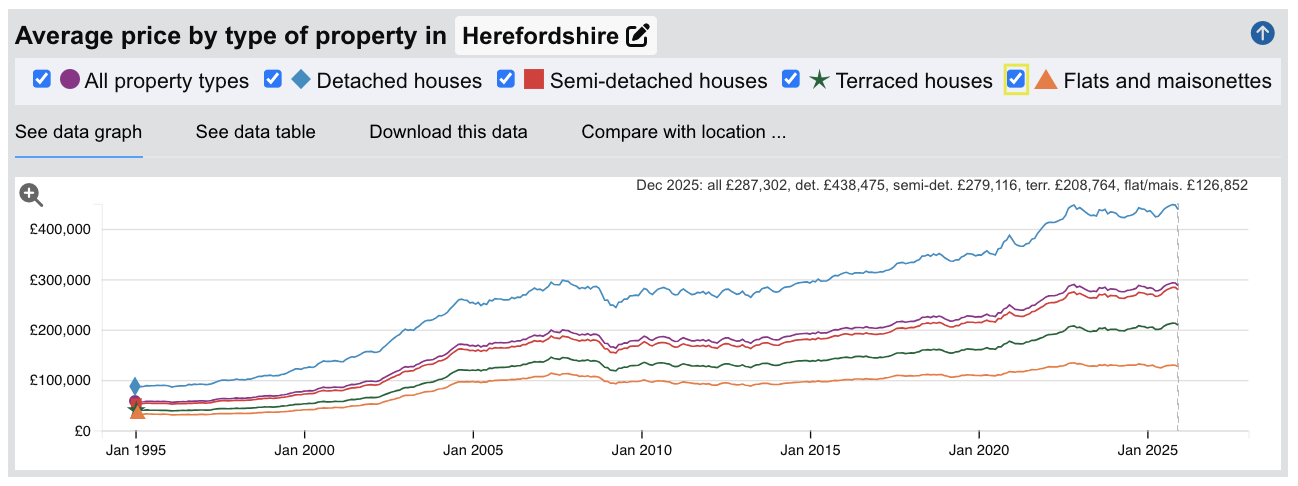
Herefordshire's average house price has grown 411.6% from £57,532 in 1995 to £294,307 in November 2025, with one major crash and a 6-year recovery. The full history from the HM Land Registry House Price Index runs from January 1995 to November 2025. The data shows one major crash, a prolonged stagnation, and a pandemic-era surge.
- 1995-2000 (Steady growth): Herefordshire began 1995 at £56,281. Prices rose steadily to £77,750 by January 2000. Growth was consistent but unspectacular, lagging behind London and the South East during the late 1990s boom.
- 2000-2007 (The boom): Prices more than doubled from £77,750 in January 2000 to a peak of £199,383 in September 2007. Cheap credit, lifestyle buyers relocating from cities, and agricultural land values all pushed Herefordshire prices far beyond what local wages could support.
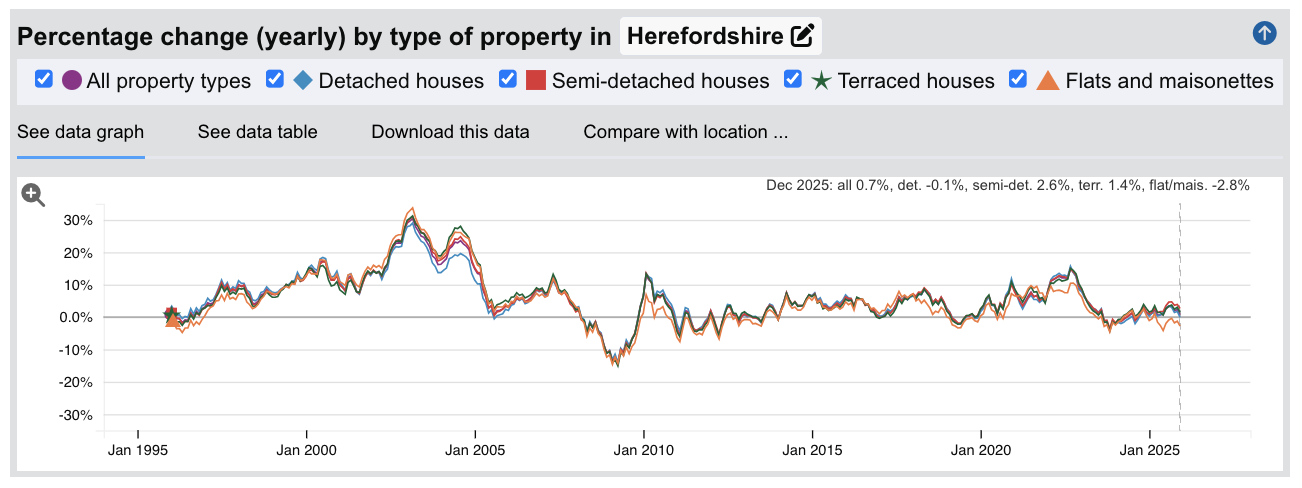
- 2007-2009 (The financial crisis): From the peak of £199,383 in September 2007 to the trough of £163,192 in April 2009, Herefordshire lost 18.2% of its value in 19 months. The worst annual change reading was -14.4% in April 2009. Herefordshire's decline of 18.2% matched the England average exactly (-18.2%) and was steeper than the West Midlands region (-16.9%).
- 2009-2013 (Stagnation): Prices bounced modestly off the trough but then flatlined. By December 2013, the average was £180,298. Still 9.6% below the pre-crash peak after more than four years. The annual change column showed 40 months of negative readings between March 2008 and July 2013. Rural markets recovered more slowly than urban centres because they lacked the jobs growth and infrastructure investment that pulled cities out of the downturn.
- 2014-2016 (Recovery): Growth returned at 2-4% per year. Prices finally passed the pre-crash peak in October 2015 at £199,986. That recovery took over 6 years from the September 2007 peak.
- 2017-2019 (Pre-pandemic growth): Prices rose from £202,844 in January 2017 to £224,672 by December 2019. Steady growth of 2-4% per year. Lifestyle demand from retirees and remote workers was already beginning to push Herefordshire prices before the pandemic accelerated the trend.
- 2020-2022 (Pandemic surge): The stamp duty holiday and the remote working shift drove strong growth. Prices jumped from £228,092 in March 2020 to £284,133 by December 2022. That is 24.6% growth in under three years. Herefordshire's rural appeal made it a direct beneficiary of the lifestyle relocation trend, with buyers moving from Birmingham, Bristol, and London.
- 2023 (Rate shock): Prices dipped slightly from £284,133 in December 2022 to £280,962 by December 2023. A decline of 1.1%. The mildest correction of any cycle, and significantly softer than the national average.
- 2024-2025 (Current): Prices recovered and continued rising. By November 2025, the average reached £294,307 with annual growth of 2.9%. Herefordshire now sits 47.6% above its pre-crash peak.
Long-Term Property Value Growth in Herefordshire
- 5 years (2020-2025): +21.1% (£243,075 to £294,307)
- 10 years (2015-2025): +47.7% (£199,289 to £294,307)
- 15 years (2010-2025): +60.7% (£183,141 to £294,307)
- 20 years (2005-2025): +68.8% (£174,324 to £294,307)
- 30 years (1995-2025): +411.6% (£57,532 to £294,307)
The 2008 crash is the reference point for Hereford investors assessing downside exposure. An 18.2% decline took 6 years to recover. The stagnation phase was longer than many urban markets because rural economies lack the job creation engines that drive demand. Today, Hereford's market is supported by different fundamentals. The Western Bypass, Transport Hub, and Towns Fund investment did not exist in 2007. But the structural vulnerability remains: when credit tightens, lifestyle-driven markets correct first.
Source: HM Land Registry House Price Index for Herefordshire

Thinking of Buying?
We have off-market investment properties averaging 8%+ annual yield.
View Property DealsSold House Prices in Hereford
Herefordshire's average sold price of £294,307 sits 0.4% above England's £293,131. That near-parity with the national average is unusual for a rural market in the West Midlands, where most locations sit well below the England figure. The premium comes from the housing mix: Herefordshire's stock is dominated by larger houses rather than flats, which pulls the average up.
Look at the flats column. Flats in Herefordshire average £130,068, a 41.3% discount to England's £221,565. That is the widest gap in the table by a significant margin. It reflects both the small flat stock in a rural county and the absence of premium city-centre apartment developments that inflate flat averages in larger cities.
| Property Type | Herefordshire Average | England Average | Difference |
|---|---|---|---|
| Detached houses | £449,650 | £474,400 | -5.2% |
| Semi-detached houses | £285,444 | £290,004 | -1.6% |
| Terraced houses | £213,850 | £245,002 | -12.7% |
| Flats and maisonettes | £130,068 | £221,565 | -41.3% |
| All property types | £294,307 | £293,131 | +0.4% |
Semi-detached houses sit just 1.6% below England at £285,444. Semis are the mainstream family housing type in Hereford's residential areas and attract strong owner-occupier demand. The narrow gap to the England average reflects genuine competition for this stock.
Detached houses at £449,650 are 5.2% below England. This is the dominant property type in a rural county. Herefordshire has a higher proportion of detached homes than most urban local authorities, and their prices are supported by lifestyle buyers and agricultural landowners.
Terraced houses average £213,850, a 12.7% discount. The terraced stock is concentrated in the city centre and older residential streets. For investors, terraces offer the lowest entry point by property type and the most likely rental stock in the HR1 postcode area.
Flats at 41.3% below England represent the starkest discount. The flat market in Hereford is small. With only 3 postcodes and a rural housing stock dominated by houses, the flat average is based on limited transactions. That discount reflects the market reality: there is very little demand for purpose-built flats in a cathedral city of this size.
Property Data Sources
Our location guide relies on diverse, authoritative datasets including:
- HM Land Registry UK House Price Index
- Ministry of Housing, Communities and Local Government
- Ordnance Survey Data Hub
- Propertydata.co.uk
We update our property data quarterly to ensure accuracy. Last update: February 2026. All data is presented as provided by our sources without adjustments or amendments.
Price Per Square Foot in Hereford
Hereford's price per square foot ranges from £274 in HR2 to £298 in HR1, a spread of just £24 across all three postcodes. Price per square foot strips out property size and shows what buyers are actually paying for space. In a location with just three postcodes, that tight spread tells you the market trades uniformly.
That is one of the tightest ranges in any location guide on this site. It means the cost of space is effectively the same wherever you buy in Hereford.
| Rank | Area | Price Per Sq Ft |
|---|---|---|
| 1 | HR2 (Hereford, Belmont, Ross-on-Wye (Rural)) | £274 |
| 2 | HR4 (Hereford, Credenhill) | £292 |
| 3 | HR1 (Hereford, Bartestree) | £298 |
HR2 at £274 per square foot offers the cheapest space. This postcode covers the southern side of Hereford including Belmont and extends into rural areas toward Ross-on-Wye. The lower figure likely reflects a mix of suburban and rural stock that includes older properties with larger footprints.
HR1 at £298 per square foot is marginally the most expensive. The city centre, cathedral quarter, and Bartestree village all sit within HR1. Central location and smaller property sizes push the per-foot cost slightly higher. But the gap to HR2 is £24. That is not a meaningful difference for investment decisions. In Hereford, the choice between postcodes comes down to tenant demand and rental data, not the cost of space.
Figures reflect averages across all property types and ages. Individual values depend on condition, location within the postcode, and building age.
For Sale Asking Prices in Hereford
Hereford's asking prices range from £332,527 in HR4 to £371,215 in HR1. The total spread across all three postcodes is £38,688. Compare that to cities with 10+ postcodes where the cheapest and most expensive areas can differ by £200,000 or more. In Hereford, the entry price is broadly the same wherever you buy.
| Rank | Area | Average Asking Price |
|---|---|---|
| 1 | HR4 (Hereford, Credenhill) | £332,527 |
| 2 | HR2 (Hereford, Belmont, Ross-on-Wye (Rural)) | £347,527 |
| 3 | HR1 (Hereford, Bartestree) | £371,215 |
HR4 at £332,527 is the most affordable entry point. Credenhill sits to the northwest of the city and includes a mix of residential estates and rural properties. It also delivers one of the two highest yields at 3.7%, making it the postcode where entry price and rental return align most closely.
HR1 at £371,215 is the most expensive but commands the city centre and surrounding villages. The premium reflects location: the cathedral quarter, railway station, and the core employment zone all sit within HR1. The asking price difference between HR1 and HR4 is £38,688. At a 30% deposit, that translates to £11,607 more capital required for the most expensive postcode.
The mean asking price across all three Hereford postcodes is £350,423. That figure appears in the comparison section later, where Hereford is measured against Worcester, Gloucester, Wolverhampton, and Cheltenham.
House Price Growth in Hereford
All three Hereford postcodes show negative one-year asking price growth, ranging from -0.3% in HR1 to -8.5% in HR4. The five-year figures tell a different story: solid appreciation across the board, with HR4 leading at 13.5%.
HR4 has delivered the strongest five-year growth at 13.5%, but its one-year figure of -8.5% is the sharpest recent decline across all three postcodes. That pattern suggests prices surged during the pandemic stamp duty holiday and have since corrected. The three-year figure of -6.1% confirms the decline has been sustained rather than a single-quarter blip.
| Area | 1 Year | 3 Years | 5 Years |
|---|---|---|---|
| HR4 (Hereford, Credenhill) | -8.5% | -6.1% | 13.5% |
| HR1 (Hereford, Bartestree) | -0.3% | 4.0% | 12.3% |
| HR2 (Hereford, Belmont, Ross-on-Wye (Rural)) | -6.6% | -0.3% | 8.9% |
All three postcodes show negative one-year growth. HR1 is closest to flat at -0.3%. HR2 at -6.6% and HR4 at -8.5% show more significant corrections. This is a market that ran up hard during the pandemic and is now adjusting.
The Land Registry data tells a different story at the county level. The latest annual change for Herefordshire is +2.9%, which suggests the broader county is still growing even if postcode-level asking prices are softening. Sold prices and asking prices are telling different stories right now.
HR1 is the most stable postcode. Its three-year growth of 4.0% and modest one-year decline of -0.3% suggest the city centre and its surrounds have held value better than the outer postcodes. That resilience is typical of areas with stronger employment anchors and tenant demand.
Monthly Property Sales in Hereford
Hereford's combined monthly sales total 103 transactions across all three postcodes, with volumes ranging from 32 in HR2 to 37 in HR4. For a city of this size, those are healthy numbers. The Land Registry records an average of 200 transactions per month across the wider Herefordshire local authority area over the past 12 months.
| Area | Sales Per Month | Turnover | Asking Price |
|---|---|---|---|
| HR4 (Hereford, Credenhill) | 37 | 35% | £332,527 |
| HR1 (Hereford, Bartestree) | 34 | 46% | £371,215 |
| HR2 (Hereford, Belmont, Ross-on-Wye (Rural)) | 32 | 50% | £347,527 |
HR2 has the highest turnover at 50% despite the lowest raw sales volume. Properties in this postcode are changing hands faster relative to available stock. For exit strategy planning, HR2 offers the deepest buyer pool proportionate to its size.
HR4 leads on raw volume at 37 sales per month but its turnover of 35% is the lowest. That combination tells you there is a large pool of property in HR4 that rarely comes to market. Landlords and homeowners hold for the long term. In markets with low turnover, off-market properties can expand the pool of available stock beyond what appears on portals.
Property Data Sources
Our location guide relies on diverse, authoritative datasets including:
- HM Land Registry UK House Price Index
- Ministry of Housing, Communities and Local Government
- Ordnance Survey Data Hub
- Propertydata.co.uk
We update our property data quarterly to ensure accuracy. Last update: February 2026. All data is presented as provided by our sources without adjustments or amendments.
Hereford Rental Market Analysis
For investors weighing up whether rental property is a worthwhile investment in Hereford, the data below breaks down average monthly rents and gross rental yields across the city's postcodes.
Rental data is available for all 3 postcodes. Monthly rents range from £1,031 in HR4 to £1,078 in HR2 and gross yields range from 3.4% to 3.7%. If you are looking to build a property portfolio in the Midlands, Hereford's yields sit at the lower end of the spectrum but rent coverage is consistent across all postcodes.
Average Rent & Gross Rental Yields in Hereford
Gross rental yield is calculated from the average asking price and average monthly rent for each postcode. It does not account for void periods, maintenance, management fees, or mortgage costs. It is a starting point for comparison, not a profit forecast.
HR2 and HR4 both deliver Hereford's highest gross yield at 3.7%, but they get there differently. HR2 achieves it through the highest absolute rent (£1,078/month) against a mid-range asking price (£347,527). HR4 achieves it through the lowest asking price (£332,527) against the lowest rent (£1,031). HR1 sits at 3.4% with the highest asking price absorbing a mid-range rent.
| Area | Average Monthly Rent | Average Asking Price | Gross Yield |
|---|---|---|---|
| HR2 (Hereford, Belmont, Ross-on-Wye (Rural)) | £1,078 | £347,527 | 3.7% |
| HR4 (Hereford, Credenhill) | £1,031 | £332,527 | 3.7% |
| HR1 (Hereford, Bartestree) | £1,040 | £371,215 | 3.4% |
The yield spread across all three postcodes is just 0.3 percentage points. That is unusually tight. In most location guides, the gap between the highest and lowest yielding postcode is 1.5 to 3 percentage points. Hereford's narrow range means the postcode choice has minimal impact on income returns. The investment decision here is about Hereford as a market, not about picking the right postcode within it.
All three yields sit below 4%, which places Hereford at the lower end of locations covered in this guide series. The numbers reflect asking prices that track the England average while rents remain anchored to below-average local wages. A property letting at £1,040 per month against an asking price of £371,215 delivers £12,480 gross annual income before any costs. At 3.4%, the margin for error after mortgage payments, management fees, and maintenance is thin.
Is Hereford Rent High?
Across all three Hereford postcodes, rent ranges from 35.6% to 37.2% of the local median gross monthly salary. That matters from both sides. For tenants, it determines whether they can sustain payments long-term. For landlords, areas where rent consumes a lower share of income tend to produce more reliable tenants and fewer arrears.
The median gross weekly salary in Herefordshire is £667.90, which equates to £2,894 per month or £34,731 per year. This is below the West Midlands regional median of £712.50 per week and the Great Britain median of £752.40 per week. Data from the Nomis Labour Market Profile (ASHE 2025).
All three sit above the general benchmark of 30% of gross income, which reflects Hereford's below-average earnings rather than unusually high rents.
| Rank | Area | Rent as % of Income |
|---|---|---|
| 1 | HR2 (Hereford, Belmont, Ross-on-Wye (Rural)) | 37.2% |
| 2 | HR1 (Hereford, Bartestree) | 35.9% |
| 3 | HR4 (Hereford, Credenhill) | 35.6% |
HR2 at 37.2% shows the highest rent-to-income ratio. This postcode commands the highest absolute rent at £1,078 per month. The affordability pressure reflects the local wage structure rather than any particular rental premium. Tenants in HR2 earning above the Herefordshire median will experience this ratio more favourably than the headline figure suggests.
The spread across all three postcodes is just 1.6 percentage points. As with yields, the postcode-level variation is minimal. Hereford's affordability picture is driven by a single factor: below-average local wages meeting rents that are broadly in line with the Midlands average. Tenants on the regional median wage of £712.50/week would see rent consuming 28-29% of gross income, comfortably below the 30% threshold.
Thinking of Buying?
We have off-market investment properties averaging 8%+ annual yield.
View Property DealsBuy-to-Let Considerations
Are Hereford House Prices High? Price-to-Earnings Ratios
Purchasing a property in Hereford requires between 9.6 and 10.7 times the median annual salary of £34,731. The national benchmark is 7.5x, calculated from England's average sold price of £293,131 against Great Britain's median annual salary of £39,125. Every Hereford postcode sits well above that threshold.
All three Hereford postcodes sit above the national benchmark of 7.5x. This is based on the Nomis Labour Market Profile for Herefordshire showing the median gross annual income for Herefordshire residents is £34,731. The combination of England-average sold prices and below-average local earnings creates affordability ratios that are stretched across the board.
| Rank | Area | Price-to-Earnings Ratio |
|---|---|---|
| 1 | HR4 (Hereford, Credenhill) | 9.6x |
| 2 | HR2 (Hereford, Belmont, Ross-on-Wye (Rural)) | 10.0x |
| 3 | HR1 (Hereford, Bartestree) | 10.7x |
HR4 at 9.6x is the most affordable ratio but still 28% above the national benchmark. For context, many Midlands cities with comparable asking prices deliver price-to-earnings ratios in the 5x-8x range because local wages are higher. Hereford's ratios are elevated not because prices are extreme, but because earnings are low.
The gap between HR4 and HR1 is 1.1x, representing the difference between a £332,527 and £371,215 property on the same salary. Neither ratio offers the kind of affordable entry that characterises the strongest buy-to-let markets. Investors in Hereford are paying a premium relative to local wages, which is reflected in the sub-4% yields across the board.
Deposit Requirements in Hereford
Hereford's 30% deposits range from £99,758 in HR4 to £111,365 in HR1, with all three postcodes requiring six-figure capital. The table below uses a 30% deposit rather than the minimum 25% most buy-to-let lenders require. At these asking prices, the higher deposit unlocks better interest rates, which matters in a market where yields are tight.
That is a higher barrier to entry than many Midlands cities where deposits in the cheapest postcodes start from £40,000-£60,000.
| Rank | Area | 30% Deposit Required |
|---|---|---|
| 1 | HR4 (Hereford, Credenhill) | £99,758 |
| 2 | HR2 (Hereford, Belmont, Ross-on-Wye (Rural)) | £104,258 |
| 3 | HR1 (Hereford, Bartestree) | £111,365 |
The difference between the cheapest and most expensive deposit is £11,607. That is a small gap, consistent with the tight spread across all of Hereford's data. The deposit difference does not buy significantly different returns: HR4 and HR1 share similar yields and rent levels.
At these price points, Hereford competes for capital with cities that offer substantially higher yields. An investor with £100,000 for a deposit could access postcodes in Wolverhampton, Coventry, or Gloucester at similar or lower prices with yields of 5-7%. The case for Hereford is not yield efficiency. It is capital preservation in a market with stable demand and limited new supply. Investors seeking lower entry points may also consider below market value properties.
Deposit is only part of the upfront cost. Budget for stamp duty (use our stamp duty calculator for an accurate figure), legal fees, and survey costs. For a full breakdown, see our guide to buy-to-let costs.

What the Hereford Data Tells Buy-to-Let Investors
The spread between Hereford's best and worst postcode is just 0.3 percentage points on yield, £24 on price per square foot, and £38,688 on asking price. That unusually tight variance changes the investment question from "which postcode?" to "does Hereford's market fit your strategy?"
For yield, the numbers are modest across the board. HR2 and HR4 both deliver 3.7%, HR1 sits at 3.4%. All three require six-figure deposits. Monthly rents of £1,031-£1,078 against asking prices of £332,527-£371,215 leave thin margins after mortgage payments and costs. This is not a cash-flow market.
For growth, the five-year figures show 8.9% to 13.5% appreciation. But all three postcodes are showing negative one-year growth, with HR4 at -8.5% leading the correction. The asking price data has not yet caught up with the Land Registry's 2.9% annual growth for Herefordshire as a whole. Sold prices and asking prices are telling different stories right now.
Hereford's data profile suits a specific investor: someone who values stability over returns. Low tenant turnover, consistent demand from defence and agricultural employment, and limited new-build supply create a market where voids and tenant quality are less of a concern than in higher-yielding cities. The trade-off is lower income and higher capital commitment. For investors comparing options, browse investment property listings or see how other locations stack up below.
How Hereford Buy-to-Let Compares to Nearby Areas
Hereford's top yield of 3.7% is the lowest of five comparable Midlands and Welsh border markets, while its mean asking price of £350,423 is the second highest. The table below compares Hereford against four nearby locations using the same methodology: mean asking price across all postcodes, mean monthly rent across postcodes with data, and top single-postcode gross yield.
| Location | Mean Asking Price | Mean Monthly Rent | Top Gross Yield |
|---|---|---|---|
| Wolverhampton | £252,562 | £981 | 5.4% |
| Worcester | £287,316 | £930 | 5.2% |
| Gloucester | £301,160 | £1,214 | 6.3% |
| Hereford | £350,423 | £1,050 | 3.7% |
| Cheltenham | £445,470 | £1,370 | 4.4% |
Hereford has the second highest asking prices in this group but the lowest top yield. Wolverhampton and Worcester both offer lower entry prices with significantly higher yields. Gloucester at £301,160 is £49,000 cheaper than Hereford and delivers a top yield of 6.3%, nearly double Hereford's 3.7%.
The only location more expensive than Hereford in this group is Cheltenham at £445,470. But Cheltenham compensates with higher rents (£1,370 vs £1,050) and a stronger top yield (4.4% vs 3.7%). Hereford's combination of premium pricing with below-average yields creates the weakest yield-per-pound-invested ratio in this comparison.
For investors prioritising income, the data favours Gloucester and Wolverhampton. For investors who value Hereford's specific qualities (rural setting, SAS-linked defence employment, limited new supply, lower tenant turnover), the lower yield is the cost of those characteristics. It is a lifestyle premium baked into the numbers. For a broader view of property investment in the UK, see how Hereford's data compares to locations nationwide.
Frequently Asked Questions
Is Hereford a nice place to live?
Hereford's population grew 1.9% to 187,034 between 2011 and 2021, driven by inward migration from higher-cost areas. The city sits on the River Wye with the Brecon Beacons and Malvern Hills within easy reach. The trade-off is connectivity: no motorway, limited rail links, and local wages below the national average at £34,731 per year. For tenants working locally, Hereford offers a lower cost of living than nearby Cheltenham or Gloucester. For remote workers, it offers rural living at prices that track the England average rather than the premium charged in the Cotswolds or Welsh Marches.
What are the best areas to live in Herefordshire?
HR4 (Credenhill) delivers the lowest entry price at £332,527, the joint-highest yield at 3.7%, and the strongest five-year growth at 13.5%. HR1 covers the city centre, cathedral quarter, and Bartestree, offering the most urban tenant profile. HR2 (Belmont and rural areas toward Ross-on-Wye) commands the highest rent at £1,078 per month. The variation across all three postcodes is tight on every metric. The wider county includes towns like Leominster, Ledbury, and Ross-on-Wye, each with distinct housing markets that fall outside the Hereford postcode coverage in this guide.
How does Hereford compare to Worcester for buy-to-let?
Worcester offers lower entry prices (mean asking price £287,316 vs Hereford's £350,423) and a higher top yield (5.2% vs 3.7%). Worcester also has better transport links with a mainline rail service to Birmingham and London. Hereford's advantage is lower tenant turnover and a rural lifestyle premium that supports long-term capital preservation. For investors optimising for income per pound invested, Worcester delivers more. For investors prioritising stability in a smaller market, Hereford's data holds up differently.
Are there property investment companies operating in Hereford?
Some firms market buy-to-let properties in the Hereford area, particularly converted agricultural buildings and rural development sites. Hereford's rural tourism appeal also makes it relevant for investors considering Airbnb properties for sale. Be cautious with any company offering guaranteed yields or sourcing fees above 2-3% of purchase price. The data in this guide covers the open market. Any property sold through an investment company can be benchmarked against these postcode-level figures, but the averages do not guarantee the value of individual properties.
What is the average house price in Hereford?
The average sold price across Herefordshire is £294,307 according to the latest HM Land Registry data (November 2025). That sits 0.4% above the England average of £293,131. Asking prices for properties currently on the market range from £332,527 in HR4 to £371,215 in HR1, with a mean across all three postcodes of £350,423. The gap between sold prices and asking prices reflects the standard market premium that sellers and agents add to guide prices.
Can I find rent-to-buy properties in Hereford?
Rent-to-buy schemes exist across the UK but availability in Hereford is limited due to the city's smaller market size and rural character. The average asking prices in this guide range from £332,527 to £371,215 across the three postcodes. Individual properties below the postcode averages do list, particularly terraced houses and older semi-detached homes. The local authority's affordable housing pipeline (Canon Pyon Road: 120 homes by March 2026, Land east of A40: 353 homes phased to 2030) may introduce shared ownership or rent-to-buy options as they deliver.