
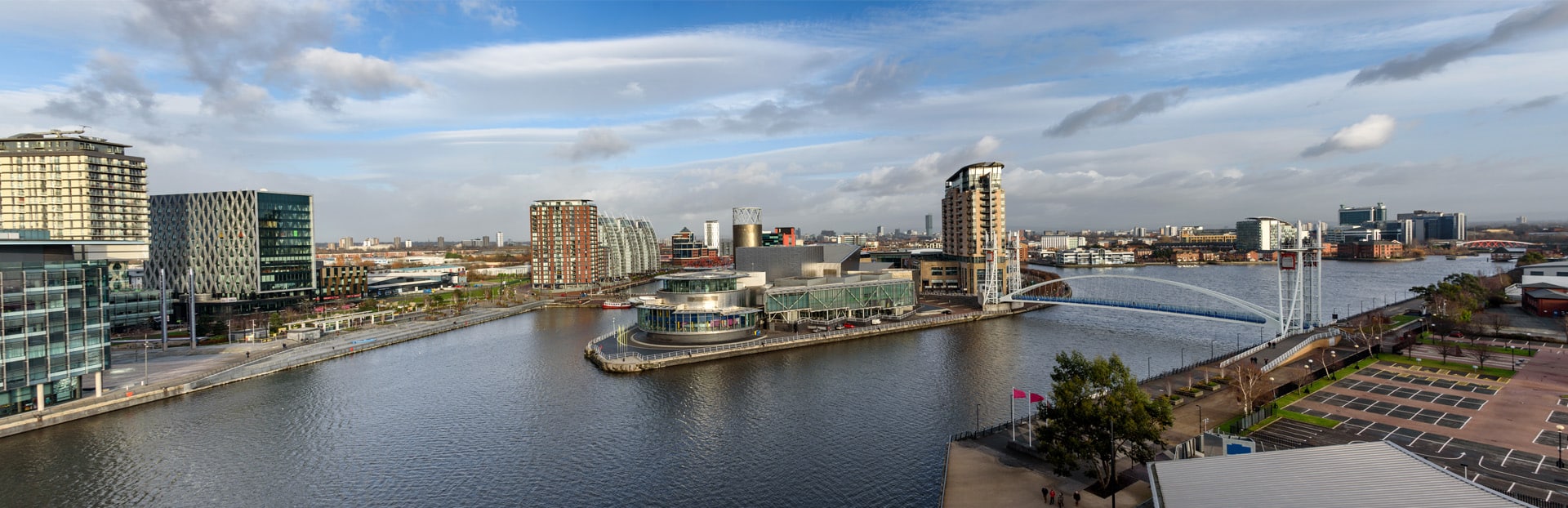
Salford is a city in Greater Manchester, in north-west England. Salford's average sold price of £223,846 on the HM Land Registry House Price Index sits 22.8% below England's £289,946, yet 4.3% above the North West regional average of £214,678. That is an unusual pairing: a borough priced well under the national market, but slightly over its own region, because the MediaCityUK and city centre fringe postcodes pull the Salford average upward while the outer suburbs keep the entry point low. Salford's population grew 15.38% between the 2011 and 2021 censuses, from 233,933 to 269,923 residents, one of the fastest rates in Greater Manchester.
The split runs right through the rental numbers. Asking prices across the 11 postcodes range from £210,621 in BL4 (Farnworth) to £353,039 in M28 (Worsley, Walkden), and the highest yields sit not with the waterfront flats but with the cheaper inner and outer postcodes. M3 (Salford City Centre) and M6 (Pendleton) both reach 6.6%, while M28's detached suburban stock returns 4.0%. For an investor, Salford is really two markets stapled together inside one borough boundary.
This guide covers the City of Salford metropolitan borough (ONS code E08000006) across postcodes M3, M5, M6, M7, M17, M27, M28, M30, M38, M50, and BL4. Salford sits immediately west of Manchester city centre, separated by the River Irwell, and forms part of the wider Greater Manchester conurbation alongside Manchester, Bolton, and Wigan.
Article updated: July 2026

Why Invest in Salford?
Salford's population grew 15.38% between the 2011 and 2021 censuses, from 233,933 to 269,923 residents, more than double the England and Wales average of 6.3%. Very few boroughs in the country added people that quickly, and the reason sits a mile west of the figures: MediaCityUK. The BBC moved its northern base to the Quays in 2011, ITV followed, and dock10, Ericsson and more than 250 creative and tech businesses came with them. A relocation of that scale built a professional rental market in a borough where the average sold price is still 22.8% below England's.
The University of Salford adds a second layer of tenant demand. Around 20,000 students study across the Peel Park and MediaCityUK campuses, and the university's HOST innovation centre in data, AI and gaming pulls postgraduate and professional students who often stay in the area after they finish. Salford Royal, part of the Northern Care Alliance and one of Greater Manchester's main stroke centres, anchors a third pool of demand around M6 Pendleton, where healthcare staff need accommodation close to the hospital.
Local earnings are the part of the picture that surprises people. The median gross annual salary in Salford is £34,958, which is 6.6% below the North West median of £37,445 and 10.7% below the Great Britain median of £39,125. Lower wages usually drag a market down, but in Salford they work the other way for income investors: house prices stay affordable while rents are propped up by tenants who work in Manchester and only live in Salford. That gap between where people earn and where they rent is what keeps yields in the inner postcodes above 6%.
Salford Economic Summary
- Population: 269,923 (2021 Census). Growth of 15.38% from 2011.
- Median annual salary: £34,958 (Salford), £37,445 (North West), £39,125 (Great Britain)
- Employment rate: 71.2% (Salford), 74.2% (North West), 75.6% (Great Britain)
- Unemployment rate: 5.4% (Salford)
- Key employment sectors: Media and creative, health and social work, higher education, digital and technology, transport and logistics
Source: ONS Census 2021, Nomis Labour Market Profile (ASHE 2025, Employment Oct 2024-Sep 2025)
Salford's employment rate of 71.2% sits below both the North West average of 74.2% and the national 75.6%, and that gap is the honest counterweight to the regeneration headlines. The borough runs a mixed economy: the Quays and Greengate draw high-earning media and professional workers, while parts of M38, BL4 and M6 carry higher unemployment and lower workforce participation. For a buy-to-let investor, the borough-wide rate matters less than the postcode underneath it, and the postcode data later in this guide is where those differences show up.
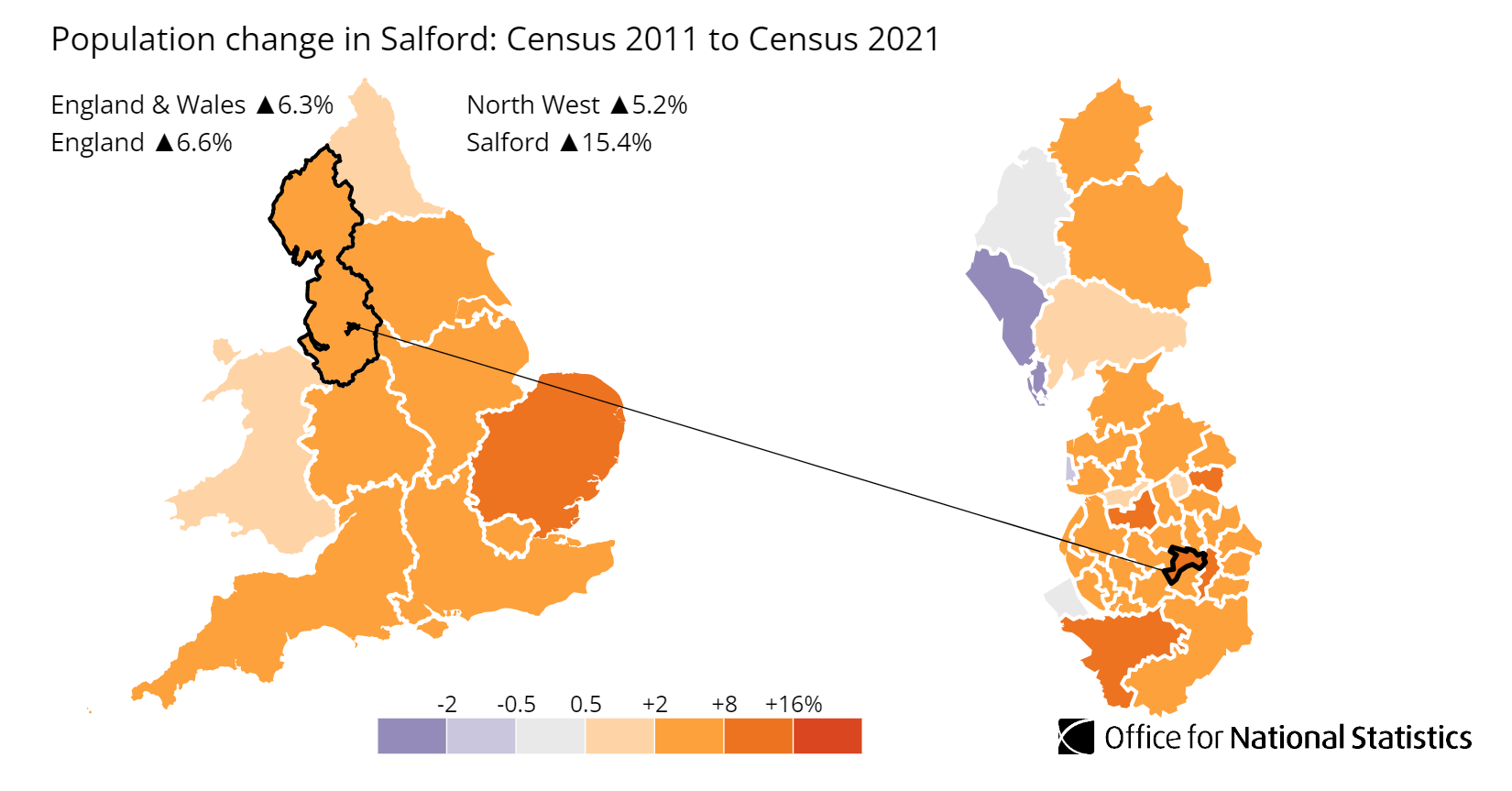
Source: Office for National Statistics - Population for Salford
Regeneration and Investment in Salford
Salford has more than £4.5 billion of active regeneration running across three flagship waterfront and city centre schemes, between them adding over 7,000 homes. That weight of development is unusual for a single metropolitan borough, and it traces back to Salford's position on the edge of Manchester city centre with a mile of dockside land to build on.
- Crescent Salford Masterplan (under construction, £2.5 billion): A 240-acre mixed-use scheme delivering 3,000+ homes, one million square feet of innovation space, and a million square feet of office and retail. Phase 1, Adelphi Village, topped out in March 2025 with more than 700 Passivhaus-standard homes and completes in 2026. It is a partnership between ECF (Homes England, Legal & General and Muse), Salford City Council and the University of Salford. Updates at Salford Now.
- MediaCityUK Phase 2 (approved, £1 billion+): A masterplan to roughly double MediaCityUK with up to 10 new buildings, 3,000 homes, 800,000 square feet of commercial space, a 330-bed hotel and new public squares. The site already houses the BBC, ITV, dock10, Ericsson and more than 250 creative and tech businesses, so the second phase builds on a proven location rather than a speculative one. Updates at Salford City Council.
- Salford Central / New Bailey (substantially complete, £1 billion): A 50-acre scheme that has delivered more than 1,000 mixed-tenure homes, 770,000 square feet of workspace and the Eden net-zero office with the largest living wall in Europe. The Chapel Street public realm completed in December 2025, and a final phase of 189 affordable homes is in planning. Updates at Muse.
Salford Property Market Analysis
Average property prices in Salford have risen 542.4% since January 1995, from £34,843 to £223,846. The sections below trace that journey through its actual cycles, then drill into current postcode-level data for sold prices, price per square foot, asking prices, growth trends and monthly transaction volumes.
When Was the Last House Price Crash in Salford?
Salford's sold prices come from HM Land Registry at borough level (ONS code E08000006), tracking the average from January 1995 to the latest reading in March 2026. That is 31 years of data, and Salford's path through it is shaped less by a sharp crash than by a long, flat trough that lasted years.
The 1995 to 2007 climb: Salford started at £34,843 in January 1995. Prices reached £43,362 by December 2000, then accelerated hard through the early-2000s boom, hitting £104,993 by December 2005 and peaking at £125,582 in October 2007. That is a 260% rise across the run, faster than the national market over the same window, helped by the first wave of Quays redevelopment.
2008 to 2012, the slump and the slow trough: Salford fell from the October 2007 peak of £125,582 to £104,339 by May 2009, with the worst year-on-year reading of -12.8% in November 2008. But unlike many markets that bottomed in 2009 and rebounded, Salford kept drifting. The true low came years later, at £98,414 in March 2012, a full 21.6% below the peak. Heavy new-build supply at the Quays and weak local earnings held the borough down well into the recovery elsewhere.
2012 to 2015, the long flat: Prices barely moved for three years. The average sat at £98,464 in December 2013, almost identical to the March 2012 trough, and only reached £117,165 by December 2015. Salford spent the best part of half a decade unable to push back to where it had been in 2007.
2016, finally back to peak: The average passed the October 2007 peak of £125,582 in May 2016, at £126,077. Recovery took eight and a half years, longer than the national market, a direct consequence of that drawn-out trough.
2016 to 2020, the catch-up: Once it cleared the old peak, Salford grew quickly. Prices rose from £134,208 in December 2016 to £153,057 by December 2019, with annual growth running between 6% and 14% as the Quays matured and Manchester's overspill demand pushed west across the Irwell.
2020 to 2022, the pandemic surge: The stamp duty holiday and the city-living rebound turbocharged Salford. Prices jumped from £165,091 in December 2020 to £208,167 by December 2021, a 26.1% annual reading in March 2021 that was among the steepest in the country, before settling at £217,938 by December 2022.
2023 to present: Higher mortgage rates cooled the market. Prices eased to £206,737 by June 2023 (-0.7% annual), recovered to an all-time high of £244,788 in May 2025, then softened again to £223,846 by March 2026, a -2.9% annual reading. The current price is 78.2% above the October 2007 peak and 8.6% below the May 2025 high.
Long-term growth summary:
- 5 years (March 2021 to March 2026): 19.1% growth (£188,022 to £223,846)
- 10 years (March 2016 to March 2026): 87.0% growth (£119,721 to £223,846)
- 15 years (March 2011 to March 2026): 122.2% growth (£100,763 to £223,846)
- 20 years (March 2006 to March 2026): 106.4% growth (£108,450 to £223,846)
- 30 years (January 1995 to March 2026): 542.4% growth (£34,843 to £223,846)
The 21.6% peak-to-trough fall was deeper than many northern markets, and the four-year flat that followed it was the real cost: an investor who bought at the October 2007 peak waited until 2016 just to break even on paper. From that low point, though, the recovery has been strong, and the 542.4% return over 31 years is one of the higher long-run figures in the North West. The recent easing from the May 2025 high is the part worth watching now rather than the distant crash.
- All property types
- Detached
- Semi-detached
- Terraced
- Flats
Source: HM Land Registry House Price Index
| Year | All property types | Detached | Semi-detached | Terraced | Flats |
|---|---|---|---|---|---|
| 1995-01 | £34,843 | £67,448 | £39,573 | £30,736 | £28,654 |
| 1995-02 | £35,284 | £67,962 | £40,240 | £31,039 | £29,077 |
| 1995-03 | £35,938 | £69,121 | £40,945 | £31,671 | £29,583 |
| 1995-04 | £36,420 | £69,826 | £41,508 | £32,108 | £30,029 |
| 1995-05 | £36,381 | £69,528 | £41,413 | £32,157 | £29,965 |
| 1995-06 | £36,360 | £69,456 | £41,451 | £32,055 | £30,087 |
| 1995-07 | £35,896 | £68,773 | £40,959 | £31,625 | £29,574 |
| 1995-08 | £35,458 | £68,452 | £40,476 | £31,182 | £29,082 |
| 1995-09 | £34,926 | £67,431 | £39,860 | £30,784 | £28,449 |
| 1995-10 | £34,567 | £66,884 | £39,518 | £30,362 | £28,257 |
| 1995-11 | £34,893 | £67,501 | £39,924 | £30,567 | £28,706 |
| 1995-12 | £34,429 | £66,791 | £39,438 | £30,071 | £28,402 |
| 1996-01 | £34,326 | £67,033 | £39,316 | £29,939 | £28,232 |
| 1996-02 | £34,340 | £67,221 | £39,372 | £29,948 | £28,077 |
| 1996-03 | £34,257 | £67,385 | £39,349 | £29,802 | £27,903 |
| 1996-04 | £34,661 | £67,873 | £39,758 | £30,222 | £28,289 |
| 1996-05 | £34,831 | £67,973 | £39,864 | £30,493 | £28,352 |
| 1996-06 | £35,251 | £68,593 | £40,236 | £30,921 | £28,857 |
| 1996-07 | £35,425 | £69,054 | £40,474 | £31,061 | £28,889 |
| 1996-08 | £35,310 | £69,286 | £40,365 | £30,861 | £28,828 |
| 1996-09 | £35,699 | £70,411 | £40,815 | £31,205 | £28,943 |
| 1996-10 | £35,616 | £70,384 | £40,764 | £31,095 | £28,825 |
| 1996-11 | £35,710 | £70,404 | £40,893 | £31,184 | £28,915 |
| 1996-12 | £36,056 | £70,806 | £41,365 | £31,483 | £29,165 |
| 1997-01 | £36,062 | £70,799 | £41,348 | £31,529 | £29,111 |
| 1997-02 | £35,856 | £70,556 | £41,133 | £31,305 | £28,956 |
| 1997-03 | £35,102 | £69,192 | £40,194 | £30,681 | £28,344 |
| 1997-04 | £34,624 | £67,997 | £39,658 | £30,298 | £27,938 |
| 1997-05 | £35,319 | £69,147 | £40,493 | £30,959 | £28,328 |
| 1997-06 | £36,289 | £71,135 | £41,649 | £31,812 | £28,945 |
| 1997-07 | £37,218 | £73,137 | £42,710 | £32,655 | £29,514 |
| 1997-08 | £36,722 | £72,467 | £42,142 | £32,195 | £29,052 |
| 1997-09 | £36,601 | £72,339 | £42,025 | £32,069 | £28,917 |
| 1997-10 | £36,486 | £72,280 | £41,958 | £31,879 | £28,888 |
| 1997-11 | £37,156 | £73,671 | £42,753 | £32,458 | £29,354 |
| 1997-12 | £37,012 | £73,397 | £42,664 | £32,273 | £29,245 |
| 1998-01 | £37,002 | £73,661 | £42,593 | £32,277 | £29,202 |
| 1998-02 | £37,015 | £73,644 | £42,603 | £32,210 | £29,488 |
| 1998-03 | £36,978 | £73,626 | £42,554 | £32,172 | £29,464 |
| 1998-04 | £37,967 | £75,252 | £43,775 | £33,041 | £30,197 |
| 1998-05 | £38,178 | £75,454 | £43,994 | £33,361 | £30,109 |
| 1998-06 | £38,065 | £75,179 | £43,819 | £33,269 | £30,126 |
| 1998-07 | £37,868 | £74,918 | £43,566 | £33,092 | £29,986 |
| 1998-08 | £37,551 | £74,686 | £43,187 | £32,749 | £29,780 |
| 1998-09 | £37,385 | £74,573 | £43,005 | £32,637 | £29,433 |
| 1998-10 | £36,984 | £73,967 | £42,534 | £32,222 | £29,248 |
| 1998-11 | £36,883 | £73,876 | £42,502 | £32,035 | £29,222 |
| 1998-12 | £37,630 | £75,124 | £43,404 | £32,601 | £30,081 |
| 1999-01 | £37,190 | £74,196 | £42,927 | £32,193 | £29,765 |
| 1999-02 | £36,657 | £73,063 | £42,326 | £31,717 | £29,384 |
| 1999-03 | £36,080 | £72,115 | £41,647 | £31,179 | £28,967 |
| 1999-04 | £36,155 | £71,934 | £41,686 | £31,325 | £29,040 |
| 1999-05 | £37,454 | £74,251 | £43,124 | £32,514 | £30,139 |
| 1999-06 | £38,167 | £75,585 | £43,911 | £33,188 | £30,660 |
| 1999-07 | £39,581 | £78,717 | £45,522 | £34,408 | £31,714 |
| 1999-08 | £39,660 | £79,113 | £45,555 | £34,515 | £31,687 |
| 1999-09 | £39,537 | £79,166 | £45,354 | £34,404 | £31,598 |
| 1999-10 | £39,351 | £78,894 | £45,214 | £34,109 | £31,632 |
| 1999-11 | £39,111 | £78,376 | £44,971 | £33,857 | £31,512 |
| 1999-12 | £39,619 | £79,056 | £45,567 | £34,272 | £32,110 |
| 2000-01 | £38,718 | £77,395 | £44,531 | £33,509 | £31,276 |
| 2000-02 | £38,863 | £77,872 | £44,713 | £33,572 | £31,444 |
| 2000-03 | £40,424 | £81,184 | £46,601 | £34,866 | £32,546 |
| 2000-04 | £42,288 | £84,515 | £48,662 | £36,507 | £34,261 |
| 2000-05 | £42,888 | £85,503 | £49,393 | £36,992 | £34,821 |
| 2000-06 | £42,180 | £83,945 | £48,566 | £36,341 | £34,420 |
| 2000-07 | £41,990 | £84,213 | £48,474 | £36,062 | £34,110 |
| 2000-08 | £44,006 | £88,730 | £50,884 | £37,626 | £35,867 |
| 2000-09 | £44,011 | £89,471 | £50,870 | £37,550 | £35,891 |
| 2000-10 | £44,873 | £91,269 | £51,954 | £38,165 | £36,719 |
| 2000-11 | £43,343 | £88,317 | £50,132 | £36,851 | £35,546 |
| 2000-12 | £43,362 | £87,921 | £50,201 | £36,795 | £35,799 |
| 2001-01 | £42,977 | £86,970 | £49,643 | £36,518 | £35,627 |
| 2001-02 | £42,613 | £85,951 | £49,241 | £36,252 | £35,274 |
| 2001-03 | £42,955 | £86,703 | £49,648 | £36,571 | £35,424 |
| 2001-04 | £43,275 | £87,216 | £49,926 | £36,893 | £35,746 |
| 2001-05 | £44,254 | £88,888 | £50,999 | £37,761 | £36,647 |
| 2001-06 | £44,971 | £90,012 | £51,728 | £38,371 | £37,495 |
| 2001-07 | £45,699 | £91,606 | £52,636 | £38,947 | £38,067 |
| 2001-08 | £45,845 | £92,314 | £52,728 | £39,030 | £38,288 |
| 2001-09 | £46,163 | £93,457 | £53,025 | £39,313 | £38,485 |
| 2001-10 | £46,023 | £93,112 | £52,867 | £39,143 | £38,506 |
| 2001-11 | £46,209 | £93,408 | £53,171 | £39,207 | £38,780 |
| 2001-12 | £46,091 | £92,704 | £53,125 | £38,960 | £39,057 |
| 2002-01 | £46,316 | £93,245 | £53,387 | £39,084 | £39,390 |
| 2002-02 | £46,471 | £93,520 | £53,482 | £39,247 | £39,585 |
| 2002-03 | £47,292 | £95,191 | £54,424 | £39,986 | £40,158 |
| 2002-04 | £48,319 | £96,763 | £55,504 | £40,882 | £41,273 |
| 2002-05 | £50,326 | £100,287 | £57,849 | £42,559 | £43,123 |
| 2002-06 | £51,188 | £101,860 | £58,708 | £43,305 | £44,084 |
| 2002-07 | £52,255 | £104,157 | £59,912 | £44,250 | £44,867 |
| 2002-08 | £54,069 | £107,908 | £61,969 | £45,800 | £46,385 |
| 2002-09 | £56,924 | £113,913 | £65,407 | £48,171 | £48,599 |
| 2002-10 | £58,964 | £117,996 | £67,919 | £49,786 | £50,355 |
| 2002-11 | £60,986 | £122,345 | £70,219 | £51,439 | £52,176 |
| 2002-12 | £60,625 | £121,055 | £69,827 | £51,099 | £52,095 |
| 2003-01 | £60,275 | £120,104 | £69,223 | £50,903 | £51,940 |
| 2003-02 | £59,573 | £117,995 | £68,466 | £50,296 | £51,508 |
| 2003-03 | £59,529 | £118,104 | £68,341 | £50,284 | £51,467 |
| 2003-04 | £60,626 | £119,883 | £69,767 | £51,123 | £52,494 |
| 2003-05 | £62,858 | £124,334 | £72,410 | £53,032 | £54,222 |
| 2003-06 | £66,361 | £130,553 | £76,396 | £56,050 | £57,385 |
| 2003-07 | £69,429 | £136,102 | £79,972 | £58,785 | £59,737 |
| 2003-08 | £70,387 | £137,311 | £81,021 | £59,750 | £60,458 |
| 2003-09 | £73,067 | £142,432 | £84,175 | £62,178 | £62,279 |
| 2003-10 | £73,398 | £142,861 | £84,453 | £62,546 | £62,571 |
| 2003-11 | £75,423 | £146,633 | £86,794 | £64,321 | £64,207 |
| 2003-12 | £76,741 | £147,739 | £88,146 | £65,651 | £65,526 |
| 2004-01 | £79,621 | £153,130 | £91,349 | £68,247 | £67,862 |
| 2004-02 | £79,700 | £152,536 | £91,245 | £68,450 | £68,014 |
| 2004-03 | £78,727 | £150,909 | £89,941 | £67,648 | £67,102 |
| 2004-04 | £79,828 | £151,139 | £91,115 | £68,972 | £67,847 |
| 2004-05 | £82,854 | £154,978 | £94,268 | £72,030 | £70,318 |
| 2004-06 | £85,287 | £158,065 | £96,959 | £74,351 | £72,395 |
| 2004-07 | £88,586 | £163,754 | £100,813 | £77,468 | £74,794 |
| 2004-08 | £92,258 | £170,854 | £105,092 | £80,772 | £77,591 |
| 2004-09 | £96,892 | £179,860 | £110,377 | £85,069 | £81,011 |
| 2004-10 | £98,502 | £182,796 | £111,831 | £86,330 | £82,949 |
| 2004-11 | £100,423 | £185,873 | £113,758 | £88,035 | £84,856 |
| 2004-12 | £102,032 | £187,710 | £115,268 | £89,481 | £86,665 |
| 2005-01 | £100,859 | £185,479 | £113,695 | £88,477 | £85,867 |
| 2005-02 | £99,098 | £182,154 | £111,775 | £86,788 | £84,552 |
| 2005-03 | £100,480 | £184,796 | £113,491 | £87,916 | £85,705 |
| 2005-04 | £103,494 | £189,222 | £117,061 | £90,702 | £88,137 |
| 2005-05 | £106,621 | £194,617 | £120,473 | £93,720 | £90,592 |
| 2005-06 | £104,436 | £189,131 | £117,799 | £92,247 | £88,527 |
| 2005-07 | £104,355 | £189,025 | £117,910 | £92,443 | £88,022 |
| 2005-08 | £106,166 | £192,282 | £119,919 | £94,346 | £89,229 |
| 2005-09 | £107,940 | £196,253 | £121,952 | £96,089 | £90,417 |
| 2005-10 | £108,775 | £197,506 | £122,404 | £96,884 | £91,388 |
| 2005-11 | £105,330 | £190,746 | £118,439 | £93,852 | £88,569 |
| 2005-12 | £104,993 | £188,899 | £117,627 | £93,517 | £88,747 |
| 2006-01 | £105,375 | £189,582 | £118,038 | £93,995 | £88,922 |
| 2006-02 | £108,311 | £193,985 | £120,992 | £96,637 | £91,653 |
| 2006-03 | £108,450 | £195,243 | £121,540 | £96,857 | £91,312 |
| 2006-04 | £108,868 | £195,250 | £122,065 | £97,442 | £91,534 |
| 2006-05 | £108,629 | £194,797 | £122,121 | £97,404 | £90,997 |
| 2006-06 | £110,206 | £196,547 | £123,914 | £99,086 | £92,199 |
| 2006-07 | £112,028 | £199,835 | £126,037 | £101,097 | £93,368 |
| 2006-08 | £112,887 | £201,830 | £127,252 | £102,281 | £93,553 |
| 2006-09 | £113,781 | £204,184 | £128,388 | £103,165 | £94,075 |
| 2006-10 | £113,317 | £203,614 | £127,888 | £102,603 | £93,766 |
| 2006-11 | £114,058 | £205,007 | £128,782 | £103,302 | £94,317 |
| 2006-12 | £115,594 | £206,689 | £130,318 | £104,920 | £95,631 |
| 2007-01 | £115,958 | £207,289 | £130,781 | £105,421 | £95,769 |
| 2007-02 | £117,320 | £209,132 | £131,970 | £106,381 | £97,330 |
| 2007-03 | £115,941 | £207,243 | £130,572 | £105,155 | £96,002 |
| 2007-04 | £118,474 | £210,957 | £133,354 | £107,694 | £98,020 |
| 2007-05 | £118,903 | £210,797 | £133,745 | £108,477 | £98,198 |
| 2007-06 | £120,672 | £213,495 | £135,613 | £110,283 | £99,613 |
| 2007-07 | £121,233 | £215,172 | £136,253 | £110,847 | £99,981 |
| 2007-08 | £121,897 | £217,879 | £137,414 | £111,709 | £100,019 |
| 2007-09 | £124,341 | £223,171 | £140,294 | £113,965 | £101,880 |
| 2007-10 | £125,582 | £225,785 | £141,489 | £114,894 | £103,120 |
| 2007-11 | £124,726 | £224,530 | £140,495 | £113,923 | £102,548 |
| 2007-12 | £122,486 | £220,155 | £137,821 | £111,781 | £100,877 |
| 2008-01 | £120,689 | £217,164 | £135,815 | £110,249 | £99,290 |
| 2008-02 | £120,596 | £216,629 | £135,425 | £110,088 | £99,468 |
| 2008-03 | £118,848 | £213,946 | £133,713 | £108,501 | £97,836 |
| 2008-04 | £118,205 | £213,213 | £133,080 | £107,941 | £97,188 |
| 2008-05 | £115,652 | £208,465 | £130,425 | £105,702 | £94,886 |
| 2008-06 | £115,776 | £208,382 | £130,509 | £105,869 | £95,001 |
| 2008-07 | £113,846 | £204,822 | £128,626 | £103,940 | £93,405 |
| 2008-08 | £115,248 | £208,073 | £130,364 | £105,285 | £94,335 |
| 2008-09 | £114,118 | £208,310 | £129,128 | £104,014 | £93,395 |
| 2008-10 | £113,197 | £206,997 | £128,079 | £103,059 | £92,716 |
| 2008-11 | £108,761 | £199,131 | £123,096 | £98,820 | £89,225 |
| 2008-12 | £107,170 | £195,055 | £121,528 | £97,682 | £87,609 |
| 2009-01 | £106,241 | £194,082 | £120,288 | £96,838 | £86,890 |
| 2009-02 | £105,710 | £192,961 | £119,521 | £96,216 | £86,693 |
| 2009-03 | £105,365 | £192,072 | £118,709 | £95,431 | £87,111 |
| 2009-04 | £103,721 | £187,900 | £116,933 | £93,870 | £85,882 |
| 2009-05 | £104,339 | £188,723 | £117,885 | £94,654 | £86,126 |
| 2009-06 | £102,889 | £186,677 | £116,778 | £93,774 | £84,269 |
| 2009-07 | £102,344 | £186,366 | £116,672 | £93,799 | £83,114 |
| 2009-08 | £102,109 | £187,265 | £116,731 | £93,852 | £82,422 |
| 2009-09 | £102,566 | £188,579 | £117,452 | £94,368 | £82,568 |
| 2009-10 | £101,749 | £187,602 | £116,790 | £93,604 | £81,716 |
| 2009-11 | £102,079 | £188,577 | £117,241 | £94,192 | £81,718 |
| 2009-12 | £102,711 | £189,038 | £118,205 | £95,297 | £81,830 |
| 2010-01 | £102,740 | £190,935 | £118,839 | £95,569 | £81,192 |
| 2010-02 | £102,276 | £190,570 | £118,955 | £95,204 | £80,454 |
| 2010-03 | £103,053 | £194,012 | £120,108 | £95,452 | £81,315 |
| 2010-04 | £102,960 | £192,646 | £119,898 | £95,326 | £81,557 |
| 2010-05 | £101,846 | £190,468 | £118,474 | £94,235 | £80,861 |
| 2010-06 | £100,969 | £188,408 | £117,602 | £93,741 | £79,756 |
| 2010-07 | £102,496 | £192,354 | £119,563 | £95,294 | £80,491 |
| 2010-08 | £104,409 | £196,805 | £122,206 | £96,987 | £81,607 |
| 2010-09 | £103,100 | £195,648 | £120,741 | £95,661 | £80,440 |
| 2010-10 | £102,288 | £194,220 | £119,717 | £94,683 | £80,092 |
| 2010-11 | £102,263 | £194,626 | £119,493 | £94,518 | £80,321 |
| 2010-12 | £101,063 | £191,845 | £118,175 | £93,241 | £79,569 |
| 2011-01 | £101,505 | £193,174 | £118,562 | £93,517 | £80,094 |
| 2011-02 | £100,675 | £192,089 | £117,339 | £92,747 | £79,589 |
| 2011-03 | £100,763 | £193,547 | £117,336 | £92,732 | £79,658 |
| 2011-04 | £99,524 | £191,004 | £115,801 | £91,679 | £78,685 |
| 2011-05 | £99,018 | £189,022 | £115,182 | £91,107 | £78,623 |
| 2011-06 | £98,480 | £186,474 | £114,629 | £90,732 | £78,241 |
| 2011-07 | £98,786 | £186,502 | £114,988 | £90,949 | £78,658 |
| 2011-08 | £99,925 | £189,344 | £116,763 | £92,146 | £78,825 |
| 2011-09 | £101,308 | £193,041 | £118,418 | £93,530 | £79,560 |
| 2011-10 | £101,009 | £193,284 | £118,405 | £93,206 | £78,922 |
| 2011-11 | £99,198 | £189,838 | £116,129 | £91,340 | £77,891 |
| 2011-12 | £99,494 | £189,627 | £116,555 | £91,538 | £78,273 |
| 2012-01 | £98,757 | £187,617 | £115,784 | £91,010 | £77,525 |
| 2012-02 | £99,224 | £187,952 | £116,407 | £91,802 | £77,502 |
| 2012-03 | £98,414 | £185,629 | £115,460 | £91,288 | £76,826 |
| 2012-04 | £99,111 | £186,962 | £116,142 | £91,860 | £77,616 |
| 2012-05 | £99,453 | £187,636 | £116,504 | £92,102 | £78,024 |
| 2012-06 | £99,953 | £188,511 | £117,010 | £92,734 | £78,290 |
| 2012-07 | £100,486 | £188,826 | £117,616 | £93,469 | £78,580 |
| 2012-08 | £99,006 | £185,526 | £115,970 | £92,394 | £77,054 |
| 2012-09 | £99,024 | £186,376 | £116,034 | £92,252 | £77,017 |
| 2012-10 | £98,959 | £186,644 | £116,008 | £92,090 | £76,943 |
| 2012-11 | £100,123 | £189,627 | £117,343 | £93,024 | £77,873 |
| 2012-12 | £100,404 | £190,611 | £117,749 | £93,230 | £77,960 |
| 2013-01 | £100,415 | £190,883 | £118,074 | £93,152 | £77,686 |
| 2013-02 | £99,755 | £189,480 | £117,345 | £92,492 | £77,203 |
| 2013-03 | £98,889 | £188,191 | £116,373 | £91,581 | £76,520 |
| 2013-04 | £97,385 | £185,430 | £114,336 | £90,291 | £75,452 |
| 2013-05 | £98,196 | £186,772 | £115,302 | £91,027 | £76,128 |
| 2013-06 | £99,352 | £187,815 | £116,661 | £92,340 | £76,975 |
| 2013-07 | £100,509 | £189,484 | £117,953 | £93,569 | £77,857 |
| 2013-08 | £101,160 | £190,634 | £118,740 | £94,261 | £78,258 |
| 2013-09 | £101,553 | £192,427 | £119,265 | £94,478 | £78,468 |
| 2013-10 | £101,654 | £193,775 | £119,597 | £94,293 | £78,451 |
| 2013-11 | £99,431 | £190,041 | £117,130 | £92,110 | £76,647 |
| 2013-12 | £98,464 | £187,565 | £116,071 | £91,169 | £76,005 |
| 2014-01 | £98,057 | £186,306 | £115,497 | £90,930 | £75,710 |
| 2014-02 | £101,901 | £193,857 | £119,939 | £94,556 | £78,649 |
| 2014-03 | £103,286 | £196,523 | £121,590 | £95,793 | £79,738 |
| 2014-04 | £106,963 | £203,081 | £125,868 | £99,357 | £82,539 |
| 2014-05 | £105,710 | £200,044 | £124,375 | £98,255 | £81,638 |
| 2014-06 | £107,404 | £203,197 | £126,402 | £100,037 | £82,723 |
| 2014-07 | £107,497 | £203,316 | £126,590 | £100,266 | £82,603 |
| 2014-08 | £109,352 | £207,062 | £128,898 | £102,155 | £83,737 |
| 2014-09 | £109,622 | £207,630 | £129,153 | £102,476 | £83,914 |
| 2014-10 | £110,090 | £208,890 | £129,804 | £102,738 | £84,304 |
| 2014-11 | £110,213 | £209,503 | £130,016 | £102,621 | £84,510 |
| 2014-12 | £111,353 | £212,089 | £131,337 | £103,451 | £85,560 |
| 2015-01 | £111,918 | £213,174 | £132,002 | £103,865 | £86,103 |
| 2015-02 | £113,010 | £214,830 | £132,996 | £104,873 | £87,209 |
| 2015-03 | £112,929 | £215,112 | £133,048 | £104,534 | £87,208 |
| 2015-04 | £112,877 | £215,538 | £132,995 | £104,538 | £87,052 |
| 2015-05 | £112,914 | £215,760 | £133,275 | £104,521 | £86,957 |
| 2015-06 | £113,056 | £215,798 | £133,617 | £105,153 | £86,570 |
| 2015-07 | £115,435 | £219,825 | £136,618 | £107,428 | £88,289 |
| 2015-08 | £115,223 | £219,826 | £136,434 | £107,423 | £87,874 |
| 2015-09 | £117,068 | £224,308 | £138,425 | £108,902 | £89,480 |
| 2015-10 | £115,987 | £223,384 | £137,286 | £107,900 | £88,426 |
| 2015-11 | £117,747 | £227,128 | £139,487 | £109,371 | £89,791 |
| 2015-12 | £117,165 | £226,011 | £139,048 | £108,890 | £89,144 |
| 2016-01 | £117,662 | £226,342 | £139,724 | £109,292 | £89,595 |
| 2016-02 | £118,672 | £228,377 | £141,050 | £110,373 | £90,160 |
| 2016-03 | £119,721 | £230,353 | £142,237 | £111,326 | £91,017 |
| 2016-04 | £122,259 | £235,338 | £145,136 | £113,711 | £92,982 |
| 2016-05 | £126,077 | £241,583 | £149,223 | £117,116 | £96,418 |
| 2016-06 | £128,016 | £244,915 | £151,423 | £118,875 | £98,040 |
| 2016-07 | £130,424 | £249,113 | £154,024 | £121,154 | £100,049 |
| 2016-08 | £129,700 | £248,525 | £153,311 | £120,446 | £99,337 |
| 2016-09 | £131,543 | £252,174 | £155,574 | £122,002 | £100,813 |
| 2016-10 | £130,615 | £251,326 | £154,624 | £120,627 | £100,327 |
| 2016-11 | £133,416 | £257,894 | £158,019 | £122,758 | £102,669 |
| 2016-12 | £134,208 | £259,879 | £158,799 | £123,247 | £103,522 |
| 2017-01 | £135,504 | £262,807 | £160,198 | £124,284 | £104,683 |
| 2017-02 | £136,288 | £263,598 | £160,751 | £125,026 | £105,585 |
| 2017-03 | £137,274 | £265,873 | £161,987 | £125,773 | £106,394 |
| 2017-04 | £137,037 | £265,097 | £161,593 | £125,651 | £106,240 |
| 2017-05 | £136,077 | £262,650 | £160,775 | £124,705 | £105,424 |
| 2017-06 | £137,837 | £264,546 | £162,639 | £126,398 | £107,022 |
| 2017-07 | £141,146 | £269,897 | £166,579 | £129,537 | £109,599 |
| 2017-08 | £143,497 | £274,335 | £169,266 | £132,058 | £111,191 |
| 2017-09 | £143,252 | £274,820 | £169,162 | £131,977 | £110,666 |
| 2017-10 | £142,514 | £274,130 | £168,517 | £131,172 | £109,977 |
| 2017-11 | £141,421 | £272,742 | £167,616 | £130,025 | £108,929 |
| 2017-12 | £142,668 | £274,856 | £169,394 | £131,298 | £109,639 |
| 2018-01 | £144,050 | £277,459 | £171,085 | £132,369 | £110,840 |
| 2018-02 | £146,106 | £282,007 | £173,205 | £134,033 | £112,720 |
| 2018-03 | £146,388 | £282,895 | £173,529 | £134,245 | £112,983 |
| 2018-04 | £147,146 | £284,766 | £174,654 | £135,500 | £112,993 |
| 2018-05 | £146,603 | £283,209 | £174,483 | £135,440 | £112,074 |
| 2018-06 | £145,360 | £280,786 | £173,314 | £134,243 | £110,996 |
| 2018-07 | £144,660 | £279,800 | £172,554 | £133,534 | £110,420 |
| 2018-08 | £143,714 | £278,239 | £171,419 | £132,600 | £109,712 |
| 2018-09 | £146,751 | £284,486 | £174,944 | £135,461 | £111,993 |
| 2018-10 | £150,558 | £292,125 | £179,514 | £138,835 | £114,948 |
| 2018-11 | £152,263 | £296,352 | £181,952 | £140,516 | £115,846 |
| 2018-12 | £151,404 | £294,570 | £181,112 | £139,800 | £115,054 |
| 2019-01 | £150,106 | £292,701 | £179,836 | £138,345 | £114,021 |
| 2019-02 | £150,952 | £294,063 | £180,442 | £138,828 | £115,113 |
| 2019-03 | £151,342 | £295,531 | £181,242 | £139,036 | £115,248 |
| 2019-04 | £148,974 | £290,310 | £178,432 | £137,317 | £113,178 |
| 2019-05 | £148,964 | £290,186 | £178,949 | £137,716 | £112,621 |
| 2019-06 | £150,464 | £292,520 | £180,735 | £139,299 | £113,694 |
| 2019-07 | £153,826 | £298,509 | £184,551 | £142,456 | £116,379 |
| 2019-08 | £154,434 | £299,459 | £185,172 | £143,260 | £116,755 |
| 2019-09 | £153,837 | £298,126 | £183,989 | £142,937 | £116,403 |
| 2019-10 | £152,871 | £296,478 | £183,533 | £141,955 | £115,347 |
| 2019-11 | £152,753 | £297,162 | £183,958 | £141,482 | £115,117 |
| 2019-12 | £153,057 | £298,868 | £185,219 | £141,853 | £114,702 |
| 2020-01 | £153,795 | £300,741 | £185,996 | £142,484 | £115,301 |
| 2020-02 | £155,058 | £303,349 | £187,562 | £144,193 | £115,960 |
| 2020-03 | £155,827 | £304,440 | £188,187 | £144,748 | £116,877 |
| 2020-04 | £156,712 | £307,564 | £189,439 | £145,974 | £117,102 |
| 2020-05 | £157,299 | £308,624 | £189,813 | £145,734 | £118,142 |
| 2020-06 | £154,389 | £303,122 | £186,937 | £143,588 | £115,342 |
| 2020-07 | £154,857 | £302,467 | £187,564 | £144,151 | £115,738 |
| 2020-08 | £155,540 | £304,427 | £189,301 | £145,603 | £115,322 |
| 2020-09 | £161,161 | £316,018 | £196,045 | £150,800 | £119,515 |
| 2020-10 | £163,045 | £321,285 | £198,817 | £153,060 | £120,279 |
| 2020-11 | £164,991 | £325,385 | £201,134 | £155,447 | £121,413 |
| 2020-12 | £165,091 | £325,740 | £201,351 | £156,114 | £121,119 |
| 2021-01 | £172,832 | £337,948 | £210,384 | £163,495 | £127,230 |
| 2021-02 | £179,980 | £348,554 | £218,094 | £170,158 | £133,448 |
| 2021-03 | £188,022 | £360,829 | £226,850 | £177,468 | £140,615 |
| 2021-04 | £184,793 | £354,890 | £222,312 | £174,415 | £138,638 |
| 2021-05 | £183,865 | £353,925 | £221,350 | £173,667 | £137,592 |
| 2021-06 | £185,236 | £355,119 | £222,808 | £176,140 | £137,988 |
| 2021-07 | £193,412 | £372,084 | £233,311 | £183,762 | £143,513 |
| 2021-08 | £198,318 | £382,872 | £240,254 | £188,867 | £145,838 |
| 2021-09 | £199,697 | £387,094 | £242,691 | £190,112 | £146,104 |
| 2021-10 | £199,016 | £388,271 | £242,634 | £189,805 | £144,392 |
| 2021-11 | £204,041 | £399,059 | £248,780 | £194,143 | £148,253 |
| 2021-12 | £208,167 | £409,673 | £254,532 | £198,273 | £150,184 |
| 2022-01 | £208,471 | £408,477 | £255,228 | £199,167 | £149,941 |
| 2022-02 | £206,335 | £402,722 | £252,410 | £197,356 | £148,508 |
| 2022-03 | £205,999 | £402,481 | £252,362 | £196,367 | £148,457 |
| 2022-04 | £206,875 | £403,778 | £253,036 | £197,427 | £149,240 |
| 2022-05 | £208,247 | £407,058 | £255,365 | £199,416 | £149,235 |
| 2022-06 | £208,113 | £405,909 | £255,200 | £199,883 | £148,830 |
| 2022-07 | £210,200 | £409,257 | £258,324 | £202,303 | £149,760 |
| 2022-08 | £210,033 | £408,728 | £258,207 | £202,726 | £149,200 |
| 2022-09 | £220,748 | £430,334 | £271,739 | £213,631 | £156,085 |
| 2022-10 | £223,998 | £437,969 | £275,803 | £216,802 | £158,153 |
| 2022-11 | £225,418 | £441,403 | £277,556 | £217,943 | £159,231 |
| 2022-12 | £217,938 | £426,638 | £268,286 | £210,560 | £154,107 |
| 2023-01 | £215,807 | £422,343 | £265,602 | £207,759 | £153,180 |
| 2023-02 | £215,217 | £421,282 | £264,429 | £206,280 | £153,630 |
| 2023-03 | £210,305 | £412,569 | £258,242 | £200,112 | £151,078 |
| 2023-04 | £207,164 | £406,911 | £254,221 | £196,638 | £149,170 |
| 2023-05 | £206,134 | £403,948 | £252,886 | £195,305 | £148,779 |
| 2023-06 | £206,737 | £404,298 | £253,523 | £196,684 | £148,849 |
| 2023-07 | £208,993 | £407,317 | £256,429 | £199,334 | £150,213 |
| 2023-08 | £210,306 | £410,185 | £258,432 | £201,600 | £150,277 |
| 2023-09 | £213,222 | £415,775 | £262,186 | £204,643 | £152,121 |
| 2023-10 | £214,733 | £417,797 | £263,536 | £206,030 | £153,615 |
| 2023-11 | £212,867 | £414,466 | £261,288 | £203,590 | £152,626 |
| 2023-12 | £213,093 | £414,311 | £261,542 | £203,596 | £152,986 |
| 2024-01 | £210,566 | £410,118 | £258,559 | £201,226 | £151,007 |
| 2024-02 | £210,200 | £407,944 | £257,998 | £201,331 | £150,668 |
| 2024-03 | £209,984 | £406,420 | £257,121 | £200,690 | £151,283 |
| 2024-04 | £213,769 | £411,989 | £261,526 | £204,391 | £154,302 |
| 2024-05 | £216,813 | £416,280 | £264,746 | £206,947 | £157,222 |
| 2024-06 | £218,359 | £418,429 | £266,656 | £209,183 | £157,920 |
| 2024-07 | £218,891 | £419,344 | £267,606 | £210,427 | £157,655 |
| 2024-08 | £217,574 | £417,325 | £266,273 | £210,049 | £155,890 |
| 2024-09 | £220,286 | £424,098 | £270,132 | £212,627 | £157,354 |
| 2024-10 | £219,991 | £424,507 | £269,353 | £212,009 | £157,488 |
| 2024-11 | £223,631 | £432,638 | £274,269 | £215,159 | £159,932 |
| 2024-12 | £221,151 | £429,083 | £271,230 | £212,809 | £157,985 |
| 2025-01 | £221,940 | £432,082 | £272,893 | £213,618 | £157,936 |
| 2025-02 | £220,530 | £429,715 | £270,895 | £212,405 | £156,952 |
| 2025-03 | £230,565 | £443,842 | £282,173 | £222,119 | £165,398 |
| 2025-04 | £238,948 | £463,274 | £293,244 | £229,620 | £170,953 |
| 2025-05 | £244,788 | £475,907 | £300,988 | £235,378 | £174,497 |
| 2025-06 | £235,910 | £463,369 | £291,653 | £226,866 | £166,559 |
| 2025-07 | £226,516 | £441,594 | £279,805 | £218,834 | £159,697 |
| 2025-08 | £225,444 | £438,675 | £278,918 | £218,045 | £158,573 |
| 2025-09 | £227,224 | £442,989 | £281,449 | £220,117 | £159,258 |
| 2025-10 | £230,814 | £449,834 | £286,144 | £223,514 | £161,692 |
| 2025-11 | £228,609 | £445,230 | £283,236 | £221,552 | £160,163 |
| 2025-12 | £226,948 | £440,285 | £281,197 | £220,382 | £158,857 |
| 2026-01 | £222,877 | £431,760 | £276,545 | £217,052 | £155,374 |
| 2026-02 | £223,392 | £432,158 | £277,091 | £217,130 | £155,765 |
| 2026-03 | £223,846 | £432,850 | £277,643 | £217,183 | £156,140 |
- All property types
- Detached
- Semi-detached
- Terraced
- Flats
Source: HM Land Registry House Price Index
| Year | All property types | Detached | Semi-detached | Terraced | Flats |
|---|---|---|---|---|---|
| 1996-01 | -1.5% | -0.6% | -0.6% | -2.6% | -1.5% |
| 1996-02 | -2.7% | -1.1% | -2.2% | -3.5% | -3.4% |
| 1996-03 | -4.7% | -2.5% | -3.9% | -5.9% | -5.7% |
| 1996-04 | -4.8% | -2.8% | -4.2% | -5.9% | -5.8% |
| 1996-05 | -4.3% | -2.2% | -3.7% | -5.2% | -5.4% |
| 1996-06 | -3.0% | -1.2% | -2.9% | -3.5% | -4.1% |
| 1996-07 | -1.3% | +0.4% | -1.2% | -1.8% | -2.3% |
| 1996-08 | -0.4% | +1.2% | -0.3% | -1.0% | -0.9% |
| 1996-09 | +2.2% | +4.4% | +2.4% | +1.4% | +1.7% |
| 1996-10 | +3.0% | +5.2% | +3.2% | +2.4% | +2.0% |
| 1996-11 | +2.3% | +4.3% | +2.4% | +2.0% | +0.7% |
| 1996-12 | +4.7% | +6.0% | +4.9% | +4.7% | +2.7% |
| 1997-01 | +5.1% | +5.6% | +5.2% | +5.3% | +3.1% |
| 1997-02 | +4.4% | +5.0% | +4.5% | +4.5% | +3.1% |
| 1997-03 | +2.5% | +2.7% | +2.1% | +3.0% | +1.6% |
| 1997-04 | -0.1% | +0.2% | -0.3% | +0.3% | -1.2% |
| 1997-05 | +1.4% | +1.7% | +1.6% | +1.5% | -0.1% |
| 1997-06 | +2.9% | +3.7% | +3.5% | +2.9% | +0.3% |
| 1997-07 | +5.1% | +5.9% | +5.5% | +5.1% | +2.2% |
| 1997-08 | +4.0% | +4.6% | +4.4% | +4.3% | +0.8% |
| 1997-09 | +2.5% | +2.7% | +3.0% | +2.8% | -0.1% |
| 1997-10 | +2.4% | +2.7% | +2.9% | +2.5% | +0.2% |
| 1997-11 | +4.1% | +4.6% | +4.6% | +4.1% | +1.5% |
| 1997-12 | +2.7% | +3.7% | +3.1% | +2.5% | +0.3% |
| 1998-01 | +2.6% | +4.0% | +3.0% | +2.4% | +0.3% |
| 1998-02 | +3.2% | +4.4% | +3.6% | +2.9% | +1.8% |
| 1998-03 | +5.3% | +6.4% | +5.9% | +4.9% | +4.0% |
| 1998-04 | +9.7% | +10.7% | +10.4% | +9.1% | +8.1% |
| 1998-05 | +8.1% | +9.1% | +8.6% | +7.8% | +6.3% |
| 1998-06 | +4.9% | +5.7% | +5.2% | +4.6% | +4.1% |
| 1998-07 | +1.7% | +2.4% | +2.0% | +1.3% | +1.6% |
| 1998-08 | +2.3% | +3.1% | +2.5% | +1.7% | +2.5% |
| 1998-09 | +2.1% | +3.1% | +2.3% | +1.8% | +1.8% |
| 1998-10 | +1.4% | +2.3% | +1.4% | +1.1% | +1.2% |
| 1998-11 | -0.7% | +0.3% | -0.6% | -1.3% | -0.5% |
| 1998-12 | +1.7% | +2.4% | +1.7% | +1.0% | +2.9% |
| 1999-01 | +0.5% | +0.7% | +0.8% | -0.3% | +1.9% |
| 1999-02 | -1.0% | -0.8% | -0.7% | -1.5% | -0.4% |
| 1999-03 | -2.4% | -2.1% | -2.1% | -3.1% | -1.7% |
| 1999-04 | -4.8% | -4.4% | -4.8% | -5.2% | -3.8% |
| 1999-05 | -1.9% | -1.6% | -2.0% | -2.5% | +0.1% |
| 1999-06 | +0.3% | +0.5% | +0.2% | -0.2% | +1.8% |
| 1999-07 | +4.5% | +5.1% | +4.5% | +4.0% | +5.8% |
| 1999-08 | +5.6% | +5.9% | +5.5% | +5.4% | +6.4% |
| 1999-09 | +5.8% | +6.2% | +5.5% | +5.4% | +7.4% |
| 1999-10 | +6.4% | +6.7% | +6.3% | +5.9% | +8.1% |
| 1999-11 | +6.0% | +6.1% | +5.8% | +5.7% | +7.8% |
| 1999-12 | +5.3% | +5.2% | +5.0% | +5.1% | +6.7% |
| 2000-01 | +4.1% | +4.3% | +3.7% | +4.1% | +5.1% |
| 2000-02 | +6.0% | +6.6% | +5.6% | +5.8% | +7.0% |
| 2000-03 | +12.0% | +12.6% | +11.9% | +11.8% | +12.4% |
| 2000-04 | +17.0% | +17.5% | +16.7% | +16.5% | +18.0% |
| 2000-05 | +14.5% | +15.2% | +14.5% | +13.8% | +15.5% |
| 2000-06 | +10.5% | +11.1% | +10.6% | +9.5% | +12.3% |
| 2000-07 | +6.1% | +7.0% | +6.5% | +4.8% | +7.6% |
| 2000-08 | +11.0% | +12.2% | +11.7% | +9.0% | +13.2% |
| 2000-09 | +11.3% | +13.0% | +12.2% | +9.1% | +13.6% |
| 2000-10 | +14.0% | +15.7% | +14.9% | +11.9% | +16.1% |
| 2000-11 | +10.8% | +12.7% | +11.5% | +8.8% | +12.8% |
| 2000-12 | +9.4% | +11.2% | +10.2% | +7.4% | +11.5% |
| 2001-01 | +11.0% | +12.4% | +11.5% | +9.0% | +13.9% |
| 2001-02 | +9.6% | +10.4% | +10.1% | +8.0% | +12.2% |
| 2001-03 | +6.3% | +6.8% | +6.5% | +4.9% | +8.8% |
| 2001-04 | +2.3% | +3.2% | +2.6% | +1.1% | +4.3% |
| 2001-05 | +3.2% | +4.0% | +3.3% | +2.1% | +5.2% |
| 2001-06 | +6.6% | +7.2% | +6.5% | +5.6% | +8.9% |
| 2001-07 | +8.8% | +8.8% | +8.6% | +8.0% | +11.6% |
| 2001-08 | +4.2% | +4.0% | +3.6% | +3.7% | +6.8% |
| 2001-09 | +4.9% | +4.5% | +4.2% | +4.7% | +7.2% |
| 2001-10 | +2.6% | +2.0% | +1.8% | +2.6% | +4.9% |
| 2001-11 | +6.6% | +5.8% | +6.1% | +6.4% | +9.1% |
| 2001-12 | +6.3% | +5.4% | +5.8% | +5.9% | +9.1% |
| 2002-01 | +7.8% | +7.2% | +7.5% | +7.0% | +10.6% |
| 2002-02 | +9.1% | +8.8% | +8.6% | +8.3% | +12.2% |
| 2002-03 | +10.1% | +9.8% | +9.6% | +9.3% | +13.4% |
| 2002-04 | +11.7% | +10.9% | +11.2% | +10.8% | +15.5% |
| 2002-05 | +13.7% | +12.8% | +13.4% | +12.7% | +17.7% |
| 2002-06 | +13.8% | +13.2% | +13.5% | +12.9% | +17.6% |
| 2002-07 | +14.3% | +13.7% | +13.8% | +13.6% | +17.9% |
| 2002-08 | +17.9% | +16.9% | +17.5% | +17.3% | +21.1% |
| 2002-09 | +23.3% | +21.9% | +23.4% | +22.5% | +26.3% |
| 2002-10 | +28.1% | +26.7% | +28.5% | +27.2% | +30.8% |
| 2002-11 | +32.0% | +31.0% | +32.1% | +31.2% | +34.5% |
| 2002-12 | +31.5% | +30.6% | +31.4% | +31.2% | +33.4% |
| 2003-01 | +30.1% | +28.8% | +29.7% | +30.2% | +31.9% |
| 2003-02 | +28.2% | +26.2% | +28.0% | +28.2% | +30.1% |
| 2003-03 | +25.9% | +24.1% | +25.6% | +25.8% | +28.2% |
| 2003-04 | +25.5% | +23.9% | +25.7% | +25.0% | +27.2% |
| 2003-05 | +24.9% | +24.0% | +25.2% | +24.6% | +25.7% |
| 2003-06 | +29.6% | +28.2% | +30.1% | +29.4% | +30.2% |
| 2003-07 | +32.9% | +30.7% | +33.5% | +32.8% | +33.1% |
| 2003-08 | +30.2% | +27.2% | +30.7% | +30.5% | +30.3% |
| 2003-09 | +28.4% | +25.0% | +28.7% | +29.1% | +28.1% |
| 2003-10 | +24.5% | +21.1% | +24.3% | +25.6% | +24.3% |
| 2003-11 | +23.7% | +19.9% | +23.6% | +25.0% | +23.1% |
| 2003-12 | +26.6% | +22.0% | +26.2% | +28.5% | +25.8% |
| 2004-01 | +32.1% | +27.5% | +32.0% | +34.1% | +30.7% |
| 2004-02 | +33.8% | +29.3% | +33.3% | +36.1% | +32.0% |
| 2004-03 | +32.2% | +27.8% | +31.6% | +34.5% | +30.4% |
| 2004-04 | +31.7% | +26.1% | +30.6% | +34.9% | +29.2% |
| 2004-05 | +31.8% | +24.6% | +30.2% | +35.8% | +29.7% |
| 2004-06 | +28.5% | +21.1% | +26.9% | +32.7% | +26.2% |
| 2004-07 | +27.6% | +20.3% | +26.1% | +31.8% | +25.2% |
| 2004-08 | +31.1% | +24.4% | +29.7% | +35.2% | +28.3% |
| 2004-09 | +32.6% | +26.3% | +31.1% | +36.8% | +30.1% |
| 2004-10 | +34.2% | +28.0% | +32.4% | +38.0% | +32.6% |
| 2004-11 | +33.1% | +26.8% | +31.1% | +36.9% | +32.2% |
| 2004-12 | +33.0% | +27.1% | +30.8% | +36.3% | +32.3% |
| 2005-01 | +26.7% | +21.1% | +24.5% | +29.6% | +26.5% |
| 2005-02 | +24.3% | +19.4% | +22.5% | +26.8% | +24.3% |
| 2005-03 | +27.6% | +22.5% | +26.2% | +30.0% | +27.7% |
| 2005-04 | +29.6% | +25.2% | +28.5% | +31.5% | +29.9% |
| 2005-05 | +28.7% | +25.6% | +27.8% | +30.1% | +28.8% |
| 2005-06 | +22.5% | +19.7% | +21.5% | +24.1% | +22.3% |
| 2005-07 | +17.8% | +15.4% | +17.0% | +19.3% | +17.7% |
| 2005-08 | +15.1% | +12.5% | +14.1% | +16.8% | +15.0% |
| 2005-09 | +11.4% | +9.1% | +10.5% | +13.0% | +11.6% |
| 2005-10 | +10.4% | +8.0% | +9.5% | +12.2% | +10.2% |
| 2005-11 | +4.9% | +2.6% | +4.1% | +6.6% | +4.4% |
| 2005-12 | +2.9% | +0.6% | +2.0% | +4.5% | +2.4% |
| 2006-01 | +4.5% | +2.2% | +3.8% | +6.2% | +3.6% |
| 2006-02 | +9.3% | +6.5% | +8.2% | +11.3% | +8.4% |
| 2006-03 | +7.9% | +5.7% | +7.1% | +10.2% | +6.5% |
| 2006-04 | +5.2% | +3.2% | +4.3% | +7.4% | +3.9% |
| 2006-05 | +1.9% | +0.1% | +1.4% | +3.9% | +0.4% |
| 2006-06 | +5.5% | +3.9% | +5.2% | +7.4% | +4.1% |
| 2006-07 | +7.4% | +5.7% | +6.9% | +9.4% | +6.1% |
| 2006-08 | +6.3% | +5.0% | +6.1% | +8.4% | +4.8% |
| 2006-09 | +5.4% | +4.0% | +5.3% | +7.4% | +4.0% |
| 2006-10 | +4.2% | +3.1% | +4.5% | +5.9% | +2.6% |
| 2006-11 | +8.3% | +7.5% | +8.7% | +10.1% | +6.5% |
| 2006-12 | +10.1% | +9.4% | +10.8% | +12.2% | +7.8% |
| 2007-01 | +10.0% | +9.3% | +10.8% | +12.2% | +7.7% |
| 2007-02 | +8.3% | +7.8% | +9.1% | +10.1% | +6.2% |
| 2007-03 | +6.9% | +6.1% | +7.4% | +8.6% | +5.1% |
| 2007-04 | +8.8% | +8.0% | +9.2% | +10.5% | +7.1% |
| 2007-05 | +9.5% | +8.2% | +9.5% | +11.4% | +7.9% |
| 2007-06 | +9.5% | +8.6% | +9.4% | +11.3% | +8.0% |
| 2007-07 | +8.2% | +7.7% | +8.1% | +9.6% | +7.1% |
| 2007-08 | +8.0% | +8.0% | +8.0% | +9.2% | +6.9% |
| 2007-09 | +9.3% | +9.3% | +9.3% | +10.5% | +8.3% |
| 2007-10 | +10.8% | +10.9% | +10.6% | +12.0% | +10.0% |
| 2007-11 | +9.4% | +9.5% | +9.1% | +10.3% | +8.7% |
| 2007-12 | +6.0% | +6.5% | +5.8% | +6.5% | +5.5% |
| 2008-01 | +4.1% | +4.8% | +3.8% | +4.6% | +3.7% |
| 2008-02 | +2.8% | +3.6% | +2.6% | +3.5% | +2.2% |
| 2008-03 | +2.5% | +3.2% | +2.4% | +3.2% | +1.9% |
| 2008-04 | -0.2% | +1.1% | -0.2% | +0.2% | -0.8% |
| 2008-05 | -2.7% | -1.1% | -2.5% | -2.6% | -3.4% |
| 2008-06 | -4.1% | -2.4% | -3.8% | -4.0% | -4.6% |
| 2008-07 | -6.1% | -4.8% | -5.6% | -6.2% | -6.6% |
| 2008-08 | -5.5% | -4.5% | -5.1% | -5.8% | -5.7% |
| 2008-09 | -8.2% | -6.7% | -8.0% | -8.7% | -8.3% |
| 2008-10 | -9.9% | -8.3% | -9.5% | -10.3% | -10.1% |
| 2008-11 | -12.8% | -11.3% | -12.4% | -13.3% | -13.0% |
| 2008-12 | -12.5% | -11.4% | -11.8% | -12.6% | -13.2% |
| 2009-01 | -12.0% | -10.6% | -11.4% | -12.2% | -12.5% |
| 2009-02 | -12.3% | -10.9% | -11.7% | -12.6% | -12.8% |
| 2009-03 | -11.3% | -10.2% | -11.2% | -12.0% | -11.0% |
| 2009-04 | -12.3% | -11.9% | -12.1% | -13.0% | -11.6% |
| 2009-05 | -9.8% | -9.5% | -9.6% | -10.5% | -9.2% |
| 2009-06 | -11.1% | -10.4% | -10.5% | -11.4% | -11.3% |
| 2009-07 | -10.1% | -9.0% | -9.3% | -9.8% | -11.0% |
| 2009-08 | -11.4% | -10.0% | -10.5% | -10.9% | -12.6% |
| 2009-09 | -10.1% | -9.5% | -9.0% | -9.3% | -11.6% |
| 2009-10 | -10.1% | -9.4% | -8.8% | -9.2% | -11.9% |
| 2009-11 | -6.1% | -5.3% | -4.8% | -4.7% | -8.4% |
| 2009-12 | -4.2% | -3.1% | -2.7% | -2.4% | -6.6% |
| 2010-01 | -3.3% | -1.6% | -1.2% | -1.3% | -6.6% |
| 2010-02 | -3.2% | -1.2% | -0.5% | -1.1% | -7.2% |
| 2010-03 | -2.2% | +1.0% | +1.2% | 0.0% | -6.7% |
| 2010-04 | -0.7% | +2.5% | +2.5% | +1.6% | -5.0% |
| 2010-05 | -2.4% | +0.9% | +0.5% | -0.4% | -6.1% |
| 2010-06 | -1.9% | +0.9% | +0.7% | 0.0% | -5.4% |
| 2010-07 | +0.1% | +3.2% | +2.5% | +1.6% | -3.2% |
| 2010-08 | +2.3% | +5.1% | +4.7% | +3.3% | -1.0% |
| 2010-09 | +0.5% | +3.7% | +2.8% | +1.4% | -2.6% |
| 2010-10 | +0.5% | +3.5% | +2.5% | +1.2% | -2.0% |
| 2010-11 | +0.2% | +3.2% | +1.9% | +0.3% | -1.7% |
| 2010-12 | -1.6% | +1.5% | 0.0% | -2.2% | -2.8% |
| 2011-01 | -1.2% | +1.2% | -0.2% | -2.1% | -1.4% |
| 2011-02 | -1.6% | +0.8% | -1.4% | -2.6% | -1.1% |
| 2011-03 | -2.2% | -0.2% | -2.3% | -2.8% | -2.0% |
| 2011-04 | -3.3% | -0.9% | -3.4% | -3.8% | -3.5% |
| 2011-05 | -2.8% | -0.8% | -2.8% | -3.3% | -2.8% |
| 2011-06 | -2.5% | -1.0% | -2.5% | -3.2% | -1.9% |
| 2011-07 | -3.6% | -3.0% | -3.8% | -4.6% | -2.3% |
| 2011-08 | -4.3% | -3.8% | -4.5% | -5.0% | -3.4% |
| 2011-09 | -1.7% | -1.3% | -1.9% | -2.2% | -1.1% |
| 2011-10 | -1.2% | -0.5% | -1.1% | -1.6% | -1.5% |
| 2011-11 | -3.0% | -2.5% | -2.8% | -3.4% | -3.0% |
| 2011-12 | -1.6% | -1.2% | -1.4% | -1.8% | -1.6% |
| 2012-01 | -2.7% | -2.9% | -2.3% | -2.7% | -3.2% |
| 2012-02 | -1.4% | -2.2% | -0.8% | -1.0% | -2.6% |
| 2012-03 | -2.3% | -4.1% | -1.6% | -1.6% | -3.6% |
| 2012-04 | -0.4% | -2.1% | +0.3% | +0.2% | -1.4% |
| 2012-05 | +0.4% | -0.7% | +1.1% | +1.1% | -0.8% |
| 2012-06 | +1.5% | +1.1% | +2.1% | +2.2% | +0.1% |
| 2012-07 | +1.7% | +1.2% | +2.3% | +2.8% | -0.1% |
| 2012-08 | -0.9% | -2.0% | -0.7% | +0.3% | -2.2% |
| 2012-09 | -2.3% | -3.5% | -2.0% | -1.4% | -3.2% |
| 2012-10 | -2.0% | -3.4% | -2.0% | -1.2% | -2.5% |
| 2012-11 | +0.9% | -0.1% | +1.0% | +1.8% | 0.0% |
| 2012-12 | +0.9% | +0.5% | +1.0% | +1.8% | -0.4% |
| 2013-01 | +1.7% | +1.7% | +2.0% | +2.4% | +0.2% |
| 2013-02 | +0.5% | +0.8% | +0.8% | +0.8% | -0.4% |
| 2013-03 | +0.5% | +1.4% | +0.8% | +0.3% | -0.4% |
| 2013-04 | -1.7% | -0.8% | -1.6% | -1.7% | -2.8% |
| 2013-05 | -1.3% | -0.5% | -1.0% | -1.2% | -2.4% |
| 2013-06 | -0.6% | -0.4% | -0.3% | -0.4% | -1.7% |
| 2013-07 | 0.0% | +0.3% | +0.3% | +0.1% | -0.9% |
| 2013-08 | +2.2% | +2.8% | +2.4% | +2.0% | +1.6% |
| 2013-09 | +2.6% | +3.2% | +2.8% | +2.4% | +1.9% |
| 2013-10 | +2.7% | +3.8% | +3.1% | +2.4% | +2.0% |
| 2013-11 | -0.7% | +0.2% | -0.2% | -1.0% | -1.6% |
| 2013-12 | -1.9% | -1.6% | -1.4% | -2.2% | -2.5% |
| 2014-01 | -2.3% | -2.4% | -2.2% | -2.4% | -2.5% |
| 2014-02 | +2.2% | +2.3% | +2.2% | +2.2% | +1.9% |
| 2014-03 | +4.4% | +4.4% | +4.5% | +4.6% | +4.2% |
| 2014-04 | +9.8% | +9.5% | +10.1% | +10.0% | +9.4% |
| 2014-05 | +7.7% | +7.1% | +7.9% | +7.9% | +7.2% |
| 2014-06 | +8.1% | +8.2% | +8.3% | +8.3% | +7.5% |
| 2014-07 | +7.0% | +7.3% | +7.3% | +7.2% | +6.1% |
| 2014-08 | +8.1% | +8.6% | +8.6% | +8.4% | +7.0% |
| 2014-09 | +7.9% | +7.9% | +8.3% | +8.5% | +6.9% |
| 2014-10 | +8.3% | +7.8% | +8.5% | +9.0% | +7.5% |
| 2014-11 | +10.8% | +10.2% | +11.0% | +11.4% | +10.3% |
| 2014-12 | +13.1% | +13.1% | +13.2% | +13.5% | +12.6% |
| 2015-01 | +14.1% | +14.4% | +14.3% | +14.2% | +13.7% |
| 2015-02 | +10.9% | +10.8% | +10.9% | +10.9% | +10.9% |
| 2015-03 | +9.3% | +9.5% | +9.4% | +9.1% | +9.4% |
| 2015-04 | +5.5% | +6.1% | +5.7% | +5.2% | +5.5% |
| 2015-05 | +6.8% | +7.9% | +7.2% | +6.4% | +6.5% |
| 2015-06 | +5.3% | +6.2% | +5.7% | +5.1% | +4.7% |
| 2015-07 | +7.4% | +8.1% | +7.9% | +7.1% | +6.9% |
| 2015-08 | +5.4% | +6.2% | +5.8% | +5.2% | +4.9% |
| 2015-09 | +6.8% | +8.0% | +7.2% | +6.3% | +6.6% |
| 2015-10 | +5.4% | +6.9% | +5.8% | +5.0% | +4.9% |
| 2015-11 | +6.8% | +8.4% | +7.3% | +6.6% | +6.2% |
| 2015-12 | +5.2% | +6.6% | +5.9% | +5.3% | +4.2% |
| 2016-01 | +5.1% | +6.2% | +5.8% | +5.2% | +4.1% |
| 2016-02 | +5.0% | +6.3% | +6.1% | +5.2% | +3.4% |
| 2016-03 | +6.0% | +7.1% | +6.9% | +6.5% | +4.4% |
| 2016-04 | +8.3% | +9.2% | +9.1% | +8.8% | +6.8% |
| 2016-05 | +11.7% | +12.0% | +12.0% | +12.1% | +10.9% |
| 2016-06 | +13.2% | +13.5% | +13.3% | +13.0% | +13.2% |
| 2016-07 | +13.0% | +13.3% | +12.7% | +12.8% | +13.3% |
| 2016-08 | +12.6% | +13.1% | +12.4% | +12.1% | +13.0% |
| 2016-09 | +12.4% | +12.4% | +12.4% | +12.0% | +12.7% |
| 2016-10 | +12.6% | +12.5% | +12.6% | +11.8% | +13.5% |
| 2016-11 | +13.3% | +13.5% | +13.3% | +12.2% | +14.3% |
| 2016-12 | +14.5% | +15.0% | +14.2% | +13.2% | +16.1% |
| 2017-01 | +15.2% | +16.1% | +14.7% | +13.7% | +16.8% |
| 2017-02 | +14.8% | +15.4% | +14.0% | +13.3% | +17.1% |
| 2017-03 | +14.7% | +15.4% | +13.9% | +13.0% | +16.9% |
| 2017-04 | +12.1% | +12.6% | +11.3% | +10.5% | +14.3% |
| 2017-05 | +7.9% | +8.7% | +7.7% | +6.5% | +9.3% |
| 2017-06 | +7.7% | +8.0% | +7.4% | +6.3% | +9.2% |
| 2017-07 | +8.2% | +8.3% | +8.2% | +6.9% | +9.5% |
| 2017-08 | +10.6% | +10.4% | +10.4% | +9.6% | +11.9% |
| 2017-09 | +8.9% | +9.0% | +8.7% | +8.2% | +9.8% |
| 2017-10 | +9.1% | +9.1% | +9.0% | +8.7% | +9.6% |
| 2017-11 | +6.0% | +5.8% | +6.1% | +5.9% | +6.1% |
| 2017-12 | +6.3% | +5.8% | +6.7% | +6.5% | +5.9% |
| 2018-01 | +6.3% | +5.6% | +6.8% | +6.5% | +5.9% |
| 2018-02 | +7.2% | +7.0% | +7.7% | +7.2% | +6.8% |
| 2018-03 | +6.6% | +6.4% | +7.1% | +6.7% | +6.2% |
| 2018-04 | +7.4% | +7.4% | +8.1% | +7.8% | +6.4% |
| 2018-05 | +7.7% | +7.8% | +8.5% | +8.6% | +6.3% |
| 2018-06 | +5.5% | +6.1% | +6.6% | +6.2% | +3.7% |
| 2018-07 | +2.5% | +3.7% | +3.6% | +3.1% | +0.7% |
| 2018-08 | +0.2% | +1.4% | +1.3% | +0.4% | -1.3% |
| 2018-09 | +2.4% | +3.5% | +3.4% | +2.6% | +1.2% |
| 2018-10 | +5.6% | +6.6% | +6.5% | +5.8% | +4.5% |
| 2018-11 | +7.7% | +8.7% | +8.6% | +8.1% | +6.4% |
| 2018-12 | +6.1% | +7.2% | +6.9% | +6.5% | +4.9% |
| 2019-01 | +4.2% | +5.5% | +5.1% | +4.5% | +2.9% |
| 2019-02 | +3.3% | +4.3% | +4.2% | +3.6% | +2.1% |
| 2019-03 | +3.4% | +4.5% | +4.4% | +3.6% | +2.0% |
| 2019-04 | +1.2% | +1.9% | +2.2% | +1.3% | +0.2% |
| 2019-05 | +1.6% | +2.5% | +2.6% | +1.7% | +0.5% |
| 2019-06 | +3.5% | +4.2% | +4.3% | +3.8% | +2.4% |
| 2019-07 | +6.3% | +6.7% | +7.0% | +6.7% | +5.4% |
| 2019-08 | +7.5% | +7.6% | +8.0% | +8.0% | +6.4% |
| 2019-09 | +4.8% | +4.8% | +5.2% | +5.5% | +3.9% |
| 2019-10 | +1.5% | +1.5% | +2.2% | +2.2% | +0.3% |
| 2019-11 | +0.3% | +0.3% | +1.1% | +0.7% | -0.6% |
| 2019-12 | +1.1% | +1.5% | +2.3% | +1.5% | -0.3% |
| 2020-01 | +2.5% | +2.7% | +3.4% | +3.0% | +1.1% |
| 2020-02 | +2.7% | +3.2% | +3.9% | +3.9% | +0.7% |
| 2020-03 | +3.0% | +3.0% | +3.8% | +4.1% | +1.4% |
| 2020-04 | +5.2% | +5.9% | +6.2% | +6.3% | +3.5% |
| 2020-05 | +5.6% | +6.4% | +6.1% | +5.8% | +4.9% |
| 2020-06 | +2.6% | +3.6% | +3.4% | +3.1% | +1.4% |
| 2020-07 | +0.7% | +1.3% | +1.6% | +1.2% | -0.6% |
| 2020-08 | +0.7% | +1.7% | +2.2% | +1.6% | -1.2% |
| 2020-09 | +4.8% | +6.0% | +6.6% | +5.5% | +2.7% |
| 2020-10 | +6.7% | +8.4% | +8.3% | +7.8% | +4.3% |
| 2020-11 | +8.0% | +9.5% | +9.3% | +9.9% | +5.5% |
| 2020-12 | +7.9% | +9.0% | +8.7% | +10.1% | +5.6% |
| 2021-01 | +12.4% | +12.4% | +13.1% | +14.7% | +10.3% |
| 2021-02 | +16.1% | +14.9% | +16.3% | +18.0% | +15.1% |
| 2021-03 | +20.7% | +18.5% | +20.5% | +22.6% | +20.3% |
| 2021-04 | +17.9% | +15.4% | +17.4% | +19.5% | +18.4% |
| 2021-05 | +16.9% | +14.7% | +16.6% | +19.2% | +16.5% |
| 2021-06 | +20.0% | +17.2% | +19.2% | +22.7% | +19.6% |
| 2021-07 | +24.9% | +23.0% | +24.4% | +27.5% | +24.0% |
| 2021-08 | +27.5% | +25.8% | +26.9% | +29.7% | +26.5% |
| 2021-09 | +23.9% | +22.5% | +23.8% | +26.1% | +22.2% |
| 2021-10 | +22.1% | +20.8% | +22.0% | +24.0% | +20.0% |
| 2021-11 | +23.7% | +22.6% | +23.7% | +24.9% | +22.1% |
| 2021-12 | +26.1% | +25.8% | +26.4% | +27.0% | +24.0% |
| 2022-01 | +20.6% | +20.9% | +21.3% | +21.8% | +17.9% |
| 2022-02 | +14.6% | +15.5% | +15.7% | +16.0% | +11.3% |
| 2022-03 | +9.6% | +11.5% | +11.2% | +10.6% | +5.6% |
| 2022-04 | +11.9% | +13.8% | +13.8% | +13.2% | +7.6% |
| 2022-05 | +13.3% | +15.0% | +15.4% | +14.8% | +8.5% |
| 2022-06 | +12.4% | +14.3% | +14.5% | +13.5% | +7.9% |
| 2022-07 | +8.7% | +10.0% | +10.7% | +10.1% | +4.4% |
| 2022-08 | +5.9% | +6.8% | +7.5% | +7.3% | +2.3% |
| 2022-09 | +10.5% | +11.2% | +12.0% | +12.4% | +6.8% |
| 2022-10 | +12.6% | +12.8% | +13.7% | +14.2% | +9.5% |
| 2022-11 | +10.5% | +10.6% | +11.6% | +12.3% | +7.4% |
| 2022-12 | +4.7% | +4.1% | +5.4% | +6.2% | +2.6% |
| 2023-01 | +3.5% | +3.4% | +4.1% | +4.3% | +2.2% |
| 2023-02 | +4.3% | +4.6% | +4.8% | +4.5% | +3.4% |
| 2023-03 | +2.1% | +2.5% | +2.3% | +1.9% | +1.8% |
| 2023-04 | +0.1% | +0.8% | +0.5% | -0.4% | 0.0% |
| 2023-05 | -1.0% | -0.8% | -1.0% | -2.1% | -0.3% |
| 2023-06 | -0.7% | -0.4% | -0.7% | -1.6% | 0.0% |
| 2023-07 | -0.6% | -0.5% | -0.7% | -1.5% | +0.3% |
| 2023-08 | +0.1% | +0.4% | +0.1% | -0.6% | +0.7% |
| 2023-09 | -3.4% | -3.4% | -3.5% | -4.2% | -2.5% |
| 2023-10 | -4.1% | -4.6% | -4.4% | -5.0% | -2.9% |
| 2023-11 | -5.6% | -6.1% | -5.9% | -6.6% | -4.1% |
| 2023-12 | -2.2% | -2.9% | -2.5% | -3.3% | -0.7% |
| 2024-01 | -2.4% | -2.9% | -2.7% | -3.1% | -1.4% |
| 2024-02 | -2.3% | -3.2% | -2.4% | -2.4% | -1.9% |
| 2024-03 | -0.2% | -1.5% | -0.4% | +0.3% | +0.1% |
| 2024-04 | +3.2% | +1.2% | +2.9% | +3.9% | +3.4% |
| 2024-05 | +5.2% | +3.1% | +4.7% | +6.0% | +5.7% |
| 2024-06 | +5.6% | +3.5% | +5.2% | +6.4% | +6.1% |
| 2024-07 | +4.7% | +3.0% | +4.4% | +5.6% | +5.0% |
| 2024-08 | +3.5% | +1.7% | +3.0% | +4.2% | +3.7% |
| 2024-09 | +3.3% | +2.0% | +3.0% | +3.9% | +3.4% |
| 2024-10 | +2.4% | +1.6% | +2.2% | +2.9% | +2.5% |
| 2024-11 | +5.1% | +4.4% | +5.0% | +5.7% | +4.8% |
| 2024-12 | +3.8% | +3.6% | +3.7% | +4.5% | +3.3% |
| 2025-01 | +5.4% | +5.4% | +5.5% | +6.2% | +4.6% |
| 2025-02 | +4.9% | +5.3% | +5.0% | +5.5% | +4.2% |
| 2025-03 | +9.8% | +9.2% | +9.7% | +10.7% | +9.3% |
| 2025-04 | +11.8% | +12.4% | +12.1% | +12.3% | +10.8% |
| 2025-05 | +12.9% | +14.3% | +13.7% | +13.7% | +11.0% |
| 2025-06 | +8.0% | +10.7% | +9.4% | +8.5% | +5.5% |
| 2025-07 | +3.5% | +5.3% | +4.6% | +4.0% | +1.3% |
| 2025-08 | +3.6% | +5.1% | +4.7% | +3.8% | +1.7% |
| 2025-09 | +3.1% | +4.5% | +4.2% | +3.5% | +1.2% |
| 2025-10 | +4.9% | +6.0% | +6.2% | +5.4% | +2.7% |
| 2025-11 | +2.2% | +2.9% | +3.3% | +3.0% | +0.1% |
| 2025-12 | +2.6% | +2.6% | +3.7% | +3.6% | +0.6% |
| 2026-01 | +0.4% | -0.1% | +1.3% | +1.6% | -1.6% |
| 2026-02 | +1.3% | +0.6% | +2.3% | +2.2% | -0.8% |
| 2026-03 | -2.9% | -2.5% | -1.6% | -2.2% | -5.6% |
Sold House Prices in Salford
Salford's average sold price of £223,846 is 22.8% below England's £289,946, but 4.3% above the North West regional average of £214,678. That second number is the one that catches investors out. Salford is cheaper than the national market by a wide margin, yet it costs slightly more than the typical North West borough, because the MediaCityUK and Greengate flats and the M28 Worsley houses sit above the regional average and drag the borough figure up. The discount to England is also spread very unevenly across property types.
| Property Type | Salford Average | England Average | Difference |
|---|---|---|---|
| Detached houses | £432,850 | £470,492 | -8.0% |
| Semi-detached houses | £277,643 | £288,185 | -3.7% |
| Terraced houses | £217,183 | £243,788 | -10.9% |
| Flats and maisonettes | £156,140 | £214,563 | -27.2% |
| All property types | £223,846 | £289,946 | -22.8% |
Detached houses at £432,850 carry the smallest gap to the national figure at 8.0% below England's £470,492. Salford's detached stock is concentrated in M28 Worsley, which has the look and increasingly the prices of a Cheshire village despite sitting inside the borough boundary. It draws buyers from across Greater Manchester, which is why it holds close to the England average. Annual change of -2.5% puts it in line with the borough's recent easing.
Semi-detached houses at £277,643 sit just 3.7% below England's £288,185, the narrowest discount of any type. Semis are the suburban workhorse of Salford, dominating M27 Swinton, M30 Eccles and M28, where owner-occupier demand in settled family areas keeps prices close to the national line. The recent annual reading of -1.6% is the mildest of the four types.
Terraced houses at £217,183 are 10.9% below England's £243,788. The terraced stock clusters in the inner postcodes, M6 Pendleton, M7 Higher Broughton and BL4 Farnworth, and it is the housing that carries most of Salford's buy-to-let activity because it pairs the lowest house-purchase prices with the borough's stronger yields. Annual change was -2.2%.
Flats and maisonettes at £156,140 show much the deepest discount at 27.2% below England's £214,563, and they also fell fastest over the year at -5.6%. Salford's flat market is really two markets: new-build apartments at M50 Salford Quays and M3 Greengate, and older converted stock in the inner suburbs. Heavy apartment supply at the Quays through the pandemic, then weaker buyer demand once rates rose, is what pushed flat values down hardest. The postcode tables below separate those two flat markets.
Price Per Square Foot in Salford
At £195 per square foot in M38 Little Hulton against £393 in M3 Salford City Centre, the price of space in Salford more than doubles from the outer suburbs to the city centre fringe. Measuring by the square foot strips out how big the homes are and shows what the location itself commands, which is why the city-centre and Quays postcodes sit so far above the suburban ones even where their headline prices look similar. M17 Trafford Park has too few residential transactions to produce a reliable figure.
| Rank | Area | Price Per Sq Ft |
|---|---|---|
| 1 | M38 (Little Hulton) | £195 |
| 2 | BL4 (Farnworth) | £203 |
| 3 | M6 (Pendleton, Irlams o' th' Height) | £248 |
| 4 | M7 (Higher Broughton) | £254 |
| 5 | M27 (Swinton, Pendlebury) | £260 |
| 6 | M30 (Eccles) | £266 |
| 7 | M5 (Ordsall, Seedley) | £268 |
| 8 | M28 (Worsley, Walkden) | £291 |
| 9 | M50 (Salford Quays, MediaCityUK) | £313 |
| 10 | M3 (Salford City Centre, Greengate) | £393 |
| - | M17 (Trafford Park) | Not enough data |
M38 Little Hulton at £195 per square foot is the cheapest space in the borough, drawn from 173 transactions. A former colliery area on Salford's north-western edge, it offers terraced and semi-detached stock at prices the inner postcodes left behind years ago. BL4 Farnworth follows at £203, straddling the Bolton border with a similar profile of affordable family housing.
M3 Salford City Centre at £393 per square foot is the most expensive space in Salford, more than twice M38's rate, on 592 transactions analysed. M3 is the Greengate apartment district on Manchester's doorstep, where a buyer pays city-centre rates for a Salford postcode. M50 Salford Quays at £313 and M28 Worsley at £291 sit behind it, the first on waterfront apartment pricing, the second on large detached suburban homes rather than per-foot premium.
For Sale Asking Prices in Salford
Asking prices in Salford run from £210,621 in BL4 Farnworth to £353,039 in M28 Worsley, a spread of 67.6% across the borough's 11 postcodes. The mean asking price across all 11 is £248,444. That ordering does not match the price-per-square-foot table, because asking prices reflect house size as well as location: M28's large detached suburban homes top the table on total price even though the Quays postcodes cost more per square foot.
| Rank | Area | Asking Price |
|---|---|---|
| 1 | BL4 (Farnworth) | £210,621 |
| 2 | M50 (Salford Quays, MediaCityUK) | £219,713 |
| 3 | M17 (Trafford Park) | £224,718 |
| 4 | M5 (Ordsall, Seedley) | £232,009 |
| 5 | M6 (Pendleton, Irlams o' th' Height) | £232,633 |
| 6 | M38 (Little Hulton) | £242,654 |
| 7 | M3 (Salford City Centre, Greengate) | £244,722 |
| 8 | M27 (Swinton, Pendlebury) | £246,313 |
| 9 | M30 (Eccles) | £252,212 |
| 10 | M7 (Higher Broughton) | £274,255 |
| 11 | M28 (Worsley, Walkden) | £353,039 |
BL4 Farnworth at £210,621 is the lowest asking price in Salford and the cheapest way into the borough. The waterfront postcodes sit unexpectedly low too: M50 Salford Quays asks £219,713 and M5 Ordsall £232,009, both below the borough mean, because their flat-heavy stock keeps the average down even though their price per square foot is high. For an income investor, that is the key feature of Salford. The places with the highest yields are not the dearest postcodes.
M28 Worsley at £353,039 is the outlier at the top, 67.6% above BL4 and the only postcode above £300,000. Worsley and Walkden hold Salford's largest detached and semi-detached family homes, and the asking price reflects owner-occupier demand rather than rental economics. The yield data below shows what that premium does to the return.

House Price Growth in Salford
M38 Little Hulton led Salford on five-year growth at 53.0%, while M50 Salford Quays fell 17.2% over the same window, the widest growth gap in the borough. The pattern is consistent: the cheap outer suburbs grew strongly, while the new-build waterfront postcodes corrected as apartment supply caught up with demand. M17 Trafford Park has too few residential sales to report a reliable growth figure.
| Area | 1 Year | 3 Years | 5 Years |
|---|---|---|---|
| M38 (Little Hulton) | 1.7% | 8.4% | 53.0% |
| BL4 (Farnworth) | 6.7% | 13.3% | 43.4% |
| M27 (Swinton, Pendlebury) | 4.9% | 5.8% | 30.7% |
| M7 (Higher Broughton) | 6.3% | 6.5% | 29.4% |
| M6 (Pendleton, Irlams o' th' Height) | 32.8% | -3.1% | 26.5% |
| M30 (Eccles) | -4.5% | 11.5% | 15.4% |
| M28 (Worsley, Walkden) | -0.1% | 1.3% | 15.2% |
| M3 (Salford City Centre, Greengate) | -9.1% | 2.0% | -2.2% |
| M5 (Ordsall, Seedley) | -14.5% | -5.4% | -13.5% |
| M50 (Salford Quays, MediaCityUK) | -18.7% | -14.0% | -17.2% |
| M17 (Trafford Park) | Not enough data | Not enough data | Not enough data |
The strongest five-year growth has come from the cheapest postcodes. M38 Little Hulton at 53.0%, BL4 Farnworth at 43.4% and M27 Swinton at 30.7% all ask under £247,000, and all three outpaced the borough's 19.1% borough-wide five-year figure by a wide margin. Priced low enough that even modest demand moved them, these outer suburbs did the heavy lifting on capital growth while the waterfront did the income.
M50 Salford Quays at -17.2% over five years and M5 Ordsall at -13.5% are the two negative readings, and they share a cause. Both saw heavy new-build apartment delivery through the pandemic; when interest rates rose and apartment demand cooled, developer and resale pricing adjusted down. M50's one-year reading of -18.7% shows the correction was still running at the latest pull. For a buyer now rather than in 2021, those compressed prices are a lower entry point than they were three years ago.
M6 Pendleton's +32.8% one-year figure is the sharpest recent move in the table, but the -3.1% three-year reading underneath it shows that jump sits on top of a softer medium-term record rather than a steady climb. Single-year swings in a smaller postcode are best read against the longer windows.
Monthly Property Sales in Salford
Monthly sales in Salford run from 5 transactions in M38 to 42 in M28, with turnover rates from 3% in M3 and M5 up to 35% in M30 Eccles. Turnover, the share of a postcode's homes that change hands each year, is the more useful figure for an investor, because it shows how easily a property moves when the time comes to sell. M17 Trafford Park records just 2 sales a month, consistent with its industrial character.
| Area | Sales Per Month | Turnover | Asking Price |
|---|---|---|---|
| M28 (Worsley, Walkden) | 42 | 14% | £353,039 |
| M27 (Swinton, Pendlebury) | 37 | 23% | £246,313 |
| M30 (Eccles) | 37 | 35% | £252,212 |
| BL4 (Farnworth) | 29 | 28% | £210,621 |
| M6 (Pendleton, Irlams o' th' Height) | 23 | 13% | £232,633 |
| M3 (Salford City Centre, Greengate) | 19 | 3% | £244,722 |
| M7 (Higher Broughton) | 18 | 15% | £274,255 |
| M5 (Ordsall, Seedley) | 15 | 3% | £232,009 |
| M50 (Salford Quays, MediaCityUK) | 7 | 5% | £219,713 |
| M38 (Little Hulton) | 5 | 11% | £242,654 |
| M17 (Trafford Park) | 2 | 7% | £224,718 |
M30 Eccles has the highest turnover in Salford at 35%, well clear of the rest. Eccles combines a deep pool of mid-priced suburban stock with strong owner-occupier demand, so homes there change hands far more often than the borough norm, and a faster-moving market means an easier exit when a landlord wants to sell. BL4 Farnworth at 28% and M27 Swinton at 23% are the next most liquid.
The waterfront tells the opposite story. M3 Greengate and M5 Ordsall both sit at 3% turnover, the lowest in the borough, with M50 Salford Quays at 5%. New-build apartment districts hold large blocks of similar units that sell slowly when the market softens, and the high stock of for-sale flats there sits on the market longer. An investor buying a Quays flat for yield should price in a slower sale at the end.
How Long Properties Take to Sell in Salford
M30 Eccles clears fastest in Salford at about 92 days, while the city-centre apartment postcodes M3 and M5 take roughly 1,014 days, the sharpest exit-speed split in the borough. Days on market is the typical time a home is listed before it sells, and months of unsold stock shows how much for-sale supply is queued at the current rate of sales. The numbers below split Salford cleanly into a fast-moving suburban half and a slow-moving waterfront one.
| Area | Avg Days to Sell | Months of Unsold Stock | Market |
|---|---|---|---|
| M30 (Eccles) | 92 | 3.0 | Seller's market |
| BL4 (Farnworth) | 113 | 3.7 | Seller's market |
| M27 (Swinton, Pendlebury) | 152 | 5.0 | Seller's market |
| M7 (Higher Broughton) | 203 | 6.7 | Balanced market |
| M6 (Pendleton, Irlams o' th' Height) | 217 | 7.1 | Balanced market |
| M28 (Worsley, Walkden) | 217 | 7.1 | Balanced market |
| M38 (Little Hulton) | 234 | 7.7 | Balanced market |
| M17 (Trafford Park) | 435 | 14.3 | Buyer's market |
| M50 (Salford Quays, MediaCityUK) | 435 | 14.3 | Buyer's market |
| M3 (Salford City Centre, Greengate) | 1,014 | 33.3 | Buyer's market |
| M5 (Ordsall, Seedley) | 1,014 | 33.3 | Buyer's market |
Where a postcode sits on this table matters as much as its yield. M3 Greengate and M5 Ordsall carry more than 33 months of unsold apartment stock, so a flat bought there for income can take years to sell into a saturated market. The suburban end is the reverse: Eccles, Farnworth and Swinton each clear in under five months. Two Salford postcodes can show a similar rental yield and a wildly different exit, and the city-centre flat is the one where your money stays tied up longest at the end.
What Type of Property Can You Buy in Salford?
Flats dominate the waterfront, where they make up 88% of M3's stock and 73% of M50's, while semi-detached and terraced houses fill the suburbs. The housing mix in each postcode points to the strategy that fits it, and Salford has more variety than most boroughs because of that city-centre-to-suburb spread. The figures below come from 2021 Census records for each postcode.
| Area | Detached | Semi-detached | Terraced | Flats |
|---|---|---|---|---|
| M3 (Salford City Centre, Greengate) | 0.4% | 6.1% | 5.7% | 87.7% |
| M5 (Ordsall, Seedley) | 4.0% | 19.5% | 28.5% | 47.9% |
| M6 (Pendleton, Irlams o' th' Height) | 6.0% | 39.6% | 34.6% | 18.4% |
| M7 (Higher Broughton) | 8.9% | 29.4% | 31.9% | 29.1% |
| M27 (Swinton, Pendlebury) | 12.5% | 46.6% | 23.7% | 17.2% |
| M28 (Worsley, Walkden) | 41.5% | 31.0% | 20.3% | 7.3% |
| M30 (Eccles) | 9.3% | 41.3% | 26.6% | 22.8% |
| M38 (Little Hulton) | 6.7% | 43.4% | 36.4% | 13.3% |
| M50 (Salford Quays, MediaCityUK) | 1.1% | 7.1% | 18.2% | 73.5% |
| M17 (Trafford Park) | 1.5% | 45.8% | 21.6% | 31.1% |
| BL4 (Farnworth) | 20.3% | 42.6% | 28.0% | 9.0% |
M3 Greengate and M50 Salford Quays are almost entirely flats, at 87.7% and 73.5% of stock. This is the apartment-led part of Salford, suited to single lets and professional-couple tenancies aimed at MediaCityUK and Manchester city-centre workers, and it lines up with both postcodes carrying the borough's slowest exit speeds. M5 Ordsall sits between the two markets at 47.9% flats.
M28 Worsley is the only postcode where detached houses lead, at 41.5%, with the smallest flat share at 7.3%. Detached and semi-detached homes together make up more than 70% of Worsley's stock, which matches its top-of-table asking price and its 4.0% yield, the lowest in the borough. This is family owner-occupier territory rather than the smaller-unit stock that drives rental income. The terraced-heavy inner postcodes, M6 and M38 among them, are where the higher-yielding buy-to-let stock concentrates.
The flat figure combines purpose-built blocks and converted units, and a small share of mobile and temporary dwellings is left out, so rows may not add up to exactly 100%.
Salford Rental Market Analysis
Monthly rents in Salford range from £986 in BL4 to £1,355 in M3, with gross yields running from 4.0% in M28 Worsley up to 6.6% in M3 and M6. The borough's income postcodes are not its waterfront ones, and the sections below break down rents, yields and tenant affordability postcode by postcode. For investors weighing whether buy to let is worth it in Salford, the answer turns on which half of the borough you buy in. If you are working out how to build a property portfolio across the North West, Salford's cheaper inner postcodes pair high yields with strong regeneration-driven demand. You can browse available buy-to-let property across the region.
Average Rent & Gross Rental Yields in Salford
M3 Salford City Centre and M6 Pendleton share the top gross yield in Salford at 6.6%, despite M3 charging £1,355 a month and M6 just £1,272. The cheapest house-purchase postcodes and the densest rental ones, not the premium suburbs, carry the strongest returns. M28 Worsley sits at the bottom on 4.0% because its £353,039 asking price swamps a £1,181 rent.
| Area | Average Monthly Rent | Asking Price | Gross Yield |
|---|---|---|---|
| M3 (Salford City Centre, Greengate) | £1,355 | £244,722 | 6.6% |
| M6 (Pendleton, Irlams o' th' Height) | £1,272 | £232,633 | 6.6% |
| M5 (Ordsall, Seedley) | £1,244 | £232,009 | 6.4% |
| M17 (Trafford Park) | £1,202 | £224,718 | 6.4% |
| M50 (Salford Quays, MediaCityUK) | £1,176 | £219,713 | 6.4% |
| M38 (Little Hulton) | £1,241 | £242,654 | 6.1% |
| BL4 (Farnworth) | £986 | £210,621 | 5.6% |
| M27 (Swinton, Pendlebury) | £1,099 | £246,313 | 5.4% |
| M30 (Eccles) | £1,116 | £252,212 | 5.3% |
| M7 (Higher Broughton) | £1,196 | £274,255 | 5.2% |
| M28 (Worsley, Walkden) | £1,181 | £353,039 | 4.0% |
M3 at 6.6% combines the highest rent in the borough, £1,355 a month, with a mid-range asking price, because Greengate's compact apartments rent to Manchester city-centre workers at a premium while still buying below £245,000. A 30% deposit there is £73,417 for the joint-top yield in Salford. M6 Pendleton matches the 6.6% from the other direction: a lower £1,272 rent on a cheaper £232,633 asking price, with the Salford Royal healthcare campus on its doorstep underpinning tenant demand.
M28 Worsley at 4.0% is the bottom of the table and the clearest case of price outrunning rent. Worsley's £1,181 monthly rent is mid-pack, but the £353,039 asking price, by far the highest in Salford, compresses the return. The premium there buys a Cheshire-village feel and capital security, not income.
Is Salford Rent High?
Salford rents take between 33.9% of local median income in BL4 and 46.5% in M3, so every postcode sits above the 30% affordability line. The widely cited rule of thumb is that rent should stay under 30% of gross income, and Salford clears that mark nowhere, because local wages are below the regional average while rents are held up by tenants who earn Manchester salaries. The gap is widest in the city-centre postcodes that those higher earners favour.
The median gross weekly salary in Salford is £672.30, which works out at £2,913 a month or £34,958 a year. That is below both the North West median of £720.10 a week and the Great Britain median of £752.40 a week. Data from the Nomis Labour Market Profile (ASHE 2025).
| Rank | Area | Rent as % of Income |
|---|---|---|
| 1 | M3 (Salford City Centre, Greengate) | 46.5% |
| 2 | M6 (Pendleton, Irlams o' th' Height) | 43.7% |
| 3 | M5 (Ordsall, Seedley) | 42.7% |
| 4 | M38 (Little Hulton) | 42.6% |
| 5 | M17 (Trafford Park) | 41.2% |
| 6 | M7 (Higher Broughton) | 41.1% |
| 7 | M28 (Worsley, Walkden) | 40.6% |
| 8 | M50 (Salford Quays, MediaCityUK) | 40.4% |
| 9 | M30 (Eccles) | 38.3% |
| 10 | M27 (Swinton, Pendlebury) | 37.7% |
| 11 | BL4 (Farnworth) | 33.9% |
BL4 Farnworth at 33.9% is the most affordable for a tenant on the local median wage, a £986 rent against a £2,913 monthly salary. That headroom matters to a landlord, because tenants who are not stretched on rent tend to stay longer and fall into arrears less often. The figures here use the Salford-wide median salary, though, and the city-centre postcodes are where the affordability ratio is least meaningful: M3 tenants are typically Manchester earners on higher pay than the Salford median, which is exactly why a £1,355 rent gets paid in a borough this affordable to buy in.
How Big Is Salford's Private Rented Sector?
The private rented sector runs deepest at the waterfront, where it holds 62.1% of households in M3 and 58.6% in M50, and thinnest in suburban M28 at 12.8%. The share of homes already let privately shows how established the local tenant market is, and Salford's range is one of the widest in the North West because the apartment districts are almost entirely renter-occupied while the family suburbs are owner-occupier strongholds. The table below shows household tenure by postcode.
| Area | Owned Outright | Owned with Mortgage | Private Rented | Social Rented |
|---|---|---|---|---|
| M3 (Salford City Centre, Greengate) | 8.2% | 15.1% | 62.1% | 14.0% |
| M50 (Salford Quays, MediaCityUK) | 7.2% | 10.8% | 58.6% | 23.0% |
| M5 (Ordsall, Seedley) | 11.0% | 16.1% | 41.7% | 30.6% |
| M7 (Higher Broughton) | 15.7% | 19.7% | 34.2% | 29.6% |
| M6 (Pendleton, Irlams o' th' Height) | 20.5% | 24.5% | 25.3% | 27.6% |
| M17 (Trafford Park) | 24.0% | 26.0% | 23.6% | 20.9% |
| M27 (Swinton, Pendlebury) | 30.4% | 32.4% | 19.4% | 16.7% |
| M38 (Little Hulton) | 18.1% | 20.6% | 16.6% | 43.7% |
| BL4 (Farnworth) | 36.4% | 28.6% | 16.2% | 18.1% |
| M30 (Eccles) | 24.4% | 29.3% | 16.1% | 29.5% |
| M28 (Worsley, Walkden) | 35.5% | 41.5% | 12.8% | 9.1% |
M3 Greengate and M50 Salford Quays have the deepest private rented sectors in Salford, at 62.1% and 58.6% of households. A market where most homes are already let is a proven one, with an active lettings infrastructure and a wide pool of tenants moving between flats, and it explains why the Quays postcodes sustain rents even when their sale prices fall. M5 Ordsall follows at 41.7%. At the other end, M28 Worsley lets just 12.8% privately and owns 77% of its homes outright or on a mortgage, which is the tenure signature of a settled family suburb rather than a rental market.
Rental listing data backs this up where the volume is there to read it. M3 shows the strongest position for landlords, with homes taking around 59 days to let, while M5 Ordsall sits the other way at about 159 days, the slowest in the borough, a sign of the apartment oversupply that also dragged its sale prices down. The thinner-volume suburban postcodes have too few live rental listings at any one time to read with confidence.
Local Housing Allowance Rates in Salford
Salford straddles two Broad Rental Market Areas: nine of its postcodes fall in Central Greater Manchester, where the two-bedroom rate is £201.37 a week, while M38 and BL4 sit in the lower Bolton and Bury area at £132.33. Local Housing Allowance is the maximum housing benefit a tenant can claim, so it is a reference point for the benefit-supported end of local demand, not a limit on the rent. The split matters in Salford because the same property size is backed by very different support depending on which side of the borough it sits.
| Property Size | Central Greater Manchester (weekly) | Bolton and Bury (weekly) |
|---|---|---|
| Shared accommodation | £94.72 | £78.59 |
| 1 bedroom | £178.36 | £109.32 |
| 2 bedrooms | £201.37 | £132.33 |
| 3 bedrooms | £218.63 | £161.10 |
| 4 bedrooms | £310.68 | £218.63 |
The nine Central Greater Manchester postcodes, which include M3, M5, M6, M7 and M50, carry the higher rates: a two-bedroom home is backed to £201.37 a week, about £873 a month, which sits some way under the £1,176 to £1,355 market rents at the waterfront but covers a good share of the inner-suburb stock in M6 and M7. M38 Little Hulton and BL4 Farnworth fall in the Bolton and Bury area, where the two-bedroom rate of £132.33 a week (around £573 a month) lines up with their cheaper rents, BL4's £986 among them. A benefits-backed tenancy in either area sits below open-market rent, and the rates update every April, so to check the current figure for a specific address you can use the government's official Local Housing Allowance calculator.
Buy-to-Let Considerations
Are Salford House Prices High? Price-to-Earnings Ratios
Buying in Salford costs between 6.0 and 10.1 times the local median salary, and six of the eleven postcodes sit below the national affordability benchmark. The price-to-earnings ratio measures asking price against the local median annual income, and it is the cleanest read on whether a market is affordable to the people who live in it. Salford's lower wages would normally push this ratio up, but its low house prices pull it back down across most of the borough. The figures use the Nomis Labour Market Profile for Salford median gross annual income of £34,958.
The national benchmark is 7.4x, England's average sold price of £289,946 divided by the Great Britain median salary of £39,125. Six Salford postcodes, BL4, M50, M17, M5, M6 and M38, fall below that line, meaning they are more affordable against local earnings than the country as a whole.
| Rank | Area | Price-to-Earnings Ratio |
|---|---|---|
| 1 | BL4 (Farnworth) | 6.0x |
| 2 | M50 (Salford Quays, MediaCityUK) | 6.3x |
| 3 | M17 (Trafford Park) | 6.4x |
| 4 | M5 (Ordsall, Seedley) | 6.6x |
| 5 | M6 (Pendleton, Irlams o' th' Height) | 6.7x |
| 6 | M38 (Little Hulton) | 6.9x |
| 7 | M3 (Salford City Centre, Greengate) | 7.0x |
| 8 | M27 (Swinton, Pendlebury) | 7.0x |
| 9 | M30 (Eccles) | 7.2x |
| 10 | M7 (Higher Broughton) | 7.8x |
| 11 | M28 (Worsley, Walkden) | 10.1x |
BL4 Farnworth at 6.0x is the most affordable postcode in Salford against local pay, and the cheapest house-purchase entry in the borough at the same time. M50 Salford Quays at 6.3x is the surprise on this table: the MediaCityUK waterfront looks expensive, but its flat-led stock keeps the asking price low enough that, measured against earnings, it is the second most affordable place to buy in Salford.
M28 Worsley at 10.1x is the only postcode well above the national benchmark, more than ten times the local median salary. That is a number tied to owner-occupier demand for large family homes rather than to rental economics, and it is the same premium that drags Worsley's yield to the bottom of the borough.
Deposit Requirements in Salford
A 30% buy-to-let deposit in Salford runs from £63,186 in BL4 Farnworth to £105,912 in M28 Worsley, a gap of £42,726. The deposit is the real barrier to entry for most investors, and in Salford the spread is wide enough that the cheapest postcode needs barely 60% of the deposit the dearest one does. The waterfront's flat-led pricing keeps several headline-name postcodes well within reach.
Beyond the deposit, the stamp duty calculation and the wider costs of buy-to-let determine the total capital you need to get a Salford purchase over the line.
| Rank | Area | 30% Deposit Required |
|---|---|---|
| 1 | BL4 (Farnworth) | £63,186 |
| 2 | M50 (Salford Quays, MediaCityUK) | £65,914 |
| 3 | M17 (Trafford Park) | £67,415 |
| 4 | M5 (Ordsall, Seedley) | £69,603 |
| 5 | M6 (Pendleton, Irlams o' th' Height) | £69,790 |
| 6 | M38 (Little Hulton) | £72,796 |
| 7 | M3 (Salford City Centre, Greengate) | £73,417 |
| 8 | M27 (Swinton, Pendlebury) | £73,894 |
| 9 | M30 (Eccles) | £75,664 |
| 10 | M7 (Higher Broughton) | £82,277 |
| 11 | M28 (Worsley, Walkden) | £105,912 |
BL4 Farnworth needs the smallest deposit at £63,186, and what it buys is a high-turnover, fast-selling suburb on the Bolton border that delivered 43.4% growth over five years. M50 Salford Quays comes next at £65,914, and the comparison between the two shows Salford's two strategies side by side. For roughly the same money down, BL4 offers a 5.6% yield with strong growth and a quick exit, while M50 offers a 6.4% yield into the MediaCityUK rental market but a much slower sale at the end and five years of falling prices behind it. Same deposit, two very different bets.
At the top, M28 Worsley asks £105,912 down, two-thirds more than BL4. That extra capital buys Salford's largest detached homes and its most settled tenure, but on a 4.0% yield it is bought for security and capital rather than income.
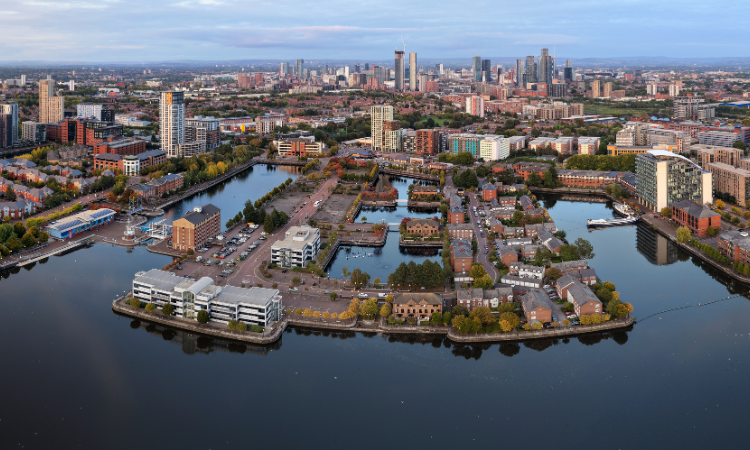
What the Salford Data Tells Buy-to-Let Investors
In Salford the income does not sit where the famous names are. M3 Salford City Centre and M6 Pendleton share the top yield at 6.6%, neither of them the waterfront postcode most people picture, while M50 Salford Quays and M5 Ordsall, the MediaCityUK-adjacent names, fell 17.2% and 13.5% over five years as apartment supply outran demand. The borough rewards reading past the postcode reputation to the numbers underneath it.
For an income buyer, the inner and cheaper postcodes do the work. M3 pairs the borough's highest rent of £1,355 with a sub-£245,000 asking price for an investment property; M6 reaches the same 6.6% from a lower base, backed by the Salford Royal healthcare campus. BL4 Farnworth offers the lowest deposit at £63,186 on a 5.6% yield, with the bonus of 43.4% five-year growth and a fast, three-and-a-half-month sale.
For a growth buyer, the affordable outer suburbs have delivered. M38 Little Hulton grew 53.0% over five years, BL4 43.4% and M27 Swinton 30.7%, all from asking prices under £247,000. M28 Worsley sits at the other end: the highest price at £353,039, the lowest yield at 4.0%, and a profile built for capital security and a Cheshire-village feel rather than rental income. Waterfront flat prices have already corrected from their 2021 peak, though their slow exit speed is the trade-off to price in. Buyers who want to come in under asking in a borough this varied often work the below market value and off-market property routes.
Salford operates no selective licensing scheme covering all private landlords, though licensing applies to houses in multiple occupation and to designated areas, so the position should be checked on Salford City Council's property licensing pages for a specific street. With more than £4.5 billion of regeneration in the ground and a tenant base topped up by Manchester earners, the borough reads as a split market: strong yields and quick sales in the affordable suburbs, deeper rental demand but slower exits at the waterfront.
How Salford Compares
Salford is the second-cheapest of five Greater Manchester locations compared here, and its 6.6% top yield is beaten only by Manchester's 8.1%. The table places Salford alongside four neighbouring markets, each with a different investor profile. Mean asking price and mean monthly rent are simple averages across all postcodes with data, and top gross yield is the single highest postcode yield in each location.
| Location | Mean Asking Price | Mean Monthly Rent | Mean Gross Yield | Top Yield (postcode) |
|---|---|---|---|---|
| Wigan | £233,131 | £892 | 4.6% | 5.4% (M46) |
| Salford | £248,444 | £1,188 | 5.7% | 6.6% (M3, M6) |
| Bolton | £255,835 | £981 | 4.6% | 6.1% (M38) |
| Manchester | £268,032 | £1,312 | 5.9% | 8.1% (M14) |
| Trafford | £375,637 | £1,329 | 4.2% | 6.4% (M17) |
Salford asks £248,444 on average, second only to Wigan at £233,131 among these five, but it pulls in a higher mean rent of £1,188 than either Wigan or Bolton, which is what lifts its top yield to 6.6%. That rent premium over its cheaper neighbours is the MediaCityUK-and-Manchester demand showing up in the numbers.
For an income investor weighing the region, Manchester next door reaches a higher 8.1% top yield from a deeper, more student-heavy rental market, while Trafford is the premium end at £375,637 mean asking, where prices outrun rents to leave a 6.4% top yield. Salford sits between them: cheaper to buy into than Manchester or Trafford, with stronger rents than Wigan or Bolton. For a data-led view across every UK market, see our guide to the highest-yielding areas to invest. Salford is one of more than 160 areas in the guide library for property investment in the UK.
Frequently Asked Questions
Is Salford a Good Place to Invest in Property?
Salford's mean asking price is £248,444, with postcode means from £210,621 in BL4 to £353,039 in M28, and published postcode gross yields reach 6.6% in M3 and M6. MediaCityUK and the University of Salford provide employment and student-demand context, while the postcode data show large differences across the borough.
Five-year growth ranges from declines in some waterfront postcodes to 53.0% in M38 (Little Hulton), with BL4 (Farnworth) at 43.4% and M27 (Swinton) at 30.7%. Selling times also vary by postcode, so the borough mean does not describe every local market.
What are the best areas in Salford for property investment?
Salford splits cleanly. For income, the inner and cheaper postcodes lead: M3 Salford City Centre and M6 Pendleton both yield 6.6%, and M5 Ordsall, M50 Salford Quays and M17 reach 6.4%. For the lowest way in, BL4 Farnworth needs a £63,186 deposit on a 5.6% yield.
For growth, the affordable outer suburbs have done the running. M38 Little Hulton returned 53.0% over five years, BL4 43.4% and M27 Swinton 30.7%. At the other end, M28 Worsley is the premium family suburb at £353,039 and the lowest yield at 4.0%, bought for capital security rather than income. So income points you inner, growth points you outer, and the waterfront sits in its own category as a corrected, slower-selling market.
How does Salford compare to Manchester for buy-to-let?
They are next-door neighbours but different bets. Manchester reaches a higher top yield of 8.1% against Salford's 6.6%, from a deeper rental market with far more postcodes and a much larger student population. Its mean asking price of £268,032 is about 8% above Salford's £248,444.
Salford trades that lower top yield for cheaper entry in several postcodes and a regeneration pipeline, the Crescent and MediaCityUK Phase 2, that is reshaping the borough. Plenty of Salford tenants earn Manchester wages while renting on the Salford side of the Irwell, which is what holds rents up. Historically, Manchester has been the stronger performer on headline yield and choice, Salford on affordable entry points.
Are there flats to buy in Salford for buy-to-let?
Yes, and they are the dominant stock in two postcodes. Flats make up 87.7% of M3 Greengate and 73.5% of M50 Salford Quays, mostly newer apartments aimed at MediaCityUK and Manchester city-centre workers. Borough-wide, flats average £156,140 on the Land Registry index, the cheapest property type and 27.2% below the England average.
The thing to know about the flat market is the exit. M3 and M5 carry more than 33 months of unsold apartment stock and take around 1,014 days to sell, so a flat bought there for yield can be slow to move on when you come to sell. The income is there, the liquidity is not.
What is the rental yield in Salford?
Gross yields run from 4.0% in M28 Worsley up to 6.6% in M3 Salford City Centre and M6 Pendleton, with most of the borough sitting between 5% and 6.6%. The pattern is the cheaper postcodes carrying the higher yields, because a similar rent on a lower asking price produces a stronger return.
Gross yield is rent before any costs, so the real net figure will be lower once you take off management, maintenance, insurance and void periods. It is a useful way to rank postcodes against each other, not a number to bank.
Is there rental demand from MediaCityUK and students in Salford?
Yes, and it is the foundation of Salford's rental case. MediaCityUK at the Quays houses the BBC, ITV, dock10 and more than 250 creative and tech businesses, and the University of Salford has around 20,000 students across its Peel Park and MediaCityUK campuses. That professional and student demand concentrates in M50 Salford Quays and the M3 and M5 city-centre fringe, where the private rented sector already accounts for 62.1% of M3's households.
The trade-off is that those are also the postcodes that saw prices fall over five years and that sell slowly. The demand to let is strong, but if you are buying a Quays flat for student or professional tenants, factor in the slower resale at the end. For the purpose-built side of the student market, see our guide to student property investment.
What is the population of Salford?
Salford's population was 269,923 at the 2021 Census, up 15.38% from 233,933 in 2011. That is more than double the England and Wales average growth of 6.3% over the decade and one of the fastest rates in Greater Manchester, driven by the scale of new housing at the Quays and the city-centre fringe.
For an investor, fast population growth is a demand signal: more people competing for a housing stock that has not kept pace, with over £4.5 billion of regeneration adding thousands more homes through the Crescent and MediaCityUK Phase 2. It is one of the reasons rents have held up even where sale prices softened.
How do I buy an investment property in Salford?
Work out first whether you are buying for income or for growth, because in Salford that points you at a different half of the borough. For income, the inner postcodes lead, M3 and M6 at 6.6%. For growth, the affordable outer suburbs have delivered, M38 at 53.0% over five years. Budget for a 30% deposit, which runs from £63,186 in BL4 up to £105,912 in M28.
Beyond what is listed on the portals, a lot of experienced investors buy under asking through off-market property and below market value channels. To see what is available now, you can browse investment properties or current buy-to-let homes for sale.
Ready to buy property?
Browse investment properties with prices and gross yields shown for each opportunity.
Get property alerts