
Where to Buy Property Investments in Sunderland: Yields of 9.7%
Sunderland's gross rental yields range from 3.6% to 9.7% across postcodes with rental data, with SR1 delivering the highest returns. Average sold prices sit 50.9% below the England average, and the city's population was 274,172 at the 2021 census.
Sunderland's average sold price of £143,824 makes it one of the most affordable cities in England for buy-to-let investors. That is 13.7% below the North East regional average of £166,568 and creates entry points that few English cities can match. Asking prices start from £73,898 in SR1, and rental data is available for 11 of the city's 12 postcodes. For investors comparing locations across the UK, our property investment hub covers every major market.
This guide covers all 12 Sunderland postcodes from SR1 to SR8, DH4, DH5, NE37, and NE38 under the City of Sunderland metropolitan borough (ONS code E08000024). Sunderland sits on the North East coast at the mouth of the River Wear. The local authority boundary extends south to Seaham and Peterlee (SR7, SR8) and west to Washington (NE37, NE38) and Houghton-le-Spring (DH4, DH5). Investors comparing options in the region may also consider Durham, Newcastle, or Middlesbrough. Browse all our North East location guides.
Article updated: February 2026
Sunderland Buy-to-Let Market Overview 2026
Sunderland offers some of the lowest entry prices in England, backed by Nissan's multi-billion-pound EV manufacturing commitment and major city centre regeneration.
- Average sold price: £143,824 (50.9% below England's £293,131)
- Asking price range: £73,898 (SR1) to £256,541 (SR3)
- Rental yields: 3.6% (SR3) to 9.7% (SR1) across postcodes with rental data
- Rental income: Monthly rents from £555 (SR8) to £837 (SR6)
- Price per sq ft: House prices from £58/sq ft (SR1) to £218/sq ft (SR6)
- Market activity: Sales ranging from 7 per month (SR1) to 38 per month (SR8)
- Deposit requirements: 30% deposits range from £22,169 (SR1) to £76,962 (SR3)
- Affordability ratios: Property prices from 2.3 to 7.8 times Sunderland's median annual salary of £32,744
Contents

-
by Robert Jones, Founder of Property Investments UK
With two decades in UK property, Rob has been investing in buy-to-let since 2005, and uses property data to develop tools for property market analysis.

Property Data Sources
Our location guide relies on diverse, authoritative datasets including:
- HM Land Registry UK House Price Index
- Ministry of Housing, Communities and Local Government
- Ordnance Survey Data Hub
- Propertydata.co.uk
We update our property data quarterly to ensure accuracy. Last update: February 2026. All data is presented as provided by our sources without adjustments or amendments.
Why Invest in Sunderland?
Nissan's Sunderland plant produces around 350,000 vehicles per year and directly employs over 6,000 people, making it the largest car factory in the UK. Sunderland's economy has been rebuilding around two pillars that give it a claim most North East cities cannot make. The EV36Zero programme is transforming the plant into Europe's largest electric vehicle manufacturing hub, with battery production and an expanded supply chain locking in employment for decades. That single factory anchors the western half of Sunderland's labour market.
The second pillar is public sector and service employment. Sunderland Royal Hospital, the city council, and the University of Sunderland between them employ thousands across the city centre and surrounding areas. The university has around 14,000 students, which creates consistent rental demand in SR1 and SR2 during term time. Some investors in these postcodes also explore Airbnb properties to capitalise on Sunderland's growing visitor numbers during the summer months when student lets are vacant.
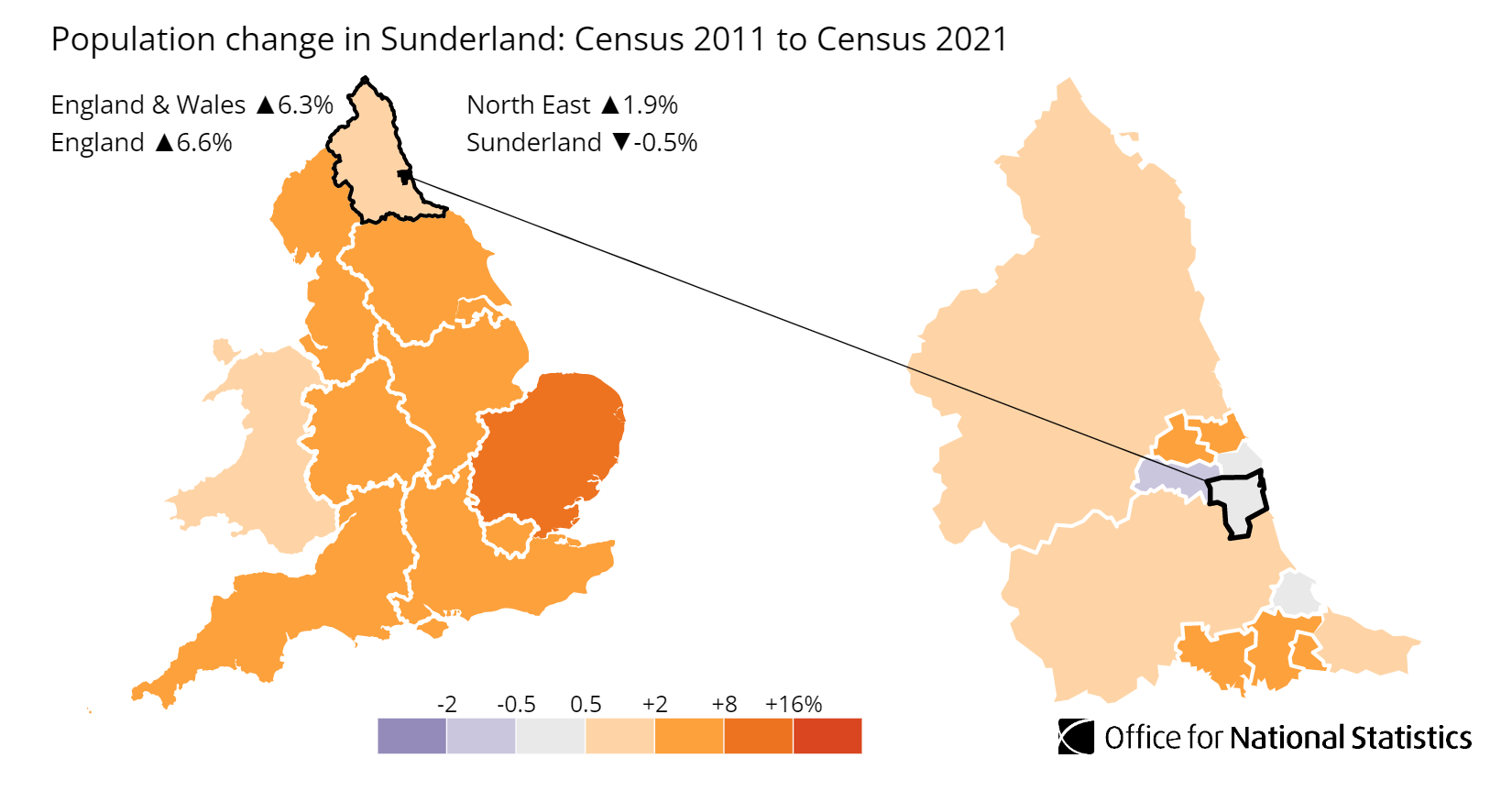
Between the 2011 and 2021 censuses, Sunderland's population fell marginally from 275,506 to 274,172, a decline of 0.48%. That is notable but not alarming. Sunderland's population has been broadly stable for decades, and the city's employment base is shifting from legacy industries toward advanced manufacturing and services. Population growth is not driving this market. Affordability and yield are.
Earnings in Sunderland sit below both the regional and national averages. The median annual salary is £32,744, compared to £34,835 across the North East and £39,125 for Great Britain. Lower local wages combined with very affordable house prices create a market where gross rental yields reach levels that most English cities cannot match.
Sunderland Economic Summary
- Population: 274,172 (2021 Census). Decline of 0.48% from 2011.
- Median annual salary: £32,744 (Sunderland), £34,835 (North East), £39,125 (Great Britain)
- Employment rate: 69.4% (Sunderland)
- Unemployment rate: 6.6% (Sunderland)
- Key employment sectors: Automotive manufacturing, healthcare, higher education, public administration, retail and services
Source: ONS Census 2021, Nomis Labour Market Profile (ASHE 2025)
Sunderland's employment rate of 69.4% is below the Great Britain average of 75.6%. The unemployment rate of 6.6% is above the national 4.3%. These figures reflect a city still transitioning from its industrial past. For buy-to-let investors, the question is whether the employment base is secure enough to sustain rental demand. Nissan's multi-billion-pound commitment and the Riverside Sunderland regeneration programme suggest the trajectory is positive, even if the headline employment numbers lag behind.
Regeneration and Investment in Sunderland
Sunderland's regeneration is driven by an unusual combination: one of the UK's largest private sector investments in Nissan's EV programme, and a council-led city centre rebuild that has already attracted institutional backing from Homes England and Legal & General.
- Nissan EV36Zero Hub (underway, up to £3bn): A multi-billion-pound programme transforming Nissan's Sunderland plant into the UK's largest electric vehicle manufacturing hub, supporting 6,000 direct jobs and thousands more in the supply chain. LEAF production began in December 2025, with electric Juke and Qashqai to follow. This locks in Sunderland's position as a major employment centre for decades, underpinning tenant demand across the SR3, SR4, and SR5 postcodes closest to the plant. Updates at GOV.UK.
- Riverside Sunderland (underway, £600m+ invested): A city centre regeneration programme delivering new homes, 1 million sq ft of workspace, and public realm across the former Vaux Brewery site and surrounding riverside land. The 33-hectare masterplan includes 1,000 homes, backed by Homes England, Legal & General, Canada Life, and Placefirst. New city centre housing at scale creates a rental market where none previously existed. Updates at GOV.UK.
- International Advanced Manufacturing Park (underway, £400m+): A 150-hectare advanced manufacturing park adjacent to Nissan, with phase 1 delivering 623,000 sq ft and capacity for a further 1 million sq ft. JATCO's £49m EV powertrain factory is already operational, and the park is designed to support over 7,000 jobs. A second major employment zone north of the river diversifies Sunderland's job base beyond Nissan itself. Updates at IAMP North East.
Sunderland Property Market Analysis
When Was the Last House Price Crash in Sunderland?
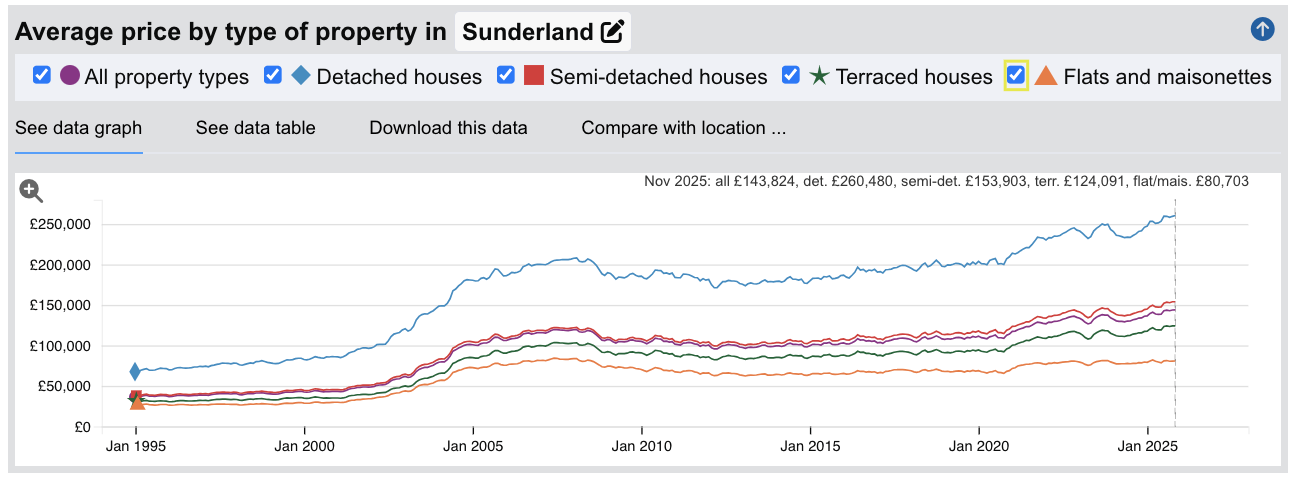
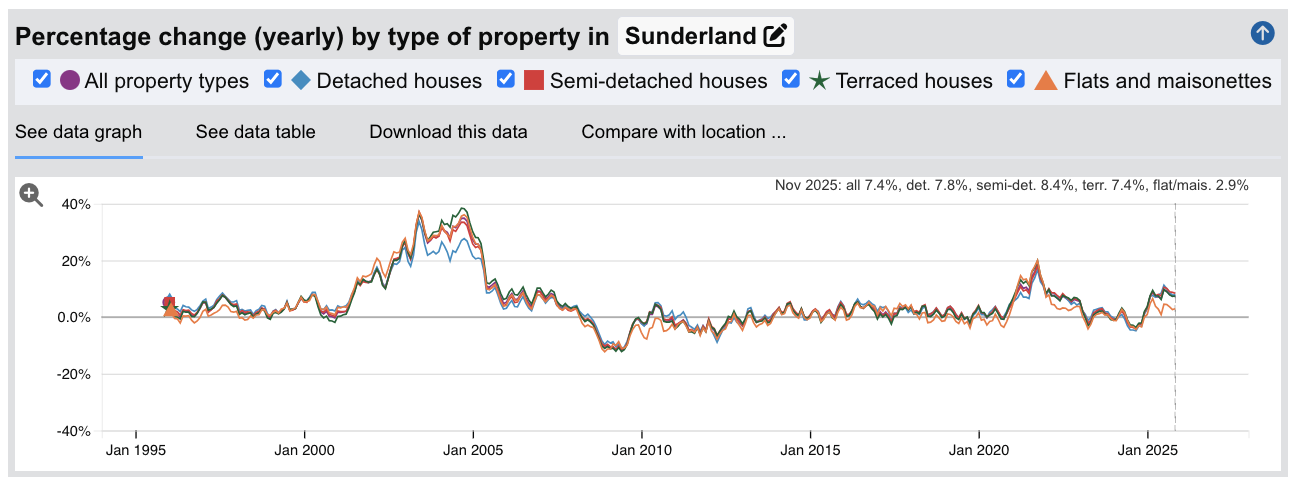
Sunderland lost 20.0% of its value between February 2008 and March 2012, and the recovery took over 13 years. The full house price history from the HM Land Registry House Price Index runs from January 1995 to November 2025. The data shows one major crash, followed by the longest recovery in any city we have analysed.
- 1995-2000 (Slow start): Sunderland began 1995 at £34,978. Growth was sluggish through the mid-1990s as the city adjusted to shipyard closures and industrial decline. By January 2000, prices had only reached £42,401. Five years of single-digit growth while southern England surged.
- 2000-2007 (The boom): Prices nearly tripled from £42,401 in January 2000 to a peak of £119,596 in February 2008. The steepest growth came in 2003-2004, when annual change exceeded 30%. Cheap credit pushed prices well beyond what local wages could support. The gap between Sunderland and the national average narrowed sharply during this period.
- 2008-2012 (The financial crisis and prolonged decline): From the peak of £119,596 in February 2008 to the trough of £95,634 in March 2012, Sunderland lost 20.0% of its value. The worst annual change reading was -11.7% in June 2009. Unlike southern England, where the decline was sharp but the recovery came quickly, Sunderland's prices kept falling long after the national market had stabilised.
- Property type breakdown during the crash: Flats were hit hardest, declining 25.3% from £83,746 to £62,576. Terraced houses fell 20.3%, semi-detached 18.7%, and detached 17.7%. Sunderland's overall decline of 20.0% was broadly in line with the North East region (-19.7%) and worse than England overall (-18.2%).
- 2013-2016 (Stagnation): Prices traded sideways for four years. Annual changes flipped between small gains and small losses. By December 2016, the average was £105,455. Still 11.8% below the pre-crash peak. While London and the South East had passed their pre-crash highs by 2013-2014, Sunderland was nowhere close.
- 2017-2019 (Marginal recovery): Growth returned but at a glacial pace. Prices rose from £103,211 in January 2017 to £110,052 by December 2019. Annual growth rarely exceeded 3%. Sunderland was still below its 2008 peak heading into 2020.
- 2020-2022 (Pandemic surge): The stamp duty holiday and the affordability shift finally hit Sunderland. Prices jumped from £111,424 in January 2020 to £136,045 by November 2022. That is 22.1% growth in under three years. Sunderland benefited disproportionately from the pandemic-era hunt for affordable property.
- 2023 (Rate shock): Interest rate rises cooled the market. Annual change turned negative from late 2023 into 2024, but the decline was modest. The worst reading was -4.1% in September 2024.
- 2024-2025 (Recovery): Prices stabilised and began rising again from early 2025. By November 2025, the average reached £143,824 with annual growth of 7.4%. Sunderland is now outpacing both the North East (6.8%) and England (2.2%) on annual growth.
Long-Term Property Value Growth in Sunderland
- 5 years (2020-2025): +27.8% (£112,564 to £143,824)
- 10 years (2015-2025): +41.9% (£101,324 to £143,824)
- 15 years (2010-2025): +38.3% (£103,989 to £143,824)
- 20 years (2005-2025): +33.4% (£107,797 to £143,824)
- 30 years (1995-2025): +281.2% (£37,728 to £143,824)
The critical number for Sunderland investors is this: it took over 13 years for prices to recover the pre-crash peak. The £119,596 of February 2008 was not exceeded until April 2021. That is the longest crash recovery of any city in our analysis. Anyone who bought during the recovery period between 2012 and 2019 has seen strong capital growth since.
The question is whether the current drivers are more durable than 2007's credit-fuelled boom. Nissan's EV commitment and £4bn+ of regeneration investment suggest they are. Sunderland's market remains fundamentally tied to a single major employer, and that concentration is the key variable for the next cycle.

Thinking of Buying?
We have off-market investment properties averaging 8%+ annual yield.
View Property DealsSold House Prices in Sunderland
The latest sold house price index from the Land Registry confirms Sunderland's position as one of the most affordable markets in England. The headline figure of £143,824 is 50.9% below England's £293,131 and 13.7% below the North East's £166,568. That discount is wide across every property type, but flats stand out.
Flats in Sunderland average £80,703. That is 63.6% below the England average of £221,565. No other property type in Sunderland comes close to that gap. The flat market here is dominated by converted terraces, ex-local authority stock, and purpose-built blocks near the city centre and seafront. There is no premium new-build apartment market to inflate the average.
| Property Type | Sunderland Average | England Average | Difference |
|---|---|---|---|
| Detached houses | £260,480 | £474,400 | -45.1% |
| Semi-detached houses | £153,903 | £290,004 | -46.9% |
| Terraced houses | £124,091 | £245,002 | -49.4% |
| Flats and maisonettes | £80,703 | £221,565 | -63.6% |
| All property types | £143,824 | £293,131 | -50.9% |
Detached houses sit 45.1% below England at £260,480. Detached stock in Sunderland is concentrated in the suburban postcodes of SR3 (Doxford Park), SR6 (Fulwell, Roker), and DH4 (Houghton-le-Spring). These areas attract owner-occupiers and family tenants but at prices that would barely cover a semi-detached in the South East.
Semi-detached houses show a 46.9% discount at £153,903. Semis are the core housing stock across Sunderland's middle-ring postcodes. They represent the typical buy-to-let entry point for investors targeting family tenants and housing benefit tenants, particularly in SR4 and SR5.
Terraced houses average £124,091, a 49.4% discount. The terraced market splits between older Victorian and Edwardian stock near the city centre (SR1, SR2) and newer estate terraces in the outer postcodes. SR8 (Peterlee) and SR7 (Seaham) have large concentrations of affordable terraced housing that drive yields in those areas.
Flats at £80,703 represent the deepest discount in the entire market. At 63.6% below England's average, Sunderland flats are priced at levels that allow single-property investors to enter with deposits under £25,000. The yield maths works at these prices even with modest rents, but investors need to watch service charges and building condition carefully at the lower end.
Property Data Sources
Our location guide relies on diverse, authoritative datasets including:
- HM Land Registry UK House Price Index
- Ministry of Housing, Communities and Local Government
- Ordnance Survey Data Hub
- Propertydata.co.uk
We update our property data quarterly to ensure accuracy. Last update: February 2026. All data is presented as provided by our sources without adjustments or amendments.
Price Per Square Foot in Sunderland
Sunderland's price per square foot ranges from £58 in SR1 to £218 in SR6, a spread of nearly 4x across twelve postcodes. How much are you actually paying for space? Average asking prices can mislead because a postcode might look expensive simply because it has larger properties. Price per square foot strips out that size bias and shows what you are really paying.
That is an extraordinarily wide range and reflects the gulf between SR1's city centre flat market and SR6's premium coastal properties in Fulwell and Roker.
| Rank | Area | Price Per Sq Ft |
|---|---|---|
| 1 | SR1 (City Centre) | £58 |
| 2 | SR8 (Peterlee) | £90 |
| 3 | SR5 (Town End Farm, Castletown) | £133 |
| 4 | SR4 (Pennywell, Grindon) | £137 |
| 5 | SR2 (Ryhope, Grangetown) | £138 |
| 6 | SR7 (Seaham) | £145 |
| 7 | DH5 (Hetton-le-Hole) | £151 |
| 8 | NE37 (Washington, Usworth/Donwell) | £156 |
| 9 | DH4 (Houghton-le-Spring) | £173 |
| 10 | SR3 (Doxford Park, Silksworth) | £177 |
| 11 | NE38 (Washington, Town Centre) | £192 |
| 12 | SR6 (Fulwell, Roker) | £218 |
SR1 at £58 per square foot is not just the cheapest in Sunderland. It is one of the lowest figures we have seen in any English city. The city centre is dominated by flats and converted properties where low per-foot costs translate directly into the headline 9.7% gross yield. Investors buying in SR1 are paying for space at a fraction of what it costs even a few postcodes away.
The mid-range cluster from SR5 to SR7 (£133 to £145 per sq ft) is where most buy-to-let activity sits. These postcodes offer the balance between affordable entry and reasonable rental returns. SR5 at £133 per sq ft ranks third cheapest but delivers the second-highest yield at 7.5%. That combination of low space costs and strong rental performance is what makes SR5 stand out alongside SR1.
SR6 at £218 per square foot is the premium end. Fulwell and Roker are Sunderland's coastal suburbs with period properties, sea views, and a different tenant demographic. The higher per-foot cost explains why SR6's yield compresses to 4.2% despite commanding the highest absolute rents in Sunderland at £837 per month.
Figures reflect averages across all property types and ages. Individual values depend on condition, location within the postcode, and building age.
Houses for Sale in Sunderland: Current Asking Prices
Asking prices across Sunderland range from £73,898 in SR1 to £256,541 in SR3. What does it actually cost to buy in Sunderland today? Asking prices reflect what sellers and agents think the market will pay. They are not the same as sold prices, which capture what buyers actually paid. In a rising market, asking prices run ahead of sold prices.
That is a spread of nearly £183,000 across twelve postcodes, but the majority cluster below £200,000. Nine of twelve postcodes have average asking prices under £205,000.
| Rank | Area | Average Asking Price |
|---|---|---|
| 1 | SR1 (City Centre) | £73,898 |
| 2 | SR8 (Peterlee) | £96,022 |
| 3 | SR5 (Town End Farm, Castletown) | £121,921 |
| 4 | NE37 (Washington, Usworth/Donwell) | £124,175 |
| 5 | SR4 (Pennywell, Grindon) | £139,573 |
| 6 | DH5 (Hetton-le-Hole) | £174,833 |
| 7 | SR7 (Seaham) | £176,895 |
| 8 | NE38 (Washington, Town Centre) | £177,415 |
| 9 | SR2 (Ryhope, Grangetown) | £186,992 |
| 10 | DH4 (Houghton-le-Spring) | £204,626 |
| 11 | SR6 (Fulwell, Roker) | £240,227 |
| 12 | SR3 (Doxford Park, Silksworth) | £256,541 |
Three postcodes sit below £125,000: SR1, SR8, and SR5. These are the entry-level buy-to-let postcodes where 30% deposits range from £22,169 to £36,576. SR1 at £73,898 is in a different bracket entirely. At that price, the deposit is under £23,000, which puts buy-to-let within reach of investors who might be priced out of almost every other English city.
SR3 at £256,541 is the most expensive postcode in Sunderland. Doxford Park is a newer residential area with larger detached and semi-detached properties. The premium reflects housing quality rather than location. SR6 at £240,227 commands its price through coastal proximity. Both postcodes serve the owner-occupier market more than the rental market.
The mean asking price across all twelve Sunderland postcodes is £164,426. That figure appears in the comparison section later, where Sunderland is measured against Newcastle, Durham, and Middlesbrough.

House Price Growth in Sunderland
Seven of Sunderland's twelve postcodes delivered positive five-year growth, with SR5 leading at 29.8%. Growth data shows where prices have moved over 1, 3, and 5 years. For buy-to-let investors, the five-year figure matters most. It captures a full market cycle and filters out short-term noise.
An investor who bought a £94,000 property in SR5 five years ago would be looking at a property now asking £121,921. That is roughly £28,000 in equity growth from one of Sunderland's most affordable entry points.
| Area | 1 Year | 3 Years | 5 Years |
|---|---|---|---|
| SR5 (Town End Farm, Castletown) | 10.8% | 8.7% | 29.8% |
| SR4 (Pennywell, Grindon) | 11.2% | 11.8% | 23.2% |
| NE37 (Washington, Usworth/Donwell) | 19.9% | 26.6% | 20.9% |
| SR8 (Peterlee) | 18.6% | 3.7% | 16.4% |
| SR3 (Doxford Park, Silksworth) | -5.7% | -8.9% | 14.9% |
| SR2 (Ryhope, Grangetown) | -1.9% | -1.6% | 10.5% |
| DH4 (Houghton-le-Spring) | -0.4% | -1.0% | 9.6% |
| NE38 (Washington, Town Centre) | 9.4% | 19.4% | 6.9% |
| SR6 (Fulwell, Roker) | 0.3% | -3.7% | 4.5% |
| SR7 (Seaham) | -2.2% | 13.5% | 3.6% |
| DH5 (Hetton-le-Hole) | 3.1% | -3.5% | 1.5% |
| SR1 (City Centre) | -19.2% | -47.8% | -8.5% |
The growth leaders are the affordable, working postcodes. SR5 (29.8%), SR4 (23.2%), and NE37 (20.9%) all sit below £140,000 asking price and have delivered strong five-year appreciation. These are not premium areas. They are the terraced and semi-detached suburbs where first-time buyers and investors compete for the same stock. That competition is what drives prices up from a low base.
NE37 Washington stands out with 19.9% one-year growth and 26.6% three-year growth. That acceleration suggests Washington is catching up after years of underperformance. Proximity to both Nissan and the IAMP is a plausible driver. Whether this pace continues depends on how quickly those employment zones expand.
SR1 City Centre at -8.5% five-year and -19.2% one-year growth is the clear outlier. SR1's market is dominated by low-value flats, and a small number of transactions can produce volatile growth figures. The average price of £73,898 is driven by ex-local authority and converted stock. SR1 delivers Sunderland's highest yield at 9.7%, but capital growth has been negative. Investors here are buying for income, not appreciation.
SR3 shows an interesting pattern: positive five-year growth (14.9%) but negative one-year (-5.7%) and three-year (-8.9%) growth. Prices surged during the pandemic stamp duty holiday and have since corrected. Doxford Park's newer, higher-value stock attracted pandemic-era buyers who have since found better value elsewhere.
Monthly Property Sales in Sunderland
Monthly sales across Sunderland range from 7 in SR1 to 38 in SR8, with 321 transactions per month across all twelve postcodes. Transaction volumes reveal which areas have the deepest buyer pools. For buy-to-let investors, this is an exit strategy question: if you need to sell, can you?
The standout figure is SR6's turnover rate of 101%, meaning properties in Fulwell and Roker change hands faster than anywhere else in Sunderland.
| Area | Sales Per Month | Turnover | Asking Price |
|---|---|---|---|
| SR8 (Peterlee) | 38 | 64% | £96,022 |
| SR4 (Pennywell, Grindon) | 37 | 83% | £139,573 |
| SR2 (Ryhope, Grangetown) | 36 | 32% | £186,992 |
| SR7 (Seaham) | 34 | 38% | £176,895 |
| DH4 (Houghton-le-Spring) | 32 | 26% | £204,626 |
| SR6 (Fulwell, Roker) | 30 | 101% | £240,227 |
| NE38 (Washington, Town Centre) | 27 | 67% | £177,415 |
| SR3 (Doxford Park, Silksworth) | 25 | 29% | £256,541 |
| DH5 (Hetton-le-Hole) | 23 | 43% | £174,833 |
| NE37 (Washington, Usworth/Donwell) | 16 | 30% | £124,175 |
| SR5 (Town End Farm, Castletown) | 16 | 46% | £121,921 |
| SR1 (City Centre) | 7 | 22% | £73,898 |
SR4 Pennywell at 83% turnover and 37 sales per month is the strongest combination of volume and liquidity. Properties here move quickly, which matters when you need to exit an investment. SR6 at 101% turnover moves even faster, but at a higher price point of £240,227.
SR1 City Centre at 7 sales per month is a red flag for exit strategy. The city centre has Sunderland's highest yield at 9.7%, but only 7 transactions per month and 22% turnover. Selling a property in SR1 could take significantly longer than in any other Sunderland postcode. Investors buying for yield in SR1 need to plan for a long hold.
SR8 Peterlee leads on raw volume with 38 sales per month. That depth of market activity at an average asking price of £96,022 makes SR8 one of the more liquid affordable postcodes. Combined with a 6.9% yield, SR8 offers a balanced proposition: decent income, reasonable growth (16.4% over five years), and a deep enough market to exit when needed.
Property Data Sources
Our location guide relies on diverse, authoritative datasets including:
- HM Land Registry UK House Price Index
- Ministry of Housing, Communities and Local Government
- Ordnance Survey Data Hub
- Propertydata.co.uk
We update our property data quarterly to ensure accuracy. Last update: February 2026. All data is presented as provided by our sources without adjustments or amendments.
Sunderland Rental Market Analysis
For investors weighing up whether rental property is a worthwhile investment in Sunderland, the data below breaks down average monthly rents and gross rental yields across the city's postcodes.
Rental data is available for 11 of 12 postcodes. NE38 (Washington, Town Centre) has insufficient current listings for reliable figures. For the eleven with data, monthly rents range from £555 in SR8 to £837 in SR6 and gross yields range from 3.6% to 9.7%. If you are looking to build a property portfolio in the North East, Sunderland's combination of sub-£100,000 entry points and double-digit headline yields makes it one of the most affordable starting positions in England.
Average Rent & Gross Rental Yields in Sunderland
SR1 delivers Sunderland's highest gross yield at 9.7%, where monthly rents of £595 meet asking prices of £73,898. Gross rental yield is calculated from the average asking price and average monthly rent for each postcode. It does not account for void periods, maintenance, management fees, or mortgage costs. It is a starting point for comparison, not a profit forecast.
At the other end, SR3 Doxford Park at 3.6% reflects higher asking prices absorbing modest rents. The yield spread across Sunderland is 6.1 percentage points. That gap is one of the widest we have seen in any English city and creates genuinely different investment profiles within the same local authority.
| Area | Avg Monthly Rent | Avg Asking Price | Gross Yield |
|---|---|---|---|
| SR1 (City Centre) | £595 | £73,898 | 9.7% |
| SR5 (Town End Farm, Castletown) | £758 | £121,921 | 7.5% |
| SR8 (Peterlee) | £555 | £96,022 | 6.9% |
| NE37 (Washington, Usworth/Donwell) | £660 | £124,175 | 6.4% |
| SR4 (Pennywell, Grindon) | £716 | £139,573 | 6.2% |
| DH5 (Hetton-le-Hole) | £672 | £174,833 | 4.6% |
| SR7 (Seaham) | £676 | £176,895 | 4.6% |
| SR2 (Ryhope, Grangetown) | £683 | £186,992 | 4.4% |
| SR6 (Fulwell, Roker) | £837 | £240,227 | 4.2% |
| DH4 (Houghton-le-Spring) | £670 | £204,626 | 3.9% |
| SR3 (Doxford Park, Silksworth) | £774 | £256,541 | 3.6% |
| NE38 (Washington, Town Centre) | Not enough data | £177,415 | Not enough data |
Five postcodes sit above 6% gross yield: SR1, SR5, SR8, NE37, and SR4. Each draws from a different tenant pool. SR1 attracts students and city centre workers. SR5 and SR4 serve working families and housing benefit tenants. SR8 Peterlee draws from a mixed tenant base across east Durham.
NE37 Washington benefits from proximity to Nissan and the IAMP. That diversity of demand means the yield story is not dependent on a single tenant type.
SR6 commands Sunderland's highest absolute rent at £837 per month but delivers only 4.2% yield. Fulwell and Roker attract professional tenants willing to pay a premium for coastal living. The yield is compressed by asking prices of £240,227. Investors here are buying for tenant quality and long-term appreciation rather than cash flow.
The cluster from DH5 to SR2 (4.4% to 4.6%) represents the suburban middle ground. These postcodes have similar rents (£672 to £683 per month) but asking prices between £175,000 and £187,000. They deliver modest yields without the volatility of the high-yield postcodes or the capital requirements of the premium areas.
Is Sunderland Rent High?
Across Sunderland's eleven postcodes with rental data, rent ranges from 21.8% to 30.7% of the local median gross monthly salary. Rent affordability matters from both sides. For tenants, it determines whether they can sustain payments long-term. For landlords, areas where rent consumes a lower share of income tend to produce more reliable tenants and fewer arrears.
The median gross weekly salary in Sunderland is £629.70, which equates to £2,729 per month or £32,744 per year. This is below the North East regional median of £669.90 per week and the Great Britain median of £752.40 per week. Data from the Nomis Labour Market Profile (ASHE 2025).
The general benchmark is that rent becomes stretched above 30% of gross income. Only one Sunderland postcode crosses that threshold. Rents are genuinely affordable relative to local earnings, which reduces arrears and supports tenant retention.
| Rank | Area | Rent as % of Income |
|---|---|---|
| 1 | SR6 (Fulwell, Roker) | 30.7% |
| 2 | SR3 (Doxford Park, Silksworth) | 28.3% |
| 3 | SR5 (Town End Farm, Castletown) | 27.8% |
| 4 | SR4 (Pennywell, Grindon) | 26.2% |
| 5 | SR2 (Ryhope, Grangetown) | 25.0% |
| 6 | SR7 (Seaham) | 24.8% |
| 7 | DH5 (Hetton-le-Hole) | 24.6% |
| 8 | DH4 (Houghton-le-Spring) | 24.6% |
| 9 | NE37 (Washington, Usworth/Donwell) | 24.2% |
| 10 | SR1 (City Centre) | 21.8% |
| — | NE38 (Washington, Town Centre) | Not enough data |
SR6 at 30.7% is the only postcode above the 30% affordability threshold. Fulwell and Roker command the highest rents in Sunderland at £837 per month, and that pushes the ratio just above the benchmark. But SR6 attracts tenants who earn above the Sunderland median. Coastal professionals are not on £32,744. The city-wide median understates what tenants in this postcode actually earn.
Nine of eleven postcodes sit below 28% of gross income. That is an unusually strong affordability picture. In most cities, we see at least half the postcodes above 30%. Sunderland's low rents relative to local earnings mean tenants have more headroom.
For landlords, that translates to lower arrears and longer tenancy durations. SR1 at 21.8% is the most affordable, which aligns with its position as the lowest-rent postcode in the city.
Thinking of Buying?
We have off-market investment properties averaging 8%+ annual yield.
View Property DealsBuy-to-Let Considerations
Are Sunderland House Prices High? Price-to-Earnings Ratios
Purchasing a property in Sunderland requires between 2.3 and 7.8 times the median annual salary of £32,744. The price-to-earnings ratio compares a postcode's average asking price to the local median annual salary. Lower ratios mean more affordable entry points relative to local wages. The national benchmark is 7.5x.
Salary data from the Nomis Labour Market Profile for Sunderland (ASHE 2025). England's average sold price of £293,131 against Great Britain's median salary of £39,125 gives the national 7.5x benchmark.
Ten of Sunderland's twelve postcodes sit below the national benchmark of 7.5x. Only SR6 at 7.3x and SR3 at 7.8x approach or exceed it. The remaining ten postcodes are all 6.2x or lower. That depth of affordability is exceptional by national standards.
| Rank | Area | Price-to-Earnings Ratio |
|---|---|---|
| 1 | SR1 (City Centre) | 2.3x |
| 2 | SR8 (Peterlee) | 2.9x |
| 3 | SR5 (Town End Farm, Castletown) | 3.7x |
| 4 | NE37 (Washington, Usworth/Donwell) | 3.8x |
| 5 | SR4 (Pennywell, Grindon) | 4.3x |
| 6 | DH5 (Hetton-le-Hole) | 5.3x |
| 7 | SR7 (Seaham) | 5.4x |
| 8 | NE38 (Washington, Town Centre) | 5.4x |
| 9 | SR2 (Ryhope, Grangetown) | 5.7x |
| 10 | DH4 (Houghton-le-Spring) | 6.2x |
| 11 | SR6 (Fulwell, Roker) | 7.3x |
| 12 | SR3 (Doxford Park, Silksworth) | 7.8x |
SR1 at 2.3x is one of the lowest price-to-earnings ratios in England. A property costing just 2.3 times the local median salary is almost unheard of outside of the most distressed markets. SR8 at 2.9x and SR5 at 3.7x sit in similar territory. These ratios mean that properties in Sunderland's most affordable postcodes are accessible to local first-time buyers without significant stretching, which supports long-term demand.
SR3 at 7.8x is the only postcode above the national benchmark. Doxford Park's newer, larger homes push the ratio above national norms. SR6 at 7.3x sits just below. Both serve owner-occupier markets where buyer demographics differ from the city-wide median. For the ten postcodes below 7.5x, Sunderland's affordability story is consistent and genuine.
Deposit Requirements in Sunderland
Sunderland's 30% deposit requirements range from £22,169 in SR1 to £76,962 in SR3, with seven postcodes under £55,000. Most buy-to-let mortgage lenders require a minimum 25% deposit. The table below uses a more conservative 30% to reflect the rates and products available at higher loan-to-value ratios. A 30% deposit typically unlocks better interest rates, which matters for cash flow in a yield-driven market.
That puts buy-to-let within reach for investors who might be priced out of almost every other part of England.
| Rank | Area | 30% Deposit Required |
|---|---|---|
| 1 | SR1 (City Centre) | £22,169 |
| 2 | SR8 (Peterlee) | £28,807 |
| 3 | SR5 (Town End Farm, Castletown) | £36,576 |
| 4 | NE37 (Washington, Usworth/Donwell) | £37,253 |
| 5 | SR4 (Pennywell, Grindon) | £41,872 |
| 6 | DH5 (Hetton-le-Hole) | £52,450 |
| 7 | SR7 (Seaham) | £53,068 |
| 8 | NE38 (Washington, Town Centre) | £53,225 |
| 9 | SR2 (Ryhope, Grangetown) | £56,098 |
| 10 | DH4 (Houghton-le-Spring) | £61,388 |
| 11 | SR6 (Fulwell, Roker) | £72,068 |
| 12 | SR3 (Doxford Park, Silksworth) | £76,962 |
SR1 at £22,169 is the lowest deposit requirement in our entire location guide library. At that price, an investor can enter the buy-to-let market with the equivalent of a modest car purchase. The 9.7% gross yield means the income maths works from day one, even at higher mortgage rates. SR8 at £28,807 is the next step up, offering better growth prospects (16.4% over five years vs SR1's -8.5%) for only £6,600 more in deposit. At these price levels, investors looking for below market value properties will find Sunderland's entire lower tier already trades at a deep discount.
The five cheapest postcodes all deliver yields above 6%. SR1 (9.7%), SR5 (7.5%), SR8 (6.9%), NE37 (6.4%), and SR4 (6.2%) all require deposits under £42,000. You do not need to stretch into the higher deposit brackets to access Sunderland's strongest rental returns. The yield premium is at the affordable end of the market.
Deposit is only part of the upfront cost. Budget for stamp duty (use our stamp duty calculator for an accurate figure), legal fees, and survey costs. For a full breakdown, see our guide to buy-to-let costs.
What the Sunderland Data Tells Buy-to-Let Investors
The postcode-level data across this guide points to a market that rewards investors who prioritise income over capital growth, with a few postcodes offering both. For those exploring investment property options across the UK, Sunderland's entry prices open doors that most English cities have closed.
For yield, the numbers favour SR1 (9.7%), SR5 (7.5%), and SR8 (6.9%). All three sit below 3.7x price-to-earnings with 30% deposits between £22,169 and £36,576. SR1 is the headline grabber at 9.7%, but the negative growth data (-8.5% over five years) and very low transaction volume (7 sales/month) demand caution. SR5 is the more balanced choice: strong yield (7.5%), the best five-year growth in Sunderland (29.8%), and affordable entry at £36,576.
For growth, SR5 (29.8%), SR4 (23.2%), and NE37 (20.9%) lead the field. NE37 Washington is accelerating fastest with 19.9% one-year growth, driven by proximity to Nissan and the IAMP. SR4 combines solid growth with the highest sales volume (37/month) and 83% turnover, making it the strongest exit strategy postcode among the growth leaders.
NE38 Washington has no rental data, which makes it difficult to assess as a buy-to-let proposition. The 9.4% one-year growth and 67% turnover suggest an active market, but without yield figures investors are pricing blind on the income side. SR3, DH4, and SR6 are the premium postcodes where yields compress below 4.2%. These suit investors prioritising tenant quality and long-term holds over cash flow. Sunderland Council operates a selective licensing scheme in parts of the city, so check licensing requirements before purchasing.
How Sunderland Buy-to-Let Compares to Nearby Areas
At £164,426 mean asking price, Sunderland is the cheapest entry point among the major North East investment cities. The table below compares Sunderland against three nearby locations using the same methodology: mean asking price across all postcodes, mean monthly rent across postcodes with data, and top single-postcode gross yield.
| Location | Mean Asking Price | Mean Monthly Rent | Top Gross Yield |
|---|---|---|---|
| Sunderland | £164,426 | £704 | 9.7% |
| Middlesbrough | £187,133 | £717 | 8.3% |
| Durham | £187,881 | £774 | 5.5% |
| Newcastle | £254,411 | £1,166 | 9.7% |
Sunderland is the cheapest entry point in this group by a clear margin. Mean asking prices of £164,426 are £23,000 below Middlesbrough and Durham, and £90,000 below Newcastle. That lower entry price is what drives Sunderland's headline yields despite lower absolute rents.
Sunderland and Newcastle both reach 9.7% top yields, but from very different markets. Newcastle's top yield comes from a larger, more diverse rental market with higher absolute rents (£1,166 mean vs Sunderland's £704). Sunderland's 9.7% is achieved through very low asking prices in SR1 rather than high rents. The capital requirement is dramatically different: Sunderland's cheapest deposit (£22,169) is a fraction of what the equivalent Newcastle postcode demands.
Durham offers the lowest top yield at 5.5% but benefits from a university-driven tenant pool that provides stability through the academic year. Middlesbrough sits between Sunderland and Durham on yield (8.3%) with similar asking prices to Durham. For investors with limited capital looking for the highest yield-per-pound-invested in the North East, Sunderland's numbers lead the group.
Frequently Asked Questions
What are the best areas to live in Sunderland?
It depends on what you are looking for. SR6 (Fulwell, Roker) is the premium coastal area with period homes, sea views, and the highest rents at £837 per month. SR3 (Doxford Park, Silksworth) is a newer suburban area with larger family homes and the highest asking prices at £256,541. For affordable living near the city centre, SR4 (Pennywell, Grindon) and SR5 (Town End Farm, Castletown) offer lower prices with good transport links to Nissan and the city centre. The outer areas of DH4 (Houghton-le-Spring) and SR7 (Seaham) provide a quieter, more rural feel while still falling within the Sunderland local authority boundary.
Is Sunderland a good place to live?
Sunderland's strengths are affordability and coastal access. House prices sit 50.9% below the England average, and the city has direct coastline at Roker and Seaburn along with the newly redeveloped seafront. The employment base is anchored by Nissan (6,000+ jobs) and public sector employers. Earnings are below the national average at £32,744, but the low cost of living compensates.
The city centre is undergoing significant transformation through the £600m+ Riverside Sunderland programme. The main trade-off is that Sunderland's economy is still transitioning, and the unemployment rate of 6.6% reflects that.
What are the areas of Sunderland?
The Sunderland local authority covers twelve postcode areas. The city centre and immediate surrounds are SR1 and SR2. SR3 to SR6 cover the southern and coastal suburbs from Doxford Park through to Fulwell and Roker. SR7 (Seaham) and SR8 (Peterlee) extend south along the coast into east Durham.
DH4 (Houghton-le-Spring) and DH5 (Hetton-le-Hole) lie inland to the south-west. NE37 and NE38 cover Washington to the north-west. Each area has a distinct character, from the Victorian terraces near the city centre to the newer estates in Washington and the coastal properties in Roker.
Are there property investment companies operating in Sunderland?
Several firms market buy-to-let properties in Sunderland, particularly targeting out-of-area investors attracted by the high headline yields. Be cautious with any company offering guaranteed yields or sourcing fees above 2-3% of purchase price. The data in this guide covers the open market. For sourcing strategies beyond portals, see our guide to off-market properties.
Any property sold through an investment company could be benchmarked against these figures, but it does not guarantee a market value as these are average values. SR1's 9.7% headline yield attracts attention, but the -19.2% one-year price decline and 7 sales per month are part of the due diligence conversation.
Can I find buy-to-let property in Sunderland under £50,000?
The average asking prices in this guide range from £73,898 (SR1) to £256,541 (SR3), but these are postcode averages across all property types. Individual flats and terraced houses in SR1 and SR8 regularly list below £50,000. Sunderland's average flat price of £80,703 from the Land Registry confirms that sub-£50,000 stock exists, particularly in the city centre. At that price point, a 30% deposit is under £15,000. Due diligence on building condition, lease length, service charges, and actual tenant demand is essential at the lowest end of the market.