

Lincoln is a cathedral city in Lincolnshire, in the East Midlands. The average sold price across Lincoln is £185,514 on the HM Land Registry House Price Index, 36.0% below the England average of £289,946 and 23.3% below the East Midlands average of £241,747. The district's population grew 11.0% between the 2011 and 2021 censuses, from 93,541 to 103,813 residents.
Lincoln's affordability sits alongside earnings that run below both the region and the country. The median gross weekly salary is £659.60, against £696.00 across the East Midlands and £752.40 for Great Britain. Rents are modest in pounds, £908 to £1,052 a month, and the five postcodes with a published rent yield between 4.0% and 4.8%. Asking prices run from £226,661 in LN5 to £318,432 in LN3, and the two highest yields sit in LN5 and LN1.
This guide covers the City of Lincoln district (ONS code E07000138) across postcodes LN1, LN2, LN3, LN4, LN5, and LN6. Every one of those postcodes runs past the city boundary: Saxilby and Stow in LN1, Nettleham and Welton in LN2, and Fiskerton and Cherry Willingham in LN3 sit in West Lindsey, while Waddington and Bracebridge Heath in LN5, North Hykeham and Skellingthorpe in LN6, and Branston and Washingborough in LN4 sit in North Kesteven. The district-level sold prices, wages and population figures cover the city only; the postcode tables cover every address in the postcode. Lincoln sits in Lincolnshire on the eastern edge of the East Midlands, with rail and road links to Newark and Nottingham. Investors weighing the wider region often look at Nottingham and Derby alongside it.
Article updated: July 2026

Why Invest in Lincoln?
Lincoln's population grew 11.0% between the 2011 and 2021 censuses, from 93,541 to 103,813 residents, well above the England and Wales average of 6.3%. The University of Lincoln's Brayford Pool campus was established in 1996 on the west side of the city centre, in LN6, and it now teaches around 17,000 students. How much of the population growth is down to the university is not something the census figures can show.
The second half of the local economy is engineering and defence. Siemens Energy runs a gas turbine plant in the city, part of a manufacturing base that goes back well over a century, and the RAF stations at Waddington and Cranwell sit within commuting distance. So the city has a large student population alongside public-sector and industrial employment.
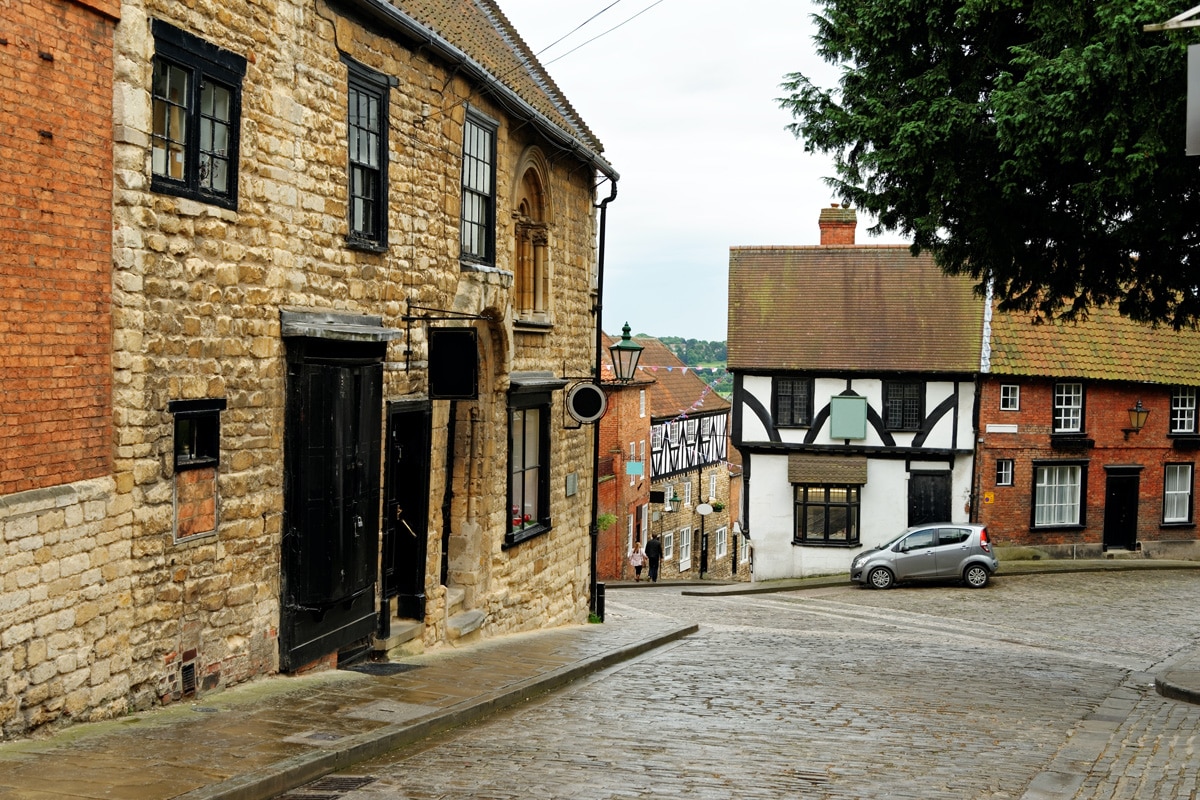
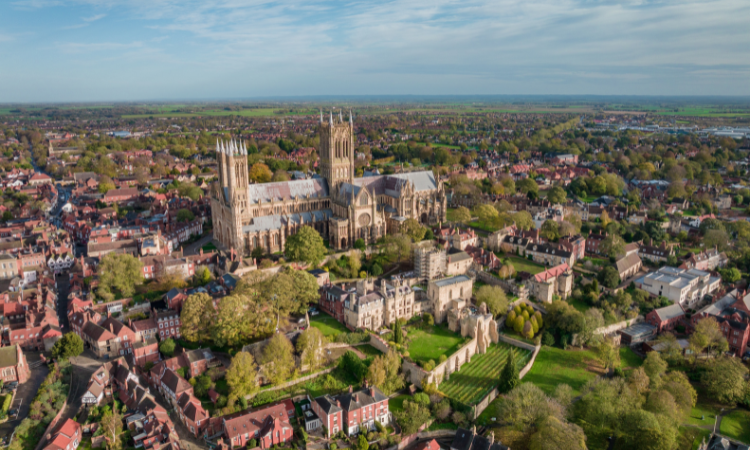
Earnings run lower. The median gross annual salary in Lincoln is £34,301, against £36,192 across the East Midlands and £39,125 for Great Britain. The employment rate of 78.5% is close to the national picture, and Lincoln Cathedral and the Steep Hill quarter bring year-round visitors and the hospitality jobs that go with them.
Lincoln Economic Summary
- Population: 103,813 (2021 Census). Growth of 11.0% from 2011.
- Median annual salary: £34,301 (Lincoln), £36,192 (East Midlands), £39,125 (Great Britain)
- Employment rate: 78.5% (Lincoln)
- Key employment sectors: Higher education, engineering and manufacturing, defence, tourism and hospitality, healthcare
Source: ONS Census 2021, Nomis Labour Market Profile (ASHE 2025)
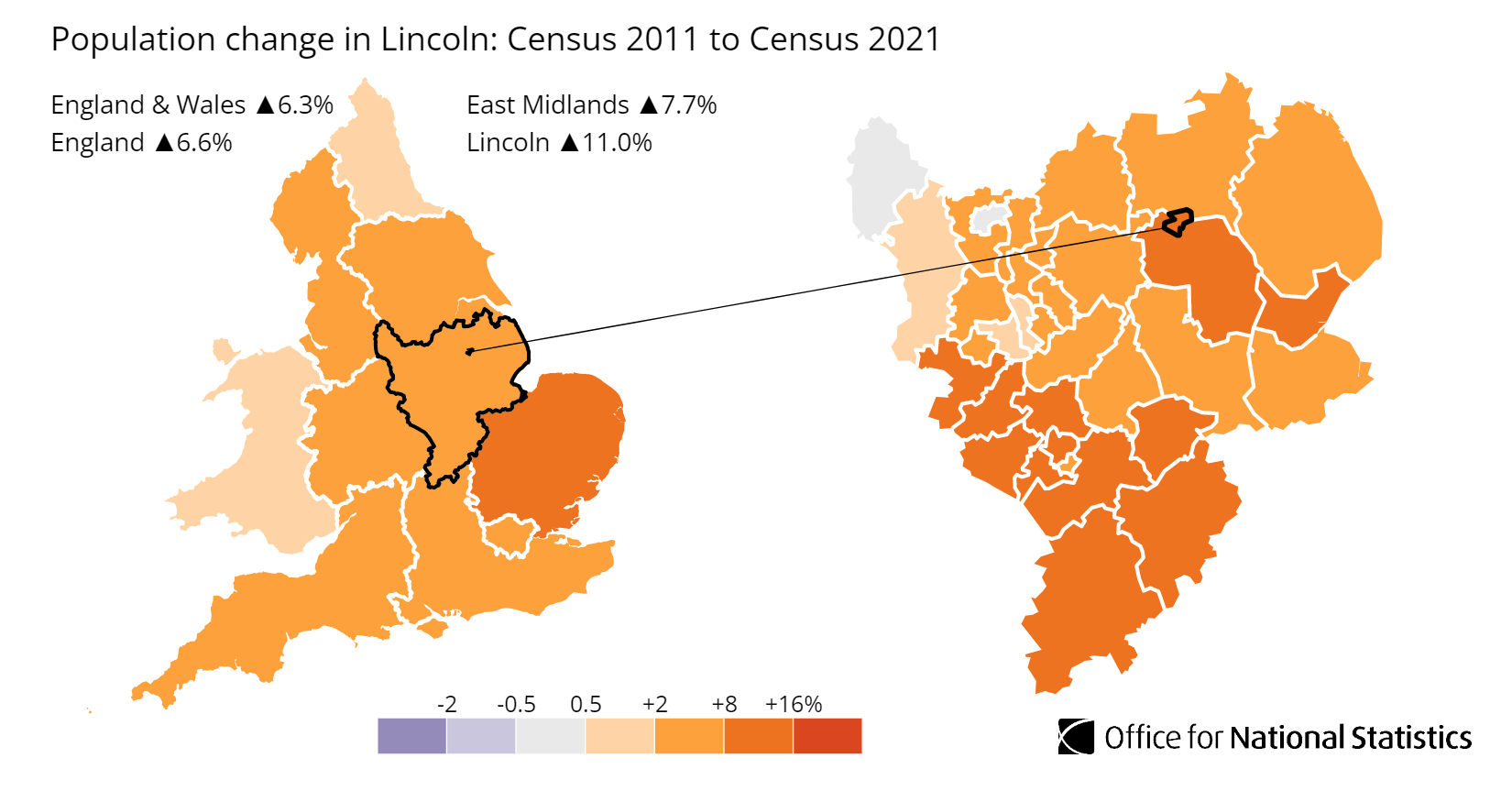
Source: Office for National Statistics - Population for Lincoln
Regeneration and Investment in Lincoln
Lincoln has its largest housing scheme in decades under way on its western edge, alongside a completed city-centre market that anchored a wider Town Deal. The two together add new homes on one side of the city and new footfall in the centre.
- Charterholme / Western Growth Corridor (under construction, £500m-plus over its lifetime): Lincoln's biggest development in a generation, delivering around 3,200 new homes on the western fringe with a neighbourhood centre, community facilities, a business park, and new transport links. A bridge crossing the railway and river is under construction, with £20m of government funding secured for road access. A scheme of this size expands the city's housing supply gradually over 15 years or more, and the new infrastructure reaches the LN6 side of the city. Updates at City of Lincoln Council.
- Cornhill Quarter / Be Lincoln Town Deal (Cornhill Market reopened May 2024): The Grade II listed Cornhill Market reopened in May 2024 after an £8.75m restoration, funded by £5.9m from the government's Towns Fund through the Be Lincoln Town Deal, £1.9m from City of Lincoln Council, and £918,000 from Historic England. It now runs as a food, drink, and independent-retail hall in the city centre, part of the wider £19m Town Deal programme reshaping the Cornhill and Sincil Street area. Updates at Cornhill Market Lincoln.
- Sincil Bank Rejuvenation (Town Deal scheme; the county council's timeline lists completion as June 2026): A green corridor for cyclists and pedestrians, a revised traffic system, and gateway improvements near Lincoln City Football Club's ground, funded from the Town Deal. The county council's project timeline lists construction starting September 2024, main highways works complete in March 2025 and the project complete in June 2026, with future dates marked as projected. The works sit in LN5, close to the Sincil Bank terraces that make up a slice of the city's rental stock. Updates at Lincolnshire County Council.
Lincoln Property Market Analysis
Average property prices in Lincoln have risen 439.2% since January 1995, from £34,405 to £185,514. The sections below walk through that history cycle by cycle, then drop into postcode-level detail for sold prices, price per square foot, asking prices, growth, and monthly transaction volumes.
When was the last house price crash in Lincoln?
Lincoln's sold prices are recorded by HM Land Registry at City of Lincoln district level. The House Price Index tracks average prices from January 1995 to March 2026, covering 31 years of market cycles.
The 1995 to 2007 boom: Lincoln started at £34,405 in January 1995. Growth was slow through the late 1990s, and prices reached only £40,730 by January 2000. The 2000s changed that. Prices tripled to a peak of £123,987 in August 2007.
2008 to 2009, the financial crisis: Prices fell from the August 2007 peak of £123,987 to a trough of £102,129 in April 2009, a decline of 17.6% over 20 months. The worst year-on-year reading was -15.4% in April 2009.
The 2010 to 2013 stagnation: Lincoln bounced off the trough quickly, recovering to £108,069 by December 2009, then stalled. Prices traded in a narrow band for four years, sitting at £115,227 by December 2013, still 7.1% below the pre-crash peak.
Recovery, 2014 to 2016: Growth returned. Prices passed the August 2007 peak of £123,987 for the first time in October 2014, at £124,387. That recovery took just over seven years.
The 2017 to 2019 pre-pandemic growth: Steady single-digit growth carried prices from £133,144 in January 2017 to £146,564 by December 2019.
2020 to 2022, the pandemic surge: Prices rose from £150,194 in March 2020 to £185,692 by December 2022, growth of 23.6% in under three years.
The 2023 rate shock: Prices eased from £185,692 in December 2022 to £173,298 by December 2023, a fall of 6.7%.
2024 to present: Prices recovered through 2024 and 2025, reaching an all-time high of £188,087 in December 2025 before easing slightly to £185,514 by the latest March 2026 reading. The current price sits 49.6% above the August 2007 pre-crash peak.
Long-term growth summary:
- 5 years (March 2021 to March 2026): 15.5% growth (£160,656 to £185,514)
- 10 years (March 2016 to March 2026): 38.9% growth (£133,554 to £185,514)
- 15 years (March 2011 to March 2026): 76.0% growth (£105,399 to £185,514)
- 20 years (March 2006 to March 2026): 71.8% growth (£107,957 to £185,514)
- 31 years (January 1995 to March 2026): 439.2% growth (£34,405 to £185,514)
Lincoln's crash took 17.6% off the average, and the 31-year return is 439.2%. Someone who bought at the exact August 2007 peak would be up 49.6% on the Land Registry average today.
- All property types
- Detached
- Semi-detached
- Terraced
- Flats
Source: HM Land Registry House Price Index
| Year | All property types | Detached | Semi-detached | Terraced | Flats |
|---|---|---|---|---|---|
| 1995-01 | £34,405 | £60,250 | £36,531 | £28,390 | £25,261 |
| 1995-02 | £35,106 | £61,259 | £37,463 | £28,923 | £25,732 |
| 1995-03 | £34,688 | £60,384 | £37,002 | £28,614 | £25,387 |
| 1995-04 | £35,225 | £61,107 | £37,607 | £29,080 | £25,790 |
| 1995-05 | £34,420 | £59,561 | £36,681 | £28,473 | £25,214 |
| 1995-06 | £35,050 | £60,707 | £37,386 | £28,961 | £25,793 |
| 1995-07 | £35,085 | £60,957 | £37,385 | £28,980 | £25,685 |
| 1995-08 | £35,886 | £62,638 | £38,213 | £29,613 | £26,105 |
| 1995-09 | £36,073 | £62,936 | £38,360 | £29,804 | £26,119 |
| 1995-10 | £35,993 | £62,986 | £38,436 | £29,618 | £26,206 |
| 1995-11 | £36,334 | £63,679 | £38,918 | £29,812 | £26,680 |
| 1995-12 | £36,199 | £63,648 | £38,878 | £29,614 | £26,593 |
| 1996-01 | £35,944 | £63,321 | £38,580 | £29,407 | £26,198 |
| 1996-02 | £35,573 | £62,566 | £38,215 | £29,120 | £25,718 |
| 1996-03 | £36,099 | £63,624 | £38,889 | £29,456 | £26,072 |
| 1996-04 | £36,899 | £64,826 | £39,720 | £30,172 | £26,710 |
| 1996-05 | £37,066 | £65,035 | £39,812 | £30,386 | £26,860 |
| 1996-06 | £36,263 | £63,431 | £38,827 | £29,850 | £26,363 |
| 1996-07 | £36,086 | £63,164 | £38,621 | £29,713 | £26,143 |
| 1996-08 | £36,293 | £63,865 | £38,805 | £29,847 | £26,129 |
| 1996-09 | £37,006 | £65,378 | £39,494 | £30,444 | £26,410 |
| 1996-10 | £36,469 | £64,652 | £38,957 | £29,936 | £25,939 |
| 1996-11 | £36,290 | £64,203 | £38,820 | £29,772 | £25,894 |
| 1996-12 | £36,174 | £63,910 | £38,780 | £29,644 | £25,691 |
| 1997-01 | £36,745 | £64,835 | £39,326 | £30,179 | £26,048 |
| 1997-02 | £36,740 | £65,009 | £39,350 | £30,128 | £26,035 |
| 1997-03 | £36,658 | £64,898 | £39,208 | £30,085 | £26,114 |
| 1997-04 | £36,541 | £64,476 | £39,152 | £29,991 | £26,069 |
| 1997-05 | £36,744 | £64,568 | £39,351 | £30,230 | £26,076 |
| 1997-06 | £36,692 | £64,499 | £39,297 | £30,190 | £25,872 |
| 1997-07 | £37,701 | £66,345 | £40,256 | £31,086 | £26,379 |
| 1997-08 | £37,713 | £66,555 | £40,233 | £31,079 | £26,350 |
| 1997-09 | £37,879 | £66,782 | £40,390 | £31,240 | £26,467 |
| 1997-10 | £36,946 | £65,355 | £39,511 | £30,360 | £25,864 |
| 1997-11 | £37,173 | £65,897 | £39,830 | £30,476 | £26,038 |
| 1997-12 | £37,994 | £67,556 | £40,825 | £31,050 | £26,535 |
| 1998-01 | £38,038 | £67,741 | £40,801 | £31,104 | £26,548 |
| 1998-02 | £37,734 | £67,091 | £40,460 | £30,879 | £26,487 |
| 1998-03 | £36,715 | £65,168 | £39,337 | £30,091 | £25,748 |
| 1998-04 | £36,875 | £65,296 | £39,605 | £30,204 | £25,878 |
| 1998-05 | £37,630 | £66,515 | £40,371 | £30,884 | £26,209 |
| 1998-06 | £38,535 | £68,189 | £41,312 | £31,619 | £26,955 |
| 1998-07 | £38,791 | £68,666 | £41,499 | £31,873 | £27,055 |
| 1998-08 | £38,695 | £68,779 | £41,334 | £31,770 | £26,930 |
| 1998-09 | £38,337 | £68,289 | £40,930 | £31,467 | £26,550 |
| 1998-10 | £38,287 | £68,386 | £40,910 | £31,363 | £26,617 |
| 1998-11 | £38,556 | £69,156 | £41,375 | £31,426 | £26,957 |
| 1998-12 | £38,764 | £69,449 | £41,697 | £31,546 | £27,344 |
| 1999-01 | £38,740 | £69,371 | £41,737 | £31,495 | £27,394 |
| 1999-02 | £38,941 | £69,496 | £41,941 | £31,704 | £27,612 |
| 1999-03 | £39,212 | £70,000 | £42,243 | £31,913 | £27,797 |
| 1999-04 | £39,780 | £70,729 | £42,826 | £32,467 | £28,088 |
| 1999-05 | £39,742 | £70,490 | £42,743 | £32,514 | £27,863 |
| 1999-06 | £40,195 | £71,240 | £43,135 | £32,957 | £28,081 |
| 1999-07 | £40,345 | £71,730 | £43,202 | £33,084 | £28,109 |
| 1999-08 | £41,092 | £73,135 | £43,900 | £33,739 | £28,576 |
| 1999-09 | £40,341 | £71,937 | £43,023 | £33,140 | £27,944 |
| 1999-10 | £40,221 | £71,971 | £43,018 | £32,906 | £28,031 |
| 1999-11 | £39,927 | £71,438 | £42,762 | £32,624 | £27,942 |
| 1999-12 | £40,482 | £72,313 | £43,408 | £33,065 | £28,468 |
| 2000-01 | £40,730 | £72,764 | £43,686 | £33,278 | £28,458 |
| 2000-02 | £41,040 | £73,587 | £44,048 | £33,470 | £28,516 |
| 2000-03 | £41,558 | £74,637 | £44,727 | £33,821 | £28,670 |
| 2000-04 | £42,184 | £75,537 | £45,330 | £34,396 | £29,260 |
| 2000-05 | £43,013 | £76,806 | £46,246 | £35,085 | £29,994 |
| 2000-06 | £43,385 | £77,438 | £46,622 | £35,381 | £30,458 |
| 2000-07 | £43,658 | £78,317 | £47,006 | £35,490 | £30,478 |
| 2000-08 | £43,818 | £79,004 | £47,238 | £35,490 | £30,667 |
| 2000-09 | £44,261 | £80,306 | £47,681 | £35,766 | £30,924 |
| 2000-10 | £44,428 | £80,818 | £47,973 | £35,780 | £31,162 |
| 2000-11 | £44,579 | £81,357 | £48,157 | £35,821 | £31,356 |
| 2000-12 | £44,312 | £80,786 | £48,006 | £35,522 | £31,395 |
| 2001-01 | £44,766 | £81,523 | £48,379 | £35,950 | £31,851 |
| 2001-02 | £44,425 | £80,577 | £47,983 | £35,760 | £31,568 |
| 2001-03 | £45,247 | £82,035 | £48,843 | £36,464 | £31,957 |
| 2001-04 | £46,253 | £83,770 | £49,883 | £37,311 | £32,682 |
| 2001-05 | £47,237 | £85,331 | £50,941 | £38,135 | £33,501 |
| 2001-06 | £48,286 | £86,961 | £51,970 | £39,061 | £34,457 |
| 2001-07 | £48,689 | £87,693 | £52,416 | £39,382 | £34,721 |
| 2001-08 | £49,789 | £90,020 | £53,498 | £40,263 | £35,521 |
| 2001-09 | £50,683 | £92,041 | £54,368 | £40,967 | £36,113 |
| 2001-10 | £51,549 | £93,702 | £55,372 | £41,613 | £36,764 |
| 2001-11 | £53,207 | £96,877 | £57,360 | £42,820 | £37,999 |
| 2001-12 | £53,188 | £96,706 | £57,554 | £42,698 | £38,364 |
| 2002-01 | £53,905 | £98,136 | £58,347 | £43,239 | £38,983 |
| 2002-02 | £53,162 | £96,714 | £57,427 | £42,707 | £38,471 |
| 2002-03 | £54,891 | £99,712 | £59,276 | £44,147 | £39,474 |
| 2002-04 | £56,457 | £102,191 | £60,908 | £45,481 | £40,816 |
| 2002-05 | £59,039 | £106,431 | £63,784 | £47,586 | £42,747 |
| 2002-06 | £61,159 | £110,111 | £65,876 | £49,405 | £44,440 |
| 2002-07 | £63,002 | £113,375 | £67,764 | £50,963 | £45,584 |
| 2002-08 | £65,653 | £118,212 | £70,561 | £53,120 | £47,544 |
| 2002-09 | £67,890 | £122,486 | £73,189 | £54,795 | £48,925 |
| 2002-10 | £69,648 | £125,918 | £75,360 | £56,027 | £50,336 |
| 2002-11 | £69,598 | £126,168 | £75,335 | £55,913 | £50,338 |
| 2002-12 | £70,381 | £127,121 | £76,283 | £56,549 | £51,245 |
| 2003-01 | £71,979 | £129,644 | £77,821 | £57,985 | £52,465 |
| 2003-02 | £73,369 | £131,529 | £79,384 | £59,189 | £53,303 |
| 2003-03 | £73,978 | £132,770 | £79,854 | £59,764 | £53,490 |
| 2003-04 | £76,301 | £136,642 | £82,508 | £61,608 | £55,338 |
| 2003-05 | £80,374 | £143,882 | £86,972 | £64,866 | £58,478 |
| 2003-06 | £83,768 | £149,385 | £90,757 | £67,612 | £61,476 |
| 2003-07 | £85,458 | £151,647 | £92,587 | £69,108 | £62,652 |
| 2003-08 | £86,359 | £152,373 | £93,420 | £70,045 | £63,506 |
| 2003-09 | £88,367 | £155,474 | £95,529 | £71,799 | £64,672 |
| 2003-10 | £88,838 | £156,163 | £95,931 | £72,255 | £65,077 |
| 2003-11 | £90,057 | £158,272 | £97,336 | £73,215 | £65,866 |
| 2003-12 | £90,611 | £158,032 | £97,833 | £73,903 | £66,676 |
| 2004-01 | £92,512 | £160,991 | £99,756 | £75,580 | £68,079 |
| 2004-02 | £92,906 | £160,783 | £100,009 | £76,127 | £68,710 |
| 2004-03 | £95,015 | £164,465 | £102,076 | £77,981 | £70,143 |
| 2004-04 | £97,612 | £166,955 | £104,860 | £80,554 | £72,182 |
| 2004-05 | £100,771 | £170,627 | £108,059 | £83,653 | £74,541 |
| 2004-06 | £102,343 | £171,901 | £109,774 | £85,240 | £75,894 |
| 2004-07 | £102,585 | £171,750 | £110,073 | £85,555 | £76,053 |
| 2004-08 | £103,994 | £174,057 | £111,581 | £86,769 | £76,903 |
| 2004-09 | £104,307 | £174,737 | £111,850 | £87,063 | £76,852 |
| 2004-10 | £105,767 | £177,421 | £113,248 | £88,288 | £78,091 |
| 2004-11 | £105,918 | £177,454 | £113,319 | £88,485 | £78,421 |
| 2004-12 | £104,579 | £174,401 | £111,757 | £87,564 | £77,892 |
| 2005-01 | £102,027 | £170,049 | £108,800 | £85,555 | £76,082 |
| 2005-02 | £102,414 | £170,363 | £109,247 | £85,916 | £76,331 |
| 2005-03 | £105,714 | £175,862 | £112,891 | £88,613 | £78,596 |
| 2005-04 | £110,328 | £182,349 | £117,972 | £92,629 | £82,063 |
| 2005-05 | £109,759 | £181,302 | £117,167 | £92,249 | £81,859 |
| 2005-06 | £108,814 | £178,438 | £115,863 | £91,879 | £81,228 |
| 2005-07 | £108,304 | £177,501 | £115,224 | £91,530 | £80,820 |
| 2005-08 | £110,279 | £180,501 | £117,142 | £93,385 | £82,095 |
| 2005-09 | £111,218 | £182,427 | £118,078 | £94,144 | £82,726 |
| 2005-10 | £109,958 | £180,345 | £116,520 | £93,179 | £81,967 |
| 2005-11 | £110,395 | £180,690 | £116,976 | £93,603 | £82,455 |
| 2005-12 | £110,379 | £179,891 | £116,750 | £93,795 | £82,921 |
| 2006-01 | £110,723 | £180,141 | £117,014 | £94,273 | £82,797 |
| 2006-02 | £108,115 | £175,095 | £114,120 | £92,211 | £80,989 |
| 2006-03 | £107,957 | £175,275 | £114,168 | £91,978 | £80,112 |
| 2006-04 | £109,934 | £177,863 | £116,266 | £93,799 | £81,615 |
| 2006-05 | £112,473 | £181,893 | £119,124 | £95,975 | £83,209 |
| 2006-06 | £114,257 | £183,752 | £120,965 | £97,779 | £84,528 |
| 2006-07 | £113,930 | £182,950 | £120,542 | £97,742 | £83,902 |
| 2006-08 | £113,571 | £182,418 | £120,108 | £97,710 | £82,882 |
| 2006-09 | £114,358 | £184,243 | £120,956 | £98,343 | £83,148 |
| 2006-10 | £115,359 | £186,246 | £122,038 | £99,092 | £83,879 |
| 2006-11 | £116,430 | £187,998 | £123,244 | £99,976 | £84,625 |
| 2006-12 | £116,527 | £187,279 | £123,228 | £100,299 | £84,837 |
| 2007-01 | £118,184 | £189,741 | £125,011 | £101,799 | £85,921 |
| 2007-02 | £119,532 | £191,714 | £126,324 | £102,911 | £87,407 |
| 2007-03 | £119,416 | £191,873 | £126,177 | £102,864 | £86,913 |
| 2007-04 | £119,126 | £190,858 | £125,754 | £102,845 | £86,571 |
| 2007-05 | £120,488 | £192,260 | £127,043 | £104,294 | £87,508 |
| 2007-06 | £123,470 | £196,664 | £130,074 | £106,975 | £89,810 |
| 2007-07 | £123,623 | £197,116 | £130,159 | £107,100 | £89,964 |
| 2007-08 | £123,987 | £198,512 | £130,570 | £107,519 | £89,335 |
| 2007-09 | £122,659 | £196,925 | £129,241 | £106,306 | £88,088 |
| 2007-10 | £122,589 | £197,337 | £129,106 | £106,168 | £88,058 |
| 2007-11 | £122,193 | £197,127 | £128,752 | £105,586 | £88,113 |
| 2007-12 | £121,682 | £196,337 | £128,093 | £105,102 | £88,091 |
| 2008-01 | £122,916 | £198,467 | £129,281 | £106,150 | £89,165 |
| 2008-02 | £120,763 | £194,804 | £126,910 | £104,338 | £87,846 |
| 2008-03 | £121,966 | £197,299 | £128,493 | £105,267 | £88,326 |
| 2008-04 | £120,701 | £195,379 | £127,172 | £104,303 | £87,076 |
| 2008-05 | £119,253 | £192,657 | £125,803 | £103,068 | £86,000 |
| 2008-06 | £116,568 | £187,700 | £122,807 | £100,935 | £84,192 |
| 2008-07 | £115,542 | £185,823 | £122,032 | £99,877 | £83,539 |
| 2008-08 | £116,234 | £187,181 | £122,711 | £100,560 | £83,806 |
| 2008-09 | £112,932 | £183,217 | £119,062 | £97,494 | £81,367 |
| 2008-10 | £110,054 | £179,079 | £116,070 | £94,887 | £79,223 |
| 2008-11 | £107,061 | £174,514 | £112,995 | £92,174 | £77,083 |
| 2008-12 | £106,138 | £172,366 | £112,175 | £91,524 | £76,262 |
| 2009-01 | £106,574 | £173,575 | £112,488 | £91,691 | £76,933 |
| 2009-02 | £104,119 | £169,781 | £109,940 | £89,332 | £75,669 |
| 2009-03 | £103,623 | £169,162 | £109,382 | £88,617 | £76,074 |
| 2009-04 | £102,129 | £166,066 | £108,031 | £87,423 | £74,957 |
| 2009-05 | £102,530 | £166,310 | £108,566 | £87,904 | £74,990 |
| 2009-06 | £104,202 | £168,849 | £110,522 | £89,442 | £75,622 |
| 2009-07 | £104,400 | £169,241 | £110,769 | £89,747 | £75,100 |
| 2009-08 | £106,449 | £173,039 | £112,873 | £91,576 | £75,911 |
| 2009-09 | £105,536 | £171,802 | £111,954 | £90,799 | £74,821 |
| 2009-10 | £106,418 | £173,438 | £113,122 | £91,452 | £75,089 |
| 2009-11 | £105,504 | £172,209 | £112,092 | £90,710 | £74,109 |
| 2009-12 | £108,069 | £175,583 | £114,987 | £93,157 | £75,653 |
| 2010-01 | £106,287 | £173,585 | £113,076 | £91,591 | £73,512 |
| 2010-02 | £107,679 | £175,997 | £114,983 | £92,630 | £73,995 |
| 2010-03 | £106,157 | £174,951 | £113,415 | £90,888 | £72,763 |
| 2010-04 | £107,746 | £176,958 | £115,315 | £92,217 | £74,270 |
| 2010-05 | £108,661 | £178,601 | £116,292 | £92,892 | £75,202 |
| 2010-06 | £108,834 | £178,335 | £116,623 | £93,220 | £74,893 |
| 2010-07 | £108,069 | £177,441 | £115,738 | £92,592 | £73,956 |
| 2010-08 | £106,840 | £175,794 | £114,509 | £91,520 | £72,535 |
| 2010-09 | £105,320 | £174,227 | £112,749 | £90,072 | £71,276 |
| 2010-10 | £105,229 | £174,469 | £112,650 | £89,856 | £71,329 |
| 2010-11 | £106,209 | £176,573 | £113,652 | £90,527 | £72,230 |
| 2010-12 | £107,291 | £178,186 | £114,924 | £91,409 | £73,105 |
| 2011-01 | £106,667 | £177,497 | £114,194 | £90,783 | £72,806 |
| 2011-02 | £106,161 | £176,598 | £113,463 | £90,476 | £72,467 |
| 2011-03 | £105,399 | £176,399 | £112,485 | £89,606 | £71,975 |
| 2011-04 | £106,330 | £177,871 | £113,362 | £90,493 | £72,625 |
| 2011-05 | £106,421 | £177,742 | £113,568 | £90,493 | £73,064 |
| 2011-06 | £108,157 | £179,328 | £115,656 | £92,211 | £74,330 |
| 2011-07 | £108,177 | £178,939 | £115,743 | £92,289 | £74,463 |
| 2011-08 | £107,440 | £177,976 | £115,114 | £91,679 | £73,185 |
| 2011-09 | £105,897 | £175,925 | £113,371 | £90,385 | £71,654 |
| 2011-10 | £104,761 | £174,641 | £112,362 | £89,213 | £70,459 |
| 2011-11 | £104,462 | £174,095 | £112,082 | £88,819 | £70,754 |
| 2011-12 | £104,945 | £174,765 | £112,782 | £89,092 | £71,334 |
| 2012-01 | £107,016 | £177,732 | £115,192 | £90,913 | £72,639 |
| 2012-02 | £109,322 | £181,267 | £117,683 | £93,110 | £73,611 |
| 2012-03 | £108,978 | £179,942 | £117,388 | £93,017 | £73,330 |
| 2012-04 | £108,986 | £180,119 | £117,221 | £93,026 | £73,560 |
| 2012-05 | £106,535 | £176,186 | £114,496 | £90,919 | £72,046 |
| 2012-06 | £106,511 | £176,174 | £114,199 | £91,101 | £71,845 |
| 2012-07 | £106,578 | £175,851 | £114,262 | £91,347 | £71,680 |
| 2012-08 | £107,825 | £177,568 | £115,591 | £92,625 | £72,110 |
| 2012-09 | £110,424 | £182,408 | £118,393 | £94,716 | £73,681 |
| 2012-10 | £110,399 | £182,457 | £118,448 | £94,609 | £73,702 |
| 2012-11 | £110,124 | £182,286 | £118,180 | £94,233 | £73,668 |
| 2012-12 | £109,354 | £181,286 | £117,473 | £93,420 | £73,135 |
| 2013-01 | £108,509 | £180,027 | £116,834 | £92,566 | £72,269 |
| 2013-02 | £106,921 | £177,302 | £115,127 | £91,188 | £71,284 |
| 2013-03 | £107,767 | £178,913 | £116,093 | £91,720 | £72,043 |
| 2013-04 | £109,525 | £181,792 | £117,791 | £93,295 | £73,338 |
| 2013-05 | £112,254 | £186,039 | £120,813 | £95,596 | £75,331 |
| 2013-06 | £112,920 | £186,244 | £121,564 | £96,473 | £75,569 |
| 2013-07 | £113,408 | £186,589 | £121,937 | £97,117 | £75,869 |
| 2013-08 | £114,945 | £189,145 | £123,542 | £98,561 | £76,584 |
| 2013-09 | £116,112 | £192,062 | £124,747 | £99,309 | £77,349 |
| 2013-10 | £115,745 | £192,478 | £124,541 | £98,592 | £77,114 |
| 2013-11 | £115,819 | £193,224 | £124,764 | £98,370 | £77,241 |
| 2013-12 | £115,227 | £191,468 | £124,322 | £97,916 | £77,019 |
| 2014-01 | £115,532 | £191,711 | £124,511 | £98,321 | £77,241 |
| 2014-02 | £116,795 | £193,794 | £125,828 | £99,452 | £77,958 |
| 2014-03 | £118,713 | £197,196 | £127,987 | £100,997 | £79,089 |
| 2014-04 | £121,647 | £201,452 | £131,250 | £103,599 | £80,992 |
| 2014-05 | £122,607 | £202,489 | £132,250 | £104,527 | £81,784 |
| 2014-06 | £122,986 | £202,996 | £132,547 | £105,003 | £81,782 |
| 2014-07 | £122,246 | £201,858 | £131,696 | £104,459 | £80,989 |
| 2014-08 | £123,045 | £203,536 | £132,575 | £105,173 | £81,032 |
| 2014-09 | £123,692 | £204,753 | £133,210 | £105,738 | £81,408 |
| 2014-10 | £124,387 | £206,319 | £134,062 | £106,155 | £81,959 |
| 2014-11 | £124,250 | £206,477 | £134,061 | £105,809 | £82,099 |
| 2014-12 | £123,512 | £205,568 | £133,389 | £104,981 | £81,838 |
| 2015-01 | £123,784 | £205,752 | £133,834 | £105,152 | £82,181 |
| 2015-02 | £123,486 | £204,716 | £133,427 | £104,949 | £82,397 |
| 2015-03 | £124,355 | £206,494 | £134,553 | £105,483 | £83,051 |
| 2015-04 | £124,867 | £207,747 | £135,002 | £105,907 | £83,262 |
| 2015-05 | £127,368 | £212,160 | £137,929 | £107,949 | £84,630 |
| 2015-06 | £127,593 | £212,134 | £138,100 | £108,454 | £84,196 |
| 2015-07 | £129,688 | £215,241 | £140,583 | £110,241 | £85,519 |
| 2015-08 | £127,394 | £211,599 | £137,996 | £108,408 | £83,650 |
| 2015-09 | £127,876 | £213,298 | £138,374 | £108,618 | £84,121 |
| 2015-10 | £126,758 | £212,340 | £137,065 | £107,561 | £83,164 |
| 2015-11 | £129,796 | £217,840 | £140,495 | £109,969 | £85,144 |
| 2015-12 | £131,087 | £219,907 | £142,085 | £111,011 | £85,936 |
| 2016-01 | £133,068 | £222,637 | £144,416 | £112,723 | £87,309 |
| 2016-02 | £133,406 | £222,945 | £144,840 | £113,058 | £87,491 |
| 2016-03 | £133,554 | £223,105 | £144,939 | £113,198 | £87,710 |
| 2016-04 | £132,435 | £221,549 | £143,710 | £112,204 | £86,895 |
| 2016-05 | £131,127 | £218,719 | £142,007 | £111,220 | £86,600 |
| 2016-06 | £131,200 | £218,984 | £142,094 | £111,237 | £86,667 |
| 2016-07 | £133,219 | £221,902 | £144,058 | £113,157 | £88,038 |
| 2016-08 | £135,163 | £225,873 | £146,265 | £114,657 | £89,057 |
| 2016-09 | £137,535 | £229,854 | £148,907 | £116,654 | £90,536 |
| 2016-10 | £138,051 | £231,795 | £149,678 | £116,584 | £91,331 |
| 2016-11 | £137,852 | £232,522 | £149,549 | £116,077 | £91,321 |
| 2016-12 | £134,689 | £227,570 | £146,032 | £113,260 | £89,561 |
| 2017-01 | £133,144 | £225,105 | £144,190 | £112,039 | £88,421 |
| 2017-02 | £132,962 | £224,210 | £143,770 | £111,999 | £88,811 |
| 2017-03 | £134,310 | £226,603 | £145,334 | £112,972 | £89,998 |
| 2017-04 | £135,156 | £227,651 | £146,295 | £113,640 | £90,950 |
| 2017-05 | £136,005 | £228,548 | £147,593 | £114,267 | £91,558 |
| 2017-06 | £136,354 | £228,254 | £147,991 | £114,702 | £91,977 |
| 2017-07 | £137,376 | £229,436 | £149,028 | £115,709 | £92,715 |
| 2017-08 | £138,883 | £231,881 | £150,331 | £117,214 | £93,571 |
| 2017-09 | £141,497 | £236,751 | £153,044 | £119,452 | £95,015 |
| 2017-10 | £141,410 | £237,248 | £153,202 | £119,166 | £94,708 |
| 2017-11 | £139,870 | £235,217 | £151,886 | £117,598 | £93,518 |
| 2017-12 | £140,599 | £236,250 | £152,929 | £118,166 | £93,849 |
| 2018-01 | £142,302 | £239,071 | £154,868 | £119,566 | £94,967 |
| 2018-02 | £145,480 | £244,376 | £158,264 | £122,382 | £96,762 |
| 2018-03 | £145,003 | £243,773 | £157,703 | £122,063 | £96,120 |
| 2018-04 | £144,681 | £243,102 | £157,348 | £122,004 | £95,323 |
| 2018-05 | £143,737 | £241,557 | £156,429 | £121,225 | £94,410 |
| 2018-06 | £143,048 | £240,368 | £155,874 | £120,526 | £94,016 |
| 2018-07 | £143,827 | £241,918 | £156,692 | £121,119 | £94,589 |
| 2018-08 | £144,021 | £242,224 | £156,847 | £121,332 | £94,675 |
| 2018-09 | £146,195 | £246,036 | £159,127 | £123,257 | £95,809 |
| 2018-10 | £147,560 | £248,359 | £160,706 | £124,382 | £96,598 |
| 2018-11 | £148,198 | £250,092 | £161,590 | £124,710 | £96,791 |
| 2018-12 | £146,996 | £248,028 | £160,473 | £123,545 | £96,195 |
| 2019-01 | £146,728 | £248,353 | £160,345 | £123,069 | £95,879 |
| 2019-02 | £148,635 | £251,373 | £162,429 | £124,616 | £97,345 |
| 2019-03 | £152,391 | £258,115 | £166,788 | £127,741 | £99,224 |
| 2019-04 | £152,910 | £258,307 | £167,375 | £128,483 | £99,258 |
| 2019-05 | £151,616 | £255,790 | £166,086 | £127,743 | £97,719 |
| 2019-06 | £149,309 | £251,567 | £163,393 | £126,002 | £96,175 |
| 2019-07 | £150,889 | £253,649 | £164,893 | £127,535 | £97,346 |
| 2019-08 | £150,637 | £253,078 | £164,517 | £127,438 | £97,136 |
| 2019-09 | £150,264 | £252,224 | £163,807 | £127,336 | £96,911 |
| 2019-10 | £148,539 | £249,673 | £162,484 | £125,593 | £95,571 |
| 2019-11 | £148,031 | £249,277 | £162,207 | £124,920 | £95,192 |
| 2019-12 | £146,564 | £247,184 | £160,943 | £123,548 | £93,937 |
| 2020-01 | £146,572 | £247,381 | £160,903 | £123,520 | £93,974 |
| 2020-02 | £148,019 | £249,759 | £162,460 | £124,782 | £94,669 |
| 2020-03 | £150,194 | £253,330 | £164,929 | £126,504 | £96,195 |
| 2020-04 | £150,684 | £254,426 | £165,354 | £127,141 | £95,653 |
| 2020-05 | £151,063 | £255,332 | £165,840 | £127,273 | £96,229 |
| 2020-06 | £154,560 | £261,172 | £169,739 | £130,328 | £97,979 |
| 2020-07 | £153,846 | £259,350 | £169,002 | £129,701 | £98,065 |
| 2020-08 | £153,356 | £258,403 | £168,680 | £129,361 | £97,131 |
| 2020-09 | £148,723 | £250,927 | £163,514 | £125,449 | £94,064 |
| 2020-10 | £151,857 | £257,431 | £166,901 | £128,055 | £95,247 |
| 2020-11 | £153,051 | £259,885 | £167,800 | £129,244 | £95,789 |
| 2020-12 | £156,009 | £264,879 | £170,854 | £131,925 | £97,380 |
| 2021-01 | £156,005 | £263,131 | £170,703 | £132,164 | £98,300 |
| 2021-02 | £158,610 | £265,396 | £173,257 | £134,850 | £100,815 |
| 2021-03 | £160,656 | £266,829 | £175,221 | £136,957 | £103,282 |
| 2021-04 | £164,165 | £272,248 | £178,753 | £140,266 | £105,473 |
| 2021-05 | £165,614 | £275,054 | £180,414 | £141,407 | £106,165 |
| 2021-06 | £169,636 | £280,965 | £184,321 | £145,430 | £108,529 |
| 2021-07 | £166,989 | £276,906 | £181,904 | £142,877 | £106,538 |
| 2021-08 | £167,118 | £277,734 | £182,334 | £142,832 | £105,969 |
| 2021-09 | £168,571 | £280,680 | £184,439 | £143,753 | £106,361 |
| 2021-10 | £173,636 | £291,668 | £189,826 | £147,617 | £108,982 |
| 2021-11 | £174,802 | £294,358 | £191,160 | £148,392 | £109,623 |
| 2021-12 | £173,464 | £294,116 | £189,819 | £146,794 | £108,142 |
| 2022-01 | £172,932 | £291,514 | £189,462 | £146,789 | £107,480 |
| 2022-02 | £175,039 | £294,278 | £191,791 | £148,833 | £108,798 |
| 2022-03 | £175,964 | £295,858 | £193,265 | £149,415 | £109,095 |
| 2022-04 | £177,744 | £298,641 | £195,030 | £151,116 | £110,214 |
| 2022-05 | £175,438 | £294,649 | £192,593 | £149,244 | £108,340 |
| 2022-06 | £176,440 | £295,504 | £193,513 | £150,473 | £109,020 |
| 2022-07 | £175,346 | £292,725 | £192,489 | £149,849 | £107,909 |
| 2022-08 | £180,199 | £300,491 | £197,660 | £154,319 | £110,465 |
| 2022-09 | £181,302 | £302,234 | £198,881 | £155,405 | £110,678 |
| 2022-10 | £185,429 | £309,998 | £203,300 | £158,736 | £113,123 |
| 2022-11 | £184,016 | £307,988 | £201,861 | £157,349 | £112,213 |
| 2022-12 | £185,692 | £310,775 | £203,758 | £158,704 | £113,413 |
| 2023-01 | £180,844 | £302,800 | £198,745 | £154,369 | £110,231 |
| 2023-02 | £182,340 | £306,066 | £200,349 | £155,359 | £111,232 |
| 2023-03 | £178,750 | £301,528 | £196,779 | £151,660 | £108,847 |
| 2023-04 | £183,115 | £309,639 | £201,776 | £155,057 | £111,617 |
| 2023-05 | £181,036 | £305,652 | £199,595 | £153,291 | £110,500 |
| 2023-06 | £183,342 | £308,448 | £201,864 | £155,661 | £111,825 |
| 2023-07 | £180,111 | £301,836 | £198,372 | £153,206 | £109,717 |
| 2023-08 | £182,251 | £305,047 | £200,690 | £155,346 | £110,455 |
| 2023-09 | £180,809 | £302,400 | £199,066 | £154,316 | £109,247 |
| 2023-10 | £179,339 | £299,349 | £197,095 | £153,278 | £108,609 |
| 2023-11 | £175,363 | £293,506 | £193,137 | £149,426 | £106,379 |
| 2023-12 | £173,298 | £289,991 | £191,149 | £147,445 | £105,363 |
| 2024-01 | £170,921 | £286,536 | £188,524 | £145,385 | £103,701 |
| 2024-02 | £171,621 | £286,312 | £189,230 | £146,328 | £104,082 |
| 2024-03 | £173,384 | £289,245 | £191,117 | £147,721 | £105,555 |
| 2024-04 | £176,178 | £292,905 | £194,187 | £150,207 | £107,689 |
| 2024-05 | £179,890 | £298,820 | £198,106 | £153,424 | £110,306 |
| 2024-06 | £175,698 | £291,220 | £193,193 | £150,278 | £107,473 |
| 2024-07 | £177,292 | £293,456 | £195,028 | £151,945 | £107,705 |
| 2024-08 | £175,070 | £289,661 | £192,505 | £150,337 | £105,722 |
| 2024-09 | £179,989 | £298,325 | £198,202 | £154,484 | £108,014 |
| 2024-10 | £180,344 | £299,947 | £198,401 | £154,576 | £108,448 |
| 2024-11 | £179,304 | £298,986 | £197,526 | £153,450 | £107,473 |
| 2024-12 | £179,563 | £300,428 | £197,781 | £153,525 | £107,392 |
| 2025-01 | £180,394 | £302,113 | £199,022 | £154,252 | £107,049 |
| 2025-02 | £183,680 | £307,260 | £202,395 | £157,324 | £108,944 |
| 2025-03 | £184,357 | £305,232 | £202,828 | £158,559 | £110,311 |
| 2025-04 | £185,966 | £308,919 | £204,978 | £159,575 | £110,953 |
| 2025-05 | £185,907 | £309,170 | £205,098 | £159,536 | £110,310 |
| 2025-06 | £184,253 | £308,414 | £203,860 | £157,718 | £107,975 |
| 2025-07 | £182,861 | £304,363 | £202,025 | £157,206 | £106,945 |
| 2025-08 | £183,144 | £303,856 | £202,606 | £157,630 | £106,850 |
| 2025-09 | £184,173 | £305,715 | £203,840 | £158,597 | £106,943 |
| 2025-10 | £186,612 | £309,814 | £206,798 | £160,579 | £108,227 |
| 2025-11 | £186,894 | £310,490 | £207,143 | £160,770 | £108,327 |
| 2025-12 | £188,087 | £311,728 | £208,419 | £162,004 | £109,044 |
| 2026-01 | £185,472 | £307,129 | £205,665 | £159,882 | £107,111 |
| 2026-02 | £185,051 | £306,773 | £205,349 | £159,471 | £106,478 |
| 2026-03 | £185,514 | £307,784 | £206,199 | £159,927 | £105,912 |
- All property types
- Detached
- Semi-detached
- Terraced
- Flats
Source: HM Land Registry House Price Index
| Year | All property types | Detached | Semi-detached | Terraced | Flats |
|---|---|---|---|---|---|
| 1996-01 | +4.5% | +5.1% | +5.6% | +3.6% | +3.7% |
| 1996-02 | +1.3% | +2.1% | +2.0% | +0.7% | -0.1% |
| 1996-03 | +4.1% | +5.4% | +5.1% | +2.9% | +2.7% |
| 1996-04 | +4.8% | +6.1% | +5.6% | +3.8% | +3.6% |
| 1996-05 | +7.7% | +9.2% | +8.5% | +6.7% | +6.5% |
| 1996-06 | +3.5% | +4.5% | +3.9% | +3.1% | +2.2% |
| 1996-07 | +2.9% | +3.6% | +3.3% | +2.5% | +1.8% |
| 1996-08 | +1.1% | +2.0% | +1.5% | +0.8% | +0.1% |
| 1996-09 | +2.6% | +3.9% | +3.0% | +2.1% | +1.1% |
| 1996-10 | +1.3% | +2.6% | +1.4% | +1.1% | -1.0% |
| 1996-11 | -0.1% | +0.8% | -0.3% | -0.1% | -2.9% |
| 1996-12 | -0.1% | +0.4% | -0.3% | +0.1% | -3.4% |
| 1997-01 | +2.2% | +2.4% | +1.9% | +2.6% | -0.6% |
| 1997-02 | +3.3% | +3.9% | +3.0% | +3.5% | +1.2% |
| 1997-03 | +1.5% | +2.0% | +0.8% | +2.1% | +0.2% |
| 1997-04 | -1.0% | -0.5% | -1.4% | -0.6% | -2.4% |
| 1997-05 | -0.9% | -0.7% | -1.2% | -0.5% | -2.9% |
| 1997-06 | +1.2% | +1.7% | +1.2% | +1.1% | -1.9% |
| 1997-07 | +4.5% | +5.0% | +4.2% | +4.6% | +0.9% |
| 1997-08 | +3.9% | +4.2% | +3.7% | +4.1% | +0.8% |
| 1997-09 | +2.4% | +2.1% | +2.3% | +2.6% | +0.2% |
| 1997-10 | +1.3% | +1.1% | +1.4% | +1.4% | -0.3% |
| 1997-11 | +2.4% | +2.6% | +2.6% | +2.4% | +0.6% |
| 1997-12 | +5.0% | +5.7% | +5.3% | +4.7% | +3.3% |
| 1998-01 | +3.5% | +4.5% | +3.8% | +3.1% | +1.9% |
| 1998-02 | +2.7% | +3.2% | +2.8% | +2.5% | +1.7% |
| 1998-03 | +0.2% | +0.4% | +0.3% | 0.0% | -1.4% |
| 1998-04 | +0.9% | +1.3% | +1.2% | +0.7% | -0.7% |
| 1998-05 | +2.4% | +3.0% | +2.6% | +2.2% | +0.5% |
| 1998-06 | +5.0% | +5.7% | +5.1% | +4.7% | +4.2% |
| 1998-07 | +2.9% | +3.5% | +3.1% | +2.5% | +2.6% |
| 1998-08 | +2.6% | +3.3% | +2.7% | +2.2% | +2.2% |
| 1998-09 | +1.2% | +2.3% | +1.3% | +0.7% | +0.3% |
| 1998-10 | +3.6% | +4.6% | +3.5% | +3.3% | +2.9% |
| 1998-11 | +3.7% | +4.9% | +3.9% | +3.1% | +3.5% |
| 1998-12 | +2.0% | +2.8% | +2.1% | +1.6% | +3.0% |
| 1999-01 | +1.8% | +2.4% | +2.3% | +1.3% | +3.2% |
| 1999-02 | +3.2% | +3.6% | +3.7% | +2.7% | +4.2% |
| 1999-03 | +6.8% | +7.4% | +7.4% | +6.1% | +8.0% |
| 1999-04 | +7.9% | +8.3% | +8.1% | +7.5% | +8.5% |
| 1999-05 | +5.6% | +6.0% | +5.9% | +5.3% | +6.3% |
| 1999-06 | +4.3% | +4.5% | +4.4% | +4.2% | +4.2% |
| 1999-07 | +4.0% | +4.5% | +4.1% | +3.8% | +3.9% |
| 1999-08 | +6.2% | +6.3% | +6.2% | +6.2% | +6.1% |
| 1999-09 | +5.2% | +5.3% | +5.1% | +5.3% | +5.2% |
| 1999-10 | +5.1% | +5.2% | +5.2% | +4.9% | +5.3% |
| 1999-11 | +3.6% | +3.3% | +3.4% | +3.8% | +3.7% |
| 1999-12 | +4.4% | +4.1% | +4.1% | +4.8% | +4.1% |
| 2000-01 | +5.1% | +4.9% | +4.7% | +5.7% | +3.9% |
| 2000-02 | +5.4% | +5.9% | +5.0% | +5.6% | +3.3% |
| 2000-03 | +6.0% | +6.6% | +5.9% | +6.0% | +3.1% |
| 2000-04 | +6.0% | +6.8% | +5.8% | +5.9% | +4.2% |
| 2000-05 | +8.2% | +9.0% | +8.2% | +7.9% | +7.6% |
| 2000-06 | +7.9% | +8.7% | +8.1% | +7.4% | +8.5% |
| 2000-07 | +8.2% | +9.2% | +8.8% | +7.3% | +8.4% |
| 2000-08 | +6.6% | +8.0% | +7.6% | +5.2% | +7.3% |
| 2000-09 | +9.7% | +11.6% | +10.8% | +7.9% | +10.7% |
| 2000-10 | +10.5% | +12.3% | +11.5% | +8.7% | +11.2% |
| 2000-11 | +11.7% | +13.9% | +12.6% | +9.8% | +12.2% |
| 2000-12 | +9.5% | +11.7% | +10.6% | +7.4% | +10.3% |
| 2001-01 | +9.9% | +12.0% | +10.7% | +8.0% | +11.9% |
| 2001-02 | +8.2% | +9.5% | +8.9% | +6.8% | +10.7% |
| 2001-03 | +8.9% | +9.9% | +9.2% | +7.8% | +11.5% |
| 2001-04 | +9.6% | +10.9% | +10.0% | +8.5% | +11.7% |
| 2001-05 | +9.8% | +11.1% | +10.2% | +8.7% | +11.7% |
| 2001-06 | +11.3% | +12.3% | +11.5% | +10.4% | +13.1% |
| 2001-07 | +11.5% | +12.0% | +11.5% | +11.0% | +13.9% |
| 2001-08 | +13.6% | +13.9% | +13.3% | +13.4% | +15.8% |
| 2001-09 | +14.5% | +14.6% | +14.0% | +14.5% | +16.8% |
| 2001-10 | +16.0% | +15.9% | +15.4% | +16.3% | +18.0% |
| 2001-11 | +19.4% | +19.1% | +19.1% | +19.5% | +21.2% |
| 2001-12 | +20.0% | +19.7% | +19.9% | +20.2% | +22.2% |
| 2002-01 | +20.4% | +20.4% | +20.6% | +20.3% | +22.4% |
| 2002-02 | +19.7% | +20.0% | +19.7% | +19.4% | +21.9% |
| 2002-03 | +21.3% | +21.5% | +21.4% | +21.1% | +23.5% |
| 2002-04 | +22.1% | +22.0% | +22.1% | +21.9% | +24.9% |
| 2002-05 | +25.0% | +24.7% | +25.2% | +24.8% | +27.6% |
| 2002-06 | +26.7% | +26.6% | +26.8% | +26.5% | +29.0% |
| 2002-07 | +29.4% | +29.3% | +29.3% | +29.4% | +31.3% |
| 2002-08 | +31.9% | +31.3% | +31.9% | +31.9% | +33.8% |
| 2002-09 | +33.9% | +33.1% | +34.6% | +33.8% | +35.5% |
| 2002-10 | +35.1% | +34.4% | +36.1% | +34.6% | +36.9% |
| 2002-11 | +30.8% | +30.2% | +31.3% | +30.6% | +32.5% |
| 2002-12 | +32.3% | +31.5% | +32.5% | +32.4% | +33.6% |
| 2003-01 | +33.5% | +32.1% | +33.4% | +34.1% | +34.6% |
| 2003-02 | +38.0% | +36.0% | +38.2% | +38.6% | +38.6% |
| 2003-03 | +34.8% | +33.2% | +34.7% | +35.4% | +35.5% |
| 2003-04 | +35.1% | +33.7% | +35.5% | +35.5% | +35.6% |
| 2003-05 | +36.1% | +35.2% | +36.4% | +36.3% | +36.8% |
| 2003-06 | +37.0% | +35.7% | +37.8% | +36.9% | +38.3% |
| 2003-07 | +35.6% | +33.8% | +36.6% | +35.6% | +37.4% |
| 2003-08 | +31.5% | +28.9% | +32.4% | +31.9% | +33.6% |
| 2003-09 | +30.2% | +26.9% | +30.5% | +31.0% | +32.2% |
| 2003-10 | +27.6% | +24.0% | +27.3% | +29.0% | +29.3% |
| 2003-11 | +29.4% | +25.4% | +29.2% | +30.9% | +30.8% |
| 2003-12 | +28.7% | +24.3% | +28.2% | +30.7% | +30.1% |
| 2004-01 | +28.5% | +24.2% | +28.2% | +30.3% | +29.8% |
| 2004-02 | +26.6% | +22.2% | +26.0% | +28.6% | +28.9% |
| 2004-03 | +28.4% | +23.9% | +27.8% | +30.5% | +31.1% |
| 2004-04 | +27.9% | +22.2% | +27.1% | +30.8% | +30.4% |
| 2004-05 | +25.4% | +18.6% | +24.2% | +29.0% | +27.5% |
| 2004-06 | +22.2% | +15.1% | +21.0% | +26.1% | +23.5% |
| 2004-07 | +20.0% | +13.3% | +18.9% | +23.8% | +21.4% |
| 2004-08 | +20.4% | +14.2% | +19.4% | +23.9% | +21.1% |
| 2004-09 | +18.0% | +12.4% | +17.1% | +21.3% | +18.8% |
| 2004-10 | +19.1% | +13.6% | +18.1% | +22.2% | +20.0% |
| 2004-11 | +17.6% | +12.1% | +16.4% | +20.9% | +19.1% |
| 2004-12 | +15.4% | +10.4% | +14.2% | +18.5% | +16.8% |
| 2005-01 | +10.3% | +5.6% | +9.1% | +13.2% | +11.8% |
| 2005-02 | +10.2% | +6.0% | +9.2% | +12.9% | +11.1% |
| 2005-03 | +11.3% | +6.9% | +10.6% | +13.6% | +12.1% |
| 2005-04 | +13.0% | +9.2% | +12.5% | +15.0% | +13.7% |
| 2005-05 | +8.9% | +6.3% | +8.4% | +10.3% | +9.8% |
| 2005-06 | +6.3% | +3.8% | +5.5% | +7.8% | +7.0% |
| 2005-07 | +5.6% | +3.3% | +4.7% | +7.0% | +6.3% |
| 2005-08 | +6.0% | +3.7% | +5.0% | +7.6% | +6.8% |
| 2005-09 | +6.6% | +4.4% | +5.6% | +8.1% | +7.6% |
| 2005-10 | +4.0% | +1.6% | +2.9% | +5.5% | +5.0% |
| 2005-11 | +4.2% | +1.8% | +3.2% | +5.8% | +5.1% |
| 2005-12 | +5.5% | +3.1% | +4.5% | +7.1% | +6.5% |
| 2006-01 | +8.5% | +5.9% | +7.5% | +10.2% | +8.8% |
| 2006-02 | +5.6% | +2.8% | +4.5% | +7.3% | +6.1% |
| 2006-03 | +2.1% | -0.3% | +1.1% | +3.8% | +1.9% |
| 2006-04 | -0.4% | -2.5% | -1.4% | +1.3% | -0.5% |
| 2006-05 | +2.5% | +0.3% | +1.7% | +4.0% | +1.6% |
| 2006-06 | +5.0% | +3.0% | +4.4% | +6.4% | +4.1% |
| 2006-07 | +5.2% | +3.1% | +4.6% | +6.8% | +3.8% |
| 2006-08 | +3.0% | +1.1% | +2.5% | +4.6% | +1.0% |
| 2006-09 | +2.8% | +1.0% | +2.4% | +4.5% | +0.5% |
| 2006-10 | +4.9% | +3.3% | +4.7% | +6.3% | +2.3% |
| 2006-11 | +5.5% | +4.0% | +5.4% | +6.8% | +2.6% |
| 2006-12 | +5.6% | +4.1% | +5.5% | +6.9% | +2.3% |
| 2007-01 | +6.7% | +5.3% | +6.8% | +8.0% | +3.8% |
| 2007-02 | +10.6% | +9.5% | +10.7% | +11.6% | +7.9% |
| 2007-03 | +10.6% | +9.5% | +10.5% | +11.8% | +8.5% |
| 2007-04 | +8.4% | +7.3% | +8.2% | +9.6% | +6.1% |
| 2007-05 | +7.1% | +5.7% | +6.6% | +8.7% | +5.2% |
| 2007-06 | +8.1% | +7.0% | +7.5% | +9.4% | +6.2% |
| 2007-07 | +8.5% | +7.7% | +8.0% | +9.6% | +7.2% |
| 2007-08 | +9.2% | +8.8% | +8.7% | +10.0% | +7.8% |
| 2007-09 | +7.3% | +6.9% | +6.8% | +8.1% | +5.9% |
| 2007-10 | +6.3% | +6.0% | +5.8% | +7.1% | +5.0% |
| 2007-11 | +4.9% | +4.9% | +4.5% | +5.6% | +4.1% |
| 2007-12 | +4.4% | +4.8% | +3.9% | +4.8% | +3.8% |
| 2008-01 | +4.0% | +4.6% | +3.4% | +4.3% | +3.8% |
| 2008-02 | +1.0% | +1.6% | +0.5% | +1.4% | +0.5% |
| 2008-03 | +2.1% | +2.8% | +1.8% | +2.3% | +1.6% |
| 2008-04 | +1.3% | +2.4% | +1.1% | +1.4% | +0.6% |
| 2008-05 | -1.0% | +0.2% | -1.0% | -1.2% | -1.7% |
| 2008-06 | -5.6% | -4.6% | -5.6% | -5.6% | -6.3% |
| 2008-07 | -6.5% | -5.7% | -6.2% | -6.7% | -7.1% |
| 2008-08 | -6.3% | -5.7% | -6.0% | -6.5% | -6.2% |
| 2008-09 | -7.9% | -7.0% | -7.9% | -8.3% | -7.6% |
| 2008-10 | -10.2% | -9.3% | -10.1% | -10.6% | -10.0% |
| 2008-11 | -12.4% | -11.5% | -12.2% | -12.7% | -12.5% |
| 2008-12 | -12.8% | -12.2% | -12.4% | -12.9% | -13.4% |
| 2009-01 | -13.3% | -12.5% | -13.0% | -13.6% | -13.7% |
| 2009-02 | -13.8% | -12.8% | -13.4% | -14.4% | -13.9% |
| 2009-03 | -15.0% | -14.3% | -14.9% | -15.8% | -13.9% |
| 2009-04 | -15.4% | -15.0% | -15.1% | -16.2% | -13.9% |
| 2009-05 | -14.0% | -13.7% | -13.7% | -14.7% | -12.8% |
| 2009-06 | -10.6% | -10.0% | -10.0% | -11.4% | -10.2% |
| 2009-07 | -9.6% | -8.9% | -9.2% | -10.1% | -10.1% |
| 2009-08 | -8.4% | -7.6% | -8.0% | -8.9% | -9.4% |
| 2009-09 | -6.5% | -6.2% | -6.0% | -6.9% | -8.0% |
| 2009-10 | -3.3% | -3.1% | -2.5% | -3.6% | -5.2% |
| 2009-11 | -1.5% | -1.3% | -0.8% | -1.6% | -3.9% |
| 2009-12 | +1.8% | +1.9% | +2.5% | +1.8% | -0.8% |
| 2010-01 | -0.3% | 0.0% | +0.5% | -0.1% | -4.4% |
| 2010-02 | +3.4% | +3.7% | +4.6% | +3.7% | -2.2% |
| 2010-03 | +2.4% | +3.4% | +3.7% | +2.6% | -4.4% |
| 2010-04 | +5.5% | +6.6% | +6.7% | +5.5% | -0.9% |
| 2010-05 | +6.0% | +7.4% | +7.1% | +5.7% | +0.3% |
| 2010-06 | +4.4% | +5.6% | +5.5% | +4.2% | -1.0% |
| 2010-07 | +3.5% | +4.8% | +4.5% | +3.2% | -1.5% |
| 2010-08 | +0.4% | +1.6% | +1.4% | -0.1% | -4.4% |
| 2010-09 | -0.2% | +1.4% | +0.7% | -0.8% | -4.7% |
| 2010-10 | -1.1% | +0.6% | -0.4% | -1.7% | -5.0% |
| 2010-11 | +0.7% | +2.5% | +1.4% | -0.2% | -2.5% |
| 2010-12 | -0.7% | +1.5% | -0.1% | -1.9% | -3.4% |
| 2011-01 | +0.4% | +2.3% | +1.0% | -0.9% | -1.0% |
| 2011-02 | -1.4% | +0.3% | -1.3% | -2.3% | -2.1% |
| 2011-03 | -0.7% | +0.8% | -0.8% | -1.4% | -1.1% |
| 2011-04 | -1.3% | +0.5% | -1.7% | -1.9% | -2.2% |
| 2011-05 | -2.1% | -0.5% | -2.3% | -2.6% | -2.8% |
| 2011-06 | -0.6% | +0.6% | -0.8% | -1.1% | -0.8% |
| 2011-07 | +0.1% | +0.8% | 0.0% | -0.3% | +0.7% |
| 2011-08 | +0.6% | +1.2% | +0.5% | +0.2% | +0.9% |
| 2011-09 | +0.5% | +1.0% | +0.6% | +0.3% | +0.5% |
| 2011-10 | -0.4% | +0.1% | -0.3% | -0.7% | -1.2% |
| 2011-11 | -1.6% | -1.4% | -1.4% | -1.9% | -2.0% |
| 2011-12 | -2.2% | -1.9% | -1.9% | -2.5% | -2.4% |
| 2012-01 | +0.3% | +0.1% | +0.9% | +0.1% | -0.2% |
| 2012-02 | +3.0% | +2.6% | +3.7% | +2.9% | +1.6% |
| 2012-03 | +3.4% | +2.0% | +4.4% | +3.8% | +1.9% |
| 2012-04 | +2.5% | +1.3% | +3.4% | +2.8% | +1.3% |
| 2012-05 | +0.1% | -0.9% | +0.8% | +0.5% | -1.4% |
| 2012-06 | -1.5% | -1.8% | -1.3% | -1.2% | -3.3% |
| 2012-07 | -1.5% | -1.7% | -1.3% | -1.0% | -3.7% |
| 2012-08 | +0.4% | -0.2% | +0.4% | +1.0% | -1.5% |
| 2012-09 | +4.3% | +3.7% | +4.4% | +4.8% | +2.8% |
| 2012-10 | +5.4% | +4.5% | +5.4% | +6.0% | +4.6% |
| 2012-11 | +5.4% | +4.7% | +5.4% | +6.1% | +4.1% |
| 2012-12 | +4.2% | +3.7% | +4.2% | +4.9% | +2.5% |
| 2013-01 | +1.4% | +1.3% | +1.4% | +1.8% | -0.5% |
| 2013-02 | -2.2% | -2.2% | -2.2% | -2.1% | -3.2% |
| 2013-03 | -1.1% | -0.6% | -1.1% | -1.4% | -1.8% |
| 2013-04 | +0.5% | +0.9% | +0.5% | +0.3% | -0.3% |
| 2013-05 | +5.4% | +5.6% | +5.5% | +5.1% | +4.6% |
| 2013-06 | +6.0% | +5.7% | +6.4% | +5.9% | +5.2% |
| 2013-07 | +6.4% | +6.1% | +6.7% | +6.3% | +5.8% |
| 2013-08 | +6.6% | +6.5% | +6.9% | +6.4% | +6.2% |
| 2013-09 | +5.2% | +5.3% | +5.4% | +4.8% | +5.0% |
| 2013-10 | +4.8% | +5.5% | +5.1% | +4.2% | +4.6% |
| 2013-11 | +5.2% | +6.0% | +5.6% | +4.4% | +4.9% |
| 2013-12 | +5.4% | +5.6% | +5.8% | +4.8% | +5.3% |
| 2014-01 | +6.5% | +6.5% | +6.6% | +6.2% | +6.9% |
| 2014-02 | +9.2% | +9.3% | +9.3% | +9.1% | +9.4% |
| 2014-03 | +10.2% | +10.2% | +10.2% | +10.1% | +9.8% |
| 2014-04 | +11.1% | +10.8% | +11.4% | +11.0% | +10.4% |
| 2014-05 | +9.2% | +8.8% | +9.5% | +9.3% | +8.6% |
| 2014-06 | +8.9% | +9.0% | +9.0% | +8.8% | +8.2% |
| 2014-07 | +7.8% | +8.2% | +8.0% | +7.6% | +6.7% |
| 2014-08 | +7.0% | +7.6% | +7.3% | +6.7% | +5.8% |
| 2014-09 | +6.5% | +6.6% | +6.8% | +6.5% | +5.2% |
| 2014-10 | +7.5% | +7.2% | +7.6% | +7.7% | +6.3% |
| 2014-11 | +7.3% | +6.9% | +7.5% | +7.6% | +6.3% |
| 2014-12 | +7.2% | +7.4% | +7.3% | +7.2% | +6.3% |
| 2015-01 | +7.1% | +7.3% | +7.5% | +6.9% | +6.4% |
| 2015-02 | +5.7% | +5.6% | +6.0% | +5.5% | +5.7% |
| 2015-03 | +4.8% | +4.7% | +5.1% | +4.4% | +5.0% |
| 2015-04 | +2.6% | +3.1% | +2.9% | +2.2% | +2.8% |
| 2015-05 | +3.9% | +4.8% | +4.3% | +3.3% | +3.5% |
| 2015-06 | +3.7% | +4.5% | +4.2% | +3.3% | +3.0% |
| 2015-07 | +6.1% | +6.6% | +6.7% | +5.5% | +5.6% |
| 2015-08 | +3.5% | +4.0% | +4.1% | +3.1% | +3.2% |
| 2015-09 | +3.4% | +4.2% | +3.9% | +2.7% | +3.3% |
| 2015-10 | +1.9% | +2.9% | +2.2% | +1.3% | +1.5% |
| 2015-11 | +4.5% | +5.5% | +4.8% | +3.9% | +3.7% |
| 2015-12 | +6.1% | +7.0% | +6.5% | +5.7% | +5.0% |
| 2016-01 | +7.5% | +8.2% | +7.9% | +7.2% | +6.2% |
| 2016-02 | +8.0% | +8.9% | +8.6% | +7.7% | +6.2% |
| 2016-03 | +7.4% | +8.0% | +7.7% | +7.3% | +5.6% |
| 2016-04 | +6.1% | +6.6% | +6.5% | +5.9% | +4.4% |
| 2016-05 | +3.0% | +3.1% | +3.0% | +3.0% | +2.3% |
| 2016-06 | +2.8% | +3.2% | +2.9% | +2.6% | +2.9% |
| 2016-07 | +2.7% | +3.1% | +2.5% | +2.6% | +2.9% |
| 2016-08 | +6.1% | +6.7% | +6.0% | +5.8% | +6.5% |
| 2016-09 | +7.6% | +7.8% | +7.6% | +7.4% | +7.6% |
| 2016-10 | +8.9% | +9.2% | +9.2% | +8.4% | +9.8% |
| 2016-11 | +6.2% | +6.7% | +6.4% | +5.6% | +7.3% |
| 2016-12 | +2.7% | +3.5% | +2.8% | +2.0% | +4.2% |
| 2017-01 | +0.1% | +1.1% | -0.2% | -0.6% | +1.3% |
| 2017-02 | -0.3% | +0.6% | -0.7% | -0.9% | +1.5% |
| 2017-03 | +0.6% | +1.6% | +0.3% | -0.2% | +2.6% |
| 2017-04 | +2.1% | +2.8% | +1.8% | +1.3% | +4.7% |
| 2017-05 | +3.7% | +4.5% | +3.9% | +2.7% | +5.7% |
| 2017-06 | +3.9% | +4.2% | +4.2% | +3.1% | +6.1% |
| 2017-07 | +3.1% | +3.4% | +3.5% | +2.3% | +5.3% |
| 2017-08 | +2.8% | +2.7% | +2.8% | +2.2% | +5.1% |
| 2017-09 | +2.9% | +3.0% | +2.8% | +2.4% | +4.9% |
| 2017-10 | +2.4% | +2.4% | +2.4% | +2.2% | +3.7% |
| 2017-11 | +1.5% | +1.2% | +1.6% | +1.3% | +2.4% |
| 2017-12 | +4.4% | +3.8% | +4.7% | +4.3% | +4.8% |
| 2018-01 | +6.9% | +6.2% | +7.4% | +6.7% | +7.4% |
| 2018-02 | +9.4% | +9.0% | +10.1% | +9.3% | +9.0% |
| 2018-03 | +8.0% | +7.6% | +8.5% | +8.0% | +6.8% |
| 2018-04 | +7.0% | +6.8% | +7.6% | +7.4% | +4.8% |
| 2018-05 | +5.7% | +5.7% | +6.0% | +6.1% | +3.1% |
| 2018-06 | +4.9% | +5.3% | +5.3% | +5.1% | +2.2% |
| 2018-07 | +4.7% | +5.4% | +5.1% | +4.7% | +2.0% |
| 2018-08 | +3.7% | +4.5% | +4.3% | +3.5% | +1.2% |
| 2018-09 | +3.3% | +3.9% | +4.0% | +3.2% | +0.8% |
| 2018-10 | +4.3% | +4.7% | +4.9% | +4.4% | +2.0% |
| 2018-11 | +6.0% | +6.3% | +6.4% | +6.0% | +3.5% |
| 2018-12 | +4.5% | +5.0% | +4.9% | +4.6% | +2.5% |
| 2019-01 | +3.1% | +3.9% | +3.5% | +2.9% | +1.0% |
| 2019-02 | +2.2% | +2.9% | +2.6% | +1.8% | +0.6% |
| 2019-03 | +5.1% | +5.9% | +5.8% | +4.7% | +3.2% |
| 2019-04 | +5.7% | +6.3% | +6.4% | +5.3% | +4.1% |
| 2019-05 | +5.5% | +5.9% | +6.2% | +5.4% | +3.5% |
| 2019-06 | +4.4% | +4.7% | +4.8% | +4.5% | +2.3% |
| 2019-07 | +4.9% | +4.8% | +5.2% | +5.3% | +2.9% |
| 2019-08 | +4.6% | +4.5% | +4.9% | +5.0% | +2.6% |
| 2019-09 | +2.8% | +2.5% | +2.9% | +3.3% | +1.2% |
| 2019-10 | +0.7% | +0.5% | +1.1% | +1.0% | -1.1% |
| 2019-11 | -0.1% | -0.3% | +0.4% | +0.2% | -1.7% |
| 2019-12 | -0.3% | -0.3% | +0.3% | 0.0% | -2.3% |
| 2020-01 | -0.1% | -0.4% | +0.3% | +0.4% | -2.0% |
| 2020-02 | -0.4% | -0.6% | 0.0% | +0.1% | -2.7% |
| 2020-03 | -1.4% | -1.9% | -1.1% | -1.0% | -3.1% |
| 2020-04 | -1.5% | -1.5% | -1.2% | -1.0% | -3.6% |
| 2020-05 | -0.4% | -0.2% | -0.1% | -0.4% | -1.5% |
| 2020-06 | +3.5% | +3.8% | +3.9% | +3.4% | +1.9% |
| 2020-07 | +2.0% | +2.2% | +2.5% | +1.7% | +0.7% |
| 2020-08 | +1.8% | +2.1% | +2.5% | +1.5% | 0.0% |
| 2020-09 | -1.0% | -0.5% | -0.2% | -1.5% | -2.9% |
| 2020-10 | +2.2% | +3.1% | +2.7% | +2.0% | -0.3% |
| 2020-11 | +3.4% | +4.3% | +3.4% | +3.5% | +0.6% |
| 2020-12 | +6.4% | +7.2% | +6.2% | +6.8% | +3.7% |
| 2021-01 | +6.4% | +6.4% | +6.1% | +7.0% | +4.6% |
| 2021-02 | +7.2% | +6.3% | +6.6% | +8.1% | +6.5% |
| 2021-03 | +7.0% | +5.3% | +6.2% | +8.3% | +7.4% |
| 2021-04 | +8.9% | +7.0% | +8.1% | +10.3% | +10.3% |
| 2021-05 | +9.6% | +7.7% | +8.8% | +11.1% | +10.3% |
| 2021-06 | +9.8% | +7.6% | +8.6% | +11.6% | +10.8% |
| 2021-07 | +8.5% | +6.8% | +7.6% | +10.2% | +8.6% |
| 2021-08 | +9.0% | +7.5% | +8.1% | +10.4% | +9.1% |
| 2021-09 | +13.3% | +11.9% | +12.8% | +14.6% | +13.1% |
| 2021-10 | +14.3% | +13.3% | +13.7% | +15.3% | +14.4% |
| 2021-11 | +14.2% | +13.3% | +13.9% | +14.8% | +14.4% |
| 2021-12 | +11.2% | +11.0% | +11.1% | +11.3% | +11.1% |
| 2022-01 | +10.8% | +10.8% | +11.0% | +11.1% | +9.3% |
| 2022-02 | +10.4% | +10.9% | +10.7% | +10.4% | +7.9% |
| 2022-03 | +9.5% | +10.9% | +10.3% | +9.1% | +5.6% |
| 2022-04 | +8.3% | +9.7% | +9.1% | +7.7% | +4.5% |
| 2022-05 | +5.9% | +7.1% | +6.8% | +5.5% | +2.0% |
| 2022-06 | +4.0% | +5.2% | +5.0% | +3.5% | +0.5% |
| 2022-07 | +5.0% | +5.7% | +5.8% | +4.9% | +1.3% |
| 2022-08 | +7.8% | +8.2% | +8.4% | +8.0% | +4.2% |
| 2022-09 | +7.6% | +7.7% | +7.8% | +8.1% | +4.1% |
| 2022-10 | +6.8% | +6.3% | +7.1% | +7.5% | +3.8% |
| 2022-11 | +5.3% | +4.6% | +5.6% | +6.0% | +2.4% |
| 2022-12 | +7.0% | +5.7% | +7.3% | +8.1% | +4.9% |
| 2023-01 | +4.6% | +3.9% | +4.9% | +5.2% | +2.6% |
| 2023-02 | +4.2% | +4.0% | +4.5% | +4.4% | +2.2% |
| 2023-03 | +1.6% | +1.9% | +1.8% | +1.5% | -0.2% |
| 2023-04 | +3.0% | +3.7% | +3.5% | +2.6% | +1.3% |
| 2023-05 | +3.2% | +3.7% | +3.6% | +2.7% | +2.0% |
| 2023-06 | +3.9% | +4.4% | +4.3% | +3.4% | +2.6% |
| 2023-07 | +2.7% | +3.1% | +3.1% | +2.2% | +1.7% |
| 2023-08 | +1.1% | +1.5% | +1.5% | +0.7% | 0.0% |
| 2023-09 | -0.3% | +0.1% | +0.1% | -0.7% | -1.3% |
| 2023-10 | -3.3% | -3.4% | -3.1% | -3.4% | -4.0% |
| 2023-11 | -4.7% | -4.7% | -4.3% | -5.0% | -5.2% |
| 2023-12 | -6.7% | -6.7% | -6.2% | -7.1% | -7.1% |
| 2024-01 | -5.5% | -5.4% | -5.1% | -5.8% | -5.9% |
| 2024-02 | -5.9% | -6.5% | -5.5% | -5.8% | -6.4% |
| 2024-03 | -3.0% | -4.1% | -2.9% | -2.6% | -3.0% |
| 2024-04 | -3.8% | -5.4% | -3.8% | -3.1% | -3.5% |
| 2024-05 | -0.6% | -2.2% | -0.7% | +0.1% | -0.2% |
| 2024-06 | -4.2% | -5.6% | -4.3% | -3.5% | -3.9% |
| 2024-07 | -1.6% | -2.8% | -1.7% | -0.8% | -1.8% |
| 2024-08 | -3.9% | -5.0% | -4.1% | -3.2% | -4.3% |
| 2024-09 | -0.5% | -1.3% | -0.4% | +0.1% | -1.1% |
| 2024-10 | +0.6% | +0.2% | +0.7% | +0.8% | -0.1% |
| 2024-11 | +2.2% | +1.9% | +2.3% | +2.7% | +1.0% |
| 2024-12 | +3.6% | +3.6% | +3.5% | +4.1% | +1.9% |
| 2025-01 | +5.5% | +5.4% | +5.6% | +6.1% | +3.2% |
| 2025-02 | +7.0% | +7.3% | +7.0% | +7.5% | +4.7% |
| 2025-03 | +6.3% | +5.5% | +6.1% | +7.3% | +4.5% |
| 2025-04 | +5.6% | +5.5% | +5.6% | +6.2% | +3.0% |
| 2025-05 | +3.3% | +3.5% | +3.5% | +4.0% | 0.0% |
| 2025-06 | +4.9% | +5.9% | +5.5% | +5.0% | +0.5% |
| 2025-07 | +3.1% | +3.7% | +3.6% | +3.5% | -0.7% |
| 2025-08 | +4.6% | +4.9% | +5.2% | +4.9% | +1.1% |
| 2025-09 | +2.3% | +2.5% | +2.8% | +2.7% | -1.0% |
| 2025-10 | +3.5% | +3.3% | +4.2% | +3.9% | -0.2% |
| 2025-11 | +4.2% | +3.8% | +4.9% | +4.8% | +0.8% |
| 2025-12 | +4.7% | +3.8% | +5.4% | +5.5% | +1.5% |
| 2026-01 | +2.8% | +1.7% | +3.3% | +3.6% | +0.1% |
| 2026-02 | +0.7% | -0.2% | +1.5% | +1.4% | -2.3% |
| 2026-03 | +0.6% | +0.8% | +1.7% | +0.9% | -4.0% |
Sold House Prices in Lincoln
The average sold price across all property types in Lincoln is £185,514, which is 36.0% below the England average of £289,946 as of March 2026. The discount runs across every property type, but it is not even. Flats sit 50.6% below the England figure while detached houses are 34.6% below.
| Property Type | Lincoln Average | England Average | Difference |
|---|---|---|---|
| Detached houses | £307,784 | £470,492 | -34.6% |
| Semi-detached houses | £206,199 | £288,185 | -28.4% |
| Terraced houses | £159,927 | £243,788 | -34.4% |
| Flats and maisonettes | £105,912 | £214,563 | -50.6% |
| All property types | £185,514 | £289,946 | -36.0% |
Detached houses at £307,784 carry a 34.6% discount to England's £470,492. Detached houses are the largest type in every postcode, from 55.9% of the stock in LN4 to 63.2% in LN2, and detached values crept up 0.8% over the year.
Semi-detached houses at £206,199 show the narrowest discount at 28.4% below England's £288,185. Semis come second everywhere, and their share is highest in LN4 at 33.5%. Annual growth of 1.7% is the strongest of the four types.
Terraced houses at £159,927 sit 34.4% below England's £243,788. Lincoln's terraces sit mostly around the city centre in LN1 (11.7% of the stock) and along Sincil Bank in LN5 (8.6%), and they are the cheapest house type on the index. Annual growth was 0.9%.
Flats and maisonettes at £105,912 show the deepest discount at 50.6% below England's £214,563. Flats are under 4% of the stock in every postcode, the largest shares being LN2 at 3.8% and LN1 at 3.7%. Flat values fell 4.0% over the year, the only type to fall.
Price Per Square Foot in Lincoln
Just £33 per square foot separates Lincoln's cheapest postcode from its most expensive, with LN5 at £219 and LN2 at £252. Price per square foot strips out the effect of size, though not type or condition. Lincoln's range is narrow, about 15% from bottom to top.
| Rank | Area | Price Per Sq Ft |
|---|---|---|
| 1 | LN5 (Waddington, Bracebridge Heath) | £219 |
| 2 | LN1 (City Centre, Ermine) | £239 |
| 3 | LN4 (Branston, Washingborough) | £247 |
| 4 | LN3 (Fiskerton, Cherry Willingham) | £249 |
| 5 | LN6 (North Hykeham, Skellingthorpe) | £251 |
| 6 | LN2 (Uphill Lincoln, Nettleham) | £252 |
LN5 at £219 per square foot is the cheapest space in Lincoln. Waddington and Bracebridge Heath sit south of the city, and LN5 also has the lowest asking price of the six postcodes covered here. Based on 678 sales, LN5's per-foot cost sits 13% below LN2's.
LN2 at £252 per square foot tops the table. Uphill Lincoln and Nettleham cover the Cathedral quarter, the Bailgate, and the established residential streets north of the centre, and the figure rests on 931 transactions.
For Sale Asking Prices in Lincoln
LN5 at £226,661 and LN3 at £318,432 sit £91,771 apart, the full width of a six-postcode market. Four of the six postcodes sit between £226,661 and £276,248. The mean asking price across all six postcodes is £274,494.
| Rank | Area | Asking Price |
|---|---|---|
| 1 | LN5 (Waddington, Bracebridge Heath) | £226,661 |
| 2 | LN6 (North Hykeham, Skellingthorpe) | £264,803 |
| 3 | LN1 (City Centre, Ermine) | £268,386 |
| 4 | LN4 (Branston, Washingborough) | £276,248 |
| 5 | LN2 (Uphill Lincoln, Nettleham) | £292,432 |
| 6 | LN3 (Fiskerton, Cherry Willingham) | £318,432 |
LN5 at £226,661 is the cheapest way into Lincoln, roughly £38,000 below the next postcode and £47,833 under the six-postcode mean of £274,494. It also carries the highest published yield at 4.8%, so the lowest asking price and the highest income return sit in the same place.
LN3 at £318,432 is the outlier at the top. Fiskerton and Cherry Willingham are villages east of Lincoln with larger detached stock, but the postcode records only 6 sales a month and publishes no rent or yield in this snapshot, so its return is unknown rather than low.
House Price Growth in Lincoln
LN3 posts the highest five-year figure at 17.6% and also records the fewest sales of the six postcodes at 6 a month; LN6 is next at 11.9%, while LN5 sits at the bottom at -0.9%. The one-year and three-year columns are more mixed, with three postcodes negative over three years.
| Area | 1 Year | 3 Years | 5 Years |
|---|---|---|---|
| LN3 (Fiskerton, Cherry Willingham) | -0.2% | 1.1% | 17.6% |
| LN6 (North Hykeham, Skellingthorpe) | -0.5% | 1.3% | 11.9% |
| LN4 (Branston, Washingborough) | 1.4% | -0.9% | 6.7% |
| LN2 (Uphill Lincoln, Nettleham) | -2.1% | -2.3% | 1.7% |
| LN1 (City Centre, Ermine) | -0.1% | -8.5% | -0.6% |
| LN5 (Waddington, Bracebridge Heath) | 3.5% | 1.0% | -0.9% |
LN6 at 11.9% five-year growth is second in the table behind LN3. It also records the most sales at 64 a month and the third-highest yield at 4.6%, behind LN5 and LN1.
LN5 has the strongest recent one-year growth at 3.5% despite sitting at the bottom of the five-year column at -0.9%. LN1 has had the sharpest three-year fall among the six postcodes at 8.5%, which leaves it roughly flat over one year and 0.6% down over five.
LN3 tops the table at 17.6% over five years. Separately, it records the fewest sales of the six postcodes at 6 a month, and it publishes no rent or yield in this snapshot.
Monthly Property Sales in Lincoln
Lincoln records 219 sales a month across its six postcodes, ranging from 6 in LN3 to 64 in LN6. Turnover, monthly sales as a share of the homes on the market at the time, runs from 4% in LN3 to 11% in LN6.
| Area | Sales Per Month | Turnover | Asking Price |
|---|---|---|---|
| LN6 (North Hykeham, Skellingthorpe) | 64 | 11% | £264,803 |
| LN2 (Uphill Lincoln, Nettleham) | 41 | 10% | £292,432 |
| LN4 (Branston, Washingborough) | 38 | 9% | £276,248 |
| LN5 (Waddington, Bracebridge Heath) | 37 | 9% | £226,661 |
| LN1 (City Centre, Ermine) | 33 | 8% | £268,386 |
| LN3 (Fiskerton, Cherry Willingham) | 6 | 4% | £318,432 |
LN6 at 64 sales a month and 11% turnover is the most active market in Lincoln, and by a clear margin. Those 64 sales a month are 11% of the homes advertised for sale in LN6, the highest share across the six postcodes.
LN3 at 6 sales a month and 4% turnover is a different kind of market entirely. Fiskerton and Cherry Willingham are villages, and LN3 publishes no rent or yield in this snapshot, so its rental return is unknown. The middle four postcodes, LN1, LN2, LN4, and LN5, run 33 to 41 sales a month with turnover of 8% to 10%.
How Long Properties Take to Sell in Lincoln
Selling times split Lincoln between LN6 at an estimated 277 days and LN3 at roughly 761, with the rest in between. The days figure is an estimate from the current pace of sales, not a measured time from listing to completion; months of unsold stock is how many months of homes are on the market at that pace, from 9.1 in LN6 to 25.0 in LN3.
| Area | Avg Days to Sell | Months of Unsold Stock | Market |
|---|---|---|---|
| LN6 (North Hykeham, Skellingthorpe) | 277 | 9.1 | Balanced market |
| LN2 (Uphill Lincoln, Nettleham) | 304 | 10.0 | Balanced market |
| LN4 (Branston, Washingborough) | 338 | 11.1 | Balanced market |
| LN5 (Waddington, Bracebridge Heath) | 338 | 11.1 | Balanced market |
| LN1 (City Centre, Ermine) | 380 | 12.5 | Buyer's market |
| LN3 (Fiskerton, Cherry Willingham) | 761 | 25.0 | Buyer's market |
Four of the six postcodes are rated balanced. LN6 has the shortest estimated selling time at 277 days on 9.1 months of unsold stock, against LN1's 380 days and 12.5 months, and LN3's 761 days and 25.0 months mean far more listings competing for each buyer there.
What Type of Property Can You Buy in Lincoln?
Detached houses are the largest category in every Lincoln postcode, from 55.9% of stock in LN4 to 63.2% in LN2, while terraced houses and flats are thin on the ground across the city. The figures below come from 2021 Census records for each postcode.
| Area | Detached | Semi-detached | Terraced | Flats |
|---|---|---|---|---|
| LN1 (City Centre, Ermine) | 58.3% | 23.8% | 11.7% | 3.7% |
| LN2 (Uphill Lincoln, Nettleham) | 63.2% | 23.8% | 9.0% | 3.8% |
| LN3 (Fiskerton, Cherry Willingham) | 59.3% | 27.9% | 7.8% | 3.1% |
| LN4 (Branston, Washingborough) | 55.9% | 33.5% | 5.8% | 1.4% |
| LN5 (Waddington, Bracebridge Heath) | 59.6% | 28.7% | 8.6% | 2.9% |
| LN6 (North Hykeham, Skellingthorpe) | 58.2% | 28.9% | 8.4% | 3.0% |
LN1 has the most terraces at 11.7%, while flats are a near-tie between LN2 at 3.8% and LN1 at 3.7%. LN1 covers the city centre, and even here terraces and flats together are under 16% of the stock.
LN2 is the most detached-dominated postcode at 63.2%, with terraces and flats together under 13%. LN2 also has the highest asking price of the five postcodes with a published rent, £292,432, and the lowest published yield at 4.0%. Across every postcode, houses are more than 90% of the stock.
Flats combine purpose-built and converted units. A small share of mobile and temporary dwellings is not shown, so rows may not total 100%.
Lincoln Rental Market Analysis
Monthly rents in Lincoln range from £908 in LN5 to £1,052 in LN1, with gross rental yields from 4.0% to 4.8% across the five postcodes that carry rental data. For investors asking is buy to let worth it in Lincoln, the sections below break down rents, yields, and tenant affordability postcode by postcode. If you are working out how to build a property portfolio in the East Midlands, Lincoln's mean asking price of £274,494 sits below three of the four cities compared further down this page. You can also browse current buy-to-let investments for sale across the region.
Average Rent & Gross Rental Yields in Lincoln
Gross rental yields in Lincoln range from 4.0% in LN2 to 4.8% in LN5. The cheapest postcode has the highest yield. LN1 has the highest rent at £1,052 a month but yields 4.7%, a shade behind LN5, because its £268,386 asking price is higher. LN3 publishes no rent or yield in this snapshot, so its row reads Not enough data.
| Area | Average Monthly Rent | Asking Price | Gross Yield |
|---|---|---|---|
| LN5 (Waddington, Bracebridge Heath) | £908 | £226,661 | 4.8% |
| LN1 (City Centre, Ermine) | £1,052 | £268,386 | 4.7% |
| LN6 (North Hykeham, Skellingthorpe) | £1,016 | £264,803 | 4.6% |
| LN4 (Branston, Washingborough) | £953 | £276,248 | 4.1% |
| LN2 (Uphill Lincoln, Nettleham) | £966 | £292,432 | 4.0% |
| LN3 (Fiskerton, Cherry Willingham) | Not enough data | £318,432 | Not enough data |
LN5 at 4.8% combines the lowest asking price with the lowest rent, £908, and still gives the highest published yield. A 30% deposit there is £67,998, the lowest in Lincoln.
LN1 at 4.7% carries the highest published rent at £1,052, a postcode-wide average across every home advertised. Its rental market is rated balanced, with about 3.4 months of homes to let at the current pace of lettings.
LN2 at 4.0% sits at the bottom of the yield table. Uphill Lincoln and Nettleham have the highest asking price of the five postcodes with a published rent, £292,432, and the £966 rent does not close that gap. LN2 and LN6 are rated landlord's markets in this snapshot, with 2.5 and 0.9 months of homes to let against the pace of lettings.
Is Lincoln Rent High?
Monthly rents in Lincoln take between 31.8% and 36.8% of the local median gross monthly salary. The widely used yardstick for rent affordability is 30% of gross income, and every Lincoln postcode with rental data sits above that line. Lincoln's rents are low in pounds, but its median wage runs below both the region and the country, so the ratio still comes out above 30%.
The median gross weekly salary in Lincoln is £659.60, which works out at £2,858 per month or £34,301 per year. That is below the East Midlands median of £696.00 a week and the Great Britain median of £752.40 a week. Data from the Nomis Labour Market Profile (ASHE 2025).
| Rank | Area | Rent as % of Income |
|---|---|---|
| 1 | LN1 (City Centre, Ermine) | 36.8% |
| 2 | LN6 (North Hykeham, Skellingthorpe) | 35.6% |
| 3 | LN2 (Uphill Lincoln, Nettleham) | 33.8% |
| 4 | LN4 (Branston, Washingborough) | 33.4% |
| 5 | LN5 (Waddington, Bracebridge Heath) | 31.8% |
| - | LN3 (Fiskerton, Cherry Willingham) | Not enough data |
LN5 at 31.8% is the most affordable for tenants, and it also carries the lowest asking price, the lowest rent and the highest yield. A rent of £908 against a monthly salary of £2,858 leaves more headroom than any of the other four postcodes with rent data.
LN1 at 36.8% is the highest ratio, on the highest rent. The ratio compares a whole home's rent with one median salary, so it says nothing about how many incomes go into a tenancy, and the salary is the City of Lincoln median, a benchmark rather than a measured local wage for the village addresses outside the city.
How Big Is Lincoln's Private Rented Sector?
The private rented sector is deepest in LN1 and LN2, where it accounts for 18.6% and 18.5% of households, and shallowest in LN3 at 12.8%. The table below shows household tenure by postcode.
| Area | Owned Outright | Owned with Mortgage | Private Rented | Social Rented |
|---|---|---|---|---|
| LN1 (City Centre, Ermine) | 42.0% | 31.7% | 18.6% | 6.8% |
| LN2 (Uphill Lincoln, Nettleham) | 40.6% | 32.5% | 18.5% | 6.7% |
| LN6 (North Hykeham, Skellingthorpe) | 40.4% | 34.5% | 17.8% | 6.4% |
| LN4 (Branston, Washingborough) | 42.3% | 31.2% | 15.3% | 10.1% |
| LN5 (Waddington, Bracebridge Heath) | 42.6% | 33.0% | 14.9% | 8.4% |
| LN3 (Fiskerton, Cherry Willingham) | 42.9% | 32.7% | 12.8% | 10.1% |
LN1 and LN2 hold the largest private rented sectors in Lincoln at close to a fifth of all households. LN1 pairs the largest rented share with the second-highest yield, 4.7%, while LN2 combines a similar rented share with the lowest published yield, 4.0%. LN3, LN4, and LN5 have the smaller rented sectors, and LN3 and LN4 the largest social-rented shares at 10.1%.
Of the four postcodes with a rental-demand sample, LN2 and LN6 are rated landlord's markets, with 2.5 and 0.9 months of homes to let at the current pace of lettings, while LN1 and LN5 are rated balanced at 3.4 and 3.6 months.
Local Housing Allowance Rates in Lincoln
Every Lincoln postcode falls within the Lincoln Broad Rental Market Area, where Local Housing Allowance runs from £81.50 a week for a shared room to £212.88 a week for a four-bedroom home. Local Housing Allowance sets the maximum rent that housing support will take into account. The award can be lower than the rate, leaving the tenant to fund the remaining rent. The rates below apply right across the city. To check the current figure for a specific address, you can use the government's official Local Housing Allowance calculator.
| Property Size | Weekly LHA Rate | Monthly Equivalent |
|---|---|---|
| Shared accommodation | £81.50 | £353 |
| 1 bedroom | £113.92 | £494 |
| 2 bedrooms | £138.08 | £598 |
| 3 bedrooms | £155.34 | £673 |
| 4 bedrooms | £212.88 | £922 |
The two-bedroom LHA rate of £138.08 a week comes to about £598 a month, and the four-bedroom rate of £212.88 to about £922. The rent table above averages every home advertised in a postcode whatever its size, so the two are not a like-for-like pair: the two-bed rate is below every postcode's average, while the four-bed rate is above LN5's £908. The Lincoln rates limit how much rent enters the calculation. A tenant may receive less than that maximum and stays responsible for the rent the award leaves unpaid. The rates are the same in every Lincoln postcode because they are set across the whole Lincoln market area.
Buy-to-Let Considerations
Are House Prices High in Lincoln? Price-to-Earnings Ratios
Buying a property in Lincoln takes between 6.6 and 9.3 times the median annual salary. This uses the Nomis Labour Market Profile for Lincoln, which puts the median gross annual income for Lincoln residents at £34,301.
As a yardstick, England's £289,946 average sold price works out at about 7.4 times the £39,125 Great Britain median salary. Only LN5 of Lincoln's six postcodes comes in under that mark. The rest sit higher because local pay is below average, so even a modest asking price works out at eight or nine years of the median salary. The salary is the City of Lincoln median; for the villages outside the city it is a benchmark rather than a measured local wage.
| Rank | Area | Price-to-Earnings Ratio |
|---|---|---|
| 1 | LN5 (Waddington, Bracebridge Heath) | 6.6x |
| 2 | LN6 (North Hykeham, Skellingthorpe) | 7.7x |
| 3 | LN1 (City Centre, Ermine) | 7.8x |
| 4 | LN4 (Branston, Washingborough) | 8.1x |
| 5 | LN2 (Uphill Lincoln, Nettleham) | 8.5x |
| 6 | LN3 (Fiskerton, Cherry Willingham) | 9.3x |
LN5 at 6.6x is the only postcode below the national benchmark of 7.4x, and it pairs that ratio with the highest published yield at 4.8% and the lowest deposit.
LN3 at 9.3x is the most stretched. Its £318,432 asking price is the highest of the six postcodes, and with no published rent its yield is unknown rather than low.
Deposit Requirements in Lincoln
A 30% deposit on a buy-to-let property in Lincoln ranges from £67,998 in LN5 to £95,530 in LN3. The gap between the cheapest and most expensive is £27,532.
Beyond the deposit, the stamp duty calculation and other buy-to-let running costs shape the total capital you need going in.
| Rank | Area | 30% Deposit Required |
|---|---|---|
| 1 | LN5 (Waddington, Bracebridge Heath) | £67,998 |
| 2 | LN6 (North Hykeham, Skellingthorpe) | £79,441 |
| 3 | LN1 (City Centre, Ermine) | £80,516 |
| 4 | LN4 (Branston, Washingborough) | £82,874 |
| 5 | LN2 (Uphill Lincoln, Nettleham) | £87,730 |
| 6 | LN3 (Fiskerton, Cherry Willingham) | £95,530 |
LN5 at £67,998 needs around £11,500 less than the next cheapest postcode. LN5 also has the highest published yield at 4.8% and the only price-to-earnings ratio below the national benchmark.
LN6, LN1, and LN4 cluster between £79,441 and £82,874, within £3,500 of each other. Of the three, LN1 has the higher yield at 4.7%. LN6 has the stronger five-year growth at 11.9% and the most sales. LN4 has the lowest yield of the three at 4.1%.
What the Lincoln Data Tells Buy-to-Let Investors
Lincoln's cheapest postcode also has its highest published yield. LN5 has the highest published yield at 4.8%, the lowest asking price for buying an investment property in Lincoln at £226,661, and the only price-to-earnings ratio below the national benchmark at 6.6 times income. A 30% deposit there is £67,998, the lowest of the six postcodes, for a home renting at £908 a month. Over five years LN5 is down 0.9%, the lowest reading in the growth table, though it is up 3.5% over the last year, the highest one-year figure.
LN6 North Hykeham is up 11.9% over five years, second in the growth table behind LN3's 17.6%. Its 4.6% yield sits third behind LN5 and LN1, and at 64 sales a month it records the most sales in Lincoln. Its deposit of £79,441 is the second-lowest.
LN1 City Centre carries the highest rent at £1,052 a month and a 4.7% yield, the second-highest of the five published, though it is down 8.5% over three years. LN2 Uphill Lincoln sits at the other end, with the highest asking price of the five postcodes that publish a rent, the lowest yield at 4.0%, and 1.7% five-year growth. Our off-market property in Lincoln page covers buying below asking.
Lincoln has no selective licensing scheme for standard private rentals, though the city does operate mandatory HMO licensing and an Article 4 Direction that requires planning permission to convert a family home into an HMO. With sold prices 36.0% below the England average, 11.0% population growth over the last census decade, Lincoln pairs modest headline yields, 4.0% to 4.8%, with a sold price well under the regional average.
How Lincoln Compares
Lincoln's mean asking price of £274,494 is the second-lowest of the five locations compared here, four in the East Midlands and Coventry in the West Midlands, yet its top yield of 4.8% is the lowest of the group. The comparison places Lincoln alongside four cities, each with a different investor profile. Mean asking price and mean monthly rent are simple averages across the postcodes with data, and top gross yield is the single highest postcode yield in each location.
| Location | Mean Asking Price | Mean Monthly Rent | Mean Gross Yield | Top Yield (postcode) |
|---|---|---|---|---|
| Nottingham | £242,515 | £1,053 | 5.2% | 8.2% (NG1, NG7) |
| Lincoln | £274,494 | £979 | 4.3% | 4.8% (LN5) |
| Derby | £282,243 | £984 | 4.2% | 5.8% (DE1) |
| Coventry | £293,448 | £1,085 | 4.4% | 6.9% (CV1) |
| Leicester | £300,970 | £1,058 | 4.2% | 7.3% (LE1) |
Lincoln's top yield of 4.8% is the lowest in this group, and by a wide margin. Nottingham at 8.2% and Leicester at 7.3% deliver far stronger headline income, Nottingham on a lower mean asking price of £242,515 and Leicester on a higher one at £300,970.
On mean asking price Lincoln sits between Nottingham and Derby. Derby at £282,243 is the closest match on asking price but reaches 5.8% at the top, while Coventry at 6.9% sits between Derby and Leicester. The table carries asking prices and rents only; the other cities' borough-level sold prices are on their own pages. For a data-driven view across the whole country, see our best places to invest in buy-to-let guide.
Frequently Asked Questions
Is Lincoln a good place to live for buy-to-let tenants?
Jobs are the first thing to know. Lincoln's employment rate is 78.5%, close to the national picture, and the University of Lincoln with around 17,000 students sits alongside the engineering and defence employers. Rents run £908 to £1,052 a month, and every postcode with a published rent takes between 31.8% and 36.8% of the local median salary.
It is also a compact city, and the private rented share runs from 12.8% of households in LN3 to 18.6% in LN1.
What are the best areas in Lincoln for property investment?
The cheapest postcode and the highest-yielding one are the same place. LN5 (Waddington and Bracebridge Heath) is the cheapest way in at £226,661 and carries the highest yield at 4.8%, though it sits at the bottom of the five-year growth table at -0.9%. LN1 (City Centre, Ermine) has the highest rent at £1,052 and the second-highest yield at 4.7%. LN6 (North Hykeham and Skellingthorpe) pairs a 4.6% yield with the second-highest five-year growth at 11.9% and the most sales at 64 a month.
At the higher end, LN2 (Uphill Lincoln and Nettleham) asks £292,432 with the lowest yield at 4.0%. LN3 (Fiskerton and Cherry Willingham) asks the most at £318,432 and publishes no rent. So if income is the priority, LN5 leads on yield and price; LN3 leads on five-year growth at 17.6% and LN6 on sales volume at 64 a month, with LN6 second on growth at 11.9%.
How does Lincoln compare to Nottingham for buy-to-let?
Nottingham has the higher yields: a top yield of 8.2% against Lincoln's 4.8%, and a higher mean rent of £1,053 a month against Lincoln's £979, on a lower mean asking price of £242,515 against £274,494.
Lincoln's district-level sold price is £185,514, 36.0% below the England average, and its population grew 11.0% over the last census decade. Nottingham's own sold price and growth figures are on its page, so the like-for-like comparison here is the asking-price and rent table above.
Is there demand for student accommodation in Lincoln?
The University of Lincoln's Brayford Pool campus is on the west side of the city centre, postcode LN6 7TS, and LN1 covers the city centre next to it, with rents averaging £1,052 a month across every home advertised. The rental figures do not show student numbers by postcode. Student tenancies usually mean summer voids and a heavier management load than a single family let. For the purpose-built end of the market, see our guide to student property investment.
On the HMO side, a sample of current room adverts puts a double with a shared bathroom at around £114 a week in LN1, with most between £99 and £134 (the middle 80% of 39 adverts). LN2 and LN5 come out close behind at about £111 a week. That was the only room type with enough live adverts for a reliable figure, so ensuite and single-room rents in Lincoln are harder to pin down. For how the numbers work on a shared house, see our HMO investment guide.
Can I find buy-to-let property under £250,000 in Lincoln?
The postcode averages say yes. LN5 (Waddington, Bracebridge Heath) is the cheapest at £226,661, and three more, LN6, LN1 and LN4, average under £280,000. By type, terraced houses across the City of Lincoln average £159,927 on the Land Registry index and flats £105,912, both well under £250,000; those are district-wide type averages, not a postcode price. Our below market value property page covers buying under asking.
What are average house prices in Lincoln?
The average sold price across Lincoln is £185,514 on the Land Registry index, about 36.0% below the England average of £289,946 as of March 2026. Asking prices by postcode run from £226,661 in LN5 (Waddington, Bracebridge Heath) up to £318,432 in LN3 (Fiskerton, Cherry Willingham), with a six-postcode mean of £274,494. By type, detached homes average £307,784, semi-detached £206,199, terraced £159,927, and flats £105,912.
Through a buy-to-let lens, LN5 is the cheapest entry and the highest-yielding at 4.8%, while LN2 is the dearest of the postcodes with rental data and the lowest-yielding at 4.0%.
What are the Local Housing Allowance rates in Lincoln?
Every Lincoln postcode falls in the Lincoln Broad Rental Market Area, so they share one set of rates. As of June 2026, Local Housing Allowance runs at £81.50 a week for a shared room, £113.92 for a one-bed, £138.08 for two beds, £155.34 for three, and £212.88 for four. That figure is the most a tenant on housing support can claim towards rent, so it caps the support rather than the rent. The award can be lower, and the tenant tops up from their own income whatever the award does not cover.
What type of property is most common in Lincoln?
Detached houses, in every postcode. They run from 55.9% of the stock in LN4 up to 63.2% in LN2, which is a high share for any city. Terraces and flats are thin on the ground everywhere: the largest terrace share is LN1 at 11.7% and the largest flat share LN2 at 3.8%, with LN1 at 3.7%.
How do I buy an investment property in Lincoln?
The top yield and the top growth sit in different postcodes. LN5 (Waddington, Bracebridge Heath) is the cheapest entry at £226,661 and has the highest published yield at 4.8%. LN6 (North Hykeham, Skellingthorpe) pairs a 4.6% yield with the second-highest five-year growth at 11.9% and the most sales. A 30% deposit runs from £67,998 in LN5 to £95,530 in LN3.
Our off-market property and BMV property pages cover buying below asking. To see what is available now, browse investment property or buy-to-let homes for sale.
Ready to buy property?
Browse investment properties with prices and gross yields shown for each opportunity.
Get property alerts