
Where to Buy Property Investments in Nottingham: Yields of 9.2%
Nottingham's gross rental yields range from 4.2% to 9.2% across its 10 postcodes, with NG7 delivering the highest returns. Average sold prices sit 33.9% below the England average, and the city's population grew 5.9% to 323,632 between the 2011 and 2021 censuses.
Nottingham's average sold price of £193,879 makes it one of the most affordable cities in the East Midlands for buy-to-let investors. That is 19.9% below the East Midlands regional average and 33.9% below England. Asking prices start from £155,175 in NG1, and rental data is available for all 10 of the city's postcodes.
This guide covers all 10 Nottingham postcodes from NG1 to NG16 under the City of Nottingham unitary authority (ONS code E06000018). Nottingham sits at the heart of the East Midlands, anchored by two major universities and a growing life sciences sector. Investors comparing options in the region may also consider Derby, Leicester, or Birmingham. Browse all our Midlands location guides or return to the Property Investments UK homepage for the full range of resources.
Article updated: February 2026
Nottingham Buy-to-Let Market Overview 2026
Nottingham combines two university campuses, a growing bioscience sector, and city-centre regeneration worth £4 billion. Average sold prices sit 33.9% below England, creating entry points that few major cities can match.
- Average sold price: £193,879 (33.9% below England's £293,131)
- Asking price range: £155,175 (NG1) to £305,753 (NG2)
- Rental yields: 4.2% (NG11, NG15) to 9.2% (NG7) across all 10 postcodes
- Rental income: Monthly rents from £881 (NG16) to £1,626 (NG7)
- Price per sq ft: Sold prices from £213/sq ft (NG6, NG7) to £323/sq ft (NG2)
- Market activity: Sales ranging from 10 per month (NG1) to 81 per month (NG5)
- Deposit requirements: 30% deposits range from £46,552 (NG1) to £91,726 (NG2)
- Affordability ratios: Property prices from 4.7 to 9.3 times Nottingham's median annual salary of £32,963
Contents

-
by Robert Jones, Founder of Property Investments UK
With two decades in UK property, Rob has been investing in buy-to-let since 2005, and uses property data to develop tools for property market analysis.

Property Data Sources
Our location guide relies on diverse, authoritative datasets including:
- HM Land Registry UK House Price Index
- Ministry of Housing, Communities and Local Government
- Ordnance Survey Data Hub
- Propertydata.co.uk
We update our property data quarterly to ensure accuracy. Last update: February 2026. All data is presented as provided by our sources without adjustments or amendments.
Why Invest in Nottingham?
Nottingham runs on two universities and a growing life sciences corridor that most East Midlands cities cannot match. The University of Nottingham and Nottingham Trent University between them bring around 65,000 students into the city each year. That is not just a rental demand figure. It shapes entire postcodes. NG7 (Lenton, Radford) is essentially a student economy, and it shows in the data: the highest yield in the city at 9.2% and the highest monthly rent at £1,626. For investors searching for investment property in the Midlands, Nottingham's combination of affordable entry prices and university-driven demand is difficult to replicate elsewhere.
The city's second economic engine is healthcare and bioscience. The Queen's Medical Centre is one of the largest teaching hospitals in England, and the BioCity incubator next to Nottingham train station has been running since 2003. The Boots heritage adds pharmaceutical and retail headquarters employment that anchors NG2 and the southern postcodes.
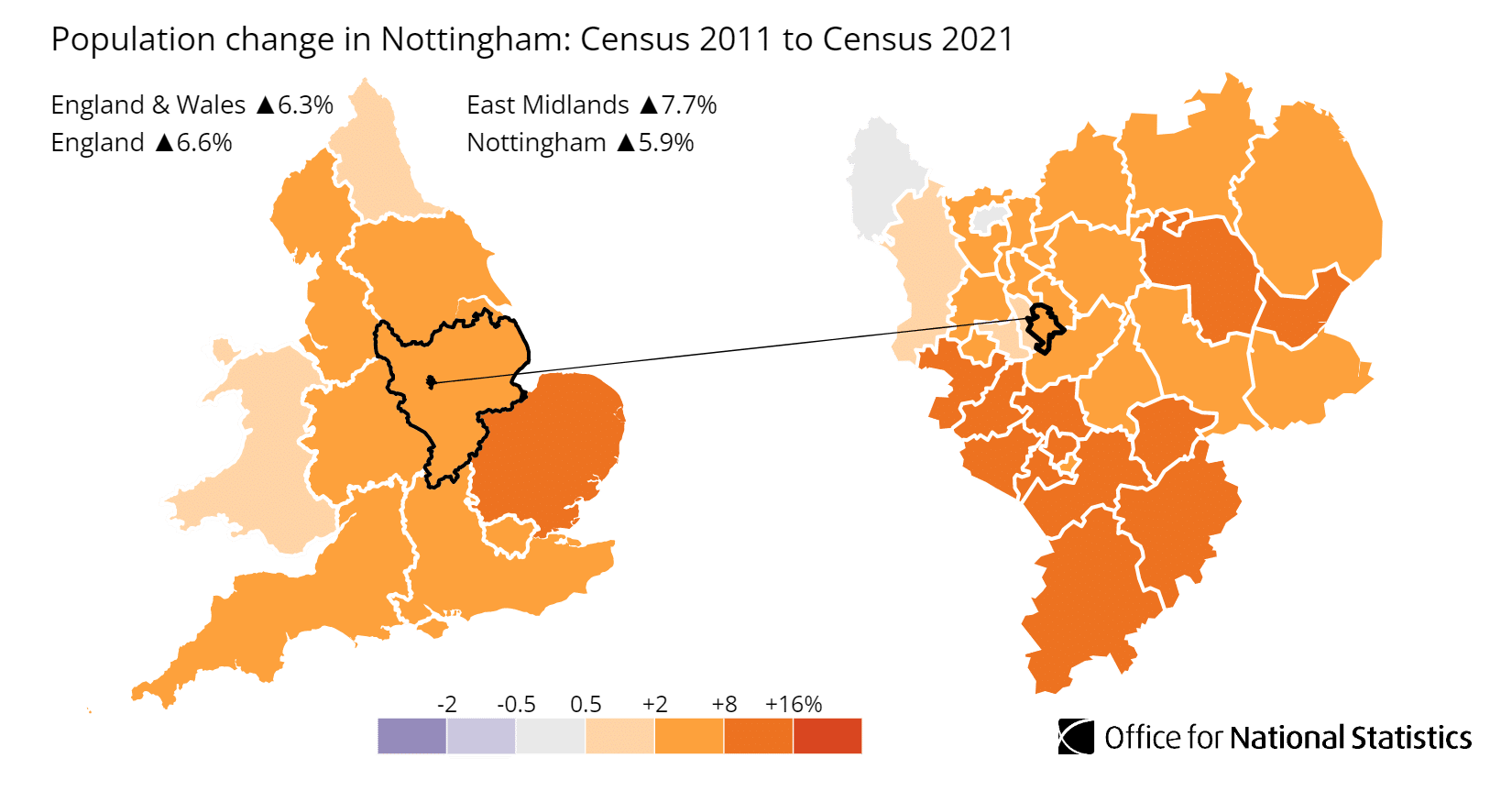
Between the 2011 and 2021 censuses, Nottingham's population grew from 305,680 to 323,632, a rise of 5.9%. That outpaces the England average of 6.6% but trails cities like Manchester and Birmingham. The growth is concentrated in the student and young professional demographic, which directly supports rental demand in the inner-city postcodes.
Earnings in Nottingham sit below both the regional and national averages. The median annual salary is £32,963, compared to £37,482 across the East Midlands and £39,863 for Great Britain. Lower local wages combined with affordable house prices create a market where rental yields hold up well even though rents themselves are not headline-grabbing outside NG7.
Nottingham's transport links include direct trains to London St Pancras in under two hours, the Nottingham Express Transit tram network covering 32km, and proximity to the M1, A52, and A453. East Midlands Airport sits 14 miles south. For investors, the tram network is the key detail. It links residential postcodes to the city centre, the universities, and the QMC, creating a transport corridor that supports rental demand across multiple postcodes.
Nottingham Economic Summary
- Population: 323,632 (2021 Census). Growth of 5.9% from 2011.
- Median annual salary: £32,963 (Nottingham), £37,482 (East Midlands), £39,863 (Great Britain)
- Employment rate: 66.7% (Nottingham), East Midlands benchmark, 75.6% (Great Britain)
- Unemployment rate: 6.7% (Nottingham), East Midlands benchmark, 4.3% (Great Britain)
- Key employment sectors: Higher education, healthcare and bioscience, financial services, digital and creative, retail headquarters
Source: ONS Census 2021, Nomis Labour Market Profile (ASHE 2025, Employment Oct 2024-Sep 2025)
Nottingham's employment rate of 66.7% sits well below the Great Britain average of 75.6%. That reflects the large student population, which depresses the headline rate without indicating economic weakness. The unemployment rate of 6.7% is above the national 4.3%, which is worth noting. For buy-to-let investors, the student-driven rental market operates somewhat independently of the broader employment statistics. NG7's 9.2% yield exists because of the student economy, not despite the employment figures.
Regeneration and Investment in Nottingham
Nottingham has a £4 billion city-centre development programme covering half a square mile. Three projects stand out for their scale and direct relevance to the rental market.
- Broad Marsh Regeneration (site acquired by Homes England, March 2025): A 20-acre redevelopment of the former Broadmarsh Shopping Centre by Homes England, with a masterplan by Thomas Heatherwick targeting 1,000 new homes and 6,000 jobs. Homes England ownership de-risks delivery and transforms the NG1 postcode with residential, retail, and leisure uses. Updates at GOV.UK Homes England.
- The Island Quarter (under construction, 36 acres): Conygar Investments' mixed-use development near the city centre delivering nearly 1,000 homes, 693-bed student accommodation (operational), a bioscience building, and 11 acres of green space. Phase 2B received planning permission in December 2025. Active construction with phased delivery over 10 years transforms the NG2 area. Updates at The Island Quarter.
- Nottingham £4 Billion Development Programme (multiple phases): A city-wide programme across 14 major schemes including Broad Marsh, Island Quarter, Nottingham Waterside, Unity Square, and Castle Meadow campus. Targets 7,000+ new homes, 15,000 new jobs, and 2 million sq ft of commercial space. Supported by East Midlands Combined County Authority. Updates at My Nottingham News.
Nottingham Property Market Analysis
When Was the Last House Price Crash in Nottingham?
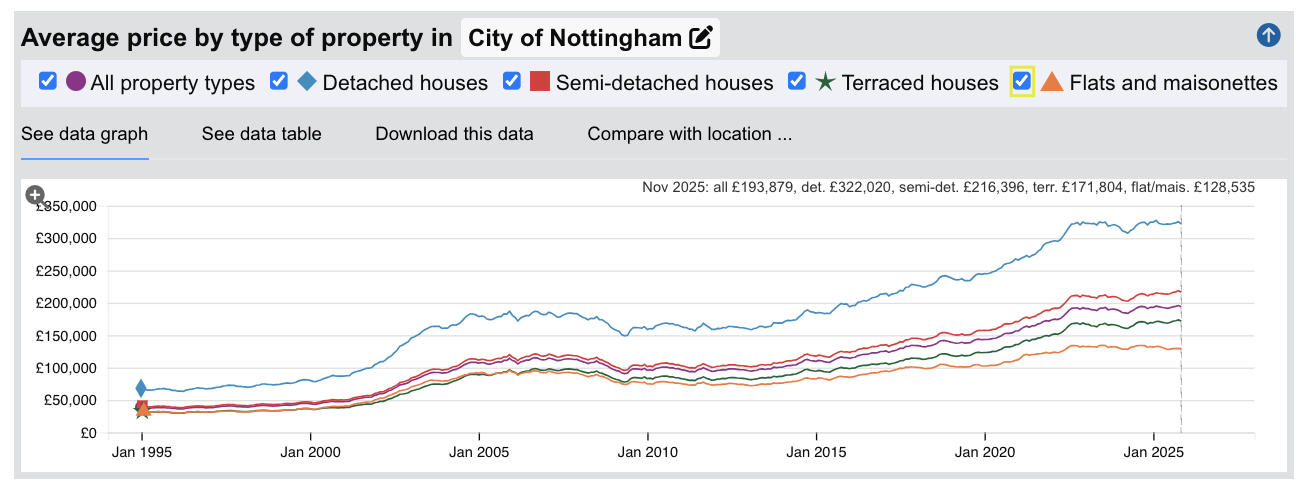
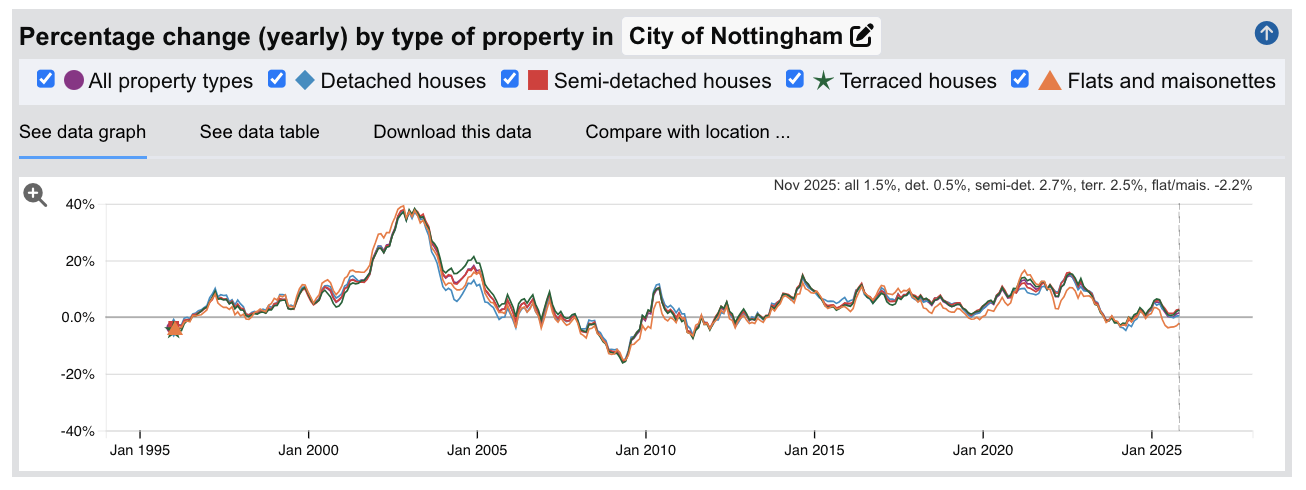
Nottingham's full house price history from the HM Land Registry House Price Index runs from January 1995 to November 2025. The data shows one major crash, a slow recovery, and a steady post-pandemic climb.
- 1995-2000 (Slow start): Nottingham began 1995 at £37,608. Prices grew steadily but unremarkably. By January 2000, the average had reached £46,428. A decade of modest gains while London surged ahead.
- 2000-2006 (The boom): Prices nearly tripled. From £46,428 in January 2000 to a pre-crash peak of £115,304 in September 2006. Cheap credit, buy-to-let mortgage expansion, and strong student demand all pushed prices beyond what local wages at the time could support.
- 2007-2009 (The financial crisis): From the peak of £115,304 in September 2006 to the trough of £90,779 in May 2009, Nottingham lost 21.3% of its value in 32 months. The worst annual change readings came through 2008 and into early 2009. All property types fell similarly: detached -20.4%, semi-detached -20.9%, terraced -21.0%, flats -24.9%. Flats were hit hardest, losing nearly a quarter of their value.
- Regional context: Nottingham's decline of 21.3% was broadly in line with England's 18.2% and the East Midlands regional average.
- 2009-2013 (Stagnation): Nottingham bounced off the trough slowly. Prices traded in a tight band around £90,000 to £98,000 for four years. By December 2013, the average was still only £97,434. Still 15.5% below the pre-crash peak.
- 2014-2015 (Turning point): Growth returned gradually. Annual changes of 3-6% closed the gap. Prices finally passed the pre-crash peak in October 2015 at £116,491. That recovery took 9.1 years from the September 2006 peak. Nottingham was slower to recover than London and the South East, where prices passed pre-crash levels by 2013-2014.
- 2016-2019 (Steady growth): Prices rose from £116,491 in late 2015 to £153,971 by November 2020. Consistent growth of 3-6% per year. Two universities, the QMC, and improving transport infrastructure provided a floor under the market.
- 2020-2022 (Pandemic surge): The stamp duty holiday and remote working shift pushed Nottingham higher. Prices climbed from £146,375 in March 2020 to around £188,000 by late 2022. That is roughly 28% growth in under three years.
- 2023 (Rate shock): Interest rate rises cooled the market briefly. Prices plateaued but did not fall sharply. Nottingham's affordability relative to southern England provided a buffer.
- 2024-2025 (Current): Prices reached £193,879 by November 2025 with annual growth of 1.5%. Nottingham now sits 68.1% above its pre-crash peak.
How Much Have Nottingham Property Prices Grown?
- 5 years (2020-2025): +25.9% (£153,971 to £193,879)
- 10 years (2015-2025): +68.1% (£115,344 to £193,879)
- 15 years (2010-2025): +97.5% (£98,165 to £193,879)
- 20 years (2005-2025): +74.7% (£110,996 to £193,879)
- 30 years (1995-2025): +415.5% (£37,608 to £193,879)
The 2008 crash is the reference point for Nottingham investors assessing downside exposure. A 21.3% decline took 9.1 years to recover fully. Flats took the biggest hit at -24.9%. But the recovery came. Nottingham today is a different market. The £4 billion regeneration programme, Homes England involvement in Broad Marsh, and two expanding universities create a structural demand profile that did not exist in 2006.

Thinking of Buying?
We have off-market investment properties averaging 8%+ annual yield.
View Property DealsSold House Prices in Nottingham
Nottingham's average sold price of £193,879 sits 33.9% below England's average of £293,131 and 19.9% below the East Midlands regional average of £242,180. That gap is wide enough to change the mathematics of a buy-to-let investment entirely. The same rental income stretching further because the asset costs less.
The Land Registry data (November 2025) breaks down by property type. Detached homes average £322,020, semi-detached £216,396, terraced £171,804, and flats £128,535. Every category sits below the England equivalent.
| Property Type | Nottingham | East Midlands | England |
|---|---|---|---|
| All | £193,879 | £242,180 | £293,131 |
| Detached | £322,020 | £358,747 | £474,400 |
| Semi-Detached | £216,396 | £230,306 | £290,004 |
| Terraced | £171,804 | £186,167 | £245,002 |
| Flat / Maisonette | £128,535 | £125,883 | £221,565 |
Nottingham Property Prices by Type: Detached, Semi, Terraced, and Flats
Detached homes in Nottingham at £322,020 are 32.1% below England's £474,400. That is a discount of over £150,000. In a buy-to-let context, detached stock is less common as a rental asset, but the figure anchors the overall price level of the city.
Semi-detached properties at £216,396 represent the core of Nottingham's family rental market. They sit 25.4% below the England average. Postcodes like NG5, NG6, and NG8 are dominated by this stock type, and these are the postcodes where yields of 5.0% to 5.3% come from.
Terraced houses at £171,804 offer the typical buy-to-let entry point. The discount to England is 29.9%. Student lets in NG7 and NG3 lean heavily on terraced stock. HMO conversions in these postcodes can push per-room income well above the headline single-let figures.
Flats at £128,535 are the one category where Nottingham actually sits above the East Midlands average of £125,883. That premium reflects the city-centre apartment market in NG1 and NG2, which draws on student and young professional demand. The gap to England's £221,565 remains substantial at 42.0%.
Property Data Sources
Our location guide relies on diverse, authoritative datasets including:
- HM Land Registry UK House Price Index
- Ministry of Housing, Communities and Local Government
- Ordnance Survey Data Hub
- Propertydata.co.uk
We update our property data quarterly to ensure accuracy. Last update: February 2026. All data is presented as provided by our sources without adjustments or amendments.
Price Per Square Foot in Nottingham
Which Nottingham postcodes give you the most property for your money? Price per square foot strips out size differences and reveals where value concentrates. Across Nottingham's 10 postcodes, sold prices range from £213 per sq ft in NG6 and NG7 to £323 per sq ft in NG2.
| Rank | Area | Sold Price Per Sq Ft |
|---|---|---|
| 1 | NG6 (Bulwell, Bestwood) | £213 |
| 2 | NG7 (Lenton, Radford, The Park) | £213 |
| 3 | NG1 (City Centre, Lace Market) | £222 |
| 4 | NG16 (Eastwood, Kimberley) | £240 |
| 5 | NG3 (Mapperley, St Ann's) | £245 |
| 6 | NG5 (Arnold, Sherwood) | £247 |
| 7 | NG15 (Hucknall) | £250 |
| 8 | NG8 (Wollaton, Aspley) | £260 |
| 9 | NG11 (Clifton, Ruddington) | £277 |
| 10 | NG2 (West Bridgford, The Meadows) | £323 |
NG2 at £323 per sq ft reflects the West Bridgford premium. This is Nottingham's most established residential area south of the Trent, with period properties and family homes that command higher prices per square foot than anywhere else in the city.
NG7 and NG6 at £213 per sq ft sit at the bottom of the table, but for different reasons. NG7's low price per sq ft comes from its student property mix: terraced houses and purpose-built flats where values are compressed by the type of stock rather than the location. NG6 (Bulwell, Bestwood) reflects a lower-income residential area where prices genuinely are cheaper. The distinction matters for investors: NG7's low capital value per sq ft is what creates the 9.2% yield.
Houses for Sale in Nottingham: Current Asking Prices
What does it cost to buy in Nottingham right now? Asking prices reflect current market expectations rather than historic sold prices. Across Nottingham's 10 postcodes, average asking prices range from £155,175 in NG1 to £305,753 in NG2. The mean asking price across all 10 postcodes is £244,881.
| Rank | Area | Avg. Asking Price |
|---|---|---|
| 1 | NG1 (City Centre, Lace Market) | £155,175 |
| 2 | NG6 (Bulwell, Bestwood) | £201,946 |
| 3 | NG7 (Lenton, Radford, The Park) | £212,365 |
| 4 | NG5 (Arnold, Sherwood) | £227,784 |
| 5 | NG16 (Eastwood, Kimberley) | £244,530 |
| 6 | NG3 (Mapperley, St Ann's) | £252,816 |
| 7 | NG15 (Hucknall) | £274,323 |
| 8 | NG8 (Wollaton, Aspley) | £275,597 |
| 9 | NG11 (Clifton, Ruddington) | £298,521 |
| 10 | NG2 (West Bridgford, The Meadows) | £305,753 |
NG1 at £155,175 is the cheapest entry point by a wide margin. City centre flats dominate the stock here. Only 10 sales per month and 5% turnover tell you this is a specialist market: small investor purchases and first-time buyers, not family movers. The asking price gap to NG6 at £201,946 is nearly £47,000.
The middle band from NG5 to NG3 (£228,000 to £253,000) is where most buy-to-let activity concentrates. These are mixed residential areas with terraced and semi-detached stock that appeals to working families and young professionals. Yields in this band run from 5.0% to 5.3%.
NG2 at £305,753 is the only postcode above £300,000. West Bridgford is Nottingham's equivalent of a commuter suburb that happens to sit just across the river. Professional tenants, excellent schools, and the Trent Bridge cricket ground all drive the premium. The yield compresses to 4.8% as a result.
House Price Growth in Nottingham
Compare Nottingham to other Midlands cities and the growth picture looks solid over five years. Zoom in to one-year data and the story splits. Three postcodes (NG5, NG6, NG8) show positive growth between 1.3% and 2.3%. The remaining seven are in negative territory, with NG1 at -15.7% and NG7 at -9.5% leading the declines. No 7-year growth data is available for Nottingham postcodes.
| Area | 1 Year | 3 Year | 5 Year |
|---|---|---|---|
| NG1 (City Centre, Lace Market) | -15.7% | -13.8% | -6.7% |
| NG2 (West Bridgford, The Meadows) | -0.1% | 4.7% | 11.5% |
| NG3 (Mapperley, St Ann's) | -0.5% | 0.4% | 15.4% |
| NG5 (Arnold, Sherwood) | 2.3% | 10.1% | 26.5% |
| NG6 (Bulwell, Bestwood) | 1.8% | 4.3% | 27.7% |
| NG7 (Lenton, Radford, The Park) | -9.5% | -3.7% | 13.8% |
| NG8 (Wollaton, Aspley) | 1.3% | 5.6% | 13.1% |
| NG11 (Clifton, Ruddington) | -6.6% | -6.9% | 26.2% |
| NG15 (Hucknall) | -0.6% | -2.1% | 14.7% |
| NG16 (Eastwood, Kimberley) | -1.1% | 3.2% | 23.3% |
The five-year picture is more revealing. NG6 leads at 27.7%, followed by NG5 at 26.5% and NG11 at 26.2%. These are the more affordable postcodes where prices had the most room to grow. The pattern is consistent across the Midlands: lower-priced areas outperform on percentage growth because the base is smaller.
NG1 is the outlier. Negative across all three periods: -6.7% over five years, -13.8% over three, -15.7% over one year. City centre flat values have been under pressure since the pandemic, when remote working reduced demand for small urban apartments. Only 10 sales per month confirms the thin market. This is a postcode where the yield (7.6%) does the work, not capital growth.
NG7 at -9.5% one-year growth looks alarming, but context matters. Student property values are volatile on a year-to-year basis because the market is dominated by investor transactions rather than owner-occupier moves. The five-year figure of 13.8% is positive. NG7's investment case rests on the 9.2% yield and the structural student demand, not on price appreciation.
Monthly Property Sales in Nottingham
Across Nottingham's 10 postcodes, total monthly sales average 459 transactions, with NG5 accounting for 81 of those and turnover rates ranging from 5% to 103%. Sales volume is the liquidity test. The spread from 81 sales per month in NG5 down to 10 in NG1 tells you which postcodes offer a reliable exit.
| Area | Sales Per Month | Turnover % | Asking Price |
|---|---|---|---|
| NG5 (Arnold, Sherwood) | 81 | 103% | £227,784 |
| NG16 (Eastwood, Kimberley) | 66 | 62% | £244,530 |
| NG2 (West Bridgford, The Meadows) | 59 | 52% | £305,753 |
| NG15 (Hucknall) | 48 | 60% | £274,323 |
| NG8 (Wollaton, Aspley) | 44 | 91% | £275,597 |
| NG3 (Mapperley, St Ann's) | 42 | 58% | £252,816 |
| NG11 (Clifton, Ruddington) | 39 | 72% | £298,521 |
| NG6 (Bulwell, Bestwood) | 38 | 77% | £201,946 |
| NG7 (Lenton, Radford, The Park) | 32 | 22% | £212,365 |
| NG1 (City Centre, Lace Market) | 10 | 5% | £155,175 |
NG5 at 103% turnover is exceptional. Turnover above 100% means properties sell faster than they list. Arnold and Sherwood sit on the northern fringe with good tram links, affordable family homes, and the kind of churn that confirms genuine demand rather than speculative listing. For buy-to-let investors, high turnover means an easier exit if you need one.
NG7 at 22% turnover and NG1 at 5% sit at the opposite end. Low turnover in NG7 reflects the student property investor base: landlords buy and hold for years, rarely selling. That is actually a positive signal for the rental market. Stock does not flood the sales market because the rental returns make holding worthwhile. NG1 at 10 sales per month and 5% turnover is a thin market where individual transactions can move the averages.
Property Data Sources
Our location guide relies on diverse, authoritative datasets including:
- HM Land Registry UK House Price Index
- Ministry of Housing, Communities and Local Government
- Ordnance Survey Data Hub
- Propertydata.co.uk
We update our property data quarterly to ensure accuracy. Last update: February 2026. All data is presented as provided by our sources without adjustments or amendments.
Nottingham Rental Market Analysis
For investors weighing up whether rental property is a worthwhile investment in Nottingham, the data below breaks down average monthly rents and gross rental yields across the city's postcodes.
All 10 Nottingham postcodes have rental data, with monthly rents ranging from £881 (NG16) to £1,626 (NG7) and gross yields from 4.2% to 9.2%. If you are looking to build a property portfolio in the Midlands, Nottingham's combination of university-driven demand and affordable entry prices creates opportunities that many other regional cities cannot match.
Average Rent & Gross Rental Yields in Nottingham
Nottingham's yield spread is one of the widest in the Midlands. The gap between NG7 at 9.2% and NG11/NG15 at 4.2% is five full percentage points. That range reflects fundamentally different rental markets within a single city: student lets at the top, suburban family homes at the bottom.
| Area | Avg. Monthly Rent | Avg. Asking Price | Gross Yield |
|---|---|---|---|
| NG7 (Lenton, Radford, The Park) | £1,626 | £212,365 | 9.2% |
| NG1 (City Centre, Lace Market) | £982 | £155,175 | 7.6% |
| NG6 (Bulwell, Bestwood) | £900 | £201,946 | 5.3% |
| NG3 (Mapperley, St Ann's) | £1,108 | £252,816 | 5.3% |
| NG8 (Wollaton, Aspley) | £1,216 | £275,597 | 5.3% |
| NG5 (Arnold, Sherwood) | £957 | £227,784 | 5.0% |
| NG2 (West Bridgford, The Meadows) | £1,231 | £305,753 | 4.8% |
| NG16 (Eastwood, Kimberley) | £881 | £244,530 | 4.3% |
| NG11 (Clifton, Ruddington) | £1,039 | £298,521 | 4.2% |
| NG15 (Hucknall) | £952 | £274,323 | 4.2% |
NG7 at 9.2% is the standout figure and it demands explanation. Monthly rent of £1,626 is the highest in the city by £395, and it comes from a postcode with an asking price of just £212,365. That rent figure reflects the HMO and student-let market. Lenton and Radford sit between the University of Nottingham's University Park campus and Nottingham Trent University. Shared houses achieving per-room rents of £400+ per month aggregate into headline figures that single-let terraced properties in the same streets would not reach.
The 5.3% yield band (NG3, NG6, NG8) represents Nottingham's working rental market. These are postcodes where working families, young professionals, and key workers rent. Rents are lower than NG7 in absolute terms but the tenant base is broader and less seasonal. NG6 at £900 per month and £201,946 asking price offers the lowest entry point in this yield tier.
NG2 at 4.8% and NG11/NG15 at 4.2% are the yield floor. Higher asking prices compress the yield even though rents are solid. NG2's £1,231 per month is the second-highest in the city, but an asking price above £305,000 pulls the yield below 5%. Investors here are typically buying for tenant quality and long-term appreciation.
Is Nottingham Rent High?
Rent affordability matters from both sides. For tenants, it determines whether they can sustain payments long-term. For landlords, areas where rent consumes a lower share of income tend to produce more reliable tenants and fewer arrears.
The median gross weekly salary in Nottingham is £633.90, which equates to £2,747 per month or £32,963 per year. This is below the East Midlands regional median of £720.80 per week and the Great Britain median of £766.60 per week. Data from the Nomis Labour Market Profile (ASHE 2025).
Across Nottingham's 10 postcodes, rent ranges from 32.1% to 59.2% of the local median gross monthly salary. The general benchmark is that rent becomes stretched above 30% of gross income. All 10 postcodes sit above that level, which reflects Nottingham's relatively low earnings rather than unusually high rents.
| Rank | Area | Rent as % of Income |
|---|---|---|
| 1 | NG7 (Lenton, Radford, The Park) | 59.2% |
| 2 | NG2 (West Bridgford, The Meadows) | 44.8% |
| 3 | NG8 (Wollaton, Aspley) | 44.3% |
| 4 | NG3 (Mapperley, St Ann's) | 40.3% |
| 5 | NG11 (Clifton, Ruddington) | 37.8% |
| 6 | NG1 (City Centre, Lace Market) | 35.7% |
| 7 | NG5 (Arnold, Sherwood) | 34.8% |
| 8 | NG15 (Hucknall) | 34.7% |
| 9 | NG6 (Bulwell, Bestwood) | 32.7% |
| 10 | NG16 (Eastwood, Kimberley) | 32.1% |
NG7 at 59.2% looks extreme, but the median salary comparison is misleading here. NG7's tenants are overwhelmingly students. Their rent is funded by maintenance loans, parental contributions, and part-time work, not by the median Nottingham salary. The affordability metric is useful for working-age tenant postcodes, but it does not apply to student markets in the same way.
NG16 at 32.1% and NG6 at 32.7% sit closest to the 30% threshold. These are the postcodes where working tenants face the least rental pressure relative to local wages. For investors, lower affordability stress typically translates to longer tenancies and fewer void periods. NG5 at 34.8% and NG15 at 34.7% sit just above, still within a manageable range for most working households.
Thinking of Buying?
We have off-market investment properties averaging 8%+ annual yield.
View Property DealsBuy-to-Let Considerations
Are Nottingham House Prices High? Price-to-Earnings Ratios
The price-to-earnings ratio compares a postcode's average asking price to the local median annual salary. Lower ratios mean more affordable entry points relative to local wages. The national benchmark is 7.4x, calculated from England's average sold price of £293,131 against Great Britain's median annual salary of £39,863.
Purchasing a property in Nottingham requires between 4.7 and 9.3 times the median annual salary. This is based on the Nomis Labour Market Profile for Nottingham showing the median gross annual income for Nottingham residents is £32,963.
Five of Nottingham's 10 postcodes sit below the national benchmark of 7.4x. NG1 at 4.7x, NG6 at 6.1x, NG7 at 6.4x, NG5 at 6.9x, and NG16 at 7.4x. That concentration of sub-benchmark affordability is unusual for a city of Nottingham's size.
| Rank | Area | Price-to-Earnings Ratio |
|---|---|---|
| 1 | NG1 (City Centre, Lace Market) | 4.7x |
| 2 | NG6 (Bulwell, Bestwood) | 6.1x |
| 3 | NG7 (Lenton, Radford, The Park) | 6.4x |
| 4 | NG5 (Arnold, Sherwood) | 6.9x |
| 5 | NG16 (Eastwood, Kimberley) | 7.4x |
| 6 | NG3 (Mapperley, St Ann's) | 7.7x |
| 7 | NG15 (Hucknall) | 8.3x |
| 8 | NG8 (Wollaton, Aspley) | 8.4x |
| 9 | NG11 (Clifton, Ruddington) | 9.1x |
| 10 | NG2 (West Bridgford, The Meadows) | 9.3x |
The five sub-benchmark postcodes map closely to the higher-yield areas. NG7 at 6.4x delivers the highest gross yield at 9.2%. NG1 at 4.7x delivers 7.6%. NG6 at 6.1x delivers 5.3%. Affordable entry prices relative to local wages and strong rental returns in the same postcodes is a combination that supports sustainable buy-to-let investment.
NG2 at 9.3x is the most stretched. West Bridgford's premium pushes the ratio well above the national benchmark. NG11 at 9.1x sits just below. Both attract owner-occupier families who push prices beyond what rental income can justify on a pure yield basis. Investors in these postcodes are typically buying for tenant quality and long-term capital growth.
Deposit Requirements in Nottingham
Most buy-to-let mortgage lenders require a minimum 25% deposit. The table below uses a more conservative 30% to reflect the rates and products available at higher loan-to-value ratios. A 30% deposit typically unlocks better interest rates, which matters for cash flow in a yield-driven market.
Nottingham's entry costs range from £46,552 in NG1 to £91,726 in NG2. Six postcodes require deposits under £76,000, putting buy-to-let within reach for a wide range of investors.
| Rank | Area | 30% Deposit Required |
|---|---|---|
| 1 | NG1 (City Centre, Lace Market) | £46,552 |
| 2 | NG6 (Bulwell, Bestwood) | £60,584 |
| 3 | NG7 (Lenton, Radford, The Park) | £63,709 |
| 4 | NG5 (Arnold, Sherwood) | £68,335 |
| 5 | NG16 (Eastwood, Kimberley) | £73,359 |
| 6 | NG3 (Mapperley, St Ann's) | £75,845 |
| 7 | NG15 (Hucknall) | £82,297 |
| 8 | NG8 (Wollaton, Aspley) | £82,679 |
| 9 | NG11 (Clifton, Ruddington) | £89,556 |
| 10 | NG2 (West Bridgford, The Meadows) | £91,726 |
NG7 at £63,709 is the best value entry in this table relative to what it delivers. A deposit just £17,000 above the cheapest postcode buys access to the highest yield in the city at 9.2%. NG6 at £60,584 offers the second-lowest deposit and delivers 5.3% yield with the strongest five-year growth in the city at 27.7%.
The £82,000-£92,000 band covers NG15, NG8, NG11, and NG2. These are established suburban postcodes with higher asking prices but lower yields. NG8 at £82,679 is the value pick in this tier: 5.3% yield, 13.1% five-year growth, and 91% turnover. For investors with more capital, NG2 at £91,726 delivers Nottingham's most professional tenant base and solid 4.8% yield.
Deposit is only part of the upfront cost. Budget for stamp duty (use our stamp duty calculator for an accurate figure), legal fees, and survey costs. For a full breakdown, see our guide to buy-to-let costs. Investors looking to reduce their upfront capital outlay may also find opportunities through below market value properties.

What the Nottingham Data Tells Buy-to-Let Investors
Best Areas to Invest in Nottingham
The postcode-level data across this guide points to three distinct tiers depending on whether you are optimising for income, growth, or a balanced approach.
For yield, the numbers favour NG7 (9.2%) and NG1 (7.6%). Both sit well below 7.0x price-to-earnings with 30% deposits under £64,000. NG7 is the student market play: high rents driven by HMO lets in Lenton and Radford between two university campuses. NG1 is city-centre flats with low asking prices and strong rental demand from young professionals. Both postcodes show negative one-year growth, which is the trade-off: income over appreciation.
For growth, the data favours NG6 (27.7% five-year), NG5 (26.5%), and NG11 (26.2%). NG5 delivers the most balanced profile: 5.0% yield, 26.5% five-year growth, 81 sales per month, and 103% turnover. That combination of income, appreciation, and liquidity in a single postcode is uncommon. NG6 at 27.7% growth with 5.3% yield is the other standout in this tier.
NG15 and NG16 sit on the city fringe with weaker data across multiple measures. NG15 shows -0.6% one-year growth, 4.2% yield, and asking prices of £274,323 that feel stretched for what the postcodes deliver. NG16 at -1.1% one-year growth and 4.3% yield is similar. Both postcodes are further from the universities and the city-centre employment anchors that drive Nottingham's rental demand. The five-year growth figures (14.7% and 23.3%) are positive, but the recent trend is flatter.
Nottingham operates a selective licensing scheme in several areas. Check whether your target postcode falls within a designated area before purchasing.
How Nottingham Buy-to-Let Compares to Nearby Areas
Nottingham's mean asking price of £244,881 is the lowest of five Midlands cities and its top yield of 9.2% is the highest by over two percentage points. The table below compares Nottingham against four nearby locations using the same methodology: mean asking price across all postcodes, mean monthly rent across postcodes with data, and top single-postcode gross yield.
| Location | Mean Asking Price | Mean Monthly Rent | Top Gross Yield |
|---|---|---|---|
| Nottingham | £244,881 | £1,089 | 9.2% |
| Birmingham | £272,648 | £1,121 | 7.0% |
| Derby | £276,761 | £946 | 5.9% |
| Leicester | £294,580 | £1,041 | 7.3% |
| Coventry | £295,504 | £1,137 | 7.3% |
Nottingham has the lowest mean asking price in this group and the highest top yield by a significant margin. At £244,881, Nottingham is £28,000 below Birmingham and £51,000 below Coventry. The 9.2% top yield (NG7) is 2.2 percentage points above Birmingham's highest. That yield gap is driven by the university HMO market, which is larger and more concentrated in Nottingham than in any other East Midlands city.
Leicester and Coventry show similar profiles to each other: higher asking prices (£294,000-£296,000) and top yields around 7.3%. Both require more capital for a lower maximum yield. Derby is the closest comparison to Nottingham in price terms at £276,761 but its top yield of 5.9% is substantially lower. Derby lacks the large student population that drives Nottingham's NG7 premium.
For investors prioritising yield per pound invested, Nottingham leads this group. For those preferring a broader rental market without the student concentration, Birmingham and Leicester offer deeper tenant pools across more postcodes. The right choice depends on whether the investor wants concentrated high yield or diversified moderate yield. Browse all our location guides and property articles to compare.
Frequently Asked Questions
What are the up and coming areas in Nottingham for property investment?
The postcode data highlights NG5 (Arnold, Sherwood) as the area with the strongest combination of yield (5.0%), five-year growth (26.5%), and market activity (81 sales per month, 103% turnover). NG6 (Bulwell, Bestwood) shows the highest five-year growth at 27.7% from a lower base price of £201,946. Both postcodes sit on the northern side of the city with tram links to the centre.
The Broad Marsh regeneration in NG1 and the Island Quarter development in NG2 are the two largest active projects reshaping the city centre, though their impact on surrounding property values is still emerging.
What are the best areas in Nottingham for buy-to-let?
It depends on what the investor is optimising for. NG7 (Lenton, Radford) delivers the highest gross yield at 9.2% through the student HMO market. NG5 (Arnold, Sherwood) offers the most balanced data: 5.0% yield, 26.5% five-year growth, and the highest sales volume in the city. NG6 (Bulwell, Bestwood) provides the lowest entry deposit at £60,584 with 5.3% yield and 27.7% five-year growth. NG2 (West Bridgford) suits investors prioritising tenant quality, with Nottingham's highest absolute rents at £1,231 per month and the most professional tenant demographic.
Why invest in Nottingham property?
Nottingham combines two large universities (around 65,000 students), a growing bioscience sector, and a £4 billion city-centre regeneration programme. Average sold prices sit 33.9% below the England average at £193,879, which creates entry points that most major cities cannot match. The city has delivered 25.9% price growth over five years and gross yields up to 9.2%. Employment is anchored by the Queen's Medical Centre, the University of Nottingham, Nottingham Trent University, and the Boots headquarters campus. The tram network links residential postcodes to these employment centres, supporting rental demand across the city.
Are there property investment companies operating in Nottingham?
Several firms market buy-to-let properties in Nottingham, particularly student accommodation and new-build developments. Be cautious with any company offering guaranteed yields or sourcing fees above 2-3% of purchase price. The data in this guide covers the open market. Any property sold through an investment company could be benchmarked against these figures but it does not guarantee a market value as these are average values.
Is student accommodation a good investment in Nottingham?
The University of Nottingham and Nottingham Trent University together bring around 65,000 students to the city. NG7 (Lenton, Radford) is the primary student letting area and delivers the highest gross yield in the city at 9.2%. The £1,626 average monthly rent reflects HMO lets where per-room income aggregates to high headline figures. The trade-off is seasonal void risk during summer months and the management overhead of student tenants. NG3 (Mapperley, St Ann's) also has a student presence. For a broader view of the sector, see our guide to purpose-built student accommodation. Some investors also consider short-let strategies during summer voids through platforms like Airbnb.