
Where to Buy Property Investments in Telford: Yields of 4.6%
Telford's gross rental yields reach 4.6% in TF3 and TF4, with rental data available for 5 of the borough's 10 postcodes. Average sold prices sit 26.1% below the England average, and Telford's population grew 11.34% to 185,541 between the 2011 and 2021 censuses.
Telford's average sold price of £215,752 creates one of the lowest entry points in the West Midlands for buy-to-let investors. Asking prices start from £217,416 in TF3 and reach £397,099 in TF6, but the buy-to-let picture is concentrated in the urban core. Only 5 of 10 postcodes have enough rental listings to produce reliable yield figures. The town's £300m council regeneration programme is targeting three centres: Telford town centre (TF3), Wellington (TF1), and Oakengates (TF2).
This guide covers all 10 Telford postcodes from TF1 to TF11 under the Telford and Wrekin unitary authority (ONS code E06000020). Telford sits in Shropshire, midway between the West Midlands conurbation and the Welsh border. Investors comparing options in the region may also consider Wolverhampton or Stoke-on-Trent. Browse all our Midlands location guides.
Article updated: February 2026
Telford Buy-to-Let Market Overview 2026
Telford offers affordable entry prices well below the England average, with a £300m regeneration programme targeting the urban core where most rental activity is concentrated.
- Average sold price: £215,752 (26.1% below England's £291,865)
- Asking price range: £217,416 (TF3) to £397,099 (TF6)
- Rental yields: 3.1% (TF10) to 4.6% (TF3, TF4) across postcodes with rental data
- Rental income: Monthly rents from £842 (TF3) to £1,033 (TF4)
- Price per sq ft: Sold prices from £168/sq ft (TF7) to £304/sq ft (TF8)
- Market activity: Sales ranging from 4 per month (TF8) to 30 per month (TF1)
- Deposit requirements: 30% deposits range from £65,225 (TF3) to £119,130 (TF6)
- Affordability ratios: Property prices from 6.0 to 11.0 times Telford's median annual salary of £36,044
Contents

-
by Robert Jones, Founder of Property Investments UK
With two decades in UK property, Rob has been investing in buy-to-let since 2005, and uses property data to develop tools for property market analysis.
Property Data Sources
Our location guide relies on diverse, authoritative datasets including:
- HM Land Registry UK House Price Index
- Ministry of Housing, Communities and Local Government
- Ordnance Survey Data Hub
- Propertydata.co.uk
We update our property data quarterly to ensure accuracy. Last update: February 2026. All data is presented as provided by our sources without adjustments or amendments.
Why Invest in Telford?
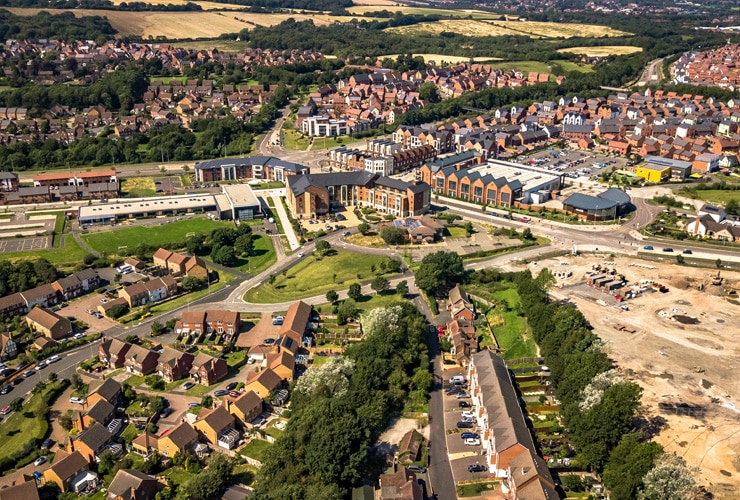
Telford is a new town, built in the 1960s around a cluster of older Shropshire settlements. That matters for investors because the housing stock is different from a typical Victorian city. Much of it is post-war, purpose-built, and lower density. The result is a market dominated by semi-detached and terraced houses rather than converted flats or dense urban blocks.
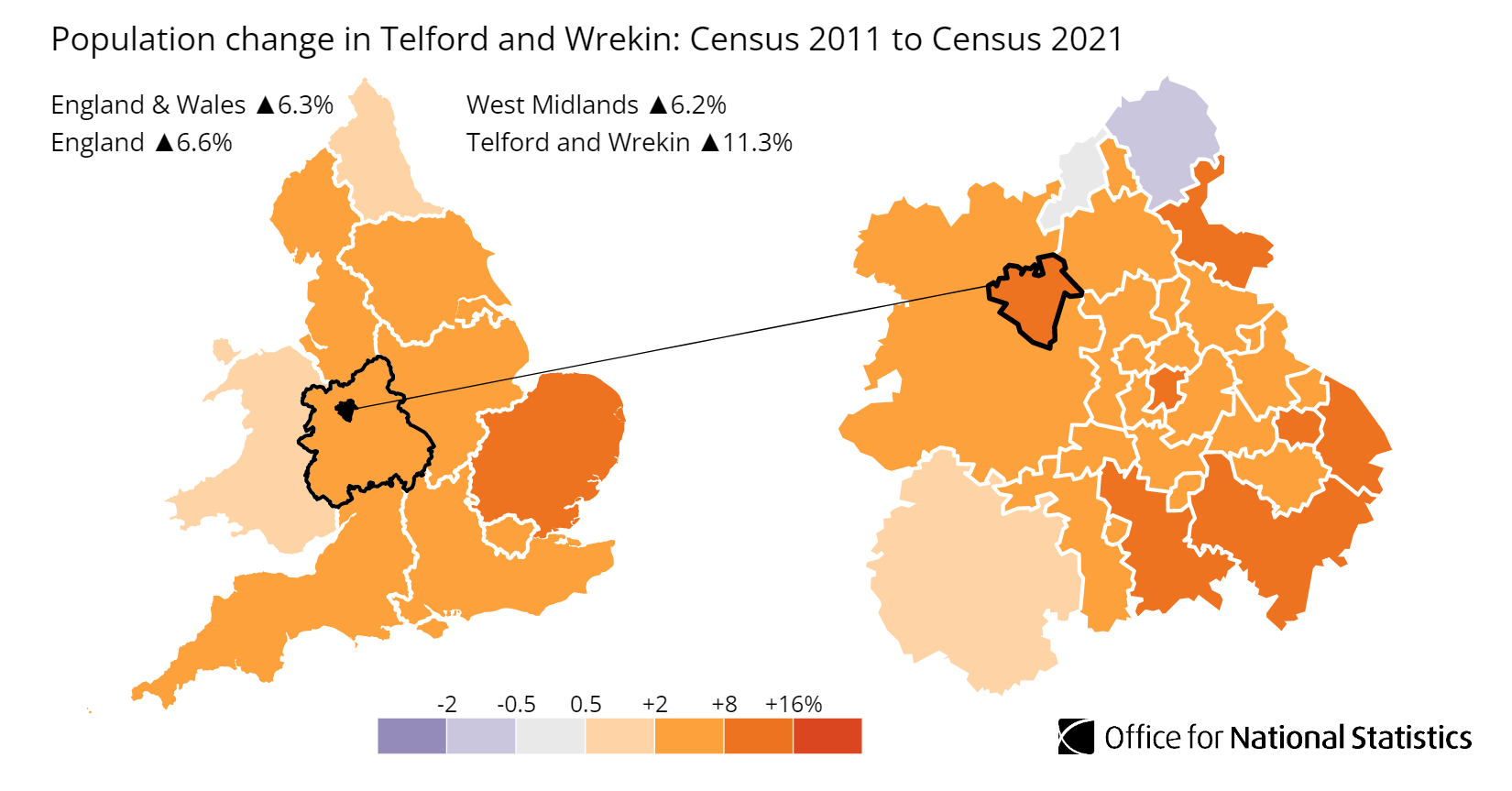
Telford's population grew from 166,641 to 185,541 between the 2011 and 2021 censuses, a rise of 11.34%. That is well above the England average of 6.6% for the same period. New housing development in areas like Lawley (TF4) and Priorslee (TF2) has attracted young families and first-time buyers, driving both population growth and rental demand in the process.
The local economy is built on manufacturing, logistics, and distribution. Telford sits on the M54 corridor with direct motorway access to the West Midlands conurbation, and the town has attracted major employers including Ricoh, Capgemini, and a cluster of advanced manufacturing firms. The logistics sector benefits from Telford's position between Birmingham and the Welsh border.
Earnings in Telford sit below both the regional and national averages. The median annual salary is £36,044, compared to £37,050 across the West Midlands and £39,125 for Great Britain. Lower wages combined with affordable property prices keep price-to-earnings ratios manageable in the core postcodes, even if yields are modest by national standards.
Telford Economic Summary
- Population: 185,541 (2021 Census). Growth of 11.34% from 2011.
- Median annual salary: £36,044 (Telford and Wrekin), £37,050 (West Midlands), £39,125 (Great Britain)
- Employment rate: 76.7% (Telford and Wrekin)
- Key employment sectors: Manufacturing, logistics, distribution, advanced engineering, public sector
Source: ONS Census 2021, Nomis Labour Market Profile (ASHE 2025)
Regeneration and Investment in Telford
Telford and Wrekin Council is halfway through a £300m regeneration programme covering three town centres and the surrounding infrastructure. That scale of public investment in a borough of 185,000 is significant relative to its size.
- Station Quarter, Telford Town Centre (Under construction, £45.7m): A mixed-use scheme delivering 189 new homes (117 Nuplace rental homes and 72 L&G affordable homes) alongside a new college facility opening September 2026. The project is part of the wider £300m programme and directly targets the TF3 postcode area. Updates at Telford & Wrekin Council Newsroom.
- Telford & Wrekin £300m Regeneration Programme (Multiple stages, by 2027): A borough-wide programme covering Station Quarter, Wellington public realm improvements (TF1), and Oakengates precinct redevelopment (TF2). Funded 50% by the council and 50% through WMCA, Towns Fund, and UKSPF grants. The programme targets the three postcodes where most of Telford's rental market operates. Updates at Telford & Wrekin Council Newsroom.
Telford and Wrekin Property Market Analysis
When Was the Last House Price Crash in Telford?
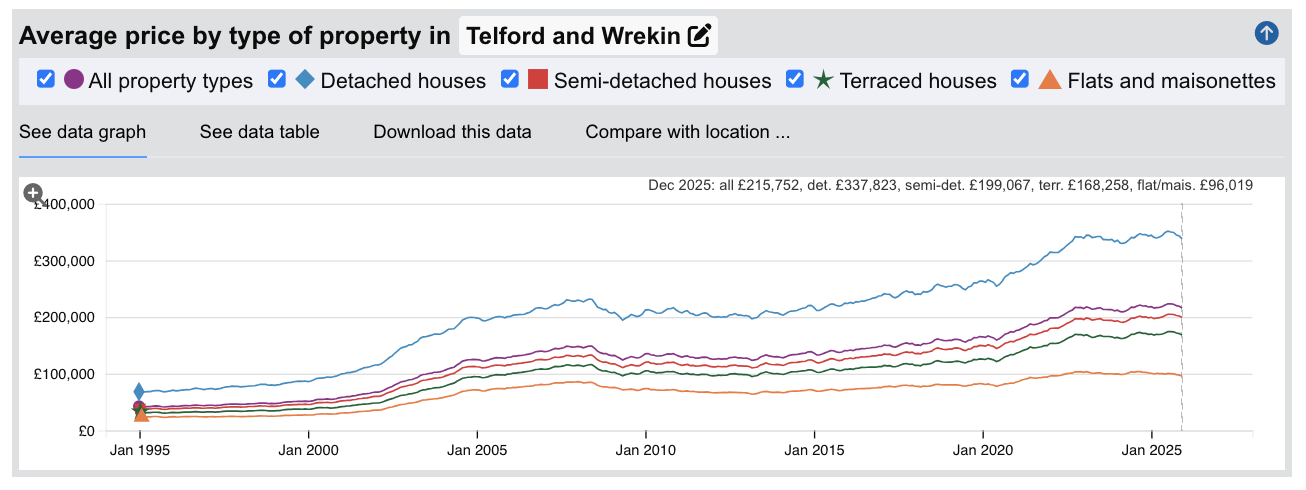
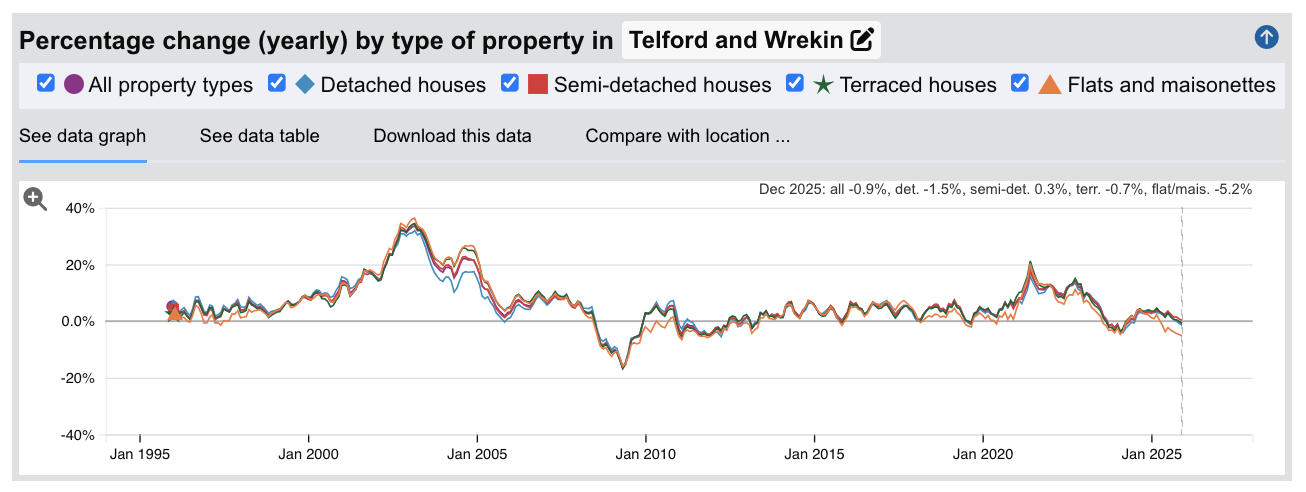
Telford's Land Registry data runs from January 1995 to December 2025, covering one major crash, a slow recovery, and a pandemic-era surge. The full history from the HM Land Registry House Price Index shows prices rising from £40,891 to today's £215,752, but the path between those two figures was far from smooth.
- 1995-2000 (Slow growth): Telford began 1995 at £40,891. Prices climbed steadily through the late 1990s, reaching £57,182 by December 2000 with annual growth of 10.7%. Telford tracked the broader national trend of steady pre-boom appreciation, though from a lower base than most English towns.
- 2000-2007 (The boom): Prices more than doubled from £57,182 to a peak of approximately £148,790 in June 2008. By June 2007, the average had already reached £143,826 with annual growth running at 8.2%. Cheap credit and strong manufacturing employment pushed prices well beyond what local wages could support.
- 2008-2009 (The financial crisis): From the peak of £148,790 in June 2008 to the trough of £123,357 in March 2013, Telford lost 17.1% of its value over 57 months. The worst annual change reading was -16.5% in May 2009. Telford's decline of 17.1% was broadly in line with the West Midlands regional decline of 16.9% and slightly better than England's 18.2%.
- 2010-2013 (Stagnation): Unlike some cities that bounced quickly off the trough, Telford ground sideways. By December 2013, the average was still just £130,166 with annual growth of 2.3%. Prices remained below the pre-crash peak for years.
- 2014-2016 (Slow recovery): Growth returned at a modest pace. Prices finally passed the pre-crash peak in February 2017 at £150,372, roughly 47 months after the March 2013 trough. By June 2016, the average had reached £144,199 with annual growth of 4.1%.
- 2017-2019 (Steady growth): Consistent appreciation of 3-5% per year. By December 2019, prices reached £165,491 with annual growth of 4.7%. New housing development in Lawley and Priorslee added stock but also attracted buyers into the area.
- 2020-2022 (Pandemic surge): The stamp duty holiday and shift to remote working hit Telford's market hard. Prices jumped from £165,491 to £203,993 by June 2022, with annual growth touching 8.6%. Telford's affordability relative to Birmingham and Wolverhampton made it a beneficiary as buyers looked for more space at lower prices.
- 2023 (Rate shock): Interest rate rises cooled the market. By December 2023, the average was £210,778 but annual change had turned negative at -2.8%. A correction, not a crash.
- 2024-2025 (Current): Prices recovered through 2024, reaching £217,687 by December 2024 with annual growth of 3.3%. By December 2025, the latest reading shows £215,752 with annual change at -0.9%. A slight pullback from the mid-2025 peak.
Long-Term Property Value Growth in Telford
- 5 years (2020-2025): +24.5% (£173,280 to £215,752)
- 10 years (2015-2025): +53.3% (£140,697 to £215,752)
- 15 years (2010-2025): +62.2% (£133,019 to £215,752)
- 20 years (2005-2025): +67.4% (£128,906 to £215,752)
- From 1995: +427.6% (£40,891 to £215,752)
The 2008 crash is the reference point for Telford investors assessing downside. A 17.1% decline took roughly 47 months from trough to recovery. That is faster than some northern cities but still a long wait with capital locked in.
Telford's structural position now is different. The £300m regeneration programme and the M54 corridor did not exist in their current form during the last downturn. Property values are never guaranteed, but the employment base and infrastructure investment have changed.
Source: HM Land Registry House Price Index for Telford and Wrekin

Thinking of Buying?
We have off-market investment properties averaging 8%+ annual yield.
View Property DealsSold House Prices in Telford
Telford's sold prices tell a clear story of affordability. The headline figure of £215,752 is 26.1% below England's £291,865 and 7.3% below the West Midlands regional average of £232,824. Every property type trades at a discount to the national market, but the scale of that discount varies dramatically.
Flats in Telford average £96,019. That is 56.2% below the England average of £219,340. It is the widest discount of any property type and reflects Telford's new town character. There is limited period conversion stock and no premium city centre apartment market of the kind that inflates flat prices in Birmingham or Manchester.
| Property Type | Telford Average | England Average | Difference |
|---|---|---|---|
| Detached houses | £337,823 | £471,667 | -28.4% |
| Semi-detached houses | £199,067 | £289,135 | -31.2% |
| Terraced houses | £168,258 | £244,830 | -31.3% |
| Flats and maisonettes | £96,019 | £219,340 | -56.2% |
| All property types | £215,752 | £291,865 | -26.1% |
Detached houses show the narrowest discount at 28.4%. Telford has a relatively high proportion of detached stock compared to older industrial cities, particularly in the newer developments around Lawley (TF4) and the semi-rural edges like TF5, TF6, and TF11. Owner-occupier demand in these areas holds detached prices closer to the national average than other property types.
Semi-detached and terraced houses cluster together at -31.2% and -31.3% respectively. These two categories make up the bulk of Telford's housing stock and are the core of the buy-to-let market. Semis at £199,067 and terraces at £168,258 offer the entry points where most investors will be looking. The near-identical discounts suggest consistent pricing across the mid-market rather than distortions in one category.
Terraced houses at £168,258 represent the most direct path to yield. At that price point and with rents around £842 to £1,033 in the core postcodes, the maths starts working for cash flow. For investors looking at current stock, see our investment property listings. The postcode-level data in the sections below shows exactly where the rental income sits.
Flats at 56.2% below England reflect Telford's character as a new town. There is no dense Victorian or Edwardian flat conversion stock. What flat stock exists is mostly modern purpose-built blocks, and the market for them is thin. Low flat prices make the headline "all property types" average look more affordable than the typical investor purchase.
Property Data Sources
Our location guide relies on diverse, authoritative datasets including:
- HM Land Registry UK House Price Index
- Ministry of Housing, Communities and Local Government
- Ordnance Survey Data Hub
- Propertydata.co.uk
We update our property data quarterly to ensure accuracy. Last update: February 2026. All data is presented as provided by our sources without adjustments or amendments.
Price Per Square Foot in Telford
What does a buyer actually get for their money in each postcode? Average asking prices can mislead because a postcode might look expensive simply because it has larger properties. Price per square foot strips out that size bias and shows what you are paying for space.
Telford's price per square foot ranges from £168 in TF7 to £304 in TF8, a spread of almost 2x across the borough's 10 postcodes. That gap maps directly to Telford's core split: the affordable urban postcodes where most buy-to-let activity happens versus the semi-rural edges where prices reflect lifestyle demand rather than rental returns.
| Rank | Area | Price Per Sq Ft |
|---|---|---|
| 1 | TF7 (Madeley, Woodside) | £168 |
| 2 | TF3 (Town Centre, Malinslee) | £209 |
| 3 | TF1 (Wellington, Hadley) | £238 |
| 4 | TF4 (Dawley, Lawley) | £245 |
| 5 | TF2 (Oakengates, Priorslee) | £258 |
| 6 | TF6 (High Ercall) | £277 |
| 7 | TF5 (Admaston, Donnington) | £285 |
| 8 | TF10 (Newport) | £290 |
| 9 | TF11 (Shifnal) | £301 |
| 10 | TF8 (Ironbridge) | £304 |
TF7 Madeley at £168 per square foot is the cheapest space in Telford by a wide margin. That is 20% less than the next cheapest postcode (TF3 at £209). TF7 is an older area south of the town centre with a mix of ex-council and 1970s stock. The low per-foot cost is reflected in the asking price data too. For investors, TF7 delivered the second-highest five-year growth at 28.3%, so cheap space has not meant stagnant values.
The five core urban postcodes (TF1 to TF4 plus TF7) all come in under £260 per square foot. These are the areas where the rental market operates. TF8, TF10, and TF11 at £290 to £304 per square foot are the semi-rural and market town postcodes where larger properties and heritage stock push per-foot costs higher. TF8 Ironbridge at the top is a tourist destination with period housing, not a buy-to-let postcode.
Figures reflect averages across all property types and ages. Individual values depend on condition, location within the postcode, and building age.
For Sale Asking Prices in Telford
In nearby Wolverhampton, asking prices cluster within a £100,000 range across postcodes. Telford's spread is almost double that. Asking prices reflect what sellers and agents think the market will pay, and Telford's -0.9% annual change at the Land Registry level suggests a market where asking prices and sold prices are converging after the pandemic overshoot.
Telford's asking prices range from £217,416 in TF3 to £397,099 in TF6. The urban core clusters between £217,416 and £281,786 across four postcodes. Outside that, the market town and rural postcodes form a distinctly different tier.
| Rank | Area | Average Asking Price |
|---|---|---|
| 1 | TF3 (Town Centre, Malinslee) | £217,416 |
| 2 | TF7 (Madeley, Woodside) | £232,103 |
| 3 | TF1 (Wellington, Hadley) | £271,089 |
| 4 | TF4 (Dawley, Lawley) | £271,631 |
| 5 | TF2 (Oakengates, Priorslee) | £281,786 |
| 6 | TF10 (Newport) | £347,177 |
| 7 | TF8 (Ironbridge) | £364,678 |
| 8 | TF11 (Shifnal) | £378,012 |
| 9 | TF5 (Admaston, Donnington) | £388,514 |
| 10 | TF6 (High Ercall) | £397,099 |
Five postcodes sit below £282,000, and five sit above £347,000. There is a £65,000 gap between TF2 at £281,786 and TF10 at £347,177. That clean break separates Telford's urban buy-to-let postcodes from its commuter and rural fringe. For investors, the decision is straightforward in terms of where the entry prices sit. TF3 and TF7 offer the lowest barrier to entry. TF1, TF4, and TF2 are the next tier up, still within reach of most buy-to-let budgets.
TF3 at £217,416 is the cheapest postcode and also the joint-highest yield at 4.6%. That combination makes it the obvious starting point for any investor working to a budget. Investors looking for stock priced below the open market may find opportunities through our below market value properties listings. TF7 at £232,103 is the second cheapest but has no rental data, so the yield picture there is unknown.
The mean asking price across all 10 Telford postcodes is £314,951. That figure appears in the comparison section below, where Telford is measured against Stoke-on-Trent, Wolverhampton, Birmingham, and Coventry.

House Price Growth in Telford
Telford's cheapest postcodes have delivered the strongest capital growth over five years. Growth data shows where prices have moved over 1, 3, and 5 years. The five-year figure matters most for buy-to-let investors because it captures a full market cycle and filters out the short-term noise of stamp duty holidays and rate shocks.
Nine of Telford's 10 postcodes delivered positive five-year growth, with TF8 Ironbridge leading at 30.0%. Only TF6 is in negative territory at -1.8%. The striking pattern is that Telford's cheapest postcodes have delivered the strongest growth. TF8 and TF7 lead the table despite being among the lower-priced areas.
| Area | 1 Year | 3 Years | 5 Years |
|---|---|---|---|
| TF8 (Ironbridge) | 11.2% | 14.7% | 30.0% |
| TF7 (Madeley, Woodside) | 5.7% | 7.3% | 28.3% |
| TF10 (Newport) | 8.1% | 9.2% | 23.9% |
| TF4 (Dawley, Lawley) | -1.9% | -2.1% | 22.2% |
| TF3 (Town Centre, Malinslee) | 4.8% | -1.8% | 18.0% |
| TF2 (Oakengates, Priorslee) | -6.5% | -1.8% | 16.7% |
| TF1 (Wellington, Hadley) | -3.6% | -3.9% | 10.8% |
| TF11 (Shifnal) | 8.6% | 5.2% | 10.5% |
| TF5 (Admaston, Donnington) | -13.4% | 0.3% | 1.1% |
| TF6 (High Ercall) | 3.3% | 8.9% | -1.8% |
TF4 Dawley shows an interesting pattern: 22.2% five-year growth but negative readings over one year (-1.9%) and three years (-2.1%). That suggests the gains came early in the five-year window, likely during the pandemic stamp duty rush, and prices have since pulled back. Lawley's new-build corridor attracted buyers in 2020-2021 and has been digesting that surge since.
TF2 Oakengates at -6.5% one-year growth is the weakest recent performance among the core postcodes. Combined with negative three-year growth of -1.8%, this is a postcode that has given back gains since the pandemic peak. The five-year figure of 16.7% is still positive, but recent momentum has stalled. The Oakengates precinct redevelopment under the £300m programme could shift this trajectory.
TF5 at -13.4% one-year change stands out. With only 5 sales per month, a single high-value transaction dropping out of the comparison window can move the annual figure significantly. The three-year reading of 0.3% and five-year reading of 1.1% are flat. TF5 is a low-volume postcode where growth data is less reliable than in higher-volume areas.
Monthly Property Sales in Telford
Telford records 152 property transactions per month across all 10 postcodes, with over half concentrated in just three areas. Transaction volumes matter for buy-to-let investors as an exit strategy question. If you need to sell, can you? High volume means a liquid market. Low volume means you may wait.
Telford's monthly sales range from 4 in TF8 to 30 in TF1, with a combined total of 152 transactions per month across all 10 postcodes. The volume is heavily concentrated in the urban core. TF1, TF2, and TF3 account for 80 of those 152 transactions.
| Area | Sales Per Month | Turnover | Asking Price |
|---|---|---|---|
| TF1 (Wellington, Hadley) | 30 | 28% | £271,089 |
| TF2 (Oakengates, Priorslee) | 29 | 28% | £281,786 |
| TF3 (Town Centre, Malinslee) | 21 | 38% | £217,416 |
| TF4 (Dawley, Lawley) | 18 | 18% | £271,631 |
| TF11 (Shifnal) | 14 | 64% | £378,012 |
| TF7 (Madeley, Woodside) | 13 | 28% | £232,103 |
| TF10 (Newport) | 12 | 28% | £347,177 |
| TF6 (High Ercall) | 6 | 52% | £397,099 |
| TF5 (Admaston, Donnington) | 5 | 133% | £388,514 |
| TF8 (Ironbridge) | 4 | 14% | £364,678 |
TF5's turnover rate of 133% looks dramatic, but with only 5 sales per month it reflects a very small pool of listed stock turning over quickly. Do not read that as a sign of a highly liquid market. TF11 Shifnal at 64% turnover with 14 sales per month is a more meaningful indicator of demand outstripping supply in the commuter belt.
TF4 Dawley has the lowest turnover at 18% despite 18 sales per month. That tells you there is a large stock of property that rarely comes to market. The Lawley new-build corridor has added significant housing, but owners tend to hold. For exit planning, TF1 and TF2 offer the highest volumes at 30 and 29 sales per month. These are the most liquid areas if you need to sell.
TF8 Ironbridge at 4 sales per month is a thin market. Combined with a turnover of 14%, properties in TF8 sit on the market and transactions are infrequent. This is a heritage area with limited stock and limited demand beyond lifestyle buyers.
Property Data Sources
Our location guide relies on diverse, authoritative datasets including:
- HM Land Registry UK House Price Index
- Ministry of Housing, Communities and Local Government
- Ordnance Survey Data Hub
- Propertydata.co.uk
We update our property data quarterly to ensure accuracy. Last update: February 2026. All data is presented as provided by our sources without adjustments or amendments.
Telford Rental Market Analysis
Telford's gross rental yields range from 3.1% to 4.6% across the five postcodes with rental data. For investors weighing up whether rental property is a worthwhile investment in Telford, the data below breaks down average monthly rents and gross rental yields across the borough's postcodes.
Rental data is available for 5 of Telford's 10 postcodes. TF5, TF6, TF7, TF8, and TF11 have insufficient current listings for reliable figures. For the five with data, monthly rents range from £842 in TF3 to £1,033 in TF4 and gross yields range from 3.1% to 4.6%. If you are looking to build a property portfolio in the Midlands, Telford's rental market is concentrated in the urban core where the regeneration money is being spent.

Average Rent & Gross Rental Yields in Telford
Gross rental yield is calculated from the average asking price and average monthly rent for each postcode. It does not account for void periods, maintenance, management fees, or mortgage costs. It is a starting point for comparison, not a profit forecast.
TF3 and TF4 share Telford's highest gross yield at 4.6%. They get there differently. TF3 achieves it through low asking prices of £217,416 with rents of £842. TF4 achieves it through higher rents of £1,033 against higher asking prices of £271,631. The yield spread across the five postcodes with data is 1.5 percentage points, from 3.1% in TF10 to 4.6% in TF3 and TF4.
| Area | Average Monthly Rent | Average Asking Price | Gross Yield |
|---|---|---|---|
| TF3 (Town Centre, Malinslee) | £842 | £217,416 | 4.6% |
| TF4 (Dawley, Lawley) | £1,033 | £271,631 | 4.6% |
| TF1 (Wellington, Hadley) | £1,021 | £271,089 | 4.5% |
| TF2 (Oakengates, Priorslee) | £1,027 | £281,786 | 4.4% |
| TF10 (Newport) | £904 | £347,177 | 3.1% |
| TF5 (Admaston, Donnington) | Not enough data | £388,514 | Not enough data |
| TF6 (High Ercall) | Not enough data | £397,099 | Not enough data |
| TF7 (Madeley, Woodside) | Not enough data | £232,103 | Not enough data |
| TF8 (Ironbridge) | Not enough data | £364,678 | Not enough data |
| TF11 (Shifnal) | Not enough data | £378,012 | Not enough data |
The four core postcodes (TF1 to TF4) sit within 0.2 percentage points of each other, between 4.4% and 4.6%. That tight range means the yield decision comes down to entry price, tenant profile, and growth trajectory rather than dramatic differences in rental return.
TF3 offers the lowest deposit entry point. TF4 commands the highest absolute rent. TF1 has the highest transaction volume at 30 sales per month. TF2 sits in the middle across most measures.
TF10 Newport at 3.1% is the clear outlier. Asking prices of £347,177 absorb the rental income of £904 per month. Newport is a market town with a distinctly different character from Telford's urban core. The higher price reflects owner-occupier demand rather than rental market dynamics, and the yield reflects that imbalance.
Five postcodes have no rental data at all. TF5, TF6, TF7, TF8, and TF11 are a mix of rural, heritage, and commuter areas where the private rental market is too thin to produce reliable figures. That does not mean these areas have zero rental activity, but it does mean making an investment decision based on yield alone is not possible.
Is Telford Rent High?
Three of Telford's five postcodes with rental data have rents above 30% of the local median gross salary. That threshold matters from both sides. For tenants, it determines whether they can sustain payments long-term. For landlords, areas where rent consumes a lower share of income tend to produce more reliable tenants and fewer arrears.
The median gross weekly salary in Telford and Wrekin is £693.20, which equates to £3,004 per month or £36,044 per year. This is below the West Midlands regional median of £712.50 per week and the Great Britain median of £752.40 per week. Data from the Nomis Labour Market Profile (ASHE 2025).
Across Telford's five postcodes with rental data, rent ranges from 28.0% to 34.4% of the local median gross monthly salary. The general benchmark is that rent becomes stretched above 30% of gross income. Three of the five postcodes sit above that level. The two most affordable postcodes are the ones with the lowest absolute rents (TF3 and TF10), not the ones with the highest yields.
| Rank | Area | Rent as % of Income |
|---|---|---|
| 1 | TF4 (Dawley, Lawley) | 34.4% |
| 2 | TF2 (Oakengates, Priorslee) | 34.2% |
| 3 | TF1 (Wellington, Hadley) | 34.0% |
| 4 | TF10 (Newport) | 30.1% |
| 5 | TF3 (Town Centre, Malinslee) | 28.0% |
| — | TF5 (Admaston, Donnington) | Not enough data |
| — | TF6 (High Ercall) | Not enough data |
| — | TF7 (Madeley, Woodside) | Not enough data |
| — | TF8 (Ironbridge) | Not enough data |
| — | TF11 (Shifnal) | Not enough data |
TF3 at 28.0% is the only postcode comfortably below the 30% threshold. That is a direct consequence of having the lowest rent in the borough at £842 per month. For landlords, TF3 tenants face the least affordability pressure, which typically translates to lower arrears and longer tenancies. The postcode also delivers the joint-highest yield at 4.6%. Low rent as a percentage of income and strong yield in the same postcode is an attractive combination.
TF1, TF2, and TF4 all sit between 34.0% and 34.4%. These are the three postcodes with monthly rents above £1,000, and the tight clustering reflects rents of similar magnitude against the same local salary figure. The 30% benchmark is a guide rather than a hard rule. In practice, many tenants in these areas will earn above the Telford median, particularly those working in the manufacturing and professional services sectors along the M54 corridor.
Thinking of Buying?
We have off-market investment properties averaging 8%+ annual yield.
View Property DealsBuy-to-Let Considerations
Are Telford House Prices High? Price-to-Earnings Ratios
Telford's price-to-earnings ratios range from 6.0x in TF3 to 11.0x in TF6, spanning both sides of the national 7.5x benchmark. The ratio compares a postcode's average asking price to the local median annual salary of £36,044. The national benchmark of 7.5x is calculated from England's average sold price of £291,865 against Great Britain's median annual salary of £39,125.
Purchasing a property in Telford requires between 6.0 and 11.0 times the median annual salary. This is based on the Nomis Labour Market Profile for Telford and Wrekin showing the median gross annual income for Telford residents is £36,044.
Three of Telford's 10 postcodes sit below the national benchmark of 7.5x. TF3 at 6.0x, TF7 at 6.4x, and TF1 at 7.5x (at the benchmark). TF4 at 7.5x also matches the benchmark exactly. The affordable urban core is broadly in line with national affordability, while the semi-rural fringes push well above it.
| Rank | Area | Price-to-Earnings Ratio |
|---|---|---|
| 1 | TF3 (Town Centre, Malinslee) | 6.0x |
| 2 | TF7 (Madeley, Woodside) | 6.4x |
| 3 | TF1 (Wellington, Hadley) | 7.5x |
| 4 | TF4 (Dawley, Lawley) | 7.5x |
| 5 | TF2 (Oakengates, Priorslee) | 7.8x |
| 6 | TF10 (Newport) | 9.6x |
| 7 | TF8 (Ironbridge) | 10.1x |
| 8 | TF11 (Shifnal) | 10.5x |
| 9 | TF5 (Admaston, Donnington) | 10.8x |
| 10 | TF6 (High Ercall) | 11.0x |
The table splits cleanly into two groups. TF3, TF7, TF1, TF4, and TF2 range from 6.0x to 7.8x. Those are the urban postcodes. TF10, TF8, TF11, TF5, and TF6 range from 9.6x to 11.0x. Those are the market towns and rural areas where prices are driven by lifestyle demand and commuter premiums rather than what local workers earn.
TF3 at 6.0x is the most affordable entry point by this measure. Combined with the joint-highest yield at 4.6% and the lowest 30% deposit at £65,225, TF3 consistently leads Telford's data across affordability metrics. Investors who want access to stock before it reaches the open market can browse our off-market properties. The numbers here reflect the town centre and Malinslee area, which is also the primary target of the Station Quarter regeneration.
Deposit Requirements in Telford
A 30% deposit on Telford's cheapest postcode (TF3) comes to £65,225, one of the lowest buy-to-let entry points in the Midlands. Most buy-to-let mortgage lenders require a minimum 25% deposit. The table below uses 30% to reflect the rates and products available at higher loan-to-value ratios, which matters in a market where yields are in the 3-5% range and cash flow margins are tight.
Telford's 30% deposit requirements range from £65,225 in TF3 to £119,130 in TF6. Five postcodes sit below £85,000, keeping buy-to-let entry within reach for investors who might be priced out of Birmingham or Coventry at equivalent deposit levels.
| Rank | Area | 30% Deposit Required |
|---|---|---|
| 1 | TF3 (Town Centre, Malinslee) | £65,225 |
| 2 | TF7 (Madeley, Woodside) | £69,631 |
| 3 | TF1 (Wellington, Hadley) | £81,327 |
| 4 | TF4 (Dawley, Lawley) | £81,489 |
| 5 | TF2 (Oakengates, Priorslee) | £84,536 |
| 6 | TF10 (Newport) | £104,153 |
| 7 | TF8 (Ironbridge) | £109,403 |
| 8 | TF11 (Shifnal) | £113,404 |
| 9 | TF5 (Admaston, Donnington) | £116,554 |
| 10 | TF6 (High Ercall) | £119,130 |
TF3 and TF7 form the lowest tier at £65,225 and £69,631. The £4,400 difference between them is marginal. TF3 has rental data and the joint-highest yield. TF7 has no rental data but the cheapest price per square foot in Telford and the second-best five-year growth at 28.3%. The choice between them depends on whether you value a known yield or a growth track record.
TF1, TF4, and TF2 cluster between £81,327 and £84,536. An extra £16,000 to £19,000 over TF3's deposit buys into the core of Telford's rental market where transaction volumes are highest and the regeneration programme is most active. All three deliver yields between 4.4% and 4.6%.
Deposit is only part of the upfront cost. Budget for stamp duty (use our stamp duty calculator for an accurate figure), legal fees, and survey costs. For a full breakdown, see our guide to buy-to-let costs.

What the Telford Data Tells Buy-to-Let Investors
The postcode-level data across this guide points to a concentrated rental market with clear front-runners and a large portion of the borough that does not produce reliable rental metrics. For more on how we identify high-yielding locations across the UK, see Property Investments UK.
For yield, the numbers favour TF3 (4.6%) and TF4 (4.6%), with TF1 (4.5%) and TF2 (4.4%) close behind. TF3 stands out on affordability: lowest asking price (£217,416), lowest deposit (£65,225), and the most affordable price-to-earnings ratio (6.0x). TF4 commands the highest absolute rent at £1,033 per month. TF1 offers the highest transaction volume at 30 sales per month, which matters for exit liquidity.
For growth, TF8 (30.0%) and TF7 (28.3%) lead over five years, but neither has rental data. TF4 at 22.2% five-year growth is the strongest performer among postcodes with known yields. That convergence of yield and growth in TF4 is notable, though recent one-year and three-year figures are negative. TF3 delivered 18.0% over five years while maintaining the joint-top yield.
Five postcodes (TF5, TF6, TF7, TF8, TF11) have no rental data, and several show characteristics that make the numbers less reliable. TF5 averages 5 sales per month. TF8 averages 4. TF6 averages 6. At those volumes, single transactions move the averages.
The numbers that do exist point to Telford's urban core as the buy-to-let market. Telford and Wrekin Council operates a selective licensing scheme in parts of the borough, so check whether your target property falls within a designated area.
How Telford Buy-to-Let Compares to Nearby Areas
Telford's top yield of 4.6% is the lowest among all five Midlands locations compared here. Investors looking at Telford are typically also considering Stoke-on-Trent, Wolverhampton, Birmingham, and Coventry. The table below compares all five using the same methodology: mean asking price across all postcodes, mean monthly rent across postcodes with data, and top single-postcode gross yield.
| Location | Mean Asking Price | Mean Monthly Rent | Top Gross Yield |
|---|---|---|---|
| Stoke-on-Trent | £246,714 | £833 | 6.6% |
| Wolverhampton | £252,562 | £981 | 5.4% |
| Birmingham | £272,648 | £1,121 | 7.0% |
| Coventry | £295,504 | £1,137 | 7.3% |
| Telford | £314,951 | £965 | 4.6% |
Telford's mean asking price of £314,951 is the highest in this group, which is counterintuitive given its sold price discount to the England average. The explanation is structural. Telford's 10 postcodes include five semi-rural and market town areas (TF5, TF6, TF8, TF10, TF11) with asking prices above £347,000. These pull the mean up. The five urban postcodes average £254,805, which sits between Stoke-on-Trent and Wolverhampton.
On top-line yield, Telford trails every comparison city. Coventry at 7.3% and Birmingham at 7.0% are in a different bracket. Stoke at 6.6% and Wolverhampton at 5.4% also sit above Telford's 4.6%. For yield-focused investors, Telford's rental returns are modest relative to its Midlands neighbours. The case for Telford rests more on affordability, population growth, and the concentrated regeneration spend than on headline yield.
Frequently Asked Questions
What are the best areas to live in Telford?
The answer depends on what you mean by "best." For families, Lawley (TF4) and Newport (TF10) offer newer housing stock and a semi-rural feel. TF4 commands the highest rent in Telford at £1,033 per month, which reflects the tenant demographic. For affordability, TF3 (Town Centre, Malinslee) has the lowest asking prices at £217,416 and TF7 (Madeley) sits at £232,103. Wellington (TF1) is the largest of the older settlements and has the highest transaction volume at 30 sales per month. Ironbridge (TF8) and Shifnal (TF11) appeal to lifestyle buyers at higher price points.
Is Telford a nice place to live?
Telford was purpose-built as a new town in the 1960s, so it looks and feels different from the historic market towns that surround it. The advantage is modern infrastructure, green space, and relatively affordable housing. The population grew 11.34% between 2011 and 2021, which is well above the England average and suggests people are moving in, not out. The Ironbridge Gorge (TF8) is a UNESCO World Heritage Site. Wellington and Newport have traditional high streets. The M54 provides direct motorway access to Birmingham in about 40 minutes.
What is the average rent in Telford?
Monthly rents range from £842 in TF3 (Town Centre, Malinslee) to £1,033 in TF4 (Dawley, Lawley) across the five postcodes with sufficient rental data. TF1 (Wellington) averages £1,021 per month, TF2 (Oakengates) averages £1,027, and TF10 (Newport) averages £904. Five of Telford's 10 postcodes do not have enough rental listings to produce reliable averages. The mean monthly rent across the five postcodes with data is £965.
How does Telford compare to Wolverhampton for buy-to-let?
Wolverhampton offers a higher top yield (5.4% vs 4.6%), lower mean asking prices (£252,562 vs £314,951 at the borough level, though Telford's urban core averages closer to £255,000), and higher mean monthly rents (£981 vs £965). Wolverhampton also has a larger, more diverse rental market with data across more postcodes. Telford's advantage is population growth (11.34% vs Wolverhampton's rate) and concentrated public investment through the £300m regeneration programme. Both sit on the M54 corridor. The choice depends on whether you prioritise yield (Wolverhampton) or potential growth from regeneration (Telford).
Are there property investment companies operating in Telford?
Several firms market buy-to-let properties in the Telford area, particularly new-build stock in areas like Lawley (TF4). Be cautious with any company offering guaranteed yields or sourcing fees above 2-3% of the purchase price. Investors considering short-term lets in Telford's tourist areas (particularly Ironbridge) can see our Airbnb properties for sale. The data in this guide covers the open market across all 10 postcodes. Any property sold through an investment company can be benchmarked against these figures, but keep in mind these are average values, not guarantees for individual properties.
Is Hadley in Telford a nice place to live?
Hadley falls within the TF1 (Wellington) postcode. Average asking prices in TF1 are £271,089 with monthly rents of £1,021 and a gross yield of 4.5%. The area has good access to Wellington town centre and the A442. TF1 has the highest transaction volume in Telford at 30 sales per month, indicating an active market. The Wellington public realm improvements under the £300m regeneration programme are targeting TF1 directly. Five-year price growth of 10.8% is below the Telford average, and one-year growth is -3.6%, so recent price performance has been softer than the core postcodes.