
Where to Buy Property Investments in Chester: Yields of 4.8%
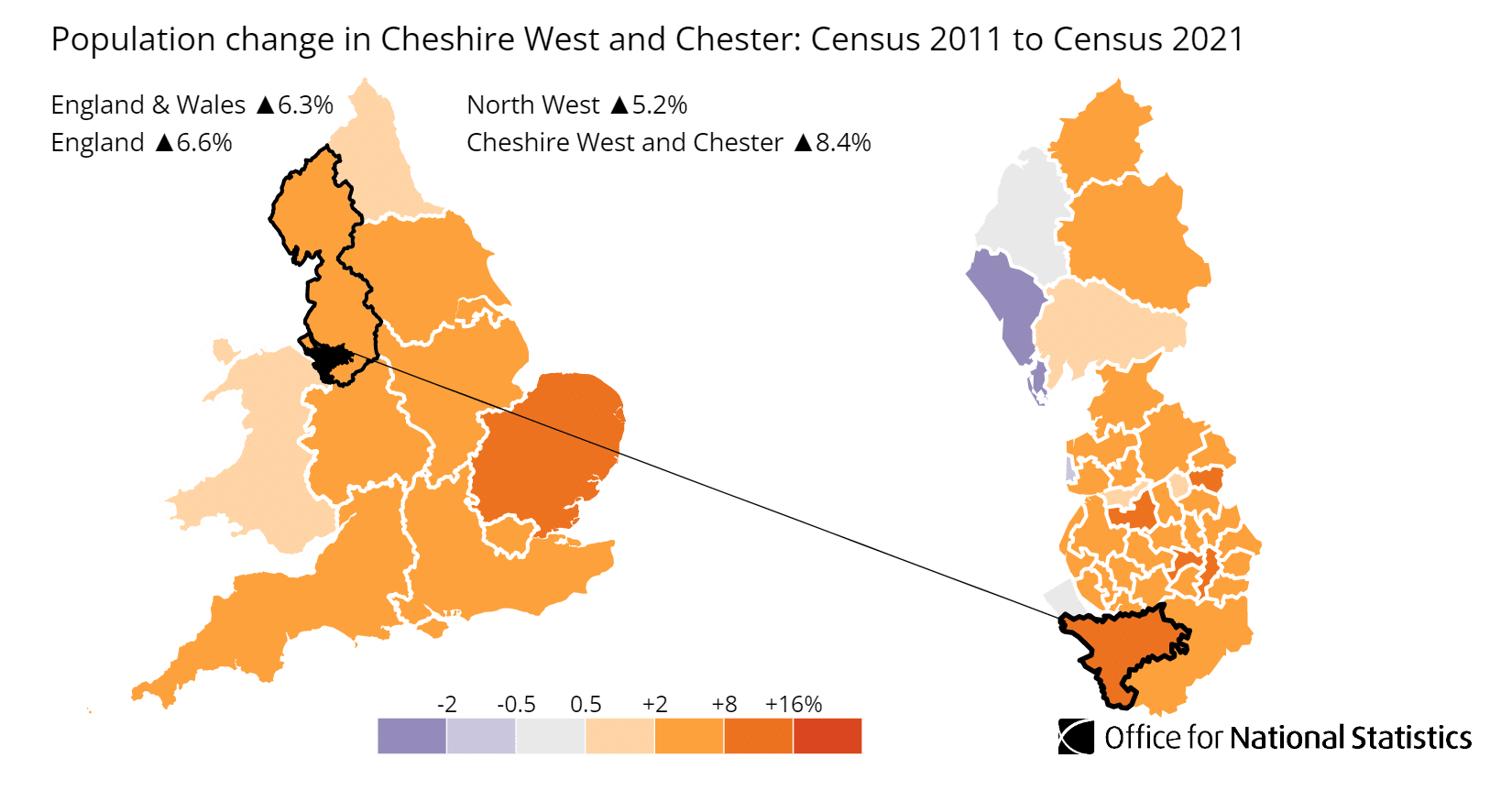
Gross rental yields of up to 4.8% in CH1, average sold prices 8.9% below the England average, and 30% deposits starting from £70,524. Chester is a compact four-postcode city where property prices sit at £265,955 on the HM Land Registry House Price Index. That is 22.3% above the North West regional average of £217,428 but still £25,910 below England's £291,865. The local authority of Cheshire West and Chester recorded population growth of 8.36% between the 2011 and 2021 censuses, from 329,608 to 357,150 residents.
Chester's premium within the North West is driven by local earnings that outstrip the region by 10.8%. The median gross weekly salary here is £797.80, compared to £720.10 across the North West and £752.40 for Great Britain. That wage base supports genuine local tenant demand across all four postcodes. For investors, the spread between CH1 at £235,079 and CH3 at £438,880 creates a two-tier market within a single city. The cheaper postcodes deliver the yields. The expensive ones do not.
This guide covers the unitary authority of Cheshire West and Chester (ONS code E06000050) across postcodes CH1, CH2, CH3, and CH4. Chester sits in the North West region, 40 miles south of Liverpool and 40 miles south-west of Manchester. The wider Cheshire buy-to-let region also includes Warrington to the north-east.
Article updated: March 2026
Chester Buy-to-Let Market Overview 2026
Chester is a heritage city that commands a North West premium, with average sold prices 22.3% above the regional average but 8.9% below the England average, creating a middle-ground entry point for buy-to-let investors.
- Average sold price: £265,955 (8.9% below England's £291,865)
- Asking price range: £235,079 (CH1) to £438,880 (CH3)
- Rental yields: 3.2% (CH3) to 4.8% (CH1) across all 4 postcodes
- Rental income: Monthly rents from £933 (CH1) to £1,208 (CH4)
- Price per sq ft: House prices from £254/sq ft (CH1) to £322/sq ft (CH3)
- Market activity: Sales ranging from 35 per month (CH1, CH3) to 38 per month (CH2)
- Deposit requirements: 30% deposits range from £70,524 (CH1) to £131,664 (CH3)
- Affordability ratios: Property prices from 5.7 to 10.6 times Chester's median annual salary of £41,486
Contents

-
by Robert Jones, Founder of Property Investments UK
With two decades in UK property, Rob has been investing in buy-to-let since 2005, and uses property data to develop tools for property market analysis.
Property Data Sources
Our location guide relies on diverse, authoritative datasets including:
- HM Land Registry UK House Price Index
- Ministry of Housing, Communities and Local Government
- Ordnance Survey Data Hub
- Propertydata.co.uk
We update our property data quarterly to ensure accuracy. Last update: March 2026. All data is presented as provided by our sources without adjustments or amendments.
Why Invest in Chester?
Chester's population grew 8.36% between the 2011 and 2021 censuses, from 329,608 to 357,150 residents. That growth rate is broadly in line with the England and Wales average of 6.3%, reflecting a city that is attracting new residents without the volatility of faster-growing urban centres. Chester's appeal is rooted in its Roman heritage, compact walkable centre, and position as the economic anchor of Cheshire West.
The local employment rate of 82.1% is significantly above both the North West average of 74.2% and Great Britain's 75.6%. Chester's economy is diversified across wholesale and retail (14.3% of employee jobs), health and social work (12.0%), and professional, scientific and technical services (10.9%). The University of Chester adds a student population that supports the rental market, while the city's tourism economy generates year-round hospitality employment and potential for holiday let investment.
Median gross annual earnings in Chester are £41,486, which is 10.8% above the North West regional median of £37,445 and 6.0% above the Great Britain median of £39,125. Higher local wages mean tenants can absorb higher rents. The combination of strong employment and above-average earnings creates a tenant base that is less reliant on housing benefit than many other North West buy-to-let locations.
Chester Economic Summary
- Population: 357,150 (2021 Census). Growth of 8.36% from 2011.
- Median annual salary: £41,486 (local), £37,445 (North West), £39,125 (Great Britain)
- Employment rate: 82.1% (local), 74.2% (North West), 75.6% (Great Britain)
- Unemployment rate: 2.7% (local), 4.1% (North West), 4.3% (Great Britain)
- Key employment sectors: Wholesale and retail, health and social work, professional and technical services, administrative services, accommodation and food
Source: ONS Census 2021, Nomis Labour Market Profile (ASHE 2025, Employment Oct 2024-Sep 2025)
Regeneration and Investment in Chester
Chester's city centre regeneration is anchored by the £72 million Northgate scheme, with over 400 new homes now in the pipeline for Phase 2. The investment is concentrated around the former Forum shopping centre site, where VINCI UK Developments and ION Property Developments signed a pre-development agreement with the council in November 2025.
- Chester Northgate Future Phases (Masterplanning, 400+ homes): VINCI UK Developments and ION Property Developments signed a pre-development agreement with Cheshire West and Chester Council in November 2025 to deliver over 400 sustainable homes, new public spaces, and reinstated historic lanes on the former Forum shopping centre site. City centre housing supply in Chester is constrained, and this scheme adds a significant residential component to the proven Northgate retail and leisure destination. Updates at Cheshire West and Chester Council.
- Chester Northgate Phase 1 (Completed, £72 million): The new retail, leisure, and dining destination in Chester city centre opened in 2022 with a six-screen Picturehouse cinema, relocated indoor market, and multiple restaurants. The scheme has welcomed over 3.5 million visitors to Chester Market since opening and has directly increased city centre footfall. Updates at Gardiner & Theobald.
- Cheshire and Warrington Growth Programme (Active): The Cheshire and Warrington Combined Authority coordinates sub-regional investment across Chester, Warrington, and Crewe, with major development sites promoted at the UKREiiF 2026 national property conference. Chester's role as the sub-region's heritage city and university town positions it for knowledge economy and life sciences investment alongside residential growth. Updates at Cheshire and Warrington.
Chester Property Market Analysis
Average property prices in Cheshire West and Chester have risen 406.4% since January 1995, from £52,516 to £265,955. The sections below break down that journey cycle by cycle, then drill into current postcode-level data for sold prices, price per square foot, asking prices, growth trends, and monthly transaction volumes.
When was the last house price crash in Chester?
Chester sits within the unitary authority of Cheshire West and Chester, so all sold property prices from HM Land Registry are recorded at this level. The Land Registry House Price Index tracks average prices from January 1995 to December 2025, covering 31 years of market cycles.
The 1995 to 2007 boom: Cheshire West and Chester started at £52,516 in January 1995. By December 2000, prices had reached £75,841, a 44.4% increase in six years driven by low interest rates and rising mortgage availability. Growth accelerated through the early 2000s, reaching £157,821 by December 2005. The market peaked at £175,410 in September 2007.
2008 to 2009, the financial crisis: Prices fell from the September 2007 peak of £175,410 to a trough of £148,501 in May 2009. That is a decline of 15.3% over 20 months. The worst year-on-year reading was -13.2% in May 2009. Chester's decline was shallower than both the England fall of 18.2% (from £183,883 in September 2007 to £150,438 in March 2009) and the North West fall of 18.3% (from £141,847 in December 2007 to £115,931 in January 2013). Chester's higher-value housing stock and stronger local economy provided a buffer that lower-priced North West markets did not have.
The 2010 to 2013 stagnation: Prices bounced off the May 2009 trough but plateaued. By December 2010, the average stood at £161,039. It drifted down to £154,485 by December 2012 before picking up to £160,349 by December 2013. Chester spent nearly four years oscillating in a narrow band, unable to push past the pre-crash peak.
Recovery, 2014 to 2016: Growth returned with prices rising from £168,043 in December 2014 to £176,690 in April 2016. That April 2016 reading was the first time prices surpassed the September 2007 pre-crash peak of £175,410. It took eight and a half years to recover. By December 2016, the average reached £180,162.
The 2017 to 2019 pre-pandemic growth: Steady single-digit growth continued. Prices moved from £187,465 in December 2017 to £191,375 in December 2018 and £195,182 in December 2019. Annual growth sat between 2.0% and 4.1% through this period.
2020 to 2022, the pandemic surge: The stamp duty holiday and a shift in buyer preferences towards cities with green space and heritage appeal turbocharged Chester. Prices jumped from £195,949 in June 2020 to £211,400 by December 2020 (8.3% annual growth). The run continued through 2021, hitting £226,756 by December 2021 (7.3% annual). By December 2022, prices reached £253,514 (11.8% annual growth).
The 2023 rate shock: Higher mortgage rates slowed the market. Prices eased to £248,201 by June 2023 and £248,737 by December 2023, recording -1.9% annual growth. Chester's correction was modest compared to markets with higher debt exposure.
2024 to present: Recovery took hold through 2024. Prices reached £258,676 by December 2024 (4.0% annual growth) and £265,955 by December 2025 (2.8% annual growth). The current price is 51.6% above the pre-crash peak of £175,410.
Long-term growth summary:
- 5 years (December 2020 to December 2025): 25.8% growth (£211,400 to £265,955)
- 10 years (December 2015 to December 2025): 52.8% growth (£174,099 to £265,955)
- 15 years (December 2010 to December 2025): 65.1% growth (£161,039 to £265,955)
- 20 years (December 2005 to December 2025): 68.5% growth (£157,821 to £265,955)
- 30 years (January 1995 to December 2025): 406.4% growth (£52,516 to £265,955)
Chester's 15.3% crash was shallower than both the regional and national averages, and the 30-year return of 406.4% demonstrates strong long-term capital growth. The eight-and-a-half-year recovery period was longer than England's, reflecting the deeper stagnation phase that affected many North West markets between 2010 and 2013. An investor who bought at the exact peak in September 2007 would now be sitting on gains of 51.6% on the Land Registry average.
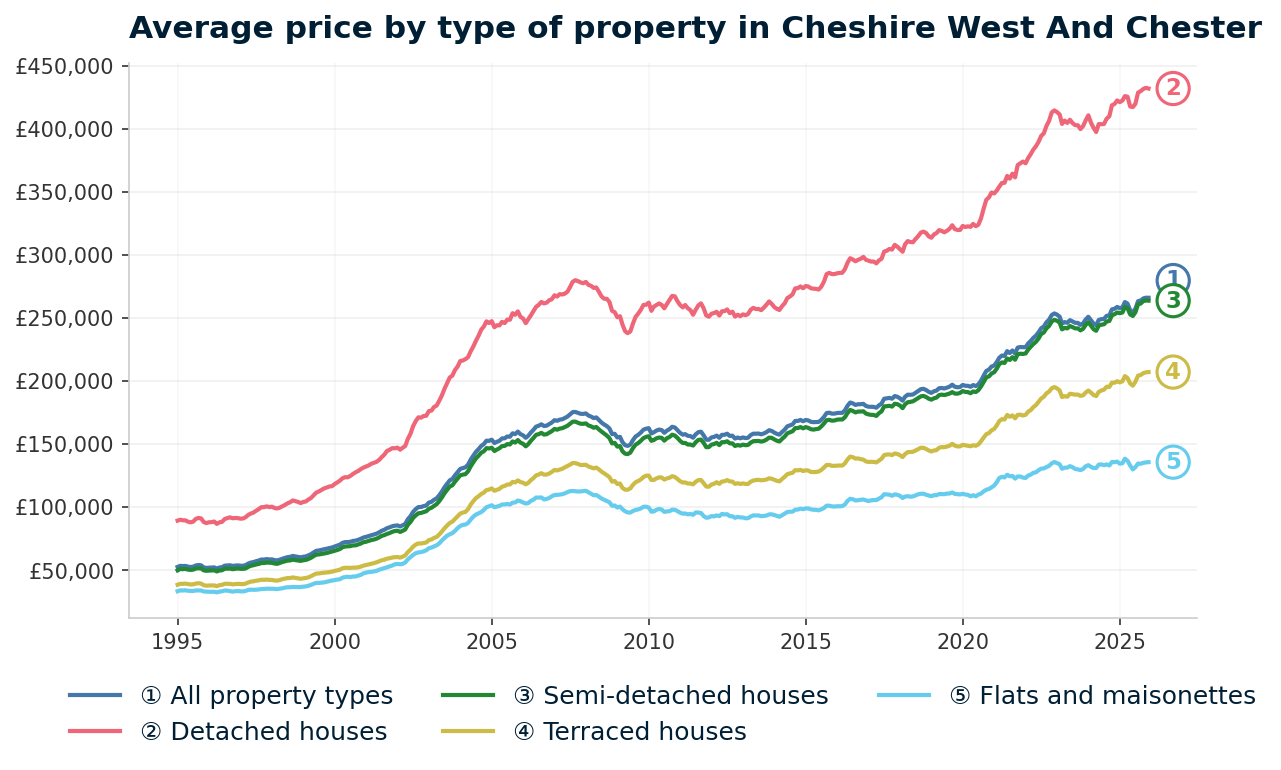
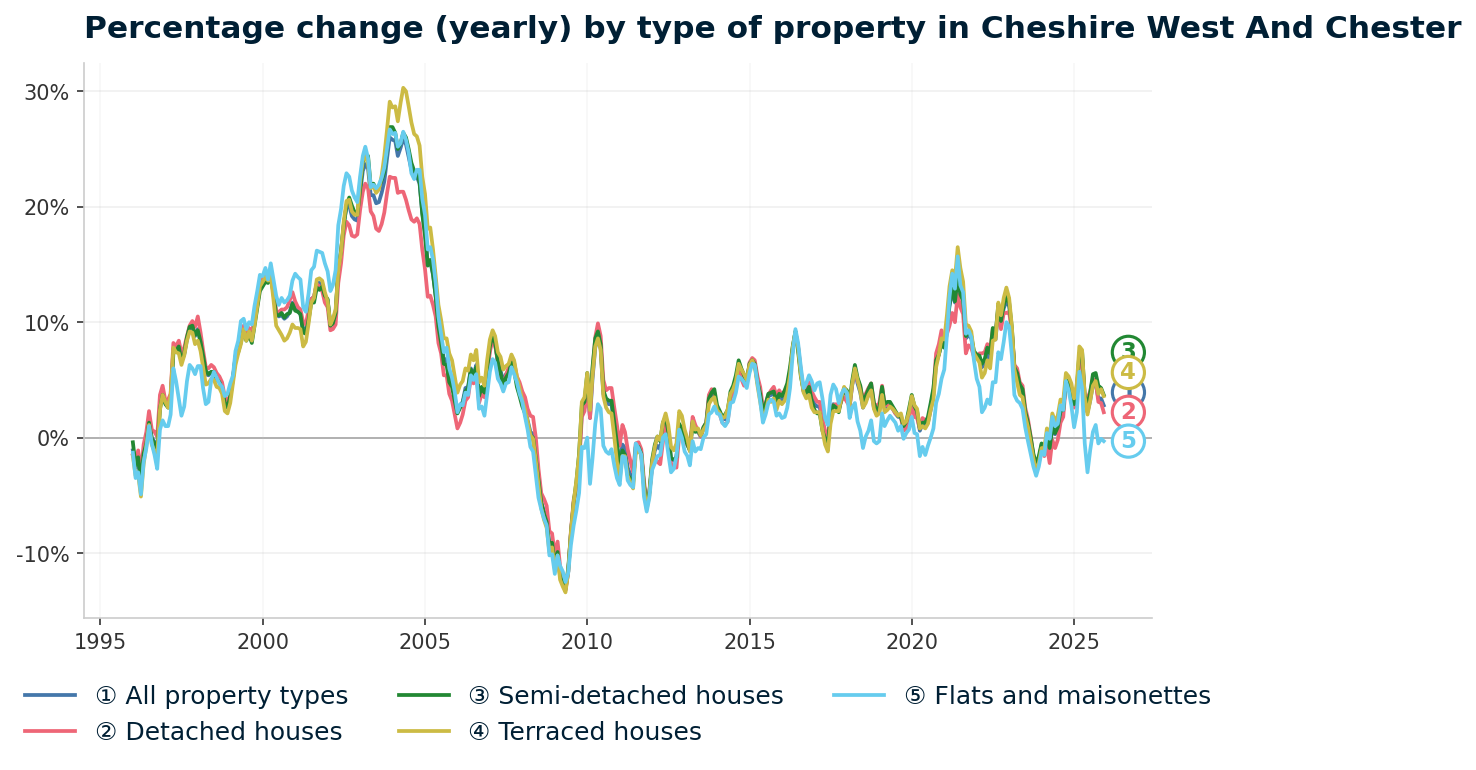
Source: HM Land Registry House Price Index for Cheshire West and Chester, January 1995 to December 2025.

Thinking of Buying?
We have off-market investment properties averaging 8%+ annual yield.
View Property DealsSold House Prices in Chester
The average sold price across all property types in Cheshire West and Chester is £265,955, which is 8.9% below the England average of £291,865. That discount is consistent across most property types, but it is not evenly distributed. Flats show a 38.2% discount to England, while detached houses are only 8.4% below. The gap tells you something about Chester's housing mix: the detached stock competes with commuter-belt Cheshire, while the flat market reflects a smaller city centre without the density of Manchester or Liverpool.
| Property Type | Chester Average | England Average | Difference |
|---|---|---|---|
| Detached houses | £431,856 | £471,667 | -8.4% |
| Semi-detached houses | £263,659 | £289,135 | -8.8% |
| Terraced houses | £207,027 | £244,830 | -15.4% |
| Flats and maisonettes | £135,600 | £219,340 | -38.2% |
| All property types | £265,955 | £291,865 | -8.9% |
Detached houses at £431,856 carry the smallest discount at 8.4% below England's £471,667. Chester's detached market draws from the same buyer pool as rural Cheshire and the Wirral, where village-style living at sub-London prices attracts professionals and families. Annual growth of 2.2% shows stable demand rather than speculative heat.
Semi-detached houses at £263,659 sit 8.8% below England's £289,135 and closely match the city-wide average. This is the workhorse of Chester's buy-to-let market. Semi-detached properties in CH2 (Hoole, Upton) and CH4 (Handbridge, Saltney) dominate letting agent stock lists, with 3.7% annual growth outpacing both detached houses and flats.
Terraced houses at £207,027 offer a 15.4% discount to England's £244,830. The terraced stock is concentrated in CH1 (City Centre, Blacon), where Victorian terraces in the city centre sit alongside post-war housing in Blacon. Annual growth of 3.6% puts terraced properties among the strongest performers in Chester.
Flats and maisonettes at £135,600 show the deepest discount at 38.2% below England's £219,340. Chester is not a flat-heavy city. The smaller volume of apartment stock and the absence of large-scale city centre tower developments mean flat prices reflect local demand only, without the institutional investor premium that inflates flat values in Manchester or Leeds. Annual change of -0.3% confirms a muted market.
Property Data Sources
Our location guide relies on diverse, authoritative datasets including:
- HM Land Registry UK House Price Index
- Ministry of Housing, Communities and Local Government
- Ordnance Survey Data Hub
- Propertydata.co.uk
We update our property data quarterly to ensure accuracy. Last update: March 2026. All data is presented as provided by our sources without adjustments or amendments.
Price Per Square Foot in Chester
Just £68 per square foot separates Chester's cheapest postcode from its most expensive, with CH1 at £254 and CH3 at £322. Price per square foot strips out the effect of property size and gives a cleaner comparison of location value. CH3 (Boughton, Christleton) commands the highest rate, reflecting the premium village stock in Christleton and the larger period properties in Boughton.
| Rank | Area | Price Per Sq Ft |
|---|---|---|
| 1 | CH1 (City Centre, Blacon) | £254 |
| 2 | CH4 (Handbridge, Saltney) | £283 |
| 3 | CH2 (Hoole, Upton) | £299 |
| 4 | CH3 (Boughton, Christleton) | £322 |
CH1 at £254 per square foot is the cheapest postcode for bricks-and-mortar value. This covers both the city centre (period conversions, smaller flats) and Blacon (predominantly social and ex-social housing). The wide range within CH1 reflects that contrast. Based on 566 transactions analysed, CH1's price per square foot sits 21.1% below CH3's.
CH3 at £322 per square foot tops the table despite also having the highest average asking price. When investors pay more per square foot, they are paying for location quality. In CH3, that means Christleton village, the rural fringe towards Tarvin, and the established residential streets of Boughton. All 701 transactions analysed show consistent premiums over the rest of the city.
For Sale Asking Prices in Chester
CH1 at £235,079 and CH3 at £438,880 sit 86.7% apart, the widest asking price gap in a city with just four postcodes. That hierarchy mirrors sold prices, but the spread is more pronounced. The mean asking price across all four Chester postcodes is £325,454.
| Rank | Area | Asking Price |
|---|---|---|
| 1 | CH1 (City Centre, Blacon) | £235,079 |
| 2 | CH2 (Hoole, Upton) | £304,615 |
| 3 | CH4 (Handbridge, Saltney) | £323,241 |
| 4 | CH3 (Boughton, Christleton) | £438,880 |
CH1 at £235,079 is the only postcode where a buy-to-let purchase falls below the city-wide Land Registry average of £265,955. The gap between CH1 and CH2 is £69,536. That is the biggest step between any two adjacent postcodes in the table. For an investor with a fixed budget, CH1 offers the most property for the money and the lowest barrier to entry.
CH3's £438,880 asking price is an outlier in a North West context. To put it in perspective, Manchester's mean asking price across 22 postcodes is £266,893. Chester's most expensive postcode costs 64.4% more than Manchester's average. CH3 is premium owner-occupier territory. The rental yield data in the sections below confirms this.

House Price Growth in Chester
Only one Chester postcode posted positive growth across all three timeframes: CH2 at 2.6% (one-year), 2.5% (three-year), and 16.1% (five-year). All four postcodes delivered positive five-year returns, but the spread tells a story. CH4 (Handbridge, Saltney) sits at the other end with negative one-year and three-year readings, despite an 8.9% five-year return.
| Area | 1 Year | 3 Years | 5 Years |
|---|---|---|---|
| CH2 (Hoole, Upton) | 2.6% | 2.5% | 16.1% |
| CH1 (City Centre, Blacon) | -0.3% | -0.9% | 10.8% |
| CH3 (Boughton, Christleton) | -0.2% | 2.3% | 10.8% |
| CH4 (Handbridge, Saltney) | -2.0% | -6.5% | 8.9% |
CH2 at 16.1% five-year growth is the standout performer. Hoole has established itself as Chester's most sought-after residential suburb, with independent shops, cafes, and easy walking distance to the city centre and station. That lifestyle appeal translates into consistent buyer demand. CH2 is also the only postcode with positive figures across all three timeframes.
CH4's -6.5% three-year decline is the weakest reading in Chester. Handbridge and Saltney sit south of the river, with Saltney straddling the Welsh border. The three-year negative figure suggests a correction from pandemic-era price spikes rather than a structural decline. The five-year return of 8.9% remains positive.
Monthly Property Sales in Chester
Exit liquidity is even across Chester, with monthly sales ranging from just 35 to 38 transactions per postcode and 144 city-wide. Even the quietest postcodes (CH1 and CH3 at 35 each) see steady transaction volumes. Turnover rates vary more dramatically, from 13% in CH3 to 32% in CH1.
| Area | Sales Per Month | Turnover | Asking Price |
|---|---|---|---|
| CH2 (Hoole, Upton) | 38 | 21% | £304,615 |
| CH4 (Handbridge, Saltney) | 36 | 18% | £323,241 |
| CH1 (City Centre, Blacon) | 35 | 32% | £235,079 |
| CH3 (Boughton, Christleton) | 35 | 13% | £438,880 |
CH1's 32% turnover rate is nearly two and a half times CH3's 13%. High turnover in CH1 reflects lower prices driving faster sales, a mix of first-time buyers and investors competing for the cheapest stock, and smaller properties that transact quickly. For buy-to-let investors, high turnover also signals an exit route. Properties in CH1 are more liquid than those in CH3.
CH3's 13% turnover rate is typical of premium postcodes. Higher-value properties take longer to sell and owners hold for longer periods. The 35 monthly sales are the same volume as CH1, but spread across a larger, more expensive housing stock. This is a buy-and-hold postcode for capital growth, not a quick-flip market.
Property Data Sources
Our location guide relies on diverse, authoritative datasets including:
- HM Land Registry UK House Price Index
- Ministry of Housing, Communities and Local Government
- Ordnance Survey Data Hub
- Propertydata.co.uk
We update our property data quarterly to ensure accuracy. Last update: March 2026. All data is presented as provided by our sources without adjustments or amendments.

Chester Rental Market Analysis
Monthly rents in Chester range from £933 in CH1 to £1,208 in CH4, with gross rental yields from 3.2% to 4.8% across all four postcodes. For investors weighing up whether rental property is a worthwhile investment in Chester, the sections below break down rents, yields, and tenant affordability postcode by postcode. If you are looking to build a property portfolio in the North West, Chester's combination of above-average wages and 82.1% employment offers a more resilient tenant base than many higher-yielding alternatives. Browse current buy-to-let property for sale across the region.
Average Rent & Gross Rental Yields in Chester
Gross rental yields in Chester range from 3.2% in CH3 to 4.8% in CH1. The pattern is straightforward: the cheapest postcode delivers the highest yield and the most expensive delivers the lowest. What is less obvious is that the rent gap between postcodes is narrower than the price gap. CH4 charges the highest monthly rent at £1,208 but ranks second for yield at 4.5% because its asking price of £323,241 is 37.5% higher than CH1's.
| Area | Average Monthly Rent | Asking Price | Gross Yield |
|---|---|---|---|
| CH1 (City Centre, Blacon) | £933 | £235,079 | 4.8% |
| CH4 (Handbridge, Saltney) | £1,208 | £323,241 | 4.5% |
| CH2 (Hoole, Upton) | £1,060 | £304,615 | 4.2% |
| CH3 (Boughton, Christleton) | £1,180 | £438,880 | 3.2% |
CH1 at 4.8% combines the lowest asking price with the lowest rent, yet still delivers the best yield. The maths is simple: £933 monthly rent on a £235,079 property. A 30% deposit of £70,524 gets an investor into the highest-yielding postcode in Chester.
The tenant profile in CH1 is mixed. City centre flats attract young professionals and University of Chester students. Blacon draws working families on more modest incomes. That diversity spreads void risk across tenant segments.
CH3 at 3.2% is a yield that most income-focused investors would pass over. The £1,180 monthly rent is only £28 less than CH4's £1,208, but the asking price is £115,639 higher. That extra £115,639 of capital deployed earns £28 less per month in rent. CH3 is a capital growth play in a premium location, not an income strategy.
Is Chester Rent High?
Monthly rents in Chester consume between 27.0% and 34.9% of the local median gross monthly salary. The widely cited threshold for rent affordability is 30% of gross income. Two of Chester's four postcodes fall below that line, and two sit above it. This is a tighter spread than many North West cities, reflecting Chester's combination of above-average wages and moderate rents.
The median gross weekly salary in Chester is £797.80, which equates to £3,457 per month or £41,486 per year. This is above the North West regional median of £720.10 per week and the Great Britain median of £752.40 per week. Data from the Nomis Labour Market Profile (ASHE 2025).
| Rank | Area | Rent as % of Income |
|---|---|---|
| 1 | CH4 (Handbridge, Saltney) | 34.9% |
| 2 | CH3 (Boughton, Christleton) | 34.1% |
| 3 | CH2 (Hoole, Upton) | 30.7% |
| 4 | CH1 (City Centre, Blacon) | 27.0% |
CH1 at 27.0% is the most affordable postcode for tenants. A monthly rent of £933 against a monthly salary of £3,457 leaves headroom. This matters for landlords because affordable rents correlate with lower void periods and fewer rent arrears. Tenants who are not financially stretched tend to stay longer.
CH4 at 34.9% is the least affordable, but the context matters. CH4 commands the highest average rent in Chester at £1,208 per month. The tenants renting at this level in Handbridge are typically professional households, often dual-income, rather than single earners on the median salary. The 34.9% figure overstates the stretch for the actual tenant profile.
Thinking of Buying?
We have off-market investment properties averaging 8%+ annual yield.
View Property DealsBuy-to-Let Considerations
Are House Prices High in Chester? Price-to-Earnings Ratios
Purchasing a property in Chester requires between 5.7 and 10.6 times the median annual salary. This is based on the Nomis Labour Market Profile for Chester showing the median gross annual income for Chester residents is £41,486.
The national benchmark for price-to-earnings is 7.5x (England's average sold price of £291,865 divided by the Great Britain median annual salary of £39,125). Two of Chester's four postcodes sit below that national benchmark, meaning they are more affordable relative to local incomes than the England average is relative to national incomes.
| Rank | Area | Price-to-Earnings Ratio |
|---|---|---|
| 1 | CH1 (City Centre, Blacon) | 5.7x |
| 2 | CH2 (Hoole, Upton) | 7.3x |
| 3 | CH4 (Handbridge, Saltney) | 7.8x |
| 4 | CH3 (Boughton, Christleton) | 10.6x |
CH1 at 5.7x is significantly below the national benchmark of 7.5x. This is the most affordable entry point in Chester. A property at 5.7 times local earnings is competitive with many of the North West's highest-yielding postcodes, but in a city with materially higher wages and employment rates.
CH3 at 10.6x sits well above the national benchmark. At more than ten times the local median salary, CH3 is firmly in premium territory. Buyers in this postcode are typically dual-income households or those trading down from more expensive parts of the South. For investors, the elevated ratio compresses yields and extends the payback period.
Deposit Requirements in Chester
A 30% deposit on a buy-to-let property in Chester ranges from £70,524 in CH1 to £131,664 in CH3. The gap between the cheapest and most expensive deposit is £61,140. That is enough to fund almost an entire second deposit in CH1. For investors comparing Chester with other North West locations, these deposit requirements sit above Liverpool (where the cheapest postcodes start below £40,000 at 30%) but below the premium end of Manchester.
Beyond the deposit, investors should factor in stamp duty and other buy-to-let costs when calculating the total capital required.
| Rank | Area | 30% Deposit Required |
|---|---|---|
| 1 | CH1 (City Centre, Blacon) | £70,524 |
| 2 | CH2 (Hoole, Upton) | £91,384 |
| 3 | CH4 (Handbridge, Saltney) | £96,972 |
| 4 | CH3 (Boughton, Christleton) | £131,664 |
The £20,860 step from CH1 (£70,524) to CH2 (£91,384) buys a significant upgrade in location quality. CH2 covers Hoole and Upton, which deliver 4.2% yields, 16.1% five-year growth, and the highest monthly sales volume in Chester. For an investor deciding between CH1 and CH2, that extra £20,860 in deposit buys better growth prospects and a more established residential character.
CH4 at £96,972 and CH2 at £91,384 are separated by just £5,588. The two postcodes sit in different parts of the city (CH4 south of the river, CH2 to the east) but are priced within 6% of each other. CH4 delivers higher rents (£1,208 vs £1,060) but weaker growth (-6.5% over three years vs CH2's +2.5%). The deposit difference is negligible. The data profiles are not.
What the Chester Data Tells Buy-to-Let Investors
CH1 leads on yield (4.8%), affordability (5.7x earnings), and turnover (32%), making it the data-driven entry point for investment property in Chester. A 30% deposit of £70,524 secures a property in Chester's cheapest postcode with monthly rent of £933 and the fastest-moving resale market in the city. The tenant base is mixed: city centre professionals, university students, and Blacon families. That diversity spreads void risk across tenant segments.
CH2 is the only postcode to deliver positive growth across all three timeframes (2.6% one-year, 2.5% three-year, 16.1% five-year). Hoole's lifestyle appeal and proximity to the city centre drive consistent buyer demand. At 4.2% yield and £91,384 deposit, CH2 occupies the middle ground between income and growth. For investors prepared to deploy more capital, this postcode offers a stronger balance sheet trajectory than CH1.
CH4 produces the highest monthly rent in Chester at £1,208, but three-year growth of -6.5% and one-year growth of -2.0% show prices moving in the wrong direction. CH3 at 3.2% yield and a 10.6x price-to-earnings ratio returns less income per pound invested than any other Chester postcode. The data for both postcodes reflects premium pricing that compresses returns. Investors looking for deals below asking price may find opportunities through off-market property channels.
Chester does not operate under a selective licensing scheme for private landlords. The city's above-average wages, 82.1% employment rate, and diversified economy make it a different proposition from the higher-yielding but more volatile North West markets.
How Chester Compares
Chester's mean asking price of £325,454 is the highest of five North West locations compared here, yet its top yield of 4.8% is the second lowest after Warrington's 4.7%. The comparison below places Chester alongside four nearby locations, each with a different investor profile. The mean asking price and mean monthly rent are simple averages across all postcodes with data. Top gross yield is the single highest postcode yield in each location.
| Location | Mean Asking Price | Mean Monthly Rent | Top Gross Yield |
|---|---|---|---|
| Liverpool | £207,760 | £870 | 7.4% |
| Stoke-on-Trent | £239,223 | £828 | 6.7% |
| Manchester | £266,893 | £1,308 | 7.8% |
| Warrington | £311,729 | £1,068 | 4.7% |
| Chester | £325,454 | £1,095 | 4.8% |
Chester is the most expensive location in this comparison at £325,454 mean asking price, but its top yield of 4.8% is only marginally above Warrington's 4.7%. Both Chester and Warrington represent the Cheshire premium: higher prices, lower yields, and a fundamentally different tenant demographic from Liverpool or Manchester.
For investors prioritising income, Liverpool at 7.4% and Manchester at 7.8% deliver significantly higher top-line yields. Stoke-on-Trent at 6.7% offers the lowest entry price in the table. For investors who want exposure to the North West with a more affluent tenant base and a heritage city setting, Chester and Warrington compete for the same capital. For a data-driven comparison across all UK locations, see our best buy-to-let areas guide.
Frequently Asked Questions
Is Chester a good place to live for buy-to-let tenants?
Chester's tenant fundamentals are stronger than most North West locations. The employment rate of 82.1% is materially above the North West average of 74.2% and the Great Britain average of 75.6%. Median weekly wages are £797.80, compared to £720.10 regionally and £752.40 nationally.
Higher wages and higher employment mean tenants are, on average, better placed to sustain rent payments. The city's compact geography, heritage setting, and access to both Liverpool and Manchester by rail add to its appeal for professional renters.
What are the best areas in Chester for property investment?
CH1 and CH2 lead the data on different metrics. CH1 (City Centre, Blacon) delivers the highest gross yield at 4.8% with the lowest asking price of £235,079 and the fastest turnover at 32%. CH2 (Hoole, Upton) is the only postcode with positive growth across one-year (2.6%), three-year (2.5%), and five-year (16.1%) timeframes.
CH3 (Boughton, Christleton) is the premium postcode at £438,880 with a 3.2% yield. CH4 (Handbridge, Saltney) produces the highest monthly rent at £1,208 but has the weakest three-year growth at -6.5%. The data points to CH1 for income and CH2 for balanced returns.
How does Chester compare to Liverpool for buy-to-let?
Liverpool delivers significantly higher yields at 7.4% vs Chester's 4.8%, and its mean asking price of £207,760 is 36.2% cheaper than Chester's £325,454. Liverpool offers more entry points, a larger postcode spread (25 postcodes with price data vs Chester's four), and a deeper student rental market.
Chester offers a more affluent tenant base, higher local wages, and lower unemployment. Liverpool suits investors prioritising yield and cash flow. Chester suits investors prioritising tenant quality and long-term capital stability.
Is there demand for student accommodation in Chester?
The University of Chester generates rental demand across CH1 in particular. The main Parkgate Road campus sits in CH1, where the city centre location and lower rents (£933 per month average) make properties accessible to shared student lets. Investors considering student accommodation should factor in seasonal void periods during summer months and the higher management intensity of student lets. For purpose-built options, see our guide to purpose-built student accommodation.
Can I find buy-to-let property under £250,000 in Chester?
CH1 (City Centre, Blacon) has an average asking price of £235,079, which is the only Chester postcode below £250,000. Within CH1, the Blacon area in particular offers terraced and semi-detached properties below the postcode average. Flats across Chester average £135,600 on the Land Registry index for Cheshire West and Chester. Investors targeting sub-£250,000 stock are limited to CH1 or flat purchases in other postcodes. Buyers seeking discounted stock can also explore below market value properties for sale across the North West.
When will the Northgate development affect Chester property prices?
Phase 2 construction starts from 2029, with tangible market effects from 2030 onwards. Northgate Phase 1 (the market, cinema, and restaurant complex) has been open since 2022 and has already contributed to city centre footfall. Phase 2, which delivers over 400 homes, signed a pre-development agreement in November 2025 with demolition targeted for 2028.
The track record of Phase 1 delivery gives the project credibility, but investors pricing in Northgate Phase 2 today are looking at a four-to-five year horizon before tangible market effects.