
Where to Buy Property Investments in Lichfield: Yields of 4.3%
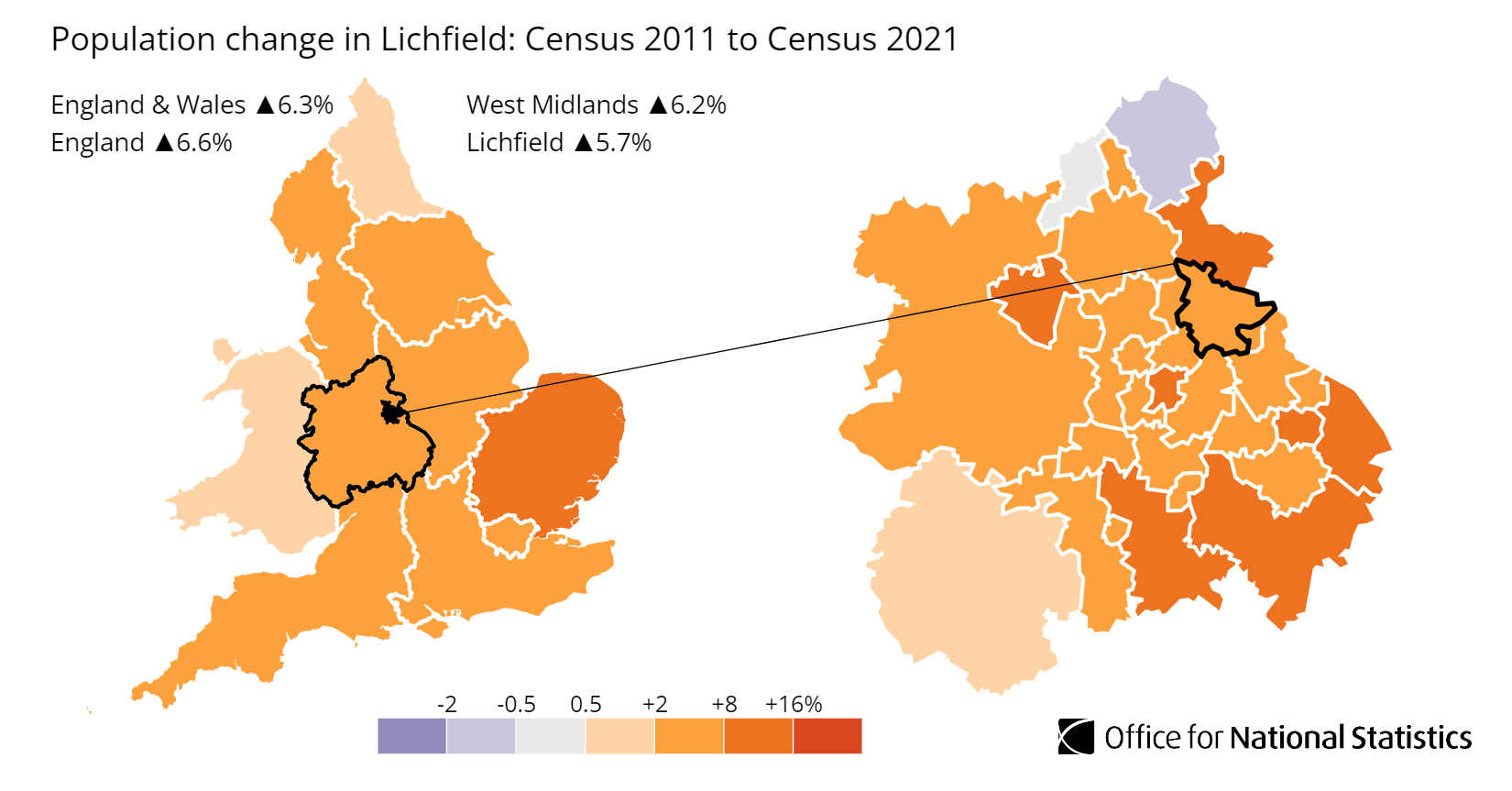
Gross rental yields in Lichfield range from 3.4% to 4.3% across seven postcodes, with the highest returns in WS7 (Burntwood) at 4.3%. The average sold price across the Lichfield district stands at £330,559, which is 12.8% above the England average of £293,131. Between the 2011 and 2021 censuses, Lichfield's population grew by 5.7% to 106,436.
Lichfield is a cathedral city and commuter hub sitting 14 miles north of Birmingham, where prices run 41.4% above the West Midlands regional average of £233,751. That premium narrows when you look at specific postcodes. WS7 (Burntwood) has an average asking price of £302,439 and delivers the district's highest yield. At the other end, B74 (Four Oaks, Little Aston) carries asking prices of £494,871. Seven postcodes make up the Lichfield property investment picture, covering the city centre, surrounding towns, and the rural fringe.
This guide covers the Lichfield district local authority (ONS code E07000194) in Staffordshire, within the West Midlands investment region. Lichfield sits between Walsall and Stoke-on-Trent, with Wolverhampton to the west. All seven postcodes are analysed below with data from the Land Registry, PropertyData, and ONS.
Article updated: February 2026
Lichfield Buy-to-Let Market Overview 2026
A commuter-belt district with earnings above the national median and property prices that reflect its proximity to Birmingham's employment base.
- Average sold price: £330,559 (12.8% above England's £293,131)
- Asking price range: £302,439 (WS7, Burntwood) to £494,871 (B74, Four Oaks)
- Rental yields: 3.4% (B79/WS15) to 4.3% (WS7) across all seven postcodes
- Rental income: Monthly rents from £972 (WS15, Rugeley) to £1,495 (B74, Four Oaks)
- Price per sq ft: House prices from £261/sq ft (WS15) to £373/sq ft (WS14)
- Market activity: Sales ranging from 19 per month (B79) to 41 per month (DE13)
- Deposit requirements: 30% deposits range from £90,732 (WS7) to £148,461 (B74)
- Affordability ratios: Property prices from 7.2 to 11.8 times Lichfield's median annual salary of £41,803
Contents

-
by Robert Jones, Founder of Property Investments UK
With two decades in UK property, Rob has been investing in buy-to-let since 2005, and uses property data to develop tools for property market analysis.
Property Data Sources
Our location guide relies on diverse, authoritative datasets including:
- HM Land Registry UK House Price Index
- Ministry of Housing, Communities and Local Government
- Ordnance Survey Data Hub
- Propertydata.co.uk
We update our property data quarterly to ensure accuracy. Last update: February 2026. All data is presented as provided by our sources without adjustments or amendments.
Why Invest in Lichfield?
Lichfield is a commuter-belt cathedral city with a median annual salary of £41,803, which sits 12.8% above the Great Britain median of £39,125. That income premium reflects who lives here. Lichfield residents commute into Birmingham, the NEC, and the manufacturing corridor along the A38 and A5. The city sits directly on the Cross City rail line, with trains into Birmingham New Street taking around 50 minutes. Lichfield Trent Valley station connects to the West Coast Main Line, putting London Euston under 90 minutes away.
The employment rate in Lichfield is 79.7%, comfortably above both the West Midlands regional figure of 74.3% and the Great Britain average of 75.6%. The local authority recorded 49,000 employee jobs, spread across health and social work (12.2%), wholesale and retail (12.2%), administrative services (10.2%), manufacturing (9.2%), and professional and technical services (9.2%). This is not a single-employer town. The jobs base is diversified and weighted toward sectors that sustain rental demand from working professionals.
Lichfield's population grew from 100,654 to 106,436 between the 2011 and 2021 censuses, a 5.7% increase. The district includes the cathedral city itself plus satellite towns including Burntwood (WS7), Rugeley (WS15), and parts of Tamworth (B79) and Four Oaks (B74).
Lichfield Economic Summary
- Population: 106,436 (2021 Census). Growth of 5.7% from 2011.
- Median annual salary: £41,803 (local), £37,050 (West Midlands), £39,125 (Great Britain)
- Employment rate: 79.7% (local), 74.3% (West Midlands), 75.6% (Great Britain)
- Unemployment rate: 4.0% (local), 5.4% (West Midlands), 4.3% (Great Britain)
- Key employment sectors: Health and social work, wholesale and retail, administrative services, manufacturing, professional and technical
Source: ONS Census 2021, Nomis Labour Market Profile (ASHE 2025, Employment Oct 2024-Sep 2025)
Regeneration and Investment in Lichfield
Lichfield District Council's city centre masterplan is redeveloping the former Friarsgate site on Birmingham Road, with the first residential plot sold and an Everyman Cinema due to open in the former Debenhams store in spring 2026. The regeneration is focused on the compact city centre, bringing new leisure and residential uses to former retail sites.
- Birmingham Road Gateway and City Centre Masterplan (under construction, multi-phase): The council's design code is guiding the redevelopment of the former Friarsgate site on Birmingham Road, with the first residential plot sold and further phases including housing zones and food and drink space. The Everyman Cinema is due to open in the former Debenhams store in spring 2026, creating a leisure anchor for the city centre. Updates at Lichfield Live.
Lichfield Property Market Analysis
When Was the Last House Price Crash in Lichfield?
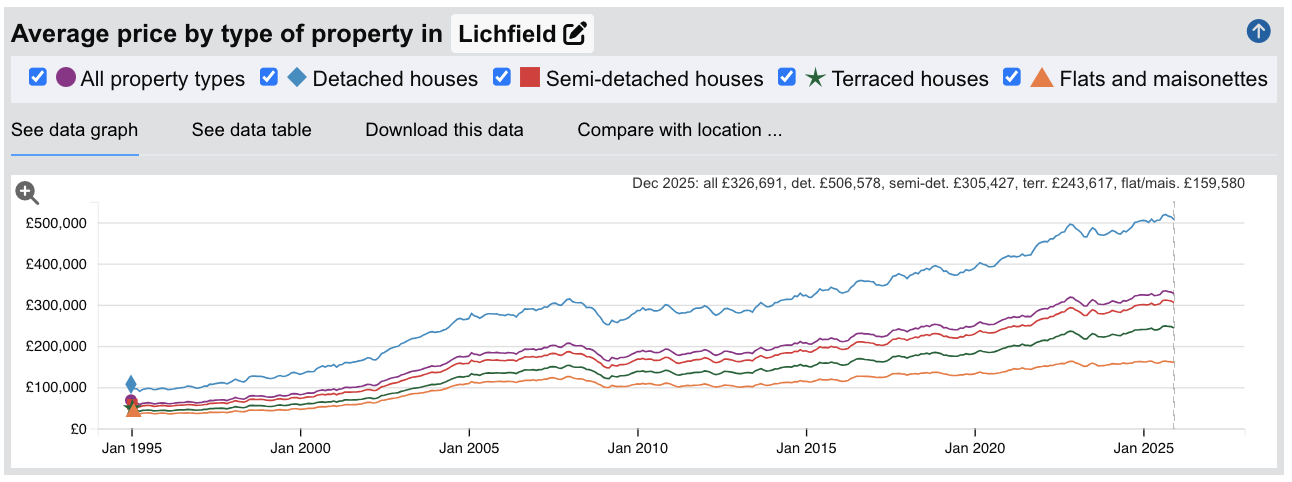
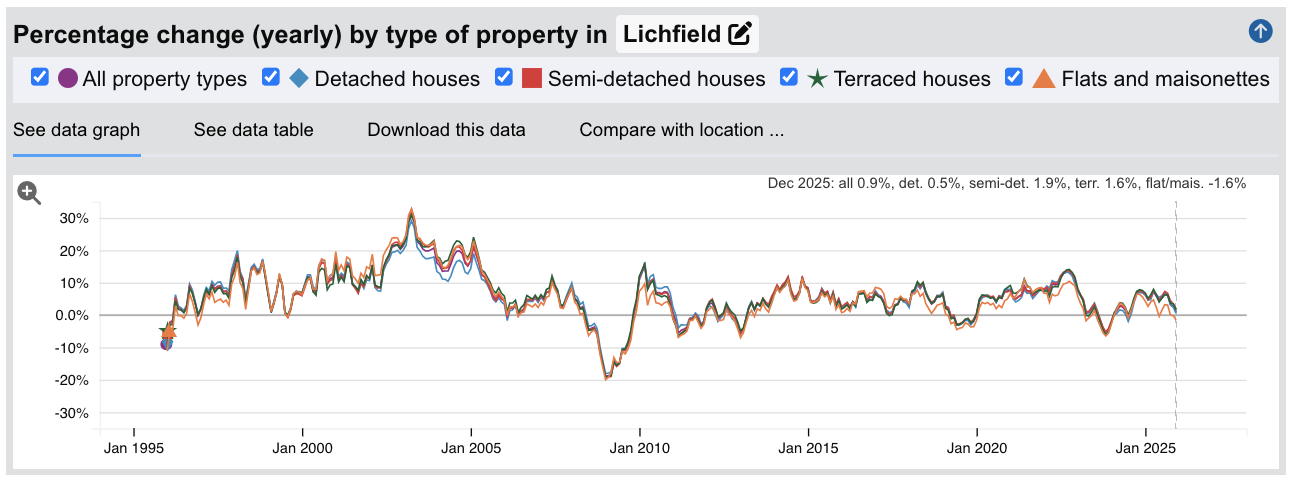
Lichfield's full house price history from the HM Land Registry House Price Index runs from January 1995 to November 2025. The data shows one major crash, a prolonged stagnation, and a sharp pandemic-era surge.
- 1995 to 2007 (The Boom): Prices rose from £67,986 in January 1995 to a pre-crisis peak of £206,897 in January 2008. That 204% increase over 13 years was driven by low interest rates, expanding mortgage availability, and Birmingham's growing employment base pulling commuter demand into Lichfield.
- 2008 to 2009 (The Financial Crisis): From the peak of £206,897 in January 2008 to a trough of £163,949 by March 2009, Lichfield lost 20.8% of its value in 14 months. The worst annual change reading hit -18.8% in January 2009. All property types fell at similar rates: detached houses dropped 19.5% (£312,327 to £251,456), semi-detached 21.0%, terraced 20.9%, and flats 20.8%. Lichfield's decline of 20.8% was steeper than the West Midlands region (-16.9%) and England overall (-18.2%). Premium commuter pricing meant a harder fall.
- 2010 to 2013 (Stagnation): Prices bounced quickly off the 2009 trough but stalled. The market moved sideways between £177,000 and £196,000 for nearly four years. Annual change readings flickered between -5.8% and +5.6% with no sustained direction. Dead money from mid-2010 through mid-2013.
- 2014 to 2016 (Recovery): Sustained growth returned in 2014 with annual changes consistently above 5%. Prices first exceeded the pre-crash peak of £206,897 in November 2014, reaching £210,719. That recovery took nearly seven years from peak to peak. By December 2016, prices had reached approximately £236,000.
- 2017 to 2019 (Pre-pandemic growth): Steady but slower growth continued, driven by ongoing commuter demand and constrained housing supply in the district. Prices reached £245,665 by November 2019.
- 2020 to 2022 (Pandemic surge): The stamp duty holiday and the shift to remote working boosted demand for Lichfield's semi-rural housing stock. Prices surged 29.5% from £245,665 (November 2019) to £318,222 (November 2022).
- 2023 (Rate shock): Rising mortgage rates paused the surge. Annual change readings turned negative by September 2023, reaching -5.6% in November. Prices dipped from £311,290 in January to £300,479 in November 2023. Brief and relatively mild compared to 2008.
- 2024 to 2025 (Current): Growth resumed through 2024, with annual changes reaching 7.2% by November 2024. The latest Land Registry figure for November 2025 is £330,559, showing 2.6% annual growth. Lichfield has set a new all-time high.
Long-Term Property Value Growth in Lichfield
- 5 years (2020-2025): +25.5% (£263,484 to £330,559)
- 10 years (2015-2025): +52.3% (£217,049 to £330,559)
- 15 years (2010-2025): +71.7% (£192,480 to £330,559)
- 20 years (2005-2025): +79.5% (£184,152 to £330,559)
- 30 years (1995-2025): +440.7% (£61,134 to £330,559)
The 2008 crash is the reference point for Lichfield investors assessing downside history. A 20.8% decline took nearly seven years to recover from peak to peak. That is longer than the England average of approximately five years. But the market Lichfield sits in now is different to 2007. Birmingham's employment base has expanded, HS2 construction has added infrastructure spending to the region, and the commuter catchment has deepened with remote and hybrid working patterns. The pandemic surge added 29.5% in three years, which masks how flat the preceding decade was.

Thinking of Buying?
We have off-market investment properties averaging 8%+ annual yield.
View Property DealsSold House Prices in Lichfield
The average sold price across all property types in Lichfield is £330,559, which is 12.8% above the England average of £293,131. That headline masks a split in the data. Detached houses, semi-detached houses, and terraced houses all sit above their England equivalents. Flats are the exception. Lichfield flats average £161,639, which is 27.0% below the England flat average of £221,565.
| Property Type | Lichfield Average | England Average | Difference |
|---|---|---|---|
| Detached houses | £512,476 | £474,400 | +8.0% |
| Semi-detached houses | £308,936 | £290,004 | +6.5% |
| Terraced houses | £246,630 | £245,002 | +0.7% |
| Flats and maisonettes | £161,639 | £221,565 | -27.0% |
| All property types | £330,559 | £293,131 | +12.8% |
Detached houses in Lichfield average £512,476, an 8.0% premium over the England figure of £474,400. This is the dominant housing stock in the district. The B74 and WS14 postcodes in particular are heavy with detached properties on larger plots, which pushes the detached average above the national figure.
Semi-detached houses average £308,936, 6.5% above the England equivalent. Semis are the core buy-to-let property type in areas like WS13 (Lichfield city centre) and WS7 (Burntwood), where they make up a significant share of the housing stock and attract professional tenants commuting into Birmingham.
Terraced houses at £246,630 sit almost exactly on the England average, with only a 0.7% premium. Terraced stock is limited across the district. Lichfield is not a dense Victorian terrace city in the way that some Midlands locations are.
Flats and maisonettes at £161,639 are 27.0% below the England flat average of £221,565. The flat market in Lichfield is small and concentrated in the city centre (WS13). England's flat average is pulled up by London and the South East. For investors looking at flat prices, Lichfield offers entry points well below the national benchmark.
Property Data Sources
Our location guide relies on diverse, authoritative datasets including:
- HM Land Registry UK House Price Index
- Ministry of Housing, Communities and Local Government
- Ordnance Survey Data Hub
- Propertydata.co.uk
We update our property data quarterly to ensure accuracy. Last update: February 2026. All data is presented as provided by our sources without adjustments or amendments.
Price Per Square Foot in Lichfield
How much property do you get for your money in each Lichfield postcode? Sold prices per square foot range from £261 in WS15 (Rugeley, Armitage) to £373 in WS14 (Lichfield, Shenstone). That £112 spread reveals two distinct tiers. The premium postcodes (WS14, B74, WS13) command prices above £325 per square foot. The remaining four postcodes cluster between £261 and £288.
| Rank | Area | Price Per Sq Ft |
|---|---|---|
| 1 | WS15 (Rugeley, Armitage) | £261 |
| 2 | WS7 (Burntwood) | £279 |
| 3 | B79 (Tamworth) | £280 |
| 4 | DE13 (Alrewas, Barton-under-Needwood) | £288 |
| 5 | WS13 (Lichfield) | £327 |
| 6 | B74 (Four Oaks, Little Aston) | £356 |
| 7 | WS14 (Lichfield, Shenstone) | £373 |
WS15 (Rugeley) at £261 per square foot offers the most space for the money. WS7 (Burntwood) and B79 (Tamworth) sit within £1 of each other at £279 and £280 respectively. These three postcodes represent the best value per square foot in the district. DE13 (Alrewas, Barton-under-Needwood) at £288 completes the affordable tier.
The premium tier starts at WS13 (Lichfield city centre) at £327 per square foot. B74 (Four Oaks) and WS14 (Shenstone) both exceed £350. The gap between the cheapest and most expensive postcode is 43%, which is moderate for a district spanning both market towns and premium commuter villages.
For Sale Asking Prices in Lichfield
Look at the gap between positions 1 and 7 in this table. The cheapest postcode (WS7, Burntwood) has an average asking price of £302,439. The most expensive (B74, Four Oaks) sits at £494,871. That is a 64% price difference within the same local authority district. The mean asking price across all seven Lichfield postcodes is £376,978.
| Rank | Area | Average Asking Price |
|---|---|---|
| 1 | WS7 (Burntwood) | £302,439 |
| 2 | DE13 (Alrewas, Barton-under-Needwood) | £342,008 |
| 3 | WS15 (Rugeley, Armitage) | £342,120 |
| 4 | B79 (Tamworth) | £347,301 |
| 5 | WS13 (Lichfield) | £369,859 |
| 6 | WS14 (Lichfield, Shenstone) | £440,246 |
| 7 | B74 (Four Oaks, Little Aston) | £494,871 |
Four postcodes cluster between £302,000 and £347,000: WS7, DE13, WS15, and B79. The price gap across this group is just £45,000. These represent the accessible end of the Lichfield market, where entry points are closest to the West Midlands regional average of £233,751.
WS13 (Lichfield city centre) at £369,859 sits in the middle ground. WS14 (Shenstone) and B74 (Four Oaks) push well above £400,000. B74 is the most expensive postcode in the Lichfield district, reflecting the prestige of Four Oaks and Little Aston as Birmingham's northern commuter belt. Investors looking to reduce their entry cost may find below market value properties in the lower-priced postcodes.
House Price Growth in Lichfield
Compare the top and bottom rows in this table. WS14 (Lichfield, Shenstone) has delivered 26.5% growth over five years, while B79 (Tamworth) has contracted by 2.4% over three years. The growth data reveals which postcodes are building value and which are treading water.
| Area | 1 Year | 3 Years | 5 Years |
|---|---|---|---|
| B74 (Four Oaks, Little Aston) | 2.0% | 5.3% | 10.4% |
| B79 (Tamworth) | 5.6% | -2.4% | 6.1% |
| DE13 (Alrewas, Barton-under-Needwood) | 2.7% | 6.0% | 13.3% |
| WS7 (Burntwood) | 1.8% | 4.4% | 13.4% |
| WS13 (Lichfield) | -7.1% | 0.3% | 5.2% |
| WS14 (Lichfield, Shenstone) | 12.3% | 19.6% | 26.5% |
| WS15 (Rugeley, Armitage) | 8.0% | 6.9% | 20.0% |
WS14 (Shenstone) stands out across every timeframe: 12.3% over one year, 19.6% over three, and 26.5% over five. This is a premium postcode that has been pulling away from the rest of the district. WS15 (Rugeley) is second at 20.0% over five years, combining lower entry prices with solid growth.
WS13 (Lichfield city centre) is the weakest performer, with a 7.1% decline over the past year and only 5.2% growth over five years. Three-year growth of just 0.3% confirms a flat market in the core postcode. Compare that to the neighbouring WS14 at 19.6% over the same three years. B79 (Tamworth) shows a similar pattern: strong short-term recovery (5.6% one-year) but negative three-year performance at -2.4%.
Monthly Property Sales in Lichfield
Exit strategy matters as much as entry price. DE13 (Alrewas, Barton-under-Needwood) records the highest monthly sales volume at 41 transactions per month, followed by WS13 and WS7 at 37 each. Turnover rates vary widely. WS7 (Burntwood) has a turnover of 111%, meaning stock is cycling faster than it is being listed. B79 (Tamworth) and WS15 (Rugeley) sit at the other end with lower turnover.
| Area | Sales Per Month | Turnover | Asking Price |
|---|---|---|---|
| B74 (Four Oaks, Little Aston) | 25 | 63% | £494,871 |
| B79 (Tamworth) | 19 | 68% | £347,301 |
| DE13 (Alrewas, Barton-under-Needwood) | 41 | 44% | £342,008 |
| WS7 (Burntwood) | 37 | 111% | £302,439 |
| WS13 (Lichfield) | 37 | 72% | £369,859 |
| WS14 (Lichfield, Shenstone) | 20 | 69% | £440,246 |
| WS15 (Rugeley, Armitage) | 38 | 50% | £342,120 |
WS7 (Burntwood) has the most active market with a 111% turnover rate and 37 sales per month. That turnover figure means properties are selling faster than new stock is appearing. For investors considering exit strategy, WS7 offers the most liquid market in the district.
DE13 (Alrewas, Barton-under-Needwood) has the highest raw volume at 41 sales per month but a lower turnover of 44%. This suggests a larger total market with more stock available. WS15 (Rugeley) follows a similar pattern: 38 sales per month but 50% turnover. B79 (Tamworth) has the lowest volume at 19 sales per month, which reflects the smaller overlap between the B79 postcode area and the Lichfield local authority boundary.
Across the Lichfield district, the Land Registry recorded 100 sales in September 2025 and 118 in August 2025. Monthly volumes have ranged from 59 (April 2025) to 222 (March 2025) over the past year. In a district with this level of turnover, off market properties can surface before they reach the open market.
Property Data Sources
Our location guide relies on diverse, authoritative datasets including:
- HM Land Registry UK House Price Index
- Ministry of Housing, Communities and Local Government
- Ordnance Survey Data Hub
- Propertydata.co.uk
We update our property data quarterly to ensure accuracy. Last update: February 2026. All data is presented as provided by our sources without adjustments or amendments.
Lichfield Rental Market Analysis
For investors weighing up whether rental property is a worthwhile investment in Lichfield, the data below breaks down average monthly rents and gross rental yields across the district's postcodes.
All seven Lichfield postcodes have rental data. Monthly rents range from £972 (WS15) to £1,495 (B74), and gross yields run from 3.4% to 4.3%. If you are looking to grow a residential property business in the West Midlands, Lichfield's combination of above-average tenant incomes and steady professional demand underpins the rental market. The cathedral city also attracts short-stay visitors, making Airbnb properties for sale a secondary consideration for the district.
Average Rent & Gross Rental Yields in Lichfield
WS7 (Burntwood) delivers the highest gross yield in Lichfield at 4.3%, combining a monthly rent of £1,090 with the district's lowest asking price of £302,439. The yield spread across the seven postcodes is narrow. Only 0.9 percentage points separate the highest yield (4.3%, WS7) from the lowest (3.4%, B79 and WS15).
| Area | Monthly Rent | Asking Price | Gross Yield |
|---|---|---|---|
| WS7 (Burntwood) | £1,090 | £302,439 | 4.3% |
| WS13 (Lichfield) | £1,272 | £369,859 | 4.1% |
| WS14 (Lichfield, Shenstone) | £1,368 | £440,246 | 3.7% |
| B74 (Four Oaks, Little Aston) | £1,495 | £494,871 | 3.6% |
| DE13 (Alrewas, Barton-under-Needwood) | £994 | £342,008 | 3.5% |
| B79 (Tamworth) | £991 | £347,301 | 3.4% |
| WS15 (Rugeley, Armitage) | £972 | £342,120 | 3.4% |
The yield pattern here is driven by the rent-to-price ratio, not by high absolute rents. WS7 tops the table because its asking price is the lowest in the district, not because it commands the highest rent. B74 (Four Oaks) takes the highest absolute rent at £1,495 per month but its asking price of £494,871 compresses the yield to 3.6%.
Compare B79 (Tamworth) and DE13 (Alrewas). Both have near-identical rents (£991 and £994) and near-identical yields (3.4% and 3.5%). The asking prices are within £5,000 of each other. The difference between them is location character: B79 is more urban and connected to Tamworth town centre, DE13 is rural with villages like Alrewas and Barton-under-Needwood.
Is Lichfield Rent High?
Monthly rents in Lichfield range from 27.9% to 42.9% of the local median gross monthly income. Three postcodes exceed the 30% affordability benchmark commonly used by lenders and letting agents. Four postcodes sit below it.
The median gross weekly salary in Lichfield is £803.90, which equates to £3,484 per month or £41,803 per year. This is above the West Midlands regional median of £712.50 per week and the Great Britain median of £752.40 per week. Data from the Nomis Labour Market Profile (ASHE 2025).
| Rank | Area | Rent as % of Income |
|---|---|---|
| 1 | B74 (Four Oaks, Little Aston) | 42.9% |
| 2 | WS14 (Lichfield, Shenstone) | 39.3% |
| 3 | WS13 (Lichfield) | 36.5% |
| 4 | WS7 (Burntwood) | 31.3% |
| 5 | DE13 (Alrewas, Barton-under-Needwood) | 28.5% |
| 6 | B79 (Tamworth) | 28.4% |
| 7 | WS15 (Rugeley, Armitage) | 27.9% |
B74 (Four Oaks) tops the table at 42.9% of the local median income. This postcode attracts professional tenants with household incomes significantly above the local authority median. The rent levels reflect the property type and quality available, not necessarily tenant stress. WS14 (39.3%) and WS13 (36.5%) also exceed the 30% benchmark.
Four postcodes keep rents below or near the 30% threshold: WS7 (31.3%), DE13 (28.5%), B79 (28.4%), and WS15 (27.9%). WS7 sits just above 30%. These figures use the Lichfield-wide median salary. Tenants in the higher-rent postcodes typically earn above the district median, which changes the affordability picture at individual household level.
Thinking of Buying?
We have off-market investment properties averaging 8%+ annual yield.
View Property DealsBuy-to-Let Considerations
Are House Prices High? Price-to-Earnings Ratios
Purchasing a property in Lichfield requires between 7.2 and 11.8 times the median annual salary. This is based on the Nomis Labour Market Profile for Lichfield showing the median gross annual income for Lichfield residents is £41,803.
| Rank | Area | Price-to-Earnings Ratio |
|---|---|---|
| 1 | WS7 (Burntwood) | 7.2x |
| 2 | DE13 (Alrewas, Barton-under-Needwood) | 8.2x |
| 3 | WS15 (Rugeley, Armitage) | 8.2x |
| 4 | B79 (Tamworth) | 8.3x |
| 5 | WS13 (Lichfield) | 8.8x |
| 6 | WS14 (Lichfield, Shenstone) | 10.5x |
| 7 | B74 (Four Oaks, Little Aston) | 11.8x |
Only WS7 (Burntwood) at 7.2x sits below the England national benchmark of approximately 7.5x. The remaining six postcodes exceed it. Lichfield's higher-than-average local earnings (£41,803 vs £39,125 GB median) help keep these ratios more moderate than the asking prices alone would suggest. Without that earnings premium, the ratios would be higher still.
WS14 (10.5x) and B74 (11.8x) are stretched by any measure. These are premium postcodes where the housing stock is predominantly detached homes on larger plots. The price-to-earnings ratios here reflect the housing mix rather than a market imbalance.
Deposit Requirements in Lichfield
A 30% deposit on a buy-to-let property in Lichfield ranges from £90,732 in WS7 (Burntwood) to £148,461 in B74 (Four Oaks, Little Aston). The district's higher price base means deposits here exceed most West Midlands locations. The entry point in WS7 is the most accessible, with just under £58,000 separating it from the next cheapest postcode.
| Rank | Area | 30% Deposit Required |
|---|---|---|
| 1 | WS7 (Burntwood) | £90,732 |
| 2 | DE13 (Alrewas, Barton-under-Needwood) | £102,602 |
| 3 | WS15 (Rugeley, Armitage) | £102,636 |
| 4 | B79 (Tamworth) | £104,190 |
| 5 | WS13 (Lichfield) | £110,958 |
| 6 | WS14 (Lichfield, Shenstone) | £132,074 |
| 7 | B74 (Four Oaks, Little Aston) | £148,461 |
Three postcodes cluster between £102,000 and £105,000: DE13, WS15, and B79. The deposit difference between these three is under £2,000. An investor choosing between them would be comparing location character, tenant profiles, and growth trajectories rather than capital requirements. Use the stamp duty calculator to work out total upfront costs, and see our guide to buy-to-let costs for a full breakdown.
What the Lichfield Data Tells Buy-to-Let Investors
WS7 (Burntwood) leads the income case: the highest yield at 4.3%, the lowest asking price at £302,439, the lowest deposit at £90,732, and the fastest turnover at 111%. It is the only postcode with a price-to-earnings ratio below the national benchmark (7.2x vs 7.5x). The tenant pool draws from professionals commuting into Lichfield, Birmingham, and the A5 corridor. Browse investment property listings in the West Midlands.
WS14 (Shenstone) leads the growth case: 26.5% over five years, 19.6% over three, and 12.3% over one year. No other Lichfield postcode comes close on growth metrics. The trade-off is a lower yield at 3.7% and a higher deposit requirement at £132,074. This is a capital appreciation play in a premium village postcode.
WS13 (Lichfield city centre) shows a 7.1% decline over one year and three-year growth of just 0.3%. The yield at 4.1% is second-highest in the district, but the negative price direction contrasts with surrounding postcodes. B79 (Tamworth) also shows negative three-year growth at -2.4%, though one-year performance has turned positive at 5.6%.
Lichfield does not have a selective licensing scheme in place across the district.
How Lichfield Compares
Lichfield's mean asking price of £376,978 is the second highest among West Midlands investment locations, behind only Solihull at £468,702. That premium comes with a trade-off: Lichfield's top yield of 4.3% is the lowest in this comparison group. The table below shows how the numbers stack up against four nearby locations with different price and yield profiles.
| Location | Mean Asking Price | Mean Monthly Rent | Top Gross Yield |
|---|---|---|---|
| Wolverhampton | £252,562 | £981 | 5.4% |
| Walsall | £287,870 | £993 | 6.1% |
| Birmingham | £272,648 | £1,121 | 7.0% |
| Lichfield | £376,978 | £1,169 | 4.3% |
| Solihull | £468,702 | £1,327 | 5.3% |
Lichfield occupies an unusual position in the West Midlands investment landscape. Its asking prices are 38% above Birmingham and 31% above Walsall, yet its top yield of 4.3% is lower than both. Birmingham offers yields of up to 7.0% at a lower mean price. Walsall delivers 6.1% yields with prices nearly £90,000 cheaper. Solihull is the only location priced higher, and it still offers a stronger top yield at 5.3%.
Lichfield's rental incomes are competitive. The mean monthly rent of £1,169 is higher than Wolverhampton (£981) and Walsall (£993), and close to Birmingham (£1,121). The higher asking prices compress yields.
Investors targeting income over capital growth will find stronger numbers elsewhere in the region. Investors targeting a premium tenant profile and long-term capital preservation will see Lichfield differently. Solihull is the nearest comparable on that basis.
Frequently Asked Questions
Is Lichfield a good place to live?
Lichfield scores well on employment, earnings, and connectivity. The employment rate is 79.7%, above both the regional and national averages. The median annual salary of £41,803 is 12.8% above the Great Britain median. The district has a cathedral city centre with independent shops and restaurants, plus market towns like Burntwood and Rugeley.
Population grew 5.7% between the 2011 and 2021 censuses. Rail connections put Birmingham city centre within commuting distance, and the A38 and A5 provide road access to the wider Midlands employment base.
Is Lichfield a nice place to live?
The district balances rural character with urban accessibility. The district includes open countryside, canal-side villages (Alrewas, Fradley), and the compact cathedral city itself. Beacon Park provides green space within walking distance of the city centre.
The Erasmus Darwin House, Samuel Johnson Birthplace Museum, and the three-spired cathedral give the city a heritage identity that most commuter belt locations lack. For tenants, this translates into a preference for the area that supports occupancy rates.
What are the best places to live in Lichfield?
Each Lichfield postcode serves a different tenant profile. WS13 covers the city centre itself, with the closest access to the cathedral quarter, Lichfield City station, and local amenities. WS14 includes Shenstone village, which has delivered 26.5% growth over five years and commands the highest price per square foot at £373.
B74 (Four Oaks, Little Aston) is the premium postcode with the highest rents but sits on the southern edge of the district closest to Sutton Coldfield. WS7 (Burntwood) is a separate market town offering the lowest entry price and highest yield. The postcode a tenant chooses depends on whether they prioritise city centre living, village character, Birmingham proximity, or value for money.
What is the average rent in Lichfield?
Monthly rents across the seven Lichfield postcodes range from £972 (WS15, Rugeley) to £1,495 (B74, Four Oaks). The mean monthly rent across the district is £1,169. WS7 (Burntwood) at £1,090 per month and WS13 (Lichfield city centre) at £1,272 represent the mid-market. These figures are from PropertyData and reflect current asking rents across the district, updated February 2026.
What is the average house price in Lichfield?
The Land Registry average sold price for Lichfield is £330,559 as of November 2025. This covers all property types: detached houses average £512,476, semi-detached £308,936, terraced £246,630, and flats £161,639. Asking prices from PropertyData (which reflect current market listings rather than completed sales) range from £302,439 (WS7) to £494,871 (B74), with a mean of £376,978 across all seven postcodes.
What is it like living in Lichfield?
Day-to-day life in this compact cathedral city of 106,436 people centres on the city centre for those in WS13 and WS14, with independent retail, a cinema arriving in spring 2026, and a compact high street. Burntwood (WS7) and Rugeley (WS15) operate as separate communities with their own centres.
Commuting is a defining feature. Cross City Line trains serve Lichfield City and Lichfield Trent Valley stations. The A38 connects north to Derby and south to Birmingham. Residents trade big-city amenities for more space, lower density, and access to Cannock Chase and the Staffordshire countryside.