
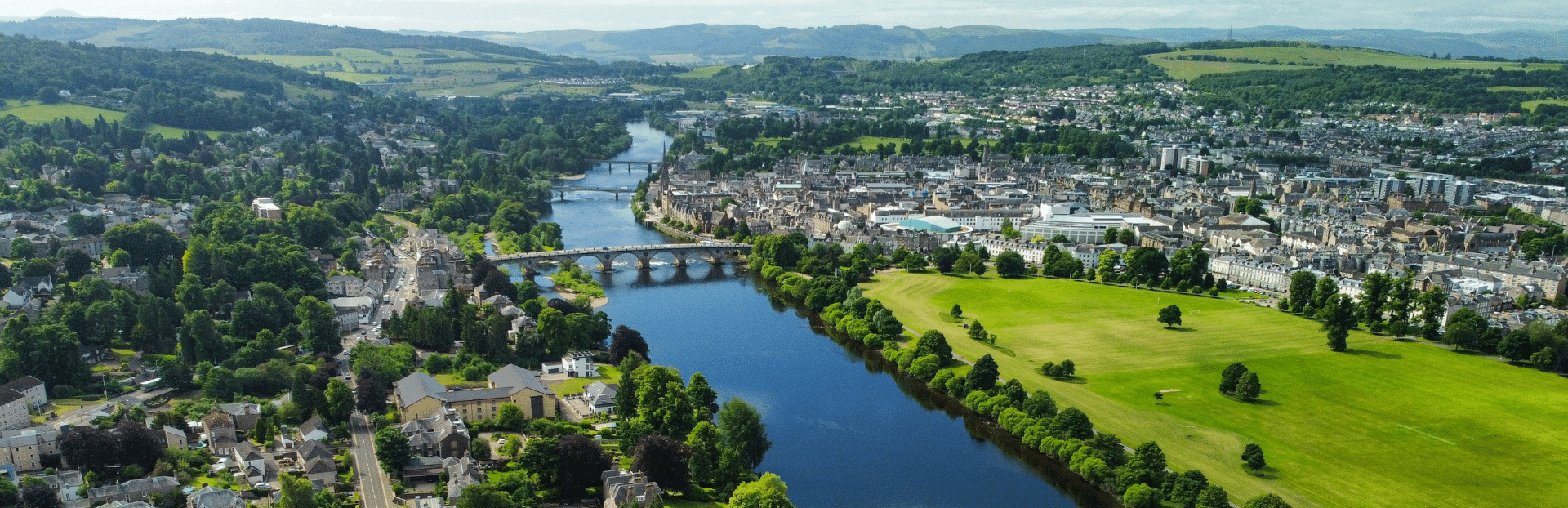
Perth is a city in the Perth and Kinross council area, in central Scotland. The average sold price across Perth and Kinross is £213,647 on the UK House Price Index, 14.5% above the Scotland average of £186,582, with houses carrying the premium and flats the one type that trades below the national figure. A detached home across the council area sells for £360,184, which is 6.3% above Scotland's £338,748, and semi-detached and terraced homes hold smaller premiums of 5.6% and 2.4%. Flats are the exception at £117,372, some 10.1% below the national average. Perth is a central-Scotland market where the headline number sits above the country as a whole, but the spread between a flat and a detached house is wide enough to give a buyer real choice.
Those area figures cover the whole Perth and Kinross council area, a large, mostly rural authority that stretches well beyond the city, so they read higher than the city itself in places and lower in others. The postcode data below is Perth-specific. The cheapest way in is PH1 (Perth North, Methven) at an average asking price of £192,814, the lowest of the five Perth postcodes, and it pairs that with the highest gross yield at 5.0%. The population of Perth and Kinross reached 150,953 at the 2022 census, up 2.9% on 2011, and the median local salary of £39,934 edges above both the Scotland and Great Britain figures.
This guide covers the five Perth postcodes (PH1, PH2, PH3, PH6, PH7) within the Perth and Kinross council area (ONS code S12000048). Perth sits at the geographic centre of Scotland on the River Tay, with mainline rail to Edinburgh, Glasgow, Dundee and Inverness. Buying here works differently from England: the purchase tax is Land and Buildings Transaction Tax rather than stamp duty, and the legal process runs on the Home Report and the conclusion of missives. Investors weighing up Scotland may also look at Dundee buy-to-let for a higher-yield, lower-price alternative on the other side of the Tay.
Article updated: July 2026

Why Invest in Perth?
Perth and Kinross grew its population 2.9% between the 2011 and 2022 censuses, from 146,652 to 150,953 residents, with the increase driven by people moving in rather than by natural growth. That migration-led pattern matters for a landlord: people choose to move to Perth for quality of life and access, which supports owner-occupier demand and steady values rather than the boom-and-bust of a single-employer town. Perth city itself holds around 50,000 people, with the rest of the council area spread across smaller towns including Crieff, Auchterarder and Comrie.
The median gross annual salary across Perth and Kinross is £39,934, fractionally above the Scotland median of £39,905 and 2.1% above the Great Britain median of £39,125. Outside Edinburgh, few Scottish areas clear the national wage. The local economy runs on a mix of financial services, food and drink, tourism and the public sector. Stagecoach Group and Scottish and Southern Electricity Networks both have their headquarters in the city. Perthshire's whisky industry is another local employer. Tourism brings more than two million visitors a year, and the opening of Perth Museum in 2024 lifted city-centre footfall. Higher local wages help tenants carry rents and underpin the area's house prices.
Perth Economic Summary
- Population (Perth and Kinross): 150,953 (Scottish Census 2022). Growth of 2.9% from 2011.
- Median annual salary: £39,934 (local), £39,905 (Scotland), £39,125 (Great Britain)
- Employment rate: 75.2% (local), 74.4% (Scotland), 75.6% (Great Britain)
- Unemployment rate: 4.2% (local), 3.8% (Scotland), 4.3% (Great Britain)
- Key employment sectors: Financial services, food and drink, tourism, public sector, higher education
Source: Nomis Labour Market Profile (ASHE 2025), Scottish Census 2022 for Perth and Kinross
Regeneration and Investment in Perth
More than £675 million of investment is completed or in delivery across Perth's three largest development and infrastructure projects, anchored by a new river crossing and a major western expansion. The schemes below carry confirmed funding or planning and the clearest bearing on where future demand and new stock will land.
- Perth West (planning approved, £500 million over 25 years): A 240-hectare mixed-use development on the city's western edge with up to 3,500 homes, a 25-hectare Eco-Innovation Park forecast to create 1,080 jobs, and a smart energy network. Phases 1 to 3 of the residential element were marketed in 2025. Updates at Scottish Construction Now.
- Cross Tay Link Road and Destiny Bridge (completed, £150 million): A 6km road linking the A9, A93 and A94 north of Perth via a new 307-metre bridge over the River Tay. It opened in March 2025, ahead of schedule, relieving city-centre congestion and unlocking development land north of the city. Updates at NEC Contract.
- Perth Museum (completed, £27 million): The conversion of the Grade B-listed City Hall into a museum and permanent home of the Stone of Destiny. It opened in March 2024 and welcomed more than 250,000 visitors in its first year, lifting city-centre tourism. Updates at Perth Museum.
Perth Property Market Analysis
Average property prices across Perth and Kinross have risen 131.9% since January 2004, from £92,131 to £213,647. The Registers of Scotland series that feeds the UK House Price Index begins in January 2004 for Scottish council areas, so the cycle below runs from 2004 onward rather than the 1995 start used for English markets. The sections after it drill into current postcode-level data for sold prices, price per square foot, asking prices, growth and transaction volumes.
When was the last house price crash in Perth?
Perth's last house price crash ran from March 2008 to March 2009 and took 19.1% off the average price. The UK House Price Index records Perth as the Perth and Kinross council area, with a monthly series starting in January 2004. That captures the late stage of the 2000s boom, the financial crisis, the long recovery and the pandemic surge, which is the full set of cycles a buyer needs to read the market.
The 2004 to 2008 boom: Perth opened the series at £92,131 in January 2004 and climbed fast, with annual growth running above 18% through 2006 and 2007. The peak landed at £165,833 in March 2008, an 80% rise in just over four years on cheap credit and rising transaction volumes. Perth was among the last UK markets to peak, lagging England by several months.
2008 to 2009, the financial crisis: From the March 2008 peak of £165,833, prices fell to a trough of £134,160 in March 2009, a decline of 19.1% in twelve months. The worst year-on-year reading was that same -19.1% in March 2009, and every property type fell almost in step: detached -19.4%, semi-detached -18.8%, terraced -18.7% and flats -19.0%. Perth's fall was deeper than Scotland's national decline of around 17%.
2010 to 2013, the stall: Perth bounced off the trough to £149,983 by January 2010, then growth stopped. Prices drifted back to £136,644 by May 2012, and by January 2013 the average of £143,837 still sat 13% below the pre-crash peak, almost five years on.
Recovery, 2014 to 2018: Growth returned at a crawl, with annual changes of 0% to 3% slowly closing the gap. Prices finally cleared the March 2008 peak in August 2018 at £167,499, more than ten years after the high. That recovery was slower than Scotland as a whole and well behind southern England, where pre-crash levels were regained by 2013 to 2014.
2020 to 2022, the pandemic surge: The shift to remote working hit Perth hard in the best way. Prices jumped from £170,271 in March 2020 to £216,647 by December 2022, growth of 27.2% in under three years, as the city's transport links and access to the Highlands drew lifestyle buyers.
The 2023 rate shock: Higher mortgage rates cooled the market. Prices eased from £216,647 in December 2022 to £211,735 by December 2023, a dip of 2.3% that was brief and mild against the 2008 fall.
2024 to present: Prices recovered through 2024 and 2025 and reached an all-time high of £232,308 in August 2025, before easing to £213,647 by the latest reading in March 2026. That puts the current average 28.8% above the March 2008 pre-crash peak, with the recent step back from the August high reading as seasonal cooling rather than a fresh correction.
Long-term growth summary:
- 5 years (March 2021 to March 2026): 12.3% growth (£190,322 to £213,647)
- 10 years (March 2016 to March 2026): 39.9% growth (£152,749 to £213,647)
- 15 years (March 2011 to March 2026): 38.7% growth (£153,997 to £213,647)
- 20 years (March 2006 to March 2026): 70.2% growth (£125,513 to £213,647)
- Full series (January 2004 to March 2026): 131.9% growth (£92,131 to £213,647)
Perth's 19.1% crash was deeper than Scotland's, and the recovery took more than a decade with a long stall between 2010 and 2013 before the pre-crash peak was cleared. Since then the area has compounded steadily, and an investor who bought at the exact March 2008 top would now be 28.8% ahead on the UK House Price Index average.
- All property types
- Detached
- Semi-detached
- Terraced
- Flats
Source: HM Land Registry House Price Index
| Year | All property types | Detached | Semi-detached | Terraced | Flats |
|---|---|---|---|---|---|
| 2004-01 | £92,131 | £163,394 | £95,362 | £71,307 | £57,458 |
| 2004-02 | £88,516 | £154,883 | £91,495 | £68,872 | £56,135 |
| 2004-03 | £91,350 | £159,072 | £94,473 | £71,409 | £58,126 |
| 2004-04 | £91,643 | £155,973 | £95,564 | £73,005 | £59,175 |
| 2004-05 | £93,466 | £157,925 | £97,720 | £74,983 | £60,583 |
| 2004-06 | £94,736 | £158,896 | £99,198 | £76,299 | £61,815 |
| 2004-07 | £98,657 | £167,451 | £102,874 | £78,795 | £63,822 |
| 2004-08 | £103,277 | £176,680 | £107,445 | £82,094 | £66,376 |
| 2004-09 | £105,586 | £181,141 | £109,688 | £83,789 | £67,721 |
| 2004-10 | £105,800 | £181,328 | £109,458 | £83,838 | £68,195 |
| 2004-11 | £104,887 | £179,331 | £108,525 | £83,293 | £67,734 |
| 2004-12 | £101,834 | £172,949 | £105,262 | £81,319 | £66,193 |
| 2005-01 | £103,035 | £174,983 | £106,550 | £82,453 | £66,863 |
| 2005-02 | £106,315 | £180,455 | £109,840 | £85,241 | £68,957 |
| 2005-03 | £108,898 | £183,686 | £112,053 | £87,071 | £70,228 |
| 2005-04 | £107,308 | £177,264 | £109,889 | £85,824 | £69,518 |
| 2005-05 | £107,878 | £175,723 | £109,776 | £86,125 | £70,215 |
| 2005-06 | £111,632 | £180,844 | £113,140 | £89,129 | £72,786 |
| 2005-07 | £119,087 | £193,470 | £120,957 | £95,224 | £77,512 |
| 2005-08 | £121,425 | £197,554 | £123,315 | £97,230 | £78,956 |
| 2005-09 | £120,613 | £197,472 | £122,723 | £96,669 | £78,287 |
| 2005-10 | £118,581 | £196,002 | £120,370 | £94,968 | £76,922 |
| 2005-11 | £120,444 | £197,796 | £122,022 | £96,514 | £78,224 |
| 2005-12 | £126,968 | £205,645 | £127,464 | £101,349 | £82,980 |
| 2006-01 | £129,601 | £209,405 | £130,302 | £103,692 | £84,611 |
| 2006-02 | £125,360 | £201,780 | £125,879 | £100,421 | £81,937 |
| 2006-03 | £125,513 | £202,985 | £126,994 | £101,088 | £81,658 |
| 2006-04 | £122,611 | £196,130 | £123,512 | £98,783 | £80,040 |
| 2006-05 | £128,778 | £205,309 | £129,582 | £103,609 | £84,194 |
| 2006-06 | £128,904 | £203,437 | £128,979 | £103,533 | £84,653 |
| 2006-07 | £134,585 | £212,920 | £134,781 | £108,333 | £88,220 |
| 2006-08 | £136,241 | £218,096 | £137,151 | £110,174 | £88,780 |
| 2006-09 | £136,009 | £220,660 | £137,753 | £110,313 | £88,117 |
| 2006-10 | £136,294 | £221,317 | £137,767 | £110,246 | £88,435 |
| 2006-11 | £138,559 | £223,466 | £139,724 | £111,866 | £90,161 |
| 2006-12 | £145,124 | £231,757 | £145,532 | £116,891 | £94,832 |
| 2007-01 | £144,519 | £230,843 | £145,222 | £116,662 | £94,287 |
| 2007-02 | £141,894 | £225,394 | £141,815 | £114,087 | £93,006 |
| 2007-03 | £135,749 | £214,661 | £135,555 | £109,368 | £89,062 |
| 2007-04 | £144,954 | £226,972 | £144,261 | £117,005 | £95,386 |
| 2007-05 | £148,963 | £232,211 | £148,090 | £120,603 | £98,005 |
| 2007-06 | £155,945 | £242,317 | £154,555 | £125,897 | £102,834 |
| 2007-07 | £153,756 | £239,365 | £152,183 | £123,907 | £101,402 |
| 2007-08 | £156,702 | £246,726 | £155,610 | £126,293 | £102,966 |
| 2007-09 | £156,643 | £248,893 | £156,404 | £126,609 | £102,486 |
| 2007-10 | £160,352 | £256,451 | £159,973 | £129,279 | £104,860 |
| 2007-11 | £164,484 | £260,515 | £163,412 | £132,348 | £108,050 |
| 2007-12 | £163,135 | £256,942 | £161,169 | £130,790 | £107,583 |
| 2008-01 | £161,592 | £254,275 | £159,968 | £130,049 | £106,398 |
| 2008-02 | £163,339 | £258,525 | £162,257 | £131,838 | £107,611 |
| 2008-03 | £165,833 | £263,349 | £166,336 | £134,904 | £109,159 |
| 2008-04 | £162,950 | £256,369 | £164,368 | £133,339 | £107,861 |
| 2008-05 | £159,677 | £249,364 | £162,227 | £131,700 | £105,775 |
| 2008-06 | £155,930 | £243,482 | £158,526 | £128,933 | £103,109 |
| 2008-07 | £155,905 | £244,967 | £158,853 | £129,172 | £101,990 |
| 2008-08 | £153,747 | £244,777 | £155,662 | £126,309 | £99,723 |
| 2008-09 | £157,512 | £251,148 | £159,195 | £128,905 | £102,307 |
| 2008-10 | £153,748 | £245,078 | £154,769 | £125,011 | £100,528 |
| 2008-11 | £155,127 | £244,392 | £156,949 | £127,062 | £102,255 |
| 2008-12 | £148,494 | £232,345 | £150,703 | £122,384 | £98,231 |
| 2009-01 | £144,841 | £226,686 | £146,716 | £119,362 | £95,893 |
| 2009-02 | £137,053 | £214,893 | £138,805 | £112,787 | £90,640 |
| 2009-03 | £134,160 | £212,177 | £135,074 | £109,694 | £88,459 |
| 2009-04 | £139,906 | £219,671 | £141,515 | £115,146 | £92,455 |
| 2009-05 | £142,504 | £223,723 | £144,307 | £117,456 | £93,961 |
| 2009-06 | £150,162 | £235,975 | £152,284 | £123,926 | £98,579 |
| 2009-07 | £151,088 | £238,758 | £152,987 | £124,457 | £98,524 |
| 2009-08 | £153,393 | £244,081 | £155,107 | £126,350 | £98,953 |
| 2009-09 | £152,969 | £244,198 | £154,700 | £126,041 | £98,066 |
| 2009-10 | £152,931 | £244,967 | £154,726 | £125,931 | £97,464 |
| 2009-11 | £153,069 | £245,362 | £154,486 | £125,936 | £97,742 |
| 2009-12 | £152,204 | £242,601 | £154,199 | £125,929 | £97,306 |
| 2010-01 | £149,983 | £240,458 | £151,645 | £123,687 | £95,388 |
| 2010-02 | £146,343 | £235,001 | £148,577 | £120,536 | £92,527 |
| 2010-03 | £146,679 | £237,317 | £148,549 | £120,199 | £92,143 |
| 2010-04 | £150,243 | £241,550 | £152,484 | £123,490 | £94,976 |
| 2010-05 | £155,043 | £248,602 | £157,035 | £127,694 | £98,490 |
| 2010-06 | £154,669 | £247,566 | £156,910 | £127,607 | £98,254 |
| 2010-07 | £152,669 | £245,688 | £154,864 | £125,717 | £96,262 |
| 2010-08 | £153,625 | £249,304 | £156,138 | £125,857 | £95,713 |
| 2010-09 | £154,868 | £252,058 | £157,203 | £126,774 | £96,181 |
| 2010-10 | £155,328 | £252,700 | £157,788 | £127,187 | £96,444 |
| 2010-11 | £152,254 | £247,987 | £154,438 | £124,599 | £94,531 |
| 2010-12 | £145,729 | £237,510 | £147,857 | £118,976 | £90,532 |
| 2011-01 | £150,327 | £245,979 | £152,119 | £122,439 | £93,177 |
| 2011-02 | £150,279 | £245,533 | £152,066 | £122,475 | £93,349 |
| 2011-03 | £153,997 | £251,245 | £156,007 | £125,903 | £95,705 |
| 2011-04 | £149,979 | £243,401 | £152,333 | £123,189 | £93,612 |
| 2011-05 | £152,863 | £246,176 | £155,629 | £126,134 | £96,373 |
| 2011-06 | £151,127 | £243,299 | £154,006 | £124,504 | £95,395 |
| 2011-07 | £150,706 | £243,410 | £153,373 | £123,775 | £94,874 |
| 2011-08 | £148,332 | £241,413 | £150,976 | £121,480 | £92,036 |
| 2011-09 | £153,444 | £250,943 | £155,997 | £125,209 | £94,636 |
| 2011-10 | £152,696 | £250,125 | £155,414 | £124,398 | £93,854 |
| 2011-11 | £151,040 | £246,417 | £153,800 | £123,121 | £93,581 |
| 2011-12 | £147,064 | £238,674 | £150,191 | £120,222 | £91,635 |
| 2012-01 | £146,047 | £236,878 | £149,392 | £119,542 | £90,848 |
| 2012-02 | £146,680 | £238,823 | £150,039 | £120,084 | £90,442 |
| 2012-03 | £144,706 | £235,814 | £147,954 | £118,794 | £88,867 |
| 2012-04 | £140,171 | £227,961 | £143,053 | £115,136 | £86,622 |
| 2012-05 | £136,644 | £221,785 | £139,409 | £112,310 | £84,802 |
| 2012-06 | £141,631 | £230,367 | £144,012 | £116,312 | £87,893 |
| 2012-07 | £145,698 | £237,788 | £147,874 | £119,558 | £89,991 |
| 2012-08 | £147,570 | £240,897 | £149,967 | £121,462 | £90,696 |
| 2012-09 | £143,163 | £234,378 | £145,487 | £117,662 | £87,536 |
| 2012-10 | £140,544 | £229,101 | £143,267 | £115,890 | £86,188 |
| 2012-11 | £139,088 | £227,064 | £141,669 | £114,655 | £85,117 |
| 2012-12 | £142,336 | £231,625 | £145,299 | £117,672 | £87,264 |
| 2013-01 | £143,837 | £234,109 | £147,210 | £118,880 | £87,898 |
| 2013-02 | £143,903 | £234,195 | £147,323 | £118,761 | £88,024 |
| 2013-03 | £141,506 | £230,856 | £144,965 | £116,495 | £86,192 |
| 2013-04 | £138,965 | £227,043 | £142,066 | £114,432 | £84,530 |
| 2013-05 | £142,589 | £231,907 | £145,847 | £117,657 | £87,430 |
| 2013-06 | £142,623 | £231,300 | £145,825 | £118,030 | £87,810 |
| 2013-07 | £147,264 | £239,016 | £150,461 | £121,766 | £90,654 |
| 2013-08 | £145,275 | £236,306 | £148,549 | £119,998 | £88,983 |
| 2013-09 | £146,263 | £239,401 | £149,159 | £120,221 | £89,009 |
| 2013-10 | £146,427 | £239,952 | £149,348 | £120,263 | £88,919 |
| 2013-11 | £147,852 | £243,561 | £150,515 | £121,013 | £89,193 |
| 2013-12 | £149,404 | £245,125 | £152,510 | £122,529 | £90,525 |
| 2014-01 | £150,093 | £246,568 | £153,034 | £122,881 | £90,953 |
| 2014-02 | £150,003 | £245,813 | £152,811 | £122,948 | £91,398 |
| 2014-03 | £147,692 | £243,074 | £150,428 | £120,685 | £89,389 |
| 2014-04 | £145,953 | £239,394 | £149,089 | £119,794 | £88,326 |
| 2014-05 | £145,899 | £239,622 | £149,162 | £119,829 | £87,873 |
| 2014-06 | £148,382 | £243,241 | £151,780 | £122,090 | £89,530 |
| 2014-07 | £150,426 | £247,780 | £153,606 | £123,385 | £90,225 |
| 2014-08 | £152,628 | £251,047 | £156,077 | £125,387 | £91,549 |
| 2014-09 | £153,477 | £253,226 | £156,677 | £125,951 | £91,683 |
| 2014-10 | £153,406 | £253,099 | £156,571 | £125,771 | £91,766 |
| 2014-11 | £152,427 | £252,365 | £155,310 | £124,492 | £90,985 |
| 2014-12 | £148,830 | £246,199 | £151,856 | £121,565 | £88,863 |
| 2015-01 | £150,729 | £249,158 | £154,014 | £122,926 | £90,153 |
| 2015-02 | £148,190 | £245,184 | £151,363 | £120,674 | £88,579 |
| 2015-03 | £156,990 | £263,765 | £159,330 | £126,078 | £92,361 |
| 2015-04 | £154,332 | £256,380 | £157,260 | £125,333 | £92,076 |
| 2015-05 | £157,953 | £260,047 | £161,572 | £129,066 | £95,373 |
| 2015-06 | £152,185 | £245,109 | £157,219 | £126,650 | £93,899 |
| 2015-07 | £154,140 | £250,748 | £158,652 | £127,214 | £93,945 |
| 2015-08 | £152,820 | £250,799 | £156,892 | £125,470 | £91,877 |
| 2015-09 | £155,101 | £255,736 | £158,780 | £126,769 | £92,895 |
| 2015-10 | £152,775 | £252,092 | £156,394 | £124,896 | £91,304 |
| 2015-11 | £153,052 | £252,289 | £156,758 | £125,131 | £91,647 |
| 2015-12 | £151,662 | £251,062 | £155,113 | £123,724 | £90,215 |
| 2016-01 | £153,603 | £254,996 | £157,049 | £124,728 | £91,193 |
| 2016-02 | £154,859 | £256,948 | £158,636 | £125,860 | £91,771 |
| 2016-03 | £152,749 | £253,104 | £156,458 | £123,985 | £90,961 |
| 2016-04 | £152,230 | £251,391 | £156,153 | £124,248 | £90,751 |
| 2016-05 | £151,541 | £248,338 | £155,475 | £124,615 | £91,379 |
| 2016-06 | £154,254 | £252,842 | £158,209 | £127,112 | £92,790 |
| 2016-07 | £156,269 | £256,106 | £160,094 | £128,615 | £94,280 |
| 2016-08 | £159,244 | £263,638 | £162,712 | £130,078 | £94,677 |
| 2016-09 | £159,145 | £262,732 | £162,991 | £129,955 | £95,067 |
| 2016-10 | £158,114 | £263,221 | £161,504 | £128,031 | £93,601 |
| 2016-11 | £156,143 | £259,381 | £159,475 | £126,160 | £93,161 |
| 2016-12 | £157,821 | £262,333 | £161,007 | £127,616 | £94,057 |
| 2017-01 | £157,128 | £260,402 | £160,440 | £127,456 | £93,931 |
| 2017-02 | £155,052 | £257,688 | £157,925 | £125,529 | £92,460 |
| 2017-03 | £156,429 | £259,952 | £159,209 | £126,238 | £93,516 |
| 2017-04 | £160,633 | £266,654 | £163,224 | £129,453 | £96,434 |
| 2017-05 | £163,511 | £269,961 | £166,616 | £131,904 | £98,778 |
| 2017-06 | £162,520 | £267,667 | £165,507 | £131,259 | £98,535 |
| 2017-07 | £162,083 | £266,672 | £165,233 | £130,872 | £98,386 |
| 2017-08 | £165,271 | £272,877 | £168,066 | £133,434 | £99,918 |
| 2017-09 | £163,391 | £270,722 | £166,196 | £131,801 | £98,246 |
| 2017-10 | £162,464 | £269,025 | £165,631 | £131,381 | £97,408 |
| 2017-11 | £161,741 | £267,838 | £165,311 | £130,791 | £96,785 |
| 2017-12 | £163,303 | £269,794 | £167,041 | £132,176 | £97,971 |
| 2018-01 | £160,210 | £265,541 | £163,841 | £129,542 | £95,691 |
| 2018-02 | £158,394 | £263,419 | £161,570 | £127,882 | £94,355 |
| 2018-03 | £155,397 | £259,583 | £158,832 | £125,645 | £91,649 |
| 2018-04 | £160,326 | £266,565 | £164,250 | £130,282 | £94,765 |
| 2018-05 | £160,999 | £266,300 | £165,430 | £131,408 | £95,431 |
| 2018-06 | £163,692 | £268,933 | £168,473 | £133,747 | £97,875 |
| 2018-07 | £165,466 | £272,378 | £169,924 | £134,867 | £98,966 |
| 2018-08 | £167,499 | £276,141 | £172,275 | £136,739 | £99,718 |
| 2018-09 | £171,449 | £284,307 | £176,285 | £139,774 | £101,243 |
| 2018-10 | £170,837 | £284,911 | £175,772 | £138,940 | £100,102 |
| 2018-11 | £169,716 | £283,225 | £174,830 | £137,941 | £99,296 |
| 2018-12 | £168,256 | £279,377 | £173,204 | £136,740 | £99,308 |
| 2019-01 | £170,314 | £282,028 | £175,421 | £138,455 | £100,884 |
| 2019-02 | £172,660 | £285,984 | £177,714 | £140,105 | £102,409 |
| 2019-03 | £171,779 | £285,918 | £176,907 | £139,302 | £101,091 |
| 2019-04 | £170,098 | £282,265 | £175,529 | £138,557 | £100,108 |
| 2019-05 | £167,671 | £277,189 | £173,296 | £137,249 | £98,805 |
| 2019-06 | £169,315 | £278,271 | £175,055 | £139,038 | £100,407 |
| 2019-07 | £171,375 | £282,262 | £176,837 | £140,438 | £101,591 |
| 2019-08 | £174,682 | £288,285 | £180,017 | £142,922 | £103,446 |
| 2019-09 | £177,325 | £293,124 | £182,498 | £145,163 | £104,815 |
| 2019-10 | £176,691 | £291,784 | £182,576 | £144,736 | £104,256 |
| 2019-11 | £174,000 | £288,130 | £180,101 | £142,319 | £102,233 |
| 2019-12 | £169,429 | £282,420 | £175,685 | £138,300 | £98,579 |
| 2020-01 | £168,818 | £282,257 | £174,895 | £137,759 | £97,861 |
| 2020-02 | £168,707 | £282,886 | £174,589 | £137,330 | £97,636 |
| 2020-03 | £170,271 | £284,842 | £176,047 | £138,469 | £99,064 |
| 2020-04 | £171,272 | £287,289 | £176,897 | £139,650 | £99,121 |
| 2020-05 | £173,631 | £290,526 | £179,449 | £141,907 | £100,653 |
| 2020-06 | £176,846 | £296,943 | £183,112 | £144,488 | £101,818 |
| 2020-07 | £176,084 | £295,847 | £182,132 | £143,228 | £101,695 |
| 2020-08 | £175,354 | £293,745 | £182,063 | £143,191 | £101,160 |
| 2020-09 | £177,121 | £294,975 | £184,328 | £145,391 | £102,540 |
| 2020-10 | £179,739 | £298,390 | £187,457 | £148,181 | £104,054 |
| 2020-11 | £184,720 | £308,336 | £191,926 | £151,773 | £106,608 |
| 2020-12 | £184,942 | £310,776 | £191,594 | £151,425 | £106,132 |
| 2021-01 | £187,079 | £313,362 | £193,298 | £152,908 | £108,282 |
| 2021-02 | £188,840 | £315,417 | £194,689 | £154,311 | £109,974 |
| 2021-03 | £190,322 | £315,817 | £196,085 | £155,873 | £111,857 |
| 2021-04 | £188,366 | £312,975 | £193,790 | £154,180 | £110,636 |
| 2021-05 | £187,017 | £310,222 | £192,636 | £153,326 | £109,914 |
| 2021-06 | £188,454 | £312,834 | £193,390 | £154,580 | £110,914 |
| 2021-07 | £193,998 | £322,835 | £199,931 | £158,891 | £113,419 |
| 2021-08 | £199,684 | £332,792 | £206,141 | £163,083 | £116,531 |
| 2021-09 | £203,019 | £339,150 | £210,089 | £165,358 | £117,988 |
| 2021-10 | £203,293 | £340,349 | £209,706 | £165,044 | £118,299 |
| 2021-11 | £204,425 | £343,495 | £210,535 | £165,530 | £118,585 |
| 2021-12 | £203,880 | £343,314 | £209,919 | £164,742 | £118,033 |
| 2022-01 | £202,529 | £341,558 | £208,560 | £163,676 | £116,907 |
| 2022-02 | £200,280 | £337,764 | £206,223 | £161,968 | £115,521 |
| 2022-03 | £199,467 | £337,179 | £205,624 | £161,135 | £114,571 |
| 2022-04 | £202,892 | £342,741 | £209,079 | £164,453 | £116,422 |
| 2022-05 | £202,113 | £340,811 | £208,401 | £164,160 | £116,083 |
| 2022-06 | £207,874 | £351,384 | £213,835 | £168,854 | £119,155 |
| 2022-07 | £211,548 | £356,403 | £218,158 | £172,335 | £121,418 |
| 2022-08 | £217,970 | £367,174 | £224,954 | £178,097 | £124,795 |
| 2022-09 | £217,695 | £364,768 | £225,396 | £178,594 | £124,999 |
| 2022-10 | £220,367 | £370,602 | £227,907 | £180,458 | £126,084 |
| 2022-11 | £218,999 | £369,350 | £226,423 | £179,039 | £124,922 |
| 2022-12 | £216,647 | £366,272 | £223,639 | £176,793 | £123,417 |
| 2023-01 | £213,184 | £360,656 | £220,493 | £173,766 | £121,236 |
| 2023-02 | £209,955 | £355,259 | £217,079 | £170,916 | £119,440 |
| 2023-03 | £210,328 | £355,841 | £217,915 | £170,766 | £119,629 |
| 2023-04 | £209,352 | £352,898 | £217,207 | £170,218 | £119,416 |
| 2023-05 | £211,866 | £356,169 | £219,907 | £172,308 | £121,219 |
| 2023-06 | £211,382 | £353,433 | £219,284 | £172,785 | £121,442 |
| 2023-07 | £213,170 | £355,876 | £221,335 | £174,665 | £122,458 |
| 2023-08 | £212,820 | £355,687 | £220,917 | £174,676 | £121,974 |
| 2023-09 | £212,049 | £356,000 | £220,086 | £173,790 | £120,950 |
| 2023-10 | £210,764 | £354,359 | £218,725 | £172,713 | £120,012 |
| 2023-11 | £210,637 | £355,007 | £219,065 | £172,234 | £119,569 |
| 2023-12 | £211,735 | £356,137 | £220,368 | £173,076 | £120,472 |
| 2024-01 | £210,532 | £354,712 | £218,778 | £172,029 | £119,675 |
| 2024-02 | £213,233 | £358,503 | £221,687 | £174,642 | £121,326 |
| 2024-03 | £214,189 | £359,575 | £222,357 | £175,392 | £122,330 |
| 2024-04 | £211,506 | £352,367 | £219,658 | £173,559 | £121,889 |
| 2024-05 | £207,145 | £343,552 | £214,926 | £170,230 | £120,082 |
| 2024-06 | £203,967 | £337,478 | £211,668 | £168,397 | £118,259 |
| 2024-07 | £208,264 | £345,405 | £216,246 | £172,221 | £120,181 |
| 2024-08 | £210,057 | £348,839 | £217,947 | £174,168 | £120,854 |
| 2024-09 | £217,517 | £362,752 | £226,432 | £180,155 | £124,201 |
| 2024-10 | £218,548 | £365,173 | £227,149 | £180,812 | £124,687 |
| 2024-11 | £220,620 | £369,638 | £229,745 | £182,112 | £125,403 |
| 2024-12 | £216,433 | £364,035 | £225,100 | £178,448 | £122,573 |
| 2025-01 | £214,018 | £361,930 | £223,184 | £176,346 | £120,104 |
| 2025-02 | £214,812 | £363,838 | £223,983 | £177,500 | £120,095 |
| 2025-03 | £215,363 | £361,883 | £225,015 | £179,022 | £121,235 |
| 2025-04 | £219,284 | £367,529 | £229,987 | £182,172 | £123,631 |
| 2025-05 | £220,423 | £368,234 | £231,654 | £183,262 | £124,640 |
| 2025-06 | £226,927 | £380,170 | £239,081 | £188,564 | £127,562 |
| 2025-07 | £231,302 | £387,462 | £243,399 | £193,076 | £129,746 |
| 2025-08 | £232,308 | £390,367 | £244,979 | £194,099 | £129,391 |
| 2025-09 | £227,722 | £384,055 | £240,222 | £190,241 | £126,099 |
| 2025-10 | £224,044 | £378,836 | £236,441 | £186,824 | £123,682 |
| 2025-11 | £224,746 | £379,555 | £237,344 | £187,738 | £124,092 |
| 2025-12 | £227,826 | £383,336 | £240,884 | £190,628 | £126,264 |
| 2026-01 | £222,627 | £374,315 | £235,445 | £186,762 | £123,277 |
| 2026-02 | £217,209 | £365,888 | £229,780 | £181,989 | £120,018 |
| 2026-03 | £213,647 | £360,184 | £226,588 | £179,648 | £117,372 |
- All property types
- Detached
- Semi-detached
- Terraced
- Flats
Source: HM Land Registry House Price Index
| Year | All property types | Detached | Semi-detached | Terraced | Flats |
|---|---|---|---|---|---|
| 2005-01 | +11.8% | +7.1% | +11.7% | +15.6% | +16.4% |
| 2005-02 | +20.1% | +16.5% | +20.1% | +23.8% | +22.8% |
| 2005-03 | +19.2% | +15.5% | +18.6% | +21.9% | +20.8% |
| 2005-04 | +17.1% | +13.7% | +15.0% | +17.6% | +17.5% |
| 2005-05 | +15.4% | +11.3% | +12.3% | +14.9% | +15.9% |
| 2005-06 | +17.8% | +13.8% | +14.1% | +16.8% | +17.7% |
| 2005-07 | +20.7% | +15.5% | +17.6% | +20.9% | +21.5% |
| 2005-08 | +17.6% | +11.8% | +14.8% | +18.4% | +19.0% |
| 2005-09 | +14.2% | +9.0% | +11.9% | +15.4% | +15.6% |
| 2005-10 | +12.1% | +8.1% | +10.0% | +13.3% | +12.8% |
| 2005-11 | +14.8% | +10.3% | +12.4% | +15.9% | +15.5% |
| 2005-12 | +24.7% | +18.9% | +21.1% | +24.6% | +25.4% |
| 2006-01 | +25.8% | +19.7% | +22.3% | +25.8% | +26.5% |
| 2006-02 | +17.9% | +11.8% | +14.6% | +17.8% | +18.8% |
| 2006-03 | +15.3% | +10.5% | +13.3% | +16.1% | +16.3% |
| 2006-04 | +14.3% | +10.6% | +12.4% | +15.1% | +15.1% |
| 2006-05 | +19.4% | +16.8% | +18.0% | +20.3% | +19.9% |
| 2006-06 | +15.5% | +12.5% | +14.0% | +16.2% | +16.3% |
| 2006-07 | +13.0% | +10.1% | +11.4% | +13.8% | +13.8% |
| 2006-08 | +12.2% | +10.4% | +11.2% | +13.3% | +12.4% |
| 2006-09 | +12.8% | +11.7% | +12.2% | +14.1% | +12.6% |
| 2006-10 | +14.9% | +12.9% | +14.5% | +16.1% | +15.0% |
| 2006-11 | +15.0% | +13.0% | +14.5% | +15.9% | +15.3% |
| 2006-12 | +14.3% | +12.7% | +14.2% | +15.3% | +14.3% |
| 2007-01 | +11.5% | +10.2% | +11.5% | +12.5% | +11.4% |
| 2007-02 | +13.2% | +11.7% | +12.7% | +13.6% | +13.5% |
| 2007-03 | +8.2% | +5.8% | +6.7% | +8.2% | +9.1% |
| 2007-04 | +18.2% | +15.7% | +16.8% | +18.4% | +19.2% |
| 2007-05 | +15.7% | +13.1% | +14.3% | +16.4% | +16.4% |
| 2007-06 | +21.0% | +19.1% | +19.8% | +21.6% | +21.5% |
| 2007-07 | +14.2% | +12.4% | +12.9% | +14.4% | +14.9% |
| 2007-08 | +15.0% | +13.1% | +13.5% | +14.6% | +16.0% |
| 2007-09 | +15.2% | +12.8% | +13.5% | +14.8% | +16.3% |
| 2007-10 | +17.7% | +15.9% | +16.1% | +17.3% | +18.6% |
| 2007-11 | +18.7% | +16.6% | +17.0% | +18.3% | +19.8% |
| 2007-12 | +12.4% | +10.9% | +10.7% | +11.9% | +13.4% |
| 2008-01 | +11.8% | +10.2% | +10.2% | +11.5% | +12.8% |
| 2008-02 | +15.1% | +14.7% | +14.4% | +15.6% | +15.7% |
| 2008-03 | +22.2% | +22.7% | +22.7% | +23.3% | +22.6% |
| 2008-04 | +12.4% | +13.0% | +13.9% | +14.0% | +13.1% |
| 2008-05 | +7.2% | +7.4% | +9.5% | +9.2% | +7.9% |
| 2008-06 | 0.0% | +0.5% | +2.6% | +2.4% | +0.3% |
| 2008-07 | +1.4% | +2.3% | +4.4% | +4.2% | +0.6% |
| 2008-08 | -1.9% | -0.8% | 0.0% | 0.0% | -3.1% |
| 2008-09 | +0.6% | +0.9% | +1.8% | +1.8% | -0.2% |
| 2008-10 | -4.1% | -4.4% | -3.3% | -3.3% | -4.1% |
| 2008-11 | -5.7% | -6.2% | -4.0% | -4.0% | -5.4% |
| 2008-12 | -9.0% | -9.6% | -6.5% | -6.4% | -8.7% |
| 2009-01 | -10.4% | -10.9% | -8.3% | -8.2% | -9.9% |
| 2009-02 | -16.1% | -16.9% | -14.5% | -14.5% | -15.8% |
| 2009-03 | -19.1% | -19.4% | -18.8% | -18.7% | -19.0% |
| 2009-04 | -14.1% | -14.3% | -13.9% | -13.6% | -14.3% |
| 2009-05 | -10.8% | -10.3% | -11.0% | -10.8% | -11.2% |
| 2009-06 | -3.7% | -3.1% | -3.9% | -3.9% | -4.4% |
| 2009-07 | -3.1% | -2.5% | -3.7% | -3.7% | -3.4% |
| 2009-08 | -0.2% | -0.3% | -0.4% | 0.0% | -0.8% |
| 2009-09 | -2.9% | -2.8% | -2.8% | -2.2% | -4.1% |
| 2009-10 | -0.5% | 0.0% | 0.0% | +0.7% | -3.0% |
| 2009-11 | -1.3% | +0.4% | -1.6% | -0.9% | -4.4% |
| 2009-12 | +2.5% | +4.4% | +2.3% | +2.9% | -0.9% |
| 2010-01 | +3.5% | +6.1% | +3.4% | +3.6% | -0.5% |
| 2010-02 | +6.8% | +9.4% | +7.0% | +6.9% | +2.1% |
| 2010-03 | +9.3% | +11.8% | +10.0% | +9.6% | +4.2% |
| 2010-04 | +7.4% | +10.0% | +7.8% | +7.2% | +2.7% |
| 2010-05 | +8.8% | +11.1% | +8.8% | +8.7% | +4.8% |
| 2010-06 | +3.0% | +4.9% | +3.0% | +3.0% | -0.3% |
| 2010-07 | +1.0% | +2.9% | +1.2% | +1.0% | -2.3% |
| 2010-08 | +0.2% | +2.1% | +0.7% | -0.4% | -3.3% |
| 2010-09 | +1.2% | +3.2% | +1.6% | +0.6% | -1.9% |
| 2010-10 | +1.6% | +3.2% | +2.0% | +1.0% | -1.0% |
| 2010-11 | -0.5% | +1.1% | 0.0% | -1.1% | -3.3% |
| 2010-12 | -4.3% | -2.1% | -4.1% | -5.5% | -7.0% |
| 2011-01 | +0.2% | +2.3% | +0.3% | -1.0% | -2.3% |
| 2011-02 | +2.7% | +4.5% | +2.3% | +1.6% | +0.9% |
| 2011-03 | +5.0% | +5.9% | +5.0% | +4.7% | +3.9% |
| 2011-04 | -0.2% | +0.8% | -0.1% | -0.2% | -1.4% |
| 2011-05 | -1.4% | -1.0% | -0.9% | -1.2% | -2.1% |
| 2011-06 | -2.3% | -1.7% | -1.9% | -2.4% | -2.9% |
| 2011-07 | -1.3% | -0.9% | -1.0% | -1.5% | -1.4% |
| 2011-08 | -3.4% | -3.2% | -3.3% | -3.5% | -3.8% |
| 2011-09 | -0.9% | -0.4% | -0.8% | -1.2% | -1.6% |
| 2011-10 | -1.7% | -1.0% | -1.5% | -2.2% | -2.7% |
| 2011-11 | -0.8% | -0.6% | -0.4% | -1.2% | -1.0% |
| 2011-12 | +0.9% | +0.5% | +1.6% | +1.0% | +1.2% |
| 2012-01 | -2.8% | -3.7% | -1.8% | -2.4% | -2.5% |
| 2012-02 | -2.4% | -2.7% | -1.3% | -2.0% | -3.1% |
| 2012-03 | -6.0% | -6.1% | -5.2% | -5.6% | -7.1% |
| 2012-04 | -6.5% | -6.3% | -6.1% | -6.5% | -7.5% |
| 2012-05 | -10.6% | -9.9% | -10.4% | -11.0% | -12.0% |
| 2012-06 | -6.3% | -5.3% | -6.5% | -6.6% | -7.9% |
| 2012-07 | -3.3% | -2.3% | -3.6% | -3.4% | -5.1% |
| 2012-08 | -0.5% | -0.2% | -0.7% | 0.0% | -1.5% |
| 2012-09 | -6.7% | -6.6% | -6.7% | -6.0% | -7.5% |
| 2012-10 | -8.0% | -8.4% | -7.8% | -6.8% | -8.2% |
| 2012-11 | -7.9% | -7.9% | -7.9% | -6.9% | -9.0% |
| 2012-12 | -3.2% | -3.0% | -3.3% | -2.1% | -4.8% |
| 2013-01 | -1.5% | -1.2% | -1.5% | -0.6% | -3.2% |
| 2013-02 | -1.9% | -1.9% | -1.8% | -1.1% | -2.7% |
| 2013-03 | -2.2% | -2.1% | -2.0% | -1.9% | -3.0% |
| 2013-04 | -0.9% | -0.4% | -0.7% | -0.6% | -2.4% |
| 2013-05 | +4.4% | +4.6% | +4.6% | +4.8% | +3.1% |
| 2013-06 | +0.7% | +0.4% | +1.3% | +1.5% | -0.1% |
| 2013-07 | +1.1% | +0.5% | +1.7% | +1.8% | +0.7% |
| 2013-08 | -1.6% | -1.9% | -0.9% | -1.2% | -1.9% |
| 2013-09 | +2.2% | +2.1% | +2.5% | +2.2% | +1.7% |
| 2013-10 | +4.2% | +4.7% | +4.2% | +3.8% | +3.2% |
| 2013-11 | +6.3% | +7.3% | +6.2% | +5.5% | +4.8% |
| 2013-12 | +5.0% | +5.8% | +5.0% | +4.1% | +3.7% |
| 2014-01 | +4.3% | +5.3% | +4.0% | +3.4% | +3.5% |
| 2014-02 | +4.2% | +5.0% | +3.7% | +3.5% | +3.8% |
| 2014-03 | +4.4% | +5.3% | +3.8% | +3.6% | +3.7% |
| 2014-04 | +5.0% | +5.4% | +4.9% | +4.7% | +4.5% |
| 2014-05 | +2.3% | +3.3% | +2.3% | +1.8% | +0.5% |
| 2014-06 | +4.0% | +5.2% | +4.1% | +3.4% | +2.0% |
| 2014-07 | +2.1% | +3.7% | +2.1% | +1.3% | -0.5% |
| 2014-08 | +5.1% | +6.2% | +5.1% | +4.5% | +2.9% |
| 2014-09 | +4.9% | +5.8% | +5.0% | +4.8% | +3.0% |
| 2014-10 | +4.8% | +5.5% | +4.8% | +4.6% | +3.2% |
| 2014-11 | +3.1% | +3.6% | +3.2% | +2.9% | +2.0% |
| 2014-12 | -0.4% | +0.4% | -0.4% | -0.8% | -1.8% |
| 2015-01 | +0.4% | +1.1% | +0.6% | 0.0% | -0.9% |
| 2015-02 | -1.2% | -0.3% | -0.9% | -1.8% | -3.1% |
| 2015-03 | +6.3% | +8.5% | +5.9% | +4.5% | +3.3% |
| 2015-04 | +5.7% | +7.1% | +5.5% | +4.6% | +4.2% |
| 2015-05 | +8.3% | +8.5% | +8.3% | +7.7% | +8.5% |
| 2015-06 | +2.6% | +0.8% | +3.6% | +3.7% | +4.9% |
| 2015-07 | +2.5% | +1.2% | +3.3% | +3.1% | +4.1% |
| 2015-08 | +0.1% | -0.1% | +0.5% | +0.1% | +0.4% |
| 2015-09 | +1.1% | +1.0% | +1.3% | +0.6% | +1.3% |
| 2015-10 | -0.4% | -0.4% | -0.1% | -0.7% | -0.5% |
| 2015-11 | +0.4% | 0.0% | +0.9% | +0.5% | +0.7% |
| 2015-12 | +1.9% | +2.0% | +2.1% | +1.8% | +1.5% |
| 2016-01 | +1.9% | +2.3% | +2.0% | +1.5% | +1.2% |
| 2016-02 | +4.5% | +4.8% | +4.8% | +4.3% | +3.6% |
| 2016-03 | -2.7% | -4.0% | -1.8% | -1.7% | -1.5% |
| 2016-04 | -1.4% | -1.9% | -0.7% | -0.9% | -1.4% |
| 2016-05 | -4.1% | -4.5% | -3.8% | -3.4% | -4.2% |
| 2016-06 | +1.4% | +3.2% | +0.6% | +0.4% | -1.2% |
| 2016-07 | +1.4% | +2.1% | +0.9% | +1.1% | +0.4% |
| 2016-08 | +4.2% | +5.1% | +3.7% | +3.7% | +3.0% |
| 2016-09 | +2.6% | +2.7% | +2.7% | +2.5% | +2.3% |
| 2016-10 | +3.5% | +4.4% | +3.3% | +2.5% | +2.5% |
| 2016-11 | +2.0% | +2.8% | +1.7% | +0.8% | +1.7% |
| 2016-12 | +4.1% | +4.5% | +3.8% | +3.1% | +4.3% |
| 2017-01 | +2.3% | +2.1% | +2.2% | +2.2% | +3.0% |
| 2017-02 | +0.1% | +0.3% | -0.4% | -0.3% | +0.8% |
| 2017-03 | +2.4% | +2.7% | +1.8% | +1.8% | +2.8% |
| 2017-04 | +5.5% | +6.1% | +4.5% | +4.2% | +6.3% |
| 2017-05 | +7.9% | +8.7% | +7.2% | +5.8% | +8.1% |
| 2017-06 | +5.4% | +5.9% | +4.6% | +3.3% | +6.2% |
| 2017-07 | +3.7% | +4.1% | +3.2% | +1.8% | +4.4% |
| 2017-08 | +3.8% | +3.5% | +3.3% | +2.6% | +5.5% |
| 2017-09 | +2.7% | +3.0% | +2.0% | +1.4% | +3.3% |
| 2017-10 | +2.8% | +2.2% | +2.6% | +2.6% | +4.1% |
| 2017-11 | +3.6% | +3.3% | +3.7% | +3.7% | +3.9% |
| 2017-12 | +3.5% | +2.8% | +3.7% | +3.6% | +4.2% |
| 2018-01 | +2.0% | +2.0% | +2.1% | +1.6% | +1.9% |
| 2018-02 | +2.2% | +2.2% | +2.3% | +1.9% | +2.0% |
| 2018-03 | -0.7% | -0.1% | -0.2% | -0.5% | -2.0% |
| 2018-04 | -0.2% | 0.0% | +0.6% | +0.6% | -1.7% |
| 2018-05 | -1.5% | -1.4% | -0.7% | -0.4% | -3.4% |
| 2018-06 | +0.7% | +0.5% | +1.8% | +1.9% | -0.7% |
| 2018-07 | +2.1% | +2.1% | +2.8% | +3.1% | +0.6% |
| 2018-08 | +1.3% | +1.2% | +2.5% | +2.5% | -0.2% |
| 2018-09 | +4.9% | +5.0% | +6.1% | +6.0% | +3.1% |
| 2018-10 | +5.2% | +5.9% | +6.1% | +5.8% | +2.8% |
| 2018-11 | +4.9% | +5.7% | +5.8% | +5.5% | +2.6% |
| 2018-12 | +3.0% | +3.6% | +3.7% | +3.5% | +1.4% |
| 2019-01 | +6.3% | +6.2% | +7.1% | +6.9% | +5.4% |
| 2019-02 | +9.0% | +8.6% | +10.0% | +9.6% | +8.5% |
| 2019-03 | +10.5% | +10.1% | +11.4% | +10.9% | +10.3% |
| 2019-04 | +6.1% | +5.9% | +6.9% | +6.4% | +5.6% |
| 2019-05 | +4.1% | +4.1% | +4.8% | +4.4% | +3.5% |
| 2019-06 | +3.4% | +3.5% | +3.9% | +4.0% | +2.6% |
| 2019-07 | +3.6% | +3.6% | +4.1% | +4.1% | +2.7% |
| 2019-08 | +4.3% | +4.4% | +4.5% | +4.5% | +3.7% |
| 2019-09 | +3.4% | +3.1% | +3.5% | +3.9% | +3.5% |
| 2019-10 | +3.4% | +2.4% | +3.9% | +4.2% | +4.2% |
| 2019-11 | +2.5% | +1.7% | +3.0% | +3.2% | +3.0% |
| 2019-12 | +0.7% | +1.1% | +1.4% | +1.1% | -0.7% |
| 2020-01 | -0.9% | +0.1% | -0.3% | -0.5% | -3.0% |
| 2020-02 | -2.3% | -1.1% | -1.8% | -2.0% | -4.7% |
| 2020-03 | -0.9% | -0.4% | -0.5% | -0.6% | -2.0% |
| 2020-04 | +0.7% | +1.8% | +0.8% | +0.8% | -1.0% |
| 2020-05 | +3.6% | +4.8% | +3.6% | +3.4% | +1.9% |
| 2020-06 | +4.4% | +6.7% | +4.6% | +3.9% | +1.4% |
| 2020-07 | +2.7% | +4.8% | +3.0% | +2.0% | +0.1% |
| 2020-08 | +0.4% | +1.9% | +1.1% | +0.2% | -2.2% |
| 2020-09 | -0.1% | +0.6% | +1.0% | +0.2% | -2.2% |
| 2020-10 | +1.7% | +2.3% | +2.7% | +2.4% | -0.2% |
| 2020-11 | +6.2% | +7.0% | +6.6% | +6.6% | +4.3% |
| 2020-12 | +9.2% | +10.0% | +9.1% | +9.5% | +7.7% |
| 2021-01 | +10.8% | +11.0% | +10.5% | +11.0% | +10.6% |
| 2021-02 | +11.9% | +11.5% | +11.5% | +12.4% | +12.6% |
| 2021-03 | +11.8% | +10.9% | +11.4% | +12.6% | +12.9% |
| 2021-04 | +10.0% | +8.9% | +9.6% | +10.4% | +11.6% |
| 2021-05 | +7.7% | +6.8% | +7.3% | +8.0% | +9.2% |
| 2021-06 | +6.6% | +5.4% | +5.6% | +7.0% | +8.9% |
| 2021-07 | +10.2% | +9.1% | +9.8% | +10.9% | +11.5% |
| 2021-08 | +13.9% | +13.3% | +13.2% | +13.9% | +15.2% |
| 2021-09 | +14.6% | +15.0% | +14.0% | +13.7% | +15.1% |
| 2021-10 | +13.1% | +14.1% | +11.9% | +11.4% | +13.7% |
| 2021-11 | +10.7% | +11.4% | +9.7% | +9.1% | +11.2% |
| 2021-12 | +10.2% | +10.5% | +9.6% | +8.8% | +11.2% |
| 2022-01 | +8.3% | +9.0% | +7.9% | +7.0% | +8.0% |
| 2022-02 | +6.1% | +7.1% | +5.9% | +5.0% | +5.0% |
| 2022-03 | +4.8% | +6.8% | +4.9% | +3.4% | +2.4% |
| 2022-04 | +7.7% | +9.5% | +7.9% | +6.7% | +5.2% |
| 2022-05 | +8.1% | +9.9% | +8.2% | +7.1% | +5.6% |
| 2022-06 | +10.3% | +12.3% | +10.6% | +9.2% | +7.4% |
| 2022-07 | +9.0% | +10.4% | +9.1% | +8.5% | +7.1% |
| 2022-08 | +9.2% | +10.3% | +9.1% | +9.2% | +7.1% |
| 2022-09 | +7.2% | +7.6% | +7.3% | +8.0% | +5.9% |
| 2022-10 | +8.4% | +8.9% | +8.7% | +9.3% | +6.6% |
| 2022-11 | +7.1% | +7.5% | +7.5% | +8.2% | +5.3% |
| 2022-12 | +6.3% | +6.7% | +6.5% | +7.3% | +4.6% |
| 2023-01 | +5.3% | +5.6% | +5.7% | +6.2% | +3.7% |
| 2023-02 | +4.8% | +5.2% | +5.3% | +5.5% | +3.4% |
| 2023-03 | +5.4% | +5.5% | +6.0% | +6.0% | +4.4% |
| 2023-04 | +3.2% | +3.0% | +3.9% | +3.5% | +2.6% |
| 2023-05 | +4.8% | +4.5% | +5.5% | +5.0% | +4.4% |
| 2023-06 | +1.7% | +0.6% | +2.5% | +2.3% | +1.9% |
| 2023-07 | +0.8% | -0.1% | +1.5% | +1.4% | +0.9% |
| 2023-08 | -2.4% | -3.1% | -1.8% | -1.9% | -2.3% |
| 2023-09 | -2.6% | -2.4% | -2.4% | -2.7% | -3.2% |
| 2023-10 | -4.4% | -4.4% | -4.0% | -4.3% | -4.8% |
| 2023-11 | -3.8% | -3.9% | -3.2% | -3.8% | -4.3% |
| 2023-12 | -2.3% | -2.8% | -1.5% | -2.1% | -2.4% |
| 2024-01 | -1.2% | -1.6% | -0.8% | -1.0% | -1.3% |
| 2024-02 | +1.6% | +0.9% | +2.1% | +2.2% | +1.6% |
| 2024-03 | +1.8% | +1.0% | +2.0% | +2.7% | +2.3% |
| 2024-04 | +1.0% | -0.2% | +1.1% | +2.0% | +2.1% |
| 2024-05 | -2.2% | -3.5% | -2.3% | -1.2% | -0.9% |
| 2024-06 | -3.5% | -4.5% | -3.5% | -2.5% | -2.6% |
| 2024-07 | -2.3% | -2.9% | -2.3% | -1.4% | -1.9% |
| 2024-08 | -1.3% | -1.9% | -1.3% | -0.3% | -0.9% |
| 2024-09 | +2.6% | +1.9% | +2.9% | +3.7% | +2.7% |
| 2024-10 | +3.7% | +3.1% | +3.9% | +4.7% | +3.9% |
| 2024-11 | +4.7% | +4.1% | +4.9% | +5.7% | +4.9% |
| 2024-12 | +2.2% | +2.2% | +2.1% | +3.1% | +1.7% |
| 2025-01 | +1.7% | +2.0% | +2.0% | +2.5% | +0.4% |
| 2025-02 | +0.7% | +1.5% | +1.0% | +1.6% | -1.0% |
| 2025-03 | +0.5% | +0.6% | +1.2% | +2.1% | -0.9% |
| 2025-04 | +3.7% | +4.3% | +4.7% | +5.0% | +1.4% |
| 2025-05 | +6.4% | +7.2% | +7.8% | +7.7% | +3.8% |
| 2025-06 | +11.3% | +12.6% | +12.9% | +12.0% | +7.9% |
| 2025-07 | +11.1% | +12.2% | +12.5% | +12.1% | +8.0% |
| 2025-08 | +10.6% | +11.9% | +12.4% | +11.4% | +7.1% |
| 2025-09 | +4.7% | +5.9% | +6.1% | +5.6% | +1.5% |
| 2025-10 | +2.5% | +3.7% | +4.1% | +3.3% | -0.8% |
| 2025-11 | +1.9% | +2.7% | +3.3% | +3.1% | -1.0% |
| 2025-12 | +5.3% | +5.3% | +7.0% | +6.8% | +3.0% |
| 2026-01 | +4.0% | +3.4% | +5.5% | +5.9% | +2.6% |
| 2026-02 | +1.1% | +0.6% | +2.6% | +2.5% | -0.1% |
| 2026-03 | -0.8% | -0.5% | +0.7% | +0.3% | -3.2% |
Source: UK House Price Index for Perth and Kinross, January 2004 to March 2026.
Sold House Prices in Perth
The average sold price across Perth and Kinross is £213,647, which is 14.5% above the Scotland average of £186,582. Most Scottish areas outside Edinburgh trade at or below the national figure, so Perth's position above it reflects a market shaped by lifestyle demand and above-average local earnings. These figures are council-wide, covering the rural towns alongside the city, which is why they read higher than a city-only average would.
The premium is concentrated in houses rather than flats. Detached and semi-detached homes sit above Scotland, terraced homes only just above, and flats are the one type that trades below.
| Property Type | Perth and Kinross Average | Scotland Average | Difference |
|---|---|---|---|
| Detached houses | £360,184 | £338,748 | +6.3% |
| Semi-detached houses | £226,588 | £214,637 | +5.6% |
| Terraced houses | £179,648 | £175,465 | +2.4% |
| Flats and maisonettes | £117,372 | £130,560 | -10.1% |
| All property types | £213,647 | £186,582 | +14.5% |
Detached houses at £360,184 carry a 6.3% premium over Scotland's £338,748. They are the most expensive type by a wide margin and concentrate in the rural postcodes PH3, PH6 and PH7, where buyers relocating from Edinburgh and Glasgow can sell a city flat and buy a family home outright. Detached prices were broadly flat over the year to March 2026 at -0.5%, so the premium is holding rather than climbing.
Semi-detached houses at £226,588 sit 5.6% above Scotland. These are the core family homes in the suburban parts of PH1 and PH2, where owner-occupier demand is steady and keeps prices above the national figure. Semi-detached values edged up 0.7% over the year, the only house type in positive territory.
Terraced houses at £179,648 hold the narrowest premium at 2.4% above Scotland. Perth has less of the Victorian and Edwardian terraced stock that dominates many Scottish city centres, and what it does have tends to be more modern, which keeps the premium thin. Terraced prices were close to flat over the year at 0.3%.
Flats are the one type where Perth trades below Scotland, at £117,372 against £130,560, a 10.1% discount. The area's flat stock is mostly older tenement conversions and ex-council blocks rather than the new-build apartments that lift flat prices in Edinburgh and Glasgow. Flats also fell 3.2% over the year, the weakest of the four types, so this is where the keenest pricing in the Perth market sits.
Price Per Square Foot in Perth
Perth's price per square foot runs from £202 in PH1 to £253 in PH6, a spread of 25% across the five postcodes. Average asking prices can mislead, because a postcode can look expensive simply because the homes are larger. Price per square foot is the typical cost of each square foot of floor space, so it strips out that size difference and compares like with like.
| Rank | Area | Price Per Sq Ft |
|---|---|---|
| 1 | PH1 (Perth North, Methven) | £202 |
| 2 | PH7 (Crieff) | £213 |
| 3 | PH2 (Perth South, Scone) | £218 |
| 4 | PH3 (Auchterarder) | £239 |
| 5 | PH6 (Comrie) | £253 |
PH1 at £202 a square foot is the cheapest space in the Perth area. This is the main urban postcode, covering Perth city centre, Perth North and Methven, where older stone-built housing and a wide mix of types keep the per-foot cost down. PH1 also has the lowest asking prices at £192,814.
PH6 Comrie at £253 a square foot is the most expensive despite the smallest sales volume. With only 4 sales a month, this is a rural postcode where limited stock and lifestyle pricing push the per-foot figure up. PH3 Auchterarder at £239 sits in the same bracket, and both draw buyers attracted to the Perthshire countryside. The mid-range PH7 (£213) and PH2 (£218) carry the bulk of activity, with PH2 the most liquid postcode in the area.
Figures reflect averages across all property types and ages. Individual values depend on condition, location within the postcode, and building age.
For Sale Asking Prices in Perth
Asking prices in Perth run from £192,814 in PH1 to £303,662 in PH3, with a mean of £246,979 across the five postcodes. Asking prices are what sellers and agents expect the market to pay, so they run ahead of sold prices in a rising market and give the clearest read on what is on the shelf today.
| Rank | Area | Asking Price |
|---|---|---|
| 1 | PH1 (Perth North, Methven) | £192,814 |
| 2 | PH6 (Comrie) | £243,194 |
| 3 | PH7 (Crieff) | £244,129 |
| 4 | PH2 (Perth South, Scone) | £251,096 |
| 5 | PH3 (Auchterarder) | £303,662 |
PH1 at £192,814 sits in a tier of its own. A £50,000 gap separates it from PH6 in second place. PH1 covers Perth city itself, where flats and smaller terraced homes pull the average down, and it is the only postcode where a 30% deposit stays below £60,000.
PH3 Auchterarder at £303,662 is the most expensive postcode. This is Gleneagles country, on the A9 between Perth and Stirling, and it draws buyers from across central Scotland. It also delivered the strongest five-year growth in the area at 23.7%, so the premium is holding rather than fading. The mean asking price of £246,979 is the figure that appears in the comparison section later, where Perth is measured against Dundee, Glasgow, Edinburgh and Stirling.

House Price Growth in Perth
Five-year growth across Perth runs from 9.6% in PH1 to 23.7% in PH3, with four of the five postcodes in positive territory. The shorter timeframes tell a more divided story. Over the past year PH2 leads at 3.5% while the rural PH6 and PH7 have slipped 7.3% and 5.0%, and PH6 is the only postcode negative across three years and five.
| Area | 1 Year | 3 Years | 5 Years |
|---|---|---|---|
| PH3 (Auchterarder) | 1.3% | 2.6% | 23.7% |
| PH2 (Perth South, Scone) | 3.5% | 4.7% | 9.8% |
| PH1 (Perth North, Methven) | 1.3% | 7.9% | 9.6% |
| PH7 (Crieff) | -5.0% | -1.9% | 3.0% |
| PH6 (Comrie) | -7.3% | -19.5% | -5.5% |
PH3 at 23.7% five-year growth is the clear leader. Auchterarder rode the same lifestyle relocation wave that lifted the wider Perth market through the pandemic, helped by rural character, A9 access and the Gleneagles draw. Its one-year and three-year readings of 1.3% and 2.6% show the surge came earlier in the cycle and has since levelled off rather than reversed.
PH2 Perth South and Scone is the steadiest performer, positive across all three windows at 3.5%, 4.7% and 9.8%. As the most active postcode in the area, it shows the kind of broad-based demand that an investor reading for consistency would value over a single big five-year number.
PH6 Comrie is the outlier, down 7.3% over one year, 19.5% over three and 5.5% over five. With only 4 sales a month, a handful of high-value transactions can swing the figures hard in either direction, so this is a thin market where the numbers are volatile and a single sale moves the average. PH7 Crieff shows a milder version of the same pattern, down over one and three years but still 3.0% ahead across five.
Monthly Property Sales in Perth
Perth records 120 property transactions a month across the five postcodes, but three-quarters of that activity sits in just two: PH1 (45) and PH2 (46). That concentration matters for exit planning, because the depth of the buyer pool decides how quickly you can sell when the time comes.
| Area | Sales Per Month | Turnover | Asking Price |
|---|---|---|---|
| PH2 (Perth South, Scone) | 46 | 28% | £251,096 |
| PH1 (Perth North, Methven) | 45 | 29% | £192,814 |
| PH7 (Crieff) | 14 | 20% | £244,129 |
| PH3 (Auchterarder) | 11 | 23% | £303,662 |
| PH6 (Comrie) | 4 | 16% | £243,194 |
PH2 and PH1 are the two liquid markets in the area, with 46 and 45 sales a month between them. For an investor planning an exit, these urban postcodes offer the deepest buyer pool and the most predictable route to a sale. PH2 covers Perth South and Scone, PH1 the city and its northern suburbs.
PH6 at 4 sales a month is effectively illiquid for investment purposes. So few transactions mean a sale could take far longer than in the city postcodes, and the 16% turnover rate is the lowest in the area. PH3 at 11 sales and PH7 at 14 are thin but workable. The trade-off is clear: the rural postcodes that delivered the strongest five-year growth are also the slowest to sell.

How Long Properties Take to Sell in Perth
The two city postcodes sell fastest, with PH1 and PH2 both clearing in around 101 days, while rural PH6 takes more than twice as long at 203 days. Days on market is the typical time a home is listed before it sells, and months of unsold stock shows how much supply is sitting there at the current rate of sales. Read together, they tell a landlord how easily a property can be turned back into cash.
| Area | Avg Days to Sell | Months of Unsold Stock | Market |
|---|---|---|---|
| PH1 (Perth North, Methven) | 101 | 3.3 | Seller's market |
| PH2 (Perth South, Scone) | 101 | 3.3 | Seller's market |
| PH3 (Auchterarder) | 127 | 4.2 | Seller's market |
| PH7 (Crieff) | 152 | 5.0 | Seller's market |
| PH6 (Comrie) | 203 | 6.7 | Balanced market |
PH1 and PH2 both clear in about 101 days with 3.3 months of unsold stock, the tightest markets in the area and both reading as seller's markets. The bulk of Perth's transactions happen here, so the two postcodes that hold the city's liquidity are also the quickest to sell in.
A yield or growth figure says nothing about how easily you can get back out. The point of this table is the exit: a 101-day market in the city means a far quicker sale than the 203 days in PH6 (Comrie), the one postcode here reading as balanced rather than tilted to sellers. For a landlord, faster-moving stock means less time carrying a property you are trying to move on.
Perth Rental Market Analysis
Rental data covers only the two city postcodes: PH1 (Perth North, Methven) yields 5.0% on a £799 rent, and PH2 (Perth South, Scone) yields 3.6% on a £754 rent. For investors asking is buy to let worth it in Perth, those two city yields are the only measured ones. Too few homes are advertised to let in the rural postcodes for a reliable average rent. Perth and Kinross has a smaller private rented sector than Scotland's larger cities, which is part of why building a property portfolio here leans on local agent knowledge as much as on published figures. Browse available buy-to-let property across Scotland.
Average Rent & Gross Rental Yields in Perth
PH1 (Perth North, Methven) is the higher-yielding of the two measured postcodes at 5.0%, pairing the area's lowest asking price with a £799 monthly rent. PH2 (Perth South, Scone) charges a slightly lower rent of £754 against a higher £251,096 asking price, which pulls its yield down to 3.6%. The three rural postcodes do not have enough advertised lets for a reliable rent figure.
| Area | Average Monthly Rent | Asking Price | Gross Yield |
|---|---|---|---|
| PH1 (Perth North, Methven) | £799 | £192,814 | 5.0% |
| PH2 (Perth South, Scone) | £754 | £251,096 | 3.6% |
| PH3 (Auchterarder) | Not enough data | £303,662 | Not enough data |
| PH6 (Comrie) | Not enough data | £243,194 | Not enough data |
| PH7 (Crieff) | Not enough data | £244,129 | Not enough data |
PH1 at 5.0% does the familiar thing of pairing the cheapest entry with the best income return. A 30% deposit of £57,844 buys into the highest-yielding postcode in the area, where the tenant base mixes city workers with students from the University of the Highlands and Islands campus and Perth College UHI. Gross yield is calculated from the average asking price and average monthly rent for each postcode, before void periods, maintenance, management fees and mortgage costs.
The three rural postcodes do not have enough advertised lets for a reliable rent, and that gap is itself worth reading. Perth and Kinross has a smaller private rented sector than the Scottish average. Few homes come up to let in PH3, PH6 and PH7, and for a specific home there a local letting agent can give a rent estimate. The Scottish Government's Rent Service Scotland publishes broad rental-zone data as a starting point, but not at postcode level.
Is Perth Rent High?
In both measured postcodes, rent takes well under a quarter of local income: 24.0% in PH1 and 22.7% in PH2. The widely used affordability threshold is 30% of gross income, and both Perth postcodes sit comfortably below it, which points to a tenant base with room to spare rather than one stretched by the rent.
The median gross weekly salary in Perth and Kinross is £758.80, and the median annual salary is £39,934, about £3,328 a month. That £39,934 local wage is why the £799 rent in PH1 and the £754 rent in PH2 both sit well below the 30% affordability line, leaving a tenant room to spare and a landlord a steadier income. The local weekly figure sits a little below the Scotland median of £775.60 a week and just below the Great Britain median of £766.60. Data from the Nomis Labour Market Profile (ASHE 2025).
| Rank | Area | Rent as % of Income |
|---|---|---|
| 1 | PH1 (Perth North, Methven) | 24.0% |
| 2 | PH2 (Perth South, Scone) | 22.7% |
| — | PH3 (Auchterarder) | Not enough data |
| — | PH6 (Comrie) | Not enough data |
| — | PH7 (Crieff) | Not enough data |
Both city postcodes leave a tenant with the bulk of their income after the rent, which tends to mean fewer arrears and longer tenancies. PH2 at 22.7% is marginally more affordable than PH1 at 24.0%, because its slightly lower rent of £754 offsets the higher asking price. Above-average local wages are the reason both figures sit so far below the 30% mark, and that affordability is part of what makes the Perth tenant base steady.
Buy-to-Let Considerations
Are Perth House Prices High? Price-to-Earnings Ratios
Buying in Perth takes between 4.8 and 7.6 times the local median annual salary of £39,934, with four of the five postcodes below the UK benchmark of 6.9 times. The UK benchmark is the UK average sold price of £270,259 against the Great Britain median salary of £39,125. This is based on the Nomis Labour Market Profile for Perth and Kinross, which puts the median gross annual income for local residents at £39,934.
| Rank | Area | Price-to-Earnings Ratio |
|---|---|---|
| 1 | PH1 (Perth North, Methven) | 4.8x |
| 2 | PH6 (Comrie) | 6.1x |
| 3 | PH7 (Crieff) | 6.1x |
| 4 | PH2 (Perth South, Scone) | 6.3x |
| 5 | PH3 (Auchterarder) | 7.6x |
PH1 at 4.8 times income sits well below the UK benchmark of 6.9. A home costing under five times the local median salary is unusual across central Scotland, where Edinburgh's equivalent ratios run past 8 times in most postcodes. PH1's £192,814 asking price against a £39,934 local salary creates an affordability profile that stands out across the whole Scottish market.
PH3 Auchterarder at 7.6 times is the only Perth postcode above the benchmark. Higher prices there reflect lifestyle demand rather than local wage pressure. PH6 and PH7 both sit at 6.1 times, below the benchmark, and PH2 at 6.3 is close behind. An investor comparing like-for-like ratios would find Perth more affordable than Stirling and well below Edinburgh at equivalent tiers.
Deposit Requirements in Perth
A 30% deposit in Perth runs from £57,844 in PH1 to £91,099 in PH3, with the whole range staying under £92,000. The standard buy-to-let deposit is 30%, which unlocks better interest rates and a wider choice of mortgage products. On top of the deposit, Scottish buyers pay Land and Buildings Transaction Tax rather than stamp duty, plus the Additional Dwelling Supplement on a second property, which both add to the ongoing rental costs you need to budget for. The tax detail is set out below the table.
| Rank | Area | 30% Deposit Required |
|---|---|---|
| 1 | PH1 (Perth North, Methven) | £57,844 |
| 2 | PH6 (Comrie) | £72,958 |
| 3 | PH7 (Crieff) | £73,239 |
| 4 | PH2 (Perth South, Scone) | £75,329 |
| 5 | PH3 (Auchterarder) | £91,099 |
PH1 at £57,844 is the lowest deposit in the area by a clear £15,000. The gap to PH6 in second place at £72,958 is wide, and PH1 carries the highest sales volume and covers the city centre, so the lower figure is not a sign of a thin market. PH6, PH7 and PH2 cluster between £72,958 and £75,329, with PH3 at £91,099 the most expensive. Against Edinburgh, where central deposits regularly exceed £95,000, Perth offers a more accessible way into the Scottish market.
On the tax side, Land and Buildings Transaction Tax (Revenue Scotland's replacement for stamp duty since 2015) is charged in bands: nothing up to £145,000, 2% to £250,000, 5% to £325,000, 10% to £750,000 and 12% above that. A buy-to-let or second home also pays the Additional Dwelling Supplement, currently 8% of the whole price, on top. On a PH1 home at £192,814 that supplement alone is over £15,000, so it is a material part of the capital you need beyond the deposit. Estimate your bill with our Scotland LBTT calculator, then verify the current rates with Revenue Scotland before you budget, as bands and the supplement change. Investors looking for stock below current asking averages may also find below market value properties or repossessed houses in the Perth area.
What the Perth Data Tells Buy-to-Let Investors
In Perth the cheapest postcode is also the highest-yielding, the most affordable against local wages, and the easiest to sell. PH1 (Perth North, Methven) has the top yield at 5.0%, the lowest asking price for an investment property in Perth at £192,814, and the most affordable prices against earnings at 4.8 times income. A 30% deposit there is £57,844, the lowest in the area, for a home renting at £799 a month, and it clears the market in about 101 days.
For capital growth, the rural postcodes have done the heavy lifting. PH3 Auchterarder leads at 23.7% over five years, helped by lifestyle demand and the Gleneagles draw, though its growth came earlier in the cycle and has since levelled off. PH2 Perth South and Scone is the steadier story, positive across one, three and five years at 3.5%, 4.7% and 9.8%, and the most liquid postcode in the area alongside PH1. The trade-off runs the other way at the rural end: PH6 Comrie pairs the area's only negative five-year reading with 4 sales a month and a 203-day selling time.
Rental data covers only the two city postcodes, so the income case rests on PH1 and PH2, where rents take well under a quarter of local income. For the rural postcodes, a local letting agent assessment is essential before committing to any off-market property in Perth, where the thin market sometimes throws up stock that never reaches the main portals.
How Perth Compares
Perth's mean asking price of £246,979 is the third-highest of six Scottish cities compared here, but its top yield of 5.0% is the lowest of the group, reflecting a market that leans on growth and affordability rather than headline income. The table places Perth alongside five other Scottish locations, each with a different investor profile. The mean asking price and mean monthly rent are simple averages across all postcodes with data; the top gross yield is the single highest postcode yield in each location.
| Location | Mean Asking Price | Mean Monthly Rent | Mean Gross Yield | Top Yield (postcode) |
|---|---|---|---|---|
| Aberdeen | £165,622 | £782 | 5.7% | 9.3% (AB11) |
| Glasgow | £183,315 | £1,078 | 7.1% | 10.8% (G2) |
| Dundee | £205,224 | £891 | 5.2% | 7.2% (DD1) |
| Perth | £246,979 | £777 | 3.8% | 5.0% (PH1) |
| Stirling | £316,532 | £1,004 | 3.8% | 5.2% (FK7) |
| Edinburgh | £337,923 | £1,394 | 5.0% | 6.9% (EH11) |
Perth sits in the middle of the Scottish market by price. Its £246,979 mean asking price is £64,000 above Glasgow and £42,000 above Dundee, but £70,000 below Stirling and £91,000 below Edinburgh. Its mean rent of £777 is the lowest in the group, which is what pulls its top yield down to 5.0%, just under the 5.2% of similarly priced commuter-belt Stirling.
On income, the budget cities are well ahead. Glasgow at 10.8% and Aberdeen at 9.3% deliver the highest top-line yields in Scotland on the lowest prices, with Dundee at 7.2% sitting in between. Perth competes on a different basis: above-average local wages, the steadiest of the central-Scotland growth records in PH2 and PH3, and a tenant base that pays a smaller share of income in rent. Inverness further north carries similar asking prices but no published rental data at all, so for a yield-led comparison Perth has more to work with. For a data-driven view across the whole country, see our best buy-to-let areas guide.
Frequently Asked Questions
What is the population of Perth, Scotland?
Perth and Kinross had a population of 150,953 at the 2022 Scottish Census, up 2.9% from 146,652 in 2011. Perth city itself holds around 50,000 people, with the rest spread across smaller towns including Crieff, Auchterarder, Comrie and Blairgowrie. The growth has come mainly from people moving into the area rather than from a rising birth rate, which tends to support steady owner-occupier demand.
How does Perth compare to Dundee for property investment?
Dundee is the cheaper of the two, with a mean asking price of £205,224 against Perth's £246,979. It also has the published rental data Perth largely lacks, with a top yield of 7.2%. Perth's measured yields top out at 5.0% in PH1, but it carries higher local wages and the steadier central-Scotland growth record, with PH2 positive across one, three and five years.
So Dundee tends to win on income and data transparency, Perth on wage base and a more affordable price-to-earnings profile. Four of Perth's five postcodes sit below the UK benchmark of 6.9 times income, with PH1 the standout at 4.8.
Why is there limited rental data for Perth?
Rental yields are published for the two city postcodes, PH1 and PH2, but not for the rural PH3, PH6 and PH7. Perth and Kinross has a smaller private rented sector than Scotland's larger cities, and the rural postcodes turn over slowly, so there are too few advertised lets at any one time to read a reliable average.
This is a data-availability point rather than a sign there is no rental demand. An investor looking at the rural postcodes will need a rent assessment from a local letting agent, and Rent Service Scotland publishes broad rental-zone figures as a starting point.
What are the best areas to buy property in Perth?
PH1 (Perth North, Methven) has the lowest asking price in Perth, at £192,814. Of the two postcodes with rent data, it also has the higher yield, at 5.0%. It needs the smallest deposit, £57,844, and has the lowest price-to-earnings ratio, at 4.8 times.
For growth, PH3 Auchterarder has the strongest five-year figure at 23.7%, while PH2 Perth South and Scone has been the steadiest, positive across every timeframe and the most liquid postcode alongside PH1. PH6 Comrie and PH7 Crieff are rural postcodes with lifestyle demand but thin, slow-selling markets, so the profile is a longer hold.
What supports holiday-let demand in Perth, and what licensing applies?
Perthshire draws more than two million visitors a year, and Perth Museum welcomed over 250,000 in its first year after opening in March 2024, so there is a real visitor economy to let into. The rural postcodes around Crieff (PH7) and Comrie (PH6) have established holiday-let demand from visitors to the Highland Perthshire corridor.
Scotland's short-term let licensing scheme, in force since October 2022, requires every short-term let to hold a licence from the local authority, and Perth and Kinross Council runs its own regime. A landlord letting a standard home also completes Scotland's landlord registration with the council. Occupancy, seasonal demand and licensing all feed into the holiday-let calculation, so it is worth checking the council's current rules before committing.
What impact will Perth West have on property prices?
Perth West is a £500 million mixed-use development planned to deliver up to 3,500 homes and an Eco-Innovation Park creating around 1,080 jobs over 25 years, with the first residential phases marketed in 2025. Large-scale housing supply usually takes five to ten years to show up materially in local price averages, so the effect will be gradual rather than sudden.
The jobs side could support rental demand in the PH1 and PH2 postcodes closest to the site, and the phased delivery means new stock arrives over a long horizon rather than all at once. The Cross Tay Link Road, which opened in 2025, has already improved access to the land north of the city.
What type of property is most common in Perth?
Houses dominate, which sets Perth apart from the flat-led markets in Edinburgh and Glasgow. The council-wide sold prices show detached homes at £360,184 and semi-detached at £226,588, both above the Scotland average, with terraced homes at £179,648 just above the national figure. The detached stock concentrates in the rural postcodes PH3, PH6 and PH7, while the suburban semi-detached homes sit mainly in PH1 and PH2.
Flats are the exception. At £117,372 they trade 10.1% below the Scotland average, the only type that does, because Perth's flat stock is older tenement conversions and ex-council blocks rather than new-build apartments. For a buy-to-let buyer that matters: the cheapest entry into the market is a flat or smaller home in PH1, the postcode that also carries the area's best yield at 5.0%.
How do property purchase taxes work in Perth?
Scotland does not use stamp duty. The purchase tax is Land and Buildings Transaction Tax, run by Revenue Scotland, charged in bands: 0% up to £145,000, 2% to £250,000, 5% to £325,000, 10% to £750,000 and 12% above. A buy-to-let or any additional home also pays the Additional Dwelling Supplement, currently 8% of the full purchase price, on top of the banded tax.
The buying process differs too: sellers provide a Home Report up front, properties are often marketed at "offers over", and the deal becomes binding at the conclusion of missives through a solicitor rather than an English-style exchange. You can estimate the tax with our Scotland LBTT calculator, and always check the current rates with Revenue Scotland before budgeting.
What are average house prices in Perth?
The average sold price across Perth and Kinross is £213,647 on the UK House Price Index, 14.5% above the Scotland average of £186,582 as of March 2026. These are council-wide figures covering the rural towns alongside the city. By type, detached homes average £360,184, semi-detached £226,588 and terraced £179,648, all above the Scotland equivalents, while flats are the exception at £117,372, some 10.1% below the national figure.
Asking prices by postcode run from £192,814 in PH1 (Perth North, Methven) up to £303,662 in PH3 (Auchterarder), with a five-postcode mean of £246,979. Through a buy-to-let lens, PH1 is the cheapest entry and the highest-yielding at 5.0%, while PH3 is the priciest and the strongest five-year grower.
How do I buy an investment property in Perth?
Start by deciding whether you are buying for income, growth or an easy exit, because each points at a different postcode. PH1 (Perth North, Methven) is the cheapest entry at £192,814 and the highest-yielding at 5.0%, while PH3 (Auchterarder) has the strongest five-year growth at 23.7% but a thinner, slower market. Budget for a 30% deposit, which runs from £57,844 in PH1 to £91,099 in PH3, plus Land and Buildings Transaction Tax and the 8% Additional Dwelling Supplement on top.
Beyond what is listed openly, experienced investors often buy below asking through off-market property in Perth and BMV property. To see what is available now, browse investment property in Perth or buy-to-let investments for sale.
Ready to buy property?
Browse investment properties with prices and gross yields shown for each opportunity.
See the latest deals