

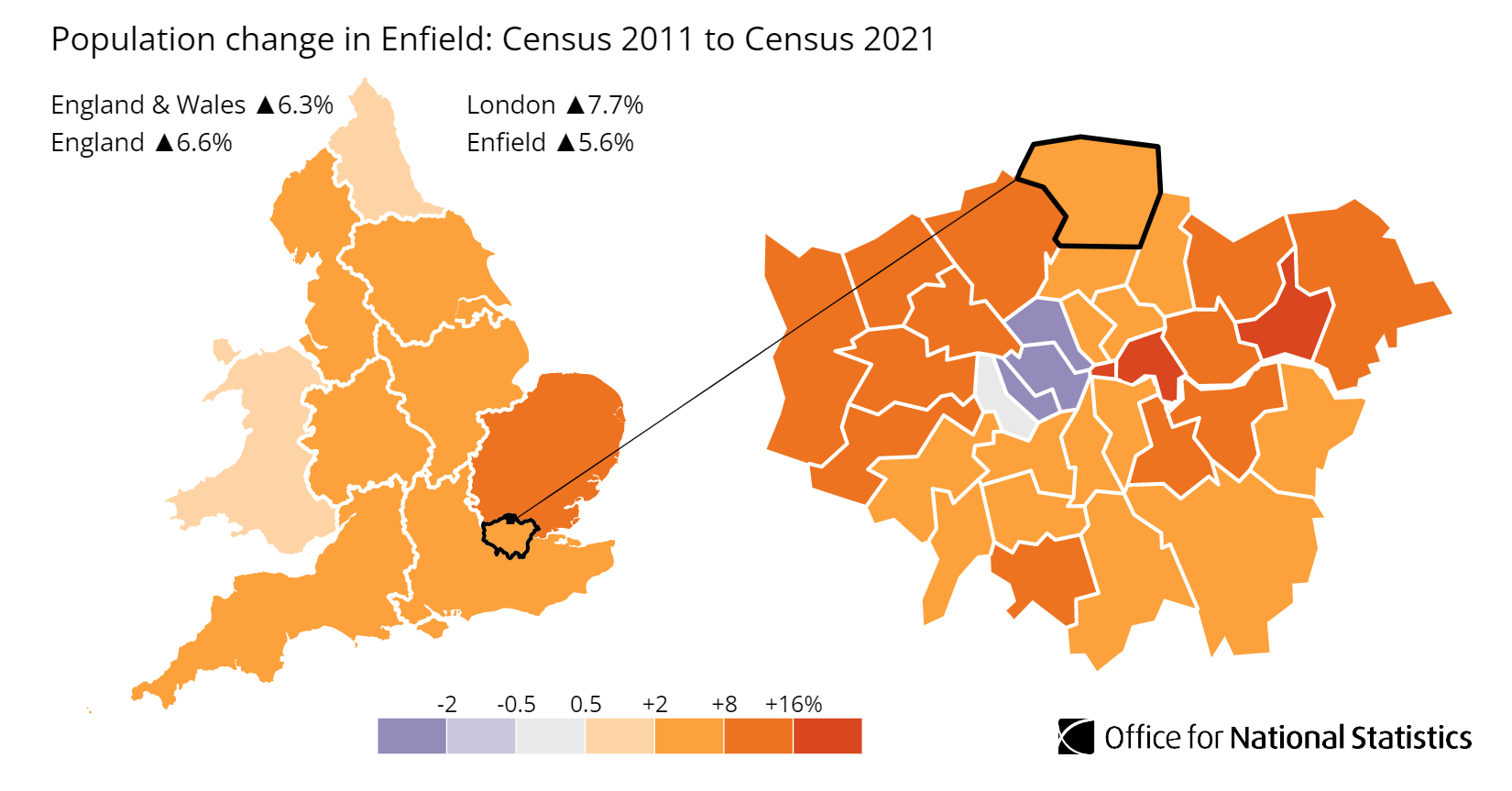
Enfield is a borough of north London. The average sold price across Enfield is £464,044 on the HM Land Registry House Price Index, 60.0% above the England average of £289,946 but well short of neighbouring Barnet. For a London borough that puts Enfield at the affordable end of the capital, a place where a flat still sells for £293,230 and a terraced house for £491,884. The borough's population grew 5.61% between the 2011 and 2021 censuses, from 312,466 to 329,984 residents.
What makes Enfield read differently from the rest of north London is where the cheaper stock sits. EN3 (Enfield Lock, Ponders End), the lowest-priced postcode at £369,035, is also the highest-yielding at 6.4%, and it backs straight onto Meridian Water, the 10,000-home regeneration on the Lee Valley. Most of the borough sells below half a million, and the price-to-earnings spread runs from 8.2 times local salary in EN3 up to 18.2 times in EN4 (Cockfosters). That is a wide gap inside one borough, and it is the spread an investor is really buying into.
This guide covers the London Borough of Enfield (ONS code E09000010) across 12 postcode districts: EN1, EN2, EN3, EN4, EN8, N9, N11, N13, N14, N18, N21 and N22. Some of these cross a boundary, so read the postcode tables with that in mind. EN8 (Waltham Cross, Cheshunt) sits mostly in Broxbourne in Hertfordshire rather than the London borough, which is why its rent and yield read differently. N22 (Wood Green) is largely in Haringey with only an edge sliver in Enfield. For the wider picture, see the north London buy-to-let guide or the broader London property investment overview.
Article updated: July 2026
Why Invest in Enfield?
Enfield added 5.61% to its population between the 2011 and 2021 censuses, reaching 329,984 residents, while staying one of the cheaper London boroughs to buy into. That growth ran a touch below the England and Wales average of 6.3%, the pace of a settled outer-London borough rather than a boom town. Enfield runs north from Edmonton and Palmers Green up to the green edge at Cockfosters and Hadley Wood, with the borough covering 31.74 square miles, much of it bordering the Lee Valley and open countryside to the north.
The local employment rate is 70.3%, below Great Britain's 75.6%, and the median full-time worker earns £865.10 a week. That wage actually sits a little under the London regional median of £902.70, which is the unusual thing about Enfield as a London borough: London-level house prices on earnings that are closer to the national picture. The economy leans on wholesale and retail (19.3% of employee jobs), health and social work (15.6%), and administrative and support services and education (10.1% each). The Lee Valley industrial corridor around Edmonton and Ponders End is the borough's jobs engine, and the Meridian Water regeneration is built around adding more of them.
Median gross annual earnings in Enfield are £44,985. Against London prices, that is what produces the borough's wide affordability spread: an investor in EN3 is buying at roughly eight times local income, while EN4 runs to eighteen. Higher local wages would close that gap; in Enfield they do not, which is why the cheaper postcodes carry the higher yields.
Enfield Economic Summary
- Population (Enfield): 329,984 (2021 Census). Growth of 5.61% from 2011.
- Median annual salary: £44,985 (local). Median gross weekly pay £865.10 (local), £902.70 (London), £766.60 (Great Britain)
- Employment rate: 70.3% (local), 75.6% (Great Britain)
- Unemployment rate: 6.5% (local)
- Key employment sectors: Wholesale and retail, health and social work, administrative and support services, education
Source: ONS Census 2021, Nomis Labour Market Profile (ASHE 2025, Employment Oct 2024-Sep 2025)
Regeneration and Investment in Enfield
Enfield's regeneration story is dominated by Meridian Water, a 10,000-home scheme on the Lee Valley led by Enfield Council, with 6,000 jobs planned over the life of the project. It sits in the borough's south-east, in and around EN3, the cheapest and highest-yielding postcode in this guide, which is the part that matters most for an investor reading the price tables below.
- Meridian Water (Enfield Council, 10,000 homes): A long-term regeneration of former industrial land next to the Lee Valley Regional Park, delivering 10,000 homes and 6,000 jobs for local people over the lifetime of the project, with an economic impact the council puts at £3.1 billion across roughly two decades. The scheme has its own railway station, Meridian Water, on the Lea Valley line into Liverpool Street. Updates at Meridian Water.
- Lea Valley line connectivity (London Overground): Edmonton Green, Ponders End and Enfield Lock all sit on the Lea Valley line now run by London Overground, the same corridor that serves Meridian Water. For tenants in EN3 and N9, that is the direct rail link into the City, and it is one of the practical reasons the cheaper east of the borough lets as readily as it does.
- Edmonton and the Upper Lee Valley (ongoing): Edmonton (N18, N9) sits at the southern, lower-priced end of the borough and is the focus of council regeneration around the town centre and the wider Upper Lee Valley. It carries the largest private rented sector in Enfield, which is covered in the rental sections below.
Enfield Property Market Analysis
Average property prices in Enfield have risen 502.5% since January 1995, from £77,018 to £464,044. The sections below walk through that journey cycle by cycle, then drill into current postcode-level data for sold prices, price per square foot, asking prices, growth trends, and how quickly homes change hands.
When was the last house price crash in Enfield?
All sold prices for Enfield come from HM Land Registry at borough level, since the London Borough of Enfield is its own local authority. The index runs monthly from January 1995 to the latest March 2026 reading, covering 31 years of the north London market.
The 1995 to 2008 climb: Enfield started at £77,018 in January 1995. By December 2000 the average had reached £135,320, then accelerated through the early-2000s mortgage boom to £227,183 by December 2005. The market kept rising into a peak of £273,135 in February 2008, later than the textbook 2007 top because London held its nerve a few months longer than much of the country.
2008 to 2009, the financial crisis: From that £273,135 peak, prices fell to a trough of £226,787 in May 2009, a drop of 17.0% over 15 months. The worst year-on-year reading was -15.9% in March 2009. Enfield's fall was in line with the national correction rather than shallower; as an affordable outer-London borough with a lot of mortgaged buyers, it had less of the cash-buyer cushion that protected the prime central markets.
Recovery, 2010 to 2013: London led the country out of the crash, and Enfield came back with it. Prices were back to £261,793 by December 2010 and £270,785 by December 2012, then cleared the old February 2008 peak in January 2013 at £273,998. Recovery to the pre-crash level took just under five years, far quicker than most markets outside the capital managed.
2013 to 2016, the London surge: This was Enfield's fastest phase. The average jumped from £291,782 in December 2013 to £334,650 by December 2014 and £401,703 by April 2016, the point at which the borough first crossed £400,000. A run of double-digit annual growth carried Enfield further in three years than the previous decade had.
2017 to 2019, the plateau: The post-2016 London cool-down showed up clearly here. Prices barely moved, from £419,832 in December 2017 to £422,085 in December 2018 and £423,700 in December 2019. Enfield spent three years flat while wages and rents kept rising underneath.
2020 to 2022, the pandemic high: The stamp duty holiday and the race for space pushed the borough to its all-time high. Prices rose from £411,588 in June 2020 to £437,798 by December 2020, £462,255 by December 2021, and a record £486,208 in December 2022.
2023 to present, the easing: Higher mortgage rates then took the top off. From the December 2022 high of £486,208, the average drifted down to £466,075 by December 2023 and £464,044 by the latest March 2026 reading, about 4.6% below the peak. Enfield's current price is 69.9% above the February 2008 pre-crash peak of £273,135.
Long-term growth summary:
- 5 years (March 2021 to March 2026): 3.7% growth (£447,288 to £464,044)
- 10 years (March 2016 to March 2026): 17.4% growth (£395,320 to £464,044)
- 15 years (March 2011 to March 2026): 81.8% growth (£255,192 to £464,044)
- 20 years (March 2006 to March 2026): 105.7% growth (£225,595 to £464,044)
- 30 years (January 1995 to March 2026): 502.5% growth (£77,018 to £464,044)
The shape of Enfield's three decades is front-loaded. Most of the 502.5% gain came before 2016; the five years since 2021 added just 3.7% as the borough peaked and eased. The 17.0% crash recovered inside five years, faster than nearly any market outside London. An investor who bought at the February 2008 peak would be up 69.9% on the Land Registry average, but one who bought at the December 2022 high would currently be sitting about 4.6% down.
- All property types
- Detached
- Semi-detached
- Terraced
- Flats
Source: HM Land Registry House Price Index
| Year | All property types | Detached | Semi-detached | Terraced | Flats |
|---|---|---|---|---|---|
| 1995-01 | £77,018 | £197,897 | £108,984 | £74,464 | £57,935 |
| 1995-02 | £77,698 | £196,594 | £109,700 | £75,372 | £58,385 |
| 1995-03 | £76,674 | £193,810 | £108,139 | £74,437 | £57,584 |
| 1995-04 | £75,880 | £190,669 | £106,917 | £73,734 | £57,015 |
| 1995-05 | £75,017 | £189,426 | £105,820 | £72,822 | £56,359 |
| 1995-06 | £75,779 | £191,153 | £106,984 | £73,410 | £57,182 |
| 1995-07 | £76,299 | £193,041 | £107,914 | £73,967 | £57,324 |
| 1995-08 | £76,724 | £194,852 | £108,664 | £74,426 | £57,418 |
| 1995-09 | £76,180 | £194,530 | £108,091 | £74,020 | £56,587 |
| 1995-10 | £76,842 | £197,095 | £109,235 | £74,408 | £57,368 |
| 1995-11 | £76,459 | £195,804 | £108,780 | £73,806 | £57,486 |
| 1995-12 | £76,886 | £196,748 | £109,340 | £74,097 | £58,070 |
| 1996-01 | £75,987 | £194,237 | £107,886 | £73,337 | £57,302 |
| 1996-02 | £75,484 | £193,050 | £107,119 | £72,926 | £56,807 |
| 1996-03 | £75,987 | £195,021 | £107,952 | £73,338 | £57,218 |
| 1996-04 | £77,021 | £196,850 | £109,308 | £74,289 | £58,240 |
| 1996-05 | £78,203 | £199,006 | £110,762 | £75,591 | £59,000 |
| 1996-06 | £78,764 | £199,329 | £111,292 | £76,158 | £59,623 |
| 1996-07 | £79,080 | £201,403 | £112,015 | £76,450 | £59,615 |
| 1996-08 | £79,961 | £205,691 | £113,599 | £77,135 | £60,250 |
| 1996-09 | £80,453 | £208,051 | £114,510 | £77,685 | £60,232 |
| 1996-10 | £80,649 | £208,902 | £114,833 | £77,907 | £60,254 |
| 1996-11 | £80,695 | £208,189 | £114,805 | £77,979 | £60,359 |
| 1996-12 | £81,653 | £209,985 | £116,298 | £78,908 | £61,065 |
| 1997-01 | £82,518 | £211,618 | £117,619 | £79,812 | £61,579 |
| 1997-02 | £82,930 | £213,356 | £118,059 | £80,186 | £61,854 |
| 1997-03 | £83,271 | £214,571 | £118,274 | £80,536 | £62,106 |
| 1997-04 | £84,547 | £218,210 | £120,032 | £81,759 | £63,064 |
| 1997-05 | £86,775 | £224,287 | £123,720 | £83,968 | £64,434 |
| 1997-06 | £89,067 | £231,879 | £127,477 | £86,222 | £65,779 |
| 1997-07 | £90,311 | £236,021 | £129,542 | £87,641 | £66,225 |
| 1997-08 | £91,775 | £240,675 | £131,922 | £89,059 | £67,140 |
| 1997-09 | £92,072 | £242,042 | £132,783 | £89,331 | £67,186 |
| 1997-10 | £93,375 | £245,686 | £134,780 | £90,402 | £68,348 |
| 1997-11 | £93,452 | £246,799 | £134,898 | £90,481 | £68,326 |
| 1997-12 | £95,531 | £251,164 | £137,788 | £92,487 | £69,981 |
| 1998-01 | £96,116 | £253,951 | £138,464 | £93,076 | £70,339 |
| 1998-02 | £97,630 | £255,607 | £139,977 | £94,354 | £71,861 |
| 1998-03 | £97,519 | £255,368 | £139,582 | £94,308 | £71,703 |
| 1998-04 | £97,866 | £254,674 | £140,390 | £94,727 | £71,862 |
| 1998-05 | £97,202 | £252,844 | £139,839 | £94,420 | £70,963 |
| 1998-06 | £96,884 | £251,060 | £139,211 | £93,976 | £70,934 |
| 1998-07 | £98,454 | £255,659 | £141,635 | £95,473 | £72,050 |
| 1998-08 | £100,008 | £262,579 | £144,071 | £96,823 | £73,188 |
| 1998-09 | £101,403 | £268,667 | £146,686 | £98,314 | £73,849 |
| 1998-10 | £100,982 | £267,901 | £145,809 | £97,686 | £73,800 |
| 1998-11 | £100,875 | £266,705 | £145,609 | £97,286 | £74,048 |
| 1998-12 | £100,755 | £263,561 | £144,970 | £96,892 | £74,433 |
| 1999-01 | £100,720 | £263,807 | £144,971 | £96,796 | £74,444 |
| 1999-02 | £100,987 | £265,149 | £145,287 | £97,112 | £74,578 |
| 1999-03 | £101,484 | £267,923 | £145,939 | £97,572 | £74,924 |
| 1999-04 | £103,509 | £272,339 | £148,366 | £99,800 | £76,289 |
| 1999-05 | £105,596 | £275,513 | £151,028 | £101,987 | £77,808 |
| 1999-06 | £107,554 | £280,874 | £153,804 | £104,026 | £79,101 |
| 1999-07 | £108,788 | £285,473 | £155,975 | £105,252 | £79,838 |
| 1999-08 | £110,647 | £293,209 | £159,028 | £107,121 | £80,949 |
| 1999-09 | £112,184 | £299,807 | £161,389 | £108,479 | £82,081 |
| 1999-10 | £114,547 | £305,795 | £164,666 | £110,383 | £84,223 |
| 1999-11 | £116,545 | £311,172 | £167,333 | £112,228 | £85,817 |
| 1999-12 | £117,286 | £309,092 | £167,720 | £112,908 | £86,693 |
| 2000-01 | £118,625 | £314,279 | £170,176 | £114,291 | £87,409 |
| 2000-02 | £119,887 | £316,708 | £171,714 | £115,574 | £88,357 |
| 2000-03 | £123,600 | £329,442 | £177,631 | £119,336 | £90,666 |
| 2000-04 | £125,559 | £332,735 | £179,732 | £121,103 | £92,368 |
| 2000-05 | £128,446 | £339,983 | £184,269 | £123,670 | £94,570 |
| 2000-06 | £130,512 | £343,522 | £187,030 | £125,268 | £96,442 |
| 2000-07 | £132,588 | £352,447 | £190,922 | £127,148 | £97,798 |
| 2000-08 | £133,450 | £356,656 | £192,562 | £127,373 | £98,721 |
| 2000-09 | £133,869 | £361,515 | £193,273 | £127,519 | £99,094 |
| 2000-10 | £135,748 | £366,032 | £196,080 | £129,107 | £100,618 |
| 2000-11 | £135,267 | £365,850 | £194,945 | £128,671 | £100,304 |
| 2000-12 | £135,320 | £363,360 | £194,658 | £128,575 | £100,579 |
| 2001-01 | £133,666 | £357,005 | £191,362 | £127,091 | £99,509 |
| 2001-02 | £135,500 | £360,537 | £194,279 | £129,010 | £100,728 |
| 2001-03 | £136,209 | £362,782 | £195,790 | £130,039 | £100,914 |
| 2001-04 | £138,731 | £368,627 | £199,322 | £132,585 | £102,727 |
| 2001-05 | £140,140 | £369,320 | £200,625 | £134,047 | £103,942 |
| 2001-06 | £143,289 | £374,884 | £204,208 | £136,628 | £106,899 |
| 2001-07 | £144,850 | £379,542 | £206,348 | £137,834 | £108,275 |
| 2001-08 | £147,713 | £388,645 | £210,266 | £140,289 | £110,604 |
| 2001-09 | £149,939 | £397,405 | £213,586 | £142,400 | £112,144 |
| 2001-10 | £152,290 | £403,505 | £216,891 | £144,398 | £114,093 |
| 2001-11 | £153,956 | £407,091 | £219,417 | £145,604 | £115,617 |
| 2001-12 | £153,413 | £401,613 | £218,206 | £144,372 | £115,999 |
| 2002-01 | £153,663 | £400,550 | £218,318 | £144,096 | £116,689 |
| 2002-02 | £154,095 | £399,733 | £218,307 | £144,454 | £117,261 |
| 2002-03 | £156,178 | £406,631 | £221,437 | £146,682 | £118,539 |
| 2002-04 | £158,402 | £409,729 | £223,605 | £148,587 | £120,688 |
| 2002-05 | £160,857 | £414,155 | £226,982 | £150,747 | £122,752 |
| 2002-06 | £164,542 | £419,719 | £230,857 | £154,076 | £126,107 |
| 2002-07 | £169,493 | £433,503 | £237,918 | £158,833 | £129,741 |
| 2002-08 | £173,384 | £443,261 | £243,026 | £162,513 | £132,782 |
| 2002-09 | £179,528 | £460,721 | £252,807 | £168,475 | £136,992 |
| 2002-10 | £184,759 | £472,728 | £260,910 | £173,407 | £140,842 |
| 2002-11 | £189,862 | £487,142 | £268,121 | £177,892 | £144,923 |
| 2002-12 | £191,811 | £489,413 | £270,976 | £179,185 | £146,897 |
| 2003-01 | £193,423 | £491,250 | £271,773 | £180,912 | £148,382 |
| 2003-02 | £196,151 | £493,928 | £275,644 | £183,328 | £150,718 |
| 2003-03 | £199,756 | £502,895 | £279,641 | £186,913 | £153,573 |
| 2003-04 | £199,966 | £501,022 | £280,220 | £186,557 | £154,184 |
| 2003-05 | £200,957 | £501,580 | £281,052 | £187,737 | £154,945 |
| 2003-06 | £201,580 | £500,141 | £281,349 | £188,184 | £155,774 |
| 2003-07 | £204,534 | £506,649 | £285,580 | £191,382 | £157,712 |
| 2003-08 | £205,350 | £507,520 | £286,615 | £192,379 | £158,222 |
| 2003-09 | £205,261 | £507,458 | £287,266 | £192,888 | £157,496 |
| 2003-10 | £206,439 | £507,745 | £288,120 | £194,270 | £158,464 |
| 2003-11 | £207,295 | £509,072 | £289,505 | £195,183 | £159,020 |
| 2003-12 | £208,184 | £505,758 | £289,729 | £196,009 | £160,147 |
| 2004-01 | £207,807 | £506,016 | £289,347 | £195,477 | £159,921 |
| 2004-02 | £208,045 | £506,337 | £289,134 | £195,854 | £160,108 |
| 2004-03 | £209,158 | £510,670 | £290,025 | £196,943 | £160,979 |
| 2004-04 | £212,560 | £513,730 | £293,991 | £200,635 | £163,513 |
| 2004-05 | £217,777 | £518,082 | £299,865 | £205,811 | £167,843 |
| 2004-06 | £220,998 | £520,530 | £303,702 | £208,824 | £170,621 |
| 2004-07 | £222,461 | £523,630 | £306,242 | £210,389 | £171,497 |
| 2004-08 | £223,240 | £529,944 | £307,625 | £211,187 | £171,864 |
| 2004-09 | £225,263 | £538,495 | £311,549 | £213,447 | £172,789 |
| 2004-10 | £225,961 | £539,050 | £311,242 | £214,002 | £173,726 |
| 2004-11 | £225,299 | £534,610 | £309,818 | £213,444 | £173,353 |
| 2004-12 | £225,012 | £529,068 | £307,847 | £213,285 | £173,530 |
| 2005-01 | £224,242 | £527,919 | £306,219 | £212,628 | £172,992 |
| 2005-02 | £224,226 | £529,157 | £306,576 | £212,576 | £172,889 |
| 2005-03 | £224,530 | £531,509 | £307,515 | £213,280 | £172,624 |
| 2005-04 | £225,446 | £531,081 | £309,465 | £214,741 | £172,762 |
| 2005-05 | £227,560 | £533,007 | £311,477 | £217,018 | £174,455 |
| 2005-06 | £226,612 | £527,505 | £309,560 | £216,384 | £173,741 |
| 2005-07 | £226,930 | £528,136 | £310,174 | £216,656 | £173,972 |
| 2005-08 | £224,830 | £524,198 | £307,400 | £215,085 | £171,970 |
| 2005-09 | £225,584 | £528,656 | £309,056 | £215,972 | £172,201 |
| 2005-10 | £224,718 | £525,844 | £307,110 | £215,164 | £171,719 |
| 2005-11 | £227,120 | £529,942 | £310,664 | £217,582 | £173,436 |
| 2005-12 | £227,183 | £525,456 | £309,469 | £217,419 | £174,078 |
| 2006-01 | £227,363 | £527,482 | £309,777 | £217,832 | £173,972 |
| 2006-02 | £226,373 | £525,337 | £307,951 | £216,706 | £173,477 |
| 2006-03 | £225,595 | £527,597 | £307,947 | £216,460 | £172,156 |
| 2006-04 | £227,633 | £530,195 | £310,527 | £218,670 | £173,637 |
| 2006-05 | £229,258 | £535,129 | £312,956 | £220,408 | £174,653 |
| 2006-06 | £232,505 | £542,334 | £317,187 | £223,666 | £177,085 |
| 2006-07 | £233,941 | £547,240 | £319,735 | £225,251 | £177,831 |
| 2006-08 | £235,882 | £552,178 | £322,783 | £227,693 | £178,764 |
| 2006-09 | £238,032 | £560,125 | £326,413 | £229,454 | £180,371 |
| 2006-10 | £239,925 | £565,057 | £328,773 | £231,122 | £181,965 |
| 2006-11 | £240,460 | £566,456 | £329,820 | £231,615 | £182,306 |
| 2006-12 | £241,142 | £566,054 | £329,971 | £232,556 | £182,865 |
| 2007-01 | £242,788 | £570,794 | £332,666 | £234,313 | £183,849 |
| 2007-02 | £245,331 | £577,250 | £335,439 | £236,016 | £186,453 |
| 2007-03 | £246,408 | £581,440 | £337,253 | £237,223 | £186,992 |
| 2007-04 | £248,064 | £583,854 | £338,661 | £239,162 | £188,237 |
| 2007-05 | £250,308 | £587,025 | £341,311 | £242,022 | £189,597 |
| 2007-06 | £256,037 | £599,660 | £348,812 | £247,554 | £194,034 |
| 2007-07 | £263,590 | £621,220 | £360,283 | £254,817 | £199,413 |
| 2007-08 | £270,073 | £640,014 | £370,101 | £261,627 | £203,616 |
| 2007-09 | £272,662 | £650,570 | £374,823 | £263,941 | £205,318 |
| 2007-10 | £271,199 | £647,527 | £371,610 | £262,174 | £204,713 |
| 2007-11 | £270,846 | £649,806 | £371,387 | £261,270 | £204,696 |
| 2007-12 | £271,407 | £646,973 | £370,999 | £261,803 | £205,502 |
| 2008-01 | £272,506 | £652,109 | £372,938 | £262,759 | £206,239 |
| 2008-02 | £273,135 | £651,878 | £374,017 | £263,374 | £206,727 |
| 2008-03 | £270,383 | £649,059 | £371,702 | £261,391 | £203,823 |
| 2008-04 | £269,848 | £648,565 | £371,785 | £261,727 | £202,724 |
| 2008-05 | £268,575 | £647,542 | £370,359 | £260,900 | £201,404 |
| 2008-06 | £266,684 | £643,660 | £367,700 | £259,072 | £199,973 |
| 2008-07 | £264,637 | £640,922 | £365,820 | £256,706 | £198,416 |
| 2008-08 | £258,707 | £628,574 | £357,773 | £250,692 | £194,041 |
| 2008-09 | £255,765 | £625,970 | £354,072 | £247,454 | £191,872 |
| 2008-10 | £251,023 | £613,565 | £346,775 | £242,590 | £188,645 |
| 2008-11 | £243,013 | £596,763 | £336,257 | £235,098 | £182,296 |
| 2008-12 | £239,003 | £584,692 | £330,616 | £231,620 | £179,128 |
| 2009-01 | £232,212 | £571,067 | £321,576 | £224,754 | £174,058 |
| 2009-02 | £232,936 | £570,589 | £322,743 | £224,754 | £175,067 |
| 2009-03 | £227,397 | £556,548 | £314,985 | £218,773 | £171,373 |
| 2009-04 | £227,588 | £552,355 | £315,462 | £219,261 | £171,370 |
| 2009-05 | £226,787 | £548,903 | £313,997 | £219,236 | £170,280 |
| 2009-06 | £234,026 | £566,244 | £324,538 | £227,152 | £174,748 |
| 2009-07 | £236,715 | £574,660 | £329,339 | £230,559 | £175,645 |
| 2009-08 | £241,106 | £588,827 | £336,476 | £235,185 | £178,132 |
| 2009-09 | £240,829 | £590,914 | £337,113 | £235,068 | £177,365 |
| 2009-10 | £242,653 | £597,407 | £340,152 | £237,088 | £178,272 |
| 2009-11 | £243,191 | £598,329 | £340,547 | £238,463 | £178,066 |
| 2009-12 | £243,914 | £596,730 | £341,255 | £239,850 | £178,248 |
| 2010-01 | £247,206 | £606,630 | £347,138 | £243,568 | £179,791 |
| 2010-02 | £251,606 | £620,328 | £355,432 | £248,127 | £182,053 |
| 2010-03 | £254,080 | £633,105 | £360,139 | £250,006 | £183,646 |
| 2010-04 | £253,897 | £631,496 | £359,458 | £249,677 | £183,789 |
| 2010-05 | £253,836 | £630,794 | £358,588 | £249,253 | £184,274 |
| 2010-06 | £257,165 | £638,570 | £363,498 | £253,217 | £186,084 |
| 2010-07 | £261,209 | £655,546 | £369,925 | £257,702 | £188,175 |
| 2010-08 | £263,499 | £663,663 | £375,020 | £260,245 | £189,008 |
| 2010-09 | £261,547 | £663,993 | £373,252 | £258,297 | £187,172 |
| 2010-10 | £260,299 | £658,639 | £371,988 | £256,836 | £186,394 |
| 2010-11 | £259,835 | £659,686 | £371,100 | £255,985 | £186,365 |
| 2010-12 | £261,793 | £663,649 | £374,355 | £257,527 | £187,989 |
| 2011-01 | £261,698 | £669,359 | £374,256 | £257,285 | £187,832 |
| 2011-02 | £258,772 | £668,177 | £370,029 | £254,174 | £185,732 |
| 2011-03 | £255,192 | £666,628 | £364,647 | £250,753 | £182,895 |
| 2011-04 | £252,920 | £659,569 | £361,070 | £248,472 | £181,445 |
| 2011-05 | £249,053 | £642,216 | £354,708 | £244,802 | £179,102 |
| 2011-06 | £249,384 | £633,840 | £354,840 | £245,239 | £179,716 |
| 2011-07 | £251,405 | £635,182 | £357,552 | £247,250 | £181,353 |
| 2011-08 | £259,099 | £659,500 | £370,411 | £255,257 | £185,787 |
| 2011-09 | £262,054 | £673,165 | £375,466 | £258,431 | £187,202 |
| 2011-10 | £262,082 | £677,484 | £377,055 | £258,542 | £186,539 |
| 2011-11 | £261,439 | £675,818 | £375,349 | £257,611 | £186,549 |
| 2011-12 | £261,140 | £670,508 | £374,662 | £257,136 | £186,740 |
| 2012-01 | £260,429 | £665,876 | £373,655 | £256,742 | £186,089 |
| 2012-02 | £256,191 | £656,635 | £368,182 | £253,125 | £182,368 |
| 2012-03 | £252,906 | £647,116 | £362,841 | £250,207 | £179,931 |
| 2012-04 | £253,790 | £648,808 | £363,002 | £251,109 | £180,849 |
| 2012-05 | £256,605 | £651,448 | £366,143 | £253,824 | £183,310 |
| 2012-06 | £261,903 | £664,319 | £373,401 | £259,848 | £186,544 |
| 2012-07 | £263,008 | £667,458 | £374,967 | £261,267 | £187,053 |
| 2012-08 | £267,708 | £680,495 | £382,286 | £266,766 | £189,503 |
| 2012-09 | £270,010 | £689,110 | £386,038 | £268,824 | £191,104 |
| 2012-10 | £271,218 | £691,239 | £387,601 | £270,303 | £191,808 |
| 2012-11 | £272,022 | £693,446 | £388,619 | £271,153 | £192,366 |
| 2012-12 | £270,785 | £690,548 | £387,273 | £270,316 | £191,044 |
| 2013-01 | £273,998 | £701,871 | £393,647 | £273,252 | £192,959 |
| 2013-02 | £270,434 | £694,559 | £388,963 | £269,136 | £190,682 |
| 2013-03 | £271,057 | £698,152 | £390,412 | £269,050 | £191,426 |
| 2013-04 | £266,566 | £685,156 | £382,345 | £265,082 | £188,334 |
| 2013-05 | £269,208 | £690,956 | £386,054 | £267,851 | £190,157 |
| 2013-06 | £270,890 | £692,316 | £388,424 | £270,167 | £191,034 |
| 2013-07 | £276,593 | £705,999 | £397,164 | £275,979 | £194,879 |
| 2013-08 | £283,087 | £721,569 | £406,840 | £282,752 | £199,222 |
| 2013-09 | £285,077 | £730,756 | £409,925 | £284,590 | £200,548 |
| 2013-10 | £288,261 | £740,124 | £414,972 | £287,585 | £202,766 |
| 2013-11 | £287,256 | £738,006 | £413,473 | £286,676 | £201,998 |
| 2013-12 | £291,782 | £742,636 | £418,981 | £291,407 | £205,471 |
| 2014-01 | £290,435 | £738,605 | £416,441 | £289,679 | £204,914 |
| 2014-02 | £292,253 | £743,074 | £418,365 | £291,304 | £206,474 |
| 2014-03 | £294,182 | £749,630 | £420,930 | £292,974 | £207,975 |
| 2014-04 | £298,707 | £760,318 | £426,785 | £297,995 | £211,005 |
| 2014-05 | £303,159 | £768,265 | £432,544 | £302,960 | £214,056 |
| 2014-06 | £307,645 | £778,641 | £439,259 | £308,117 | £216,797 |
| 2014-07 | £315,529 | £797,069 | £451,493 | £316,419 | £221,983 |
| 2014-08 | £323,882 | £819,501 | £464,790 | £325,299 | £227,277 |
| 2014-09 | £328,153 | £831,299 | £471,295 | £329,383 | £230,295 |
| 2014-10 | £332,138 | £841,586 | £477,070 | £332,970 | £233,321 |
| 2014-11 | £332,940 | £844,802 | £477,839 | £333,285 | £234,204 |
| 2014-12 | £334,650 | £848,511 | £479,575 | £334,560 | £235,819 |
| 2015-01 | £335,695 | £851,260 | £480,987 | £335,274 | £236,764 |
| 2015-02 | £336,357 | £852,714 | £481,761 | £335,044 | £237,855 |
| 2015-03 | £339,229 | £860,179 | £486,613 | £337,727 | £239,874 |
| 2015-04 | £341,738 | £867,135 | £489,529 | £340,649 | £241,482 |
| 2015-05 | £344,887 | £871,620 | £493,852 | £344,238 | £243,528 |
| 2015-06 | £348,932 | £882,878 | £500,162 | £349,296 | £245,508 |
| 2015-07 | £356,209 | £898,663 | £511,234 | £356,871 | £250,351 |
| 2015-08 | £365,479 | £923,224 | £524,940 | £366,816 | £256,269 |
| 2015-09 | £371,980 | £943,897 | £534,444 | £372,759 | £261,081 |
| 2015-10 | £375,769 | £956,291 | £540,480 | £376,648 | £263,460 |
| 2015-11 | £377,838 | £963,841 | £544,010 | £378,503 | £264,876 |
| 2015-12 | £381,958 | £972,065 | £550,506 | £382,824 | £267,564 |
| 2016-01 | £386,806 | £982,896 | £558,843 | £387,220 | £271,029 |
| 2016-02 | £390,651 | £994,211 | £564,757 | £390,744 | £273,830 |
| 2016-03 | £395,320 | £1,008,174 | £570,559 | £394,968 | £277,575 |
| 2016-04 | £401,703 | £1,021,662 | £577,098 | £402,228 | £282,115 |
| 2016-05 | £405,815 | £1,021,178 | £579,944 | £406,514 | £285,904 |
| 2016-06 | £408,163 | £1,020,455 | £581,539 | £409,059 | £288,015 |
| 2016-07 | £411,958 | £1,029,983 | £587,688 | £412,147 | £291,032 |
| 2016-08 | £418,609 | £1,051,362 | £598,362 | £418,556 | £295,492 |
| 2016-09 | £426,662 | £1,072,200 | £612,019 | £426,279 | £300,904 |
| 2016-10 | £425,545 | £1,072,128 | £610,963 | £424,059 | £300,704 |
| 2016-11 | £422,964 | £1,071,247 | £608,116 | £420,706 | £299,083 |
| 2016-12 | £418,962 | £1,062,786 | £601,033 | £415,914 | £297,097 |
| 2017-01 | £416,211 | £1,055,425 | £595,999 | £413,325 | £295,302 |
| 2017-02 | £410,258 | £1,034,885 | £584,954 | £406,701 | £292,335 |
| 2017-03 | £406,936 | £1,025,964 | £579,650 | £403,009 | £290,387 |
| 2017-04 | £413,293 | £1,042,823 | £587,505 | £408,565 | £295,689 |
| 2017-05 | £421,239 | £1,059,925 | £599,166 | £416,114 | £301,621 |
| 2017-06 | £426,416 | £1,065,393 | £605,264 | £421,731 | £305,531 |
| 2017-07 | £428,322 | £1,064,029 | £608,456 | £423,638 | £306,997 |
| 2017-08 | £428,263 | £1,066,274 | £609,361 | £424,802 | £305,764 |
| 2017-09 | £429,507 | £1,076,981 | £613,312 | £425,755 | £306,086 |
| 2017-10 | £423,689 | £1,068,970 | £606,654 | £420,142 | £301,222 |
| 2017-11 | £422,243 | £1,065,503 | £605,518 | £418,626 | £300,038 |
| 2017-12 | £419,832 | £1,056,523 | £601,663 | £417,458 | £297,652 |
| 2018-01 | £419,571 | £1,052,106 | £601,501 | £417,355 | £297,444 |
| 2018-02 | £422,403 | £1,060,492 | £606,251 | £420,455 | £299,077 |
| 2018-03 | £422,285 | £1,057,902 | £607,894 | £420,380 | £298,683 |
| 2018-04 | £421,594 | £1,055,404 | £607,877 | £421,408 | £296,881 |
| 2018-05 | £422,938 | £1,059,503 | £611,186 | £423,643 | £296,936 |
| 2018-06 | £421,336 | £1,060,960 | £610,357 | £421,668 | £295,584 |
| 2018-07 | £422,557 | £1,071,636 | £612,115 | £422,490 | £296,478 |
| 2018-08 | £419,757 | £1,067,129 | £607,584 | £419,727 | £294,510 |
| 2018-09 | £419,243 | £1,069,486 | £607,112 | £419,589 | £293,738 |
| 2018-10 | £421,938 | £1,075,303 | £611,110 | £422,438 | £295,538 |
| 2018-11 | £418,601 | £1,073,632 | £607,676 | £419,300 | £292,584 |
| 2018-12 | £422,085 | £1,077,763 | £612,320 | £422,515 | £295,427 |
| 2019-01 | £420,185 | £1,075,087 | £610,746 | £420,351 | £293,964 |
| 2019-02 | £421,925 | £1,075,076 | £612,363 | £421,828 | £295,635 |
| 2019-03 | £418,390 | £1,066,394 | £607,502 | £419,438 | £292,230 |
| 2019-04 | £418,502 | £1,062,040 | £605,826 | £420,487 | £292,077 |
| 2019-05 | £412,169 | £1,042,967 | £597,656 | £415,230 | £286,662 |
| 2019-06 | £414,402 | £1,046,289 | £600,742 | £417,605 | £288,223 |
| 2019-07 | £411,091 | £1,034,838 | £596,882 | £414,258 | £285,841 |
| 2019-08 | £417,081 | £1,050,805 | £605,463 | £420,702 | £289,674 |
| 2019-09 | £410,789 | £1,038,612 | £595,485 | £414,702 | £285,072 |
| 2019-10 | £416,540 | £1,060,013 | £606,336 | £420,505 | £288,329 |
| 2019-11 | £416,952 | £1,065,633 | £609,272 | £420,668 | £288,200 |
| 2019-12 | £423,700 | £1,084,063 | £620,207 | £427,671 | £292,450 |
| 2020-01 | £413,847 | £1,056,721 | £605,757 | £418,625 | £285,008 |
| 2020-02 | £414,403 | £1,059,674 | £605,526 | £419,860 | £285,036 |
| 2020-03 | £417,188 | £1,068,683 | £610,479 | £422,885 | £286,626 |
| 2020-04 | £420,470 | £1,086,508 | £615,264 | £427,188 | £287,782 |
| 2020-05 | £417,005 | £1,078,287 | £610,175 | £422,810 | £286,051 |
| 2020-06 | £411,588 | £1,061,788 | £603,201 | £418,181 | £281,509 |
| 2020-07 | £412,997 | £1,057,035 | £604,964 | £419,461 | £282,984 |
| 2020-08 | £423,474 | £1,086,281 | £623,431 | £431,866 | £287,897 |
| 2020-09 | £426,015 | £1,099,663 | £629,125 | £434,752 | £288,626 |
| 2020-10 | £432,225 | £1,119,934 | £639,641 | £441,817 | £291,767 |
| 2020-11 | £429,901 | £1,113,072 | £635,088 | £439,628 | £290,379 |
| 2020-12 | £437,798 | £1,131,872 | £645,976 | £448,306 | £295,523 |
| 2021-01 | £442,208 | £1,134,865 | £649,666 | £452,069 | £300,139 |
| 2021-02 | £445,262 | £1,129,813 | £649,655 | £454,385 | £304,572 |
| 2021-03 | £447,288 | £1,120,418 | £647,676 | £455,453 | £308,698 |
| 2021-04 | £445,386 | £1,114,504 | £642,964 | £453,511 | £307,979 |
| 2021-05 | £442,392 | £1,110,438 | £639,378 | £450,656 | £305,372 |
| 2021-06 | £444,023 | £1,112,715 | £639,893 | £453,909 | £305,742 |
| 2021-07 | £442,762 | £1,127,629 | £640,374 | £450,985 | £304,763 |
| 2021-08 | £448,447 | £1,159,973 | £652,976 | £456,373 | £306,984 |
| 2021-09 | £448,505 | £1,174,416 | £657,135 | £455,456 | £306,022 |
| 2021-10 | £456,366 | £1,198,217 | £672,297 | £464,187 | £309,627 |
| 2021-11 | £459,789 | £1,207,169 | £677,543 | £467,848 | £311,746 |
| 2021-12 | £462,255 | £1,220,573 | £683,930 | £470,464 | £312,267 |
| 2022-01 | £460,297 | £1,209,642 | £681,008 | £469,949 | £309,985 |
| 2022-02 | £459,240 | £1,202,361 | £678,302 | £469,210 | £309,669 |
| 2022-03 | £462,231 | £1,212,750 | £683,712 | £472,394 | £311,208 |
| 2022-04 | £468,246 | £1,225,627 | £691,090 | £479,265 | £315,219 |
| 2022-05 | £474,059 | £1,240,039 | £700,722 | £486,230 | £317,831 |
| 2022-06 | £472,928 | £1,231,629 | £697,634 | £485,935 | £316,988 |
| 2022-07 | £472,489 | £1,228,579 | £698,594 | £486,459 | £315,316 |
| 2022-08 | £474,596 | £1,230,745 | £702,088 | £489,861 | £315,586 |
| 2022-09 | £477,964 | £1,243,837 | £708,630 | £493,951 | £316,505 |
| 2022-10 | £483,658 | £1,260,234 | £716,685 | £499,835 | £320,329 |
| 2022-11 | £486,143 | £1,270,956 | £720,575 | £502,478 | £321,634 |
| 2022-12 | £486,208 | £1,267,489 | £719,325 | £502,708 | £322,150 |
| 2023-01 | £478,210 | £1,249,648 | £709,723 | £493,684 | £316,675 |
| 2023-02 | £471,236 | £1,232,259 | £699,915 | £485,138 | £312,938 |
| 2023-03 | £463,479 | £1,221,112 | £691,088 | £475,251 | £308,019 |
| 2023-04 | £461,676 | £1,220,705 | £687,823 | £472,970 | £307,125 |
| 2023-05 | £460,434 | £1,215,206 | £685,027 | £471,539 | £306,751 |
| 2023-06 | £459,546 | £1,213,489 | £682,387 | £472,057 | £305,412 |
| 2023-07 | £461,811 | £1,215,122 | £686,033 | £475,701 | £306,034 |
| 2023-08 | £465,536 | £1,232,516 | £693,404 | £481,055 | £306,608 |
| 2023-09 | £474,346 | £1,252,377 | £707,390 | £490,657 | £311,951 |
| 2023-10 | £469,150 | £1,235,059 | £698,952 | £484,543 | £309,396 |
| 2023-11 | £468,271 | £1,230,879 | £697,982 | £482,285 | £309,799 |
| 2023-12 | £466,075 | £1,218,909 | £693,935 | £479,711 | £309,014 |
| 2024-01 | £468,641 | £1,226,158 | £698,117 | £483,207 | £309,969 |
| 2024-02 | £459,073 | £1,194,461 | £683,483 | £473,923 | £303,580 |
| 2024-03 | £448,809 | £1,169,295 | £667,698 | £462,668 | £297,493 |
| 2024-04 | £449,021 | £1,169,457 | £667,342 | £462,247 | £298,356 |
| 2024-05 | £454,285 | £1,180,011 | £672,775 | £467,878 | £302,561 |
| 2024-06 | £461,881 | £1,194,969 | £683,144 | £476,910 | £307,147 |
| 2024-07 | £464,998 | £1,199,495 | £688,436 | £481,612 | £308,006 |
| 2024-08 | £468,963 | £1,208,807 | £695,191 | £487,324 | £309,144 |
| 2024-09 | £475,287 | £1,234,662 | £707,409 | £493,968 | £311,968 |
| 2024-10 | £472,201 | £1,230,078 | £701,833 | £489,926 | £310,743 |
| 2024-11 | £473,528 | £1,237,906 | £704,625 | £490,958 | £311,444 |
| 2024-12 | £467,547 | £1,219,390 | £694,761 | £485,267 | £307,531 |
| 2025-01 | £474,471 | £1,237,960 | £706,532 | £493,670 | £310,670 |
| 2025-02 | £472,150 | £1,229,425 | £702,788 | £491,934 | £308,804 |
| 2025-03 | £474,155 | £1,214,257 | £701,027 | £495,005 | £311,669 |
| 2025-04 | £471,153 | £1,222,187 | £702,566 | £490,830 | £308,178 |
| 2025-05 | £472,816 | £1,236,901 | £708,740 | £491,665 | £308,484 |
| 2025-06 | £470,522 | £1,249,537 | £712,524 | £490,006 | £303,388 |
| 2025-07 | £469,601 | £1,230,529 | £707,423 | £490,901 | £303,027 |
| 2025-08 | £471,665 | £1,223,221 | £711,252 | £495,932 | £302,356 |
| 2025-09 | £473,263 | £1,230,788 | £715,966 | £498,062 | £302,213 |
| 2025-10 | £472,799 | £1,233,294 | £716,205 | £498,269 | £300,919 |
| 2025-11 | £466,976 | £1,224,354 | £706,218 | £491,974 | £297,390 |
| 2025-12 | £468,157 | £1,222,778 | £706,004 | £493,245 | £298,889 |
| 2026-01 | £470,366 | £1,230,467 | £710,165 | £496,589 | £299,167 |
| 2026-02 | £472,410 | £1,233,633 | £713,902 | £498,766 | £300,342 |
| 2026-03 | £464,044 | £1,210,386 | £702,364 | £491,884 | £293,230 |
- All property types
- Detached
- Semi-detached
- Terraced
- Flats
Source: HM Land Registry House Price Index
| Year | All property types | Detached | Semi-detached | Terraced | Flats |
|---|---|---|---|---|---|
| 1996-01 | -1.3% | -1.8% | -1.0% | -1.5% | -1.1% |
| 1996-02 | -2.9% | -1.8% | -2.4% | -3.2% | -2.7% |
| 1996-03 | -0.9% | +0.6% | -0.2% | -1.5% | -0.6% |
| 1996-04 | +1.5% | +3.2% | +2.2% | +0.8% | +2.1% |
| 1996-05 | +4.2% | +5.1% | +4.7% | +3.8% | +4.7% |
| 1996-06 | +3.9% | +4.3% | +4.0% | +3.7% | +4.3% |
| 1996-07 | +3.6% | +4.3% | +3.8% | +3.4% | +4.0% |
| 1996-08 | +4.2% | +5.6% | +4.5% | +3.6% | +4.9% |
| 1996-09 | +5.6% | +7.0% | +5.9% | +5.0% | +6.4% |
| 1996-10 | +5.0% | +6.0% | +5.1% | +4.7% | +5.0% |
| 1996-11 | +5.5% | +6.3% | +5.5% | +5.7% | +5.0% |
| 1996-12 | +6.2% | +6.7% | +6.4% | +6.5% | +5.2% |
| 1997-01 | +8.6% | +8.9% | +9.0% | +8.8% | +7.5% |
| 1997-02 | +9.9% | +10.5% | +10.2% | +10.0% | +8.9% |
| 1997-03 | +9.6% | +10.0% | +9.6% | +9.8% | +8.5% |
| 1997-04 | +9.8% | +10.9% | +9.8% | +10.1% | +8.3% |
| 1997-05 | +11.0% | +12.7% | +11.7% | +11.1% | +9.2% |
| 1997-06 | +13.1% | +16.3% | +14.5% | +13.2% | +10.3% |
| 1997-07 | +14.2% | +17.2% | +15.6% | +14.6% | +11.1% |
| 1997-08 | +14.8% | +17.0% | +16.1% | +15.5% | +11.4% |
| 1997-09 | +14.4% | +16.3% | +16.0% | +15.0% | +11.5% |
| 1997-10 | +15.8% | +17.6% | +17.4% | +16.0% | +13.4% |
| 1997-11 | +15.8% | +18.5% | +17.5% | +16.0% | +13.2% |
| 1997-12 | +17.0% | +19.6% | +18.5% | +17.2% | +14.6% |
| 1998-01 | +16.5% | +20.0% | +17.7% | +16.6% | +14.2% |
| 1998-02 | +17.7% | +19.8% | +18.6% | +17.7% | +16.2% |
| 1998-03 | +17.1% | +19.0% | +18.0% | +17.1% | +15.5% |
| 1998-04 | +15.8% | +16.7% | +17.0% | +15.9% | +14.0% |
| 1998-05 | +12.0% | +12.7% | +13.0% | +12.4% | +10.1% |
| 1998-06 | +8.8% | +8.3% | +9.2% | +9.0% | +7.8% |
| 1998-07 | +9.0% | +8.3% | +9.3% | +8.9% | +8.8% |
| 1998-08 | +9.0% | +9.1% | +9.2% | +8.7% | +9.0% |
| 1998-09 | +10.1% | +11.0% | +10.5% | +10.1% | +9.9% |
| 1998-10 | +8.1% | +9.0% | +8.2% | +8.1% | +8.0% |
| 1998-11 | +7.9% | +8.1% | +7.9% | +7.5% | +8.4% |
| 1998-12 | +5.5% | +4.9% | +5.2% | +4.8% | +6.4% |
| 1999-01 | +4.8% | +3.9% | +4.7% | +4.0% | +5.8% |
| 1999-02 | +3.4% | +3.7% | +3.8% | +2.9% | +3.8% |
| 1999-03 | +4.1% | +4.9% | +4.6% | +3.5% | +4.5% |
| 1999-04 | +5.8% | +6.9% | +5.7% | +5.4% | +6.2% |
| 1999-05 | +8.6% | +9.0% | +8.0% | +8.0% | +9.6% |
| 1999-06 | +11.0% | +11.9% | +10.5% | +10.7% | +11.5% |
| 1999-07 | +10.5% | +11.7% | +10.1% | +10.2% | +10.8% |
| 1999-08 | +10.6% | +11.7% | +10.4% | +10.6% | +10.6% |
| 1999-09 | +10.6% | +11.6% | +10.0% | +10.3% | +11.1% |
| 1999-10 | +13.4% | +14.1% | +12.9% | +13.0% | +14.1% |
| 1999-11 | +15.5% | +16.7% | +14.9% | +15.4% | +15.9% |
| 1999-12 | +16.4% | +17.3% | +15.7% | +16.5% | +16.5% |
| 2000-01 | +17.8% | +19.1% | +17.4% | +18.1% | +17.4% |
| 2000-02 | +18.7% | +19.4% | +18.2% | +19.0% | +18.5% |
| 2000-03 | +21.8% | +23.0% | +21.7% | +22.3% | +21.0% |
| 2000-04 | +21.3% | +22.2% | +21.1% | +21.3% | +21.1% |
| 2000-05 | +21.6% | +23.4% | +22.0% | +21.3% | +21.5% |
| 2000-06 | +21.3% | +22.3% | +21.6% | +20.4% | +21.9% |
| 2000-07 | +21.9% | +23.5% | +22.4% | +20.8% | +22.5% |
| 2000-08 | +20.6% | +21.6% | +21.1% | +18.9% | +22.0% |
| 2000-09 | +19.3% | +20.6% | +19.8% | +17.6% | +20.7% |
| 2000-10 | +18.5% | +19.7% | +19.1% | +17.0% | +19.5% |
| 2000-11 | +16.1% | +17.6% | +16.5% | +14.7% | +16.9% |
| 2000-12 | +15.4% | +17.6% | +16.1% | +13.9% | +16.0% |
| 2001-01 | +12.7% | +13.6% | +12.4% | +11.2% | +13.8% |
| 2001-02 | +13.0% | +13.8% | +13.1% | +11.6% | +14.0% |
| 2001-03 | +10.2% | +10.1% | +10.2% | +9.0% | +11.3% |
| 2001-04 | +10.5% | +10.8% | +10.9% | +9.5% | +11.2% |
| 2001-05 | +9.1% | +8.6% | +8.9% | +8.4% | +9.9% |
| 2001-06 | +9.8% | +9.1% | +9.2% | +9.1% | +10.8% |
| 2001-07 | +9.2% | +7.7% | +8.1% | +8.4% | +10.7% |
| 2001-08 | +10.7% | +9.0% | +9.2% | +10.1% | +12.0% |
| 2001-09 | +12.0% | +9.9% | +10.5% | +11.7% | +13.2% |
| 2001-10 | +12.2% | +10.2% | +10.6% | +11.8% | +13.4% |
| 2001-11 | +13.8% | +11.3% | +12.6% | +13.2% | +15.3% |
| 2001-12 | +13.4% | +10.5% | +12.1% | +12.3% | +15.3% |
| 2002-01 | +15.0% | +12.2% | +14.1% | +13.4% | +17.3% |
| 2002-02 | +13.7% | +10.9% | +12.4% | +12.0% | +16.4% |
| 2002-03 | +14.7% | +12.1% | +13.1% | +12.8% | +17.5% |
| 2002-04 | +14.2% | +11.1% | +12.2% | +12.1% | +17.5% |
| 2002-05 | +14.8% | +12.1% | +13.1% | +12.5% | +18.1% |
| 2002-06 | +14.8% | +12.0% | +13.0% | +12.8% | +18.0% |
| 2002-07 | +17.0% | +14.2% | +15.3% | +15.2% | +19.8% |
| 2002-08 | +17.4% | +14.1% | +15.6% | +15.8% | +20.1% |
| 2002-09 | +19.7% | +15.9% | +18.4% | +18.3% | +22.2% |
| 2002-10 | +21.3% | +17.2% | +20.3% | +20.1% | +23.4% |
| 2002-11 | +23.3% | +19.7% | +22.2% | +22.2% | +25.3% |
| 2002-12 | +25.0% | +21.9% | +24.2% | +24.1% | +26.6% |
| 2003-01 | +25.9% | +22.6% | +24.5% | +25.5% | +27.2% |
| 2003-02 | +27.3% | +23.6% | +26.3% | +26.9% | +28.5% |
| 2003-03 | +27.9% | +23.7% | +26.3% | +27.4% | +29.6% |
| 2003-04 | +26.2% | +22.3% | +25.3% | +25.6% | +27.8% |
| 2003-05 | +24.9% | +21.1% | +23.8% | +24.5% | +26.2% |
| 2003-06 | +22.5% | +19.2% | +21.9% | +22.1% | +23.5% |
| 2003-07 | +20.7% | +16.9% | +20.0% | +20.5% | +21.6% |
| 2003-08 | +18.4% | +14.5% | +17.9% | +18.4% | +19.2% |
| 2003-09 | +14.3% | +10.1% | +13.6% | +14.5% | +15.0% |
| 2003-10 | +11.7% | +7.4% | +10.4% | +12.0% | +12.5% |
| 2003-11 | +9.2% | +4.5% | +8.0% | +9.7% | +9.7% |
| 2003-12 | +8.5% | +3.3% | +6.9% | +9.4% | +9.0% |
| 2004-01 | +7.4% | +3.0% | +6.5% | +8.1% | +7.8% |
| 2004-02 | +6.1% | +2.5% | +4.9% | +6.8% | +6.2% |
| 2004-03 | +4.7% | +1.5% | +3.7% | +5.4% | +4.8% |
| 2004-04 | +6.3% | +2.5% | +4.9% | +7.5% | +6.1% |
| 2004-05 | +8.4% | +3.3% | +6.7% | +9.6% | +8.3% |
| 2004-06 | +9.6% | +4.1% | +7.9% | +11.0% | +9.5% |
| 2004-07 | +8.8% | +3.4% | +7.2% | +9.9% | +8.7% |
| 2004-08 | +8.7% | +4.4% | +7.3% | +9.8% | +8.6% |
| 2004-09 | +9.7% | +6.1% | +8.5% | +10.7% | +9.7% |
| 2004-10 | +9.5% | +6.2% | +8.0% | +10.2% | +9.6% |
| 2004-11 | +8.7% | +5.0% | +7.0% | +9.4% | +9.0% |
| 2004-12 | +8.1% | +4.6% | +6.3% | +8.8% | +8.4% |
| 2005-01 | +7.9% | +4.3% | +5.8% | +8.8% | +8.2% |
| 2005-02 | +7.8% | +4.5% | +6.0% | +8.5% | +8.0% |
| 2005-03 | +7.3% | +4.1% | +6.0% | +8.3% | +7.2% |
| 2005-04 | +6.1% | +3.4% | +5.3% | +7.0% | +5.7% |
| 2005-05 | +4.5% | +2.9% | +3.9% | +5.4% | +3.9% |
| 2005-06 | +2.5% | +1.3% | +1.9% | +3.6% | +1.8% |
| 2005-07 | +2.0% | +0.9% | +1.3% | +3.0% | +1.4% |
| 2005-08 | +0.7% | -1.1% | -0.1% | +1.8% | +0.1% |
| 2005-09 | +0.1% | -1.8% | -0.8% | +1.2% | -0.3% |
| 2005-10 | -0.6% | -2.4% | -1.3% | +0.5% | -1.2% |
| 2005-11 | +0.8% | -0.9% | +0.3% | +1.9% | 0.0% |
| 2005-12 | +1.0% | -0.7% | +0.5% | +1.9% | +0.3% |
| 2006-01 | +1.4% | -0.1% | +1.2% | +2.4% | +0.6% |
| 2006-02 | +1.0% | -0.7% | +0.4% | +1.9% | +0.3% |
| 2006-03 | +0.5% | -0.7% | +0.1% | +1.5% | -0.3% |
| 2006-04 | +1.0% | -0.2% | +0.3% | +1.8% | +0.5% |
| 2006-05 | +0.7% | +0.4% | +0.5% | +1.6% | +0.1% |
| 2006-06 | +2.6% | +2.8% | +2.5% | +3.4% | +1.9% |
| 2006-07 | +3.1% | +3.6% | +3.1% | +4.0% | +2.2% |
| 2006-08 | +4.9% | +5.3% | +5.0% | +5.9% | +4.0% |
| 2006-09 | +5.5% | +6.0% | +5.6% | +6.2% | +4.7% |
| 2006-10 | +6.8% | +7.5% | +7.1% | +7.4% | +6.0% |
| 2006-11 | +5.9% | +6.9% | +6.2% | +6.4% | +5.1% |
| 2006-12 | +6.1% | +7.7% | +6.6% | +7.0% | +5.0% |
| 2007-01 | +6.8% | +8.2% | +7.4% | +7.6% | +5.7% |
| 2007-02 | +8.4% | +9.9% | +8.9% | +8.9% | +7.5% |
| 2007-03 | +9.2% | +10.2% | +9.5% | +9.6% | +8.6% |
| 2007-04 | +9.0% | +10.1% | +9.1% | +9.4% | +8.4% |
| 2007-05 | +9.2% | +9.7% | +9.1% | +9.8% | +8.6% |
| 2007-06 | +10.1% | +10.6% | +10.0% | +10.7% | +9.6% |
| 2007-07 | +12.7% | +13.5% | +12.7% | +13.1% | +12.1% |
| 2007-08 | +14.5% | +15.9% | +14.7% | +14.9% | +13.9% |
| 2007-09 | +14.5% | +16.1% | +14.8% | +15.0% | +13.8% |
| 2007-10 | +13.0% | +14.6% | +13.0% | +13.4% | +12.5% |
| 2007-11 | +12.6% | +14.7% | +12.6% | +12.8% | +12.3% |
| 2007-12 | +12.6% | +14.3% | +12.4% | +12.6% | +12.4% |
| 2008-01 | +12.2% | +14.2% | +12.1% | +12.1% | +12.2% |
| 2008-02 | +11.3% | +12.9% | +11.5% | +11.6% | +10.9% |
| 2008-03 | +9.7% | +11.6% | +10.2% | +10.2% | +9.0% |
| 2008-04 | +8.8% | +11.1% | +9.8% | +9.4% | +7.7% |
| 2008-05 | +7.3% | +10.3% | +8.5% | +7.8% | +6.2% |
| 2008-06 | +4.2% | +7.3% | +5.4% | +4.7% | +3.1% |
| 2008-07 | +0.4% | +3.2% | +1.5% | +0.7% | -0.5% |
| 2008-08 | -4.2% | -1.8% | -3.3% | -4.2% | -4.7% |
| 2008-09 | -6.2% | -3.8% | -5.5% | -6.2% | -6.5% |
| 2008-10 | -7.4% | -5.2% | -6.7% | -7.5% | -7.8% |
| 2008-11 | -10.3% | -8.2% | -9.5% | -10.0% | -10.9% |
| 2008-12 | -11.9% | -9.6% | -10.9% | -11.5% | -12.8% |
| 2009-01 | -14.8% | -12.4% | -13.8% | -14.5% | -15.6% |
| 2009-02 | -14.7% | -12.5% | -13.7% | -14.7% | -15.3% |
| 2009-03 | -15.9% | -14.3% | -15.3% | -16.3% | -15.9% |
| 2009-04 | -15.7% | -14.8% | -15.1% | -16.2% | -15.5% |
| 2009-05 | -15.6% | -15.2% | -15.2% | -16.0% | -15.5% |
| 2009-06 | -12.2% | -12.0% | -11.7% | -12.3% | -12.6% |
| 2009-07 | -10.6% | -10.3% | -10.0% | -10.2% | -11.5% |
| 2009-08 | -6.8% | -6.3% | -6.0% | -6.2% | -8.2% |
| 2009-09 | -5.8% | -5.6% | -4.8% | -5.0% | -7.6% |
| 2009-10 | -3.3% | -2.6% | -1.9% | -2.3% | -5.5% |
| 2009-11 | +0.1% | +0.3% | +1.3% | +1.4% | -2.3% |
| 2009-12 | +2.1% | +2.1% | +3.2% | +3.6% | -0.5% |
| 2010-01 | +6.5% | +6.2% | +7.9% | +8.4% | +3.3% |
| 2010-02 | +8.0% | +8.7% | +10.1% | +10.4% | +4.0% |
| 2010-03 | +11.7% | +13.8% | +14.3% | +14.3% | +7.2% |
| 2010-04 | +11.6% | +14.3% | +13.9% | +13.9% | +7.2% |
| 2010-05 | +11.9% | +14.9% | +14.2% | +13.7% | +8.2% |
| 2010-06 | +9.9% | +12.8% | +12.0% | +11.5% | +6.5% |
| 2010-07 | +10.3% | +14.1% | +12.3% | +11.8% | +7.1% |
| 2010-08 | +9.3% | +12.7% | +11.5% | +10.7% | +6.1% |
| 2010-09 | +8.6% | +12.4% | +10.7% | +9.9% | +5.5% |
| 2010-10 | +7.3% | +10.2% | +9.4% | +8.3% | +4.6% |
| 2010-11 | +6.8% | +10.3% | +9.0% | +7.3% | +4.7% |
| 2010-12 | +7.3% | +11.2% | +9.7% | +7.4% | +5.5% |
| 2011-01 | +5.9% | +10.3% | +7.8% | +5.6% | +4.5% |
| 2011-02 | +2.8% | +7.7% | +4.1% | +2.4% | +2.0% |
| 2011-03 | +0.4% | +5.3% | +1.3% | +0.3% | -0.4% |
| 2011-04 | -0.4% | +4.4% | +0.4% | -0.5% | -1.3% |
| 2011-05 | -1.9% | +1.8% | -1.1% | -1.8% | -2.8% |
| 2011-06 | -3.0% | -0.7% | -2.4% | -3.2% | -3.4% |
| 2011-07 | -3.8% | -3.1% | -3.3% | -4.1% | -3.6% |
| 2011-08 | -1.7% | -0.6% | -1.2% | -1.9% | -1.7% |
| 2011-09 | +0.2% | +1.4% | +0.6% | +0.1% | 0.0% |
| 2011-10 | +0.7% | +2.9% | +1.4% | +0.7% | +0.1% |
| 2011-11 | +0.6% | +2.4% | +1.1% | +0.6% | +0.1% |
| 2011-12 | -0.2% | +1.0% | +0.1% | -0.2% | -0.7% |
| 2012-01 | -0.5% | -0.5% | -0.2% | -0.2% | -0.9% |
| 2012-02 | -1.0% | -1.7% | -0.5% | -0.4% | -1.8% |
| 2012-03 | -0.9% | -2.9% | -0.5% | -0.2% | -1.6% |
| 2012-04 | +0.3% | -1.6% | +0.5% | +1.1% | -0.3% |
| 2012-05 | +3.0% | +1.4% | +3.2% | +3.7% | +2.3% |
| 2012-06 | +5.0% | +4.8% | +5.2% | +6.0% | +3.8% |
| 2012-07 | +4.6% | +5.1% | +4.9% | +5.7% | +3.1% |
| 2012-08 | +3.3% | +3.2% | +3.2% | +4.5% | +2.0% |
| 2012-09 | +3.0% | +2.4% | +2.8% | +4.0% | +2.1% |
| 2012-10 | +3.5% | +2.0% | +2.8% | +4.5% | +2.8% |
| 2012-11 | +4.0% | +2.6% | +3.5% | +5.3% | +3.1% |
| 2012-12 | +3.7% | +3.0% | +3.4% | +5.1% | +2.3% |
| 2013-01 | +5.2% | +5.4% | +5.4% | +6.4% | +3.7% |
| 2013-02 | +5.6% | +5.8% | +5.6% | +6.3% | +4.6% |
| 2013-03 | +7.2% | +7.9% | +7.6% | +7.5% | +6.4% |
| 2013-04 | +5.0% | +5.6% | +5.3% | +5.6% | +4.1% |
| 2013-05 | +4.9% | +6.1% | +5.4% | +5.5% | +3.7% |
| 2013-06 | +3.4% | +4.2% | +4.0% | +4.0% | +2.4% |
| 2013-07 | +5.2% | +5.8% | +5.9% | +5.6% | +4.2% |
| 2013-08 | +5.7% | +6.0% | +6.4% | +6.0% | +5.1% |
| 2013-09 | +5.6% | +6.0% | +6.2% | +5.9% | +4.9% |
| 2013-10 | +6.3% | +7.1% | +7.1% | +6.4% | +5.7% |
| 2013-11 | +5.6% | +6.4% | +6.4% | +5.7% | +5.0% |
| 2013-12 | +7.8% | +7.5% | +8.2% | +7.8% | +7.6% |
| 2014-01 | +6.0% | +5.2% | +5.8% | +6.0% | +6.2% |
| 2014-02 | +8.1% | +7.0% | +7.6% | +8.2% | +8.3% |
| 2014-03 | +8.5% | +7.4% | +7.8% | +8.9% | +8.6% |
| 2014-04 | +12.1% | +11.0% | +11.6% | +12.4% | +12.0% |
| 2014-05 | +12.6% | +11.2% | +12.0% | +13.1% | +12.6% |
| 2014-06 | +13.6% | +12.5% | +13.1% | +14.0% | +13.5% |
| 2014-07 | +14.1% | +12.9% | +13.7% | +14.7% | +13.9% |
| 2014-08 | +14.4% | +13.6% | +14.2% | +15.0% | +14.1% |
| 2014-09 | +15.1% | +13.8% | +15.0% | +15.7% | +14.8% |
| 2014-10 | +15.2% | +13.7% | +15.0% | +15.8% | +15.1% |
| 2014-11 | +15.9% | +14.5% | +15.6% | +16.3% | +15.9% |
| 2014-12 | +14.7% | +14.3% | +14.5% | +14.8% | +14.8% |
| 2015-01 | +15.6% | +15.3% | +15.5% | +15.7% | +15.5% |
| 2015-02 | +15.1% | +14.8% | +15.2% | +15.0% | +15.2% |
| 2015-03 | +15.3% | +14.7% | +15.6% | +15.3% | +15.3% |
| 2015-04 | +14.4% | +14.0% | +14.7% | +14.3% | +14.4% |
| 2015-05 | +13.8% | +13.5% | +14.2% | +13.6% | +13.8% |
| 2015-06 | +13.4% | +13.4% | +13.9% | +13.4% | +13.2% |
| 2015-07 | +12.9% | +12.7% | +13.2% | +12.8% | +12.8% |
| 2015-08 | +12.8% | +12.7% | +12.9% | +12.8% | +12.8% |
| 2015-09 | +13.4% | +13.5% | +13.4% | +13.2% | +13.4% |
| 2015-10 | +13.1% | +13.6% | +13.3% | +13.1% | +12.9% |
| 2015-11 | +13.5% | +14.1% | +13.8% | +13.6% | +13.1% |
| 2015-12 | +14.1% | +14.6% | +14.8% | +14.4% | +13.5% |
| 2016-01 | +15.2% | +15.5% | +16.2% | +15.5% | +14.5% |
| 2016-02 | +16.1% | +16.6% | +17.2% | +16.6% | +15.1% |
| 2016-03 | +16.5% | +17.2% | +17.3% | +16.9% | +15.7% |
| 2016-04 | +17.5% | +17.8% | +17.9% | +18.1% | +16.8% |
| 2016-05 | +17.7% | +17.2% | +17.4% | +18.1% | +17.4% |
| 2016-06 | +17.0% | +15.6% | +16.3% | +17.1% | +17.3% |
| 2016-07 | +15.7% | +14.6% | +15.0% | +15.5% | +16.2% |
| 2016-08 | +14.5% | +13.9% | +14.0% | +14.1% | +15.3% |
| 2016-09 | +14.7% | +13.6% | +14.5% | +14.4% | +15.3% |
| 2016-10 | +13.2% | +12.1% | +13.0% | +12.6% | +14.1% |
| 2016-11 | +11.9% | +11.1% | +11.8% | +11.2% | +12.9% |
| 2016-12 | +9.7% | +9.3% | +9.2% | +8.6% | +11.0% |
| 2017-01 | +7.6% | +7.4% | +6.6% | +6.7% | +9.0% |
| 2017-02 | +5.0% | +4.1% | +3.6% | +4.1% | +6.8% |
| 2017-03 | +2.9% | +1.8% | +1.6% | +2.0% | +4.6% |
| 2017-04 | +2.9% | +2.1% | +1.8% | +1.6% | +4.8% |
| 2017-05 | +3.8% | +3.8% | +3.3% | +2.4% | +5.5% |
| 2017-06 | +4.5% | +4.4% | +4.1% | +3.1% | +6.1% |
| 2017-07 | +4.0% | +3.3% | +3.5% | +2.8% | +5.5% |
| 2017-08 | +2.3% | +1.4% | +1.8% | +1.5% | +3.5% |
| 2017-09 | +0.7% | +0.4% | +0.2% | -0.1% | +1.7% |
| 2017-10 | -0.4% | -0.3% | -0.7% | -0.9% | +0.2% |
| 2017-11 | -0.2% | -0.5% | -0.4% | -0.5% | +0.3% |
| 2017-12 | +0.2% | -0.6% | +0.1% | +0.4% | +0.2% |
| 2018-01 | +0.8% | -0.3% | +0.9% | +1.0% | +0.7% |
| 2018-02 | +3.0% | +2.5% | +3.6% | +3.4% | +2.3% |
| 2018-03 | +3.8% | +3.1% | +4.9% | +4.3% | +2.9% |
| 2018-04 | +2.0% | +1.2% | +3.5% | +3.1% | +0.4% |
| 2018-05 | +0.4% | 0.0% | +2.0% | +1.8% | -1.6% |
| 2018-06 | -1.2% | -0.4% | +0.8% | 0.0% | -3.3% |
| 2018-07 | -1.3% | +0.7% | +0.6% | -0.3% | -3.4% |
| 2018-08 | -2.0% | +0.1% | -0.3% | -1.2% | -3.7% |
| 2018-09 | -2.4% | -0.7% | -1.0% | -1.4% | -4.0% |
| 2018-10 | -0.4% | +0.6% | +0.7% | +0.5% | -1.9% |
| 2018-11 | -0.9% | +0.8% | +0.4% | +0.2% | -2.5% |
| 2018-12 | +0.5% | +2.0% | +1.8% | +1.2% | -0.7% |
| 2019-01 | +0.1% | +2.2% | +1.5% | +0.7% | -1.2% |
| 2019-02 | -0.1% | +1.4% | +1.0% | +0.3% | -1.2% |
| 2019-03 | -0.9% | +0.8% | -0.1% | -0.2% | -2.2% |
| 2019-04 | -0.7% | +0.6% | -0.3% | -0.2% | -1.6% |
| 2019-05 | -2.5% | -1.6% | -2.2% | -2.0% | -3.5% |
| 2019-06 | -1.6% | -1.4% | -1.6% | -1.0% | -2.5% |
| 2019-07 | -2.7% | -3.4% | -2.5% | -1.9% | -3.6% |
| 2019-08 | -0.6% | -1.5% | -0.3% | +0.2% | -1.6% |
| 2019-09 | -2.0% | -2.9% | -1.9% | -1.2% | -3.0% |
| 2019-10 | -1.3% | -1.4% | -0.8% | -0.5% | -2.4% |
| 2019-11 | -0.4% | -0.7% | +0.3% | +0.3% | -1.5% |
| 2019-12 | +0.4% | +0.6% | +1.3% | +1.2% | -1.0% |
| 2020-01 | -1.5% | -1.7% | -0.8% | -0.4% | -3.0% |
| 2020-02 | -1.8% | -1.4% | -1.1% | -0.5% | -3.6% |
| 2020-03 | -0.3% | +0.2% | +0.5% | +0.8% | -1.9% |
| 2020-04 | +0.5% | +2.3% | +1.6% | +1.6% | -1.5% |
| 2020-05 | +1.2% | +3.4% | +2.1% | +1.8% | -0.2% |
| 2020-06 | -0.7% | +1.5% | +0.4% | +0.1% | -2.3% |
| 2020-07 | +0.5% | +2.1% | +1.4% | +1.3% | -1.0% |
| 2020-08 | +1.5% | +3.4% | +3.0% | +2.7% | -0.6% |
| 2020-09 | +3.7% | +5.9% | +5.6% | +4.8% | +1.2% |
| 2020-10 | +3.8% | +5.7% | +5.5% | +5.1% | +1.2% |
| 2020-11 | +3.1% | +4.5% | +4.2% | +4.5% | +0.8% |
| 2020-12 | +3.3% | +4.4% | +4.2% | +4.8% | +1.1% |
| 2021-01 | +6.9% | +7.4% | +7.2% | +8.0% | +5.3% |
| 2021-02 | +7.4% | +6.6% | +7.3% | +8.2% | +6.9% |
| 2021-03 | +7.2% | +4.8% | +6.1% | +7.7% | +7.7% |
| 2021-04 | +5.9% | +2.6% | +4.5% | +6.2% | +7.0% |
| 2021-05 | +6.1% | +3.0% | +4.8% | +6.6% | +6.8% |
| 2021-06 | +7.9% | +4.8% | +6.1% | +8.5% | +8.6% |
| 2021-07 | +7.2% | +6.7% | +5.9% | +7.5% | +7.7% |
| 2021-08 | +5.9% | +6.8% | +4.7% | +5.7% | +6.6% |
| 2021-09 | +5.3% | +6.8% | +4.5% | +4.8% | +6.0% |
| 2021-10 | +5.6% | +7.0% | +5.1% | +5.1% | +6.1% |
| 2021-11 | +7.0% | +8.5% | +6.7% | +6.4% | +7.4% |
| 2021-12 | +5.6% | +7.8% | +5.9% | +4.9% | +5.7% |
| 2022-01 | +4.1% | +6.6% | +4.8% | +4.0% | +3.3% |
| 2022-02 | +3.1% | +6.4% | +4.4% | +3.3% | +1.7% |
| 2022-03 | +3.3% | +8.2% | +5.6% | +3.7% | +0.8% |
| 2022-04 | +5.1% | +10.0% | +7.5% | +5.7% | +2.4% |
| 2022-05 | +7.2% | +11.7% | +9.6% | +7.9% | +4.1% |
| 2022-06 | +6.5% | +10.7% | +9.0% | +7.1% | +3.7% |
| 2022-07 | +6.7% | +9.0% | +9.1% | +7.9% | +3.5% |
| 2022-08 | +5.8% | +6.1% | +7.5% | +7.3% | +2.8% |
| 2022-09 | +6.6% | +5.9% | +7.8% | +8.5% | +3.4% |
| 2022-10 | +6.0% | +5.2% | +6.6% | +7.7% | +3.5% |
| 2022-11 | +5.7% | +5.3% | +6.4% | +7.4% | +3.2% |
| 2022-12 | +5.2% | +3.8% | +5.2% | +6.9% | +3.2% |
| 2023-01 | +3.9% | +3.3% | +4.2% | +5.1% | +2.2% |
| 2023-02 | +2.6% | +2.5% | +3.2% | +3.4% | +1.1% |
| 2023-03 | +0.3% | +0.7% | +1.1% | +0.6% | -1.0% |
| 2023-04 | -1.4% | -0.4% | -0.5% | -1.3% | -2.6% |
| 2023-05 | -2.9% | -2.0% | -2.2% | -3.0% | -3.5% |
| 2023-06 | -2.8% | -1.5% | -2.2% | -2.9% | -3.7% |
| 2023-07 | -2.3% | -1.1% | -1.8% | -2.2% | -2.9% |
| 2023-08 | -1.9% | +0.1% | -1.2% | -1.8% | -2.8% |
| 2023-09 | -0.8% | +0.7% | -0.2% | -0.7% | -1.4% |
| 2023-10 | -3.0% | -2.0% | -2.5% | -3.1% | -3.4% |
| 2023-11 | -3.7% | -3.2% | -3.1% | -4.0% | -3.7% |
| 2023-12 | -4.1% | -3.8% | -3.5% | -4.6% | -4.1% |
| 2024-01 | -2.0% | -1.9% | -1.6% | -2.1% | -2.1% |
| 2024-02 | -2.6% | -3.1% | -2.3% | -2.3% | -3.0% |
| 2024-03 | -3.2% | -4.2% | -3.4% | -2.6% | -3.4% |
| 2024-04 | -2.7% | -4.2% | -3.0% | -2.3% | -2.9% |
| 2024-05 | -1.3% | -2.9% | -1.8% | -0.8% | -1.4% |
| 2024-06 | +0.5% | -1.5% | +0.1% | +1.0% | +0.6% |
| 2024-07 | +0.7% | -1.3% | +0.4% | +1.2% | +0.6% |
| 2024-08 | +0.7% | -1.9% | +0.3% | +1.3% | +0.8% |
| 2024-09 | +0.2% | -1.4% | 0.0% | +0.7% | 0.0% |
| 2024-10 | +0.7% | -0.4% | +0.4% | +1.1% | +0.4% |
| 2024-11 | +1.1% | +0.6% | +1.0% | +1.8% | +0.5% |
| 2024-12 | +0.3% | 0.0% | +0.1% | +1.2% | -0.5% |
| 2025-01 | +1.2% | +1.0% | +1.2% | +2.2% | +0.2% |
| 2025-02 | +2.8% | +2.9% | +2.8% | +3.8% | +1.7% |
| 2025-03 | +5.6% | +3.8% | +5.0% | +7.0% | +4.8% |
| 2025-04 | +4.9% | +4.5% | +5.3% | +6.2% | +3.3% |
| 2025-05 | +4.1% | +4.8% | +5.3% | +5.1% | +2.0% |
| 2025-06 | +1.9% | +4.6% | +4.3% | +2.7% | -1.2% |
| 2025-07 | +1.0% | +2.6% | +2.8% | +1.9% | -1.6% |
| 2025-08 | +0.6% | +1.2% | +2.3% | +1.8% | -2.2% |
| 2025-09 | -0.4% | -0.3% | +1.2% | +0.8% | -3.1% |
| 2025-10 | +0.1% | +0.3% | +2.0% | +1.7% | -3.2% |
| 2025-11 | -1.4% | -1.1% | +0.2% | +0.2% | -4.5% |
| 2025-12 | +0.1% | +0.3% | +1.6% | +1.6% | -2.8% |
| 2026-01 | -0.9% | -0.6% | +0.5% | +0.6% | -3.7% |
| 2026-02 | +0.1% | +0.3% | +1.6% | +1.4% | -2.7% |
| 2026-03 | -2.1% | -0.3% | +0.2% | -0.6% | -5.9% |
Sold House Prices in Enfield
Enfield's average sold price of £464,044 is 60.0% above the England average, but the premium narrows sharply as you move down the property ladder, from 157.3% on detached houses to 36.7% on flats. That pattern is the heart of Enfield as an investment market: the family-house end carries full north-London prices, while flats stay within reach of England-average money.
| Property Type | Enfield Average | England Average | Difference |
|---|---|---|---|
| Detached houses | £1,210,386 | £470,492 | +157.3% |
| Semi-detached houses | £702,364 | £288,185 | +143.7% |
| Terraced houses | £491,884 | £243,788 | +101.8% |
| Flats and maisonettes | £293,230 | £214,563 | +36.7% |
| All property types | £464,044 | £289,946 | +60.0% |
Detached houses at £1,210,386 carry the steepest premium, 157.3% above England's £470,492. These are the large period and inter-war homes in EN4 (Cockfosters, Hadley Wood) and EN2 (Enfield Town North), the borough's green northern edge, where prices touch the same air as Barnet. Annual change of -0.3% shows that end of the market has been flat rather than falling.
Semi-detached houses at £702,364 sit 143.7% above England's £288,185. The semi is the borough's spine, the stock that fills N14 (Southgate) and N21 (Winchmore Hill) and a large part of EN1 and N13. It is also the one type still rising, up 0.2% over the year while everything else eased, which says the family-buyer demand under Enfield's mid-market is holding.
Terraced houses at £491,884 carry a 101.8% premium, double the England figure of £243,788. The terraces concentrate in the south and east, N18 (Edmonton), N9 (Lower Edmonton) and EN3 (Enfield Lock, Ponders End), and at just under £492,000 they are the realistic family-let entry point in the borough. Annual change was -0.6%.
Flats and maisonettes at £293,230 carry the smallest premium at 36.7% above England's £214,563, and they are the only type within touching distance of England-average money. The flat stock sits in N22 (Wood Green), N11 (New Southgate) and along the Lea Valley corridor. At -5.9% over the year, flats also took the sharpest fall of any type, the usual pattern in a rate-driven slowdown where the smaller, more investor-heavy units move first.
Price Per Square Foot in Enfield
£185 per square foot separates Enfield's cheapest space from its dearest, with N18 (Edmonton) at £458 and N22 (Wood Green) at £643. Measuring by the square foot takes property size out of the comparison and shows what the location itself commands. The cheapest square footage tracks the south-east of the borough, around Edmonton and the Lea Valley, while the premium attaches to the established suburbs and the Haringey-edge postcodes.
| Rank | Area | Price Per Sq Ft |
|---|---|---|
| 1 | N18 (Edmonton) | £458 |
| 2 | EN3 (Enfield Lock, Ponders End) | £461 |
| 3 | N9 (Lower Edmonton) | £461 |
| 4 | EN8 (Waltham Cross, Cheshunt) | £462 |
| 5 | EN1 (Enfield Town) | £510 |
| 6 | N13 (Palmers Green) | £536 |
| 7 | EN2 (Enfield Town North, Botany Bay) | £553 |
| 8 | N21 (Winchmore Hill) | £568 |
| 9 | N14 (Southgate) | £573 |
| 10 | N11 (New Southgate) | £577 |
| 11 | EN4 (Cockfosters, Hadley Wood) | £615 |
| 12 | N22 (Wood Green) | £643 |
N18 at £458 per square foot is the cheapest bricks-and-mortar value in Enfield, drawn from 225 transactions in Edmonton. The three lowest rates, N18, EN3 and N9, all sit in the south-east corner around the Lea Valley, the same area Meridian Water is reshaping. For an investor buying space rather than a postcode name, that corner of the borough is where the money goes furthest.
N22 at £643 per square foot tops the table, 40% above N18, from 438 transactions. The catch is that N22 is Wood Green, which sits mainly in Haringey rather than Enfield, so its figure reflects the Haringey market more than the borough's. Of the postcodes substantially inside Enfield, EN4 at £615 is the genuine top, the Cockfosters and Hadley Wood premium for low-density homes on the green edge.
For Sale Asking Prices in Enfield
Asking prices in Enfield run from £369,035 in EN3 up to £820,583 in EN4, a 2.2-times spread inside a single borough. That hierarchy follows the geography exactly: cheapest in the Lea Valley south-east, dearest on the wooded northern edge. The mean asking price across all 12 postcodes is £539,526.
| Rank | Area | Asking Price |
|---|---|---|
| 1 | EN3 (Enfield Lock, Ponders End) | £369,035 |
| 2 | N9 (Lower Edmonton) | £374,489 |
| 3 | EN8 (Waltham Cross, Cheshunt) | £398,996 |
| 4 | N18 (Edmonton) | £436,148 |
| 5 | EN1 (Enfield Town) | £484,059 |
| 6 | N11 (New Southgate) | £502,794 |
| 7 | N13 (Palmers Green) | £552,077 |
| 8 | N22 (Wood Green) | £554,264 |
| 9 | EN2 (Enfield Town North, Botany Bay) | £567,857 |
| 10 | N21 (Winchmore Hill) | £696,327 |
| 11 | N14 (Southgate) | £717,683 |
| 12 | EN4 (Cockfosters, Hadley Wood) | £820,583 |
EN3 at £369,035 is the cheapest way into Enfield, the only postcode under £400,000 alongside N9, and it carries the borough's top yield at 6.4%. EN3 is Enfield Lock and Ponders End, the Lea Valley postcode that backs onto Meridian Water and sits on the Overground into Liverpool Street. For an investor working to a budget, this is where the entry cost and the income return line up in the same place.
EN4's £820,583 sits at the other end, more than twice EN3's asking price. Cockfosters and Hadley Wood are the borough's prime owner-occupier postcode, low-density homes on the Piccadilly line at its northern terminus, priced alongside the Barnet stock they border. The yield data below shows what that price does to the income return.
House Price Growth in Enfield
N11 (New Southgate) leads five-year growth at 14.0% and N22 (Wood Green) tops the one- and three-year readings at 13.0% and 6.4%, while EN4 (Cockfosters) is the only postcode in the red over five years at -3.6%. The pattern splits the borough by direction of travel: the cheaper south-east is firming up while the premium northern edge has softened.
| Area | 1 Year | 3 Years | 5 Years |
|---|---|---|---|
| N11 (New Southgate) | 0.8% | -5.3% | 14.0% |
| EN3 (Enfield Lock, Ponders End) | -1.4% | 7.5% | 12.7% |
| EN1 (Enfield Town) | 2.9% | 0.7% | 12.3% |
| EN8 (Waltham Cross, Cheshunt) | 3.1% | 1.8% | 11.6% |
| N9 (Lower Edmonton) | 3.0% | 1.6% | 11.5% |
| N22 (Wood Green) | 13.0% | 6.4% | 11.0% |
| N18 (Edmonton) | -3.0% | -2.8% | 8.6% |
| N21 (Winchmore Hill) | -1.1% | -2.7% | 6.6% |
| EN2 (Enfield Town North, Botany Bay) | 6.2% | 0.3% | 6.1% |
| N13 (Palmers Green) | 3.7% | 9.0% | 5.8% |
| N14 (Southgate) | 6.2% | -2.3% | 4.3% |
| EN4 (Cockfosters, Hadley Wood) | -4.6% | -0.7% | -3.6% |
EN3 at 12.7% five-year growth pairs its top yield with one of the borough's stronger capital records, and its 7.5% three-year reading is the best of any postcode substantially inside Enfield. Enfield Lock and Ponders End have firmed up as the Meridian Water build-out has progressed and the Overground link has bedded in, the cheaper east of the borough catching up on the north.
EN4 at -3.6% over five years is the only Enfield postcode to have lost ground, and it is also down 4.6% over the past year. The prime Cockfosters and Hadley Wood end took the rate shock hardest, the same pattern seen across high-value outer-London stock where the largest mortgages do the most damage when rates climb. N22's strong one- and three-year figures reflect the Haringey market more than Enfield's, since Wood Green sits mostly outside the borough.
Monthly Property Sales in Enfield
Transaction volumes thin out sharply from the cheap end of Enfield to the dear end, from 32 sales a month in EN1 down to 8 in N18, with turnover running from 5% in EN4 to 14% in EN3. The busier markets are the lower-priced postcodes where there is more stock and more buyers in range; the premium north turns over slowly.
| Area | Sales Per Month | Turnover | Asking Price |
|---|---|---|---|
| EN1 (Enfield Town) | 31 | 12% | £484,059 |
| EN3 (Enfield Lock, Ponders End) | 28 | 14% | £369,035 |
| EN8 (Waltham Cross, Cheshunt) | 27 | 12% | £398,996 |
| EN2 (Enfield Town North, Botany Bay) | 21 | 7% | £567,857 |
| N11 (New Southgate) | 20 | 10% | £502,794 |
| EN4 (Cockfosters, Hadley Wood) | 18 | 5% | £820,583 |
| N22 (Wood Green) | 18 | 7% | £554,264 |
| N9 (Lower Edmonton) | 17 | 13% | £374,489 |
| N13 (Palmers Green) | 13 | 7% | £552,077 |
| N14 (Southgate) | 13 | 6% | £717,683 |
| N21 (Winchmore Hill) | 13 | 6% | £696,327 |
| N18 (Edmonton) | 8 | 11% | £436,148 |
EN3 stands out for combining a high transaction count with the borough's top turnover at 14%, on its lowest asking price. A busy, fast-turning market at the cheap end means more comparable sales to price against and an easier exit later, both of which matter more to a buy-to-let investor than they do to an owner-occupier.
EN4 at 5% turnover is the slowest market in Enfield, on the highest price. Cockfosters and Hadley Wood are owner-occupier postcodes where homes are held for the long term and change hands rarely, so a large asking price and a thin flow of sales go together. N18 records the fewest monthly transactions at 8, though its 11% turnover shows that reflects a smaller stock rather than a stagnant one.
How Long Properties Take to Sell in Enfield
EN3 (Enfield Lock, Ponders End) clears fastest at about 217 days, while EN4 (Cockfosters) sits roughly three times as long at 608. Days on market is the typical time a home is listed before it sells, and months of unsold stock is how much for-sale supply is queued at the current sales rate; together they show how quickly an investor could get back out of a postcode.
| Area | Avg Days to Sell | Months of Unsold Stock | Market |
|---|---|---|---|
| EN3 (Enfield Lock, Ponders End) | 217 | 7.1 | Balanced market |
| N9 (Lower Edmonton) | 234 | 7.7 | Balanced market |
| N18 (Edmonton) | 234 | 7.7 | Balanced market |
| EN1 (Enfield Town) | 254 | 8.3 | Balanced market |
| EN8 (Waltham Cross, Cheshunt) | 254 | 8.3 | Balanced market |
| N11 (New Southgate) | 338 | 11.1 | Balanced market |
| N13 (Palmers Green) | 338 | 11.1 | Balanced market |
| N22 (Wood Green) | 435 | 14.3 | Buyer's market |
| EN2 (Enfield Town North, Botany Bay) | 507 | 16.7 | Buyer's market |
| N14 (Southgate) | 507 | 16.7 | Buyer's market |
| N21 (Winchmore Hill) | 507 | 16.7 | Buyer's market |
| EN4 (Cockfosters, Hadley Wood) | 608 | 20.0 | Buyer's market |
The figure that rarely reaches the spreadsheet is how long a sale takes, and in Enfield it splits the borough cleanly by price. The four cheapest postcodes, EN3, N9, N18 and EN8, all sit in balanced markets and clear inside about eight months of stock, while the premium north, EN4, N21, N14 and EN2, runs to a year and a half or more of unsold supply. The same money buys a far quicker exit in the Lea Valley postcodes than on the green edge, which is a holding cost worth pricing in before you buy.
What Type of Property Can You Buy in Enfield?
Enfield is a terraced-and-flat borough at the cheap end and a house borough at the top, with terraces running to 43.4% of stock in N18 (Edmonton) and detached houses to a third in EN2 and EN4. The housing mix shifts with the geography, and it shapes which strategy fits each postcode. The figures below come from 2021 Census records for each postcode.
| Area | Detached | Semi-detached | Terraced | Flats |
|---|---|---|---|---|
| EN1 (Enfield Town) | 4.8% | 25.6% | 35.6% | 33.9% |
| EN2 (Enfield Town North, Botany Bay) | 33.6% | 31.6% | 17.0% | 17.2% |
| EN3 (Enfield Lock, Ponders End) | 5.5% | 24.2% | 33.2% | 36.9% |
| EN4 (Cockfosters, Hadley Wood) | 33.1% | 29.6% | 10.0% | 27.3% |
| EN8 (Waltham Cross, Cheshunt) | 10.4% | 29.7% | 30.5% | 27.7% |
| N9 (Lower Edmonton) | 7.3% | 29.2% | 35.2% | 28.1% |
| N11 (New Southgate) | 5.6% | 35.6% | 20.3% | 38.5% |
| N13 (Palmers Green) | 3.6% | 26.9% | 31.3% | 38.1% |
| N14 (Southgate) | 9.5% | 50.5% | 11.6% | 28.5% |
| N18 (Edmonton) | 8.9% | 19.2% | 43.4% | 28.3% |
| N21 (Winchmore Hill) | 20.0% | 38.9% | 18.5% | 22.5% |
| N22 (Wood Green) | 5.6% | 15.6% | 29.5% | 49.2% |
EN1 and EN3 hold the smaller-unit stock that usually drives buy-to-let, with terraces and flats together making up more than two-thirds of homes in both. EN3 in particular, at 33.2% terraced and 36.9% flats, is the postcode where the cheaper, more lettable stock and the borough's top yield meet, which is why it leads the income tables below. N22 is the most flat-heavy postcode at 49.2%, though that reflects its Haringey character more than Enfield's.
EN2 and EN4 sit at the other end, the only two postcodes where detached houses pass a third of stock. These are the family-home suburbs on the borough's northern edge, weighted towards owner-occupiers rather than the smaller units that produce rental income, and that mix lines up with their premium prices and lowest yields. N14 is the semi-detached heartland at 50.5%, the most house-dominated profile in the borough after the two detached strongholds.
Flats cover purpose-built blocks, conversions and the small commercial-building share. A few mobile and temporary dwellings are not shown, so rows may not total 100%.
Enfield Rental Market Analysis
Monthly rents in Enfield range from £1,549 in EN8 to £2,163 in EN4, with gross rental yields from 3.2% to 6.4% across the borough. For investors asking is buy to let a good investment in Enfield, the sections below break down rents, yields, and tenant affordability postcode by postcode. If you are looking at how to build property portfolio uk in north London, Enfield's mix of London-edge prices and a deep, established rented sector sets it apart from the dearer boroughs to its south. Browse current buy-to-let property for sale across the region.

Average Rent & Gross Rental Yields in Enfield
Gross rental yields in Enfield run from 3.2% in EN4 to 6.4% in EN3, and the cheaper a postcode is, the higher its yield reads. EN3, the lowest-priced postcode, tops the table; EN4, the dearest, sits at the bottom despite charging the highest rent in the borough at £2,163 a month. EN3 is the only Enfield postcode above 6%.
| Area | Average Monthly Rent | Asking Price | Gross Yield |
|---|---|---|---|
| EN3 (Enfield Lock, Ponders End) | £1,962 | £369,035 | 6.4% |
| N9 (Lower Edmonton) | £1,811 | £374,489 | 5.8% |
| N18 (Edmonton) | £2,017 | £436,148 | 5.5% |
| EN8 (Waltham Cross, Cheshunt) | £1,549 | £398,996 | 4.7% |
| N11 (New Southgate) | £1,979 | £502,794 | 4.7% |
| EN1 (Enfield Town) | £1,787 | £484,059 | 4.4% |
| N22 (Wood Green) | £1,973 | £554,264 | 4.3% |
| N13 (Palmers Green) | £1,895 | £552,077 | 4.1% |
| EN2 (Enfield Town North, Botany Bay) | £1,833 | £567,857 | 3.9% |
| N14 (Southgate) | £2,000 | £717,683 | 3.3% |
| EN4 (Cockfosters, Hadley Wood) | £2,163 | £820,583 | 3.2% |
| N21 (Winchmore Hill) | Not enough data | £696,327 | — |
EN3 at 6.4% combines the lowest asking price with a strong £1,962 monthly rent, the rare case where the cheapest entry also produces the best income. A 30% deposit of £110,711 buys into the borough's top-yielding postcode, on the Lea Valley line next to Meridian Water. The tenant base here is a mix of working households along the Ponders End and Enfield Lock corridor, spreading void risk across more than one type of renter.
EN4 at 3.2% sits at the bottom of the yield table even though it charges the highest rent in Enfield. The £2,163 a month is real money, but against an £820,583 asking price the income return is thin. In Cockfosters and Hadley Wood the price is doing far more for capital than for cash flow, and the five-year growth figure of -3.6% shows even that has not paid off recently.
Is Enfield Rent High?
A market rent in Enfield swallows between 41.3% and 57.7% of the typical local salary, well above the 30% affordability benchmark in every postcode. The widely used threshold for affordable rent is 30% of gross income, and no Enfield postcode comes close. That gap is the clearest sign of the borough's core tension: London rents on earnings that sit a little below the London average.
The median gross weekly salary in Enfield is £865.10, which works out at £3,749 per month or £44,985 per year. That is below the London regional median of £902.70 a week, though above the Great Britain median of £766.60. Data from the Nomis Labour Market Profile (ASHE 2025).
| Rank | Area | Rent as % of Income |
|---|---|---|
| 1 | EN4 (Cockfosters, Hadley Wood) | 57.7% |
| 2 | N18 (Edmonton) | 53.8% |
| 3 | N14 (Southgate) | 53.4% |
| 4 | N11 (New Southgate) | 52.8% |
| 5 | N22 (Wood Green) | 52.6% |
| 6 | EN3 (Enfield Lock, Ponders End) | 52.3% |
| 7 | N13 (Palmers Green) | 50.5% |
| 8 | EN2 (Enfield Town North, Botany Bay) | 48.9% |
| 9 | N9 (Lower Edmonton) | 48.3% |
| 10 | EN1 (Enfield Town) | 47.7% |
| 11 | EN8 (Waltham Cross, Cheshunt) | 41.3% |
| — | N21 (Winchmore Hill) | Not enough data |
EN8 at 41.3% is the most affordable for tenants, which fits its position on the Hertfordshire edge where rents track Broxbourne rather than London proper. Even so, every Enfield postcode sits well above the 30% mark a single median earner would need to rent comfortably. In practice that means most Enfield tenancies are taken by dual-income households or by tenants spending a high share of pay on housing, the reality across much of outer London.
EN4 at 57.7% is the least affordable on the median-salary measure, though the tenants paying £2,163 a month in Cockfosters and Hadley Wood are typically professional or dual-income households rather than single earners on the borough median. The headline ratio overstates the strain for the people actually renting at that level.
How Big Is Enfield's Private Rented Sector?
The private rented sector is deepest in N18 (Edmonton) at 39.4% of households and shallowest on the northern edge, at 17.3% in N21 and 18.3% in EN4. The share of homes already let privately is a read on how big and how tested the local tenant market is, and in Enfield it tracks the price map almost exactly: the cheaper south-east rents widely, the premium north owns. The table below shows household tenure by postcode.
| Area | Owned Outright | Owned with Mortgage | Private Rented | Social Rented |
|---|---|---|---|---|
| N18 (Edmonton) | 19.1% | 20.5% | 39.4% | 20.1% |
| N22 (Wood Green) | 22.9% | 23.2% | 32.7% | 19.7% |
| EN3 (Enfield Lock, Ponders End) | 20.2% | 25.5% | 31.5% | 20.4% |
| N13 (Palmers Green) | 31.4% | 29.4% | 30.0% | 8.3% |
| N9 (Lower Edmonton) | 26.3% | 23.5% | 30.0% | 19.0% |
| EN1 (Enfield Town) | 26.5% | 29.1% | 26.2% | 17.4% |
| N11 (New Southgate) | 30.1% | 29.6% | 25.9% | 12.9% |
| N14 (Southgate) | 37.7% | 32.9% | 23.0% | 5.5% |
| EN2 (Enfield Town North, Botany Bay) | 34.6% | 35.8% | 21.8% | 7.3% |
| EN4 (Cockfosters, Hadley Wood) | 38.9% | 35.8% | 18.3% | 6.4% |
| N21 (Winchmore Hill) | 39.6% | 37.6% | 17.3% | 5.1% |
| EN8 (Waltham Cross, Cheshunt) | 31.3% | 32.9% | 16.6% | 18.2% |
N18, N22 and EN3 carry the largest private rented sectors in Enfield, all close to or above a third of households. A rented sector that size points to an active lettings market with a deep pool of existing tenants, which is a different signal from yield. EN3 is the postcode where the deep rented sector and the top yield land together, the strongest combination in the borough for an income-led buyer. The southern postcodes also carry sizeable social-rented shares, around a fifth of households in N18 and EN3.
The premium northern postcodes own rather than rent. N21 and EN4 have the smallest private rented sectors, under a fifth of homes, paired with the highest outright ownership, nearly 40%. Across the borough, every postcode with a rental reading falls within the landlord's-market band, with homes letting in roughly five to eleven weeks in this snapshot.
HMO and Shared-House Rents in Enfield
A double room with a shared bathroom in Enfield rents for £177 to £202 a week depending on postcode, with N13 (Palmers Green) the highest at £202 and the Lea Valley south-east around £177 to £183. Enfield has no university, so the shared-housing market here is a professional and commuter one rather than a student one, the kind of household that wants a room close to the rail line into central London without the cost of a self-contained flat. An HMO, a house in multiple occupation, lets a single property to several such tenants by the room, which is why room-level rents matter to anyone weighing this strategy against a standard single-let. The table below shows the published average weekly rent for a double room with a shared bathroom in six Enfield postcodes.
| Area | Double Room, Shared Bathroom (weekly) | Per Room (monthly) |
|---|---|---|
| N13 (Palmers Green) | £202 | £875 |
| N11 (New Southgate) | £192 | £832 |
| EN1 (Enfield Town) | £183 | £793 |
| N22 (Wood Green) | £180 | £780 |
| EN3 (Enfield Lock, Ponders End) | £178 | £771 |
| N9 (Lower Edmonton) | £177 | £767 |
| EN2, EN4, EN8, N14, N18, N21 | Not enough data | |
Room rents cluster tightly, from £767 a month in N9 up to £875 in N13, so the gap between postcodes is far narrower than it is for whole-property prices or for self-contained flats. That tells you the shared-room market is set more by what a commuting tenant will pay for a bedroom near the train than by the local sale price of the house around it. A four-bed house run as four let rooms in N13 would gross in the region of £3,500 a month at these averages, against the £1,549 to £2,163 single-let rents recorded across the borough, which is the spread that draws investors to the strategy in the first place. The room-rent data is thinnest in the premium north, where EN2, EN4, N14 and N21 carry too few shared listings to report, consistent with their small private rented sectors above; the readable rooms sit in the working south and the Palmers Green and New Southgate belt.
The trade-off is regulation and management. In England a property let to five or more people forming two or more households who share a kitchen, bathroom or toilet needs a mandatory HMO licence, and councils can also require smaller shared houses to be licensed under additional or selective schemes that vary by area and change over time. Before committing to a room-by-room let in any Enfield postcode, confirm the current licensing position for that address on Enfield Council's property licensing pages and read our guide to licensing for landlords, because the rules, the costs and the property standards they impose feed straight into the numbers above.
Local Housing Allowance Rates in Enfield
Most of Enfield falls within the Outer North London Broad Rental Market Area, where Local Housing Allowance runs from £136.93 a week for a shared room to £506.30 for a four-bedroom home, with EN8 the exception on the Hertfordshire side. Local Housing Allowance sets the most a tenant on housing support can claim, so it caps the support itself, while the rent a tenant actually pays can run higher with a top-up from their own income. Eleven of Enfield's twelve postcodes sit in the Outer North London area; EN8 (Waltham Cross, Cheshunt) falls in the South East Herts area, where the rates are lower. To check the current rate for a specific address, use the government's official Local Housing Allowance calculator.
| Property Size | Outer North London (weekly) | South East Herts / EN8 (weekly) |
|---|---|---|
| Shared accommodation | £136.93 | £109.32 |
| 1 bedroom | £264.66 | £192.16 |
| 2 bedrooms | £322.19 | £241.64 |
| 3 bedrooms | £390.08 | £315.29 |
| 4 bedrooms | £506.30 | £391.23 |
The two-bedroom Outer North London rate of £322.19 a week works out at about £1,396 a month, below the £1,549 to £2,163 open-market rents recorded across the borough. A benefit-backed tenancy at the LHA rate therefore sits under Enfield's market rents, and the stock that fits within these rates concentrates in the cheaper south-east, EN3, N9 and N18, where both asking prices and rents are lowest. EN8 sits on a separate, lower set of rates because it is administered with Hertfordshire rather than London, the same reason its market rent is the lowest of the twelve.
Buy-to-Let Considerations
Are House Prices High in Enfield? Price-to-Earnings Ratios
Buying in Enfield takes between 8.2 and 18.2 times the median local salary. This is based on the Nomis Labour Market Profile for Enfield showing the median gross annual income for Enfield residents is £44,985.
The national benchmark for price-to-earnings is 7.4x (England's average sold price of £289,946 divided by the Great Britain median annual salary of £39,125). Every Enfield postcode sits above that benchmark, which is what you would expect of a London borough, but the spread within it is unusually wide, from a touch over eight times income in the south-east to more than eighteen on the northern edge.
| Rank | Area | Price-to-Earnings Ratio |
|---|---|---|
| 1 | EN3 (Enfield Lock, Ponders End) | 8.2x |
| 2 | N9 (Lower Edmonton) | 8.3x |
| 3 | EN8 (Waltham Cross, Cheshunt) | 8.9x |
| 4 | N18 (Edmonton) | 9.7x |
| 5 | EN1 (Enfield Town) | 10.8x |
| 6 | N11 (New Southgate) | 11.2x |
| 7 | N13 (Palmers Green) | 12.3x |
| 8 | N22 (Wood Green) | 12.3x |
| 9 | EN2 (Enfield Town North, Botany Bay) | 12.6x |
| 10 | N21 (Winchmore Hill) | 15.5x |
| 11 | N14 (Southgate) | 16.0x |
| 12 | EN4 (Cockfosters, Hadley Wood) | 18.2x |
EN3 at 8.2x is the most affordable entry in Enfield relative to local earnings, and the lowest of any postcode in this guide. For a London borough that is a low multiple, the kind of ratio that usually goes with the higher-yielding parts of the capital, and it lines up with EN3 carrying the top yield at 6.4%.
EN4 at 18.2x sits at the far end. At more than eighteen times the local median salary, Cockfosters and Hadley Wood are firmly prime owner-occupier territory, bought by households whose earnings or equity sit well above the borough average. For an investor the high ratio compresses yield and stretches the payback period, which is exactly what the 3.2% yield reading reflects.
Deposit Requirements in Enfield
A 30% deposit on a buy-to-let in Enfield runs from £110,711 in EN3 up to £246,175 in EN4. The gap between the cheapest and dearest deposit is £135,464, which is more than a whole second deposit in EN3. For investors comparing Enfield with the rest of north London, the EN3 entry point sits below most of Barnet and Haringey while still buying into a London borough.
Beyond the deposit, the additional stamp duty calculator and other buy to let costs affect the total capital required.
| Rank | Area | 30% Deposit Required |
|---|---|---|
| 1 | EN3 (Enfield Lock, Ponders End) | £110,711 |
| 2 | N9 (Lower Edmonton) | £112,347 |
| 3 | EN8 (Waltham Cross, Cheshunt) | £119,699 |
| 4 | N18 (Edmonton) | £130,844 |
| 5 | EN1 (Enfield Town) | £145,218 |
| 6 | N11 (New Southgate) | £150,838 |
| 7 | N13 (Palmers Green) | £165,623 |
| 8 | N22 (Wood Green) | £166,279 |
| 9 | EN2 (Enfield Town North, Botany Bay) | £170,357 |
| 10 | N21 (Winchmore Hill) | £208,898 |
| 11 | N14 (Southgate) | £215,305 |
| 12 | EN4 (Cockfosters, Hadley Wood) | £246,175 |
EN3 is the cheapest route into Enfield at a £110,711 deposit, and it is also the highest-yielding, so the lowest capital outlay and the best income return sit in the same postcode. N9 is barely £1,600 more and offers a similar profile, a 5.8% yield on a slightly larger Lower Edmonton entry, so the two cheapest postcodes give an income-led buyer two close options at the bottom of the table.
At the top, the EN4 deposit of £246,175 is more than double EN3's, and it buys a very different investment. Cockfosters and Hadley Wood deliver a 3.2% yield and have lost ground over five years, while EN3 pairs its lower entry with the borough's top yield and a 12.7% five-year gain. The extra capital in EN4 buys a prime address and the slowest-selling market in the borough, not a stronger return.

What the Enfield Data Tells Buy-to-Let Investors
In Enfield the cheapest way in is also the highest-yielding, and it sits next to the borough's biggest regeneration. EN3 has the top yield at 6.4%, the lowest asking price for buying an investment property at £369,035, the most affordable price against local earnings at 8.2 times income, and the borough's deepest private rented sector outside Edmonton. A 30% deposit there is £110,711, for a home renting at £1,962 a month on the Lea Valley line next to Meridian Water.
N9 and N18 fill out the cheaper south-east. N9 (Lower Edmonton) returns 5.8% at a price barely above EN3's, while N18 (Edmonton) carries the borough's largest private rented sector at 39.4% of households and a 5.5% yield. This corner of Enfield, the Lea Valley postcodes around Edmonton and Ponders End, is where the lower prices, higher yields and deeper rental demand all cluster.
The premium north is the mirror image. EN4 (Cockfosters, Hadley Wood) and N14 (Southgate) charge the highest rents but return 3.2% and 3.3%, and EN4 has lost 3.6% over five years and sells slowest of all. N22's strong growth figures lean on the Haringey market, since Wood Green sits mostly outside the borough, and EN8's lower rents and yield reflect its Hertfordshire side. Buyers who want to come in below asking tend to work the off market property channels rather than the open portals.
What sets Enfield apart in north London is the combination: London-edge prices on earnings that sit just under the London median, which keeps the cheaper postcodes high-yielding while the rest of the capital has priced income out. The 17.4% ten-year growth and 3.7% over five years show the capital record has cooled, while the cheaper Lea Valley postcodes still carry the stronger income returns.
How Enfield Compares
Enfield's mean asking price of £539,526 is among the lowest of five north London boroughs compared here, second only to Waltham Forest, while its top yield of 6.4% is the highest. The comparison places Enfield alongside four neighbours, each with a different investor profile. Mean asking price and mean monthly rent are simple averages across all postcodes with data; top gross yield is the single highest postcode yield in each borough.
| Location | Mean Asking Price | Mean Monthly Rent | Mean Gross Yield | Top Yield (postcode) |
|---|---|---|---|---|
| Waltham Forest | £518,892 | £1,997 | 4.6% | 6.3% (E15) |
| Enfield | £539,526 | £1,906 | 4.2% | 6.4% (EN3) |
| Brent | £554,541 | £2,103 | 4.6% | 5.6% (NW9) |
| Haringey | £608,827 | £2,145 | 4.2% | 6.1% (N17) |
| Barnet | £693,741 | £2,100 | 3.6% | 5.6% (NW9) |
Enfield is the second-cheapest borough in this comparison at £539,526 mean asking price, just above Waltham Forest, and its top yield of 6.4% leads the table. A low asking price paired with the highest top-line yield is the borough's distinctive position on the northern edge of London. The yield advantage is concentrated in EN3 rather than spread across the borough, but no neighbour here matches it.
For investors comparing the neighbours, Barnet is the most expensive at £693,741 on a 5.6% top yield, the prime end of this group. Brent at 5.6% and Haringey at 6.1% sit in between on price, while Waltham Forest is the cheapest of the five at £518,892 and runs Enfield closest on yield at 6.3%. Enfield trades a wide internal spread, with a cheap, high-yielding south-east and a premium north, for the highest top yield of the five. For a data-driven comparison across all UK locations, see our best buy-to-let areas guide.
Frequently Asked Questions
Is Enfield a good place to live for buy-to-let tenants?
For renters it works, mostly because of the transport and the price. Enfield is one of the cheaper London boroughs to rent in, and the Lea Valley line now run by London Overground takes Edmonton, Ponders End and Enfield Lock straight into Liverpool Street, with the Piccadilly line covering Southgate and Cockfosters in the west. That is a lot of London access at outer-London rents.
The honest caveat is affordability. The typical local wage of £865.10 a week sits a touch below the London average, and market rents take more than 40% of a median salary in every postcode. So a lot of Enfield's renting is done by dual-income households, which is worth factoring in when you think about who your tenant will be.
What are the best areas in Enfield for property investment?
Enfield splits cleanly by geography. The cheaper south-east, around the Lea Valley, leans towards income: EN3 (Enfield Lock, Ponders End) is the lowest entry at £369,035 and the highest yield at 6.4%, with N9 (Lower Edmonton) close behind at 5.8% and N18 (Edmonton) at 5.5% on the borough's deepest rented sector.
The premium north, EN4 (Cockfosters, Hadley Wood), N14 (Southgate) and EN2, is the opposite: higher prices, the lowest yields at 3.2% to 3.9%, and a slower market. If income matters most, the Lea Valley postcodes lead on yield and price; the northern edge is where the borough's capital value sits, though it has been flat to falling over the past five years.
How does Enfield compare to Barnet for buy-to-let?
They sit either side of the same border but read differently. Barnet is the dearer, prime-leaning option, with a mean asking price of £693,741 against Enfield's £539,526, and a lower top yield of 5.6% to Enfield's 6.4%. Put plainly, Enfield is roughly 22% cheaper to buy into and carries a higher top-line yield.
What Barnet offers in return is a wealthier, more settled buyer base and a stronger prime-housing market. Enfield's edge is the cheap, high-yielding south-east around Edmonton and Ponders End that Barnet does not really have an equivalent of. For the detail on the neighbour, see the Barnet buy-to-let guide.
Can I find buy-to-let property under £400,000 in Enfield?
Yes, but only at the cheap end. The two postcodes under £400,000 on average are EN3 (Enfield Lock, Ponders End) at £369,035 and N9 (Lower Edmonton) at £374,489, both in the Lea Valley south-east. EN8 (Waltham Cross, Cheshunt) sits just under at £398,996, though that postcode is mostly in Hertfordshire rather than the London borough.
Below those averages, the route in is by property type. Flats across Enfield average £293,230 on the Land Registry index, and terraces in N18, N9 and EN3 sit below their postcode averages, so a sub-£400,000 flat or terrace in the south-east is realistic. To look wider, see BMV property.
When will Meridian Water affect Enfield property prices?
It is a long game. Meridian Water is a 10,000-home, ~20-year regeneration led by Enfield Council, so it delivers in phases rather than all at once, and the full effect on prices is a long-term story rather than a near-term jump. The early phases and the dedicated railway station are already in, which is part of why EN3 next door has firmed up.
For an investor, the practical point is that EN3 already carries the borough's top yield today, with the regeneration as a slow-burn capital story layered on top rather than the reason to buy. Pricing in the finished scheme now means a wait measured in years.
What are average house prices in Enfield?
The average sold price across Enfield is £464,044 on the Land Registry index, about 60.0% above the England average of £289,946 as of March 2026. Asking prices by postcode run from £369,035 in EN3 (Enfield Lock, Ponders End) up to £820,583 in EN4 (Cockfosters, Hadley Wood), with a borough-wide mean of £539,526. By type, detached homes average £1,210,386, semi-detached £702,364, terraced £491,884 and flats £293,230.
Through a buy-to-let lens, EN3 is the cheapest entry and the highest-yielding at 6.4%, while EN4 is the dearest and lowest-yielding at 3.2%.
What are the Local Housing Allowance rates in Enfield?
Enfield spans two areas, so it is not one set of rates. Eleven of the twelve postcodes fall in the Outer North London Broad Rental Market Area, where as of June 2026 Local Housing Allowance runs at £136.93 a week for a shared room, £264.66 for a one-bed, £322.19 for two beds, £390.08 for three and £506.30 for four. EN8 (Waltham Cross, Cheshunt) sits in the lower South East Herts area instead, since it is administered with Hertfordshire. Those figures are the most a tenant on housing support can claim, so they fix what the benefit will meet; market rents can sit above or below them.
How do HMO demand, licensing and returns compare in Enfield?
For anyone researching HMO investment, Enfield has no university, so the shared-house market here runs on professional and commuter tenants who want a room near the rail line into London rather than students. A double room with a shared bathroom rents for £177 to £202 a week across the six postcodes with published figures, from £767 a month in N9 up to £875 in N13 (Palmers Green), with N11 (New Southgate) close behind at £832. Run a four-bed house as four let rooms in that belt and the gross sits near £3,500 a month, against the £1,549 to £2,163 the same borough pays for a single-let. The licensing position depends on the occupancy and property: mandatory HMO licensing applies where five or more people from two or more households share facilities such as a kitchen or bathroom, and Enfield Council can require some smaller shared houses to be licensed too. The current position needs confirming for the specific address; our guide explains selective licensing rules.
What type of property is most common in Enfield?
It shifts across the borough. In the cheaper south-east, terraces and flats dominate: EN1 is 35.6% terraced and 33.9% flats, and EN3 is 33.2% terraced and 36.9% flats, the smaller stock that usually suits buy-to-let. N18 (Edmonton) has the highest terraced share at 43.4%, and N22 the highest flat share at 49.2%.
The northern edge is house country. EN2 and EN4 are the only postcodes where detached homes pass a third of stock, and N14 (Southgate) is half semi-detached at 50.5%. So the borough runs from flat-and-terrace at the bottom to detached-and-semi at the top, with price following the same line.
How do I buy an investment property in Enfield?
Decide first whether you are buying for income or for the long-term London capital story, because the two point at different ends of the borough. For income, the Lea Valley south-east leads: EN3 (Enfield Lock, Ponders End) is the cheapest entry at £369,035 and the highest yield at 6.4%, with N9 and N18 close behind. For prime value, the northern edge around EN4 and N14 costs far more and yields far less. Budget for a 30% deposit, which runs from £110,711 in EN3 up to £246,175 in EN4.
Beyond what is listed openly, a lot of investors buy below asking through off-market properties and BMV properties. To see what is available now, browse investment properties or buy-to-let homes for sale.
Ready to buy property?
Browse investment properties with prices and gross yields shown for each opportunity.
Get property alerts