
Where to Buy Property Investments in Preston: Yields of 6.9%
Preston's gross rental yields range from 4.1% to 6.9% across postcodes with rental data, with PR1 delivering the highest returns. Average sold prices sit 35.3% below the England average, and the city's population grew 5.4% to 147,835 between the 2011 and 2021 censuses.
Preston's average sold price of £190,209 positions it as one of the most affordable cities in the North West for buy-to-let investors. That is 12.2% below the North West regional average and creates entry points that few Lancashire cities can match. Asking prices start from £156,149 in PR1, and rental data is available for 5 of the city's 6 postcodes. PR11 is a large-user postcode covering DWP offices with no residential property data.
This guide covers all 6 Preston postcodes from PR1 to PR11 under the Preston local authority district (ONS code E07000123). Preston is the administrative capital of Lancashire, sitting on the West Coast Main Line with direct rail services to London, Manchester, and Glasgow. Investors comparing options in the region may also consider Blackpool, Wigan, or Manchester. Browse all our North West location guides.
Article updated: February 2026
Preston Buy-to-Let Market Overview 2026
Preston offers some of the lowest entry prices in the North West, backed by public sector employment, a major university, and a regeneration pipeline exceeding £600 million.
- Average sold price: £190,209 (35.3% below England's £293,913)
- Asking price range: £156,149 (PR1) to £325,884 (PR3)
- Rental yields: 4.1% (PR3) to 6.9% (PR1) across postcodes with rental data
- Rental income: Monthly rents from £894 (PR1) to £1,123 (PR3)
- Price per sq ft: Sold prices from £182/sq ft (PR1) to £251/sq ft (PR3)
- Market activity: Sales ranging from 39 per month (PR3) to 80 per month (PR2)
- Deposit requirements: 30% deposits range from £46,845 (PR1) to £97,765 (PR3)
- Affordability ratios: Property prices from 4.2 to 8.8 times Preston's median annual salary of £37,214
Contents

-
by Robert Jones, Founder of Property Investments UK
With two decades in UK property, Rob has been investing in buy-to-let since 2005, and uses property data to develop tools for property market analysis.
Property Data Sources
Our location guide relies on diverse, authoritative datasets including:
- HM Land Registry UK House Price Index
- Ministry of Housing, Communities and Local Government
- Ordnance Survey Data Hub
- Propertydata.co.uk
We update our property data quarterly to ensure accuracy. Last update: February 2026. All data is presented as provided by our sources without adjustments or amendments.
Why Invest in Preston?
Preston's economy is anchored by public sector employment that does not disappear in a downturn. The city is the administrative capital of Lancashire, home to Lancashire County Council, Preston City Council, and major government offices including a large Department for Work and Pensions hub. That concentration of government employment creates a baseline of rental demand that private-sector-dependent cities cannot match.
The University of Central Lancashire (UCLan) is one of the UK's largest universities, with over 30,000 students enrolled across its Preston campus and partner institutions. Students and postgraduates create year-round rental demand in the city centre and surrounding residential areas. UCLan has invested heavily in campus facilities, reinforcing its long-term commitment to Preston as its primary base.
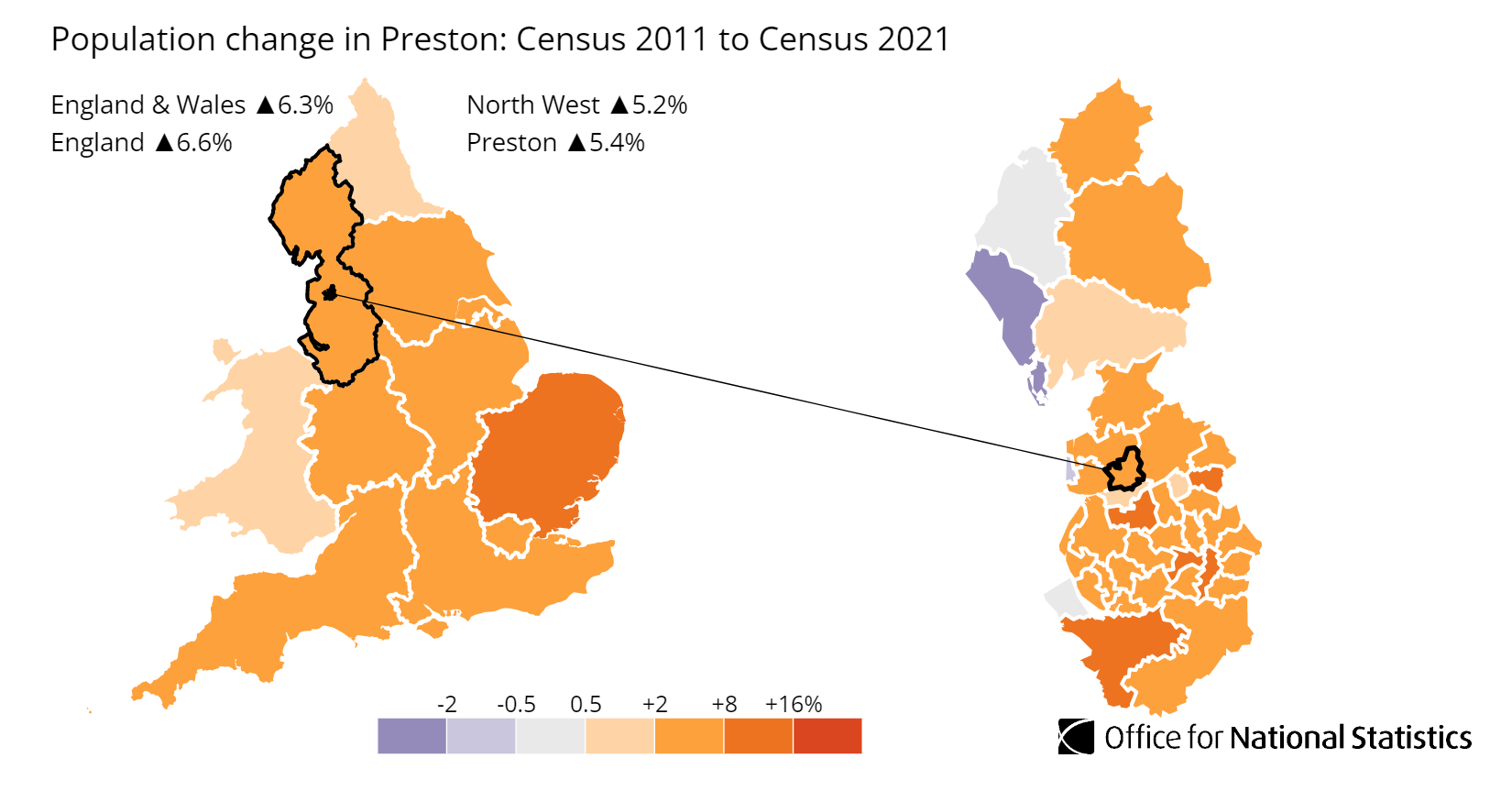
Between the 2011 and 2021 censuses, Preston's population grew from 140,202 to 147,835, a rise of 5.4%. That outpaces many comparable Lancashire towns and reflects genuine organic growth rather than boundary changes. The Royal Preston Hospital, operated by Lancashire Teaching Hospitals NHS Foundation Trust, is the area's major acute hospital and a significant employer drawing healthcare professionals into the local rental market.
Earnings in Preston sit below both the regional and national averages. The median annual salary is £37,214, compared to £37,445 across the North West and £39,125 for Great Britain. The gap is narrow at regional level, which means Preston's property discount of 12.2% below the North West average is not explained by lower wages alone.
Transport links play a role. Preston sits on the M6 motorway and the West Coast Main Line, with direct trains to London Euston in just over two hours, Manchester in under an hour, and Glasgow in three. That connectivity supports property investment in a city that punches above its size for accessibility.
The aerospace and advanced manufacturing sectors also contribute. BAE Systems operates major facilities in nearby Warton and Samlesbury, with thousands of employees living within Preston's postcode areas. The combination of defence, public sector, healthcare, and higher education gives Preston a diversified employment base that reduces reliance on any single industry.
Preston Economic Summary
- Population: 147,835 (2021 Census). Growth of 5.4% from 2011.
- Median annual salary: £37,214 (Preston), £37,445 (North West), £39,125 (Great Britain)
- Employment rate: 78.2% (Preston), 75.6% (Great Britain)
- Unemployment rate: Not available (APS sample size suppressed), 4.3% (Great Britain)
- Key employment sectors: Public administration, healthcare, higher education, aerospace and defence, advanced manufacturing
Source: ONS Census 2021, Nomis Labour Market Profile (ASHE 2025)
Preston's employment rate of 78.2% sits above the Great Britain average of 75.6%. The unemployment rate is not published for Preston due to the Annual Population Survey sample being too small for reliable local estimates. That suppression itself is telling. It typically occurs in smaller local authorities with low unemployment, where the sample cannot produce a statistically reliable figure. For buy-to-let investors, Preston's above-average employment rate and diversified employer base are the more relevant indicators of tenant reliability.
Regeneration and Investment in Preston
More than £600 million of regeneration investment is flowing through Preston's city centre across three overlapping initiatives. The programme is concentrated in the commercial, cultural, and residential heart of the city, with schemes at various stages of delivery.
- Harris Quarter Regeneration Programme (Under construction, £200 million): Transformational regeneration of Preston's cultural and civic heart, kickstarted by £20.9 million Towns Fund investment. Phase 1 includes the £45 million Animate entertainment complex (opened February 2025), £19 million Harris Museum restoration (reopened September 2025), and conversion of Red Rose and Elizabethan House into 130 luxury apartments. Updates at Invest Preston City.
- Preston Station Quarter (Masterplanning, part of £434 million City Deal): Regeneration framework for the area around Preston railway station covering four quadrants: Station East (commercial-led mixed use), University Walk, County Hill, and Station West. Aims to deliver Grade A office space, city centre living, new civic spaces, and an enhanced station gateway. Updates at Invest Preston City.
- Preston 35 City Investment Plan (Adopted, delivery 2024-2035, multi-billion pound): Ten-year regeneration strategy encompassing Harris Quarter, Station Quarter, a 60-acre residential quarter, Active Preston (£24 million sports investment), and Transforming Cities Fund transport improvements (£14.7 million). Updates at Invest Preston City.
Preston Property Market Analysis
When Was the Last House Price Crash in Preston?
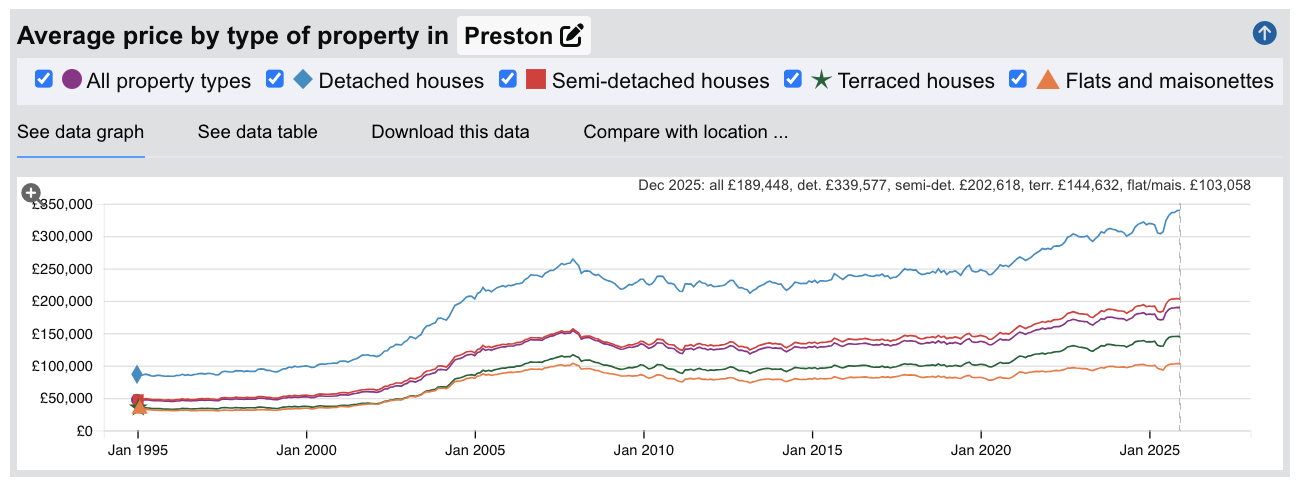
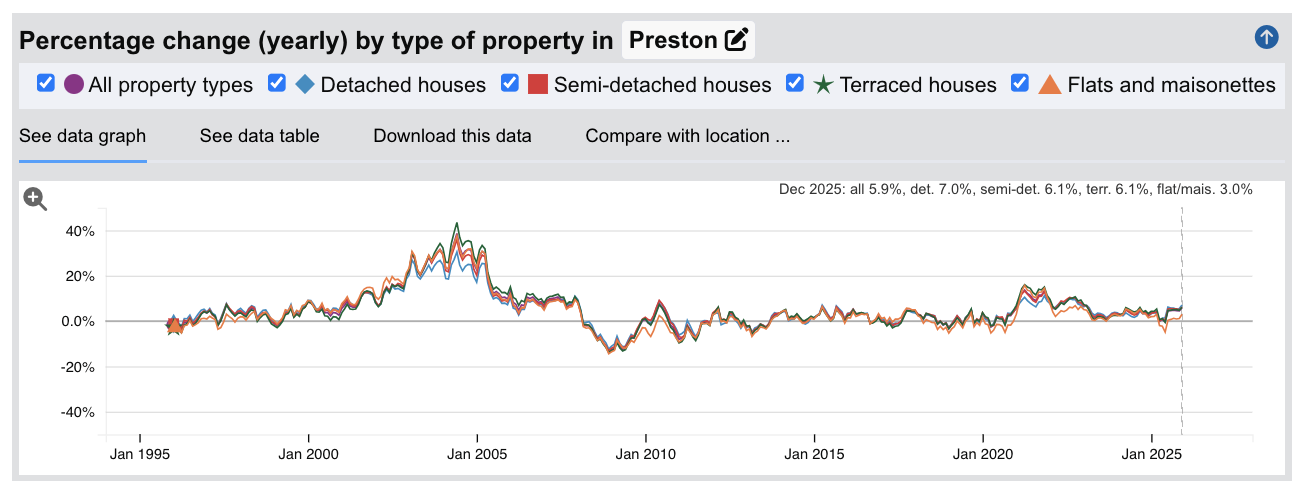
The full house price history from the HM Land Registry House Price Index runs from January 1995 to November 2025 for Preston. The data shows one major crash, an exceptionally slow recovery, and a sharp pandemic-era surge. Preston took nearly 14 years to recover its pre-crash peak. That is one of the longest recovery periods of any North West city.
- 1995-2000 (Slow start): Preston began 1995 at £45,764. Growth was modest through the late 1990s, with prices barely moving above the mid-£40,000s. By January 2000, prices sat around £48,000. The national property boom had not yet reached Lancashire's smaller cities.
- 2000-2007 (The boom): Prices accelerated sharply through the early 2000s. Easy credit, buy-to-let mortgage expansion, and genuine housing undersupply pushed Preston from under £50,000 to a peak of £154,136 in December 2007. That is a tripling of values in seven years. The boom was broad-based across all property types, with terraced houses and flats seeing the steepest percentage gains from their low starting points.
- 2008-2009 (The financial crisis): From the peak of £154,136 in December 2007 to the deepest point of £118,002 in March 2013, Preston lost 23.4% of its value. The worst annual change reading was -13.6% in December 2008. By property type, flats fell hardest at -14.4%, followed by terraced houses at -13.9%, semi-detached at -13.1%, and detached at -12.4%. Preston's overall decline of 23.4% was significantly steeper than England's 18.2% (September 2007 peak of £183,883 to March 2009 trough of £150,438) and the North West's 18.3% (December 2007 peak of £141,847 to January 2013 trough of £115,931). There were 51 months of negative annual change between 2008 and 2013.
- 2009-2013 (Extended stagnation): Unlike many UK cities that found a floor in 2009, Preston continued to slide. Prices bounced briefly in late 2009 and 2010 before falling again. The true trough did not arrive until March 2013 at £118,002. That extended decline meant Preston investors experienced over five years of negative territory.
- 2014-2016 (Slow recovery): Growth returned but at a cautious pace. Annual changes of 2-5% gradually rebuilt values. Prices remained below the pre-crash peak throughout this entire period. The university and public sector employment provided stability, but private sector confidence was slow to return to a city that had fallen harder than the regional average.
- 2017-2019 (Steady growth): Consistent annual growth of 3-5% continued. By late 2019, prices were approaching the £140,000 mark but still had not recovered the December 2007 peak of £154,136. Preston was one of the last North West cities to close this gap.
- 2020-2022 (Pandemic surge): The stamp duty holiday and remote working shift finally pushed Preston through the ceiling. Prices dropped briefly to £132,306 in April 2020 before surging to recover the pre-crash peak by September 2021 at £155,168. Nearly 14 years from peak to recovery. The surge continued through 2022 as lifestyle relocation and affordable northern housing attracted buyers from more expensive cities.
- 2023 (Rate shock): Rising interest rates cooled the market. Annual growth slowed but Preston did not experience a significant price decline. The correction was mild compared to 2008.
- 2024-2025 (Current): By November 2025, the average reached £190,209 with annual growth of 4.7%. Preston now sits 23.4% above its pre-crash peak, with the strongest growth momentum in over a decade.
Key takeaway: Preston's 23.4% crash was deeper than England's 18.2% and the North West's 18.3%. The recovery took nearly 14 years. From the £45,764 starting point in 1995 to today's £190,209, that is a 322% gain over 30 years.
Long-Term Property Value Growth in Preston
- 5 years (2020-2025): +36.7% (£139,167 to £190,209)
- 10 years (2015-2025): +45.1% (£131,072 to £190,209)
- 15 years (2010-2025): +50.1% (£126,712 to £190,209)
- 20 years (2005-2025): +47.4% (£129,046 to £190,209)
- 30 years (1995-2025): +322.1% (£45,060 to £190,209)
The 20-year growth figure of 47.4% is lower than the 15-year figure of 50.1%. That is not an error. November 2005 prices (£129,046) were higher than November 2010 prices (£126,712) because the crash wiped the gains made between 2005 and 2007. Investors who bought at the 2005 level and held for 20 years are sitting on less growth than those who bought at the 2010 trough and held for 15.
The 2008 crash is the reference point for Preston investors assessing downside exposure. A 23.4% decline and nearly 14 years to recover is the worst-case scenario from recent history. Preston fell harder and recovered slower than the North West average. The current regeneration pipeline and structural employment base are different from what existed in 2007, but property prices are never guaranteed.

Thinking of Buying?
We have off-market investment properties averaging 8%+ annual yield.
View Property DealsSold House Prices in Preston
The latest sold house price index by the Land Registry positions Preston firmly in discount territory against the national average. The headline figure of £190,209 is 35.3% below England's £293,913 and 12.2% below the North West's £216,741. That double discount, below both national and regional benchmarks, is what creates the yield opportunity across Preston's postcodes.
Flats in Preston average £103,034. That is 53.6% below the England average of £221,836. It is the deepest discount of any property type and reflects Preston's stock profile: predominantly purpose-built blocks and converted terraces near the city centre and university, without the premium new-build apartment market that inflates flat prices in Manchester or Liverpool.
| Property Type | Preston Average | England Average | Difference |
|---|---|---|---|
| Detached houses | £340,365 | £475,046 | -28.4% |
| Semi-detached houses | £204,027 | £290,937 | -29.9% |
| Terraced houses | £145,323 | £246,024 | -40.9% |
| Flats and maisonettes | £103,034 | £221,836 | -53.6% |
| All property types | £190,209 | £293,913 | -35.3% |
Detached houses sit 28.4% below England at £340,365. Detached stock in Preston is concentrated in the outer postcodes of PR3 (Garstang, Longridge) and PR4 (Kirkham, Freckleton), where rural and semi-rural settings keep prices below the southern English premiums that push the national average. The discount is substantial but narrows compared to other property types because Preston's detached stock competes with owner-occupier demand across Lancashire.
Semi-detached houses show a 29.9% discount at £204,027. Semis are the core family housing stock in PR2 (Fulwood, Ribbleton) and PR5 (Bamber Bridge, Walton-le-Dale). Owner-occupier competition is strongest in this segment, particularly in the Fulwood area of PR2 where school catchments drive demand.
Terraced houses average £145,323, a 40.9% discount to England. Victorian and Edwardian terraces in PR1 (City Centre, Deepdale) are the backbone of Preston's rental stock. These properties offer some of the lowest entry points in the city and form the majority of the buy-to-let market close to the university and city centre employment.
Flats represent the deepest value discount at 53.6% below the national market. For investors, that means even modest rental income generates meaningful yields against a low purchase price. Preston's flat stock is concentrated in PR1 and PR2, with a mix of purpose-built blocks and converted houses near UCLan and the city centre.
Property Data Sources
Our location guide relies on diverse, authoritative datasets including:
- HM Land Registry UK House Price Index
- Ministry of Housing, Communities and Local Government
- Ordnance Survey Data Hub
- Propertydata.co.uk
We update our property data quarterly to ensure accuracy. Last update: February 2026. All data is presented as provided by our sources without adjustments or amendments.
Price Per Square Foot in Preston
Average asking prices can mislead. A postcode might look expensive simply because it has larger properties. Price per square foot strips out that size bias and shows what you are actually paying for space. It is the closest measure to true underlying value across different property types and sizes.
Preston's price per square foot ranges from £182 in PR1 to £251 in PR3, a spread of £69 across five postcodes with data. That is a tighter range than many cities, reflecting Preston's relatively uniform housing stock across its urban and suburban areas. PR11 has no residential data.
| Rank | Area | Price Per Sq Ft |
|---|---|---|
| 1 | PR1 (City Centre, Deepdale) | £182 |
| 2 | PR2 (Fulwood, Ribbleton) | £210 |
| 3 | PR5 (Bamber Bridge, Walton-le-Dale) | £226 |
| 4 | PR4 (Kirkham, Freckleton) | £243 |
| 5 | PR3 (Garstang, Longridge) | £251 |
| — | PR11 (Preston Large User/DWP) | Not enough data |
PR1 at £182 per square foot is the cheapest space in Preston. This is the city centre and Deepdale area, closest to UCLan and the main employment hubs. Older terraced housing and ex-council stock keep per-foot costs low. PR1 also delivers the highest yield at 6.9%. The cheapest space and the strongest rental return in the same postcode is a combination that draws buy-to-let investors to city centre stock.
PR3 and PR4 at £251 and £243 per square foot form the premium tier. These are the semi-rural and rural postcodes covering Garstang, Longridge, Kirkham, and Freckleton. Larger detached properties and village settings command higher rates per square foot. The gap between PR1 and PR3 is 38%, which is modest compared to many cities where premium postcodes trade at double or triple the cheapest areas.
The middle ground of PR2 and PR5 (£210 to £226) is where most residential buy-to-let activity concentrates. PR5 at £226 ranks third for price per square foot but delivers the second-highest yield at 5.1% alongside the strongest five-year growth at 24.3%. Read this alongside the yield data to see how per-foot cost translates into rental returns.
Figures reflect averages across all property types and ages. Individual values depend on condition, location within the postcode, and building age.
For Sale Asking Prices in Preston
Asking prices reflect what sellers and agents think the market will pay. They are not the same as sold prices, which capture what buyers actually paid. The gap between the two matters. In a rising market, asking prices run ahead of sold prices. In a cooling market, asking prices sit above what eventually transacts.
Preston's asking prices range from £156,149 in PR1 to £325,884 in PR3. That is a spread of £169,735 across the five postcodes with data. Strip out the two rural-fringe postcodes (PR3 and PR4) and the urban range narrows to £156,149 to £222,888, a manageable corridor for investors comparing city entry points.
| Rank | Area | Average Asking Price |
|---|---|---|
| 1 | PR1 (City Centre, Deepdale) | £156,149 |
| 2 | PR2 (Fulwood, Ribbleton) | £220,155 |
| 3 | PR5 (Bamber Bridge, Walton-le-Dale) | £222,888 |
| 4 | PR4 (Kirkham, Freckleton) | £312,887 |
| 5 | PR3 (Garstang, Longridge) | £325,884 |
| — | PR11 (Preston Large User/DWP) | Not enough data |
PR1 at £156,149 sits in its own tier, nearly £64,000 below the next cheapest postcode. That gap is striking. PR2 and PR5 cluster together at £220,155 and £222,888, effectively the same entry price. The choice between those two comes down to yield, growth profile, and tenant demographics rather than affordability.
PR3 and PR4 represent a different market. Asking prices above £310,000 reflect larger detached and semi-detached stock in semi-rural settings. These postcodes attract owner-occupiers and downsizers from wider Lancashire. Yields are lower (4.1% and 4.3%) and sales volumes suggest a less liquid market for investors looking at exit strategy timelines.
The mean asking price across all five Preston postcodes with data is £247,593. That figure appears in the comparison section later, where Preston is measured against Liverpool, Blackburn, Bolton, and Lancaster.
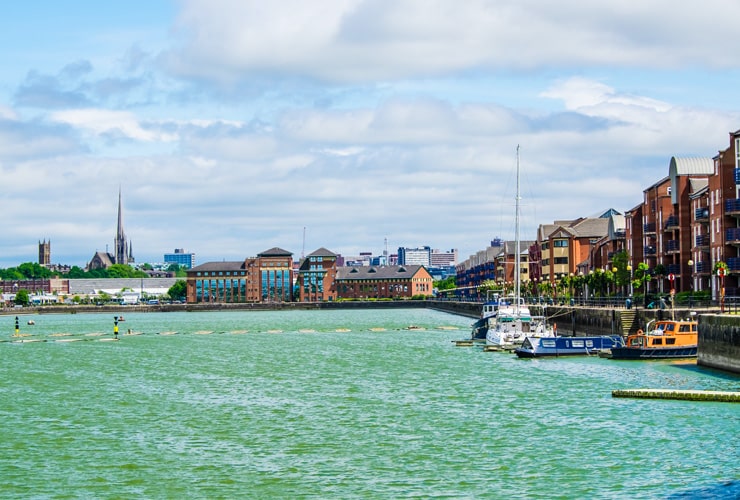
House Price Growth in Preston
Growth data shows where prices have moved over 1, 3, and 5 years. For buy-to-let investors, the five-year figure matters most. It captures a full market cycle and filters out short-term noise. One-year growth can swing on a handful of transactions. Five years tells you whether an area is genuinely appreciating.
PR5 Bamber Bridge leads Preston with 24.3% five-year growth, followed closely by PR2 Fulwood at 18.1%. An investor who bought a £180,000 property in PR5 five years ago would be sitting on a property now asking £222,888. That is £42,888 in equity growth. PR1 City Centre delivered 14.0% over five years, modest in absolute terms but from a base price under £140,000, meaning the capital deployed was far smaller.
| Area | 1 Year | 3 Years | 5 Years |
|---|---|---|---|
| PR5 (Bamber Bridge, Walton-le-Dale) | 8.4% | 7.6% | 24.3% |
| PR2 (Fulwood, Ribbleton) | -2.9% | 5.1% | 18.1% |
| PR1 (City Centre, Deepdale) | -4.3% | 6.9% | 14.0% |
| PR3 (Garstang, Longridge) | -1.6% | -3.4% | 9.5% |
| PR4 (Kirkham, Freckleton) | -2.4% | 4.8% | 7.5% |
| PR11 (Preston Large User/DWP) | Not enough data | Not enough data | Not enough data |
PR5 is the standout across every timeframe. It is the only Preston postcode showing positive one-year growth at 8.4%, while all other postcodes are negative over the last 12 months. The three-year figure of 7.6% is also healthy. Bamber Bridge and Walton-le-Dale sit just south of the city, with good access to the M6 and M65 corridors. Young families priced out of central Preston have driven demand here, and the turnover rate of 72% (see monthly sales section) confirms that properties move quickly.
Four of five postcodes show negative one-year growth. PR1 at -4.3% is the weakest short-term performer. That dip may reflect a correction after the pandemic surge or seasonal variation in a postcode dominated by smaller, cheaper stock. The three-year figure of 6.9% suggests the underlying trajectory is still upward. One-year snapshots can mislead in lower-volume markets.
PR3 shows an unusual pattern: negative three-year growth of -3.4% despite positive five-year growth of 9.5%. That means prices surged during the pandemic stamp duty holiday period (2020-2021) and have since fallen back. The rural Garstang and Longridge areas attracted lifestyle buyers during the remote working boom, and some of that premium has unwound as working patterns normalised.
Monthly Property Sales in Preston
Transaction volumes reveal which areas have the deepest buyer pools. For buy-to-let investors, this is an exit strategy question. If you need to sell, can you? High volume and high turnover mean a liquid market. Low volume means longer waits and potentially accepting lower offers.
Preston's monthly sales range from 39 in PR3 to 80 in PR2, with a combined total of 290 transactions per month across the five postcodes with data. The standout figure is PR5's turnover rate of 72%, the highest in Preston, meaning properties are selling nearly as fast as they are listed.
| Area | Sales Per Month | Turnover | Asking Price |
|---|---|---|---|
| PR2 (Fulwood, Ribbleton) | 80 | 43% | £220,155 |
| PR4 (Kirkham, Freckleton) | 67 | 39% | £312,887 |
| PR1 (City Centre, Deepdale) | 56 | 28% | £156,149 |
| PR5 (Bamber Bridge, Walton-le-Dale) | 48 | 72% | £222,888 |
| PR3 (Garstang, Longridge) | 39 | 22% | £325,884 |
| PR11 (Preston Large User/DWP) | Not enough data | Not enough data | Not enough data |
PR2 Fulwood dominates on raw volume at 80 sales per month. That is the largest pool of buyer activity in Preston and reflects Fulwood's broad appeal to both owner-occupiers and investors. The turnover rate of 43% is moderate, meaning supply keeps pace with demand. For exit strategy planning, PR2 offers the deepest buyer pool in the city.
PR5 at 72% turnover is the fastest-moving market despite lower absolute volume. Forty-eight sales per month with 72% turnover means properties are selling before new listings can build up. That liquidity is valuable. An investor looking to sell a property in PR5 faces less competition from other listings. Combined with the highest five-year growth (24.3%) and second-highest yield (5.1%), PR5 is a postcode where multiple metrics converge.
PR3 at 22% turnover and 39 sales per month is the least liquid market. Higher asking prices (£325,884) and a rural setting mean fewer buyers and longer selling timelines. PR1 at 28% turnover is also relatively low. The city centre's large volume of rental stock means fewer properties change hands via open-market sale. Landlords hold long-term in PR1, which keeps turnover low despite 56 monthly sales.
Property Data Sources
Our location guide relies on diverse, authoritative datasets including:
- HM Land Registry UK House Price Index
- Ministry of Housing, Communities and Local Government
- Ordnance Survey Data Hub
- Propertydata.co.uk
We update our property data quarterly to ensure accuracy. Last update: February 2026. All data is presented as provided by our sources without adjustments or amendments.
Preston Rental Market Analysis
For investors weighing up whether rental property is a worthwhile investment in Preston, the data below breaks down average monthly rents and gross rental yields across the city's postcodes.
Rental data is available for 5 of 6 postcodes. PR11 (Preston Large User/DWP) has no residential property data. For the five with data, monthly rents range from £894 in PR1 to £1,123 in PR3 and gross yields range from 4.1% to 6.9%. If you are looking to build a property portfolio in the North West, Preston's combination of low entry prices, near-7% yields, and strong transport links makes it a location that the data supports.
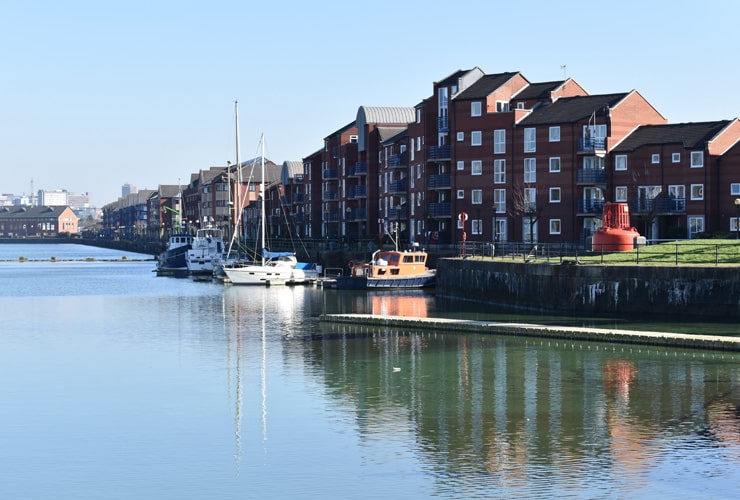
Average Rent & Gross Rental Yields in Preston
Gross rental yield is calculated from the average asking price and average monthly rent for each postcode. It does not account for void periods, maintenance, management fees, or mortgage costs. It is a starting point for comparison, not a profit forecast.
PR1 delivers Preston's highest gross yield at 6.9%, where monthly rents of £894 meet asking prices of just £156,149. That sub-£160,000 entry point is what drives the yield. At the other end, PR3 Garstang at 4.1% reflects higher asking prices absorbing stronger absolute rents. The yield spread across Preston is 2.8 percentage points, a wide gap that means the difference between a property that cash-flows comfortably and one that depends entirely on capital growth.
| Area | Average Monthly Rent | Average Asking Price | Gross Yield |
|---|---|---|---|
| PR1 (City Centre, Deepdale) | £894 | £156,149 | 6.9% |
| PR5 (Bamber Bridge, Walton-le-Dale) | £954 | £222,888 | 5.1% |
| PR2 (Fulwood, Ribbleton) | £918 | £220,155 | 5.0% |
| PR4 (Kirkham, Freckleton) | £1,119 | £312,887 | 4.3% |
| PR3 (Garstang, Longridge) | £1,123 | £325,884 | 4.1% |
| PR11 (Preston Large User/DWP) | Not enough data | Not enough data | Not enough data |
Three postcodes sit at or above 5.0% gross yield: PR1, PR5, and PR2. Each taps into a different tenant pool. PR1 City Centre draws students, young professionals, and public sector workers near the university and council offices. PR5 Bamber Bridge attracts working families with access to the M6 and M65 corridors. PR2 Fulwood ranges from professional families in the west to a more mixed demographic in the Ribbleton area. That diversity of demand across the top-yielding postcodes is a strength.
PR3 and PR4 command Preston's highest absolute rents at £1,123 and £1,119 per month. But asking prices above £310,000 compress yields below 4.5%. These are semi-rural postcodes where tenants tend to be professional families or relocating workers. The tenant quality is high, but the numbers favour capital growth over cash flow.
PR1's yield of 6.9% at an asking price of £156,149 is the clearest income play in Preston. A 30% deposit of £46,845 and monthly rent of £894 means the rental income works hard relative to the capital deployed. Read this alongside the rent affordability data below. PR1's rents at 28.8% of local income are the most sustainable in the city, which supports lower void periods and fewer arrears.
Is Preston Rent High?
Rent affordability matters from both sides. For tenants, it determines whether they can sustain payments long-term. For landlords, areas where rent consumes a lower share of income tend to produce more reliable tenants and fewer arrears.
The median gross weekly salary in Preston is £715.70, which equates to £3,101 per month or £37,214 per year. This is below the North West regional median of £720.10 per week and the Great Britain median of £752.40 per week. Data from the Nomis Labour Market Profile (ASHE 2025).
Across Preston's five postcodes with rental data, rent ranges from 28.8% to 36.2% of the local median gross monthly salary. The general benchmark is that rent becomes stretched above 30% of gross income. Three of the five postcodes sit above that level. The two below 30% are PR1 and PR2, both in the urban core where rents are lower in absolute terms.
| Rank | Area | Rent as % of Income |
|---|---|---|
| 1 | PR3 (Garstang, Longridge) | 36.2% |
| 2 | PR4 (Kirkham, Freckleton) | 36.1% |
| 3 | PR5 (Bamber Bridge, Walton-le-Dale) | 30.8% |
| 4 | PR2 (Fulwood, Ribbleton) | 29.6% |
| 5 | PR1 (City Centre, Deepdale) | 28.8% |
| — | PR11 (Preston Large User/DWP) | Not enough data |
PR3 and PR4 at 36.2% and 36.1% are the most stretched postcodes. But these are higher-rent semi-rural areas attracting tenants who typically earn above the Preston median. Professional families relocating to Garstang or Kirkham are not on £37,214. The median salary is a city-wide figure that understates what tenants in these postcodes actually earn.
PR1 at 28.8% is the most affordable postcode for tenants and the highest-yielding for investors. That alignment is significant. Rents of £894 per month are high enough to drive a 6.9% gross yield, but affordable enough relative to local incomes that tenants can sustain payments without financial pressure. PR2 at 29.6% sits just below the 30% threshold, offering a similar balance. For investors concerned about tenant sustainability, these two postcodes have the strongest position.
Thinking of Buying?
We have off-market investment properties averaging 8%+ annual yield.
View Property DealsBuy-to-Let Considerations
Are Preston House Prices High? Price-to-Earnings Ratios
The price-to-earnings ratio compares a postcode's average asking price to the local median annual salary. Lower ratios mean more affordable entry points relative to local wages. The national benchmark is 7.5x, calculated from England's average sold price of £293,913 against Great Britain's median annual salary of £39,125.
Purchasing a property in Preston requires between 4.2 and 8.8 times the median annual salary. This is based on the Nomis Labour Market Profile for Preston showing the median gross annual income for Preston residents is £37,214.
Three of Preston's five postcodes with data sit below the national benchmark of 7.5x. PR1, PR2, and PR5 all come in at 6.0x or below. Only PR3 and PR4 exceed the national average, and those are the semi-rural postcodes where larger properties push prices above what local wages alone would support.
| Rank | Area | Price-to-Earnings Ratio |
|---|---|---|
| 1 | PR1 (City Centre, Deepdale) | 4.2x |
| 2 | PR2 (Fulwood, Ribbleton) | 5.9x |
| 3 | PR5 (Bamber Bridge, Walton-le-Dale) | 6.0x |
| 4 | PR4 (Kirkham, Freckleton) | 8.4x |
| 5 | PR3 (Garstang, Longridge) | 8.8x |
| — | PR11 (Preston Large User/DWP) | Not enough data |
PR1 at 4.2x is the most affordable postcode by any measure. A price-to-earnings ratio of 4.2x is well below half the national benchmark. That extreme affordability is what drives the 6.9% yield. PR1 also delivers the lowest deposit requirement (£46,845) and the most affordable rent-to-income ratio (28.8%). Every affordability metric points in the same direction.
PR3 and PR4 at 8.8x and 8.4x are above the national benchmark. Rural and semi-rural stock in Garstang, Longridge, Kirkham, and Freckleton attracts buyers from across Lancashire. Prices in these postcodes are driven by owner-occupier demand and lifestyle factors rather than local wage levels.
Deposit Requirements in Preston
Most buy-to-let mortgage lenders require a minimum 25% deposit. The table below uses a more conservative 30% to reflect the rates and products available at higher loan-to-value ratios. A 30% deposit typically unlocks better interest rates, which matters for cash flow in a yield-driven market.
Preston's entry costs range from £46,845 in PR1 to £97,765 in PR3. Three postcodes require deposits under £67,000. That sub-£67,000 bracket puts buy-to-let in Preston within reach for investors who may be priced out of Manchester, Lancaster, or other higher-value North West locations.
| Rank | Area | 30% Deposit Required |
|---|---|---|
| 1 | PR1 (City Centre, Deepdale) | £46,845 |
| 2 | PR2 (Fulwood, Ribbleton) | £66,046 |
| 3 | PR5 (Bamber Bridge, Walton-le-Dale) | £66,866 |
| 4 | PR4 (Kirkham, Freckleton) | £93,866 |
| 5 | PR3 (Garstang, Longridge) | £97,765 |
| — | PR11 (Preston Large User/DWP) | Not enough data |
PR1 at £46,845 is nearly £20,000 cheaper to enter than any other Preston postcode. That gap is the single biggest differentiator in the deposit table. For £46,845, an investor gains access to Preston's highest yield (6.9%), most affordable rent-to-income ratio (28.8%), and a price-to-earnings ratio of 4.2x. The deposit is the equivalent of one year's gross rent from the property. Investors targeting below market value properties in PR1 can reduce that entry cost further. Few postcodes in the North West offer that kind of capital efficiency.
PR2 and PR5 sit within £820 of each other at £66,046 and £66,866. Almost identical entry costs, but different profiles. PR2 delivers 5.0% yield with the deepest buyer pool (80 sales per month). PR5 delivers 5.1% yield with the strongest growth (24.3% over five years) and highest turnover (72%). For investors choosing between these two, the data supports PR5 for total return and PR2 for liquidity.
Deposit is only part of the upfront cost. Budget for stamp duty (use our stamp duty calculator for an accurate figure), legal fees, and survey costs. For a full breakdown, see our guide to buy-to-let costs.
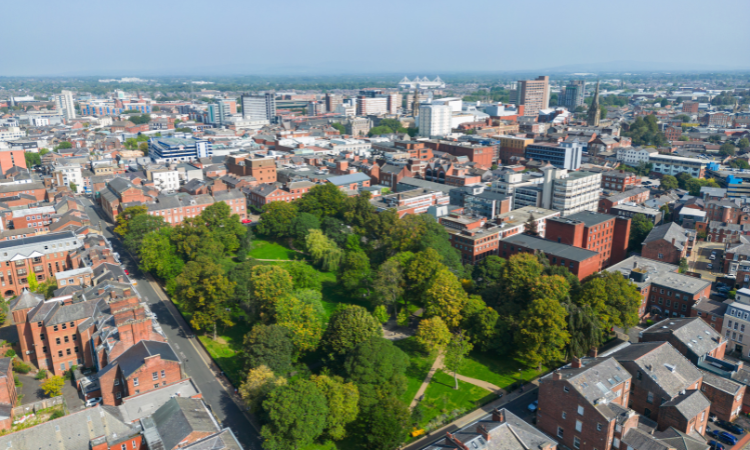
What the Preston Data Tells Buy-to-Let Investors
For yield, the numbers favour PR1 (6.9%), PR5 (5.1%), and PR2 (5.0%). All three sit at or below 6.0x price-to-earnings with 30% deposits between £46,845 and £66,866. PR1 stands apart at 6.9% yield, the lowest entry point in the city, and 28.8% rent-to-income. The tenant pool is university students, young professionals, and public sector workers. Rents at £894 per month are modest in absolute terms but work hard against a £156,149 asking price. Sourcing off-market properties in PR1 can improve those numbers further.
For growth, PR5 leads convincingly. Five-year growth of 24.3% is the highest in Preston by a wide margin. PR5 is also the only postcode with positive one-year growth at 8.4%. The 72% turnover rate confirms a liquid market. Combining 5.1% yield with 24.3% growth is unusual in any city. Most postcodes deliver one or the other. PR5 delivers both.
PR3 and PR4 show weaker data across several measures. Both deliver yields below 4.5%, price-to-earnings ratios above 8x, and negative one-year growth. PR3's three-year growth is negative at -3.4%. These are semi-rural postcodes with higher absolute prices and lower liquidity. The five-year growth figures of 9.5% (PR3) and 7.5% (PR4) are positive but significantly trail the urban postcodes. The data points to a market that suits owner-occupiers more than yield-focused buy-to-let investors.
Preston does not currently operate a selective licensing scheme for private rented properties. Landlords in the city benefit from lower regulatory overhead compared to nearby councils that have implemented area-based licensing. Check with Preston City Council for the latest position, as licensing designations can change. For investors seeking investment property in the North West, Preston's regulatory environment adds to its appeal.
How Preston Buy-to-Let Compares to Nearby Areas
Preston's mean monthly rent of £1,001 is the highest of five North West locations compared here, and its top yield of 6.9% ranks second. The table below compares Preston against four nearby cities using the same methodology: mean asking price across all postcodes, mean monthly rent across postcodes with data, and top single-postcode gross yield.
| Location | Mean Asking Price | Mean Monthly Rent | Top Gross Yield |
|---|---|---|---|
| Blackburn | £224,155 | £827 | 5.1% |
| Preston | £247,593 | £1,001 | 6.9% |
| Bolton | £254,422 | £954 | 6.7% |
| Lancaster | £278,654 | £916 | 5.6% |
| Liverpool | £206,849 | £872 | 7.5% |
Preston's top yield of 6.9% is the second-highest in this group, behind only Liverpool at 7.5%. Liverpool offers a lower mean asking price (£206,849) and a marginally higher top yield, but Preston's mean monthly rent of £1,001 is the highest in the group. That means Preston generates more absolute rental income per property despite sitting in the middle of the price range.
Blackburn is the cheapest entry point at £224,155 mean asking price, but its top yield of 5.1% is significantly below Preston's 6.9%. For investors prioritising yield over pure affordability, Preston delivers more rental return per pound of deposit. Bolton at £254,422 is the closest competitor on yield (6.7%) and sits just £7,000 above Preston on asking price.
Lancaster is the most expensive option at £278,654 with a lower top yield of 5.6%. Lancaster's university city appeal and historic character attract a different buyer profile. For investors with limited capital looking for the best yield-per-pound-invested in Lancashire, Preston's numbers are the strongest in this group once Liverpool is excluded from a Lancashire-only comparison. Our property investment courses cover how to evaluate these regional comparisons in more detail.
Frequently Asked Questions
Is Preston a good place to live?
Preston's employment rate of 78.2% sits above the Great Britain average, and the city's population grew 5.4% between the 2011 and 2021 censuses. Median earnings of £37,214 sit close to the North West regional median. The city's position on the West Coast Main Line means London is just over two hours by train, Manchester under an hour. UCLan brings over 30,000 students, and the Harris Quarter regeneration has added a £45 million entertainment complex and restored the Grade I listed Harris Museum. The livability data supports sustained rental demand rather than a temporary spike.
What are the best areas in Preston for buy-to-let?
PR1 (City Centre, Deepdale) and PR5 (Bamber Bridge, Walton-le-Dale) lead across the broadest range of metrics. PR1 is compact and urban, centred on the university quarter, the city centre retail core, and the Deepdale area near Preston North End's stadium. The housing stock is predominantly terraced houses and flats, which suits student and young professional lets.
PR5 sits south of the city with a more suburban character. Bamber Bridge has its own high street, primary schools, and direct access to the M6 and M65. Families and working couples are the primary tenant pool. The two areas attract fundamentally different tenants, which means an investor holding properties in both is diversified by location and demographic.
Is student accommodation a good investment in Preston?
UCLan has over 30,000 students on its Preston campus, making it one of the UK's largest universities. The campus sits in the heart of PR1, which drives rental demand for terraced houses and flats within walking distance. HMO (house in multiple occupation) lets in the student areas around Moor Park and Adelphi typically generate higher per-room rental income than the headline single-let figures in this guide, particularly during term time. Void periods during summer months are the trade-off. For a broader view of the student property market, see our guide to purpose-built student accommodation.
When will Preston's regeneration affect property prices?
The Harris Quarter is already delivering, with two major completions in 2025. The Animate entertainment complex opened in February 2025 and the Harris Museum reopened in September 2025 after a £19 million restoration. The conversion of Red Rose and Elizabethan House into 130 luxury apartments is in progress.
The Station Quarter is at masterplanning stage as part of a £434 million City Deal, with delivery extending through the late 2020s and beyond. Preston 35 is a ten-year strategy running to 2035. The timeline is long. Investors positioning now in PR1 city centre stock are closest to the projects already complete and under construction.
Can I find buy-to-let property in Preston under £100,000?
Individual flats and terraced houses in PR1 do list below £100,000. The average asking prices in this guide range from £156,149 (PR1) to £325,884 (PR3), but these are postcode averages across all property types. Ex-council stock and smaller one-bedroom units near the city centre regularly appear at sub-£100,000 prices. Preston's average flat price of £103,034 from the Land Registry confirms that stock at this level exists.
At that price point, a 30% deposit is under £30,000. Due diligence on lease length, service charges, building condition, and actual tenant demand at the individual property level is essential. Preston is also featured in our guide to the cheapest places to buy a house in England.
How does Preston compare to other North West cities for buy-to-let?
Preston's top yield of 6.9% places it second in the Lancashire group behind Liverpool (7.5%). Bolton follows at 6.7%, Lancaster at 5.6%, and Blackburn at 5.1%. Preston's mean monthly rent of £1,001 is the highest of the five, meaning it generates more absolute rental income per property. The mean asking price of £247,593 sits in the middle.
Liverpool offers cheaper entry and a higher top yield but in a larger, more competitive investor market. Bolton is the closest comparison on yield and price. For investors wanting to explore different property investment strategies across the North West, Preston's data sits in a strong position relative to its Lancashire neighbours. The rent-to-buy model is another option for investors looking at affordable markets like Preston.
Where can I find houses for sale in Preston?
Asking prices in Preston range from £156,149 in PR1 to £325,884 in PR3. The city centre postcode of PR1 offers the lowest entry point, with terraced houses and flats making up the bulk of available stock. PR2 and PR5 sit in the £220,000 to £223,000 bracket for family homes. For investors looking specifically at buy-to-let property for sale, Preston's combination of sub-£160,000 entry prices in PR1 and 6.9% gross yields makes it one of the more compelling options in the North West.
What types of property are available to rent in Preston?
Flats in Preston average £103,034 from Land Registry data, making them the most affordable property type in the city. Terraced houses at £145,323 form the backbone of the rental market in PR1 and PR2, popular with students and young professionals near UCLan. Semi-detached houses at £204,027 attract working families in PR2 and PR5. The rental stock also includes Airbnb properties for sale near the city centre, where short-stay demand from business travellers and university visitors creates an alternative income stream alongside traditional lets.