
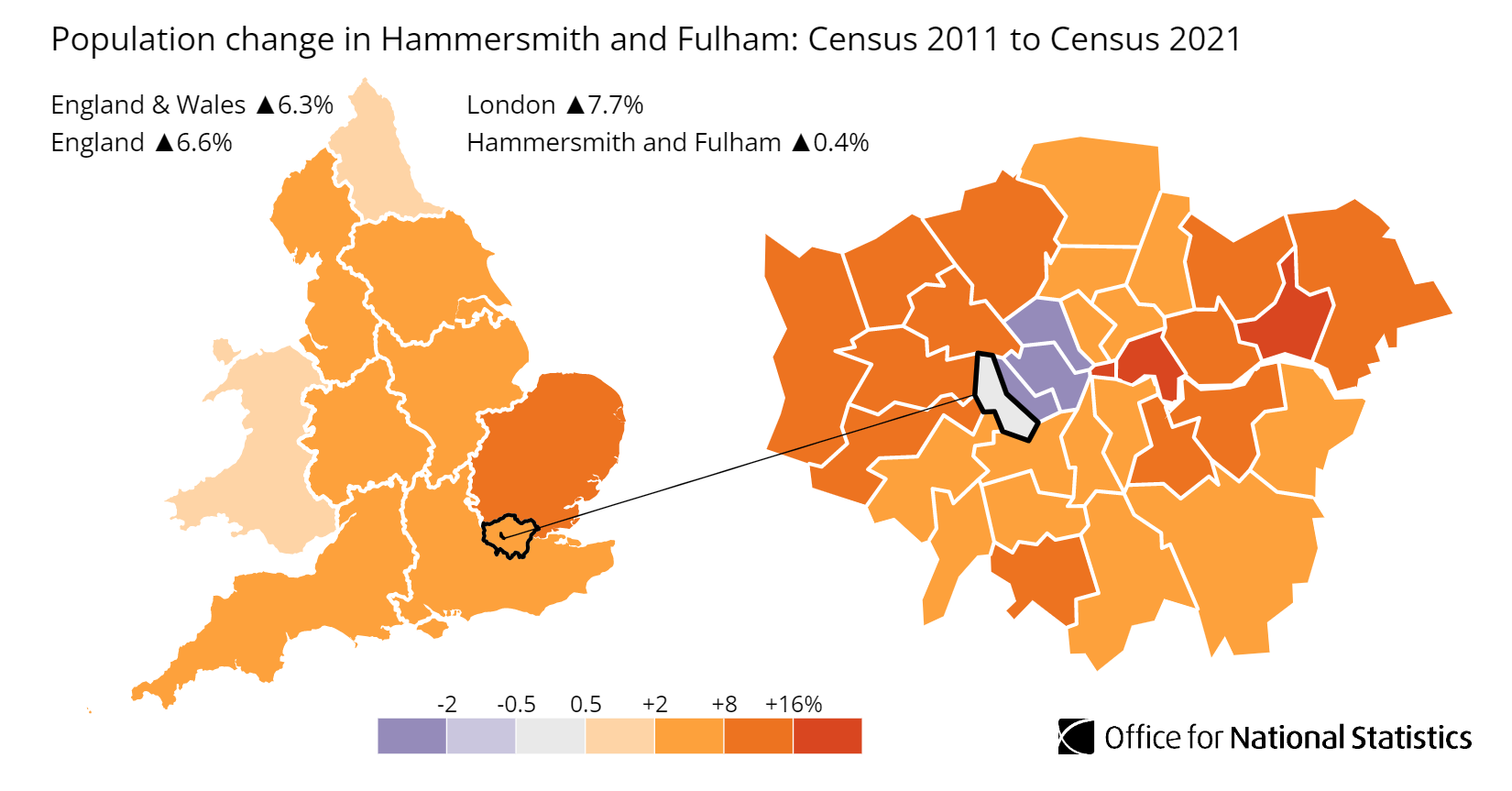
Hammersmith and Fulham is a west London borough. Average sold prices across Hammersmith and Fulham sit at £741,612 on the HM Land Registry House Price Index, 155.8% above the England average of £289,946 and 34.2% above the wider London figure of £552,655. That is prime West London pricing, but the gap between the borough's cheapest and dearest postcodes is what an investor reads first: W12 in Shepherd's Bush opens the borough at a £711,599 asking price while W11 around Notting Hill runs to £1,269,474, two very different markets inside one borough. The local population was almost static between the 2011 and 2021 censuses, edging up 0.36% from 182,493 to 183,157 residents.
What sets Hammersmith and Fulham apart from most of London is the timing of its price cycle. The borough did not peak in the 2020 stamp-duty boom like the rest of the capital; it ran on to an all-time high of £889,834 in March 2023 and has since eased back to £741,612, about 16.7% below that high, leaving the market down 4.8% over five years and down 8.0% over ten. A late peak followed by a fall changes what an investor is buying: the question becomes the rental income and which of the borough's two halves you are in, the cheaper Shepherd's Bush and Fulham postcodes or the prime Notting Hill and Chelsea-fringe streets, rather than a bet on the next leg up. Top gross yields reach 4.9% in W6 Hammersmith, while the dearest postcodes yield closer to 3.4%.
This guide covers the London Borough of Hammersmith and Fulham (ONS code E09000013) across postcodes W6, W12, W14, SW6, W11, and SW10. The borough runs north to south down the western edge of inner London, from Shepherd's Bush and Hammersmith through Fulham to the river, sharing borders with Kensington and Chelsea to the east and Ealing to the north-west.
Article updated: July 2026
Why Invest in Hammersmith and Fulham?
Hammersmith and Fulham added just 664 residents between the 2011 and 2021 censuses, a 0.36% rise from 182,493 to 183,157, far below the 6.3% England and Wales average. A near-static population in one of London's most established boroughs reflects how little undeveloped land remains rather than weak demand; the people wanting to live here outnumber the homes available, which is the structural backdrop to the rental market. The borough packs three distinct markets into a narrow strip: the busy, cheaper Shepherd's Bush and Hammersmith postcodes at the north, the long Fulham residential market in the middle, and the prime Notting Hill and Chelsea-fringe streets at the eastern and southern edges.
The local employment rate of 71.3% sits below both the London figure of 74.9% and the Great Britain figure of 75.6%, and unemployment runs at 6.4%. Those headline figures understate the borough's earning power, because they sit alongside a large professional and high-net-worth population whose income is not fully captured by a residence-based employment rate. For a landlord, the practical read is a tenant base weighted towards City and West End professionals, media workers around the White City and Television Centre cluster, and students, with the balance shifting from one postcode to the next.
Median gross weekly earnings for residents are £917.30, and the median annual salary is £47,192. That sits above the London median of £902.70 a week and well clear of the Great Britain figure of £766.60. Those above-average wages help explain how the borough sustains rents that run from £2,619 a month in W14 up to £3,726 in the SW10 Chelsea-fringe postcode. The Imperial College White City campus and the broadcast and creative cluster around Television Centre add a steady graduate and professional layer to that demand.
Hammersmith and Fulham Economic Summary
- Population: 183,157 (2021 Census). Growth of 0.36% from 2011.
- Median annual salary: £47,192 (local), £46,415 (London), £39,125 (Great Britain)
- Employment rate: 71.3% (local), 74.9% (London), 75.6% (Great Britain)
- Unemployment rate: 6.4% (local)
- Key employment sectors: Professional and financial services, media and creative industries, health, education, retail and hospitality
Source: ONS Census 2021, Nomis Labour Market Profile (ASHE 2025, residence-based earnings)
Regeneration and Investment in Hammersmith and Fulham
Hammersmith and Fulham holds one of London's largest single regeneration sites, the 40-acre Earls Court masterplan, alongside the Olympia rebuild and the Civic Campus on King Street, together planned to deliver thousands of new homes over the next two decades. The investment is concentrated at the eastern and northern edges of the borough, in and around the W14, SW10 and W6 postcodes, which is also where the recent price correction has been sharpest.
- Earls Court Masterplan (Approved, around 4,000 homes): The Earls Court Development Company, backed by Delancey, the Dutch pension fund APG, and Transport for London's property arm Places for London, is delivering a 40-acre scheme straddling Hammersmith and Fulham and neighbouring Kensington and Chelsea, with around 4,000 new homes (35% affordable), a 4.5-acre park, 2.5 million square feet of workspace and three cultural venues. Phase one is set to begin construction in late 2026, with the first residents moving in around 2030 and the masterplan building out in phases to 2041. Updates at Places for London.
- Olympia London (Under construction, around £1.3 billion): Yoo Capital and Deutsche Finance International are rebuilding the historic Olympia exhibition centre in West Kensington into a mixed-use cultural and commercial quarter with a 4,000-capacity music arena, a 1,575-seat theatre, two hotels, workspace, bars and restaurants. The scheme reshapes the W14 corridor between Hammersmith and Kensington and brings a major new visitor and employment draw to the eastern edge of the borough. Updates at Hammersmith and Fulham Council.
- Civic Campus, King Street (Active): The council's long-running Civic Campus scheme on King Street in W6 combines new civic buildings with around 200 new homes, a public square and ground-floor retail, anchoring the regeneration of Hammersmith town centre. The development adds residential supply directly in the borough's busiest commuter postcode, beside the Hammersmith Underground interchange. Updates at Hammersmith and Fulham Council.
Hammersmith and Fulham Property Market Analysis
Average property prices in Hammersmith and Fulham have risen 473.3% since January 1995, from £129,363 to £741,612. The sections below trace that path through the borough's actual cycles, then break down current postcode-level data for sold prices, price per square foot, asking prices, growth trends, and monthly transaction volumes.
When was the last house price crash in Hammersmith and Fulham?
Hammersmith and Fulham's sold prices are recorded by HM Land Registry at borough level under ONS code E09000013, and the House Price Index runs from January 1995 to the latest reading in April 2026, covering 31 years of market cycles. The borough's path differs from the national one in a way that matters for timing: its highest point came not in 2007 and not in the 2020 boom, but in early 2023, with the give-back since.
The 1995 to 2007 climb: Hammersmith and Fulham started at £129,363 in January 1995. Prime West London demand carried it past £271,466 by December 2000 and £380,093 by December 2005. The pre-crash market topped out at £537,733 in October 2007, more than four times its 1995 level.
2008 to 2009, the financial crisis: Prices fell from the October 2007 peak of £537,733 to a trough of £423,107 in March 2009, a drop of 21.3% over 17 months, with the worst year-on-year reading at -18.3% in March 2009. The borough's heavy flat stock and its exposure to City and finance buyers meant the correction here ran a little deeper than the wider London fall of around 18%.
Recovery, 2009 to 2010: The bounce came fast. Prices climbed back through 2010 and passed the October 2007 pre-crash peak by August 2010, when the average reached £546,375. That recovery took under three years, far quicker than the regional markets that needed the best part of a decade, because prime London demand returned first.
2011 to 2016, the prime London surge: This was the borough's strongest stretch. Prices ran from £507,042 in February 2011 to £633,324 by December 2012 and reached £763,281 by December 2016, lifted by a wave of domestic and overseas buyers into West London before the 2016 stamp-duty changes cooled the prime end.
2017 to 2019, the plateau: Growth stalled and slipped. The average drifted from the £763,281 of December 2016 down to £738,677 by December 2019, as the higher-rate stamp duty on additional and high-value homes, plus Brexit uncertainty, took the heat out of the prime market.
2020 to 2023, the late peak: Where most of London peaked in the 2020 stamp-duty boom, Hammersmith and Fulham kept climbing. Prices reached £740,233 by December 2020, £803,536 by December 2022, and an all-time high of £889,834 in March 2023, the highest reading in the borough's 31-year record.
2023 to present, the give-back: Since that March 2023 high the market has eased rather than crashed. Prices slipped to £839,977 by December 2023 as mortgage rates rose, on to £788,951 by December 2024, and have settled at £741,612 by April 2026. That leaves the borough about 16.7% below its March 2023 peak, down 4.8% over five years and down 8.0% over ten.
Long-term growth summary:
- 5 years (April 2021 to April 2026): -4.8% (£779,324 to £741,612)
- 10 years (April 2016 to April 2026): -8.0% (£806,073 to £741,612)
- 15 years (April 2011 to April 2026): 38.4% growth (£535,969 to £741,612)
- 20 years (April 2006 to April 2026): 87.9% growth (£394,666 to £741,612)
- 30 years (January 1995 to April 2026): 473.3% growth (£129,363 to £741,612)
The shape of those numbers is the key to the borough today. The 30-year and 20-year returns are strong, but the five-year and ten-year readings are negative, which sets Hammersmith and Fulham apart from the outer-London markets still grinding higher. Buy at the March 2023 high and you are about 16.7% under water on the Land Registry average; buy before 2016 and you hold a large gain. What an investor weighs today, then, is the rent the property earns and which half of the borough it sits in, because the market is not currently doing the lifting.
- All property types
- Detached
- Semi-detached
- Terraced
- Flats
Source: HM Land Registry House Price Index
| Year | All property types | Detached | Semi-detached | Terraced | Flats |
|---|---|---|---|---|---|
| 1995-01 | £129,363 | £266,529 | £228,833 | £167,000 | £109,829 |
| 1995-02 | £126,448 | £259,757 | £224,165 | £163,573 | £107,127 |
| 1995-03 | £124,944 | £256,583 | £221,121 | £161,688 | £105,827 |
| 1995-04 | £125,761 | £256,814 | £221,980 | £162,758 | £106,532 |
| 1995-05 | £128,877 | £262,011 | £227,530 | £166,935 | £109,082 |
| 1995-06 | £130,681 | £263,646 | £230,488 | £168,899 | £110,854 |
| 1995-07 | £128,823 | £261,093 | £228,019 | £167,115 | £108,865 |
| 1995-08 | £128,040 | £260,567 | £226,762 | £166,398 | £108,012 |
| 1995-09 | £127,490 | £261,041 | £226,610 | £166,409 | £107,064 |
| 1995-10 | £127,851 | £261,755 | £227,820 | £166,351 | £107,679 |
| 1995-11 | £126,284 | £256,650 | £224,269 | £163,540 | £106,870 |
| 1995-12 | £127,105 | £257,151 | £225,550 | £164,284 | £107,771 |
| 1996-01 | £131,446 | £267,266 | £232,692 | £170,134 | £111,317 |
| 1996-02 | £134,086 | £274,331 | £237,863 | £173,854 | £113,335 |
| 1996-03 | £139,259 | £286,762 | £248,520 | £180,794 | £117,523 |
| 1996-04 | £136,593 | £278,175 | £242,538 | £177,035 | £115,486 |
| 1996-05 | £135,647 | £275,313 | £240,438 | £176,300 | £114,446 |
| 1996-06 | £133,051 | £268,551 | £234,626 | £172,748 | £112,396 |
| 1996-07 | £135,881 | £276,883 | £241,733 | £177,246 | £114,272 |
| 1996-08 | £138,535 | £284,533 | £247,964 | £181,247 | £116,165 |
| 1996-09 | £138,223 | £286,244 | £246,883 | £181,278 | £115,683 |
| 1996-10 | £138,052 | £287,298 | £246,749 | £180,965 | £115,574 |
| 1996-11 | £138,524 | £286,711 | £246,879 | £181,308 | £116,142 |
| 1996-12 | £141,830 | £292,282 | £253,280 | £185,687 | £118,874 |
| 1997-01 | £143,150 | £293,594 | £255,110 | £187,976 | £119,714 |
| 1997-02 | £141,943 | £292,913 | £252,852 | £186,275 | £118,716 |
| 1997-03 | £141,512 | £292,140 | £251,775 | £185,953 | £118,207 |
| 1997-04 | £144,929 | £299,641 | £258,498 | £190,440 | £121,045 |
| 1997-05 | £151,746 | £314,023 | £271,993 | £200,139 | £126,395 |
| 1997-06 | £157,203 | £327,254 | £283,589 | £208,300 | £130,481 |
| 1997-07 | £158,523 | £330,964 | £286,399 | £211,102 | £131,123 |
| 1997-08 | £164,521 | £344,048 | £297,359 | £219,455 | £135,925 |
| 1997-09 | £169,762 | £353,776 | £307,000 | £226,639 | £140,182 |
| 1997-10 | £172,810 | £360,157 | £312,866 | £230,112 | £142,936 |
| 1997-11 | £169,929 | £355,088 | £308,182 | £226,114 | £140,601 |
| 1997-12 | £169,670 | £355,211 | £307,403 | £225,348 | £140,564 |
| 1998-01 | £174,229 | £365,420 | £315,882 | £232,013 | £144,080 |
| 1998-02 | £178,177 | £370,238 | £321,262 | £236,542 | £147,667 |
| 1998-03 | £180,698 | £374,190 | £324,804 | £240,181 | £149,649 |
| 1998-04 | £182,161 | £374,596 | £326,846 | £242,365 | £150,793 |
| 1998-05 | £179,820 | £370,012 | £322,350 | £240,420 | £148,405 |
| 1998-06 | £179,292 | £367,818 | £320,438 | £239,428 | £148,107 |
| 1998-07 | £182,542 | £375,217 | £326,860 | £244,291 | £150,576 |
| 1998-08 | £189,375 | £391,267 | £340,760 | £254,019 | £155,945 |
| 1998-09 | £190,360 | £396,457 | £344,401 | £256,134 | £156,394 |
| 1998-10 | £183,749 | £383,443 | £331,171 | £245,885 | £151,506 |
| 1998-11 | £180,674 | £376,351 | £324,425 | £240,303 | £149,565 |
| 1998-12 | £178,153 | £366,844 | £318,050 | £235,904 | £147,943 |
| 1999-01 | £184,542 | £378,583 | £330,519 | £244,745 | £153,083 |
| 1999-02 | £184,180 | £378,008 | £331,285 | £244,868 | £152,519 |
| 1999-03 | £187,729 | £386,129 | £337,800 | £249,436 | £155,554 |
| 1999-04 | £189,650 | £388,586 | £340,563 | £252,481 | £156,956 |
| 1999-05 | £194,723 | £395,908 | £347,292 | £259,283 | £161,210 |
| 1999-06 | £201,081 | £407,739 | £359,414 | £268,806 | £165,994 |
| 1999-07 | £207,400 | £420,614 | £370,556 | £278,005 | £170,890 |
| 1999-08 | £214,318 | £434,875 | £384,489 | £288,415 | £176,057 |
| 1999-09 | £220,156 | £447,501 | £394,479 | £296,253 | £180,868 |
| 1999-10 | £222,962 | £453,134 | £398,397 | £298,194 | £184,002 |
| 1999-11 | £229,909 | £468,657 | £411,304 | £306,528 | £190,128 |
| 1999-12 | £235,401 | £477,336 | £418,716 | £312,594 | £195,299 |
| 2000-01 | £237,659 | £482,551 | £424,888 | £316,903 | £196,539 |
| 2000-02 | £237,806 | £480,068 | £423,249 | £316,654 | £196,848 |
| 2000-03 | £242,225 | £491,812 | £434,911 | £323,818 | £199,805 |
| 2000-04 | £252,966 | £508,061 | £451,369 | £337,311 | £209,072 |
| 2000-05 | £255,399 | £509,584 | £455,700 | £340,692 | £211,044 |
| 2000-06 | £254,664 | £503,038 | £452,068 | £338,614 | £210,923 |
| 2000-07 | £253,032 | £505,806 | £452,354 | £337,115 | £209,226 |
| 2000-08 | £265,711 | £532,281 | £474,188 | £352,819 | £220,178 |
| 2000-09 | £267,055 | £539,671 | £476,646 | £354,180 | £221,435 |
| 2000-10 | £269,416 | £541,663 | £480,520 | £355,645 | £224,041 |
| 2000-11 | £265,757 | £537,082 | £474,567 | £350,308 | £221,171 |
| 2000-12 | £271,466 | £543,457 | £482,440 | £356,512 | £226,505 |
| 2001-01 | £268,998 | £538,080 | £475,594 | £353,491 | £224,417 |
| 2001-02 | £271,702 | £542,061 | £480,782 | £357,853 | £226,358 |
| 2001-03 | £271,125 | £545,384 | £481,428 | £358,304 | £225,376 |
| 2001-04 | £276,319 | £557,349 | £488,116 | £365,600 | £229,584 |
| 2001-05 | £276,210 | £558,355 | £484,544 | £365,429 | £229,597 |
| 2001-06 | £282,914 | £567,288 | £493,598 | £373,061 | £235,776 |
| 2001-07 | £287,109 | £574,285 | £503,553 | £378,652 | £239,174 |
| 2001-08 | £293,836 | £586,914 | £515,516 | £387,258 | £244,887 |
| 2001-09 | £290,694 | £584,683 | £510,235 | £383,820 | £241,957 |
| 2001-10 | £288,060 | £578,828 | £505,815 | £379,009 | £240,314 |
| 2001-11 | £285,247 | £572,357 | £500,990 | £373,419 | £238,763 |
| 2001-12 | £287,339 | £569,333 | £503,307 | £373,896 | £241,531 |
| 2002-01 | £290,596 | £574,889 | £506,838 | £376,991 | £244,815 |
| 2002-02 | £288,953 | £568,495 | £502,601 | £375,164 | £243,345 |
| 2002-03 | £288,921 | £569,604 | £504,480 | £375,886 | £242,930 |
| 2002-04 | £294,661 | £576,310 | £511,957 | £382,106 | £248,374 |
| 2002-05 | £303,972 | £593,226 | £527,471 | £393,364 | £256,594 |
| 2002-06 | £313,807 | £608,820 | £539,585 | £404,816 | £265,599 |
| 2002-07 | £325,639 | £633,463 | £561,301 | £421,854 | £274,811 |
| 2002-08 | £329,034 | £640,117 | £565,887 | £426,160 | £277,752 |
| 2002-09 | £332,012 | £649,504 | £573,439 | £430,825 | £279,836 |
| 2002-10 | £326,918 | £638,791 | £564,307 | £422,069 | £276,476 |
| 2002-11 | £330,540 | £647,051 | £570,278 | £425,570 | £280,055 |
| 2002-12 | £334,071 | £649,139 | £575,437 | £428,416 | £283,825 |
| 2003-01 | £340,933 | £660,433 | £584,139 | £437,099 | £289,801 |
| 2003-02 | £332,893 | £641,641 | £569,816 | £426,093 | £283,295 |
| 2003-03 | £327,312 | £629,913 | £559,897 | £418,492 | £278,761 |
| 2003-04 | £312,396 | £597,495 | £535,446 | £398,250 | £266,546 |
| 2003-05 | £318,229 | £606,511 | £547,070 | £406,437 | £271,149 |
| 2003-06 | £320,394 | £610,037 | £549,640 | £409,536 | £272,881 |
| 2003-07 | £333,273 | £635,133 | £572,614 | £427,426 | £283,197 |
| 2003-08 | £333,832 | £635,435 | £573,123 | £428,469 | £283,546 |
| 2003-09 | £332,690 | £635,229 | £574,087 | £428,529 | £281,817 |
| 2003-10 | £331,322 | £632,625 | £569,141 | £426,032 | £281,056 |
| 2003-11 | £335,863 | £642,714 | £575,890 | £431,130 | £285,261 |
| 2003-12 | £343,149 | £650,659 | £584,785 | £439,104 | £292,169 |
| 2004-01 | £340,501 | £646,129 | £583,044 | £435,937 | £289,735 |
| 2004-02 | £339,442 | £640,170 | £583,432 | £435,112 | £288,558 |
| 2004-03 | £343,373 | £648,735 | £590,633 | £440,767 | £291,585 |
| 2004-04 | £352,850 | £659,581 | £605,870 | £454,207 | £299,203 |
| 2004-05 | £359,931 | £666,160 | £612,108 | £463,197 | £305,397 |
| 2004-06 | £362,188 | £665,563 | £615,440 | £466,006 | £307,372 |
| 2004-07 | £368,675 | £678,884 | £628,168 | £474,981 | £312,607 |
| 2004-08 | £371,300 | £687,349 | £637,549 | £479,266 | £314,385 |
| 2004-09 | £370,699 | £689,882 | £639,189 | £479,336 | £313,498 |
| 2004-10 | £361,406 | £670,445 | £619,483 | £465,209 | £306,500 |
| 2004-11 | £350,730 | £648,514 | £598,571 | £450,255 | £297,954 |
| 2004-12 | £346,627 | £634,440 | £587,356 | £443,495 | £295,132 |
| 2005-01 | £348,844 | £636,811 | £592,025 | £448,188 | £296,318 |
| 2005-02 | £358,647 | £657,143 | £613,713 | £462,556 | £303,884 |
| 2005-03 | £361,839 | £661,989 | £622,035 | £468,178 | £305,987 |
| 2005-04 | £375,090 | £685,575 | £645,694 | £485,475 | £317,118 |
| 2005-05 | £373,418 | £677,852 | £638,114 | £482,453 | £316,142 |
| 2005-06 | £382,378 | £696,212 | £653,369 | £495,352 | £323,208 |
| 2005-07 | £383,163 | £701,732 | £655,992 | £496,902 | £323,631 |
| 2005-08 | £392,703 | £724,541 | £673,729 | £510,333 | £331,234 |
| 2005-09 | £388,293 | £723,678 | £668,447 | £504,850 | £327,356 |
| 2005-10 | £381,345 | £709,222 | £654,663 | £495,113 | £321,812 |
| 2005-11 | £380,472 | £706,678 | £652,711 | £493,819 | £321,149 |
| 2005-12 | £380,093 | £698,564 | £647,910 | £491,998 | £321,444 |
| 2006-01 | £388,181 | £716,061 | £663,192 | £504,269 | £327,553 |
| 2006-02 | £380,607 | £699,180 | £649,642 | £495,256 | £320,853 |
| 2006-03 | £391,532 | £725,179 | £672,090 | £511,400 | £329,226 |
| 2006-04 | £394,666 | £727,713 | £675,009 | £515,869 | £331,757 |
| 2006-05 | £408,673 | £753,115 | £699,326 | £534,352 | £343,458 |
| 2006-06 | £416,287 | £762,546 | £713,028 | £544,488 | £349,784 |
| 2006-07 | £423,845 | £776,070 | £728,457 | £556,453 | £355,292 |
| 2006-08 | £429,297 | £787,204 | £737,649 | £565,564 | £359,100 |
| 2006-09 | £432,363 | £795,876 | £742,621 | £571,226 | £361,031 |
| 2006-10 | £432,535 | £797,355 | £741,902 | £569,477 | £361,953 |
| 2006-11 | £426,743 | £787,426 | £732,972 | £561,242 | £357,326 |
| 2006-12 | £416,688 | £766,490 | £716,601 | £547,712 | £349,015 |
| 2007-01 | £421,631 | £777,813 | £727,076 | £554,951 | £352,834 |
| 2007-02 | £437,606 | £807,901 | £755,898 | £574,287 | £366,695 |
| 2007-03 | £458,921 | £853,491 | £794,797 | £603,331 | £384,170 |
| 2007-04 | £470,662 | £870,490 | £814,898 | £621,038 | £393,312 |
| 2007-05 | £477,112 | £876,626 | £824,228 | £631,161 | £398,250 |
| 2007-06 | £487,360 | £891,341 | £841,129 | £644,378 | £406,937 |
| 2007-07 | £503,084 | £926,111 | £870,054 | £666,213 | £419,690 |
| 2007-08 | £520,854 | £966,789 | £903,359 | £692,948 | £433,441 |
| 2007-09 | £530,901 | £989,841 | £923,225 | £706,982 | £441,530 |
| 2007-10 | £537,733 | £1,002,689 | £931,960 | £713,110 | £448,197 |
| 2007-11 | £528,415 | £986,170 | £916,592 | £698,009 | £441,263 |
| 2007-12 | £518,592 | £962,010 | £894,628 | £682,931 | £433,838 |
| 2008-01 | £505,331 | £943,501 | £874,056 | £665,597 | £422,636 |
| 2008-02 | £512,110 | £963,567 | £887,950 | £674,964 | £428,099 |
| 2008-03 | £518,067 | £987,082 | £902,381 | £685,189 | £432,229 |
| 2008-04 | £503,388 | £966,423 | £879,719 | £668,347 | £419,132 |
| 2008-05 | £501,954 | £960,622 | £879,702 | £669,085 | £417,105 |
| 2008-06 | £495,114 | £941,042 | £869,441 | £661,221 | £411,029 |
| 2008-07 | £503,245 | £949,620 | £887,664 | £672,677 | £417,538 |
| 2008-08 | £504,759 | £949,967 | £890,899 | £674,360 | £418,890 |
| 2008-09 | £491,310 | £932,507 | £864,884 | £655,472 | £408,029 |
| 2008-10 | £472,496 | £897,240 | £825,244 | £627,803 | £393,306 |
| 2008-11 | £443,022 | £842,843 | £772,533 | £587,762 | £369,056 |
| 2008-12 | £452,108 | £854,785 | £790,170 | £600,627 | £376,361 |
| 2009-01 | £453,297 | £856,953 | £793,535 | £601,730 | £377,464 |
| 2009-02 | £447,022 | £840,883 | £780,769 | £592,717 | £372,479 |
| 2009-03 | £423,107 | £790,855 | £736,475 | £559,737 | £352,966 |
| 2009-04 | £428,768 | £795,300 | £745,447 | £568,445 | £357,257 |
| 2009-05 | £427,071 | £789,685 | £741,881 | £568,465 | £354,965 |
| 2009-06 | £428,432 | £792,652 | £745,261 | £572,595 | £355,130 |
| 2009-07 | £435,400 | £804,973 | £760,498 | £586,033 | £359,168 |
| 2009-08 | £457,376 | £852,252 | £804,992 | £618,265 | £376,012 |
| 2009-09 | £475,659 | £886,890 | £839,769 | £644,708 | £390,271 |
| 2009-10 | £475,709 | £890,536 | £844,230 | £645,451 | £389,886 |
| 2009-11 | £475,714 | £890,965 | £840,644 | £646,229 | £389,708 |
| 2009-12 | £484,531 | £908,364 | £858,610 | £658,899 | £396,578 |
| 2010-01 | £502,271 | £942,319 | £890,254 | £686,314 | £409,826 |
| 2010-02 | £508,465 | £962,299 | £910,572 | £697,575 | £413,535 |
| 2010-03 | £504,257 | £958,459 | £904,415 | £692,931 | £409,602 |
| 2010-04 | £505,517 | £962,675 | £906,280 | £693,271 | £411,156 |
| 2010-05 | £511,514 | £975,922 | £911,017 | £699,868 | £416,771 |
| 2010-06 | £525,901 | £1,004,163 | £937,783 | £721,174 | £427,850 |
| 2010-07 | £535,005 | £1,032,710 | £957,553 | £737,977 | £433,531 |
| 2010-08 | £546,375 | £1,053,993 | £980,787 | £756,421 | £441,645 |
| 2010-09 | £548,235 | £1,064,426 | £987,999 | £761,408 | £442,144 |
| 2010-10 | £534,827 | £1,033,964 | £963,427 | £741,034 | £432,003 |
| 2010-11 | £516,690 | £1,003,397 | £930,131 | £713,948 | £418,090 |
| 2010-12 | £503,259 | £976,832 | £907,246 | £694,628 | £407,480 |
| 2011-01 | £502,728 | £978,723 | £913,326 | £695,627 | £406,253 |
| 2011-02 | £507,042 | £988,334 | £929,119 | £702,782 | £409,055 |
| 2011-03 | £519,576 | £1,021,984 | £956,278 | £721,602 | £418,505 |
| 2011-04 | £535,969 | £1,057,800 | £983,909 | £743,227 | £432,144 |
| 2011-05 | £548,316 | £1,074,949 | £992,296 | £756,985 | £443,661 |
| 2011-06 | £550,469 | £1,068,918 | £987,318 | £757,218 | £446,604 |
| 2011-07 | £540,632 | £1,040,810 | £964,853 | £743,407 | £438,877 |
| 2011-08 | £539,161 | £1,046,257 | £975,837 | £747,611 | £435,162 |
| 2011-09 | £543,877 | £1,062,287 | £993,394 | £758,543 | £437,220 |
| 2011-10 | £553,349 | £1,092,214 | £1,017,060 | £772,649 | £444,323 |
| 2011-11 | £558,028 | £1,094,991 | £1,023,833 | £776,047 | £449,218 |
| 2011-12 | £545,965 | £1,069,332 | £992,765 | £755,217 | £441,116 |
| 2012-01 | £527,666 | £1,029,560 | £957,980 | £731,042 | £426,002 |
| 2012-02 | £536,607 | £1,051,889 | £980,890 | £747,204 | £431,821 |
| 2012-03 | £549,151 | £1,072,321 | £1,009,283 | £765,192 | £441,426 |
| 2012-04 | £574,283 | £1,118,594 | £1,051,052 | £798,224 | £462,264 |
| 2012-05 | £572,225 | £1,110,028 | £1,035,701 | £792,724 | £461,546 |
| 2012-06 | £589,168 | £1,142,523 | £1,061,730 | £820,353 | £474,118 |
| 2012-07 | £601,301 | £1,163,726 | £1,085,913 | £840,169 | £483,033 |
| 2012-08 | £613,692 | £1,191,622 | £1,111,497 | £862,669 | £491,477 |
| 2012-09 | £609,851 | £1,188,248 | £1,108,461 | £857,288 | £488,321 |
| 2012-10 | £625,441 | £1,221,564 | £1,135,801 | £877,924 | £501,168 |
| 2012-11 | £615,288 | £1,202,083 | £1,118,118 | £862,386 | £493,373 |
| 2012-12 | £633,324 | £1,242,306 | £1,150,699 | £888,184 | £507,680 |
| 2013-01 | £622,856 | £1,224,195 | £1,142,538 | £875,755 | £498,485 |
| 2013-02 | £640,412 | £1,263,409 | £1,179,021 | £900,111 | £512,539 |
| 2013-03 | £639,000 | £1,260,945 | £1,176,617 | £896,311 | £511,896 |
| 2013-04 | £632,655 | £1,249,375 | £1,155,296 | £887,468 | £506,939 |
| 2013-05 | £641,525 | £1,261,093 | £1,168,275 | £899,273 | £514,287 |
| 2013-06 | £630,138 | £1,234,663 | £1,147,991 | £885,576 | £504,543 |
| 2013-07 | £648,881 | £1,265,223 | £1,183,477 | £913,810 | £519,034 |
| 2013-08 | £648,285 | £1,269,035 | £1,182,181 | £916,080 | £517,698 |
| 2013-09 | £679,929 | £1,338,058 | £1,242,442 | £960,498 | £542,988 |
| 2013-10 | £687,513 | £1,362,989 | £1,252,034 | £968,144 | £549,914 |
| 2013-11 | £687,311 | £1,359,974 | £1,247,881 | £964,888 | £550,628 |
| 2013-12 | £690,477 | £1,359,350 | £1,246,203 | £965,702 | £554,298 |
| 2014-01 | £690,376 | £1,362,089 | £1,251,089 | £965,285 | £554,206 |
| 2014-02 | £706,825 | £1,402,674 | £1,284,224 | £986,331 | £567,718 |
| 2014-03 | £705,411 | £1,405,547 | £1,285,163 | £985,481 | £566,090 |
| 2014-04 | £716,051 | £1,425,865 | £1,305,754 | £1,001,441 | £574,413 |
| 2014-05 | £721,445 | £1,429,407 | £1,314,478 | £1,010,606 | £578,453 |
| 2014-06 | £738,813 | £1,461,923 | £1,342,493 | £1,035,944 | £592,222 |
| 2014-07 | £767,403 | £1,517,185 | £1,391,173 | £1,078,535 | £614,697 |
| 2014-08 | £789,866 | £1,565,355 | £1,432,609 | £1,112,895 | £632,145 |
| 2014-09 | £801,307 | £1,591,817 | £1,458,893 | £1,130,112 | £641,038 |
| 2014-10 | £790,290 | £1,572,467 | £1,438,310 | £1,110,066 | £633,079 |
| 2014-11 | £773,080 | £1,540,244 | £1,407,574 | £1,083,287 | £619,777 |
| 2014-12 | £761,347 | £1,516,828 | £1,381,780 | £1,063,347 | £611,079 |
| 2015-01 | £758,517 | £1,512,356 | £1,379,258 | £1,060,712 | £608,531 |
| 2015-02 | £761,258 | £1,511,392 | £1,381,060 | £1,063,420 | £611,035 |
| 2015-03 | £769,718 | £1,526,576 | £1,393,120 | £1,074,531 | £618,121 |
| 2015-04 | £778,445 | £1,543,697 | £1,408,304 | £1,086,836 | £625,107 |
| 2015-05 | £790,514 | £1,571,979 | £1,427,051 | £1,102,280 | £635,141 |
| 2015-06 | £798,510 | £1,595,856 | £1,451,426 | £1,120,291 | £639,906 |
| 2015-07 | £800,431 | £1,598,723 | £1,452,808 | £1,123,766 | £641,291 |
| 2015-08 | £808,293 | £1,615,270 | £1,469,990 | £1,138,599 | £646,699 |
| 2015-09 | £807,437 | £1,610,638 | £1,467,664 | £1,134,164 | £646,751 |
| 2015-10 | £793,390 | £1,584,708 | £1,443,280 | £1,114,435 | £635,485 |
| 2015-11 | £790,008 | £1,584,078 | £1,440,854 | £1,109,126 | £632,857 |
| 2015-12 | £799,528 | £1,613,628 | £1,454,532 | £1,122,074 | £640,596 |
| 2016-01 | £798,220 | £1,611,840 | £1,453,766 | £1,119,460 | £639,707 |
| 2016-02 | £800,804 | £1,623,800 | £1,464,089 | £1,123,838 | £641,545 |
| 2016-03 | £792,842 | £1,599,942 | £1,455,898 | £1,113,184 | £635,000 |
| 2016-04 | £806,073 | £1,642,416 | £1,470,745 | £1,129,768 | £646,115 |
| 2016-05 | £801,661 | £1,625,756 | £1,444,351 | £1,118,069 | £644,021 |
| 2016-06 | £806,069 | £1,646,962 | £1,440,606 | £1,120,279 | £648,550 |
| 2016-07 | £786,860 | £1,597,266 | £1,408,392 | £1,095,132 | £632,739 |
| 2016-08 | £776,653 | £1,581,654 | £1,394,340 | £1,083,385 | £623,920 |
| 2016-09 | £756,738 | £1,538,609 | £1,358,236 | £1,055,927 | £607,854 |
| 2016-10 | £746,600 | £1,515,168 | £1,339,175 | £1,036,244 | £600,991 |
| 2016-11 | £748,953 | £1,525,233 | £1,342,582 | £1,036,449 | £603,586 |
| 2016-12 | £763,281 | £1,559,533 | £1,365,629 | £1,053,849 | £615,709 |
| 2017-01 | £782,398 | £1,605,665 | £1,397,182 | £1,081,373 | £630,883 |
| 2017-02 | £791,684 | £1,617,106 | £1,407,793 | £1,089,126 | £639,380 |
| 2017-03 | £777,841 | £1,589,211 | £1,380,074 | £1,067,819 | £628,623 |
| 2017-04 | £801,580 | £1,641,926 | £1,420,201 | £1,097,577 | £648,346 |
| 2017-05 | £782,110 | £1,601,434 | £1,384,052 | £1,068,692 | £633,033 |
| 2017-06 | £782,912 | £1,595,339 | £1,379,151 | £1,069,408 | £633,829 |
| 2017-07 | £778,672 | £1,573,245 | £1,368,393 | £1,063,224 | £630,514 |
| 2017-08 | £809,072 | £1,634,282 | £1,425,963 | £1,111,864 | £653,762 |
| 2017-09 | £786,012 | £1,588,365 | £1,395,124 | £1,082,915 | £634,514 |
| 2017-10 | £777,454 | £1,581,001 | £1,388,712 | £1,074,894 | £626,810 |
| 2017-11 | £768,020 | £1,569,465 | £1,371,167 | £1,059,853 | £619,574 |
| 2017-12 | £769,407 | £1,572,603 | £1,371,736 | £1,061,107 | £620,835 |
| 2018-01 | £750,374 | £1,528,020 | £1,334,018 | £1,033,077 | £605,847 |
| 2018-02 | £736,481 | £1,501,875 | £1,311,654 | £1,014,211 | £594,549 |
| 2018-03 | £754,797 | £1,534,395 | £1,345,811 | £1,041,799 | £608,901 |
| 2018-04 | £735,448 | £1,503,845 | £1,314,467 | £1,019,085 | £592,534 |
| 2018-05 | £737,781 | £1,509,204 | £1,326,640 | £1,029,239 | £593,087 |
| 2018-06 | £738,440 | £1,524,835 | £1,335,199 | £1,030,560 | £593,433 |
| 2018-07 | £763,178 | £1,588,623 | £1,386,346 | £1,067,896 | £612,725 |
| 2018-08 | £764,581 | £1,598,043 | £1,390,398 | £1,069,596 | £613,870 |
| 2018-09 | £756,744 | £1,577,767 | £1,379,408 | £1,063,496 | £606,692 |
| 2018-10 | £765,962 | £1,592,583 | £1,394,070 | £1,072,933 | £614,729 |
| 2018-11 | £756,631 | £1,584,459 | £1,383,512 | £1,062,158 | £606,746 |
| 2018-12 | £759,287 | £1,599,907 | £1,382,295 | £1,058,411 | £610,253 |
| 2019-01 | £747,830 | £1,576,043 | £1,362,893 | £1,043,487 | £600,843 |
| 2019-02 | £742,394 | £1,548,423 | £1,345,355 | £1,030,606 | £597,471 |
| 2019-03 | £742,197 | £1,547,112 | £1,347,718 | £1,035,918 | £596,304 |
| 2019-04 | £739,440 | £1,541,668 | £1,344,704 | £1,035,741 | £593,482 |
| 2019-05 | £742,498 | £1,558,288 | £1,354,405 | £1,047,793 | £594,649 |
| 2019-06 | £737,197 | £1,546,493 | £1,345,566 | £1,043,155 | £589,942 |
| 2019-07 | £750,734 | £1,569,179 | £1,366,596 | £1,061,110 | £601,002 |
| 2019-08 | £753,952 | £1,575,341 | £1,373,642 | £1,069,115 | £603,025 |
| 2019-09 | £758,798 | £1,580,011 | £1,382,571 | £1,077,400 | £606,677 |
| 2019-10 | £737,385 | £1,530,577 | £1,352,972 | £1,047,968 | £589,315 |
| 2019-11 | £730,034 | £1,526,959 | £1,344,922 | £1,036,275 | £583,581 |
| 2019-12 | £738,677 | £1,552,224 | £1,368,298 | £1,047,604 | £590,567 |
| 2020-01 | £748,571 | £1,574,565 | £1,382,457 | £1,061,528 | £598,533 |
| 2020-02 | £763,188 | £1,596,503 | £1,416,701 | £1,081,948 | £609,882 |
| 2020-03 | £745,686 | £1,553,835 | £1,388,945 | £1,057,044 | £595,773 |
| 2020-04 | £720,174 | £1,509,001 | £1,356,528 | £1,027,637 | £573,725 |
| 2020-05 | £703,712 | £1,472,194 | £1,323,495 | £1,000,248 | £561,490 |
| 2020-06 | £747,039 | £1,568,421 | £1,392,656 | £1,064,872 | £595,544 |
| 2020-07 | £785,016 | £1,644,164 | £1,450,984 | £1,116,533 | £626,508 |
| 2020-08 | £794,010 | £1,666,181 | £1,471,614 | £1,137,415 | £631,878 |
| 2020-09 | £771,737 | £1,621,881 | £1,445,050 | £1,111,022 | £612,780 |
| 2020-10 | £750,193 | £1,593,610 | £1,404,684 | £1,086,493 | £594,266 |
| 2020-11 | £765,733 | £1,630,806 | £1,423,875 | £1,109,973 | £606,485 |
| 2020-12 | £740,233 | £1,580,522 | £1,371,531 | £1,073,789 | £586,178 |
| 2021-01 | £750,262 | £1,584,644 | £1,384,635 | £1,082,028 | £595,558 |
| 2021-02 | £736,576 | £1,550,473 | £1,354,366 | £1,055,556 | £586,146 |
| 2021-03 | £760,004 | £1,589,129 | £1,384,600 | £1,080,263 | £606,754 |
| 2021-04 | £779,324 | £1,640,886 | £1,420,034 | £1,105,793 | £622,499 |
| 2021-05 | £781,100 | £1,644,538 | £1,423,767 | £1,108,591 | £623,861 |
| 2021-06 | £773,615 | £1,626,123 | £1,411,764 | £1,103,397 | £616,865 |
| 2021-07 | £824,324 | £1,741,878 | £1,520,582 | £1,178,424 | £656,584 |
| 2021-08 | £863,699 | £1,862,994 | £1,621,379 | £1,244,818 | £685,678 |
| 2021-09 | £876,633 | £1,914,883 | £1,661,449 | £1,265,955 | £695,237 |
| 2021-10 | £811,997 | £1,805,805 | £1,551,355 | £1,177,857 | £642,789 |
| 2021-11 | £776,567 | £1,726,647 | £1,481,115 | £1,123,730 | £615,263 |
| 2021-12 | £765,339 | £1,714,157 | £1,464,243 | £1,111,309 | £605,590 |
| 2022-01 | £777,125 | £1,735,527 | £1,489,819 | £1,132,540 | £614,156 |
| 2022-02 | £786,154 | £1,749,833 | £1,503,097 | £1,145,291 | £621,818 |
| 2022-03 | £780,693 | £1,747,970 | £1,504,285 | £1,136,787 | £617,532 |
| 2022-04 | £779,635 | £1,743,054 | £1,500,608 | £1,135,738 | £616,590 |
| 2022-05 | £782,403 | £1,754,140 | £1,514,895 | £1,145,327 | £617,093 |
| 2022-06 | £810,866 | £1,806,989 | £1,564,619 | £1,187,338 | £639,548 |
| 2022-07 | £821,844 | £1,823,621 | £1,585,493 | £1,207,984 | £646,976 |
| 2022-08 | £841,588 | £1,858,496 | £1,618,980 | £1,241,612 | £661,352 |
| 2022-09 | £829,810 | £1,842,993 | £1,604,641 | £1,231,230 | £650,045 |
| 2022-10 | £811,747 | £1,815,314 | £1,572,989 | £1,203,289 | £636,135 |
| 2022-11 | £798,127 | £1,802,686 | £1,553,298 | £1,180,840 | £625,941 |
| 2022-12 | £803,536 | £1,814,933 | £1,558,852 | £1,184,580 | £631,415 |
| 2023-01 | £844,048 | £1,909,517 | £1,643,437 | £1,244,858 | £663,002 |
| 2023-02 | £864,807 | £1,956,929 | £1,677,166 | £1,274,409 | £679,708 |
| 2023-03 | £889,834 | £2,027,790 | £1,731,708 | £1,309,371 | £699,842 |
| 2023-04 | £876,080 | £2,000,966 | £1,702,414 | £1,287,632 | £689,481 |
| 2023-05 | £867,120 | £1,982,065 | £1,685,164 | £1,273,196 | £682,790 |
| 2023-06 | £854,102 | £1,948,093 | £1,658,476 | £1,260,161 | £670,813 |
| 2023-07 | £849,204 | £1,929,203 | £1,649,148 | £1,257,606 | £665,644 |
| 2023-08 | £831,654 | £1,883,845 | £1,622,170 | £1,238,779 | £649,745 |
| 2023-09 | £849,656 | £1,923,557 | £1,655,472 | £1,266,541 | £663,567 |
| 2023-10 | £856,522 | £1,935,310 | £1,660,131 | £1,272,614 | £670,261 |
| 2023-11 | £869,881 | £1,971,795 | £1,685,077 | £1,286,241 | £682,493 |
| 2023-12 | £839,977 | £1,893,680 | £1,619,531 | £1,236,171 | £660,857 |
| 2024-01 | £814,617 | £1,836,068 | £1,571,781 | £1,200,779 | £640,334 |
| 2024-02 | £818,469 | £1,832,755 | £1,574,282 | £1,208,687 | £642,790 |
| 2024-03 | £843,711 | £1,876,654 | £1,619,415 | £1,244,665 | £662,687 |
| 2024-04 | £844,993 | £1,874,122 | £1,627,551 | £1,245,684 | £663,829 |
| 2024-05 | £833,390 | £1,839,065 | £1,603,836 | £1,226,642 | £655,168 |
| 2024-06 | £821,783 | £1,816,265 | £1,584,636 | £1,213,339 | £645,166 |
| 2024-07 | £825,377 | £1,826,811 | £1,589,408 | £1,224,318 | £646,775 |
| 2024-08 | £830,053 | £1,845,320 | £1,597,094 | £1,237,728 | £649,029 |
| 2024-09 | £810,837 | £1,816,260 | £1,573,768 | £1,215,236 | £632,493 |
| 2024-10 | £801,580 | £1,796,008 | £1,554,677 | £1,196,990 | £626,233 |
| 2024-11 | £794,934 | £1,790,466 | £1,548,868 | £1,186,412 | £621,091 |
| 2024-12 | £788,951 | £1,785,041 | £1,526,536 | £1,175,157 | £617,026 |
| 2025-01 | £797,038 | £1,812,365 | £1,543,770 | £1,190,209 | £622,667 |
| 2025-02 | £787,078 | £1,786,051 | £1,521,172 | £1,173,849 | £615,234 |
| 2025-03 | £782,135 | £1,738,905 | £1,498,581 | £1,157,329 | £613,489 |
| 2025-04 | £802,994 | £1,806,037 | £1,556,040 | £1,194,907 | £628,258 |
| 2025-05 | £817,818 | £1,852,889 | £1,595,259 | £1,222,637 | £638,557 |
| 2025-06 | £834,184 | £1,922,003 | £1,648,365 | £1,260,716 | £648,204 |
| 2025-07 | £809,234 | £1,845,226 | £1,583,259 | £1,220,462 | £629,538 |
| 2025-08 | £792,292 | £1,797,463 | £1,545,324 | £1,199,460 | £615,514 |
| 2025-09 | £785,025 | £1,785,373 | £1,535,389 | £1,195,671 | £608,371 |
| 2025-10 | £774,831 | £1,776,032 | £1,530,551 | £1,184,122 | £599,482 |
| 2025-11 | £764,538 | £1,757,281 | £1,514,521 | £1,169,724 | £591,199 |
| 2025-12 | £743,447 | £1,713,324 | £1,477,564 | £1,135,208 | £575,275 |
| 2026-01 | £734,359 | £1,704,473 | £1,475,386 | £1,128,029 | £566,735 |
| 2026-02 | £733,753 | £1,720,453 | £1,479,226 | £1,124,988 | £566,543 |
| 2026-03 | £742,214 | £1,743,039 | £1,489,641 | £1,138,174 | £573,045 |
| 2026-04 | £741,612 | £1,742,069 | £1,478,691 | £1,132,205 | £573,628 |
- All property types
- Detached
- Semi-detached
- Terraced
- Flats
Source: HM Land Registry House Price Index
| Year | All property types | Detached | Semi-detached | Terraced | Flats |
|---|---|---|---|---|---|
| 1996-01 | +1.6% | +0.3% | +1.7% | +1.9% | +1.4% |
| 1996-02 | +6.0% | +5.6% | +6.1% | +6.3% | +5.8% |
| 1996-03 | +11.5% | +11.8% | +12.4% | +11.8% | +11.1% |
| 1996-04 | +8.6% | +8.3% | +9.3% | +8.8% | +8.4% |
| 1996-05 | +5.3% | +5.1% | +5.7% | +5.6% | +4.9% |
| 1996-06 | +1.8% | +1.9% | +1.8% | +2.3% | +1.4% |
| 1996-07 | +5.5% | +6.0% | +6.0% | +6.1% | +5.0% |
| 1996-08 | +8.2% | +9.2% | +9.3% | +8.9% | +7.5% |
| 1996-09 | +8.4% | +9.7% | +8.9% | +8.9% | +8.1% |
| 1996-10 | +8.0% | +9.8% | +8.3% | +8.8% | +7.3% |
| 1996-11 | +9.7% | +11.7% | +10.1% | +10.9% | +8.7% |
| 1996-12 | +11.6% | +13.7% | +12.3% | +13.0% | +10.3% |
| 1997-01 | +8.9% | +9.9% | +9.6% | +10.5% | +7.5% |
| 1997-02 | +5.9% | +6.8% | +6.3% | +7.1% | +4.7% |
| 1997-03 | +1.6% | +1.9% | +1.3% | +2.9% | +0.6% |
| 1997-04 | +6.1% | +7.7% | +6.6% | +7.6% | +4.8% |
| 1997-05 | +11.9% | +14.1% | +13.1% | +13.5% | +10.4% |
| 1997-06 | +18.2% | +21.9% | +20.9% | +20.6% | +16.1% |
| 1997-07 | +16.7% | +19.5% | +18.5% | +19.1% | +14.7% |
| 1997-08 | +18.8% | +20.9% | +19.9% | +21.1% | +17.0% |
| 1997-09 | +22.8% | +23.6% | +24.4% | +25.0% | +21.2% |
| 1997-10 | +25.2% | +25.4% | +26.8% | +27.2% | +23.7% |
| 1997-11 | +22.7% | +23.8% | +24.8% | +24.7% | +21.1% |
| 1997-12 | +19.6% | +21.5% | +21.4% | +21.4% | +18.2% |
| 1998-01 | +21.7% | +24.5% | +23.8% | +23.4% | +20.4% |
| 1998-02 | +25.5% | +26.4% | +27.1% | +27.0% | +24.4% |
| 1998-03 | +27.7% | +28.1% | +29.0% | +29.2% | +26.6% |
| 1998-04 | +25.7% | +25.0% | +26.4% | +27.3% | +24.6% |
| 1998-05 | +18.5% | +17.8% | +18.5% | +20.1% | +17.4% |
| 1998-06 | +14.1% | +12.4% | +13.0% | +14.9% | +13.5% |
| 1998-07 | +15.2% | +13.4% | +14.1% | +15.7% | +14.8% |
| 1998-08 | +15.1% | +13.7% | +14.6% | +15.8% | +14.7% |
| 1998-09 | +12.1% | +12.1% | +12.2% | +13.0% | +11.6% |
| 1998-10 | +6.3% | +6.5% | +5.9% | +6.9% | +6.0% |
| 1998-11 | +6.3% | +6.0% | +5.3% | +6.3% | +6.4% |
| 1998-12 | +5.0% | +3.3% | +3.5% | +4.7% | +5.2% |
| 1999-01 | +5.9% | +3.6% | +4.6% | +5.5% | +6.2% |
| 1999-02 | +3.4% | +2.1% | +3.1% | +3.5% | +3.3% |
| 1999-03 | +3.9% | +3.2% | +4.0% | +3.9% | +3.9% |
| 1999-04 | +4.1% | +3.7% | +4.2% | +4.2% | +4.1% |
| 1999-05 | +8.3% | +7.0% | +7.7% | +7.8% | +8.6% |
| 1999-06 | +12.2% | +10.9% | +12.2% | +12.3% | +12.1% |
| 1999-07 | +13.6% | +12.1% | +13.4% | +13.8% | +13.5% |
| 1999-08 | +13.2% | +11.1% | +12.8% | +13.5% | +12.9% |
| 1999-09 | +15.7% | +12.9% | +14.5% | +15.7% | +15.6% |
| 1999-10 | +21.3% | +18.2% | +20.3% | +21.3% | +21.4% |
| 1999-11 | +27.3% | +24.5% | +26.8% | +27.6% | +27.1% |
| 1999-12 | +32.1% | +30.1% | +31.7% | +32.5% | +32.0% |
| 2000-01 | +28.8% | +27.5% | +28.6% | +29.5% | +28.4% |
| 2000-02 | +29.1% | +27.0% | +27.8% | +29.3% | +29.1% |
| 2000-03 | +29.0% | +27.4% | +28.7% | +29.8% | +28.4% |
| 2000-04 | +33.4% | +30.7% | +32.5% | +33.6% | +33.2% |
| 2000-05 | +31.2% | +28.7% | +31.2% | +31.4% | +30.9% |
| 2000-06 | +26.6% | +23.4% | +25.8% | +26.0% | +27.1% |
| 2000-07 | +22.0% | +20.3% | +22.1% | +21.3% | +22.4% |
| 2000-08 | +24.0% | +22.4% | +23.3% | +22.3% | +25.1% |
| 2000-09 | +21.3% | +20.6% | +20.8% | +19.6% | +22.4% |
| 2000-10 | +20.8% | +19.5% | +20.6% | +19.3% | +21.8% |
| 2000-11 | +15.6% | +14.6% | +15.4% | +14.3% | +16.3% |
| 2000-12 | +15.3% | +13.9% | +15.2% | +14.0% | +16.0% |
| 2001-01 | +13.2% | +11.5% | +11.9% | +11.5% | +14.2% |
| 2001-02 | +14.3% | +12.9% | +13.6% | +13.0% | +15.0% |
| 2001-03 | +11.9% | +10.9% | +10.7% | +10.6% | +12.8% |
| 2001-04 | +9.2% | +9.7% | +8.1% | +8.4% | +9.8% |
| 2001-05 | +8.1% | +9.6% | +6.3% | +7.3% | +8.8% |
| 2001-06 | +11.1% | +12.8% | +9.2% | +10.2% | +11.8% |
| 2001-07 | +13.5% | +13.5% | +11.3% | +12.3% | +14.3% |
| 2001-08 | +10.6% | +10.3% | +8.7% | +9.8% | +11.2% |
| 2001-09 | +8.9% | +8.3% | +7.0% | +8.4% | +9.3% |
| 2001-10 | +6.9% | +6.9% | +5.3% | +6.6% | +7.3% |
| 2001-11 | +7.3% | +6.6% | +5.6% | +6.6% | +8.0% |
| 2001-12 | +5.8% | +4.8% | +4.3% | +4.9% | +6.6% |
| 2002-01 | +8.0% | +6.8% | +6.6% | +6.6% | +9.1% |
| 2002-02 | +6.3% | +4.9% | +4.5% | +4.8% | +7.5% |
| 2002-03 | +6.6% | +4.4% | +4.8% | +4.9% | +7.8% |
| 2002-04 | +6.6% | +3.4% | +4.9% | +4.5% | +8.2% |
| 2002-05 | +10.1% | +6.2% | +8.9% | +7.6% | +11.8% |
| 2002-06 | +10.9% | +7.3% | +9.3% | +8.5% | +12.6% |
| 2002-07 | +13.4% | +10.3% | +11.5% | +11.4% | +14.9% |
| 2002-08 | +12.0% | +9.1% | +9.8% | +10.0% | +13.4% |
| 2002-09 | +14.2% | +11.1% | +12.4% | +12.2% | +15.7% |
| 2002-10 | +13.5% | +10.4% | +11.6% | +11.4% | +15.0% |
| 2002-11 | +15.9% | +13.1% | +13.8% | +14.0% | +17.3% |
| 2002-12 | +16.3% | +14.0% | +14.3% | +14.6% | +17.5% |
| 2003-01 | +17.3% | +14.9% | +15.3% | +15.9% | +18.4% |
| 2003-02 | +15.2% | +12.9% | +13.4% | +13.6% | +16.4% |
| 2003-03 | +13.3% | +10.6% | +11.0% | +11.3% | +14.7% |
| 2003-04 | +6.0% | +3.7% | +4.6% | +4.2% | +7.3% |
| 2003-05 | +4.7% | +2.2% | +3.7% | +3.3% | +5.7% |
| 2003-06 | +2.1% | +0.2% | +1.9% | +1.2% | +2.7% |
| 2003-07 | +2.3% | +0.3% | +2.0% | +1.3% | +3.1% |
| 2003-08 | +1.5% | -0.7% | +1.3% | +0.5% | +2.1% |
| 2003-09 | +0.2% | -2.2% | +0.1% | -0.5% | +0.7% |
| 2003-10 | +1.3% | -1.0% | +0.9% | +0.9% | +1.7% |
| 2003-11 | +1.6% | -0.7% | +1.0% | +1.3% | +1.9% |
| 2003-12 | +2.7% | +0.2% | +1.6% | +2.5% | +2.9% |
| 2004-01 | -0.1% | -2.2% | -0.2% | -0.3% | 0.0% |
| 2004-02 | +2.0% | -0.2% | +2.4% | +2.1% | +1.9% |
| 2004-03 | +4.9% | +3.0% | +5.5% | +5.3% | +4.6% |
| 2004-04 | +12.9% | +10.4% | +13.2% | +14.1% | +12.3% |
| 2004-05 | +13.1% | +9.8% | +11.9% | +14.0% | +12.6% |
| 2004-06 | +13.0% | +9.1% | +12.0% | +13.8% | +12.6% |
| 2004-07 | +10.6% | +6.9% | +9.7% | +11.1% | +10.4% |
| 2004-08 | +11.2% | +8.2% | +11.2% | +11.9% | +10.9% |
| 2004-09 | +11.4% | +8.6% | +11.3% | +11.9% | +11.2% |
| 2004-10 | +9.1% | +6.0% | +8.8% | +9.2% | +9.1% |
| 2004-11 | +4.4% | +0.9% | +3.9% | +4.4% | +4.4% |
| 2004-12 | +1.0% | -2.5% | +0.4% | +1.0% | +1.0% |
| 2005-01 | +2.5% | -1.4% | +1.5% | +2.8% | +2.3% |
| 2005-02 | +5.7% | +2.7% | +5.2% | +6.3% | +5.3% |
| 2005-03 | +5.4% | +2.0% | +5.3% | +6.2% | +4.9% |
| 2005-04 | +6.3% | +3.9% | +6.6% | +6.9% | +6.0% |
| 2005-05 | +3.7% | +1.8% | +4.2% | +4.2% | +3.5% |
| 2005-06 | +5.6% | +4.6% | +6.2% | +6.3% | +5.2% |
| 2005-07 | +3.9% | +3.4% | +4.4% | +4.6% | +3.5% |
| 2005-08 | +5.8% | +5.4% | +5.7% | +6.5% | +5.4% |
| 2005-09 | +4.7% | +4.9% | +4.6% | +5.3% | +4.4% |
| 2005-10 | +5.5% | +5.8% | +5.7% | +6.4% | +5.0% |
| 2005-11 | +8.5% | +9.0% | +9.0% | +9.7% | +7.8% |
| 2005-12 | +9.7% | +10.1% | +10.3% | +10.9% | +8.9% |
| 2006-01 | +11.3% | +12.4% | +12.0% | +12.5% | +10.5% |
| 2006-02 | +6.1% | +6.4% | +5.9% | +7.1% | +5.6% |
| 2006-03 | +8.2% | +9.5% | +8.0% | +9.2% | +7.6% |
| 2006-04 | +5.2% | +6.1% | +4.5% | +6.3% | +4.6% |
| 2006-05 | +9.4% | +11.1% | +9.6% | +10.8% | +8.6% |
| 2006-06 | +8.9% | +9.5% | +9.1% | +9.9% | +8.2% |
| 2006-07 | +10.6% | +10.6% | +11.0% | +12.0% | +9.8% |
| 2006-08 | +9.3% | +8.6% | +9.5% | +10.8% | +8.4% |
| 2006-09 | +11.3% | +10.0% | +11.1% | +13.1% | +10.3% |
| 2006-10 | +13.4% | +12.4% | +13.3% | +15.0% | +12.5% |
| 2006-11 | +12.2% | +11.4% | +12.3% | +13.7% | +11.3% |
| 2006-12 | +9.6% | +9.7% | +10.6% | +11.3% | +8.6% |
| 2007-01 | +8.6% | +8.6% | +9.6% | +10.1% | +7.7% |
| 2007-02 | +15.0% | +15.5% | +16.4% | +16.0% | +14.3% |
| 2007-03 | +17.2% | +17.7% | +18.3% | +18.0% | +16.7% |
| 2007-04 | +19.3% | +19.6% | +20.7% | +20.4% | +18.6% |
| 2007-05 | +16.7% | +16.4% | +17.9% | +18.1% | +16.0% |
| 2007-06 | +17.1% | +16.9% | +18.0% | +18.3% | +16.3% |
| 2007-07 | +18.7% | +19.3% | +19.4% | +19.7% | +18.1% |
| 2007-08 | +21.3% | +22.8% | +22.5% | +22.5% | +20.7% |
| 2007-09 | +22.8% | +24.4% | +24.3% | +23.8% | +22.3% |
| 2007-10 | +24.3% | +25.8% | +25.6% | +25.2% | +23.8% |
| 2007-11 | +23.8% | +25.2% | +25.1% | +24.4% | +23.5% |
| 2007-12 | +24.5% | +25.5% | +24.8% | +24.7% | +24.3% |
| 2008-01 | +19.9% | +21.3% | +20.2% | +19.9% | +19.8% |
| 2008-02 | +17.0% | +19.3% | +17.5% | +17.5% | +16.7% |
| 2008-03 | +12.9% | +15.7% | +13.5% | +13.6% | +12.5% |
| 2008-04 | +7.0% | +11.0% | +8.0% | +7.6% | +6.6% |
| 2008-05 | +5.2% | +9.6% | +6.7% | +6.0% | +4.7% |
| 2008-06 | +1.6% | +5.6% | +3.4% | +2.6% | +1.0% |
| 2008-07 | 0.0% | +2.5% | +2.0% | +1.0% | -0.5% |
| 2008-08 | -3.1% | -1.7% | -1.4% | -2.7% | -3.4% |
| 2008-09 | -7.5% | -5.8% | -6.3% | -7.3% | -7.6% |
| 2008-10 | -12.1% | -10.5% | -11.5% | -12.0% | -12.2% |
| 2008-11 | -16.2% | -14.5% | -15.7% | -15.8% | -16.4% |
| 2008-12 | -12.8% | -11.1% | -11.7% | -12.1% | -13.2% |
| 2009-01 | -10.3% | -9.2% | -9.2% | -9.6% | -10.7% |
| 2009-02 | -12.7% | -12.7% | -12.1% | -12.2% | -13.0% |
| 2009-03 | -18.3% | -19.9% | -18.4% | -18.3% | -18.3% |
| 2009-04 | -14.8% | -17.7% | -15.3% | -14.9% | -14.8% |
| 2009-05 | -14.9% | -17.8% | -15.7% | -15.0% | -14.9% |
| 2009-06 | -13.5% | -15.8% | -14.3% | -13.4% | -13.6% |
| 2009-07 | -13.5% | -15.2% | -14.3% | -12.9% | -14.0% |
| 2009-08 | -9.4% | -10.3% | -9.6% | -8.3% | -10.2% |
| 2009-09 | -3.2% | -4.9% | -2.9% | -1.6% | -4.4% |
| 2009-10 | +0.7% | -0.7% | +2.3% | +2.8% | -0.9% |
| 2009-11 | +7.4% | +5.7% | +8.8% | +9.9% | +5.6% |
| 2009-12 | +7.2% | +6.3% | +8.7% | +9.7% | +5.4% |
| 2010-01 | +10.8% | +10.0% | +12.2% | +14.1% | +8.6% |
| 2010-02 | +13.7% | +14.4% | +16.6% | +17.7% | +11.0% |
| 2010-03 | +19.2% | +21.2% | +22.8% | +23.8% | +16.0% |
| 2010-04 | +17.9% | +21.0% | +21.6% | +22.0% | +15.1% |
| 2010-05 | +19.8% | +23.6% | +22.8% | +23.1% | +17.4% |
| 2010-06 | +22.8% | +26.7% | +25.8% | +25.9% | +20.5% |
| 2010-07 | +22.9% | +28.3% | +25.9% | +25.9% | +20.7% |
| 2010-08 | +19.5% | +23.7% | +21.8% | +22.3% | +17.5% |
| 2010-09 | +15.3% | +20.0% | +17.7% | +18.1% | +13.3% |
| 2010-10 | +12.4% | +16.1% | +14.1% | +14.8% | +10.8% |
| 2010-11 | +8.6% | +12.6% | +10.6% | +10.5% | +7.3% |
| 2010-12 | +3.9% | +7.5% | +5.7% | +5.4% | +2.7% |
| 2011-01 | +0.1% | +3.9% | +2.6% | +1.4% | -0.9% |
| 2011-02 | -0.3% | +2.7% | +2.0% | +0.7% | -1.1% |
| 2011-03 | +3.0% | +6.6% | +5.7% | +4.1% | +2.2% |
| 2011-04 | +6.0% | +9.9% | +8.6% | +7.2% | +5.1% |
| 2011-05 | +7.2% | +10.1% | +8.9% | +8.2% | +6.5% |
| 2011-06 | +4.7% | +6.4% | +5.3% | +5.0% | +4.4% |
| 2011-07 | +1.1% | +0.8% | +0.8% | +0.7% | +1.2% |
| 2011-08 | -1.3% | -0.7% | -0.5% | -1.2% | -1.5% |
| 2011-09 | -0.8% | -0.2% | +0.5% | -0.4% | -1.1% |
| 2011-10 | +3.5% | +5.6% | +5.6% | +4.3% | +2.9% |
| 2011-11 | +8.0% | +9.1% | +10.1% | +8.7% | +7.4% |
| 2011-12 | +8.5% | +9.5% | +9.4% | +8.7% | +8.3% |
| 2012-01 | +5.0% | +5.2% | +4.9% | +5.1% | +4.9% |
| 2012-02 | +5.8% | +6.4% | +5.6% | +6.3% | +5.6% |
| 2012-03 | +5.7% | +4.9% | +5.5% | +6.0% | +5.5% |
| 2012-04 | +7.1% | +5.7% | +6.8% | +7.4% | +7.0% |
| 2012-05 | +4.4% | +3.3% | +4.4% | +4.7% | +4.0% |
| 2012-06 | +7.0% | +6.9% | +7.5% | +8.3% | +6.2% |
| 2012-07 | +11.2% | +11.8% | +12.5% | +13.0% | +10.1% |
| 2012-08 | +13.8% | +13.9% | +13.9% | +15.4% | +12.9% |
| 2012-09 | +12.1% | +11.9% | +11.6% | +13.0% | +11.7% |
| 2012-10 | +13.0% | +11.8% | +11.7% | +13.6% | +12.8% |
| 2012-11 | +10.3% | +9.8% | +9.2% | +11.1% | +9.8% |
| 2012-12 | +16.0% | +16.2% | +15.9% | +17.6% | +15.1% |
| 2013-01 | +18.0% | +18.9% | +19.3% | +19.8% | +17.0% |
| 2013-02 | +19.3% | +20.1% | +20.2% | +20.5% | +18.7% |
| 2013-03 | +16.4% | +17.6% | +16.6% | +17.1% | +16.0% |
| 2013-04 | +10.2% | +11.7% | +9.9% | +11.2% | +9.7% |
| 2013-05 | +12.1% | +13.6% | +12.8% | +13.4% | +11.4% |
| 2013-06 | +7.0% | +8.1% | +8.1% | +8.0% | +6.4% |
| 2013-07 | +7.9% | +8.7% | +9.0% | +8.8% | +7.5% |
| 2013-08 | +5.6% | +6.5% | +6.4% | +6.2% | +5.3% |
| 2013-09 | +11.5% | +12.6% | +12.1% | +12.0% | +11.2% |
| 2013-10 | +9.9% | +11.6% | +10.2% | +10.3% | +9.7% |
| 2013-11 | +11.7% | +13.1% | +11.6% | +11.9% | +11.6% |
| 2013-12 | +9.0% | +9.4% | +8.3% | +8.7% | +9.2% |
| 2014-01 | +10.8% | +11.3% | +9.5% | +10.2% | +11.2% |
| 2014-02 | +10.4% | +11.0% | +8.9% | +9.6% | +10.8% |
| 2014-03 | +10.4% | +11.5% | +9.2% | +9.9% | +10.6% |
| 2014-04 | +13.2% | +14.1% | +13.0% | +12.8% | +13.3% |
| 2014-05 | +12.5% | +13.3% | +12.5% | +12.4% | +12.5% |
| 2014-06 | +17.2% | +18.4% | +16.9% | +17.0% | +17.4% |
| 2014-07 | +18.3% | +19.9% | +17.5% | +18.0% | +18.4% |
| 2014-08 | +21.8% | +23.3% | +21.2% | +21.5% | +22.1% |
| 2014-09 | +17.9% | +19.0% | +17.4% | +17.7% | +18.1% |
| 2014-10 | +14.9% | +15.4% | +14.9% | +14.7% | +15.1% |
| 2014-11 | +12.5% | +13.3% | +12.8% | +12.3% | +12.6% |
| 2014-12 | +10.3% | +11.6% | +10.9% | +10.1% | +10.2% |
| 2015-01 | +9.9% | +11.0% | +10.2% | +9.9% | +9.8% |
| 2015-02 | +7.7% | +7.8% | +7.5% | +7.8% | +7.6% |
| 2015-03 | +9.1% | +8.6% | +8.4% | +9.0% | +9.2% |
| 2015-04 | +8.7% | +8.3% | +7.9% | +8.5% | +8.8% |
| 2015-05 | +9.6% | +10.0% | +8.6% | +9.1% | +9.8% |
| 2015-06 | +8.1% | +9.2% | +8.1% | +8.1% | +8.1% |
| 2015-07 | +4.3% | +5.4% | +4.4% | +4.2% | +4.3% |
| 2015-08 | +2.3% | +3.2% | +2.6% | +2.3% | +2.3% |
| 2015-09 | +0.8% | +1.2% | +0.6% | +0.4% | +0.9% |
| 2015-10 | +0.4% | +0.8% | +0.3% | +0.4% | +0.4% |
| 2015-11 | +2.2% | +2.8% | +2.4% | +2.4% | +2.1% |
| 2015-12 | +5.0% | +6.4% | +5.3% | +5.5% | +4.8% |
| 2016-01 | +5.2% | +6.6% | +5.4% | +5.5% | +5.1% |
| 2016-02 | +5.2% | +7.4% | +6.0% | +5.7% | +5.0% |
| 2016-03 | +3.0% | +4.8% | +4.5% | +3.6% | +2.7% |
| 2016-04 | +3.5% | +6.4% | +4.4% | +4.0% | +3.4% |
| 2016-05 | +1.4% | +3.4% | +1.2% | +1.4% | +1.4% |
| 2016-06 | +0.9% | +3.2% | -0.7% | 0.0% | +1.4% |
| 2016-07 | -1.7% | -0.1% | -3.1% | -2.5% | -1.3% |
| 2016-08 | -3.9% | -2.1% | -5.1% | -4.8% | -3.5% |
| 2016-09 | -6.3% | -4.5% | -7.5% | -6.9% | -6.0% |
| 2016-10 | -5.9% | -4.4% | -7.2% | -7.0% | -5.4% |
| 2016-11 | -5.2% | -3.7% | -6.8% | -6.6% | -4.6% |
| 2016-12 | -4.5% | -3.4% | -6.1% | -6.1% | -3.9% |
| 2017-01 | -2.0% | -0.4% | -3.9% | -3.4% | -1.4% |
| 2017-02 | -1.1% | -0.4% | -3.8% | -3.1% | -0.3% |
| 2017-03 | -1.9% | -0.7% | -5.2% | -4.1% | -1.0% |
| 2017-04 | -0.6% | 0.0% | -3.4% | -2.8% | +0.3% |
| 2017-05 | -2.4% | -1.5% | -4.2% | -4.4% | -1.7% |
| 2017-06 | -2.9% | -3.1% | -4.3% | -4.5% | -2.3% |
| 2017-07 | -1.0% | -1.5% | -2.8% | -2.9% | -0.4% |
| 2017-08 | +4.2% | +3.3% | +2.3% | +2.6% | +4.8% |
| 2017-09 | +3.9% | +3.2% | +2.7% | +2.6% | +4.4% |
| 2017-10 | +4.1% | +4.3% | +3.7% | +3.7% | +4.3% |
| 2017-11 | +2.5% | +2.9% | +2.1% | +2.3% | +2.6% |
| 2017-12 | +0.8% | +0.8% | +0.4% | +0.7% | +0.8% |
| 2018-01 | -4.1% | -4.8% | -4.5% | -4.5% | -4.0% |
| 2018-02 | -7.0% | -7.1% | -6.8% | -6.9% | -7.0% |
| 2018-03 | -3.0% | -3.4% | -2.5% | -2.4% | -3.1% |
| 2018-04 | -8.3% | -8.4% | -7.4% | -7.2% | -8.6% |
| 2018-05 | -5.7% | -5.8% | -4.1% | -3.7% | -6.3% |
| 2018-06 | -5.7% | -4.4% | -3.2% | -3.6% | -6.4% |
| 2018-07 | -2.0% | +1.0% | +1.3% | +0.4% | -2.8% |
| 2018-08 | -5.5% | -2.2% | -2.5% | -3.8% | -6.1% |
| 2018-09 | -3.7% | -0.7% | -1.1% | -1.8% | -4.4% |
| 2018-10 | -1.5% | +0.7% | +0.4% | -0.2% | -1.9% |
| 2018-11 | -1.5% | +1.0% | +0.9% | +0.2% | -2.1% |
| 2018-12 | -1.3% | +1.7% | +0.8% | -0.3% | -1.7% |
| 2019-01 | -0.3% | +3.1% | +2.2% | +1.0% | -0.8% |
| 2019-02 | +0.8% | +3.1% | +2.6% | +1.6% | +0.5% |
| 2019-03 | -1.7% | +0.8% | +0.1% | -0.6% | -2.1% |
| 2019-04 | +0.5% | +2.5% | +2.3% | +1.6% | +0.2% |
| 2019-05 | +0.6% | +3.3% | +2.1% | +1.8% | +0.3% |
| 2019-06 | -0.2% | +1.4% | +0.8% | +1.2% | -0.6% |
| 2019-07 | -1.6% | -1.2% | -1.4% | -0.6% | -1.9% |
| 2019-08 | -1.4% | -1.4% | -1.2% | 0.0% | -1.8% |
| 2019-09 | +0.3% | +0.1% | +0.2% | +1.3% | 0.0% |
| 2019-10 | -3.7% | -3.9% | -2.9% | -2.3% | -4.1% |
| 2019-11 | -3.5% | -3.6% | -2.8% | -2.4% | -3.8% |
| 2019-12 | -2.7% | -3.0% | -1.0% | -1.0% | -3.2% |
| 2020-01 | +0.1% | -0.1% | +1.4% | +1.7% | -0.4% |
| 2020-02 | +2.8% | +3.1% | +5.3% | +5.0% | +2.1% |
| 2020-03 | +0.5% | +0.4% | +3.1% | +2.0% | -0.1% |
| 2020-04 | -2.6% | -2.1% | +0.9% | -0.8% | -3.3% |
| 2020-05 | -5.2% | -5.5% | -2.3% | -4.5% | -5.6% |
| 2020-06 | +1.3% | +1.4% | +3.5% | +2.1% | +0.9% |
| 2020-07 | +4.6% | +4.8% | +6.2% | +5.2% | +4.2% |
| 2020-08 | +5.3% | +5.8% | +7.1% | +6.4% | +4.8% |
| 2020-09 | +1.7% | +2.7% | +4.5% | +3.1% | +1.0% |
| 2020-10 | +1.7% | +4.1% | +3.8% | +3.7% | +0.8% |
| 2020-11 | +4.9% | +6.8% | +5.9% | +7.1% | +3.9% |
| 2020-12 | +0.2% | +1.8% | +0.2% | +2.5% | -0.7% |
| 2021-01 | +0.2% | +0.6% | +0.2% | +1.9% | -0.5% |
| 2021-02 | -3.5% | -2.9% | -4.4% | -2.4% | -3.9% |
| 2021-03 | +1.9% | +2.3% | -0.3% | +2.2% | +1.8% |
| 2021-04 | +8.2% | +8.7% | +4.7% | +7.6% | +8.5% |
| 2021-05 | +11.0% | +11.7% | +7.6% | +10.8% | +11.1% |
| 2021-06 | +3.6% | +3.7% | +1.4% | +3.6% | +3.6% |
| 2021-07 | +5.0% | +5.9% | +4.8% | +5.5% | +4.8% |
| 2021-08 | +8.8% | +11.8% | +10.2% | +9.4% | +8.5% |
| 2021-09 | +13.6% | +18.1% | +15.0% | +13.9% | +13.5% |
| 2021-10 | +8.2% | +13.3% | +10.4% | +8.4% | +8.2% |
| 2021-11 | +1.4% | +5.9% | +4.0% | +1.2% | +1.4% |
| 2021-12 | +3.4% | +8.5% | +6.8% | +3.5% | +3.3% |
| 2022-01 | +3.6% | +9.5% | +7.6% | +4.7% | +3.1% |
| 2022-02 | +6.7% | +12.9% | +11.0% | +8.5% | +6.1% |
| 2022-03 | +2.7% | +10.0% | +8.6% | +5.2% | +1.8% |
| 2022-04 | 0.0% | +6.2% | +5.7% | +2.7% | -0.9% |
| 2022-05 | +0.2% | +6.7% | +6.4% | +3.3% | -1.1% |
| 2022-06 | +4.8% | +11.1% | +10.8% | +7.6% | +3.7% |
| 2022-07 | -0.3% | +4.7% | +4.3% | +2.5% | -1.5% |
| 2022-08 | -2.6% | -0.2% | -0.1% | -0.3% | -3.5% |
| 2022-09 | -5.3% | -3.8% | -3.4% | -2.7% | -6.5% |
| 2022-10 | 0.0% | +0.5% | +1.4% | +2.2% | -1.0% |
| 2022-11 | +2.8% | +4.4% | +4.9% | +5.1% | +1.7% |
| 2022-12 | +5.0% | +5.9% | +6.5% | +6.6% | +4.3% |
| 2023-01 | +8.6% | +10.0% | +10.3% | +9.9% | +8.0% |
| 2023-02 | +10.0% | +11.8% | +11.6% | +11.3% | +9.3% |
| 2023-03 | +14.0% | +16.0% | +15.1% | +15.2% | +13.3% |
| 2023-04 | +12.4% | +14.8% | +13.4% | +13.4% | +11.8% |
| 2023-05 | +10.8% | +13.0% | +11.2% | +11.2% | +10.6% |
| 2023-06 | +5.3% | +7.8% | +6.0% | +6.1% | +4.9% |
| 2023-07 | +3.3% | +5.8% | +4.0% | +4.1% | +2.9% |
| 2023-08 | -1.2% | +1.4% | +0.2% | -0.2% | -1.8% |
| 2023-09 | +2.4% | +4.4% | +3.2% | +2.9% | +2.1% |
| 2023-10 | +5.5% | +6.6% | +5.5% | +5.8% | +5.4% |
| 2023-11 | +9.0% | +9.4% | +8.5% | +8.9% | +9.0% |
| 2023-12 | +4.5% | +4.3% | +3.9% | +4.4% | +4.7% |
| 2024-01 | -3.5% | -3.8% | -4.4% | -3.5% | -3.4% |
| 2024-02 | -5.4% | -6.3% | -6.1% | -5.2% | -5.4% |
| 2024-03 | -5.2% | -7.5% | -6.5% | -4.9% | -5.3% |
| 2024-04 | -3.5% | -6.3% | -4.4% | -3.3% | -3.7% |
| 2024-05 | -3.9% | -7.2% | -4.8% | -3.7% | -4.0% |
| 2024-06 | -3.8% | -6.8% | -4.5% | -3.7% | -3.8% |
| 2024-07 | -2.8% | -5.3% | -3.6% | -2.6% | -2.8% |
| 2024-08 | -0.2% | -2.0% | -1.5% | -0.1% | -0.1% |
| 2024-09 | -4.6% | -5.6% | -4.9% | -4.1% | -4.7% |
| 2024-10 | -6.4% | -7.2% | -6.4% | -5.9% | -6.6% |
| 2024-11 | -8.6% | -9.2% | -8.1% | -7.8% | -9.0% |
| 2024-12 | -6.1% | -5.7% | -5.7% | -4.9% | -6.6% |
| 2025-01 | -2.2% | -1.3% | -1.8% | -0.9% | -2.8% |
| 2025-02 | -3.8% | -2.5% | -3.4% | -2.9% | -4.3% |
| 2025-03 | -7.3% | -7.3% | -7.5% | -7.0% | -7.4% |
| 2025-04 | -5.0% | -3.6% | -4.4% | -4.1% | -5.4% |
| 2025-05 | -1.8% | +0.8% | -0.5% | -0.3% | -2.5% |
| 2025-06 | +1.5% | +5.8% | +4.0% | +3.9% | +0.5% |
| 2025-07 | -1.9% | +1.0% | -0.4% | -0.3% | -2.6% |
| 2025-08 | -4.5% | -2.6% | -3.2% | -3.1% | -5.2% |
| 2025-09 | -3.2% | -1.7% | -2.4% | -1.6% | -3.8% |
| 2025-10 | -3.3% | -1.1% | -1.6% | -1.1% | -4.3% |
| 2025-11 | -3.8% | -1.9% | -2.2% | -1.4% | -4.8% |
| 2025-12 | -5.8% | -4.0% | -3.2% | -3.4% | -6.8% |
| 2026-01 | -7.9% | -6.0% | -4.4% | -5.2% | -9.0% |
| 2026-02 | -6.8% | -3.7% | -2.8% | -4.2% | -7.9% |
| 2026-03 | -5.1% | +0.2% | -0.6% | -1.7% | -6.6% |
| 2026-04 | -7.6% | -3.5% | -5.0% | -5.2% | -8.7% |
Sold House Prices in Hammersmith and Fulham
The average sold price across all property types in Hammersmith and Fulham is £741,612, which is 155.8% above the England average of £289,946 as of April 2026. The premium widens with the size of the home: detached houses cost 270.3% more than the England average, while flats, the type most investors here actually buy, cost 167.3% more. That spread matters because the borough is overwhelmingly a flat market, so the all-property figure sits much closer to the flat price than to any house type.
| Property Type | Hammersmith and Fulham Average | England Average | Difference |
|---|---|---|---|
| Detached houses | £1,742,069 | £470,492 | +270.3% |
| Semi-detached houses | £1,478,691 | £288,185 | +413.1% |
| Terraced houses | £1,132,205 | £243,788 | +364.4% |
| Flats and maisonettes | £573,628 | £214,563 | +167.3% |
| All property types | £741,612 | £289,946 | +155.8% |
Detached houses at £1,742,069 are 270.3% above the England average, but they are rare in Hammersmith and Fulham, making up between 1.2% and 3.3% of stock across the postcodes. The figure reflects a small, expensive slice of large period homes rather than anything most investors will buy, and detached values fell 3.5% over the year, the shallowest annual drop of the four types.
Semi-detached houses at £1,478,691 carry the widest premium of all four types at 413.1% above England. These are the larger family houses that concentrate in the W11 and W12 streets, where semi-detached stock reaches around 14% to 15% of homes, the highest share in the borough. They fell 5.0% over the year.
Terraced houses at £1,132,205 sit 364.4% above the England average. The borough's terraces run heaviest through Fulham's SW6 and Hammersmith's W6, where terraced stock makes up around a quarter and a fifth of homes respectively, the period two- and three-storey houses that define those streets. Terraced values fell 5.2% over the year.
Flats and maisonettes at £573,628 are 167.3% above England, the narrowest premium of the four and the part of the market that defines the borough as an investment. Flats make up between 67.2% and 81.1% of the stock across every postcode, so the all-property average of £741,612 sits much closer to the flat figure than to any house type. Flat values fell 8.7% over the year, the steepest of the four, which is why the headline all-types reading was firmly negative.
Price Per Square Foot in Hammersmith and Fulham
£657 per square foot separates Hammersmith and Fulham's cheapest postcode from its dearest, with W12 at £768 and W11 at £1,425. Pricing by the square foot strips out how large the homes are and shows what the location itself commands, which across the borough rises steadily from the busy Shepherd's Bush end towards the prime Notting Hill streets. W11 tops the table by a wide margin, reflecting its position on the Royal Borough boundary.
| Rank | Area | Price Per Sq Ft |
|---|---|---|
| 1 | W12 (Shepherd's Bush) | £768 |
| 2 | W6 (Hammersmith) | £898 |
| 3 | W14 (West Kensington) | £906 |
| 4 | SW6 (Fulham, Parsons Green) | £956 |
| 5 | SW10 (West Brompton, Chelsea fringe) | £1,138 |
| 6 | W11 (Notting Hill, Holland Park) | £1,425 |
W12 at £768 per square foot is the most affordable space in the borough, covering Shepherd's Bush and the White City regeneration cluster in the north. Based on 429 transactions analysed, its rate sits about 46% below W11's, the trade-off being a less prime position than the postcodes nearer the Royal Borough.
W11 at £1,425 per square foot tops the table from 276 transactions, with SW10 next at £1,138. W11 wraps Notting Hill and Holland Park on the eastern boundary, where stucco-fronted period houses command the highest rate per square foot in the borough, while SW10's figure reflects the Chelsea-fringe streets of West Brompton that carry a prime premium for space.
For Sale Asking Prices in Hammersmith and Fulham
W12 at £711,599 and W11 at £1,269,474 sit 78.4% apart, the full width of Hammersmith and Fulham's asking-price range. The hierarchy splits the borough into a cheaper northern band around Shepherd's Bush, Hammersmith and West Kensington, and a dearer band on the eastern and southern prime edges. The mean asking price across all six postcodes is £977,540.
| Rank | Area | Asking Price |
|---|---|---|
| 1 | W12 (Shepherd's Bush) | £711,599 |
| 2 | W6 (Hammersmith) | £809,094 |
| 3 | W14 (West Kensington) | £845,674 |
| 4 | SW6 (Fulham, Parsons Green) | £968,169 |
| 5 | SW10 (West Brompton, Chelsea fringe) | £1,261,228 |
| 6 | W11 (Notting Hill, Holland Park) | £1,269,474 |
W12 at £711,599 is the cheapest way into the borough, covering Shepherd's Bush and the White City cluster where Imperial College's campus and Television Centre have drawn new homes and jobs. It sits a clear step below W6 in Hammersmith at £809,094, and the two are effectively the entry point for a buyer working to a budget. Both sit below the borough's Land Registry sold average of £741,612 on the all-property measure once the prime postcodes are stripped out.
W11 at £1,269,474 is the most expensive, the Notting Hill and Holland Park market of stucco period houses on the Royal Borough boundary, with SW10 a fraction behind at £1,261,228. The £557,875 step from W12 to W11 buys a far more prime postcode rather than more space, and the yield tables below show what that premium does to the income return.
House Price Growth in Hammersmith and Fulham
W6 leads Hammersmith and Fulham's recent growth with a five-year return of -5.7%, the least negative in a borough where every postcode has fallen over the period. The growth table is the clearest expression of how far the prime market has come off its 2023 high: even the borough's strongest postcode is down over five years, and the weakest has lost roughly a quarter of its value.
| Area | 1 Year | 3 Years | 5 Years |
|---|---|---|---|
| SW10 (West Brompton, Chelsea fringe) | -15.7% | -27.3% | -5.1% |
| W6 (Hammersmith) | 2.4% | 7.0% | -5.7% |
| SW6 (Fulham, Parsons Green) | -8.1% | -12.6% | -6.4% |
| W11 (Notting Hill, Holland Park) | -9.1% | -20.4% | -13.5% |
| W14 (West Kensington) | -17.0% | -16.9% | -19.5% |
| W12 (Shepherd's Bush) | -15.7% | -16.8% | -24.4% |
W6 (Hammersmith) holds up best across the windows, the only postcode with positive one-year and three-year readings at 2.4% and 7.0%, even though it is still down 5.7% over five years. Its position around the Hammersmith transport interchange and the Civic Campus regeneration has steadied it while the prime postcodes corrected harder. SW10 (West Brompton) shows the shallowest five-year fall at -5.1%, but its -27.3% three-year reading flags how sharp the move off the 2023 peak has been at the Chelsea-fringe end.
W12 (Shepherd's Bush) sits at the bottom over five years at -24.4%, with W14 (West Kensington) next at -19.5%. These cheaper northern postcodes ran up fastest into 2021 and have given back the most since, a reminder that the lowest asking price in the borough is not the same as the steadiest recent performer. For a buyer the falls cut both ways: a lower price to buy in now against a market that has not yet found a floor.
Monthly Property Sales in Hammersmith and Fulham
Hammersmith and Fulham records around 127 sales a month across its six postcodes, with SW6 (Fulham) the busiest at 38 and W11 (Notting Hill) the quietest at 11. Transaction volumes and turnover vary widely, which shapes how easily an investor can buy now or sell later.
| Area | Sales Per Month | Turnover | Asking Price |
|---|---|---|---|
| SW6 (Fulham, Parsons Green) | 38 | 3% | £968,169 |
| W12 (Shepherd's Bush) | 24 | 5% | £711,599 |
| W14 (West Kensington) | 21 | 3% | £845,674 |
| W6 (Hammersmith) | 20 | 4% | £809,094 |
| SW10 (West Brompton, Chelsea fringe) | 13 | 3% | £1,261,228 |
| W11 (Notting Hill, Holland Park) | 11 | 2% | £1,269,474 |
SW6 is the busiest market at 38 sales a month, the long Fulham residential postcode that covers Parsons Green and the streets down to the river. For a buyer, more transactions mean more choice and more comparable evidence on price; for a future seller, they point to an easier exit, though even in SW6 a month's sales clear just 3% of the homes advertised. W12 in Shepherd's Bush follows at 24 sales a month on the borough's highest turnover at 5%, its listings clearing a little faster, which fits its position as the cheapest and most active postcode.
W11 in Notting Hill is the quietest at 11 sales a month on 2% turnover, a tightly held prime market where the stucco period houses rarely come up. Thin volume in W11 has two edges: a buyer finds little to choose from, and as the selling-times section below shows, a prime home there can take years to find its buyer.
How Long Properties Take to Sell in Hammersmith and Fulham
W12 (Shepherd's Bush) clears fastest at about 608 days, while SW10 (West Brompton) carries roughly 50 months of unsold stock at the current rate of sale. Days on market is the typical time a home is listed before it sells, and months of unsold stock measures how much for-sale supply is queued at the current pace. The yield figure tells you what the property earns; it says nothing about how long it takes to turn back into cash, and here that wait stretches from about a year and a half in W12 to over four years in SW10. The table is ranked fastest first.
| Area | Avg Days to Sell | Months of Unsold Stock | Market |
|---|---|---|---|
| W12 (Shepherd's Bush) | 608 | 20.0 | Buyer's market |
| W6 (Hammersmith) | 761 | 25.0 | Buyer's market |
| SW6 (Fulham, Parsons Green) | 1,014 | 33.3 | Buyer's market |
| W11 (Notting Hill, Holland Park) | 1,014 | 33.3 | Buyer's market |
| W14 (West Kensington) | 1,014 | 33.3 | Buyer's market |
| SW10 (West Brompton, Chelsea fringe) | 1,521 | 50.0 | Buyer's market |
W12 in Shepherd's Bush clears quickest at about 608 days and 20 months of supply, the busiest and cheapest postcode where its higher turnover keeps stock moving faster than the prime end. Every postcode in the borough reads as a buyer's market, so even the quickest exit here takes well over a year. At the other end SW10 carries 50 months of unsold stock and takes around 1,521 days to sell, roughly two and a half times W12's exit time. In the slow prime postcodes that backlog hands a buyer leverage to negotiate the price down today, but it is the same backlog that traps the money for years on the way out, so the discount won at purchase has to cover the cost of a slow exit.
What Type of Property Can You Buy in Hammersmith and Fulham?
Flats dominate every postcode in the borough, from 67.2% of stock in SW6 up to 81.1% in W14, with houses always the minority. The mix is the single most important fact about Hammersmith and Fulham for a buy-to-let investor: this is a flat market wall to wall, and the house stock that does exist is split between period terraces in Fulham and Hammersmith and the larger semi-detached houses around Notting Hill. The shares quoted here and in the table are the housing-type breakdown a commercial property-data provider reports for each postcode, which it describes as Census-based. The Census release and the areas behind each figure are not specified in the data we hold, so read the percentages as the provider's reported figures rather than verified proportions of all the homes in the postcode.
| Area | Detached | Semi-detached | Terraced | Flats |
|---|---|---|---|---|
| W14 (West Kensington) | 2.1% | 3.3% | 13.5% | 81.1% |
| SW10 (West Brompton, Chelsea fringe) | 1.4% | 5.5% | 15.5% | 77.5% |
| W6 (Hammersmith) | 1.2% | 5.8% | 21.5% | 71.2% |
| W11 (Notting Hill, Holland Park) | 3.3% | 13.5% | 13.9% | 68.9% |
| W12 (Shepherd's Bush) | 3.3% | 14.8% | 12.9% | 68.7% |
| SW6 (Fulham, Parsons Green) | 1.4% | 6.8% | 24.6% | 67.2% |
W14 in West Kensington is the most flat-heavy at 81.1%, with SW10 next at 77.5%, the dense streets of mansion blocks and converted period buildings near the Earls Court and Olympia sites. These are the single-let and professional-sharer postcodes, with very little for an investor chasing a house.
SW6 in Fulham has the largest terraced share at 24.6% and the lowest flat share at 67.2%, the borough's deepest pool of period houses, while W11 and W12 hold the most semi-detached stock at around 14% to 15%. A buyer wanting a house in the borough is effectively shopping in Fulham's terraces or the larger Notting Hill and Shepherd's Bush semis, and competing with owner-occupier families for it.
Flats combine purpose-built blocks and converted units, and a small share of other dwelling types is left out, so rows may not total 100%.
Hammersmith and Fulham Rental Market Analysis
Monthly rents in Hammersmith and Fulham range from £2,619 in W14 to £3,726 in SW10, with gross rental yields from 3.4% to 4.9% across the six postcodes. For investors weighing whether buy to let is worth it in a prime borough still settling below its 2023 high, the rent does most of the work in the return for now, and the sections below break down rents, yields and tenant affordability postcode by postcode. Browse available buy-to-let property across the capital.
Average Rent & Gross Rental Yields in Hammersmith and Fulham
Gross rental yields in Hammersmith and Fulham run from 3.4% in W11 to 4.9% in W6. Yields climb as you move north out of the prime streets: the cheaper Hammersmith and Shepherd's Bush postcodes pay more per pound invested than Notting Hill or the Chelsea fringe, where high prices outrun the rents. W6 pairs a mid-range asking price with the borough's strongest rent-to-price ratio to top the table.
| Area | Average Monthly Rent | Asking Price | Gross Yield |
|---|---|---|---|
| W6 (Hammersmith) | £3,288 | £809,094 | 4.9% |
| W12 (Shepherd's Bush) | £2,795 | £711,599 | 4.7% |
| SW6 (Fulham, Parsons Green) | £3,103 | £968,169 | 3.8% |
| W14 (West Kensington) | £2,619 | £845,674 | 3.7% |
| SW10 (West Brompton, Chelsea fringe) | £3,726 | £1,261,228 | 3.5% |
| W11 (Notting Hill, Holland Park) | £3,580 | £1,269,474 | 3.4% |
W6 tops the yield table at 4.9%, pairing an £809,094 asking price with a £3,288 monthly rent in Hammersmith. A 30% deposit there is £242,728. W12 in Shepherd's Bush follows at 4.7%, the cheapest asking price in the borough at £711,599 and the lowest deposit, which makes the two northern postcodes the practical starting point for an income-focused buyer.
W11 in Notting Hill sits at the bottom of the yield table at 3.4%, where a £1,269,474 asking price meets a £3,580 rent. The prime postcodes hold their cachet, but the rent has not climbed to match the price, so the income return thins out exactly where the price per square foot is highest. That is the cost of buying the borough's most sought-after streets through a rental lens.
Is Hammersmith and Fulham Rent High?
Rents in Hammersmith and Fulham consume between 66.6% and 94.7% of the local median individual salary, well above the 30% affordability benchmark and a clear marker of how the borough's rental market is priced. The common rule of thumb is that rent should take around 30% of gross income. No postcode in the borough comes close to that on a single median salary, which tells you who actually rents here.
The median gross weekly salary in Hammersmith and Fulham is £917.30, and the median annual salary is £47,192, about £3,933 a month. That sits above the London median of £902.70 a week and well clear of the Great Britain median of £766.60. Data from the Nomis Labour Market Profile (ASHE 2025).
| Rank | Area | Rent as % of Income |
|---|---|---|
| 1 | SW10 (West Brompton, Chelsea fringe) | 94.7% |
| 2 | W11 (Notting Hill, Holland Park) | 91.0% |
| 3 | W6 (Hammersmith) | 83.6% |
| 4 | SW6 (Fulham, Parsons Green) | 78.9% |
| 5 | W12 (Shepherd's Bush) | 71.1% |
| 6 | W14 (West Kensington) | 66.6% |
These figures compare a one-bedroom-or-larger market rent against a single resident's median pay, so they read high by design. In practice the borough's renters are mostly couples and sharers pooling two or more incomes, which is how an area with rents above £2,600 a month sustains the demand it does. W14 in West Kensington at 66.6% is the most affordable on this measure, where the borough's lowest rent meets the same median salary.
How Big Is Hammersmith and Fulham's Private Rented Sector?
The private rented sector is deepest in W14 and W6, where it accounts for 41.9% and 37.7% of households, and shallowest in SW6 at 34.7%. The share of homes already rented privately is a guide to how large and established the local tenant pool is, and across the borough it sits consistently above a third, among the deepest rental markets in inner London. The table below shows household tenure by postcode.
| Area | Owned Outright | Owned with Mortgage | Private Rented | Social Rented |
|---|---|---|---|---|
| W14 (West Kensington) | 19.4% | 13.8% | 41.9% | 23.7% |
| W6 (Hammersmith) | 18.1% | 17.2% | 37.7% | 25.4% |
| W12 (Shepherd's Bush) | 15.8% | 16.6% | 37.4% | 28.3% |
| SW10 (West Brompton, Chelsea fringe) | 24.2% | 17.8% | 36.8% | 19.4% |
| W11 (Notting Hill, Holland Park) | 17.4% | 14.7% | 34.8% | 31.2% |
| SW6 (Fulham, Parsons Green) | 20.9% | 20.5% | 34.7% | 22.3% |
W14 and W6 hold the largest private rented sectors at 41.9% and 37.7%, the West Kensington and Hammersmith postcodes where renting is the default tenure for the professionals and graduates who fill the mansion blocks and converted flats. A private rented share above a third in every postcode points to a deep, tested lettings market rather than an untried one.
Social renting runs between 19.4% in SW10 and 31.2% in W11, a reminder that even the prime postcodes carry a sizeable council and housing-association presence alongside the private market. Owner-occupation is highest in SW10 and SW6, the Chelsea-fringe and Fulham streets where settled owner households are most common. That spread is why tenant demand in the borough is broad rather than uniform, shifting from young professional renters in the north to a more settled mix further south.
Local Housing Allowance Rates in Hammersmith and Fulham
Hammersmith and Fulham straddles two Broad Rental Market Areas: W11 and SW10 fall in the Central London BRMA, while W6, W12, W14 and SW6 sit in the Inner West London BRMA, so the Local Housing Allowance rate depends on the postcode. Local Housing Allowance is the most a tenant on housing support can claim towards rent, so it is one read on the paying power of the benefit-supported end of the market. To check the figure for a specific address, use the government's official Local Housing Allowance calculator.
| Property Size | Central London (weekly) | Inner West London (weekly) |
|---|---|---|
| Shared accommodation | £190.97 | £174.90 |
| 1 bedroom | £331.39 | £310.68 |
| 2 bedrooms | £412.86 | £373.97 |
| 3 bedrooms | £497.10 | £471.78 |
| 4 bedrooms | £704.22 | £586.85 |
The two-bedroom Inner West London rate of £373.97 a week works out at about £1,621 a month, and the Central London rate of £412.86 at about £1,789, both well below the borough's open-market rents of £2,619 to £3,726. A benefit-backed tenancy at the LHA rate therefore sits a long way under market rents in every postcode, with the gap widest in the prime SW10 and W11 streets where rents are highest. The Central London rates that apply to those two postcodes are the higher of the two bands, but even they fall short of local asking rents. These rates are the June 2026 figures and are reset each April.
Buy-to-Let Considerations
Are House Prices High in Hammersmith and Fulham? Price-to-Earnings Ratios
Buying in Hammersmith and Fulham takes between 15.1 and 26.9 times the local median salary, with every postcode far above the national benchmark. This is based on the Nomis Labour Market Profile for Hammersmith and Fulham, which puts the median gross annual income for residents at £47,192.
The national benchmark for price-to-earnings is 7.4x (England's average sold price of £289,946 divided by the Great Britain median annual salary of £39,125). No postcode in the borough comes within twice that, which puts the whole area firmly in expensive territory relative to local incomes, even before the deposit and purchase costs are added.
| Rank | Area | Price-to-Earnings Ratio |
|---|---|---|
| 1 | W12 (Shepherd's Bush) | 15.1x |
| 2 | W6 (Hammersmith) | 17.1x |
| 3 | W14 (West Kensington) | 17.9x |
| 4 | SW6 (Fulham, Parsons Green) | 20.5x |
| 5 | SW10 (West Brompton, Chelsea fringe) | 26.7x |
| 6 | W11 (Notting Hill, Holland Park) | 26.9x |
W12 and W6 are the most affordable on this measure at 15.1x and 17.1x, still more than double the national 7.4x. Even the cheapest way into Shepherd's Bush or Hammersmith takes around fifteen years of the local median salary, a reminder that buyers in this borough rarely rely on a single local wage.
W11 at 26.9x is the least affordable, with SW10 just behind at 26.7x. The two prime postcodes reach almost the same point through the premium that Notting Hill and the Chelsea fringe carry for period houses and prime flats. Both sit at the bottom of the yield table for the same reason, a purchase price the rent struggles to keep up with.
Deposit Requirements in Hammersmith and Fulham
A 30% deposit on a buy-to-let in Hammersmith and Fulham ranges from £213,480 in W12 to £380,842 in W11. The £167,362 gap between the cheapest and dearest deposit is itself larger than a full deposit in much of the country. For investors comparing the borough with the rest of London, these deposits sit above the outer-London boroughs and just below the prime neighbours of Kensington and Chelsea and Westminster.
Beyond the deposit, the stamp duty and other running costs of buy-to-let add materially to the capital required, particularly at these price points where the surcharge on additional property runs well into five figures on its own.
| Rank | Area | 30% Deposit Required |
|---|---|---|
| 1 | W12 (Shepherd's Bush) | £213,480 |
| 2 | W6 (Hammersmith) | £242,728 |
| 3 | W14 (West Kensington) | £253,702 |
| 4 | SW6 (Fulham, Parsons Green) | £290,451 |
| 5 | SW10 (West Brompton, Chelsea fringe) | £378,368 |
| 6 | W11 (Notting Hill, Holland Park) | £380,842 |
W12 keeps the entry cost down at a £213,480 deposit, and W6 is within about £29,000 of it. Shepherd's Bush and Hammersmith are the practical starting point for an investor working to a budget, pairing the two lowest deposits with the two highest yields in the borough at 4.7% and 4.9%.
At the top, W11 needs a £380,842 deposit, around £167,000 more than W12, for a postcode that earns less per pound through the rent and takes far longer to sell. The extra deposit buys a prime Notting Hill address rather than a stronger investment return.
What the Hammersmith and Fulham Data Tells Buy-to-Let Investors
In Hammersmith and Fulham the cheaper northern postcodes carry both the highest yields and the lowest entry costs. W6 (Hammersmith) tops the yield table at 4.9% and W12 (Shepherd's Bush) follows at 4.7% with the borough's lowest asking price at £711,599 for an investment property in Hammersmith and Fulham and the cheapest deposit at £213,480. Both sit beside the Civic Campus and White City regeneration, and both are the most active markets in the borough.
The growth picture is what makes this borough unusual. Every postcode is down over five years, from W6's -5.7% to W12's -24.4%, because the area peaked late, in March 2023, and has corrected since rather than riding the rest of London's 2020 boom. No postcode here pairs strong yield with strong recent growth; the income sits in the cheaper northern postcodes, and the prime southern and eastern ones have fallen furthest from their high.
The flat-dominated stock is the defining feature across the whole borough. Flats make up between 67.2% and 81.1% of homes in every postcode, and the all-property sold average of £741,612 sits much closer to the flat figure of £573,628 than to any house type. A genuine house market exists only in pockets, the Fulham terraces of SW6 and the larger Notting Hill semis of W11 and W12, and that is the more tightly held, slower-selling end.
Against the rest of inner London, the borough reads as a high-deposit prime market that has come off a 2023 high: down 4.8% over five years and 8.0% over ten, about 16.7% below its peak. That makes it a place to hold for the rent and the long run, not to ride a rising market. Every postcode is a buyer's market and SW10 alone holds 50 months of unsold stock, so a patient buyer has negotiating room, and the sharpest prices usually surface through below market value and off-market property channels well before they reach the open portals.
How Hammersmith and Fulham Compares
Hammersmith and Fulham's mean asking price of £977,540 places it below the prime neighbours Kensington and Chelsea and Camden but well above Wandsworth across the river, while its top yield of 4.9% is the highest of the four. The comparison below sets the borough alongside three nearby areas, each with a different balance of price and income return. Mean asking price and mean monthly rent are simple averages across all postcodes with data, and top gross yield is the single highest postcode yield in each area.
| Location | Mean Asking Price | Mean Monthly Rent | Mean Gross Yield | Top Yield (postcode) |
|---|---|---|---|---|
| Wandsworth | £663,635 | £2,770 | 5.0% | 5.3% (SW11, SW4) |
| Hammersmith and Fulham | £977,540 | £3,185 | 3.9% | 4.9% (W6) |
| Camden | £1,020,119 | £3,414 | 4.0% | 5.2% (EC1) |
| Kensington and Chelsea | £1,438,749 | £3,839 | 3.2% | 4.3% (W10) |
Hammersmith and Fulham and Camden are close on price, at £977,540 and £1,020,119, the two mid-prime boroughs in this group, but Camden edges ahead on both rent and top yield, reaching 5.2% against Hammersmith and Fulham's 4.9%. Both are inner-London boroughs with deep professional rental demand, heavy flat stock and a mix of busy commercial centres and quieter residential streets.
Wandsworth is the cheaper route at a £663,635 average and the highest yield of the four at 5.3%, the south-of-the-river alternative with a similar professional tenant base, while Kensington and Chelsea is the most expensive at £1,438,749 and the lowest-yielding at 4.3%, the prime trade-off of higher prices and strongest cachet for less income. For investors prioritising yield from a smaller deposit, Wandsworth makes the case; for those wanting Hammersmith and Fulham's regeneration pipeline and West London position, the premium over Wandsworth buys it. For a data-driven comparison across the whole country, see our best places to invest in buy-to-let guide.
Frequently Asked Questions
What are buy-to-let prices, yields and growth in Hammersmith and Fulham?
The numbers describe a borough you buy for the rent and the long hold, not for a quick capital gain. Tenant demand here is among the deepest in inner London, with private rented sectors above a third of households in every postcode and resident earnings of £47,192 a year, above the London median. Gross yields reach 4.9% in W6, modest by national standards but strong for a prime West London borough. What has changed is the capital-growth picture: the area is about 16.7% below its March 2023 high, down 4.8% over five years and down 8.0% over ten.
That makes the choice of postcode the whole decision. W6 and W12 pair the lowest prices with the highest yields and the White City and Civic Campus regeneration, while the prime SW10 and W11 postcodes cost far more, yield less, and have fallen furthest from the peak. Treated as one market the borough misleads; read postcode by postcode the numbers separate cleanly.
What are the best areas in Hammersmith and Fulham for property investment?
The borough splits between a cheaper, higher-yielding north and a prime, lower-yielding south and east, and the goal points to the postcode. For yield, W6 (Hammersmith) leads at 4.9% and W12 (Shepherd's Bush) follows at 4.7% with the lowest asking price at £711,599 and the cheapest deposit at £213,480. For prime cachet and the largest period houses, W11 (Notting Hill) and SW10 (West Brompton) lead on price but yield just 3.4% and 3.5%.
SW6 (Fulham) sits in between as the busiest market at 38 sales a month and the borough's deepest pool of terraced houses. So income runs north to Hammersmith and Shepherd's Bush, the prime houses run east and south to Notting Hill and the Chelsea fringe, and Fulham offers the easiest market to buy into.
What are average house prices in Hammersmith and Fulham?
The average sold price across the borough is £741,612 on the Land Registry index, about 155.8% above the England average of £289,946 as of April 2026. Asking prices by postcode run from £711,599 in W12 (Shepherd's Bush) up to £1,269,474 in W11 (Notting Hill), with a borough-wide mean of £977,540. By type, the index puts flats at £573,628, terraced houses at £1,132,205, semi-detached at £1,478,691 and detached at £1,742,069, though houses are a minority of stock in every postcode.
Through a buy-to-let lens, W12 is the cheapest entry and W6 the highest-yielding at 4.9%, while W11 is the dearest and among the lowest-yielding.
What type of property is most common in Hammersmith and Fulham?
Flats, across the whole borough. They run from 67.2% of the stock in SW6 (Fulham) up to 81.1% in W14 (West Kensington), with houses always the minority. The house stock that exists is split between period terraces, heaviest in Fulham's SW6 at 24.6%, and the larger semi-detached houses around Notting Hill and Shepherd's Bush at around 14% to 15%. For a buy-to-let investor, this is a flat market wall to wall, with the period house stock more tightly held and slower to trade.
Why have Hammersmith and Fulham house prices fallen recently?
The borough reached an all-time high of £889,834 in March 2023 and has since eased to £741,612 by April 2026, around 16.7% below that peak. Unlike most of London, it did not peak in the 2020 stamp-duty boom but kept climbing into early 2023, so its correction has come later and is still working through. The fall is sharpest in the cheaper northern postcodes that ran up fastest, with W12 down 24.4% over five years and W14 down 19.5%, while prime W6 has held best at -5.7%.
The longer view matters too. The borough is down about 8.0% over ten years but up 473.3% over thirty, so the recent dip follows a long-run rise off a late peak rather than a sharp reversal of fresh growth. For a buyer today the working assumption is rent first and a slow market, not a swift rebound.
Is there demand for student and shared accommodation in Hammersmith and Fulham?
Student and sharer demand is one of the borough's steadier rental currents. Imperial College London's White City campus sits in W12, the Chelsea and Westminster Hospital and several college sites are a short hop east, and central London is a few stops away on the Underground, which keeps a constant flow of students and graduate sharers moving through the market. That demand sits behind the deep private rented sectors above a third of households in every postcode.
On the shared-house side, the large flat stock and high rents make house shares and HMOs a common route to a workable yield, since a single-let yield in the prime postcodes is thin. For how the numbers work on a shared house, see our guide to HMO property, and for the purpose-built end of the market, our guide to PBSA investment.
How does Hammersmith and Fulham compare to Kensington and Chelsea for buy-to-let?
Hammersmith and Fulham is the more affordable and higher-yielding of the two neighbours. Its mean asking price is £977,540 against Kensington and Chelsea's £1,438,749, and its top yield is 4.9% against 4.3%, on a lower average rent of £3,185 versus £3,839. Both are prime West London boroughs with heavy flat stock and deep professional rental demand, sharing a border along the eastern edge of W11 and SW10.
Hammersmith and Fulham adds the larger active regeneration pipeline, with Earls Court, Olympia and the Civic Campus inside or on its boundary, while Kensington and Chelsea offers the higher cachet and the deeper prime market. The choice between them tends to come down to budget and whether the priority is income or a prime address.
What are the Local Housing Allowance rates in Hammersmith and Fulham?
The borough straddles two Broad Rental Market Areas, so the rate depends on the postcode. W11 and SW10 fall in the Central London BRMA, where the June 2026 figures run from £190.97 a week for a shared room to £704.22 for a four-bed, with a one-bed at £331.39 and a two-bed at £412.86. W6, W12, W14 and SW6 fall in the Inner West London BRMA, where the rates are a little lower, from £174.90 for a room to £586.85 for a four-bed. Those figures are the most a tenant on housing support can claim, so where the rent runs higher, the tenant covers the shortfall from other income, and they sit well below the borough's open-market rents in every postcode.
How do I buy an investment property in Hammersmith and Fulham?
Start by deciding whether you are buying for income or for a prime address, because the two point to different postcodes. For yield, W6 (Hammersmith) is the highest-yielding at 4.9% and W12 (Shepherd's Bush) the cheapest entry at £711,599, with the lowest deposit at £213,480. For prime cachet, the Notting Hill and Chelsea-fringe postcodes cost far more and yield less but hold the borough's most sought-after streets. Budget for a 30% deposit, which runs from £213,480 in W12 to £380,842 in W11.
Because every postcode is a buyer's market, with SW10 carrying around 50 months of unsold stock, there is often real room to negotiate. Plenty of experienced investors buy below asking through off market properties and BMV property. To see what is available now, browse investment properties or buy-to-let opportunities.
Ready to buy property?
Browse investment properties with prices and gross yields shown for each opportunity.
See the latest deals