
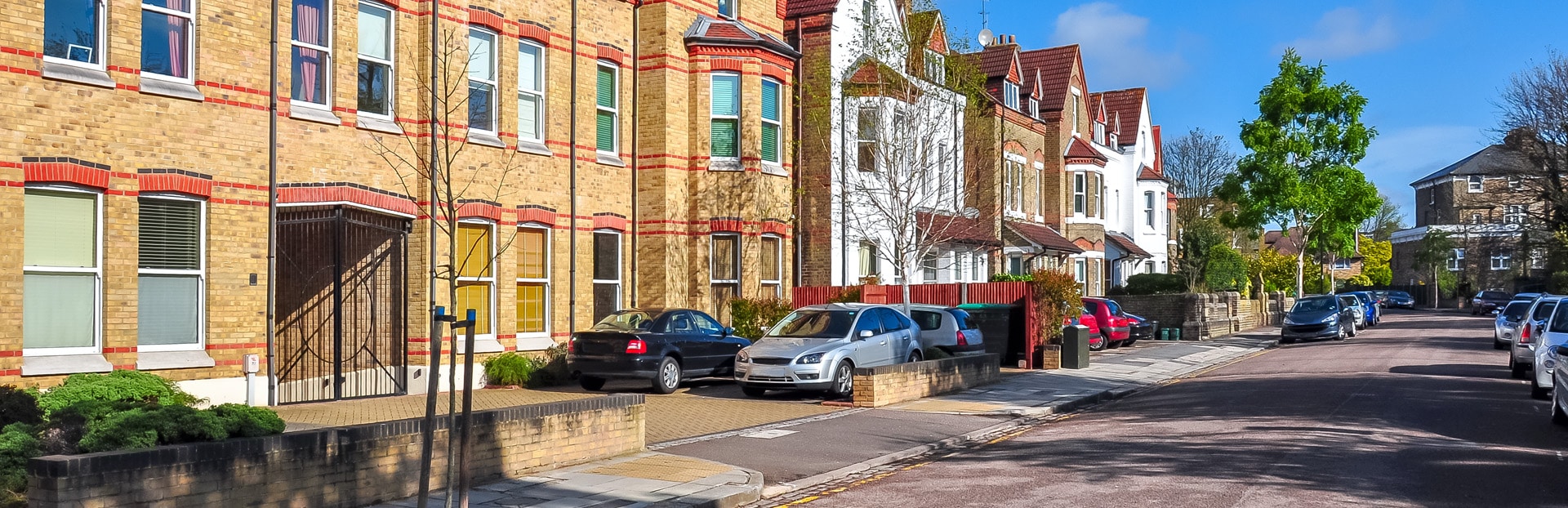
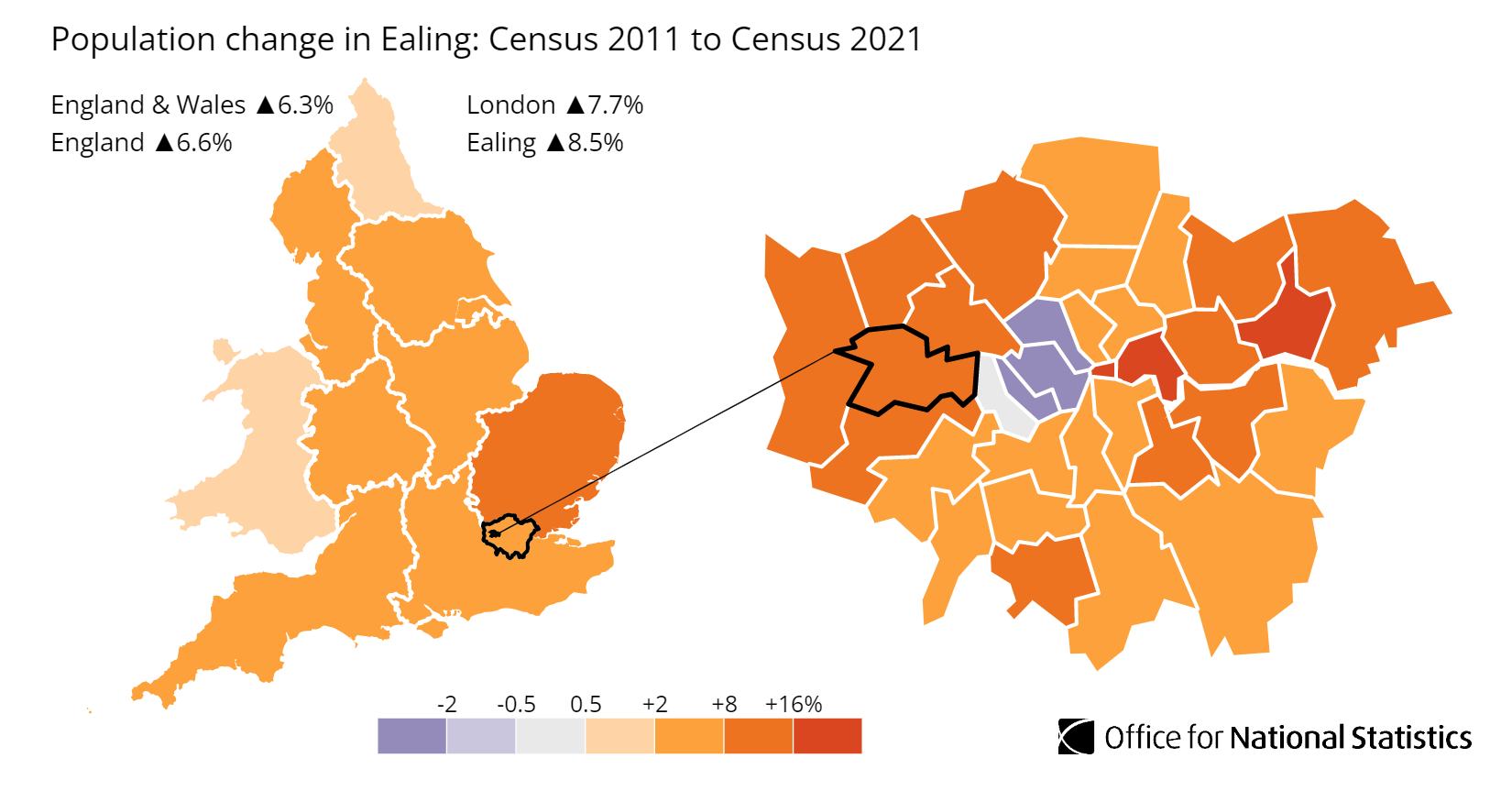
Ealing is a borough of west London. Average sold prices across the London Borough of Ealing reached £566,930 on the HM Land Registry House Price Index, 95.5% above the England average of £289,946 and 4.6% above the £542,065 recorded across Greater London. Ealing is firmly a high-value West London market, where even the cheapest postcode buys at a level most of England never reaches. The borough's population grew 8.47% between the 2011 and 2021 censuses, from 338,449 to 367,115 residents.
The story for an investor here starts with price, not yield. A detached home in Ealing sold for an average of £1,346,731, a semi-detached for £855,172 and a terraced house for £691,859, each of them roughly three times the equivalent England figure. That premium reflects what west London buyers pay for Elizabeth line access, period housing stock and the borough's long-standing "Queen of the Suburbs" reputation. For an investor, the spread runs from UB2 (Norwood Green, Southall) at a £414,353 asking price up to W4 (Chiswick) at £744,235, an 11-postcode market where the highest yields sit with the cheaper postcodes to the west rather than the prime streets to the east.
This guide covers the London Borough of Ealing (ONS code E09000009) and the postcodes around it: HA0, NW10, TW8, UB1, UB2, UB6, W3, W4, W5, W7 and W13. Some of these outcodes straddle a borough boundary, with HA0 (Wembley) and NW10 (Willesden) reaching into Brent, and TW8 (Brentford) and W4 (Chiswick) into Hounslow. Ealing sits in west London, about 7.5 miles from Charing Cross, with the wider west London buy-to-let market on every side.
Article updated: July 2026
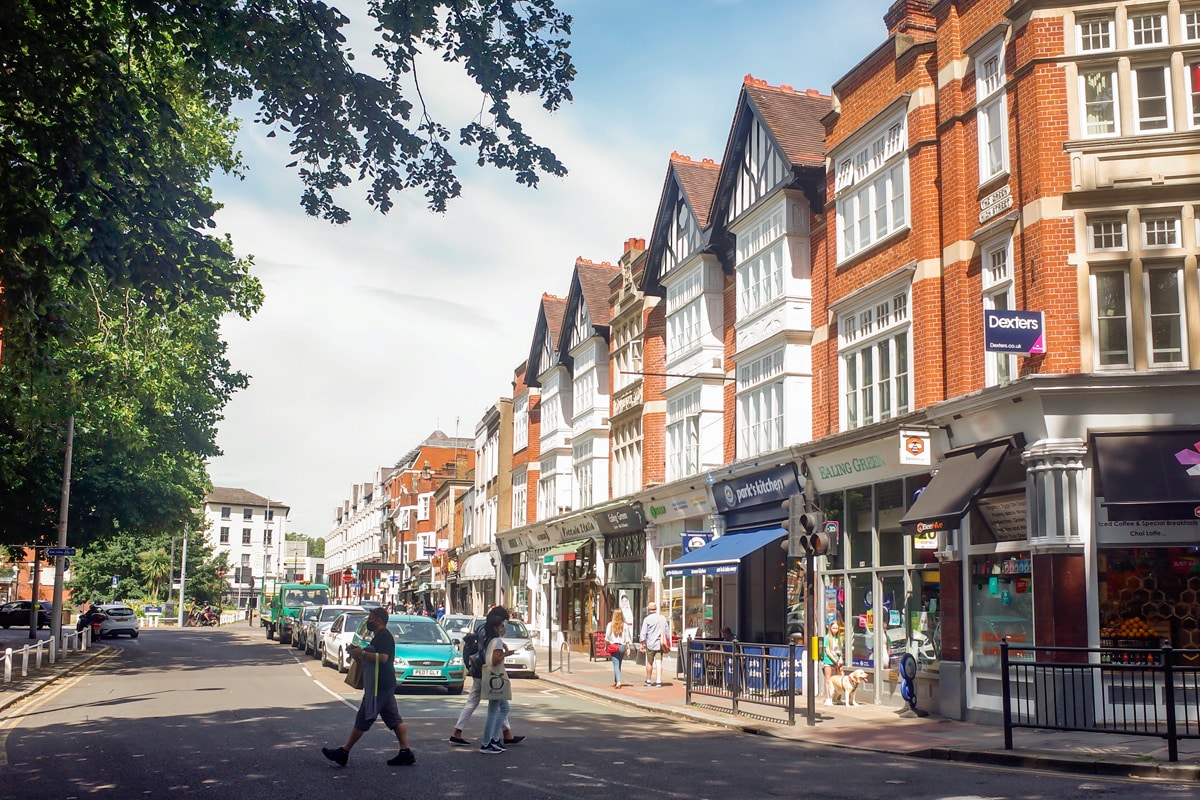
Why Invest in Ealing?
Ealing's population grew 8.47% between the 2011 and 2021 censuses, from 338,449 to 367,115 residents, a faster rate than the 6.3% recorded across England and Wales. That is steady, sustained growth in one of London's larger boroughs, driven by its position on the western corridor into central London and a housing market that spans terraced Southall to prime Chiswick. Ealing's draw is its mix: leafy residential streets, a working high street economy, and the kind of fast central-London access that keeps tenant demand high.
The local employment rate is 76.5%, close to the Great Britain average of 75.6%, while the local unemployment rate of 9.3% runs above the national figure. Ealing's economy leans on a broad service base, retail and hospitality along its high streets, and the logistics and light-industry employers clustered around Park Royal, one of Europe's largest industrial estates, on the borough's northern edge. The arrival of the Elizabeth line at Ealing Broadway, West Ealing, Hanwell and Southall in 2022 added direct, fast connections to the City, Canary Wharf and Heathrow, which underpins both commuter demand and the regeneration now reshaping the borough's town centres.
Median gross annual earnings for Ealing residents are £40,889, which sits below the London regional median but close to the Great Britain median of £39,125. London tenants, though, are not paying rent out of the borough's median salary alone. A large share of Ealing's renters are dual-income professional households commuting into central London on higher pay, which is what supports rents that run well above the local wage base. The combination of population growth, Elizabeth line access and a deep, established rental market is what makes Ealing a tenant-demand story rather than a high-yield one.
Ealing Economic Summary
- Population (London Borough of Ealing): 367,115 (2021 Census). Growth of 8.47% from 2011.
- Median annual salary: £40,889 (local), £39,125 (Great Britain)
- Employment rate: 76.5% (local), 75.6% (Great Britain)
- Unemployment rate: 9.3% (local)
- Key employment sectors: Wholesale and retail, accommodation and food, health and social work, transport and logistics, administrative services
Source: ONS Census 2021, Nomis Labour Market Profile (ASHE 2025)
Regeneration and Investment in Ealing
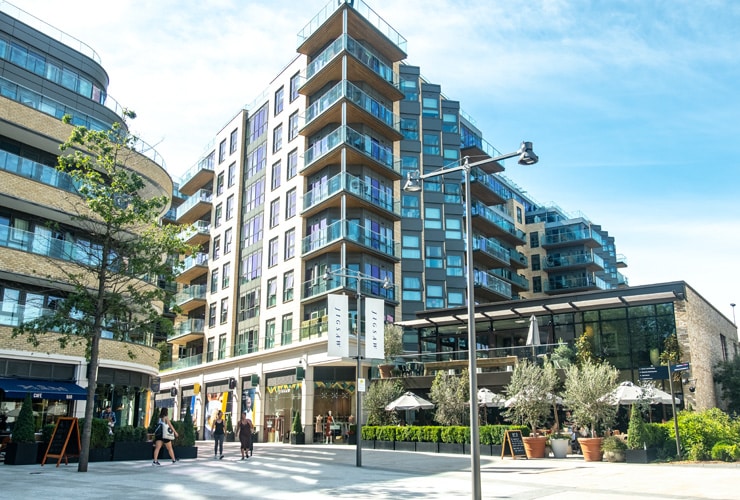
Ealing's regeneration is concentrated on its Elizabeth line town centres, led by the £300 million Broadway Connection scheme at Ealing Broadway and £175 million for 575 homes at Merrick Place in Southall. The investment follows the transport: the boroughs of west London that gained Elizabeth line stations in 2022 are where the new mixed-use density is being built, and Ealing has three of the larger sites.
- Broadway Connection, Ealing Broadway (Planning consent granted, £300 million GDV): British Land secured consent in February 2024 for a 300,000 sq ft mixed-use redevelopment on a 1.4-acre site directly opposite Ealing Broadway station, where the Elizabeth, Central and District lines meet. The scheme reshapes the town centre with new homes, workspace and public realm at the borough's busiest transport interchange. Updates at Broadway Connection.
- Merrick Place, Southall (Under construction, £175 million): A development of 575 new homes about 100 metres from Southall's Elizabeth line station, with 35% affordable housing, delivered by Vistry Group, Sovereign Network Group and Grainger and due to complete in 2026. The scheme adds significant rental and owner-occupier supply to one of the borough's most affordable postcodes. Updates at Cartwright Pickard.
- Acton Gardens, South Acton (Under construction, phased): The regeneration of the former South Acton estate across 52 acres is delivering nearly 3,500 new homes, with 2,098 completed between 2012 and 2024. It is the largest estate regeneration in the borough, replacing dated stock with a mix of tenures in W3, run by Ealing Council with L&Q and Countryside Properties. Updates at Ealing Council.
Ealing Property Market Analysis
Average property prices in Ealing have risen 563.3% since January 1995, from £85,469 to £566,930. The sections below trace that journey cycle by cycle, then drill into current postcode-level data for sold prices, price per square foot, asking prices, growth trends, and monthly transaction volumes.
When was the last house price crash in Ealing?
Ealing's sold prices are recorded by HM Land Registry at borough level, under the local authority of Ealing. The House Price Index tracks average prices from January 1995 to the latest reading, covering more than three decades of London market cycles.
The 1995 to 2007 boom: Ealing started at £85,469 in January 1995. By December 2000 the average had reached £168,339, almost doubling in six years as London's market ran hot. Growth continued through the early 2000s, with prices passing £261,044 by December 2005. The market climbed to its pre-crash peak of £331,851 in January 2008.
2008 to 2009, the financial crisis: Prices fell from the January 2008 peak of £331,851 to a trough of £268,454 in April 2009, a decline of 19.1% over 15 months. The worst year-on-year reading was -18.4% in March 2009. Ealing's fall was steeper than the England decline of 18.2% over the same crisis, which is typical of London boroughs: higher-value, higher-debt markets correct harder and faster when credit tightens.
Recovery, 2010 to 2012: London led the national recovery, and Ealing followed. Prices bounced off the April 2009 trough and climbed through 2010 and 2011. By May 2012 the average had reached £332,662, edging past the January 2008 pre-crash peak. That recovery took about four years and three months, far quicker than the eight years it took many markets outside the capital.
The 2013 to 2016 surge: This was Ealing's strongest phase. Prices ran from £350,161 in December 2012 to £441,688 by December 2014, a 17.0% annual rate at the peak of the cycle, and reached £519,314 by December 2016. London's post-crisis boom, fed by cheap credit and international buyers, pushed the borough up by more than half in four years.
2017 to 2019, the plateau: Growth stalled as stamp duty changes and Brexit uncertainty cooled the top of the London market. Prices drifted from £501,934 in December 2017 to £516,007 in December 2018 and back to £501,738 by December 2019, moving sideways in a narrow band for three years.
2020 to 2022, the pandemic recovery: The stamp duty holiday and renewed demand lifted prices again, from £501,055 in June 2020 to £530,267 by December 2020 and £560,468 by December 2021. The borough reached its all-time high of £593,867 in December 2022.
The 2023 rate shock: Higher mortgage rates hit a high-value, high-borrowing borough hard. Prices eased from the December 2022 peak to £554,947 by December 2023, a -6.6% annual reading, one of the sharper corrections among London boroughs.
2024 to present: Prices recovered to £566,203 by December 2024 and touched £593,012 in June 2025, just shy of the all-time high, before easing again to £566,930 by the latest reading in March 2026. The current price is 70.8% above the January 2008 pre-crash peak of £331,851.
Long-term growth summary:
- 5 years (March 2021 to March 2026): 6.2% growth (£533,989 to £566,930)
- 10 years (March 2016 to March 2026): 12.0% growth (£506,170 to £566,930)
- 15 years (March 2011 to March 2026): 76.8% growth (£320,689 to £566,930)
- 20 years (March 2006 to March 2026): 111.7% growth (£267,776 to £566,930)
- 30 years (January 1995 to March 2026): 563.3% growth (£85,469 to £566,930)
Ealing's 19.1% crash was deeper than the England average, a reminder that London's higher-value boroughs swing harder through a downturn. But the recovery was faster, and the 30-year return of 563.3% reflects the long-run capital growth that has historically defined west London. An investor who bought at the exact peak in January 2008 would be sitting on gains of 70.8% on the Land Registry average, though the past decade has been far flatter than the decade before it, with prices up just 12.0% over the ten years to March 2026.
- All property types
- Detached
- Semi-detached
- Terraced
- Flats
Source: HM Land Registry House Price Index
| Year | All property types | Detached | Semi-detached | Terraced | Flats |
|---|---|---|---|---|---|
| 1995-01 | £85,469 | £203,694 | £118,568 | £91,348 | £68,609 |
| 1995-02 | £86,551 | £202,905 | £120,320 | £92,677 | £69,339 |
| 1995-03 | £87,067 | £203,040 | £120,947 | £93,338 | £69,740 |
| 1995-04 | £87,933 | £203,213 | £122,010 | £94,356 | £70,499 |
| 1995-05 | £87,813 | £203,317 | £121,776 | £94,224 | £70,422 |
| 1995-06 | £87,336 | £202,127 | £120,947 | £93,510 | £70,330 |
| 1995-07 | £88,108 | £204,926 | £122,273 | £94,489 | £70,624 |
| 1995-08 | £88,487 | £207,133 | £122,841 | £95,040 | £70,702 |
| 1995-09 | £87,743 | £206,825 | £122,011 | £94,450 | £69,726 |
| 1995-10 | £86,150 | £203,538 | £119,941 | £92,365 | £68,740 |
| 1995-11 | £84,813 | £199,619 | £117,966 | £90,578 | £68,119 |
| 1995-12 | £85,270 | £199,717 | £118,658 | £90,920 | £68,651 |
| 1996-01 | £85,820 | £200,309 | £119,268 | £91,717 | £68,992 |
| 1996-02 | £86,486 | £201,561 | £120,213 | £92,598 | £69,364 |
| 1996-03 | £86,673 | £203,218 | £120,518 | £92,792 | £69,435 |
| 1996-04 | £86,705 | £202,841 | £120,120 | £92,905 | £69,663 |
| 1996-05 | £87,539 | £204,636 | £121,122 | £94,125 | £70,122 |
| 1996-06 | £88,333 | £205,260 | £121,986 | £95,000 | £70,930 |
| 1996-07 | £89,876 | £210,056 | £124,639 | £96,676 | £71,797 |
| 1996-08 | £90,753 | £213,920 | £126,119 | £97,552 | £72,325 |
| 1996-09 | £91,662 | £217,386 | £127,451 | £98,784 | £72,707 |
| 1996-10 | £91,577 | £217,995 | £127,405 | £98,711 | £72,545 |
| 1996-11 | £92,257 | £218,757 | £128,166 | £99,465 | £73,207 |
| 1996-12 | £92,934 | £219,828 | £129,231 | £100,245 | £73,651 |
| 1997-01 | £94,248 | £222,231 | £131,046 | £101,910 | £74,503 |
| 1997-02 | £96,228 | £227,538 | £133,721 | £103,963 | £76,051 |
| 1997-03 | £97,389 | £230,143 | £135,216 | £105,266 | £76,917 |
| 1997-04 | £98,420 | £232,259 | £136,721 | £106,345 | £77,738 |
| 1997-05 | £100,246 | £236,670 | £139,872 | £108,544 | £78,806 |
| 1997-06 | £102,515 | £244,025 | £143,631 | £111,182 | £80,209 |
| 1997-07 | £106,724 | £255,657 | £149,640 | £116,210 | £83,109 |
| 1997-08 | £109,212 | £262,615 | £153,267 | £119,017 | £84,907 |
| 1997-09 | £112,465 | £271,055 | £157,881 | £122,589 | £87,386 |
| 1997-10 | £112,849 | £271,999 | £158,644 | £122,684 | £87,822 |
| 1997-11 | £112,383 | £272,102 | £158,186 | £122,116 | £87,401 |
| 1997-12 | £113,016 | £272,661 | £159,127 | £122,743 | £87,943 |
| 1998-01 | £115,094 | £278,728 | £161,951 | £125,128 | £89,481 |
| 1998-02 | £114,834 | £275,655 | £161,026 | £124,624 | £89,639 |
| 1998-03 | £114,598 | £274,633 | £160,287 | £124,509 | £89,484 |
| 1998-04 | £114,800 | £274,009 | £160,710 | £124,857 | £89,547 |
| 1998-05 | £117,694 | £281,223 | £164,843 | £128,508 | £91,459 |
| 1998-06 | £120,542 | £287,866 | £168,634 | £131,462 | £93,826 |
| 1998-07 | £121,756 | £291,360 | £170,618 | £132,798 | £94,676 |
| 1998-08 | £122,535 | £295,704 | £171,973 | £133,554 | £95,215 |
| 1998-09 | £122,808 | £298,686 | £173,004 | £134,015 | £95,098 |
| 1998-10 | £122,171 | £296,571 | £171,640 | £132,975 | £94,958 |
| 1998-11 | £122,138 | £296,014 | £171,518 | £132,444 | £95,276 |
| 1998-12 | £120,527 | £290,129 | £168,937 | £130,332 | £94,377 |
| 1999-01 | £120,806 | £291,310 | £169,448 | £130,569 | £94,593 |
| 1999-02 | £121,718 | £293,336 | £170,739 | £131,702 | £95,214 |
| 1999-03 | £123,267 | £296,980 | £172,598 | £133,325 | £96,569 |
| 1999-04 | £127,150 | £304,748 | £177,494 | £137,943 | £99,564 |
| 1999-05 | £130,243 | £309,940 | £181,256 | £141,553 | £102,060 |
| 1999-06 | £132,683 | £316,456 | £184,796 | £144,564 | £103,691 |
| 1999-07 | £135,018 | £324,582 | £188,304 | £147,326 | £105,245 |
| 1999-08 | £139,451 | £338,059 | £194,862 | £152,411 | £108,367 |
| 1999-09 | £144,081 | £351,347 | £201,013 | £157,380 | £112,066 |
| 1999-10 | £147,002 | £357,330 | £204,847 | £159,844 | £114,875 |
| 1999-11 | £148,238 | £359,840 | £206,382 | £160,871 | £116,099 |
| 1999-12 | £151,589 | £363,558 | £210,568 | £164,243 | £119,145 |
| 2000-01 | £154,441 | £373,016 | £215,228 | £167,491 | £121,013 |
| 2000-02 | £155,437 | £374,136 | £216,409 | £168,572 | £121,858 |
| 2000-03 | £156,699 | £380,068 | £218,897 | £170,203 | £122,365 |
| 2000-04 | £160,163 | £384,943 | £222,841 | £173,836 | £125,458 |
| 2000-05 | £164,050 | £393,881 | £228,304 | £177,880 | £128,592 |
| 2000-06 | £166,037 | £396,755 | £230,847 | £179,545 | £130,516 |
| 2000-07 | £167,864 | £405,492 | £234,375 | £181,425 | £131,640 |
| 2000-08 | £169,748 | £411,868 | £237,098 | £182,754 | £133,424 |
| 2000-09 | £169,929 | £415,972 | £237,186 | £182,662 | £133,670 |
| 2000-10 | £168,017 | £409,666 | £234,583 | £180,100 | £132,460 |
| 2000-11 | £167,563 | £409,648 | £233,735 | £179,453 | £132,216 |
| 2000-12 | £168,339 | £408,058 | £234,507 | £179,940 | £133,187 |
| 2001-01 | £170,629 | £411,705 | £236,681 | £182,656 | £135,166 |
| 2001-02 | £172,244 | £413,405 | £238,998 | £184,762 | £136,281 |
| 2001-03 | £175,278 | £420,897 | £243,520 | £188,512 | £138,322 |
| 2001-04 | £177,076 | £425,019 | £245,691 | £190,630 | £139,727 |
| 2001-05 | £179,556 | £428,806 | £248,319 | £193,462 | £141,857 |
| 2001-06 | £180,442 | £427,917 | £248,662 | £193,925 | £143,163 |
| 2001-07 | £181,597 | £431,153 | £250,628 | £194,913 | £144,116 |
| 2001-08 | £185,825 | £442,274 | £256,370 | £199,174 | £147,643 |
| 2001-09 | £190,074 | £455,805 | £262,123 | £203,854 | £150,904 |
| 2001-10 | £192,426 | £460,700 | £265,422 | £205,919 | £153,046 |
| 2001-11 | £190,354 | £455,061 | £262,890 | £203,086 | £151,694 |
| 2001-12 | £189,519 | £448,586 | £261,594 | £201,162 | £151,800 |
| 2002-01 | £190,605 | £449,638 | £262,724 | £201,784 | £153,128 |
| 2002-02 | £194,534 | £456,948 | £267,790 | £206,058 | £156,353 |
| 2002-03 | £198,586 | £466,985 | £273,615 | £210,759 | £159,273 |
| 2002-04 | £203,782 | £476,014 | £279,757 | £215,979 | £163,978 |
| 2002-05 | £206,816 | £480,653 | £283,630 | £218,875 | £166,752 |
| 2002-06 | £210,875 | £486,264 | £287,794 | £223,038 | £170,594 |
| 2002-07 | £213,137 | £492,838 | £291,109 | £225,856 | £172,067 |
| 2002-08 | £218,467 | £505,824 | £297,987 | £231,535 | £176,452 |
| 2002-09 | £222,869 | £519,114 | £305,217 | £236,328 | £179,507 |
| 2002-10 | £228,305 | £530,304 | £313,522 | £241,558 | £184,001 |
| 2002-11 | £228,864 | £532,394 | £314,364 | £241,714 | £184,685 |
| 2002-12 | £230,696 | £533,115 | £317,015 | £242,865 | £186,692 |
| 2003-01 | £229,997 | £529,973 | £314,404 | £242,324 | £186,510 |
| 2003-02 | £234,095 | £535,123 | £320,260 | £246,374 | £190,018 |
| 2003-03 | £234,442 | £536,270 | £320,080 | £246,949 | £190,351 |
| 2003-04 | £237,030 | £538,898 | £324,455 | £249,144 | £192,612 |
| 2003-05 | £236,842 | £536,890 | £324,517 | £249,324 | £192,165 |
| 2003-06 | £237,059 | £535,029 | £324,226 | £249,504 | £192,594 |
| 2003-07 | £236,130 | £532,823 | £322,878 | £249,174 | £191,459 |
| 2003-08 | £236,765 | £534,526 | £323,258 | £250,021 | £191,998 |
| 2003-09 | £237,611 | £537,063 | £325,366 | £251,612 | £191,955 |
| 2003-10 | £239,830 | £540,418 | £327,659 | £254,074 | £193,930 |
| 2003-11 | £241,869 | £543,494 | £330,510 | £256,325 | £195,536 |
| 2003-12 | £244,524 | £544,654 | £333,080 | £258,995 | £198,184 |
| 2004-01 | £245,923 | £549,057 | £335,576 | £260,348 | £199,201 |
| 2004-02 | £246,629 | £551,010 | £336,310 | £261,297 | £199,699 |
| 2004-03 | £247,847 | £553,700 | £337,465 | £262,991 | £200,550 |
| 2004-04 | £251,304 | £555,733 | £341,091 | £267,457 | £203,266 |
| 2004-05 | £255,349 | £558,402 | £345,104 | £272,250 | £206,771 |
| 2004-06 | £260,313 | £566,377 | £351,435 | £277,433 | £211,020 |
| 2004-07 | £263,422 | £574,493 | £356,420 | £280,880 | £213,216 |
| 2004-08 | £265,911 | £582,313 | £360,112 | £283,541 | £215,090 |
| 2004-09 | £266,014 | £586,842 | £361,318 | £283,943 | £214,611 |
| 2004-10 | £263,572 | £579,287 | £356,456 | £280,947 | £213,350 |
| 2004-11 | £264,505 | £580,149 | £357,198 | £281,770 | £214,379 |
| 2004-12 | £263,825 | £572,910 | £354,681 | £281,028 | £214,399 |
| 2005-01 | £262,055 | £568,767 | £351,957 | £279,613 | £212,778 |
| 2005-02 | £257,899 | £558,803 | £347,136 | £275,425 | £209,052 |
| 2005-03 | £256,162 | £555,010 | £345,338 | £274,180 | £207,118 |
| 2005-04 | £259,919 | £560,053 | £351,020 | £278,778 | £209,688 |
| 2005-05 | £262,027 | £562,623 | £352,881 | £281,421 | £211,477 |
| 2005-06 | £262,832 | £563,519 | £353,119 | £282,934 | £211,994 |
| 2005-07 | £264,691 | £569,001 | £355,932 | £285,033 | £213,318 |
| 2005-08 | £265,744 | £573,508 | £357,366 | £286,683 | £213,805 |
| 2005-09 | £267,124 | £578,643 | £360,244 | £288,146 | £214,597 |
| 2005-10 | £263,913 | £570,281 | £355,213 | £284,554 | £212,322 |
| 2005-11 | £260,417 | £559,859 | £350,843 | £280,827 | £209,442 |
| 2005-12 | £261,044 | £556,801 | £350,172 | £281,209 | £210,645 |
| 2006-01 | £264,898 | £567,085 | £355,338 | £285,957 | £213,359 |
| 2006-02 | £268,798 | £575,368 | £360,008 | £290,126 | £216,620 |
| 2006-03 | £267,776 | £576,789 | £360,182 | £289,760 | £214,863 |
| 2006-04 | £269,268 | £577,981 | £361,736 | £291,711 | £216,037 |
| 2006-05 | £272,862 | £587,138 | £366,693 | £295,781 | £218,774 |
| 2006-06 | £277,770 | £596,469 | £372,676 | £301,201 | £222,824 |
| 2006-07 | £280,308 | £603,459 | £376,911 | £304,530 | £224,361 |
| 2006-08 | £283,571 | £610,749 | £381,345 | £309,042 | £226,483 |
| 2006-09 | £288,120 | £623,782 | £388,071 | £314,068 | £229,880 |
| 2006-10 | £289,239 | £626,211 | £389,165 | £314,787 | £231,109 |
| 2006-11 | £288,357 | £624,273 | £388,420 | £313,679 | £230,377 |
| 2006-12 | £289,734 | £625,218 | £389,964 | £315,375 | £231,493 |
| 2007-01 | £292,688 | £632,957 | £394,335 | £318,820 | £233,624 |
| 2007-02 | £299,187 | £646,963 | £402,572 | £324,955 | £239,347 |
| 2007-03 | £301,812 | £652,920 | £406,343 | £328,336 | £241,138 |
| 2007-04 | £306,144 | £661,112 | £411,567 | £333,890 | £244,369 |
| 2007-05 | £306,889 | £660,775 | £411,532 | £335,631 | £244,793 |
| 2007-06 | £309,481 | £666,811 | £414,663 | £338,335 | £246,982 |
| 2007-07 | £316,137 | £684,363 | £424,021 | £345,562 | £252,163 |
| 2007-08 | £321,593 | £700,899 | £432,662 | £352,679 | £255,626 |
| 2007-09 | £327,338 | £718,330 | £441,417 | £358,827 | £259,952 |
| 2007-10 | £329,075 | £720,261 | £442,439 | £360,078 | £261,938 |
| 2007-11 | £331,597 | £728,935 | £446,149 | £361,693 | £264,333 |
| 2007-12 | £329,850 | £722,194 | £442,513 | £359,473 | £263,405 |
| 2008-01 | £331,851 | £730,240 | £445,823 | £361,433 | £264,901 |
| 2008-02 | £327,011 | £717,393 | £439,746 | £356,286 | £260,903 |
| 2008-03 | £329,299 | £722,219 | £444,121 | £359,748 | £261,957 |
| 2008-04 | £321,913 | £706,603 | £434,979 | £352,877 | £255,291 |
| 2008-05 | £325,262 | £713,396 | £439,411 | £357,184 | £257,662 |
| 2008-06 | £320,285 | £702,689 | £432,143 | £351,886 | £253,757 |
| 2008-07 | £318,153 | £698,418 | £430,082 | £349,277 | £252,009 |
| 2008-08 | £313,801 | £690,929 | £424,113 | £344,350 | £248,619 |
| 2008-09 | £313,904 | £697,022 | £423,953 | £343,929 | £248,929 |
| 2008-10 | £306,957 | £680,410 | £412,685 | £335,776 | £244,135 |
| 2008-11 | £298,844 | £663,304 | £401,717 | £326,718 | £237,771 |
| 2008-12 | £284,294 | £628,162 | £382,951 | £311,247 | £225,851 |
| 2009-01 | £275,538 | £613,479 | £372,245 | £301,373 | £218,710 |
| 2009-02 | £271,702 | £603,263 | £367,383 | £296,693 | £215,872 |
| 2009-03 | £268,681 | £594,770 | £362,832 | £292,652 | £214,015 |
| 2009-04 | £268,454 | £584,734 | £362,264 | £293,336 | £213,548 |
| 2009-05 | £268,624 | £583,409 | £361,982 | £294,779 | £213,057 |
| 2009-06 | £272,845 | £592,029 | £367,718 | £300,880 | £215,428 |
| 2009-07 | £282,155 | £616,330 | £381,787 | £312,295 | £221,430 |
| 2009-08 | £287,573 | £630,205 | £390,584 | £318,947 | £224,733 |
| 2009-09 | £296,793 | £652,326 | £404,162 | £329,697 | £231,209 |
| 2009-10 | £300,135 | £661,958 | £409,680 | £333,413 | £233,447 |
| 2009-11 | £298,332 | £660,318 | £407,020 | £332,409 | £231,406 |
| 2009-12 | £299,114 | £659,252 | £408,507 | £333,707 | £231,679 |
| 2010-01 | £303,029 | £668,544 | £414,652 | £339,598 | £233,483 |
| 2010-02 | £308,002 | £678,589 | £423,731 | £345,507 | £236,407 |
| 2010-03 | £308,920 | £684,169 | £425,273 | £346,358 | £236,859 |
| 2010-04 | £305,602 | £674,569 | £420,214 | £342,111 | £234,768 |
| 2010-05 | £306,765 | £676,326 | £420,730 | £343,055 | £236,148 |
| 2010-06 | £307,197 | £677,051 | £421,766 | £344,522 | £235,849 |
| 2010-07 | £313,817 | £698,724 | £431,476 | £353,080 | £240,028 |
| 2010-08 | £318,999 | £712,578 | £439,953 | £359,992 | £243,025 |
| 2010-09 | £322,277 | £725,244 | £445,404 | £364,127 | £244,939 |
| 2010-10 | £323,866 | £726,800 | £448,130 | £365,482 | £246,281 |
| 2010-11 | £320,866 | £722,722 | £443,765 | £361,253 | £244,438 |
| 2010-12 | £320,151 | £719,930 | £443,512 | £359,929 | £244,000 |
| 2011-01 | £320,057 | £724,521 | £443,563 | £359,557 | £243,919 |
| 2011-02 | £322,826 | £735,735 | £447,675 | £362,212 | £246,120 |
| 2011-03 | £320,689 | £738,607 | £444,428 | £359,967 | £244,303 |
| 2011-04 | £321,886 | £739,949 | £445,895 | £361,222 | £245,351 |
| 2011-05 | £318,933 | £724,875 | £439,747 | £358,074 | £243,762 |
| 2011-06 | £323,371 | £725,329 | £445,098 | £362,748 | £247,783 |
| 2011-07 | £325,067 | £725,334 | £446,922 | £364,735 | £249,269 |
| 2011-08 | £328,810 | £741,130 | £455,380 | £370,078 | £250,457 |
| 2011-09 | £329,262 | £748,454 | £457,308 | £371,456 | £249,816 |
| 2011-10 | £325,509 | £745,585 | £454,172 | £367,367 | £246,212 |
| 2011-11 | £320,531 | £733,128 | £446,187 | £360,693 | £243,321 |
| 2011-12 | £324,278 | £737,839 | £450,624 | £364,419 | £246,738 |
| 2012-01 | £325,985 | £740,345 | £453,403 | £366,786 | £247,726 |
| 2012-02 | £329,862 | £752,685 | £459,828 | £372,254 | £249,697 |
| 2012-03 | £326,662 | £744,900 | £455,590 | £368,594 | £247,112 |
| 2012-04 | £326,108 | £741,450 | £452,985 | £367,645 | £247,275 |
| 2012-05 | £332,662 | £749,305 | £460,345 | £374,917 | £252,814 |
| 2012-06 | £344,220 | £775,421 | £475,520 | £389,737 | £260,907 |
| 2012-07 | £352,327 | £798,088 | £487,393 | £400,024 | £266,287 |
| 2012-08 | £353,733 | £804,844 | £489,790 | £403,384 | £266,337 |
| 2012-09 | £348,872 | £796,128 | £484,367 | £397,537 | £262,499 |
| 2012-10 | £348,636 | £791,515 | £483,251 | £397,003 | £262,698 |
| 2012-11 | £352,426 | £798,932 | £488,422 | £400,926 | £265,783 |
| 2012-12 | £350,161 | £794,795 | £484,971 | £398,516 | £264,039 |
| 2013-01 | £347,741 | £794,192 | £484,913 | £395,817 | £261,408 |
| 2013-02 | £344,802 | £791,137 | £482,421 | £392,082 | £258,951 |
| 2013-03 | £344,070 | £791,043 | £481,790 | £390,790 | £258,458 |
| 2013-04 | £351,607 | £806,006 | £488,812 | £400,024 | £264,533 |
| 2013-05 | £354,243 | £809,916 | £491,827 | £402,978 | £266,707 |
| 2013-06 | £363,866 | £831,035 | £505,625 | £414,788 | £273,509 |
| 2013-07 | £368,256 | £839,831 | £512,338 | £420,230 | £276,529 |
| 2013-08 | £371,566 | £848,334 | £517,311 | £424,934 | £278,515 |
| 2013-09 | £373,219 | £855,347 | £520,016 | £426,515 | £279,739 |
| 2013-10 | £369,947 | £849,177 | £515,955 | £422,325 | £277,361 |
| 2013-11 | £373,656 | £855,256 | £520,699 | £426,086 | £280,487 |
| 2013-12 | £377,638 | £856,994 | £525,577 | £430,515 | £283,825 |
| 2014-01 | £389,989 | £886,336 | £544,013 | £444,056 | £293,085 |
| 2014-02 | £396,522 | £904,567 | £554,064 | £450,984 | £297,963 |
| 2014-03 | £404,157 | £924,009 | £564,487 | £459,554 | £303,727 |
| 2014-04 | £411,805 | £939,832 | £574,350 | £468,903 | £309,376 |
| 2014-05 | £422,697 | £959,643 | £588,481 | £482,076 | £317,526 |
| 2014-06 | £433,515 | £981,911 | £603,253 | £495,312 | £325,371 |
| 2014-07 | £441,899 | £999,832 | £615,517 | £505,669 | £331,254 |
| 2014-08 | £452,244 | £1,026,958 | £631,560 | £518,378 | £338,278 |
| 2014-09 | £453,427 | £1,033,869 | £635,102 | £519,401 | £338,882 |
| 2014-10 | £445,906 | £1,017,945 | £625,116 | £509,649 | £333,616 |
| 2014-11 | £442,123 | £1,009,542 | £619,719 | £504,259 | £331,246 |
| 2014-12 | £441,688 | £1,006,728 | £618,018 | £502,940 | £331,498 |
| 2015-01 | £441,204 | £1,005,458 | £617,199 | £502,328 | £331,190 |
| 2015-02 | £440,796 | £1,005,631 | £616,262 | £500,691 | £331,409 |
| 2015-03 | £440,404 | £1,004,783 | £615,637 | £499,868 | £331,250 |
| 2015-04 | £448,097 | £1,024,123 | £626,716 | £508,961 | £336,808 |
| 2015-05 | £451,891 | £1,028,600 | £632,376 | £513,868 | £339,431 |
| 2015-06 | £460,302 | £1,049,976 | £646,463 | £525,926 | £344,332 |
| 2015-07 | £470,247 | £1,069,682 | £660,636 | £537,928 | £351,531 |
| 2015-08 | £476,987 | £1,086,483 | £670,886 | £547,094 | £355,834 |
| 2015-09 | £485,647 | £1,111,812 | £683,396 | £555,787 | £362,642 |
| 2015-10 | £494,988 | £1,136,654 | £698,001 | £566,646 | £369,256 |
| 2015-11 | £507,561 | £1,168,407 | £716,564 | £580,689 | £378,593 |
| 2015-12 | £509,198 | £1,169,213 | £718,951 | £582,658 | £379,812 |
| 2016-01 | £503,390 | £1,153,719 | £711,912 | £575,410 | £375,569 |
| 2016-02 | £504,218 | £1,158,756 | £714,593 | £576,015 | £376,027 |
| 2016-03 | £506,170 | £1,165,787 | £716,895 | £577,887 | £377,660 |
| 2016-04 | £510,580 | £1,173,241 | £719,881 | £583,374 | £381,342 |
| 2016-05 | £502,730 | £1,140,552 | £703,167 | £573,410 | £377,046 |
| 2016-06 | £510,559 | £1,152,573 | £712,724 | £581,644 | £383,520 |
| 2016-07 | £511,891 | £1,154,577 | £714,986 | £583,013 | £384,531 |
| 2016-08 | £517,663 | £1,173,740 | £725,061 | £590,236 | £388,167 |
| 2016-09 | £510,857 | £1,156,419 | £716,503 | £582,640 | £382,871 |
| 2016-10 | £510,621 | £1,158,284 | £716,163 | £579,820 | £383,686 |
| 2016-11 | £508,872 | £1,158,835 | £713,395 | £576,314 | £382,962 |
| 2016-12 | £519,314 | £1,183,988 | £726,363 | £586,788 | £391,621 |
| 2017-01 | £523,565 | £1,192,283 | £730,779 | £592,080 | £394,904 |
| 2017-02 | £523,911 | £1,188,606 | £728,682 | £590,519 | £396,487 |
| 2017-03 | £519,904 | £1,180,287 | £721,565 | £584,789 | £394,202 |
| 2017-04 | £515,949 | £1,174,014 | £714,528 | £578,849 | £392,032 |
| 2017-05 | £520,248 | £1,179,684 | £720,303 | £582,878 | £395,738 |
| 2017-06 | £517,693 | £1,168,164 | £715,089 | £580,224 | £394,106 |
| 2017-07 | £523,516 | £1,175,393 | £723,757 | £586,771 | £398,533 |
| 2017-08 | £522,553 | £1,177,984 | £723,779 | £587,961 | £396,535 |
| 2017-09 | £523,248 | £1,184,615 | £727,391 | £589,054 | £396,382 |
| 2017-10 | £516,164 | £1,175,126 | £719,885 | £581,731 | £390,225 |
| 2017-11 | £512,832 | £1,165,849 | £716,089 | £577,651 | £387,725 |
| 2017-12 | £501,934 | £1,140,746 | £701,151 | £566,280 | £379,072 |
| 2018-01 | £506,732 | £1,148,287 | £707,731 | £571,545 | £382,840 |
| 2018-02 | £510,049 | £1,157,637 | £713,046 | £575,348 | £385,168 |
| 2018-03 | £517,696 | £1,171,273 | £724,929 | £584,607 | £390,563 |
| 2018-04 | £514,725 | £1,163,975 | £722,842 | £583,711 | £387,020 |
| 2018-05 | £506,208 | £1,146,811 | £713,211 | £576,471 | £379,246 |
| 2018-06 | £510,153 | £1,160,159 | £721,813 | £580,723 | £381,726 |
| 2018-07 | £511,809 | £1,171,647 | £724,681 | £582,670 | £382,738 |
| 2018-08 | £519,534 | £1,191,013 | £735,595 | £591,423 | £388,510 |
| 2018-09 | £519,181 | £1,193,296 | £734,318 | £592,115 | £387,899 |
| 2018-10 | £514,935 | £1,180,806 | £727,434 | £586,641 | £385,159 |
| 2018-11 | £516,640 | £1,190,878 | £732,120 | £589,222 | £385,724 |
| 2018-12 | £516,007 | £1,186,240 | £732,458 | £586,922 | £385,714 |
| 2019-01 | £517,116 | £1,192,192 | £735,290 | £588,366 | £386,214 |
| 2019-02 | £509,960 | £1,173,303 | £723,971 | £578,690 | £381,697 |
| 2019-03 | £499,657 | £1,152,570 | £709,422 | £568,913 | £373,174 |
| 2019-04 | £493,968 | £1,136,990 | £700,952 | £563,878 | £368,467 |
| 2019-05 | £498,051 | £1,142,946 | £707,518 | £571,181 | £370,388 |
| 2019-06 | £507,184 | £1,162,395 | £720,843 | £582,357 | £376,865 |
| 2019-07 | £508,088 | £1,160,246 | £721,905 | £583,072 | £377,781 |
| 2019-08 | £506,684 | £1,162,086 | £720,792 | £582,430 | £376,112 |
| 2019-09 | £505,129 | £1,160,721 | £717,154 | £581,003 | £375,034 |
| 2019-10 | £508,532 | £1,175,028 | £725,902 | £584,988 | £376,715 |
| 2019-11 | £505,611 | £1,169,632 | £722,957 | £581,468 | £374,372 |
| 2019-12 | £501,738 | £1,163,196 | £719,850 | £577,605 | £370,792 |
| 2020-01 | £500,081 | £1,156,984 | £717,256 | £576,632 | £369,281 |
| 2020-02 | £500,136 | £1,159,842 | £718,953 | £576,847 | £368,901 |
| 2020-03 | £512,485 | £1,189,472 | £737,842 | £590,634 | £377,969 |
| 2020-04 | £510,147 | £1,191,417 | £734,403 | £590,070 | £375,255 |
| 2020-05 | £506,046 | £1,176,800 | £727,069 | £584,202 | £373,048 |
| 2020-06 | £501,055 | £1,157,446 | £720,512 | £580,544 | £368,537 |
| 2020-07 | £506,723 | £1,164,655 | £728,242 | £586,686 | £373,058 |
| 2020-08 | £518,898 | £1,200,975 | £749,294 | £603,912 | £379,968 |
| 2020-09 | £523,227 | £1,222,759 | £757,740 | £610,167 | £382,046 |
| 2020-10 | £523,059 | £1,227,972 | £759,465 | £612,273 | £380,547 |
| 2020-11 | £527,127 | £1,234,906 | £764,069 | £617,836 | £383,460 |
| 2020-12 | £530,267 | £1,241,868 | £768,862 | £622,472 | £385,328 |
| 2021-01 | £532,484 | £1,239,049 | £769,413 | £622,569 | £388,570 |
| 2021-02 | £530,445 | £1,223,380 | £763,594 | £617,495 | £388,900 |
| 2021-03 | £533,989 | £1,216,266 | £763,095 | £618,234 | £394,250 |
| 2021-04 | £534,972 | £1,216,403 | £763,667 | £618,845 | £395,432 |
| 2021-05 | £535,127 | £1,218,882 | £763,867 | £619,331 | £395,357 |
| 2021-06 | £537,634 | £1,224,851 | £767,532 | £624,673 | £396,080 |
| 2021-07 | £536,783 | £1,230,765 | £765,364 | £622,710 | £395,883 |
| 2021-08 | £538,460 | £1,252,982 | £773,178 | £625,793 | £395,122 |
| 2021-09 | £536,941 | £1,262,250 | £775,201 | £623,642 | £393,043 |
| 2021-10 | £555,964 | £1,325,198 | £811,953 | £647,386 | £403,995 |
| 2021-11 | £559,836 | £1,334,505 | £818,104 | £651,848 | £406,736 |
| 2021-12 | £560,468 | £1,347,549 | £822,656 | £653,560 | £405,797 |
| 2022-01 | £555,874 | £1,331,107 | £816,699 | £650,099 | £401,615 |
| 2022-02 | £554,799 | £1,322,226 | £813,098 | £648,033 | £401,764 |
| 2022-03 | £554,163 | £1,322,016 | £814,499 | £646,252 | £401,301 |
| 2022-04 | £550,235 | £1,310,540 | £808,145 | £642,140 | £398,405 |
| 2022-05 | £556,173 | £1,330,991 | £821,793 | £651,566 | £400,489 |
| 2022-06 | £565,319 | £1,348,054 | £833,741 | £663,755 | £406,824 |
| 2022-07 | £576,514 | £1,375,073 | £850,638 | £679,145 | £413,809 |
| 2022-08 | £575,497 | £1,371,789 | £849,094 | £680,246 | £412,097 |
| 2022-09 | £575,467 | £1,379,734 | £852,132 | £682,657 | £410,240 |
| 2022-10 | £575,696 | £1,381,439 | £854,382 | £682,972 | £409,997 |
| 2022-11 | £591,865 | £1,421,824 | £879,524 | £701,483 | £421,553 |
| 2022-12 | £593,867 | £1,420,187 | £881,379 | £702,988 | £423,709 |
| 2023-01 | £592,076 | £1,415,556 | £880,056 | £699,117 | £422,953 |
| 2023-02 | £580,255 | £1,385,617 | £860,067 | £682,902 | £416,000 |
| 2023-03 | £563,579 | £1,350,742 | £835,784 | £659,644 | £405,470 |
| 2023-04 | £560,740 | £1,347,480 | £829,341 | £655,541 | £404,121 |
| 2023-05 | £556,547 | £1,330,435 | £821,382 | £650,735 | £401,542 |
| 2023-06 | £561,152 | £1,343,654 | £826,495 | £659,783 | £403,511 |
| 2023-07 | £562,961 | £1,347,488 | £829,755 | £663,974 | £403,797 |
| 2023-08 | £566,874 | £1,366,798 | £837,766 | £671,414 | £404,720 |
| 2023-09 | £568,529 | £1,367,621 | £841,094 | £673,881 | £405,577 |
| 2023-10 | £560,473 | £1,341,980 | £827,082 | £663,060 | £400,920 |
| 2023-11 | £549,736 | £1,315,782 | £812,420 | £647,455 | £394,304 |
| 2023-12 | £554,947 | £1,323,069 | £819,162 | £652,423 | £398,844 |
| 2024-01 | £559,562 | £1,332,829 | £826,327 | £658,827 | £401,688 |
| 2024-02 | £567,373 | £1,345,089 | £836,782 | £669,221 | £407,093 |
| 2024-03 | £561,283 | £1,332,414 | £826,057 | £660,399 | £403,520 |
| 2024-04 | £560,665 | £1,330,922 | £825,494 | £659,118 | £403,224 |
| 2024-05 | £566,192 | £1,339,153 | £830,447 | £664,877 | £408,021 |
| 2024-06 | £573,058 | £1,351,116 | £841,259 | £675,559 | £411,984 |
| 2024-07 | £576,879 | £1,360,840 | £848,517 | £682,697 | £413,537 |
| 2024-08 | £577,023 | £1,364,449 | £850,967 | £686,605 | £411,916 |
| 2024-09 | £576,660 | £1,373,268 | £854,139 | £687,123 | £410,618 |
| 2024-10 | £572,592 | £1,364,689 | £846,838 | £680,470 | £408,531 |
| 2024-11 | £570,233 | £1,361,454 | £844,175 | £677,051 | £406,905 |
| 2024-12 | £566,203 | £1,350,777 | £836,385 | £672,218 | £404,329 |
| 2025-01 | £572,622 | £1,364,994 | £846,315 | £681,252 | £408,362 |
| 2025-02 | £570,209 | £1,353,504 | £841,981 | £678,183 | £406,977 |
| 2025-03 | £572,875 | £1,330,011 | £839,233 | £680,020 | £411,192 |
| 2025-04 | £581,149 | £1,363,374 | £856,720 | £690,135 | £415,813 |
| 2025-05 | £585,508 | £1,383,852 | £866,632 | £695,598 | £418,007 |
| 2025-06 | £593,012 | £1,425,978 | £886,687 | £708,144 | £419,926 |
| 2025-07 | £581,450 | £1,385,250 | £867,300 | £696,553 | £411,572 |
| 2025-08 | £578,961 | £1,375,309 | £866,416 | £697,483 | £408,027 |
| 2025-09 | £571,398 | £1,363,144 | £858,001 | £690,590 | £401,300 |
| 2025-10 | £569,575 | £1,363,956 | £857,147 | £689,416 | £399,227 |
| 2025-11 | £569,332 | £1,361,950 | £855,237 | £689,141 | £399,335 |
| 2025-12 | £572,539 | £1,365,019 | £858,923 | £692,421 | £402,084 |
| 2026-01 | £576,418 | £1,375,784 | £866,202 | £699,808 | £403,590 |
| 2026-02 | £572,954 | £1,369,270 | £863,011 | £695,878 | £400,749 |
| 2026-03 | £566,930 | £1,346,731 | £855,172 | £691,859 | £395,309 |
- All property types
- Detached
- Semi-detached
- Terraced
- Flats
Source: HM Land Registry House Price Index
| Year | All property types | Detached | Semi-detached | Terraced | Flats |
|---|---|---|---|---|---|
| 1996-01 | +0.4% | -1.7% | +0.6% | +0.4% | +0.6% |
| 1996-02 | -0.1% | -0.7% | -0.1% | -0.1% | 0.0% |
| 1996-03 | -0.5% | +0.1% | -0.4% | -0.6% | -0.4% |
| 1996-04 | -1.4% | -0.2% | -1.5% | -1.5% | -1.2% |
| 1996-05 | -0.3% | +0.6% | -0.5% | -0.1% | -0.4% |
| 1996-06 | +1.1% | +1.6% | +0.9% | +1.6% | +0.9% |
| 1996-07 | +2.0% | +2.5% | +1.9% | +2.3% | +1.7% |
| 1996-08 | +2.6% | +3.3% | +2.7% | +2.6% | +2.3% |
| 1996-09 | +4.5% | +5.1% | +4.5% | +4.6% | +4.3% |
| 1996-10 | +6.3% | +7.1% | +6.2% | +6.9% | +5.5% |
| 1996-11 | +8.8% | +9.6% | +8.6% | +9.8% | +7.5% |
| 1996-12 | +9.0% | +10.1% | +8.9% | +10.3% | +7.3% |
| 1997-01 | +9.8% | +10.9% | +9.9% | +11.1% | +8.0% |
| 1997-02 | +11.3% | +12.9% | +11.2% | +12.3% | +9.6% |
| 1997-03 | +12.4% | +13.2% | +12.2% | +13.4% | +10.8% |
| 1997-04 | +13.5% | +14.5% | +13.8% | +14.5% | +11.6% |
| 1997-05 | +14.5% | +15.7% | +15.5% | +15.3% | +12.4% |
| 1997-06 | +16.1% | +18.9% | +17.7% | +17.0% | +13.1% |
| 1997-07 | +18.7% | +21.7% | +20.1% | +20.2% | +15.8% |
| 1997-08 | +20.3% | +22.8% | +21.5% | +22.0% | +17.4% |
| 1997-09 | +22.7% | +24.7% | +23.9% | +24.1% | +20.2% |
| 1997-10 | +23.2% | +24.8% | +24.5% | +24.3% | +21.1% |
| 1997-11 | +21.8% | +24.4% | +23.4% | +22.8% | +19.4% |
| 1997-12 | +21.6% | +24.0% | +23.1% | +22.4% | +19.4% |
| 1998-01 | +22.1% | +25.4% | +23.6% | +22.8% | +20.1% |
| 1998-02 | +19.3% | +21.1% | +20.4% | +19.9% | +17.9% |
| 1998-03 | +17.7% | +19.3% | +18.5% | +18.3% | +16.3% |
| 1998-04 | +16.6% | +18.0% | +17.5% | +17.4% | +15.2% |
| 1998-05 | +17.4% | +18.8% | +17.9% | +18.4% | +16.1% |
| 1998-06 | +17.6% | +18.0% | +17.4% | +18.2% | +17.0% |
| 1998-07 | +14.1% | +14.0% | +14.0% | +14.3% | +13.9% |
| 1998-08 | +12.2% | +12.6% | +12.2% | +12.2% | +12.1% |
| 1998-09 | +9.2% | +10.2% | +9.6% | +9.3% | +8.8% |
| 1998-10 | +8.3% | +9.0% | +8.2% | +8.4% | +8.1% |
| 1998-11 | +8.7% | +8.8% | +8.4% | +8.5% | +9.0% |
| 1998-12 | +6.6% | +6.4% | +6.2% | +6.2% | +7.3% |
| 1999-01 | +5.0% | +4.5% | +4.6% | +4.3% | +5.7% |
| 1999-02 | +6.0% | +6.4% | +6.0% | +5.7% | +6.2% |
| 1999-03 | +7.6% | +8.1% | +7.7% | +7.1% | +7.9% |
| 1999-04 | +10.8% | +11.2% | +10.4% | +10.5% | +11.2% |
| 1999-05 | +10.7% | +10.2% | +10.0% | +10.2% | +11.6% |
| 1999-06 | +10.1% | +9.9% | +9.6% | +10.0% | +10.5% |
| 1999-07 | +10.9% | +11.4% | +10.4% | +10.9% | +11.2% |
| 1999-08 | +13.8% | +14.3% | +13.3% | +14.1% | +13.8% |
| 1999-09 | +17.3% | +17.6% | +16.2% | +17.4% | +17.8% |
| 1999-10 | +20.3% | +20.5% | +19.3% | +20.2% | +21.0% |
| 1999-11 | +21.4% | +21.6% | +20.3% | +21.5% | +21.9% |
| 1999-12 | +25.8% | +25.3% | +24.6% | +26.0% | +26.2% |
| 2000-01 | +27.8% | +28.0% | +27.0% | +28.3% | +27.9% |
| 2000-02 | +27.7% | +27.5% | +26.7% | +28.0% | +28.0% |
| 2000-03 | +27.1% | +28.0% | +26.8% | +27.7% | +26.7% |
| 2000-04 | +26.0% | +26.3% | +25.5% | +26.0% | +26.0% |
| 2000-05 | +26.0% | +27.1% | +26.0% | +25.7% | +26.0% |
| 2000-06 | +25.1% | +25.4% | +24.9% | +24.2% | +25.9% |
| 2000-07 | +24.3% | +24.9% | +24.5% | +23.1% | +25.1% |
| 2000-08 | +21.7% | +21.8% | +21.7% | +19.9% | +23.1% |
| 2000-09 | +17.9% | +18.4% | +18.0% | +16.1% | +19.3% |
| 2000-10 | +14.3% | +14.6% | +14.5% | +12.7% | +15.3% |
| 2000-11 | +13.0% | +13.8% | +13.3% | +11.6% | +13.9% |
| 2000-12 | +11.0% | +12.2% | +11.4% | +9.6% | +11.8% |
| 2001-01 | +10.5% | +10.4% | +10.0% | +9.1% | +11.7% |
| 2001-02 | +10.8% | +10.5% | +10.4% | +9.6% | +11.8% |
| 2001-03 | +11.9% | +10.7% | +11.2% | +10.8% | +13.0% |
| 2001-04 | +10.6% | +10.4% | +10.3% | +9.7% | +11.4% |
| 2001-05 | +9.5% | +8.9% | +8.8% | +8.8% | +10.3% |
| 2001-06 | +8.7% | +7.9% | +7.7% | +8.0% | +9.7% |
| 2001-07 | +8.2% | +6.3% | +6.9% | +7.4% | +9.5% |
| 2001-08 | +9.5% | +7.4% | +8.1% | +9.0% | +10.7% |
| 2001-09 | +11.9% | +9.6% | +10.5% | +11.6% | +12.9% |
| 2001-10 | +14.5% | +12.5% | +13.1% | +14.3% | +15.5% |
| 2001-11 | +13.6% | +11.1% | +12.5% | +13.2% | +14.7% |
| 2001-12 | +12.6% | +9.9% | +11.6% | +11.8% | +14.0% |
| 2002-01 | +11.7% | +9.2% | +11.0% | +10.5% | +13.3% |
| 2002-02 | +12.9% | +10.5% | +12.0% | +11.5% | +14.7% |
| 2002-03 | +13.3% | +10.9% | +12.4% | +11.8% | +15.1% |
| 2002-04 | +15.1% | +12.0% | +13.9% | +13.3% | +17.4% |
| 2002-05 | +15.2% | +12.1% | +14.2% | +13.1% | +17.5% |
| 2002-06 | +16.9% | +13.6% | +15.7% | +15.0% | +19.2% |
| 2002-07 | +17.4% | +14.3% | +16.2% | +15.9% | +19.4% |
| 2002-08 | +17.6% | +14.4% | +16.2% | +16.2% | +19.5% |
| 2002-09 | +17.3% | +13.9% | +16.4% | +15.9% | +19.0% |
| 2002-10 | +18.6% | +15.1% | +18.1% | +17.3% | +20.2% |
| 2002-11 | +20.2% | +17.0% | +19.6% | +19.0% | +21.7% |
| 2002-12 | +21.7% | +18.8% | +21.2% | +20.7% | +23.0% |
| 2003-01 | +20.7% | +17.9% | +19.7% | +20.1% | +21.8% |
| 2003-02 | +20.3% | +17.1% | +19.6% | +19.6% | +21.5% |
| 2003-03 | +18.1% | +14.8% | +17.0% | +17.2% | +19.5% |
| 2003-04 | +16.3% | +13.2% | +16.0% | +15.4% | +17.5% |
| 2003-05 | +14.5% | +11.7% | +14.4% | +13.9% | +15.2% |
| 2003-06 | +12.4% | +10.0% | +12.7% | +11.9% | +12.9% |
| 2003-07 | +10.8% | +8.1% | +10.9% | +10.3% | +11.3% |
| 2003-08 | +8.4% | +5.7% | +8.5% | +8.0% | +8.8% |
| 2003-09 | +6.6% | +3.5% | +6.6% | +6.5% | +6.9% |
| 2003-10 | +5.0% | +1.9% | +4.5% | +5.2% | +5.4% |
| 2003-11 | +5.7% | +2.1% | +5.1% | +6.0% | +5.9% |
| 2003-12 | +6.0% | +2.2% | +5.1% | +6.6% | +6.2% |
| 2004-01 | +6.9% | +3.6% | +6.7% | +7.4% | +6.8% |
| 2004-02 | +5.4% | +3.0% | +5.0% | +6.1% | +5.1% |
| 2004-03 | +5.7% | +3.3% | +5.4% | +6.5% | +5.4% |
| 2004-04 | +6.0% | +3.1% | +5.1% | +7.4% | +5.5% |
| 2004-05 | +7.8% | +4.0% | +6.3% | +9.2% | +7.6% |
| 2004-06 | +9.8% | +5.9% | +8.4% | +11.2% | +9.6% |
| 2004-07 | +11.6% | +7.8% | +10.4% | +12.7% | +11.4% |
| 2004-08 | +12.3% | +8.9% | +11.4% | +13.4% | +12.0% |
| 2004-09 | +12.0% | +9.3% | +11.0% | +12.8% | +11.8% |
| 2004-10 | +9.9% | +7.2% | +8.8% | +10.6% | +10.0% |
| 2004-11 | +9.4% | +6.7% | +8.1% | +9.9% | +9.6% |
| 2004-12 | +7.9% | +5.2% | +6.5% | +8.5% | +8.2% |
| 2005-01 | +6.6% | +3.6% | +4.9% | +7.4% | +6.8% |
| 2005-02 | +4.6% | +1.4% | +3.2% | +5.4% | +4.7% |
| 2005-03 | +3.4% | +0.2% | +2.3% | +4.3% | +3.3% |
| 2005-04 | +3.4% | +0.8% | +2.9% | +4.2% | +3.2% |
| 2005-05 | +2.6% | +0.8% | +2.3% | +3.4% | +2.3% |
| 2005-06 | +1.0% | -0.5% | +0.5% | +2.0% | +0.5% |
| 2005-07 | +0.5% | -1.0% | -0.1% | +1.5% | 0.0% |
| 2005-08 | -0.1% | -1.5% | -0.8% | +1.1% | -0.6% |
| 2005-09 | +0.4% | -1.4% | -0.3% | +1.5% | 0.0% |
| 2005-10 | +0.1% | -1.6% | -0.3% | +1.3% | -0.5% |
| 2005-11 | -1.5% | -3.5% | -1.8% | -0.3% | -2.3% |
| 2005-12 | -1.1% | -2.8% | -1.3% | +0.1% | -1.8% |
| 2006-01 | +1.1% | -0.3% | +1.0% | +2.3% | +0.3% |
| 2006-02 | +4.2% | +3.0% | +3.7% | +5.3% | +3.6% |
| 2006-03 | +4.5% | +3.9% | +4.3% | +5.7% | +3.7% |
| 2006-04 | +3.6% | +3.2% | +3.1% | +4.6% | +3.0% |
| 2006-05 | +4.1% | +4.4% | +3.9% | +5.1% | +3.5% |
| 2006-06 | +5.7% | +5.8% | +5.5% | +6.5% | +5.1% |
| 2006-07 | +5.9% | +6.1% | +5.9% | +6.8% | +5.2% |
| 2006-08 | +6.7% | +6.5% | +6.7% | +7.8% | +5.9% |
| 2006-09 | +7.9% | +7.8% | +7.7% | +9.0% | +7.1% |
| 2006-10 | +9.6% | +9.8% | +9.6% | +10.6% | +8.8% |
| 2006-11 | +10.7% | +11.5% | +10.7% | +11.7% | +10.0% |
| 2006-12 | +11.0% | +12.3% | +11.4% | +12.1% | +9.9% |
| 2007-01 | +10.5% | +11.6% | +11.0% | +11.5% | +9.5% |
| 2007-02 | +11.3% | +12.4% | +11.8% | +12.0% | +10.5% |
| 2007-03 | +12.7% | +13.2% | +12.8% | +13.3% | +12.2% |
| 2007-04 | +13.7% | +14.4% | +13.8% | +14.5% | +13.1% |
| 2007-05 | +12.5% | +12.5% | +12.2% | +13.5% | +11.9% |
| 2007-06 | +11.4% | +11.8% | +11.3% | +12.3% | +10.8% |
| 2007-07 | +12.8% | +13.4% | +12.5% | +13.5% | +12.4% |
| 2007-08 | +13.4% | +14.8% | +13.5% | +14.1% | +12.9% |
| 2007-09 | +13.6% | +15.2% | +13.7% | +14.3% | +13.1% |
| 2007-10 | +13.8% | +15.0% | +13.7% | +14.4% | +13.3% |
| 2007-11 | +15.0% | +16.8% | +14.9% | +15.3% | +14.7% |
| 2007-12 | +13.8% | +15.5% | +13.5% | +14.0% | +13.8% |
| 2008-01 | +13.4% | +15.4% | +13.1% | +13.4% | +13.4% |
| 2008-02 | +9.3% | +10.9% | +9.2% | +9.6% | +9.0% |
| 2008-03 | +9.1% | +10.6% | +9.3% | +9.6% | +8.6% |
| 2008-04 | +5.2% | +6.9% | +5.7% | +5.7% | +4.5% |
| 2008-05 | +6.0% | +8.0% | +6.8% | +6.4% | +5.3% |
| 2008-06 | +3.5% | +5.4% | +4.2% | +4.0% | +2.7% |
| 2008-07 | +0.6% | +2.1% | +1.4% | +1.1% | -0.1% |
| 2008-08 | -2.4% | -1.4% | -2.0% | -2.4% | -2.7% |
| 2008-09 | -4.1% | -3.0% | -4.0% | -4.2% | -4.2% |
| 2008-10 | -6.7% | -5.5% | -6.7% | -6.7% | -6.8% |
| 2008-11 | -9.9% | -9.0% | -10.0% | -9.7% | -10.0% |
| 2008-12 | -13.8% | -13.0% | -13.5% | -13.4% | -14.3% |
| 2009-01 | -17.0% | -16.0% | -16.5% | -16.6% | -17.4% |
| 2009-02 | -16.9% | -15.9% | -16.5% | -16.7% | -17.3% |
| 2009-03 | -18.4% | -17.6% | -18.3% | -18.7% | -18.3% |
| 2009-04 | -16.6% | -17.2% | -16.7% | -16.9% | -16.4% |
| 2009-05 | -17.4% | -18.2% | -17.6% | -17.5% | -17.3% |
| 2009-06 | -14.8% | -15.7% | -14.9% | -14.5% | -15.1% |
| 2009-07 | -11.3% | -11.8% | -11.2% | -10.6% | -12.1% |
| 2009-08 | -8.4% | -8.8% | -7.9% | -7.4% | -9.6% |
| 2009-09 | -5.5% | -6.4% | -4.7% | -4.1% | -7.1% |
| 2009-10 | -2.2% | -2.7% | -0.7% | -0.7% | -4.4% |
| 2009-11 | -0.2% | -0.5% | +1.3% | +1.7% | -2.7% |
| 2009-12 | +5.2% | +4.9% | +6.7% | +7.2% | +2.6% |
| 2010-01 | +10.0% | +9.0% | +11.4% | +12.7% | +6.8% |
| 2010-02 | +13.4% | +12.5% | +15.3% | +16.5% | +9.5% |
| 2010-03 | +15.0% | +15.0% | +17.2% | +18.4% | +10.7% |
| 2010-04 | +13.8% | +15.4% | +16.0% | +16.6% | +9.9% |
| 2010-05 | +14.2% | +15.9% | +16.2% | +16.4% | +10.8% |
| 2010-06 | +12.6% | +14.4% | +14.7% | +14.5% | +9.5% |
| 2010-07 | +11.2% | +13.4% | +13.0% | +13.1% | +8.4% |
| 2010-08 | +10.9% | +13.1% | +12.6% | +12.9% | +8.1% |
| 2010-09 | +8.6% | +11.2% | +10.2% | +10.4% | +5.9% |
| 2010-10 | +7.9% | +9.8% | +9.4% | +9.6% | +5.5% |
| 2010-11 | +7.6% | +9.5% | +9.0% | +8.7% | +5.6% |
| 2010-12 | +7.0% | +9.2% | +8.6% | +7.9% | +5.3% |
| 2011-01 | +5.6% | +8.4% | +7.0% | +5.9% | +4.5% |
| 2011-02 | +4.8% | +8.4% | +5.7% | +4.8% | +4.1% |
| 2011-03 | +3.8% | +8.0% | +4.5% | +3.9% | +3.1% |
| 2011-04 | +5.3% | +9.7% | +6.1% | +5.6% | +4.5% |
| 2011-05 | +4.0% | +7.2% | +4.5% | +4.4% | +3.2% |
| 2011-06 | +5.3% | +7.1% | +5.5% | +5.3% | +5.1% |
| 2011-07 | +3.6% | +3.8% | +3.6% | +3.3% | +3.9% |
| 2011-08 | +3.1% | +4.0% | +3.5% | +2.8% | +3.1% |
| 2011-09 | +2.2% | +3.2% | +2.7% | +2.0% | +2.0% |
| 2011-10 | +0.5% | +2.6% | +1.3% | +0.5% | 0.0% |
| 2011-11 | -0.1% | +1.4% | +0.5% | -0.2% | -0.5% |
| 2011-12 | +1.3% | +2.5% | +1.6% | +1.2% | +1.1% |
| 2012-01 | +1.9% | +2.2% | +2.2% | +2.0% | +1.6% |
| 2012-02 | +2.2% | +2.3% | +2.7% | +2.8% | +1.5% |
| 2012-03 | +1.9% | +0.9% | +2.5% | +2.4% | +1.2% |
| 2012-04 | +1.3% | +0.2% | +1.6% | +1.8% | +0.8% |
| 2012-05 | +4.3% | +3.4% | +4.7% | +4.7% | +3.7% |
| 2012-06 | +6.4% | +6.9% | +6.8% | +7.4% | +5.3% |
| 2012-07 | +8.4% | +10.0% | +9.1% | +9.7% | +6.8% |
| 2012-08 | +7.6% | +8.6% | +7.6% | +9.0% | +6.3% |
| 2012-09 | +6.0% | +6.4% | +5.9% | +7.0% | +5.1% |
| 2012-10 | +7.1% | +6.2% | +6.4% | +8.1% | +6.7% |
| 2012-11 | +10.0% | +9.0% | +9.5% | +11.2% | +9.2% |
| 2012-12 | +8.0% | +7.7% | +7.6% | +9.4% | +7.0% |
| 2013-01 | +6.7% | +7.3% | +6.9% | +7.9% | +5.5% |
| 2013-02 | +4.5% | +5.1% | +4.9% | +5.3% | +3.7% |
| 2013-03 | +5.3% | +6.2% | +5.8% | +6.0% | +4.6% |
| 2013-04 | +7.8% | +8.7% | +7.9% | +8.8% | +7.0% |
| 2013-05 | +6.5% | +8.1% | +6.8% | +7.5% | +5.5% |
| 2013-06 | +5.7% | +7.2% | +6.3% | +6.4% | +4.8% |
| 2013-07 | +4.5% | +5.2% | +5.1% | +5.1% | +3.8% |
| 2013-08 | +5.0% | +5.4% | +5.6% | +5.3% | +4.6% |
| 2013-09 | +7.0% | +7.4% | +7.4% | +7.3% | +6.6% |
| 2013-10 | +6.1% | +7.3% | +6.8% | +6.4% | +5.6% |
| 2013-11 | +6.0% | +7.0% | +6.6% | +6.3% | +5.5% |
| 2013-12 | +7.8% | +7.8% | +8.4% | +8.0% | +7.5% |
| 2014-01 | +12.1% | +11.6% | +12.2% | +12.2% | +12.1% |
| 2014-02 | +15.0% | +14.3% | +14.9% | +15.0% | +15.1% |
| 2014-03 | +17.5% | +16.8% | +17.2% | +17.6% | +17.5% |
| 2014-04 | +17.1% | +16.6% | +17.5% | +17.2% | +17.0% |
| 2014-05 | +19.3% | +18.5% | +19.7% | +19.6% | +19.1% |
| 2014-06 | +19.1% | +18.2% | +19.3% | +19.4% | +19.0% |
| 2014-07 | +20.0% | +19.1% | +20.1% | +20.3% | +19.8% |
| 2014-08 | +21.7% | +21.1% | +22.1% | +22.0% | +21.5% |
| 2014-09 | +21.5% | +20.9% | +22.1% | +21.8% | +21.1% |
| 2014-10 | +20.5% | +19.9% | +21.2% | +20.7% | +20.3% |
| 2014-11 | +18.3% | +18.0% | +19.0% | +18.3% | +18.1% |
| 2014-12 | +17.0% | +17.5% | +17.6% | +16.8% | +16.8% |
| 2015-01 | +13.1% | +13.4% | +13.5% | +13.1% | +13.0% |
| 2015-02 | +11.2% | +11.2% | +11.2% | +11.0% | +11.2% |
| 2015-03 | +9.0% | +8.7% | +9.1% | +8.8% | +9.1% |
| 2015-04 | +8.8% | +9.0% | +9.1% | +8.5% | +8.9% |
| 2015-05 | +6.9% | +7.2% | +7.5% | +6.6% | +6.9% |
| 2015-06 | +6.2% | +6.9% | +7.2% | +6.2% | +5.8% |
| 2015-07 | +6.4% | +7.0% | +7.3% | +6.4% | +6.1% |
| 2015-08 | +5.5% | +5.8% | +6.2% | +5.5% | +5.2% |
| 2015-09 | +7.1% | +7.5% | +7.6% | +7.0% | +7.0% |
| 2015-10 | +11.0% | +11.7% | +11.7% | +11.2% | +10.7% |
| 2015-11 | +14.8% | +15.7% | +15.6% | +15.2% | +14.3% |
| 2015-12 | +15.3% | +16.1% | +16.3% | +15.9% | +14.6% |
| 2016-01 | +14.1% | +14.7% | +15.3% | +14.5% | +13.4% |
| 2016-02 | +14.4% | +15.2% | +16.0% | +15.0% | +13.5% |
| 2016-03 | +14.9% | +16.0% | +16.4% | +15.6% | +14.0% |
| 2016-04 | +13.9% | +14.6% | +14.9% | +14.6% | +13.2% |
| 2016-05 | +11.3% | +10.9% | +11.2% | +11.6% | +11.1% |
| 2016-06 | +10.9% | +9.8% | +10.2% | +10.6% | +11.4% |
| 2016-07 | +8.9% | +7.9% | +8.2% | +8.4% | +9.4% |
| 2016-08 | +8.5% | +8.0% | +8.1% | +7.9% | +9.1% |
| 2016-09 | +5.2% | +4.0% | +4.8% | +4.8% | +5.6% |
| 2016-10 | +3.2% | +1.9% | +2.6% | +2.3% | +3.9% |
| 2016-11 | +0.3% | -0.8% | -0.4% | -0.8% | +1.2% |
| 2016-12 | +2.0% | +1.3% | +1.0% | +0.7% | +3.1% |
| 2017-01 | +4.0% | +3.3% | +2.7% | +2.9% | +5.1% |
| 2017-02 | +3.9% | +2.6% | +2.0% | +2.5% | +5.4% |
| 2017-03 | +2.7% | +1.2% | +0.7% | +1.2% | +4.4% |
| 2017-04 | +1.1% | +0.1% | -0.7% | -0.8% | +2.8% |
| 2017-05 | +3.5% | +3.4% | +2.4% | +1.7% | +5.0% |
| 2017-06 | +1.4% | +1.4% | +0.3% | -0.2% | +2.8% |
| 2017-07 | +2.3% | +1.8% | +1.2% | +0.6% | +3.6% |
| 2017-08 | +0.9% | +0.4% | -0.2% | -0.4% | +2.2% |
| 2017-09 | +2.4% | +2.4% | +1.5% | +1.1% | +3.5% |
| 2017-10 | +1.1% | +1.5% | +0.5% | +0.3% | +1.7% |
| 2017-11 | +0.8% | +0.6% | +0.4% | +0.2% | +1.2% |
| 2017-12 | -3.3% | -3.7% | -3.5% | -3.5% | -3.2% |
| 2018-01 | -3.2% | -3.7% | -3.2% | -3.5% | -3.1% |
| 2018-02 | -2.6% | -2.6% | -2.1% | -2.6% | -2.9% |
| 2018-03 | -0.4% | -0.8% | +0.5% | 0.0% | -0.9% |
| 2018-04 | -0.2% | -0.9% | +1.2% | +0.8% | -1.3% |
| 2018-05 | -2.7% | -2.8% | -1.0% | -1.1% | -4.2% |
| 2018-06 | -1.5% | -0.7% | +0.9% | +0.1% | -3.1% |
| 2018-07 | -2.2% | -0.3% | +0.1% | -0.7% | -4.0% |
| 2018-08 | -0.6% | +1.1% | +1.6% | +0.6% | -2.0% |
| 2018-09 | -0.8% | +0.7% | +1.0% | +0.5% | -2.1% |
| 2018-10 | -0.2% | +0.5% | +1.0% | +0.8% | -1.3% |
| 2018-11 | +0.7% | +2.1% | +2.2% | +2.0% | -0.5% |
| 2018-12 | +2.8% | +4.0% | +4.5% | +3.6% | +1.8% |
| 2019-01 | +2.0% | +3.8% | +3.9% | +2.9% | +0.9% |
| 2019-02 | 0.0% | +1.4% | +1.5% | +0.6% | -0.9% |
| 2019-03 | -3.5% | -1.6% | -2.1% | -2.7% | -4.5% |
| 2019-04 | -4.0% | -2.3% | -3.0% | -3.4% | -4.8% |
| 2019-05 | -1.6% | -0.3% | -0.8% | -0.9% | -2.3% |
| 2019-06 | -0.6% | +0.2% | -0.1% | +0.3% | -1.3% |
| 2019-07 | -0.7% | -1.0% | -0.4% | +0.1% | -1.3% |
| 2019-08 | -2.5% | -2.4% | -2.0% | -1.5% | -3.2% |
| 2019-09 | -2.7% | -2.7% | -2.3% | -1.9% | -3.3% |
| 2019-10 | -1.2% | -0.5% | -0.2% | -0.3% | -2.2% |
| 2019-11 | -2.1% | -1.8% | -1.3% | -1.3% | -2.9% |
| 2019-12 | -2.8% | -1.9% | -1.7% | -1.6% | -3.9% |
| 2020-01 | -3.3% | -3.0% | -2.5% | -2.0% | -4.4% |
| 2020-02 | -1.9% | -1.1% | -0.7% | -0.3% | -3.4% |
| 2020-03 | +2.6% | +3.2% | +4.0% | +3.8% | +1.3% |
| 2020-04 | +3.3% | +4.8% | +4.8% | +4.6% | +1.8% |
| 2020-05 | +1.6% | +3.0% | +2.8% | +2.3% | +0.7% |
| 2020-06 | -1.2% | -0.4% | 0.0% | -0.3% | -2.2% |
| 2020-07 | -0.3% | +0.4% | +0.9% | +0.6% | -1.3% |
| 2020-08 | +2.4% | +3.3% | +4.0% | +3.7% | +1.0% |
| 2020-09 | +3.6% | +5.3% | +5.7% | +5.0% | +1.9% |
| 2020-10 | +2.9% | +4.5% | +4.6% | +4.7% | +1.0% |
| 2020-11 | +4.3% | +5.6% | +5.7% | +6.3% | +2.4% |
| 2020-12 | +5.7% | +6.8% | +6.8% | +7.8% | +3.9% |
| 2021-01 | +6.5% | +7.1% | +7.3% | +8.0% | +5.2% |
| 2021-02 | +6.1% | +5.5% | +6.2% | +7.0% | +5.4% |
| 2021-03 | +4.2% | +2.3% | +3.4% | +4.7% | +4.3% |
| 2021-04 | +4.9% | +2.1% | +4.0% | +4.9% | +5.4% |
| 2021-05 | +5.7% | +3.6% | +5.1% | +6.0% | +6.0% |
| 2021-06 | +7.3% | +5.8% | +6.5% | +7.6% | +7.5% |
| 2021-07 | +5.9% | +5.7% | +5.1% | +6.1% | +6.1% |
| 2021-08 | +3.8% | +4.3% | +3.2% | +3.6% | +4.0% |
| 2021-09 | +2.6% | +3.2% | +2.3% | +2.2% | +2.9% |
| 2021-10 | +6.3% | +7.9% | +6.9% | +5.7% | +6.2% |
| 2021-11 | +6.2% | +8.1% | +7.1% | +5.5% | +6.1% |
| 2021-12 | +5.7% | +8.5% | +7.0% | +5.0% | +5.3% |
| 2022-01 | +4.4% | +7.4% | +6.1% | +4.4% | +3.4% |
| 2022-02 | +4.6% | +8.1% | +6.5% | +4.9% | +3.3% |
| 2022-03 | +3.8% | +8.7% | +6.7% | +4.5% | +1.8% |
| 2022-04 | +2.9% | +7.7% | +5.8% | +3.8% | +0.8% |
| 2022-05 | +3.9% | +9.2% | +7.6% | +5.2% | +1.3% |
| 2022-06 | +5.1% | +10.1% | +8.6% | +6.3% | +2.7% |
| 2022-07 | +7.4% | +11.7% | +11.1% | +9.1% | +4.5% |
| 2022-08 | +6.9% | +9.5% | +9.8% | +8.7% | +4.3% |
| 2022-09 | +7.2% | +9.3% | +9.9% | +9.5% | +4.4% |
| 2022-10 | +3.5% | +4.2% | +5.2% | +5.5% | +1.5% |
| 2022-11 | +5.7% | +6.5% | +7.5% | +7.6% | +3.6% |
| 2022-12 | +6.0% | +5.4% | +7.1% | +7.6% | +4.4% |
| 2023-01 | +6.5% | +6.3% | +7.8% | +7.5% | +5.3% |
| 2023-02 | +4.6% | +4.8% | +5.8% | +5.4% | +3.5% |
| 2023-03 | +1.7% | +2.2% | +2.6% | +2.1% | +1.0% |
| 2023-04 | +1.9% | +2.8% | +2.6% | +2.1% | +1.4% |
| 2023-05 | +0.1% | 0.0% | -0.1% | -0.1% | +0.3% |
| 2023-06 | -0.7% | -0.3% | -0.9% | -0.6% | -0.8% |
| 2023-07 | -2.4% | -2.0% | -2.5% | -2.2% | -2.4% |
| 2023-08 | -1.5% | -0.4% | -1.3% | -1.3% | -1.8% |
| 2023-09 | -1.2% | -0.9% | -1.3% | -1.3% | -1.1% |
| 2023-10 | -2.6% | -2.9% | -3.2% | -2.9% | -2.2% |
| 2023-11 | -7.1% | -7.5% | -7.6% | -7.7% | -6.5% |
| 2023-12 | -6.6% | -6.8% | -7.1% | -7.2% | -5.9% |
| 2024-01 | -5.5% | -5.8% | -6.1% | -5.8% | -5.0% |
| 2024-02 | -2.2% | -2.9% | -2.7% | -2.0% | -2.1% |
| 2024-03 | -0.4% | -1.4% | -1.2% | +0.1% | -0.5% |
| 2024-04 | 0.0% | -1.2% | -0.5% | +0.5% | -0.2% |
| 2024-05 | +1.7% | +0.7% | +1.1% | +2.2% | +1.6% |
| 2024-06 | +2.1% | +0.6% | +1.8% | +2.4% | +2.1% |
| 2024-07 | +2.5% | +1.0% | +2.3% | +2.8% | +2.4% |
| 2024-08 | +1.8% | -0.2% | +1.6% | +2.3% | +1.8% |
| 2024-09 | +1.4% | +0.4% | +1.6% | +2.0% | +1.2% |
| 2024-10 | +2.2% | +1.7% | +2.4% | +2.6% | +1.9% |
| 2024-11 | +3.7% | +3.5% | +3.9% | +4.6% | +3.2% |
| 2024-12 | +2.0% | +2.1% | +2.1% | +3.0% | +1.4% |
| 2025-01 | +2.3% | +2.4% | +2.4% | +3.4% | +1.7% |
| 2025-02 | +0.5% | +0.6% | +0.6% | +1.3% | 0.0% |
| 2025-03 | +2.1% | -0.2% | +1.6% | +3.0% | +1.9% |
| 2025-04 | +3.7% | +2.4% | +3.8% | +4.7% | +3.1% |
| 2025-05 | +3.4% | +3.3% | +4.4% | +4.6% | +2.4% |
| 2025-06 | +3.5% | +5.5% | +5.4% | +4.8% | +1.9% |
| 2025-07 | +0.8% | +1.8% | +2.2% | +2.0% | -0.5% |
| 2025-08 | +0.3% | +0.8% | +1.8% | +1.6% | -0.9% |
| 2025-09 | -0.9% | -0.7% | +0.5% | +0.5% | -2.3% |
| 2025-10 | -0.5% | -0.1% | +1.2% | +1.3% | -2.3% |
| 2025-11 | -0.2% | 0.0% | +1.3% | +1.8% | -1.9% |
| 2025-12 | +1.1% | +1.1% | +2.7% | +3.0% | -0.6% |
| 2026-01 | +0.7% | +0.8% | +2.3% | +2.7% | -1.2% |
| 2026-02 | +0.5% | +1.2% | +2.5% | +2.6% | -1.5% |
| 2026-03 | -1.0% | +1.3% | +1.9% | +1.7% | -3.9% |
Both charts show the same shape across property types: a steep run to 2016, a plateau through the late 2010s, and a choppier, flatter market since. Detached homes have been the most volatile in cash terms given their seven-figure values, while flats have lagged, with a -3.9% annual change in the latest reading.
Sold House Prices in Ealing
The average sold price across all property types in Ealing is £566,930, which is 95.5% above the England average of £289,946 as of March 2026. That premium holds across every house type, but it is not even. Houses carry a premium close to three times England, while flats, at 84.2% above, are the one segment where the gap narrows. The mix tells you what Ealing is: a borough of period houses where flats are the affordable way in rather than the dominant stock.
| Property Type | Ealing Average | England Average | Difference |
|---|---|---|---|
| Detached houses | £1,346,731 | £470,492 | +186.2% |
| Semi-detached houses | £855,172 | £288,185 | +196.7% |
| Terraced houses | £691,859 | £243,788 | +183.8% |
| Flats and maisonettes | £395,309 | £214,563 | +84.2% |
| All property types | £566,930 | £289,946 | +95.5% |
Detached houses average £1,346,731, which is 186.2% above England's £470,492. There are not many of them in Ealing, and where they exist, in the larger plots of W5 (Ealing Broadway) and parts of W4 (Chiswick), they trade as prime owner-occupier homes well outside buy-to-let range. Annual growth of 1.3% points to a stable but slow top of the market.
Semi-detached houses average £855,172, a 196.7% premium over England's £288,185 and the widest gap of any type. These are the classic Ealing family home, the inter-war and Edwardian semis that fill streets across Hanwell, Greenford and West Ealing. Annual growth of 1.9% is the strongest of the four types, reflecting steady owner-occupier demand for the borough's core stock.
Terraced houses average £691,859, 183.8% above England's £243,788. Terraces concentrate in the denser, more affordable postcodes, Southall, Acton and parts of Wembley, and they are the house type most often bought to let as family homes or houses in multiple occupation. Annual growth of 1.7% keeps terraces broadly in step with the rest of the market.
Flats and maisonettes average £395,309, an 84.2% premium that is by far the narrowest, and the only type to fall over the year at -3.9%. Flats are where buy-to-let in Ealing is most workable on price, concentrated in TW8 (Brentford), W3 (Acton) and the new-build blocks around the Elizabeth line stations. The recent softening in flat values reflects the rate-hit, supply-heavy bottom of the London flat market more than anything specific to Ealing.
Price Per Square Foot in Ealing
£363 per square foot separates Ealing's cheapest postcode from its dearest, with UB2 (Norwood Green, Southall) at £486 and W4 (Chiswick) at £849. Stripping price back to a per-square-foot figure removes the effect of how big the homes are, so it compares the cost of the location itself rather than the size of the house. W4 commands the most because Chiswick is prime West London, with the riverside streets and period terraces that pull the borough's highest values.
| Rank | Area | Price Per Sq Ft |
|---|---|---|
| 1 | UB2 (Norwood Green, Southall) | £486 |
| 2 | UB1 (Southall) | £499 |
| 3 | HA0 (Wembley, Alperton) | £538 |
| 4 | UB6 (Greenford, Perivale) | £551 |
| 5 | NW10 (Willesden, Harlesden) | £603 |
| 6 | TW8 (Brentford) | £603 |
| 7 | W7 (Hanwell) | £635 |
| 8 | W3 (Acton) | £667 |
| 9 | W5 (Ealing Broadway) | £720 |
| 10 | W13 (West Ealing) | £737 |
| 11 | W4 (Chiswick) | £849 |
UB2 at £486 per square foot is the cheapest place to buy bricks and mortar in this part of west London, based on 216 transactions analysed. Southall and Norwood Green sit at the borough's affordable western edge, and the gap to W4 is 75%, the difference between an outer-borough commuter postcode and prime Chiswick. For an investor focused on income, the cheaper land at the UB end is where the yield maths starts to work.
W4 at £849 per square foot tops the table, drawn from 637 transactions. Chiswick is the most expensive corner of the area covered here, where buyers pay for riverside period housing and a short hop into central London. When you pay this much per square foot you are buying location quality, and in W4 the rental yield, the lowest in the table, confirms that the price is doing more for the owner-occupier than the landlord.
For Sale Asking Prices in Ealing
UB2 (Norwood Green, Southall) at £414,353 and W4 (Chiswick) at £744,235 sit 79.6% apart, the full span of an 11-postcode market. That hierarchy follows sold prices closely. The mean asking price across all 11 postcodes is £541,582.
| Rank | Area | Asking Price |
|---|---|---|
| 1 | UB2 (Norwood Green, Southall) | £414,353 |
| 2 | UB1 (Southall) | £456,612 |
| 3 | HA0 (Wembley, Alperton) | £474,704 |
| 4 | TW8 (Brentford) | £495,123 |
| 5 | NW10 (Willesden, Harlesden) | £523,947 |
| 6 | W3 (Acton) | £531,754 |
| 7 | W7 (Hanwell) | £537,157 |
| 8 | UB6 (Greenford, Perivale) | £540,516 |
| 9 | W13 (West Ealing) | £581,465 |
| 10 | W5 (Ealing Broadway) | £657,537 |
| 11 | W4 (Chiswick) | £744,235 |
UB2 at £414,353 is the lowest entry point in the area, the only postcode under £450,000 and the natural starting place for an investor working to a budget. Southall and Norwood Green carry the borough's most affordable stock, and UB2 pairs that asking price with the highest gross yield of the 11 postcodes. The step up to UB1 is £42,259, and from there the rise is gradual until the jump to prime W5 and W4 at the top.
W4 at £744,235 is the priciest postcode by a clear margin, £86,698 above W5 and almost £330,000 above UB2. Chiswick is prime owner-occupier territory: large period houses, riverside streets and the strongest pull towards central London buyers. At this level the asking price is set by what owner-occupiers will pay, not by what rent can service, which is why W4's yield is the lowest in the borough.
House Price Growth in Ealing
UB1 (Southall) leads Ealing's five-year growth at 29.4%, almost double the next postcode, while W3 (Acton) is the only one of the 11 to post a negative five-year figure at -3.4%. The spread across timeframes is wide, which is normal for a borough this large and varied. The cheaper western postcodes have generally outgrown the prime eastern ones over five years, a pattern that often follows transport investment into more affordable areas.
| Area | 1 Year | 3 Years | 5 Years |
|---|---|---|---|
| UB1 (Southall) | 2.5% | 1.3% | 29.4% |
| W13 (West Ealing) | 5.5% | 8.7% | 15.1% |
| W7 (Hanwell) | 15.3% | 9.8% | 11.7% |
| HA0 (Wembley, Alperton) | -0.3% | 4.6% | 10.3% |
| NW10 (Willesden, Harlesden) | -3.8% | -11.0% | 8.9% |
| UB2 (Norwood Green, Southall) | 4.1% | 17.1% | 7.6% |
| W4 (Chiswick) | 2.3% | -8.3% | 5.1% |
| TW8 (Brentford) | -4.5% | -6.6% | 3.7% |
| UB6 (Greenford, Perivale) | -3.8% | -3.2% | 3.7% |
| W5 (Ealing Broadway) | -4.1% | 1.7% | 3.4% |
| W3 (Acton) | -2.5% | -2.9% | -3.4% |
UB1 at 29.4% over five years sits well clear of the rest, with Southall's Elizabeth line station and the Merrick Place regeneration both landing in the postcode over that window. W7 (Hanwell) stands out on the short view, up 15.3% over the past year, the only postcode in double digits, while W13 (West Ealing) is the steadiest, positive across all three timeframes at 5.5%, 8.7% and 15.1%.
At the other end, W3 (Acton) is the only postcode down over five years at -3.4%, and is negative across all three windows, partly a function of the heavy new-build flat supply through the South Acton regeneration weighing on average values. NW10 (Willesden, Harlesden) shows the choppiest medium-term record, down 11.0% over three years but still up 8.9% over five, so its recent weakness sits on top of stronger earlier gains.
Monthly Property Sales in Ealing
Transaction volumes vary widely across Ealing, from 9 sales a month in UB1 (Southall) to 36 in NW10 (Willesden, Harlesden). The busier postcodes are the larger, denser ones with more sales. Turnover, monthly sales as a share of the homes advertised for sale, runs from 3% in TW8 up to 9% in UB6, with most of the borough sitting at the lower end for London.
| Area | Sales Per Month | Turnover | Asking Price |
|---|---|---|---|
| NW10 (Willesden, Harlesden) | 36 | 6% | £523,947 |
| W3 (Acton) | 34 | 4% | £531,754 |
| W5 (Ealing Broadway) | 26 | 4% | £657,537 |
| W4 (Chiswick) | 25 | 5% | £744,235 |
| W13 (West Ealing) | 20 | 6% | £581,465 |
| HA0 (Wembley, Alperton) | 18 | 6% | £474,704 |
| UB6 (Greenford, Perivale) | 17 | 9% | £540,516 |
| TW8 (Brentford) | 15 | 3% | £495,123 |
| W7 (Hanwell) | 15 | 8% | £537,157 |
| UB2 (Norwood Green, Southall) | 10 | 5% | £414,353 |
| UB1 (Southall) | 9 | 4% | £456,612 |
NW10 records the most sales at 36 a month, with Willesden and Harlesden offering a deep pool of mid-priced flats and terraces that change hands often. W3 (Acton) is close behind at 34, helped by the volume of new-build flats coming through South Acton. For a landlord, more monthly transactions usually means an easier exit, since there is a steadier flow of buyers when the time comes to sell.
UB6 (Greenford, Perivale) records the highest turnover at 9% despite a middling 17 sales a month, so its sales are a larger share of the homes advertised there. At the quiet end, UB1 (Southall) sees just 9 sales a month on 4% turnover, the thinnest market of the 11, where a buyer has fewer comparable sales to work from and a seller fewer buyers to reach.
How Long Properties Take to Sell in Ealing
Every Ealing postcode reads as a buyer's market on selling speed, with W7 (Hanwell) the quickest to clear at about 380 days and TW8 (Brentford) the slowest at roughly 1,014. Time on market is how long a typical home is listed before it sells, while months of unsold stock measures how much for-sale supply is queued at the current rate of sales. Long figures across the board reflect a London sales market that has been slow to move at these price levels since rates rose.
| Area | Avg Days to Sell | Months of Unsold Stock | Market |
|---|---|---|---|
| W7 (Hanwell) | 380 | 12.5 | Buyer's market |
| HA0 (Wembley, Alperton) | 435 | 14.3 | Buyer's market |
| UB6 (Greenford, Perivale) | 507 | 16.7 | Buyer's market |
| W13 (West Ealing) | 507 | 16.7 | Buyer's market |
| NW10 (Willesden, Harlesden) | 608 | 20.0 | Buyer's market |
| UB2 (Norwood Green, Southall) | 608 | 20.0 | Buyer's market |
| W4 (Chiswick) | 608 | 20.0 | Buyer's market |
| UB1 (Southall) | 761 | 25.0 | Buyer's market |
| W3 (Acton) | 761 | 25.0 | Buyer's market |
| W5 (Ealing Broadway) | 761 | 25.0 | Buyer's market |
| TW8 (Brentford) | 1014 | 33.3 | Buyer's market |
The half of the return that never reaches the rent column is how long your money stays tied up at the end, and in Ealing that figure is long. W7's roughly 380 days against TW8's 1,014 is the difference between waiting a year to sell and waiting close to three, on near-identical asking prices. TW8's 33.3 months of unsold stock is the heaviest in the borough, driven by a wave of new-build flats around Brentford that has outpaced the buyers for them. In a sales market this slow, the exit plan matters as much as the asking price.
What Type of Property Can You Buy in Ealing?
Flats are the largest single category across most of Ealing, peaking at 63.2% of stock in TW8 (Brentford), while the western postcodes are house markets, led by 28.5% terraced in UB1 (Southall). The mix of housing shapes which strategy fits each postcode. The figures below come from 2021 Census records for each postcode.
| Area | Detached | Semi-detached | Terraced | Flats |
|---|---|---|---|---|
| HA0 (Wembley, Alperton) | 8.0% | 37.7% | 20.4% | 33.8% |
| NW10 (Willesden, Harlesden) | 4.2% | 17.6% | 22.0% | 55.3% |
| TW8 (Brentford) | 3.0% | 13.7% | 19.6% | 63.2% |
| UB1 (Southall) | 7.5% | 33.8% | 28.5% | 30.0% |
| UB2 (Norwood Green, Southall) | 9.8% | 27.5% | 21.4% | 39.9% |
| UB6 (Greenford, Perivale) | 4.7% | 36.6% | 28.3% | 29.6% |
| W3 (Acton) | 4.0% | 21.0% | 13.8% | 61.1% |
| W4 (Chiswick) | 4.1% | 19.9% | 22.0% | 53.7% |
| W5 (Ealing Broadway) | 10.8% | 20.3% | 18.6% | 50.2% |
| W7 (Hanwell) | 5.3% | 26.8% | 26.3% | 41.4% |
| W13 (West Ealing) | 6.1% | 24.0% | 25.0% | 44.9% |
TW8 (Brentford) is the most flat-heavy postcode at 63.2%, followed closely by W3 (Acton) at 61.1%, both reshaped by recent purpose-built development. That is the smaller-unit stock that typically forms the buy-to-let market, and it lines up with both postcodes sitting among the more affordable per-square-foot options. Brentford and Acton flats suit single professional lets and the new-build rental end of the market.
The western postcodes are the house markets. UB1 (Southall) holds the largest terraced share at 28.5%, with UB6 (Greenford) close behind at 28.3%, and HA0 (Wembley) leads on semi-detached at 37.7%. These are the postcodes for family lets and houses in multiple occupation, where larger terraced and semi-detached homes can be let by the room or to sharing households.
The flats figure covers both purpose-built blocks and conversions. A small share of mobile and temporary dwellings is excluded, so rows may not total 100%.
Ealing Rental Market Analysis
Monthly rents in Ealing range from £1,963 in UB2 (Norwood Green, Southall) to £2,596 in W4 (Chiswick), with gross rental yields from 4.1% to 5.7% across the 11 postcodes. For investors asking whether buy-to-let still works as an investment in Ealing, the sections below break down rents, yields and tenant affordability postcode by postcode. If you are looking at how to build a property portfolio uk in west London, Ealing's deep, established rental market and Elizabeth line connectivity support steadier tenant demand than the headline yields suggest. Browse current buy-to-let property for sale across the region.
Average Rent & Gross Rental Yields in Ealing
Gross rental yields in Ealing range from 4.1% in W13 (West Ealing) to 5.7% in UB2 (Norwood Green, Southall). The cheaper western postcodes carry the higher yields and the prime eastern ones the lower, the usual pattern in a high-value London borough. W4 (Chiswick) charges the highest rent at £2,596 a month but ranks near the bottom for yield at 4.2%, because its £744,235 asking price is 79.6% above UB2's.
| Area | Average Monthly Rent | Asking Price | Gross Yield |
|---|---|---|---|
| UB2 (Norwood Green, Southall) | £1,963 | £414,353 | 5.7% |
| TW8 (Brentford) | £2,205 | £495,123 | 5.3% |
| UB1 (Southall) | £2,008 | £456,612 | 5.3% |
| HA0 (Wembley, Alperton) | £2,060 | £474,704 | 5.2% |
| W3 (Acton) | £2,300 | £531,754 | 5.2% |
| NW10 (Willesden, Harlesden) | £2,137 | £523,947 | 4.9% |
| W7 (Hanwell) | £2,155 | £537,157 | 4.8% |
| UB6 (Greenford, Perivale) | £2,041 | £540,516 | 4.5% |
| W5 (Ealing Broadway) | £2,341 | £657,537 | 4.3% |
| W4 (Chiswick) | £2,596 | £744,235 | 4.2% |
| W13 (West Ealing) | £1,999 | £581,465 | 4.1% |
UB2 at 5.7% pairs the lowest asking price in the borough with a solid £1,963 monthly rent to deliver the best yield. A 30% deposit of £124,306 gets an investor into the highest-yielding postcode, in a Southall and Norwood Green market reshaped by the Elizabeth line and the Merrick Place regeneration next door.
W13 (West Ealing) at 4.1% sits at the bottom of the yield table, an outlier of sorts: its £1,999 rent is among the lowest in the borough while its £581,465 asking price is the third-highest, so the income return is squeezed from both sides. The prime postcodes W5 and W4 follow the more familiar pattern, high rents that still cannot keep pace with prime asking prices.
Is Ealing Rent High?
Monthly rents in Ealing consume between 57.6% and 76.2% of the local median gross monthly salary, well above the level a single earner could comfortably meet. The widely cited threshold for rent affordability is 30% of gross income, and every Ealing postcode sits far beyond it on a single local salary. This is the reality of renting in inner west London: rents are set by dual-income and central-London-commuting households, not by the borough's median wage.
The median gross weekly salary for Ealing residents is £786.30, which equates to £3,407 per month or £40,889 per year. That is below the London regional median but close to the Great Britain figure. Data from the Nomis Labour Market Profile (ASHE 2025).
| Rank | Area | Rent as % of Income |
|---|---|---|
| 1 | W4 (Chiswick) | 76.2% |
| 2 | W5 (Ealing Broadway) | 68.7% |
| 3 | W3 (Acton) | 67.5% |
| 4 | TW8 (Brentford) | 64.7% |
| 5 | W7 (Hanwell) | 63.3% |
| 6 | NW10 (Willesden, Harlesden) | 62.7% |
| 7 | HA0 (Wembley, Alperton) | 60.5% |
| 8 | UB6 (Greenford, Perivale) | 59.9% |
| 9 | UB1 (Southall) | 58.9% |
| 10 | W13 (West Ealing) | 58.7% |
| 11 | UB2 (Norwood Green, Southall) | 57.6% |
UB2 at 57.6% is the most affordable postcode for a tenant on the local median, though still well beyond the 30% benchmark. A £1,963 rent against a £3,407 monthly salary makes the point: Ealing tenancies are funded by households earning more than the borough median, typically two incomes or commuters on central-London pay. For a landlord, that shapes the tenant base towards working professionals and sharers rather than single local earners.
W4 (Chiswick) at 76.2% is the least affordable, where a £2,596 rent takes more than three-quarters of a single median salary. Tenants at this level are professional or dual-income households, often choosing Chiswick for its riverside setting and fast central-London access. The high rent-to-income ratio across the borough is a feature of inner London, not a warning sign on any one postcode.
How Big Is Ealing's Private Rented Sector?
The private rented sector is deepest in W3 (Acton) and W5 (Ealing Broadway), where it accounts for 40.5% and 38.7% of households, and shallowest in W7 (Hanwell) at 26.1%. The share of homes already let privately is a read on how large and how tested the local tenant pool is. The table below shows household tenure by postcode.
| Area | Owned Outright | Owned with Mortgage | Private Rented | Social Rented |
|---|---|---|---|---|
| W3 (Acton) | 19.7% | 18.4% | 40.5% | 19.4% |
| W5 (Ealing Broadway) | 27.4% | 24.7% | 38.7% | 8.2% |
| HA0 (Wembley, Alperton) | 28.8% | 23.9% | 35.4% | 10.7% |
| UB1 (Southall) | 26.7% | 22.4% | 33.1% | 16.4% |
| NW10 (Willesden, Harlesden) | 17.1% | 15.2% | 32.7% | 33.0% |
| UB6 (Greenford, Perivale) | 29.3% | 26.4% | 31.3% | 11.8% |
| W4 (Chiswick) | 25.8% | 27.1% | 30.7% | 15.4% |
| W13 (West Ealing) | 29.1% | 27.6% | 30.5% | 11.7% |
| TW8 (Brentford) | 15.0% | 20.7% | 30.4% | 31.6% |
| UB2 (Norwood Green, Southall) | 22.8% | 22.5% | 27.8% | 22.9% |
| W7 (Hanwell) | 26.2% | 27.0% | 26.1% | 18.3% |
W3 (Acton) has the largest private rented sector at 40.5%, with W5 (Ealing Broadway) close behind at 38.7%. A rented share this high points to an active, well-tested lettings market with a deep pool of existing tenants, a different signal from yield. W3 pairs its deep rented sector with a mid-table 5.2% yield, while W5 sits near the bottom of the yield table at 4.3%, so a large tenant base does not automatically translate into a high return.
NW10 (Willesden, Harlesden) and TW8 (Brentford) stand out for their large social rented sectors, at 33.0% and 31.6%, which compresses the owner-occupied share. Across the borough the private rented sector is consistently large, between a quarter and two-fifths of households in every postcode, which reflects Ealing's role as one of west London's deepest rental markets.
The rental side of the market moves quickly. Most Ealing postcodes read as a landlord's market on rental demand, with homes letting in around six to eight weeks: W13 (West Ealing) and UB1 (Southall) are the fastest at roughly 41 and 43 days to let, while NW10 (Willesden) and UB2 (Southall) sit closer to balanced at about 80 days. A tenant market that lets this quickly is the counterweight to the slow sales market: getting a property let here is far easier than getting one sold.
Local Housing Allowance Rates in Ealing
Ealing's postcodes are split across four Broad Rental Market Areas, so Local Housing Allowance varies sharply within the borough, from a £230.14 weekly one-bedroom rate in Southall to £331.39 in Willesden. Local Housing Allowance sets the maximum housing support a tenant on benefits can claim, so it caps the state's contribution, not the rent a landlord can charge; it puts no floor under the wider market. Because Ealing straddles four market areas, the rate that applies depends on the postcode, and the table below shows the spread. To check the rate for a specific address, use the government's official Local Housing Allowance calculator.
| Broad Rental Market Area | Ealing Postcodes | 1 Bed (Weekly) | 2 Bed (Weekly) | 3 Bed (Weekly) |
|---|---|---|---|---|
| Inner North London | NW10 | £331.39 | £412.86 | £497.10 |
| Inner West London | TW8, UB6, W3, W4, W5, W7, W13 | £310.68 | £373.97 | £471.78 |
| North West London | HA0 | £253.15 | £310.68 | £386.63 |
| Outer West London | UB1, UB2 | £230.14 | £299.18 | £339.45 |
The Inner West London area covers most of the borough, seven of the 11 postcodes, with a two-bedroom rate of £373.97 a week, about £1,621 a month. That sits well below the £1,963 to £2,596 open-market rents recorded across Ealing, so a benefit-backed tenancy returns less than a market let almost everywhere in the borough. The Outer West London rate covering Southall is the lowest, while the Inner North London rate covering Willesden is the highest, a £101 weekly gap on a one-bedroom home between two postcodes a few miles apart. As of June 2026, the shared-accommodation rate runs from £132.63 a week in the Outer West London area to £174.90 in Inner West London.
Buy-to-Let Considerations
Are House Prices High in Ealing? Price-to-Earnings Ratios
Purchasing a property in Ealing requires between 10.1 and 18.2 times the median annual salary, putting every postcode well beyond the national affordability benchmark. This is based on the Nomis Labour Market Profile for Ealing showing the median gross annual income for residents is £40,889.
The national benchmark for price-to-earnings is 7.4x (England's average sold price of £289,946 divided by the Great Britain median annual salary of £39,125). Every one of Ealing's 11 postcodes sits above that benchmark, which is the norm for inner London, where prices are set against London-wide demand rather than the local wage base.
| Rank | Area | Price-to-Earnings Ratio |
|---|---|---|
| 1 | UB2 (Norwood Green, Southall) | 10.1x |
| 2 | UB1 (Southall) | 11.2x |
| 3 | HA0 (Wembley, Alperton) | 11.6x |
| 4 | TW8 (Brentford) | 12.1x |
| 5 | NW10 (Willesden, Harlesden) | 12.8x |
| 6 | W3 (Acton) | 13.0x |
| 7 | W7 (Hanwell) | 13.1x |
| 8 | UB6 (Greenford, Perivale) | 13.2x |
| 9 | W13 (West Ealing) | 14.2x |
| 10 | W5 (Ealing Broadway) | 16.1x |
| 11 | W4 (Chiswick) | 18.2x |
UB2 at 10.1x is the most affordable entry against local earnings, which still means more than ten years of the median salary to buy the average home. Southall and Norwood Green carry the borough's cheapest stock, and the ratio explains why this is the postcode where the yield maths works best: a lower multiple of earnings leaves more room for rent to cover the cost.
W4 (Chiswick) at 18.2x is the least affordable, comfortably the highest multiple in the borough. At more than eighteen times local earnings, Chiswick is bought by buyers whose income or capital sits well above the Ealing median, often trading within London or moving in from pricier central postcodes. For an investor, that elevated ratio is exactly why W4's yield is the lowest, with the price doing far more for the owner than the rent.
Deposit Requirements in Ealing
A 30% deposit on a buy-to-let property in Ealing ranges from £124,306 in UB2 (Norwood Green, Southall) to £223,270 in W4 (Chiswick). The gap between the cheapest and most expensive deposit is £98,964, close to a second full deposit at the UB2 end. These are large numbers by any UK standard, a function of buying into a high-value London borough where even the cheapest postcode needs six figures down.
Beyond the deposit, the buy to let stamp duty calculator and the costs of buy to let add materially to the total capital required, and at London prices the stamp duty bill alone runs into tens of thousands.
| Rank | Area | 30% Deposit Required |
|---|---|---|
| 1 | UB2 (Norwood Green, Southall) | £124,306 |
| 2 | UB1 (Southall) | £136,984 |
| 3 | HA0 (Wembley, Alperton) | £142,411 |
| 4 | TW8 (Brentford) | £148,537 |
| 5 | NW10 (Willesden, Harlesden) | £157,184 |
| 6 | W3 (Acton) | £159,526 |
| 7 | W7 (Hanwell) | £161,147 |
| 8 | UB6 (Greenford, Perivale) | £162,155 |
| 9 | W13 (West Ealing) | £174,440 |
| 10 | W5 (Ealing Broadway) | £197,261 |
| 11 | W4 (Chiswick) | £223,270 |
UB2 is the cheapest way into Ealing at a £124,306 deposit, and it is also the highest-yielding postcode, so the lowest capital outlay and the best income return line up in the same place. Stepping up to UB1 costs about £12,700 more for a Southall postcode with strong five-year growth behind it but a thinner sales market.
At the top, the deposit for W4 (Chiswick) at £223,270 is £26,000 more than W5 (Ealing Broadway) and almost £100,000 above UB2. That extra capital buys a prime postcode and the borough's highest rent, but the lowest yield, so the W4 case rests on long-run capital growth and tenant quality rather than monthly income. The deposit gap across the borough is wide enough that the choice of postcode is really a choice between two different investment strategies.

What the Ealing Data Tells Buy-to-Let Investors
In Ealing the cheapest way in is also the highest-yielding, and it sits at the western edge of the borough. UB2 (Norwood Green, Southall) has the top yield at 5.7%, the lowest asking price for buying an investment property at £414,353, and the most affordable prices against local earnings at 10.1 times income. A 30% deposit there is £124,306, the lowest in the borough, for a home renting at £1,963 a month.
The western postcodes carry the income story. UB2, UB1 (Southall), HA0 (Wembley) and TW8 (Brentford) all return 5.2% or better, all sit below the borough's mean asking price, and all benefit from Elizabeth line stations or the regeneration following them. UB1 has also delivered the strongest five-year growth in the borough at 29.4%, and W7 (Hanwell) the strongest single year at 15.3%, so growth and income are not confined to the same handful of postcodes.
The prime eastern postcodes earn their keep differently. W4 (Chiswick) carries the highest rent at £2,596 a month, but with a 4.2% yield and an 18.2 times price-to-earnings ratio, the case for it rests on capital growth and tenant quality rather than monthly income. W5 (Ealing Broadway) at 4.3% and W13 (West Ealing) at 4.1% sit alongside it on the lower yields. To beat the asking prices in a borough this slow to sell, investors tend to work the off market properties and below market value property routes, where a deal can be struck before a property reaches the open portals.
Two features define the Ealing market: a deep, fast-letting rental sector and a slow sales market. Homes let in weeks but take a year or more to sell, so the holding cost on exit is real and the entry discount matters. With Elizabeth line access, ongoing town-centre regeneration and one of west London's largest tenant bases, Ealing pairs deep tenant demand with capital growth, while yields run lower in the west.
How Ealing Compares
Ealing's mean asking price of £541,582 sits below neighbouring Harrow and Brent in this group of four west London boroughs, while its top yield of 5.7% is the joint-highest with Hounslow. The comparison below places Ealing alongside three neighbouring boroughs, each with a slightly different investor profile. The mean asking price and mean monthly rent are simple averages across all postcodes with data. Top gross yield is the single highest postcode yield in each location.
| Location | Mean Asking Price | Mean Monthly Rent | Mean Gross Yield | Top Yield (postcode) |
|---|---|---|---|---|
| Hounslow | £512,043 | £1,920 | 4.5% | 5.7% (UB2) |
| Ealing | £541,582 | £2,164 | 4.8% | 5.7% (UB2) |
| Harrow | £549,497 | £1,921 | 4.2% | 5.4% (HA9) |
| Brent | £554,541 | £2,103 | 4.6% | 5.6% (NW9) |
Ealing carries the joint-highest top yield in this group at 5.7%, level with Hounslow, helped by the affordable Southall and Norwood Green postcodes at its western edge. The four boroughs sit close together on price, all clustered between £512,000 and £555,000, which reflects how similar the west London market is across borough lines.
For investors comparing the group, Hounslow offers the lowest mean asking price at £512,043 and matches Ealing's 5.7% top yield, Brent is the most expensive at £554,541 on a 5.6% yield, and Harrow sits between them with the lowest yield of the four at 5.4%. Ealing's distinctive feature is the unusually wide spread between its cheap western postcodes and prime Chiswick, which lifts its top yield to the front of the group. For a data-driven comparison across all UK locations, see our best buy-to-let areas guide.
Frequently Asked Questions
Is Ealing a good place to live for buy-to-let tenants?
For renters, it is one of west London's easier places to settle. Ealing Broadway, West Ealing, Hanwell and Southall all gained Elizabeth line stations in 2022, which puts the City, Canary Wharf and Heathrow within a fast, direct ride, and that connectivity is what keeps tenant demand high. The borough also has plenty of green space and a string of working high streets, which suits professional renters who tend to stay put.
The rental market backs that up. Across most postcodes homes let in around six to eight weeks, and W13 (West Ealing) and UB1 (Southall) let fastest at roughly 41 and 43 days. For a landlord, a market that lets this quickly means shorter voids between tenancies.
What are the best areas in Ealing for property investment?
It splits cleanly between west and east. The western postcodes lead on income: UB2 (Norwood Green, Southall) tops the yield table at 5.7% on the lowest asking price of £414,353, with UB1, HA0 (Wembley) and TW8 (Brentford) all returning 5.2% or more. These are the postcodes where rent covers more of the cost.
The eastern postcodes lead on prestige and rent rather than yield. W4 (Chiswick) charges the highest rent at £2,596 a month but yields just 4.2%, and W5 (Ealing Broadway) sits at 4.3%. So if income matters most, look west to Southall and Wembley; if you want prime stock and long-run capital growth, the W postcodes are where Ealing's value has historically sat.
How does Ealing compare to Hounslow for buy-to-let?
They are close neighbours with similar economics. Ealing's mean asking price of £541,582 is a little above Hounslow's £503,213, and Ealing's top yield of 5.7% edges Hounslow's 5.2%. Both are west London boroughs on the Elizabeth line and Piccadilly line corridors, with deep rental markets and the same slow sales pace.
The practical difference is at the margins. Hounslow gives a slightly lower asking price, Ealing a slightly higher top yield through its Southall postcodes. The borough boundary even runs through shared outcodes, with Brentford and Chiswick straddling the two, so for an investor the two markets are best read together rather than as rivals.
Is there demand for student accommodation in Ealing?
There is some, though Ealing is not a major student city in the way a campus town is. The University of West London has its main campus in Ealing, which supports a steady flow of student renters, mostly into shared houses and flats in the more affordable western and central postcodes. The deep private rented sector across the borough, between a quarter and two-fifths of households in every postcode, gives that demand somewhere to land.
Student lets here come with the usual trade-offs of summer voids and more hands-on management, so factor those in. For the purpose-built end of the market, see our guide to PBSA investment, and for shared-house economics our complete guide to investing in HMOs.
Can I find buy-to-let property under £450,000 in Ealing?
Yes, but only at the western edge. UB2 (Norwood Green, Southall) is the one postcode with an average asking price below that line, at £414,353, and it happens to be the highest-yielding in the borough at 5.7%. UB1 (Southall) is just above at £456,612, and everywhere else the average sits higher.
Below those averages, the way in is by property type: flats average £395,309 across the borough on the Land Registry index, well under the house prices, so a flat in TW8 (Brentford) or W3 (Acton) can come in under £450,000. If a lower asking price is the goal, Southall postcodes and flats are where to look, or explore below market value.
How will the Elizabeth line affect Ealing property prices?
It already has, and the effect is uneven across the borough. The stations opened in 2022 at Ealing Broadway, West Ealing, Hanwell and Southall, and the postcodes around them have generally outperformed: UB1 (Southall) is up 29.4% over five years, the strongest in the borough, and W7 (Hanwell) led the past year at 15.3%. The regeneration following the line, the £175 million Merrick Place scheme by Southall station and the £300 million Broadway Connection at Ealing Broadway, is concentrated at exactly these stops.
The larger price effects are likely still to come as those schemes complete and the town centres around the stations finish reshaping. Anyone buying near a station today is buying into infrastructure already in the ground rather than a promise, which is a more reliable bet than speculative regeneration.
What are average house prices in Ealing?
The average sold price across the borough is £566,930 on the Land Registry index, about 95.5% above the England average of £289,946 and 4.6% above the Greater London figure as of March 2026. Asking prices by postcode run from £414,353 in UB2 (Norwood Green, Southall) up to £744,235 in W4 (Chiswick), with a borough-wide mean of £541,582. By type, detached homes average £1,346,731, semi-detached £855,172, terraced £691,859 and flats £395,309.
Through a buy-to-let lens, UB2 is the cheapest entry and the highest-yielding at 5.7%, while W4 and W13 (West Ealing) are the lowest-yielding at 4.2% and 4.1%.
What type of property is most common in Ealing?
It depends which side of the borough you look at. In the eastern and central postcodes, flats are the most common stock, peaking at 63.2% in TW8 (Brentford) and 61.1% in W3 (Acton), much of it purpose-built and reshaped by recent development. That is the smaller-unit stock that usually forms the buy-to-let market.
In the western postcodes, houses take over. UB1 (Southall) and UB6 (Greenford) hold the largest terraced shares at 28.5% and 28.3%, and HA0 (Wembley) leads on semi-detached at 37.7%. Detached homes are rare across the whole borough, never more than 10.8% of stock in any postcode, which fits Ealing's character as a dense inner-London market rather than a suburban one.
How do I buy an investment property in Ealing?
Decide first whether you are buying for income or for capital growth, because in Ealing the two point you to different ends of the borough. For income, the western postcodes lead: UB2 (Norwood Green, Southall) is the cheapest entry at £414,353 and the highest-yielding at 5.7%. For prime stock and long-run growth, the eastern W postcodes around Chiswick and Ealing Broadway are where the borough's value has historically sat. Budget for a 30% deposit, which runs from £124,306 in UB2 to £223,270 in W4.
Because Ealing's sales market is slow, with homes taking a year or more to sell, the entry discount matters more than usual. Plenty of experienced investors buy below asking through off-market property sales and buy-to-let property for sale channels. To see what is available now, browse investment properties across the region.
Ready to buy property?
Browse investment properties with prices and gross yields shown for each opportunity.
Get property alerts