
Where to Buy Property Investments in Hertfordshire: Yields of 6.1%
Hertfordshire delivers rental yields of 6.1% in AL10 (Hatfield), with median earnings 52% above the national average and property prices that still sit significantly below London. For property investment in the UK's most connected London commuter county, those fundamentals deserve attention.
New property data confirms where Hertfordshire sits in the market. Average sold prices in Hertfordshire of £469,132 sit 61% above the England average of £291,515, and 38% above the East of England average of £340,037. This is a premium commuter county, priced accordingly, but with wide variation from £333k entry points in Stevenage to over £1m in Radlett.
Our buy-to-let analysis examines Hertfordshire's 47 postcode districts, evaluating capital growth, rental yields (you can also use our rental yield calculator here to help), and the investment potential from premium St Albans (AL1-AL4) to the value markets of Stevenage (SG1-SG2) and the London fringe around Watford (WD postcodes).
Article updated: January 2026
Hertfordshire Buy-to-Let Market Overview 2026
Hertfordshire's property market delivers sold prices 61% above the England average, reflecting the premium for this London commuter county, with these key statistics:
- Average sold price: £469,132 (61% above England's £291,515)
- Asking price range: £333,065 (SG1) to £1,057,797 (WD7) across Hertfordshire postcodes
- Rental yields: 2.8% (AL5) to 6.1% (AL10) across postcodes with rental data
- Rental income: Monthly rents from £1,275 (CM21) to £2,674 (WD7)
- Price per sq ft: House prices from £377/sq ft (SG1) to £648/sq ft (AL5)
- Market activity: Sales ranging from 2 per month (SG10) to 45 per month (CM23)
- Deposit requirements: 30% deposits range from £99,920 (SG1) to £317,339 (WD7)
- Affordability ratios: Property prices from 6.9 to 21.8 times Hertfordshire's median annual salary of £48,537
Contents

-
by Robert Jones, Founder of Property Investments UK
With two decades in UK property, Rob has been investing in buy-to-let since 2005, and uses property data to develop tools for property market analysis.
Property Data Sources
Our location guide relies on diverse, authoritative datasets including:
- HM Land Registry UK House Price Index
- Ministry of Housing, Communities and Local Government
- Ordnance Survey Data Hub
- Propertydata.co.uk
We update our property data quarterly to ensure accuracy. Last update: January 2026. All data is presented as provided by our sources without adjustments or amendments.
Why Invest in Hertfordshire?
Hertfordshire's investment case rests on a simple equation: London salaries, not-quite-London prices. Multiple rail lines put commuters into King's Cross, St Pancras, Liverpool Street, and Euston within 20-45 minutes, while property prices sit roughly 40% below the capital. That gap sustains consistent tenant demand from professionals who've done the maths on renting here versus buying in London.
The employment base is more diversified than a pure commuter county. Pharmaceuticals anchor the economy around Welwyn Garden City and Stevenage, with major employers including GlaxoSmithKline and Roche. Film and television production clusters around Borehamwood and Elstree Studios. Professional services concentrate in Watford and St Albans, serving clients who want London-adjacent offices at lower costs. You can see the full employment breakdown via the Nomis Labour Market Profile for Hertfordshire.
Local earnings reflect this professional employment mix. The median salary of £48,537 sits 52% above the national median of £31,875, giving tenants genuine spending power. An employment rate of 80.4% and economic activity rate of 83.8% both exceed regional and national averages. A jobs density of 0.95 confirms this is a county where people work locally, not just sleep before commuting. Jobs create rental demand.
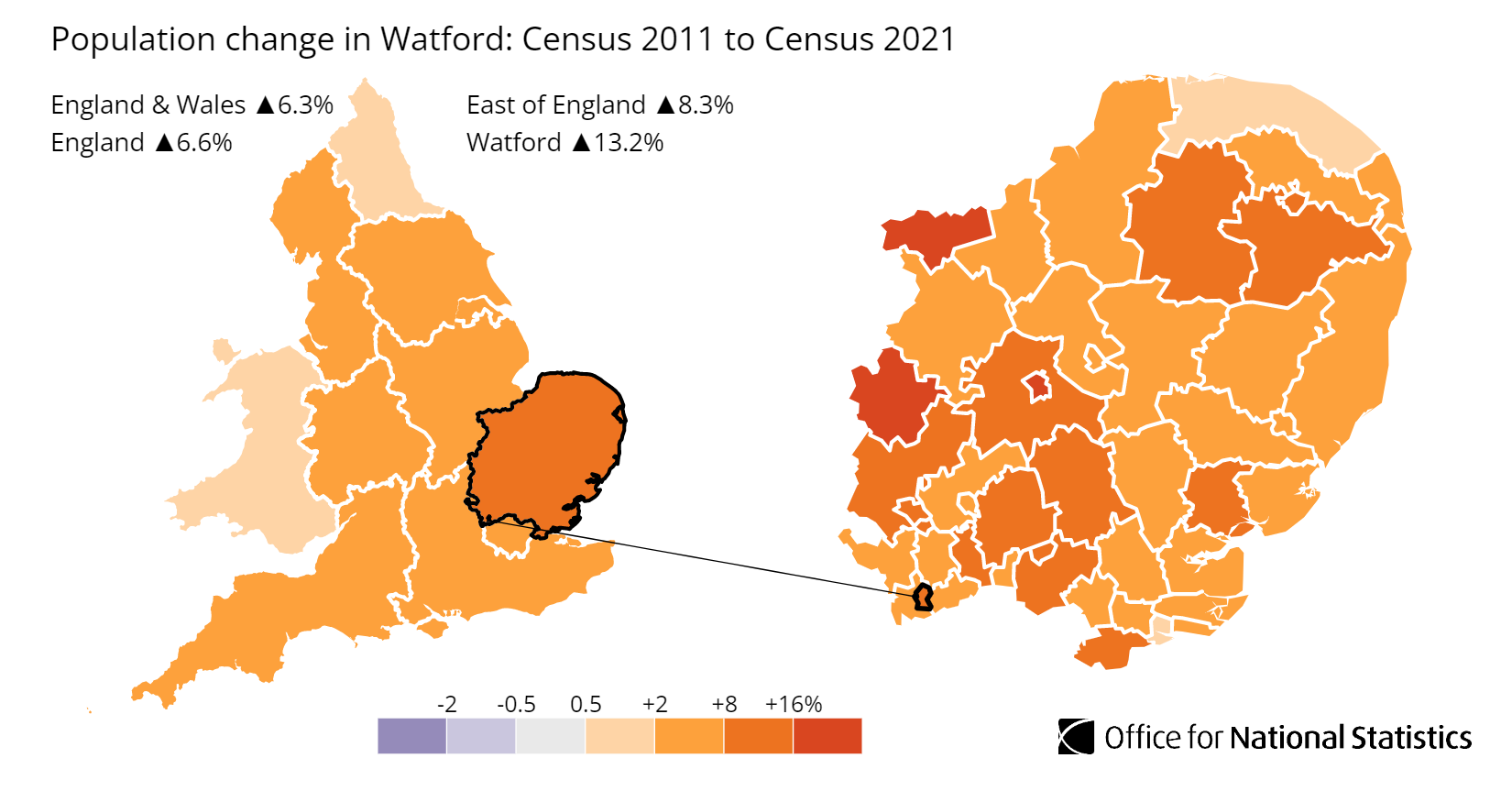
Hertfordshire Population Growth by Local Authority (2011-2021)
| Rank & Local Authority | 2011 | 2021 | Growth |
|---|---|---|---|
| 1. Watford | 90,300 | 102,200 | +13.2% |
| 2. East Hertfordshire | 137,700 | 150,200 | +9.1% |
| 3. Welwyn Hatfield | 110,500 | 119,800 | +8.4% |
| 4. Hertsmere | 100,000 | 107,800 | +7.8% |
| 5. Three Rivers | 87,300 | 93,800 | +7.4% |
| 6. Dacorum | 144,800 | 155,100 | +7.1% |
| 7. Stevenage | 84,000 | 89,500 | +6.6% |
| 8. Broxbourne | 93,600 | 99,000 | +5.8% |
| 9. St Albans | 140,700 | 148,200 | +5.3% |
| 10. North Hertfordshire | 127,100 | 133,200 | +4.8% |
| Hertfordshire Total | 1,116,000 | 1,198,800 | +7.4% |
Hertfordshire's population grew 7.4% between censuses, ahead of England's 6.6% but slightly below the East of England's 8.3%. The standout is Watford at +13.2%, making it the second-most densely populated local authority in the East of England after Luton. East Hertfordshire and Welwyn Hatfield also outperformed regional averages. The slower growth in St Albans and North Hertfordshire reflects their already-established, premium character where new housing supply is constrained. You can explore each district's breakdown via the ONS Census Area Changes for Hertfordshire.
For comparable London commuter markets, consider Essex (eastern commuter belt with lower average prices and similar yield range), Surrey (southern premium market with higher prices but comparable fundamentals), or Kent (southeast corridor with better value entry points and strong regeneration story).
Hertfordshire's Property Markets at a Glance
Hertfordshire isn't one market. It's several distinct property markets that happen to share a county boundary. Understanding which type you're looking at matters for setting realistic expectations on yields, growth, and tenant demand.
Premium commuter towns like St Albans, Harpenden, and Berkhamsted command the highest prices in the county. These are established, affluent areas with period property, outstanding schools, and fast trains to London. Yields here tend to be lowest (2.8-3.5%) but capital preservation is strong. Tenants are typically senior professionals or families priced out of London ownership who can afford premium rents.
New town value markets including Stevenage, Hemel Hempstead, and Welwyn Garden City offer the most accessible entry points. Post-war planned towns with more modern housing stock, larger properties, and prices starting around £330k. Yields reach 5-6% in the right postcodes. Tenant profiles skew younger professionals and key workers.
London fringe towns such as Watford, Borehamwood, and Potters Bar sit closest to the capital with the shortest commutes. Strong tenant demand from London workers, but prices reflect that accessibility. Watford in particular has seen significant regeneration investment. These areas balance yield and growth better than the premium towns.
Market towns including Hitchin, Hertford, Bishop's Stortford, and Ware offer a middle ground. Independent high streets, historic character, and prices between the premium and value extremes. Tenant demand comes from both London commuters and local employment. Bishop's Stortford benefits from Stansted Airport proximity.
Rural and village postcodes across the SG, HP, and CM districts show limited rental data in our analysis. This reflects their predominantly owner-occupier character rather than weak fundamentals. Where rental figures do appear for rural postcodes, they often reflect larger properties rather than strong per-square-foot demand. These areas suit different strategies, potentially holiday lets or higher-end family rentals rather than standard buy-to-let.
The tables that follow let you compare all 47 postcodes across these market types.
Hertfordshire Property Market Analysis
When Was the Last House Price Crash in Hertfordshire?
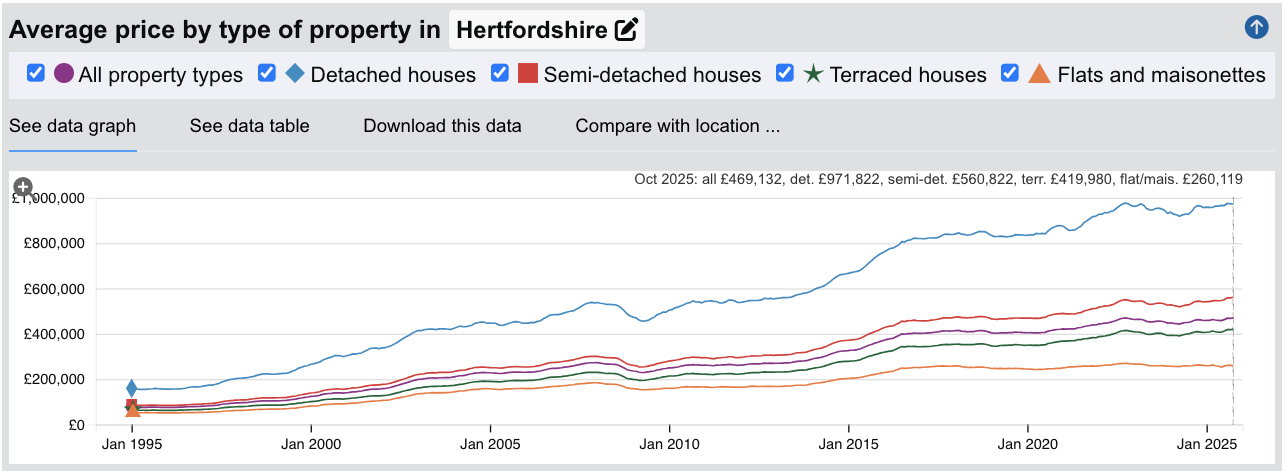
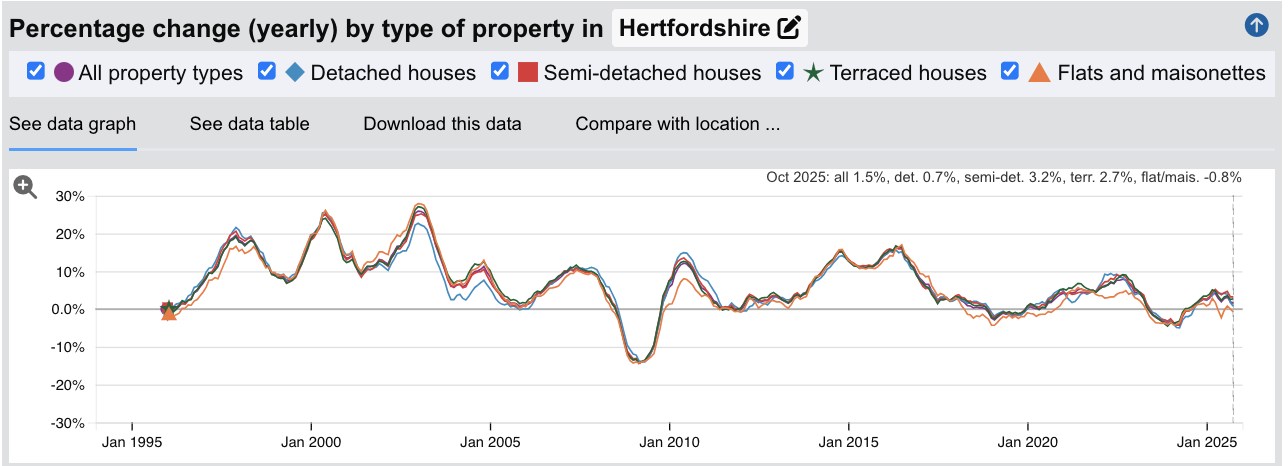
Hertfordshire experienced a correction during the 2008 financial crisis, though less severe than London. Average sold prices fell from a peak of £271,529 in November 2007 to a trough of £228,567 by April 2009, a decline of 15.8%. Recovery took longer than many expected, with prices not sustainably exceeding pre-crash levels until late 2013.
Source: HM Land Registry House Price Index for Hertfordshire
Here is how the Hertfordshire property market has performed over key cycles:
- 1995-2007 saw property values more than triple, rising from £75,185 to £271,529 as Hertfordshire cemented its position as the premier London commuter county with multiple rail lines feeding the capital.
- 2008-2009 brought a correction of 15.8%. Hertfordshire held up better than many southern markets, cushioned by its diversified employment base and the resilience of premium areas like St Albans and Harpenden where cash buyers remained active.
- 2010-2013 saw a slow, grinding recovery. Prices fluctuated between £248,000 and £280,000 for nearly four years as credit remained tight and buyer confidence gradually rebuilt.
- 2014-2016 delivered exceptional growth. Prices surged from £288,074 to £400,039, a gain of 39% in under three years. London's affordability crisis pushed professionals further into the commuter belt, and Hertfordshire captured much of that displaced demand.
- 2017-2019 brought a plateau. Prices fluctuated between £401,000 and £414,000 as stamp duty surcharges, Brexit uncertainty, and stretched affordability cooled the market.
- 2020-2022 saw the pandemic surge. Prices climbed from £404,003 to £469,572, a gain of 16% as demand for space intensified. Family homes in towns like Bishop's Stortford and Hitchin saw particularly strong competition.
- 2023 brought a modest correction of 4.9% as mortgage rates spiked, with prices easing from the October 2022 peak of £469,572 to £446,471 by December 2023.
- 2024-2025 has marked recovery. Prices have climbed back to £469,132 as of October 2025, essentially matching the previous peak and showing year-on-year growth of 3.2%.
Long-Term Property Value Growth in Hertfordshire
For buy-to-let investors focused on capital preservation and long-term appreciation, Hertfordshire's trajectory shows substantial gains despite periodic corrections:
- 5 years (2020-2025): 12.7% growth (£416,431 to £469,132)
- 10 years (2015-2025): 30.9% growth (£358,318 to £469,132)
- 15 years (2010-2025): 79.3% growth (£261,604 to £469,132)
- 20 years (2005-2025): 103.1% growth (£230,998 to £469,132)
- 30 years (1995-2025): 524.0% growth (£75,185 to £469,132)
The 2008 and 2023 corrections demonstrate that Hertfordshire is not immune to property market cycles. However, the county's fundamentals have consistently driven recovery: structural demand from London commuters, high local earnings supporting mortgage serviceability, diversified employment beyond pure commuting, and constrained housing supply within the Green Belt. The key risk for investors is overpaying at cyclical peaks, but those who held through 2008 have seen their investments more than double in value.

Thinking of Buying?
We have off-market investment properties averaging 8%+ annual yield.
View Property DealsSold House Prices in Hertfordshire
The latest sold house price index by the Land Registry confirms Hertfordshire's position as a premium commuter county, with values sitting substantially above national benchmarks across every property type. Prices here exceed Essex and approach Surrey levels in the most sought-after towns.
Hertfordshire property prices average £469,132, which is 61% above the England average of £291,515. This premium reflects the county's exceptional commuter credentials, with multiple rail lines feeding King's Cross, St Pancras, Liverpool Street, and Euston within 20-45 minutes, combined with high local earnings and strong employment beyond London.
Detached houses command a significant premium, averaging £971,822, more than double the national average. These are concentrated in premium towns like St Albans, Harpenden, Berkhamsted, and the villages of Three Rivers. Semi-detached houses average £560,822, sitting 93% above the England figure, the workhorse of the family rental market across most Hertfordshire towns.
Terraced houses average £419,980, representing a 72% premium on the national average. Victorian and Edwardian terraces in Hitchin, Hertford, and St Albans attract both owner-occupiers and landlords. Flats and maisonettes offer the most accessible entry point at £260,119, though still 19% above national levels. For investors, flats in Watford, Stevenage, and Hemel Hempstead near stations typically offer the strongest gross rental yield returns in the county.
Updated January 2026
| Property Type | Hertfordshire Average | England Average | Difference |
|---|---|---|---|
| Detached houses | £971,822 | £470,151 | +106.7% |
| Semi-detached houses | £560,822 | £289,909 | +93.4% |
| Terraced houses | £419,980 | £243,978 | +72.1% |
| Flats and maisonettes | £260,119 | £219,065 | +18.7% |
| All property types | £469,132 | £291,515 | +60.9% |
Property Data Sources
Our location guide relies on diverse, authoritative datasets including:
- HM Land Registry UK House Price Index
- Ministry of Housing, Communities and Local Government
- Ordnance Survey Data Hub
- Propertydata.co.uk
We update our property data quarterly to ensure accuracy. Last update: January 2026. All data is presented as provided by our sources without adjustments or amendments.
Asking Prices and Price Per Square Foot in Hertfordshire
Updated January 2026
This table combines two key metrics: average asking prices of properties currently listed for sale, and the average sold price per square foot showing where you get the most physical space for your money. The top 10 postcodes by asking price are shown.
| Rank & Area | Average Asking Price | Price Per Sq Ft |
|---|---|---|
| 1. WD7 (Radlett) | £1,057,797 | £631 |
| 2. AL5 (Harpenden) | £952,740 | £648 |
| 3. HP4 (Berkhamsted) | £818,498 | £546 |
| 4. WD3 (Rickmansworth) | £808,498 | £519 |
| 5. AL4 (Wheathampstead, Sandridge) | £762,498 | £530 |
| 6. AL1 (St Albans City Centre) | £686,498 | £542 |
| 7. AL3 (St Albans West) | £660,998 | £499 |
| 8. SG4 (Hitchin) | £575,498 | £438 |
| 9. CM23 (Bishop's Stortford) | £540,831 | £428 |
| 10. AL2 (Park Street, London Colney) | £527,165 | £446 |
Hertfordshire's pricing reveals the county's premium tier. The top five postcodes all exceed £750,000 average asking prices, with WD7 (Radlett) breaking the £1 million barrier. These are lifestyle markets dominated by large detached houses and owner-occupiers rather than rental demand. For investors, these postcodes offer capital preservation but yields struggle to exceed 3%.
Price per square foot tells a slightly different story. AL5 (Harpenden) commands the highest rate at £648/sq ft despite ranking second on absolute price, reflecting tighter housing stock and intense competition. WD7 at £631/sq ft actually offers marginally better value per square foot than Harpenden, though both sit well above the county average.
The gap between premium and value markets is substantial. Entry-level postcodes like SG1 (Stevenage) at £333,065 and £377/sq ft don't appear in this top 10, but offer asking prices less than a third of Radlett's. For investors prioritising yield over capital growth, those value markets warrant closer attention in the sections that follow.
For comparison, Cambridge averages over £500/sq ft across all postcodes. Hertfordshire's premium postcodes exceed Cambridge rates, while its value markets compete on price per square foot with commuter towns further from London.
Note: These figures represent averages across all property types. Individual property values depend on condition, specific location, and building age.
House Price Growth in Hertfordshire (%)
Updated January 2026
The data represents average house price growth across multiple timeframes, calculated using postcode-level data blending sold prices and asking prices. The top 10 postcodes by five-year growth are shown.
| Rank & Area | 1 Year | 3 Year | 5 Year |
|---|---|---|---|
| 1. SG14 (Hertford North) | +5.9% | +3.7% | +21.4% |
| 2. AL10 (Hatfield) | +5.3% | +5.3% | +19.4% |
| 3. SG13 (Hertford) | +8.7% | +3.7% | +18.5% |
| 4. EN11 (Hoddesdon) | +6.3% | +5.6% | +17.9% |
| 5. HP3 (Hemel Hempstead South) | +5.7% | +1.9% | +16.5% |
| 6. EN8 (Cheshunt) | +4.7% | +3.2% | +15.9% |
| 7. WD25 (Watford North) | +6.9% | +5.0% | +15.6% |
| 8. SG12 (Ware) | +3.4% | +0.6% | +15.0% |
| 9. EN10 (Broxbourne) | +2.1% | +0.7% | +14.5% |
| 10. SG1 (Stevenage Town Centre) | +1.9% | -0.5% | +14.4% |
The strongest five-year performers are notably absent from Hertfordshire's premium postcode list. SG14 (Hertford North) leads with +21.4% growth, followed by AL10 (Hatfield) at +19.4% and SG13 (Hertford) at +18.5%. These are mid-market towns where affordability headroom remained, allowing prices to catch up with more established areas.
The Lea Valley corridor shows consistent strength. Hoddesdon (EN11), Cheshunt (EN8), and Broxbourne (EN10) all feature in the top 10, benefiting from their position as the most affordable London-accessible postcodes in the county. The Brookfield Riverside development and improved transport links support continued demand here.
SG13 (Hertford) posts the strongest one-year growth at +8.7%, suggesting current momentum in the county town market. Meanwhile SG1 (Stevenage) shows a different pattern: solid five-year growth of +14.4% but a negative three-year figure (-0.5%), reflecting the 2022-2023 correction hitting value markets harder before the recent recovery.
Notably absent from this growth table are the premium postcodes. WD7 (Radlett), AL5 (Harpenden), and the St Albans postcodes have already priced in their fundamentals, leaving less room for percentage gains. Investors seeking capital appreciation may find better opportunities in Hertfordshire's second-tier towns.
Average Monthly Property Sales in Hertfordshire
Updated January 2026
The data represents the average number of residential property sales per month across Hertfordshire's postcode districts, acting as a key indicator of market liquidity. The top 10 postcodes by sales volume are shown.
| Rank & Area | Average Monthly Sales | Average Asking Price |
|---|---|---|
| 1. CM23 (Bishop's Stortford) | 45 | £540,831 |
| 2. SG1 (Stevenage Town Centre) | 44 | £333,065 |
| 3. HP2 (Hemel Hempstead East) | 42 | £410,498 |
| 4. AL1 (St Albans City Centre) | 41 | £686,498 |
| 5. WD17 (Watford Town Centre) | 39 | £433,831 |
| 6. HP1 (Hemel Hempstead West) | 38 | £421,331 |
| 7. SG2 (Stevenage South) | 37 | £374,998 |
| 8. HP3 (Hemel Hempstead South) | 36 | £484,165 |
| 9. EN8 (Cheshunt) | 35 | £397,831 |
| 10. WD6 (Borehamwood) | 33 | £517,665 |
Hertfordshire's most liquid markets cluster around the major towns rather than the premium villages. CM23 (Bishop's Stortford) leads with 45 monthly sales, benefiting from Stansted Airport employment and strong demand from London commuters on the Liverpool Street line. SG1 (Stevenage) follows closely at 44 sales, combining the county's lowest entry prices with consistent buyer and tenant demand.
The Hemel Hempstead postcodes (HP1, HP2, HP3) collectively record 116 monthly sales, making it the most active market in Hertfordshire when viewed as a single town. This depth of activity reflects Hemel's role as a value market with strong transport links and the regeneration momentum from Hemel Garden Communities.
AL1 (St Albans) is the only premium postcode in the top 10, recording 41 monthly sales despite average asking prices of £686,498. This unusual combination of high prices and high volume reflects St Albans' exceptional desirability and the depth of its buyer pool. For investors, it means confident exit options even at premium price points.
Notably absent are the ultra-premium postcodes. WD7 (Radlett) records just 10 monthly sales, while AL5 (Harpenden) manages 19. These markets offer capital preservation but require patience when buying or selling. Investors prioritising liquidity should focus on the urban postcodes listed above.
Property Data Sources
Our location guide relies on diverse, authoritative datasets including:
- HM Land Registry UK House Price Index
- Ministry of Housing, Communities and Local Government
- Ordnance Survey Data Hub
- Propertydata.co.uk
We update our property data quarterly to ensure accuracy. Last update: January 2026. All data is presented as provided by our sources without adjustments or amendments.
Hertfordshire Rental Market Analysis
For new landlords and investors considering if buy to let still makes sense in Hertfordshire and thinking how much they can charge for rent across the county's towns and villages, the rental data below gives an indication of the rental income per month and the rental yields landlords can aim to achieve. This is helpful if you are considering building a property company in this area.
Rental Prices and Gross Yields in Hertfordshire
Updated January 2026
The data represents the average monthly rent for long-let AST properties and the corresponding gross rental yields across Hertfordshire's postcode districts. The top 10 postcodes by yield are shown, excluding areas with insufficient rental data.
| Rank & Area | Gross Yield | Average Monthly Rent | Average Asking Price |
|---|---|---|---|
| 1. AL10 (Hatfield) | 6.1% | £1,784 | £352,500 |
| 2. WD18 (Watford Central) | 5.3% | £1,583 | £358,118 |
| 3. SG1 (Stevenage Town Centre) | 5.0% | £1,390 | £333,065 |
| 4. SG13 (Hertford) | 5.0% | £2,023 | £490,234 |
| 5. WD24 (Watford South) | 4.9% | £1,606 | £389,804 |
| 6. HP2 (Hemel Hempstead East) | 4.8% | £1,564 | £389,517 |
| 7. AL7 (Welwyn Garden City) | 4.7% | £1,469 | £371,650 |
| 8. EN8 (Cheshunt) | 4.6% | £1,538 | £405,308 |
| 9. SG6 (Letchworth Garden City) | 4.5% | £1,297 | £347,979 |
| 10. SG2 (Stevenage South) | 4.4% | £1,458 | £401,536 |
AL10 (Hatfield) stands out at 6.1%, the highest yield in Hertfordshire by a clear margin. The University of Hertfordshire drives consistent student and young professional demand, while asking prices around £352,500 remain accessible. This combination of institutional demand and relative affordability creates genuine cash flow potential rare in the county.
Watford delivers two postcodes in the top five. WD18 at 5.3% benefits from central location and strong rental demand from young professionals, while WD24 at 4.9% offers similar fundamentals slightly further from the station. Both sit below £400,000 average asking prices, making Watford the standout urban market for yield-focused investors.
The new towns cluster strongly. Stevenage (SG1, SG2), Welwyn Garden City (AL7), Hemel Hempstead (HP2), and Letchworth (SG6) all feature in the top 10. These post-war planned towns combine affordable housing stock with solid tenant demand from local employers. Entry prices between £333,000 and £402,000 keep deposits manageable while yields exceed 4.4%.
SG13 (Hertford) is the outlier: higher asking prices at £490,234 but exceptional rents of £2,023 per month deliver a 5.0% yield. The county town commands premium rents from professionals seeking character property and riverside living while maintaining London commuter access.
Notably absent are the premium postcodes. AL5 (Harpenden) yields just 2.8%, WD7 (Radlett) manages 3.0%, and the St Albans postcodes sit between 2.9-3.2%. High rents of £1,500-£2,600+ don't offset asking prices approaching or exceeding £600,000. These markets suit investors prioritising capital preservation over income, but cash flow will be tight after mortgage costs.
For context, Hertfordshire's best yields sit below northern cities like Liverpool (7%+) or Nottingham (6%+), but above most southern commuter markets. The trade-off is tenant quality and capital growth potential. Hertfordshire's £48,537 median earnings and professional employment base create a tenant pool of established workers rather than transient renters. Lower yields, but lower risk.
Is Hertfordshire Rent Affordable?
Hertfordshire rents sit at the upper end of affordability for a commuter county, though they remain more manageable than London where tenants might otherwise look.
Average rent in Hertfordshire costs between 32% and 66% of the median gross annual earnings depending on postcode. This is based on the Nomis Labour Market Profile for Hertfordshire showing the median gross annual income for Hertfordshire residents is £48,537 (2025 ASHE data).
The general affordability guideline suggests rent should not exceed 30% of gross income. Most Hertfordshire postcodes exceed this threshold, though the county's high local earnings mean tenants are often better placed to absorb these costs than the headline figures suggest. Many renters in commuter towns earn London salaries while paying Hertfordshire rents.
| Rank & Area | Average Monthly Rent | Rent as % of Income | Average Asking Price |
|---|---|---|---|
| 1. WD7 (Radlett) | £2,674 | 66.1% | £1,057,797 |
| 2. SG13 (Hertford) | £2,023 | 50.0% | £490,234 |
| 3. WD4 (Kings Langley) | £1,895 | 46.8% | £604,938 |
| 4. WD3 (Rickmansworth) | £1,876 | 46.4% | £620,089 |
| 5. AL5 (Harpenden) | £1,837 | 45.4% | £788,408 |
| 6. SG1 (Stevenage Town Centre) | £1,390 | 34.4% | £333,065 |
| 7. SG6 (Letchworth Garden City) | £1,297 | 32.1% | £347,979 |
The table reveals Hertfordshire's split market. Premium postcodes like WD7 (Radlett) at 66% of income and SG13 (Hertford) at 50% are technically unaffordable against local median earnings. But these areas attract tenants earning well above the median: senior professionals, dual-income households, and London workers commanding City salaries. The rental properties here are typically large family homes, not entry-level flats.
The new town postcodes tell a different story. SG1 (Stevenage) at 34% and SG6 (Letchworth) at 32% sit much closer to the 30% affordability threshold. These markets serve a broader tenant base including key workers, young professionals, and families on more typical incomes. For investors, this wider tenant pool reduces void risk and supports consistent demand.
For context, Hertfordshire remains significantly more affordable than Cambridge where rents can consume 48%+ of local income. The county's position as a "middle ground" between London prices and genuine affordability sustains its appeal to tenants who want commuter access without London rental costs.
Note: These calculations use median gross salary for Hertfordshire residents from the 2025 ASHE data. Actual tenant affordability varies based on household income, with many Hertfordshire tenants earning above the local median due to the commuter profile of the county.
Thinking of Buying?
We have off-market investment properties averaging 8%+ annual yield.
View Property DealsBuy-to-Let Considerations
Are Hertfordshire House Prices High?
Hertfordshire spans a vast affordability range, from genuinely accessible new town markets to some of the most expensive postcodes in the South East outside London.
Purchasing a property in Hertfordshire requires between 6.9 and 21.8 times the median annual salary depending on postcode. This is based on the Nomis Labour Market Profile for Hertfordshire showing the median gross annual income for Hertfordshire residents is £48,537.
The premium postcodes like WD7 (Radlett) at 21.8x and AL5 (Harpenden) at 16.2x are effectively cash-buyer or high-net-worth markets. These ratios far exceed any conventional mortgage affordability test. But the new town postcodes tell a different story: SG1 (Stevenage) at 6.9x and SG6 (Letchworth) at 7.2x sit below the national average and remain accessible to dual-income professional households.
| Rank & Area | Price to Income Ratio | 30% Deposit | Average Asking Price |
|---|---|---|---|
| 1. SG1 (Stevenage Town Centre) | 6.9x | £99,920 | £333,065 |
| 2. SG6 (Letchworth Garden City) | 7.2x | £104,394 | £347,979 |
| 3. AL10 (Hatfield) | 7.3x | £105,750 | £352,500 |
| 4. WD18 (Watford Central) | 7.4x | £107,435 | £358,118 |
| 5. HP2 (Hemel Hempstead East) | 8.0x | £116,855 | £389,517 |
| 6. WD24 (Watford South) | 8.0x | £116,941 | £389,804 |
| 7. SG2 (Stevenage South) | 8.3x | £120,461 | £401,536 |
| 8. SG7 (Baldock) | 8.3x | £120,628 | £402,093 |
| 9. EN8 (Cheshunt) | 8.4x | £121,592 | £405,308 |
| 10. HP1 (Hemel Hempstead West) | 8.8x | £127,670 | £425,567 |
For context, the England average price-to-income ratio sits around 9.1x based on national median earnings of £31,875 against average sold prices of £291,515. All ten of Hertfordshire's most affordable postcodes undercut this national benchmark despite being prime London commuter territory. Higher local salaries offset higher property prices.
This affordability explains why Hertfordshire continues to attract London leavers to specific towns. A couple priced out of North London or unable to stretch to St Albans can realistically purchase in Stevenage, Hatfield, or Hemel Hempstead while keeping the same job. For investors, this sustained buyer demand from relocating Londoners supports both rental occupancy and long-term capital growth.
Deposit requirements range from just under £100,000 in SG1 to £127,670 in HP1. That same £100,000 deposit would stretch further in nearby Luton or Peterborough, but neither offers Hertfordshire's combination of fast London access and high local employment. Investors with larger deposits might consider the buy-refurbish-refinance strategy in the new town markets where strong sales volumes mean refinanced properties can be revalued and remortgaged relatively quickly.
How to Invest in Buy-to-Let in Hertfordshire
Property Investments UK and our partners have ready to go buy-to-let properties to purchase across Hertfordshire and the rest of the UK.
With new properties coming available weekly, we can source suitable investment properties across the region and country to match your criteria.
We have partnered with the best property investment agents we can find for 8+ years and below you can find links to help you buy properties in Hertfordshire and across the region including:
- Buy-to-let investment properties
- PBSA and student lets
- BMV properties for sale
- Airbnbs for sale
- and other high yielding opportunities
and articles helping you with:
- How to find off-market properties
- Why you should consider a Holiday home investment or a serviced accommodation asset
- Are HMO properties a good investment
Consider Similar Areas to Hertfordshire for Buy-to-Let
For investors seeking higher yields with lower entry prices, buy-to-let in Milton Keynes offers a purpose-built new town with strong employment growth and yields above 5%. Buy-to-let in Northampton sits an hour north with average prices under £250,000 and fast access to both London and Birmingham.
For comparable London commuter markets, buy-to-let in Reading mirrors Hertfordshire's blend of local employment and fast rail links to Paddington. Buy-to-let in Slough offers lower entry prices with Elizabeth Line connectivity into central London.
Or to explore the wider region, see our guides to buy-to-let in Chelmsford for Essex's county town with 34-minute trains to Liverpool Street, and buy-to-let in Bedford for the Thameslink corridor with prices significantly below Hertfordshire's commuter belt.